



Abstract
This article focuses on Swedish merchant shipping in the first decade of the French Revolutionary Wars, when Sweden, due its neutrality, expanded its trade and shipping. The article attempts to balance two contradictory views of neutral shipping: that of high risks of seizure by belligerents, and that of wartime profits. Three different perspectives are employed to demonstrate the complexity of neutral shipping business. Registers of ship documents (fribrev and Algerian sea passes) show the relatively limited impact of political events on shipping activities. Legal documents in diplomatic correspondence illustrate practically how the cases of seized ships were handled on both political and court levels. The debate in print on the case of ship Maria (the convoy affair of 1798) indicates how the issue of neutral prizes became incorporated into the political discourse on international relations and law of nations.
Introduction
The French Revolutionary and Napoleonic Wars set Sweden on a chaotic and unpredictable journey: France’s ally before 1789 became one of the Napoleon’s fiercest critics, and abandoned its neutrality to enter war in 1805. As an outcome of Napoleon’s 1807 treaty with the Russian Tsar in Tilsit, Sweden engaged in a disastrous war against Russia in 1808–1809, which ended with the loss of Finland. This conflict caused the political and constitutional revolution of 1809 that forced King Gustav IV Adolph to resign and brought to the throne a new dynasty, that of Napoleon’s general Bernadotte. After the peace with Russia, the new Swedish government was forced to sign peace with Napoleon and enter the Continental System, declaring a ‘phony’ war on Britain during 1810–1812. Such a policy lacked support in Sweden. Eventually, after Napoleon’s failed invasion of Russia, Sweden again joined the anti-Napoleonic coalition. In 1814 the loss of Finland was compensated for by the creation of the double monarchy with Norway, until then part of the Danish kingdom, one of Napoleon’s last allies. The annexation of Norway had been Sweden’s long-term aim, but the union between Sweden and Norway was far from successful. The ‘United Kingdoms’, as the union was called, never became an integrated state. Until the dissolution of this union in 1905, the two kingdoms shared only the same king and a foreign policy.
The chaotic history of Sweden in 1793–1815 is also reflected in the complex economic impact of wars on Sweden. The Finnish war of 1808–1809 was a disaster, but for most of the period 1793–1815 Sweden actually avoided direct conflict and military occupation. Due to Sweden’s neutrality from 1793 to 1805, and its ability to act largely outside the Continental System from 1807 to 1812, Sweden actually enjoyed two decades of wartime boom, although its fiscal situation deteriorated. This article focuses on the impact of war on shipping and foreign trade, in particular on Swedish shipping to Southern Europe, where neutrality played a key role. It also addresses the prize taking of Swedish vessels and its political and discursive consequences. The analysis is confined here to the French Revolutionary Wars (1793–1801). The starting point is obvious, the beginning of the war, while the end point of 1801 witnessed the termination of the Second League of Armed Neutrality.
The first part of the article looks at the evolution of Swedish shipping and trade, and the specific conditions and difficulties Swedish vessels met with in Southern Europe. The second and third parts of the article analyse the legal and political/discursive aspects of Sweden’s neutral shipping. The combination of economic, legal and political perspectives is necessary to balance the contradiction between the stress on risks, on the one hand, and the evidence of profits of neutral shipping, on the other. I will describe in detail Sweden’s foreign policy regarding neutral shipping between 1793 and 1801, and provide examples of controversies that neutral shipping generated in courts and among lawyers and political thinkers. I will pay special attention to the legal discourse that appeared at the time of the crisis about 1800 concerning neutrals’ rights, a crisis that culminated with the convoy affairs of 1798–1800, when neutral Swedish and Danish convoys were taken by British cruisers. This pushed the two Nordic neutrals into a defensive alliance with Russia (the Second League of Armed Neutrality) and into an open conflict with Britain in spring 1801. If, after the Battle of Copenhagen in 1801, neutrality appeared no longer a viable way forward for Sweden and Denmark, the legacy of the discourse on neutrality around 1800 can be traced in the foreign policies both in small neutral states (Sweden, Denmark) and in rapidly growing ones (the United States) in the nineteenth century, a golden age of neutrality. 1
The boom in Swedish trade and shipping services to Southern Europe, 1793–1801
A number of factors explain the successful development of Sweden’s shipping in the eighteenth century. First, Sweden exported large volumes of bulky commodities such as iron, tar, pitch and sawn goods. The growing significance of Southern Europe as a market for Swedish exports required an increasing number of Swedish bottoms, since the protectionist Swedish Navigation Act of 1724 (produktplakatet) excluded foreigners from carrying Swedish imports and exports. A second factor relates to the importance of Portuguese and Mediterranean salt, a vital commodity that demanded huge carrying capacity. The third factor that affected the development of Swedish merchant fleet was the demand for tramp shipping, especially for neutral carrying capacity in wartime. The latter factor played a major role during the Seven Years War and after, notably in Southern Europe. The expansion of Swedish merchant tonnage correlates strongly with the years of war, a point which strengthens the argument that neutrality was the single most important factor in the long-term growth of Swedish shipping capacity. Other elements, such as shipbuilding costs, seamen’s wages, freight rates, insurance premiums could be taken into consideration as well, but they too were subject to significant changes related to war and peace. 2
Two sources are particularly useful to map the development of Sweden’s shipping in the French Revolutionary Wars. All Swedish ships employed in foreign trade were provided with an identity document issued by Sweden’s Board of Trade, the so-called fribrev. The registers of these documents (fribrevsdiarier) are well preserved and provide rich information on a ship’s tonnage and home port. 3 Unfortunately, this source does not say anything about destinations and, consequently, on the tramp shipping patterns of Swedish vessels.
The total number of Swedish ships registered for foreign trade in 1795 was 1235, of which 883 (71%) were from Sweden, 83 (7%) from Finland and 269 (22%) from Swedish Pomerania. In 1803, at the apex of the wartime boom, there were 1539 ships, 1012 (65%) of which were from Sweden, 166 (11%) from Finland and 374 (24%) from Swedish Pomerania. The proportions of ships from different parts of Sweden shifted slightly, Finland and especially Swedish Pomerania profited more from neutrality than Sweden proper. 4
To get a picture of the patterns of shipping, we need to look at the Algerian sea pass registers. Algerian sea passes were mandatory for all Swedish ships sailing beyond Cape Finisterre in Spain, to protect them against Barbary corsairs. The registers consequently record all Swedish ships bound to Southern Europe, employed in Mediterranean, but also in oceanic shipping in the Atlantic and Indian oceans. Information from the fribrev and the Algerian sea passes show similar trends, suggesting the latter is a reliable source of information for mapping Swedish shipping. 5 Figure 1 combines the two datasets. It shows that at least one-third of all Swedish-flagged vessels were sailing beyond Cape Finisterre. As Swedish ships in such trades often navigated for more than a year, the importance of Southern European trades is actually even greater.
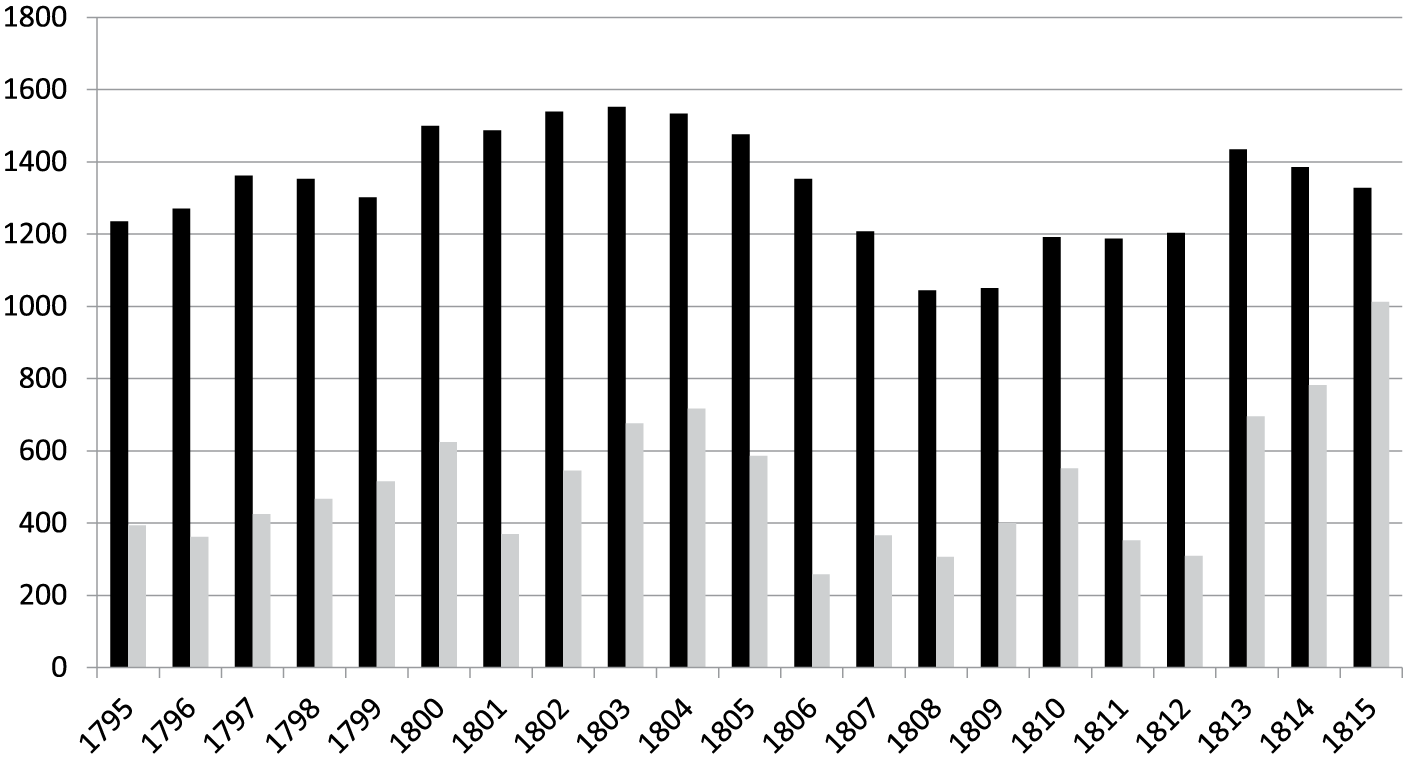
Combined data of Algerian sea pass and fribrev registers, 1795–1815.
The Algerian sea pass dataset confirms that the increase in Pomeranian shipping was related to the French Revolutionary Wars and the state of neutrality. Swedish Pomerania’s fleet had excellent preconditions for tramp shipping in Southern Europe, being nearer than other Swedish ports to southern Baltic and ice-free waters, but enjoying the same competitive advantage in terms of neutral flag.
It is difficult to get much further as far as the destinations of Swedish vessels are concerned from these sources. Since the issue of the first Algerian sea pass in 1739, the registers included some information about the destination of the licensed ship. However, the destinations provided in the registers from 1793 to 1801 are extremely vague, referring to broad categories such as the North Sea and beyond, the Western Sea, the Mediterranean, the Spanish Sea, etc (Table 1). The most probable explanation of the vagueness of the destination is the fact that ships were intended for tramp shipping with multiple and open destinations. For example, a ship destined for ‘the North Sea and beyond’ (‘Nordsjön och vidare’) was engaged first in sailing to a Northern European port, with the voyage continuing to Southern Europe. The Western Sea (‘Västersjön) meant simply that ship was sailing westwards from Sweden. 6 It was subsequently difficult to provide a single specific destination, which was contested by belligerents’ privateers. 7
Vague Destinations of Swedish Ships, 1800.

Source: Stockholm, Riksarkivet, Board of Trade (Kommerskollegium), C II b, Algerian Sea Pass Registers, 1739–1831.
In 1801 a state investigation in Sweden produced a report on the economy of Swedish shipping, which was initiated by the high costs of convoying, more specifically the outlays of the so-called Convoy Office (Konvojkommissariatet). The Office organised convoying of Swedish ships in partnership with the navy. It also had responsibility for upholding the peace treaties with North Africa and the consular service there. The Office had been suppressed between 1792 and 1796 to reduce costs, precisely when neutral shipping expanded, but it was re-established in March 1797: it consequently organized convoys from 1798 to 1800, which are studied later in detail. 8
The reason behind the investigation of 1801 was the critical situation for Swedish shipping in 1798–1800, with an increasing number of Swedish vessels taken as prize in the Mediterranean, and with two whole convoys detained by the British Navy in 1798. Moreover, the financial situation of the kingdom was delicate. The report argued, however, that in spite of all the risks and costs, Swedish carrying tonnage was necessary to secure the transport of iron and salt. Moreover, according to the report, the merchant fleet provided employment for about 15,000 seamen and many shipyards, and contributed to national income through freights. Freights made in trade with Portugal alone were estimated at 250,000 rixdollar banco, although this was probably a very rough estimate. 9 Reorganization of the Office and new ways of funding were suggested. More importantly, the report itself shows that neutral shipping under Swedish flag was not uncontested: politicians weighed risks against benefits.
Politics of neutrality and prize taking, 1793–1801
Sweden’s foreign policy in the first decade of French Revolutionary Wars rested on the kingdom’s experience from the second part of the eighteenth century. The frame for neutrality policy and neutral shipping derived from bilateral treaties between Sweden and other countries, and additional multilateral agreements, such as the treaty of Utrecht in 1713, which stated the rights of neutrals to sail and trade in wartime. In general, neutrals’ rights were conceived as a part of the law of nations, although this ‘law’ lacked the support of an internationally accepted body. The understanding of what it actually meant for neutrals varied from country to country and from case to case.
With regard to bilateral treaties, the most important and most frequently quoted, as late as in the 1790s, was the Anglo-Swedish trade treaty of 1661. This treaty gave Swedes the right to carry their exports to non-belligerent countries with the exception of contraband of war. Although the latter was not very precisely defined, Sweden’s staple exports, iron, boards, tar and pitch, were explicitly excluded from the contraband of war, and as a matter of fact, in the course of the eighteenth century Sweden exported large quantities of these goods. The British, however, began contesting this part of the treaty, as we will see.
Besides treaties, another way to secure neutral shipping was to convoy ships and to enter into defensive collaboration with other neutrals, such as in the so-called Armed Neutralities. Sweden and Denmark signed such conventions for the first time in 1691 and 1693, during the Nine Years’ War. The conventions obliged the parties to join in defence of their merchant vessels, and were directed against the Dutch and English praying on neutral trade and shipping in the North Sea. 10 The next convention between Sweden and Denmark was signed in 1756, at the beginning of Seven Years’ War. That year the joint fleet of eight Swedish and eight Danish warships patrolled the waters in Skagerrak and Kattegat to hinder the belligerents from entering the Baltic Sea. 11 But the two kingdoms had quite different views on neutrality in general, and on their own economic interests in neutral shipping in particular. For example, neutral carrying trade with the West Indies was of key importance to Danish vessels, whereas exports of bulky goods such as Norwegian stockfish and sawn goods were limited. For Sweden it was the opposite. When Sweden was drawn into war against Prussia in 1757, the collaboration with the Danes faded.
In the following European conflict, the Nordic countries faced once more the issue of protecting their shipping. The League of Armed Neutrality of 1780–1783 had partly a different purpose than the Danish-Swedish conventions of the 1690s and of 1756. The league was initiated by Russia, one of the European great powers and in many respects a strange neutral contender. Russia had almost no merchant fleet and hence only a marginal interest in neutral shipping as such. 12 Catherine II’s main rational was political and not economic: she aimed at providing alternative organization of inter-state relations, in contrast to the struggle for hegemony between Britain and France. Her invitation to join a league of non-belligerent states, which she sent to European courts, was perceived as an initiative to set up a new system of international relations based on international law. The most important component of the Russian proposal was an implementation of the rule ‘free ships make free goods’, in fact a concrete expression of the right to sail freely at sea: liberty of sea. 13 Sweden and Denmark joined the league in 1780, and the Dutch Republic, Prussia, Austria and Portugal followed in the course of the American War of Independence (Illustration 1). 14 For the European state system the effect of the league was however negligible: Catherine II’s foreign policy soon returned to the traditional channels.

Den Britsen Leopard tot Reden begracht (1780).
Sweden’s foreign policy during the first years of the French Revolutionary Wars was marked by pragmatism. Between 1792, the year of the assassination of Gustav III, and 1796, when his son Gustav IV Adolph came of age, Sweden was ruled by Gustaf Adolf Reuterholm. The aim of Reuterholm’s cautious foreign policy was to follow the strict neutrality that had worked so well for Sweden in 1780–1783. To strengthen Sweden’s position, and in reaction to the praying on neutral ships since the previous summer, he signed a defensive convention with Denmark in 1794 that copied the bilateral 1756 convention. The convention foresaw joint surveillance of waters in Kattegat and Skagerrak but it did not include convoying of Danish and Swedish ships to Southern Europe. The Nordic politicians recognized that the British had not acknowledged a convoy as a guarantee for the neutrality of ships and cargoes it protected. There was consequently a great risk of escalation of political conflict if the British searched a whole Nordic convoy instead of an unprotected vessel. At the beginning of the war, the Danish Minister Bernstorff discretely informed Danish merchants and ship-owners that they could not expect any help by the government if searched and detained by the British. 15 Nor did the Swedish authorities organize convoying between 1794 and 1797. 16
As early as August 1793, a British privateer captured the Swedish ship Hedvig Charlotta from Karlskrona on her way from Bordeaux to Ostend, apparently with a French-owned cargo. The lugger Experiment took the Hedwig Charlotta to London, where the ship was released by the court decision after five months and 21 days. 17 In January 1794, the Swedish consul Törngren in Leghorn reported on the brig Sara Christina from Uddevalla, on Sweden’s west coast, being taken by an English ship Speedy. Sara Christina was on her way from Cadiz to Genoa when she was captured in December 1793 and taken by force to Leghorn. Her Swedish captain, Knape, was arrested and only once in Leghorn could he inform the Swedish consul and the ship-owners about his misfortunes. Törngren and Knape contacted the local authorities and the English consul on the spot but the correspondence shows little progress in the case: by the end of January they were waiting for the court decision in London. 18
An interesting case relates to the 16 ships belonging to Casimir Fournier from Gothenburg, which according to his complaint note in June 1794 had all been taken by the British. All ships were directed to Bilbao, Lisbon, Barcelona or Leghorn. Fournier remarked that he was born in France but, as a burger of Gothenburg, he should not be hindered from sending his neutral ships to Spain or Portugal. 19 Apparently the British thought differently.
A few cases in 1796 indicate that Swedish ships extended their activities far beyond Cape Finisterre, and took part in neutral carrying business between the West Indies and Southern Europe. While this trade is invisible in the Swedish sources mentioned above (fribrev and Algerian sea pass registers), it can be traced in other documents. The ship Neptunus from Gothenburg, Captain Ritterberg, was detained in September 1796 by a British privateer on her voyage from Paramaribo in Surinam to Gothenburg with a cargo of ‘free’ goods (most probably colonial produce). The cruiser, Schauguerame, under Captain William Parker, took the Swede first to Barbados then to the British-occupied Martinique, where ship and cargo were declared a good prize. The ship-owner Shierman stated in his claim that this was ‘in apparent disagreement with all law of nations in the world, that a neutral ship with free cargo on neutral account should be treated in such a way’ and expressed his request for a full restitution from Britain. 20 The case of the ship Gustaf Adolph from Gothenburg was similar. She was taken on her way from Surinam to Gothenburg on 7 June 1796, and carried to Portsmouth, England. According to the captor, the Swede was in reality bound to Amsterdam. In January 1796, the Susanna of Gothenburg was taken by the Hezekiel on her way from Guadalupe to Gothenburg, via the Swedish West Indian island Saint Barthélemy, with a cargo of sugar and coffee belonging to her ship-owner. 21 The cases of Gustaf Adolph and Susanna were argued in public, in printed pamphlets containing references to the lengthy arguments of both the captors and the defendants, including excerpts of letters found on board. Some Dutch letters on board were translated to English, to strengthen the captor’s claim that the cargo was Dutch, in fact. It is difficult to say how widely such prints circulated, but both recourse to print and the liveliness of discussion indicate an interested readership.
Between 1797 and 1800 the conflict over neutral rights intensified. In 1796 the French abandoned the principle that free ships made free goods and began to treat all neutrals as carriers of enemy goods. Swedish consuls reported about ships taken by the French. In April 1797 the consul Emmery from Dunkerque, the centre of French privateering in the North Sea, reported to Stockholm on 78 prizes taken by the French. The Swedish consul in Marseille, Fölsch, was involved in defending Swedish ships in prize courts, for example the case of Quintus. 22 Consuls Kantzow from Lisbon and Christiernin from Cadiz were reporting about increasing activities directed against the Swedes. 23 Kantzow claimed that it was necessary to convoy Swedish merchant ships. But the issue was delicate. Some merchants were hesitant to convoying, as they were well aware of the fact that protection by a naval ship was no guarantee of safety and there were political risks as well as delays and extra costs for convoying.
Swedish and Danish governments re-negotiated the extension of the 1794 convention including joint convoying to Southern Europa, and they signed new agreement in 1797. In reality the two neutrals began again to convoy their ships, but separately. From 1797, however, the issue of convoying had become important. It also made neutral shipping an increasingly political issue, and a dangerous one. From the Danish and Swedish point of view, all ships sailing in convoy under the protection of their naval units should pass freely. The convoying officer guaranteed that there was no contraband on board. Any attempt to search a neutral ship in a convoy was considered as an assault on the escorting naval ship and an insult to her sovereign and ought to be answered by force. The officer of the naval ship was obliged to counter such a threat with arms, otherwise he risked a martial court.
In 1798 Sweden’s navy organised three convoys bound to Southern Europe, with a starting point at Elsinore in the Danish Sound or near port Marstrand on west coast. The first two convoys left Sweden in summer months, under the protection of respective frigates Ulla Fersen and Freja, and sailed through the Channel, where they were detained by the Royal Navy.
The first convoy, under protection of Freja, was stopped at the Channel on 30 June 1798 by two British ships, King’s Advocate and Arnold (under commodore Lawford). The convoy was loaded with typical Swedish export goods destined for Southern Europe. After a protest, but without any violent resistance, the convoy, including Freja under command of Anton Wrangel, was taken to England. The High Court of Admiralty was to decide whether the convoy should be released or not. A year later, the final judgement by the Judge Sir William Scott in the so-called ‘case Maria’, master Paulsen, occurred on 11 June 1799, with Scott declaring the convoy a lawful prize. 24 The sentence received much attention all around Europe and it pushed Sweden towards an armed alliance with Russia and Denmark. This sentence and the discourse it generated offer a good illustration of the link between the practice of neutral shipping and the political discourse of neutrality. Before examining them in details, it is necessary to take the development of the Swedish policy between 1798 and 1801 into account, and the increasing troubles caused by its neutral position. 25
A second convoy, under the protection of the frigate Ulla Fersen, was arrested on 7 August by British naval force in the Channel and taken to Dunes (Downs). In this case neither did the Swedish frigate fight back, in spite of the clear orders of the Swedish king. Commanders of Ulla Fersen and Freja were released and returned to Sweden. In the court martial they were sentenced to death in conformity to their responsibility to defend convoys. The sentences, however, were converted to prison and degrade. 26 Also, the frigates were released after some months of detention and took part in the third convoy that left Sweden on 18 October 1798. This convoy, consisting of 38 merchant ships, under command of Rudolf Cederström, a well-known Swedish naval commander, included three frigates: Ulla Fersen, Freja and Bellona. When approaching the Channel a part of the convoy, consisting in four ships and the frigate Freja, chose to sail north of the British Isles. The remaining ships continued via the Channel and this time they were let free. The two frigates returned home, being back in Gothenburg by late November. 27
Obviously, as far as convoying is concerned, 1798 was a bad year for Sweden. The preparations for the next year’s convoying evolved slowly. The two convoying frigates spent a considerable part of the year in England. There was a lack of money, in addition to the hesitation to continue with a practice that apparently did not work. The complexity of the situation is also reflected in the above-mentioned report on Swedish shipping made in 1801.
The Anglo-Danish relations deteriorated in 1798–1800 as well. In December 1798 there was an armed confrontation near Gibraltar. One year later a Danish naval ship, Havfroen, shot to defend a convoy of merchant vessels. The British ships did not respond to the gunfire but London warned Copenhagen via diplomatic channels on the political consequences of such actions. In July 1800, when the Danish frigate Freya got into an action against a British squadron, the fight ended with the British taking the whole convoy to England. 28
In other words, by the summer of 1800 the two Nordic neutrals were openly heading toward hostility with Britain. It was precisely at this moment that Russian Tsar Paul invited the two humiliated kings to form the Second League of Armed Neutrality. This league, however, was more a tool to implement Russian rather than Danish and Swedish interests. It was a part of Tsar Paul’s plan to approach Napoleon and a part of his grand continental policy. Russia had, once again, no neutral commercial interests to defend. As the British expressed it when negotiating with the Danes after the fatal battle of Copenhagen in 1801, ‘it was nonsense to talk of a neutral protection of trade, with a power [Russia] who had none.’ 29
The negotiations between Russia and the two neutrals continued until October 1800. The final terms of the league were the same as in 1780. 30 The parties required freedom for neutral shipping and an international acceptance of the principle ‘free ships make free goods’. The league also suggested a clear definition of contraband of war, and stated that the only acceptable way to prevent neutral trade was to exert a real blockade on an enemy port. In addition, the agreement required neutral convoys to be inviolable. The three parties also agreed to form a joint naval force. 31 Russia’s share in the joint fleet was 15 ships of line and 5 frigates; Denmark’s share consisted of 8 ships of line and 2 frigates, and the weakest partner, Sweden, was bound to provide 7 ships of line and 3 frigates. The league disposed in theory of a total of 40 naval ships, before it was joined by another great power, Prussia, which from 1800 had started an anti-British policy. 32
The tensions between the league and Britain turned into open conflict when on 4 November 1800 Tsar Paul placed an embargo on all British ships in Russia and confiscated all British property. The reason for this was British occupation of Malta, which is revealing for the Tsar’s far-reaching foreign policy focus. The Tsar was a knight of Malta and felt personally offended by the course of the events in the Mediterranean.
As a response, the British declared an embargo in January 1801 on all the vessels of the league in Britain, and occupied Danish and Swedish islands in the West Indies. The Swedes and Danes in return confiscated all British ships on their territories. The British began to plan naval operations in the Baltic: their strategy was to confront the league members one at the time and as soon as possible, before they could join their forces. The British fleet entered the Sound at the end of March and engaged on 2 April 1801 in the battle of Copenhagen. After the defeat of the Danes, the Royal Navy prepared to meet the Swedes, but the campaign stopped when news of the assassination of the Tsar Paul which occurred on 23 March reached London. A separate peace between Denmark and Britain, and the reversal in Russia’s foreign policy following the assassination, effectively ended the Second League of Armed Neutrality, without any fatal consequences for the Swedes.

Northern Bears taught to dance (1801).
Despite conflicts over the extent of neutral shipping, the impact of warfare on Swedish shipping should not be relativized. There was at first some decline in shipping activities (Figure 1), but the impact seems limited in comparison with the growth in shipping in the preceding war years. We can also assess the importance of warfare disturbances – the total number of ships taken. Between 1793 and 1801, the French took 218 Swedish ships, and the British 231. 33 This total of 449 seized vessels in an eight-year period might seem considerable, but it should be compared with the total number of 21,837 Swedish and foreign vessels leaving Sweden’s ports. 34 Moreover, the number of seized vessels is not the same as the number of condemned vessels or cargoes. Many seized vessels were freed, and eventually damages and interests paid for the losses caused. Since the mid-century the British applied policy to compensate the ship-owners for losses, if the cargo consisted of naval stores destined for a neutral port. 35
Debating neutrality issues: The case of ship Maria
The practice of neutral shipping and its relevance for the foreign policy of small states produced in the eighteenth century a voluminous discourse on neutrality, international relations and the civilizing role of free trade. 36 This discourse culminated in the years of the French Revolutionary Wars, as it became a part of the ideological controversy between Revolutionary France and Imperial Britain. In this neutrality and prize taking attracted much attention. Contradictory visions of international relations, law of nations, and the role of trade emerged. Court arguments were printed in full: they circulated, and were cited in the debate. 37 The case of ship Maria, and its Swedish convoy of 1798, was one of the most central prize cases. The judgement was reprinted, translated and commented on many times. In the preceding section I linked the judgment to the political crisis of 1798–1800, and to the rise of the Second League of Armed Neutrality. In this section I will scrutinize the arguments that the case produced.
The final judgement in this politically sensitive case was made by Sir William Scott on 11 June 1799, only a year after Scott had been appointed Judge of the High Court of Admiralty. 38 This source tells us that the Swedish convoy consisted of a number merchant vessels sailing under protection of a naval ship when it was stopped in the Channel. After some non-violent resistance, the captured convoy proceeded to Margate Roads. The ships were found out to carry tar, pitch, hemp, deals and iron destined to several ports in France, Portugal and the Mediterranean. Regarding the ship Maria, her specific destination was Genoa, a neutral port that was turning increasingly hostile to the British.
Scott was very careful to stress that his judgement was not biased but based on the law of nations. The existence of law of nations was undisputable and so it did not matter where the prize court was located because ‘the law itself has no locality’. 39 The judge also stressed his principled and universal approach to the case by referring to arguments made in other contexts. He found for instance support for a general acceptance of the rule that the rights of belligerents had priority over the rights of neutrals in the ‘Swedish Authority’ (Scott’s quotation) on law of nations, Samuel Pufendorf. It was particularly Pufendorf’s comments made during the Nine Years’ War (1689–1697) that attracted Scott’s attention. Responding to the writings of the lawyer Johannes Groningius (Gröning) who had published a treatise defending Swedish and Danish neutral rights, Pufendorf claimed that the rights of belligerent princes should always trump ‘the complaints of some greedy merchants, who care not how things go, provided they can but satisfy their thirst of gain.’ 40 This view cohered perfectly with eighteenth-century British perception of neutral trade and shipping as business of greedy merchants (often the Dutch) making money on others’ bloodshed.
Scott’s reasons for his sentence incorporated three different arguments. First, the belligerent has the right to search any neutral ship to discover if she has enemy’s goods or contraband of war on board. ‘That the right of visiting and searching merchant ships […] is an incontestable right of the lawfully commissioned cruizers of a belligerent nation.’ 41 All authorities on law of nations, including the Danish Martin Hübner, agreed on this point, stated Scott. He said nothing about the principle ‘free ships make free goods’, but stressed the belligerent’s right to check that a neutral’s statement on the character of cargo was accurate.
Second, resistance of the neutral is by itself a reason for condemnation and seizure of neutral ship and cargo. ‘That the penalty for the violent contravention of this right is the confiscation of the property so withheld from visitation and search.’ 42 Authorities on the eighteenth-century law of nations, like Emer de Vattel and Bynkershoek, were mentioned to support this argument. However, the Swedish commander did not show any ‘violent contravention’, which indeed was in direct contradiction to orders given to convoying naval ships.
Scott’s third argument to condemn the ship and her cargo related to the contraband-of-war character of the Swedish exports. He departed here from the law of nations and cited the Anglo-Swedish treaty instead. Scott admitted that according to the treaty of 1661 (and its predecessor from 1651) the Swedes were allowed to export their produce as non-contraband.
[…] though formerly, when the hostilities of Europe were less naval than they have since become, they [i.e. naval stores] were of a disputable nature, and perhaps continued so at the time of making that treaty which is the basis of it, I mean the treaty in which Whitlock was employed in the year 1651.
43
But the increasingly naval character of warfare since 1651, transformed the character of the Swedish exports, turning them by the end of the eighteenth century into contraband ‘in their own nature’. This natural transformation of Swedish exports into contraband, too, provided argument for British condemnation of naval stores.
To summarize, Scott argued that his sentence was based on the law of nations and that any court in any other country would make the same judgement. He quoted and referred to a number of continental authorities on the issues of neutrality, neutral shipping and international relations, such as Pufendorf, Bynkershoek, de Vattel and Hübner. Moreover, he argued that the sentence was not in contradiction to Anglo-Swedish trade treaty of 1661 as the character of naval stores had naturally changed over the eighteenth century. All this indicates that he was formulating his argument for an international audience in the year 1799, and that he perfectly was aware of the political impact of his judgement.
The most elaborated answer to Scott’s judgement came from J. F. W. Schlegel, professor of law at University of Copenhagen. In a number of treatises published in Danish and French, and translated to English, Schlegel dismantled Scott’s argument. 44 His main point was that the visitation of neutral ships was not natural and not a part of law of nations, but a part of conventional law. The search of the cargo of a neutral ship under convoy protection was disrespectable to the neutral government which guaranteed the neutrality of the convoy. This also violated the principle ‘free ships make free goods’ which by 1799 had been included in a large number of bilateral treaties, including two British treaties. 45 Forcible resistance by the neutral in response to a search, thus, should not result in confiscation. And finally: ‘The whole affair is on no account qualified to undergo judicial proceedings, but should be decided through the mediation of the two Courts, as it has been clearly showed, that the commanding Swedish officer acted consonantly to the positive orders of his Government.’ 46 Here Schlegel pointed at the crucial contradiction between the commander’s orders, given by his sovereign, to defend the convoy, and the captor’s right to search a neutral ship, given by captor’s sovereign. Such a contradiction had to be solved at a diplomatic level, and should not become a ground to seizure.
Schlegel’s treatise also included an interesting example of a prize case judged in 1785, in which a London court ruled in exactly the opposite to Scott. The court considered that resistance of a neutral ship was lawful and did in no way legitimized a seizure by captor. 47 Other treatises on the judgement in the case Maria were published in Sweden too, notably one written by the well-known political writer Lorens Münter Philipson, who was not a lawyer, and who used the same argument as Schlegel. 48
The discussion continued in Britain. In 1801 Robert Ward published an answer to Schlegel. Approaching the topic from a historical perspective, he argued in length for the British right to search and visit neutrals. The major targets of Ward’s publication, written under the winter crisis 1800–1801, were Hübner and Schlegel. Like Scott, Ward sought support for his pro-British stance drawing on arguments from the law of nations. 49
Finally, in 1801 the well-known American publicist and politician Thomas Paine published a short pamphlet on the neutral rights to trade and shipping entitled Compact maritime. 50 He dismantled Scott’s judgement in a much more bellicose way than Schlegel, putting the Maria case, and the 1800–1801 crisis in the North, in the broader context of the ongoing conflict between France and Britain. Paine saw Scott’s judgement as an expression of Britain’s ambition to monopolize world trade and to achieve British maritime hegemony. The conflict about neutrals’ rights was in his words part of a bigger issue: ‘the great object I am speaking of, the right of commerce and the liberty of the seas’. 51 Two ideological visions of the world trade stood in opposition to one another: one represented a British monopoly of commerce and power at sea, the other pro-French vision of free trade and liberty of seas. 52 It is important to note that Paine’s opinion was expressed in 1801. His perception of France as promoter of free trade would rapidly change. Napoleon’s economic policy and introduction of Continental system were far from the ideas of free trade and liberty of seas.
Conclusion
The convoy issues and the following crisis in the North in 1800–1801 were important moments in the history of the French Revolutionary Wars. They inspired an ideological struggle, which projected different future visions of Europe and the world. However, they did not impact greatly the shipping activities of Sweden, nor its trade. Decline of Swedish trade and shipping around 1800 was limited, and the business flourished soon again. 1804 represents the top wartime boom year, with 717 Swedish ships obtaining an Algerian sea pass. In 1803–1804 Sweden came closer to Great Britain, and Swedish Pomerania became a basis for British operations against the French. The improved relations between Sweden and Great Britain resulted in the British paying compensation for the convoys taken in 1798. But by 1805 Sweden’s neutrality was over: the country entered into the third coalition against Napoleon together with Russia, Austria and Prussia.
The first conclusion we may draw on Sweden’s case of neutral shipping is that the prize taking activities, the convoy affairs and the crisis between the Second League of Armed Neutrality and Britain in 1800 had limited impact on shipping activities. Ship-owners were willing to send out ships in spite of the risks generated by war and conflicts. It is possible that the scale of activities contracted, but it is difficult to assess this with the sources used here.
Second, existing correspondence clearly indicates that each case was processed in bureaucratic systems, drawing on established administrative routines – a far cry from any popular notion of piracy. The costs of ship’s detention, lost freights, seamen’s wages and capital costs were noted and summarized in detail, and forwarded to Britain. By all accounts, concerned ship-owners and merchants expected to be refunded and, in general, they were.
Third, a close reading of material related to the case of the ship Maria proves first that there was a strong continuity in the ongoing debate on neutrality and neutrals’ rights. The debates of the seventeenth century were apparently still highly relevant to the arguments in 1800. Authors referred to the same authorities on natural law, law of nations, and rights to trade and sail at sea. Even when the arguments differed, there was a general consensus on which literature to rely upon. I see this as a shift in the British position toward a limited acceptance of a kind of international order around 1800. The war against Revolutionary France was a different kind of conflict in comparison with the Seven Years’ War or even the American War of Independence. By the beginning of the new century Great Britain was fighting a ‘just war’. It became necessary for the British to argue for a just and lawful character of their war endeavour and to direct the arguments also to an international audience including non-belligerents.
Footnotes
1.
Ove Bring, Neutralitetens uppgång och fall—eller den gemensamma säkerhetens historia (Stockholm, 2008), 15.
2.
Leos Müller, ‘Commerce et navigation suédois en Méditerranée à l’époque moderne, 1650–1815’, Revue d’histoire maritime, 13 (2011), 45–70.
3.
I rely here on the Jan Kilborn’s reconstruction of the total number of Swedish ships in foreign trade based on this source. His results are consistent with comparable data. Jan Kilborn, ‘Den svenska utrikeshandelsflottan åren 1795–1820: En pilotstudie i Kommerskollegiums fribrevsdiarier’, Forum navale, 63 (2007), 38–69. The same dataset of fribrev registers and Algerian sea passes was used by Leos Müller, ‘The Forgotten Age of Swedish Shipping: The Eighteenth Century’, International Journal of Maritime History, 24, No. 2 (2012), 1–18.
4.
Kilborn, ‘Den svenska utrikeshandelsflottan’, 48.
5.
Erik Gøbel, ‘De algeriske søpasprotokoller: En kilde til langfarten 1747–1840’, Arkiv. Tidskrift for arkivforskning, 2–3 (1982–83), 65–108; Erik Gøbel, ‘The Danish “Algerian Sea Passes”, 1747–1838: An Example of Extraterritorial Production of “Human Security”’, Historical Social Research/Historische Sozialforschung, 35 (2010), 164–89; Leos Müller, Consuls, Corsairs, and Commerce: The Swedish Consular Service and Long-Distance Shipping, 1720–1815 (Uppsala, 2004), 144–54.
6.
The Swedish terms ‘Östersjön’ and ‘Västersjön’ refer to the Eastern Sea and Western Sea. While the Eastern Sea (‘Östersjön’) is identical with the Baltic Sea, Western Sea (‘Västersjön’) is a non-official term for the sea west of Sweden’s coast. The Spanish Sea (‘Spanska sjön’) is a non-official term for the seas around the Iberian Peninsula.
7.
See the debate about the destination of the ship Quintus in her Algerian sea pass in Pierre-Yves Beaurepaire’s contribution to this Forum; Pierre-Yves Beaurepaire, ‘No law ever prohibited neutral caravans in time of war’, International Journal of Maritime History 28 (2016).
8.
Bengt Carlson, ‘Sveriges handel och sjöfart på Medelhavet 1797–1803’, in Åke Holmberg, ed., Handel och sjöfart under gustaviansk tid: Meddelanden från historiska institutionen i Göteborg, (Göteborg, 1971), 8.
9.
Carlson, ‘Sveriges handel och sjöfart’.
10.
Johan C.W. Thyrén, Den första väpnade neutraliteten: svensk-danska förbunden af 1690, 1691 och 1693; jämte en inledande öfversigt af Europas politiska ställning vid det stora krigets utbrott 1688–1689 (Lund, 1886).
11.
Carl Sprinchorn, ‘Ett bidrag till den väpnade neutralitetens historia i Sverige’, Historisk Tidskrift, 1 (1881), 247–73; see also Gunner Lind, ‘The Making of the Neutrality Convention of 1756’, Scandinavian Journal of History, 8 (1983), 171–92.
12.
Isabel De Madariaga, Britain, Russia, and the Armed Neutrality of 1780: Sir James Harris’s Mission to St. Petersburg during the American Revolution (New Haven, 1962); Ole Feldbæk, Dansk neutralitetspolitik under krigen 1778–1783: Studier i regeringens prioritering af politiske og økonomiske interesser (København, 1971); Carl A. Zachrisson, Sveriges underhandlingar om beväpnad neutralitet åren 1778–80 (Uppsala, 1863); Leos Müller, ‘Sweden’s Neutral Trade under Gustav III: The Ideal of Commercial Independence under the Predicament of Political Isolation’, in Koen Stapelbroek, ed., Trade and War: The Neutrality of Commerce in the Inter-State System (Helsinki, 2011), 143–60.
13.
As it stood, intellectuals perceived the League as the first real law of nations, because it invited as many states as possible to sign. ‘The only thing that has any pretention of right to be called and considered as a law of nations is the convention proposed and patronized by Russia during the American war, and known by the name of the Armed Neutrality. That convention was signed and ratified by a large majority of the maritime commercial nations of Europe’. Thomas Paine, Compact maritime, under the following heads: I. Dissertation on the law of nations. II. On the Jacobinism of the English at sea. III. Compact maritime for the protection of neutral commerce, and securing the liberty of the seas. IV. Observations on some passages in the discourse of the judge of the English admiralty (City of Washington, 1801), 4.
14.
The Dutch, however, became involved in the war against Britain, 1781–1784, before their formal admission to the League.
15.
For the Danish standpoint on the issue of convoying in 1793–1794, and for the exact quotation of the Danish Prime Minister, see Pierrick Pourchasse’s contribution in this Forum. See also Ole Feldbæk, The Battle of Copenhagen 1801 (Barnsley, 2002), 16.
16.
Otto Lybeck, ed., Svenska flottans historia: örlogsflottan i ord och bild från dess grundläggning under Gustav Vasa fram till våra dagar, Vol. 2 1680–1814 (Malmö, 1943), 526.
17.
Letters in the archives relate to the shipowner’s claims of costs and loss of freight. Stockholm, Riksarkivet, Diplomatica Anglica vol. 548, Handlingar ang. kaperier.
18.
Letter of Törngren, 4 January 1794, and Statement by Capt. Knape, 20 January 1794. Stockholm, Riksarkivet, Diplomatica Anglica vol. 548, Handlingar ang. kaperier.
19.
Letter of Cazimir Fournier, Göteborg, 24 June 1794. Stockholm, Riksarkivet, Diplomatica Anglica vol. 548, Handlingar ang. kaperier.
20.
‘uppenbart stridande emot all folckrätt i werlden, at ett Neutralt skepp med fri laddning för Neutral rekning således skall behandlas’, Letter of Shierman via Nicol. Alrot, Göteborg, 25 February 1797. Stockholm, Riksarkivet, Diplomatica Anglica vol. 548, Handlingar ang. kaperier.
21.
The cases of Gustaf Adolp and Susanna are available in print: see Stockholm, Riksarkivet, Diplomatica Anglica vol. 443, Handlingar ang. kaperier.
22.
For the ship Quintus, see Pierre-Yves Beaurepaire’s article in this Forum, ‘No law ever prohibited neutral caravans in time of war’.
23.
Olle Gasslander, ‘The Convoy Affair of 1798’, Scandinavian Economic History Review, 1 (1954), 22–30, 26–7.
24.
Gasslander, ‘Convoy Affair of 1798’.
25.
Feldbæk, Battle of Copenhagen.
26.
Lybeck, Svenska flottans historia, 527.
27.
Ericson Wolke, Kapare och pirater, 255.
28.
Feldbæk, Battle of Copenhagen, 19–24.
29.
Seved Johnson, Sverige och stormakterna 1800–1804: Studier i svensk handels- och utrikespolitik (Lund, 1957), 47 (note).
30.
Feldbæk, Battle of Copenhagen, 33.
31.
Feldbæk, Battle of Copenhagen, 33.
32.
In 1801, Prussia occupied Hanover.
33.
Johnson, Sverige och stormakterna, 40.
34.
Johnson, Sverige och stormakterna, 40.
35.
See the pre-emption rules in Pierrick Pourchasse’s contribution to this Forum, ‘Danish shipping in the Mediterranean during the Revolutionary wars (1793–1795)’, International Journal of Maritime History, 29 (2016).
36.
Koen Stapelbroek, ed., Trade and War: The Neutrality of Commerce in the Inter-State System (Helsinki, 2011); Antonella Alimento, ed., War, Trade and Neutrality: Europe and the Mediterranean in the Seventeenth and Eighteenth Centuries (Milan, 2011).
37.
See the cases of Swedish ships Gustav Adolph and Susanna above.
38.
The judgment was reprinted many times. This version is from J.F.W. Schlegel, An Examination of the Sentence in the Case of the Swedish Convoy Pronounced in England on the Eleventh of June, 1799. Translated from the Danish (London, 1800). See also the annotated version in James Brown Scott, ed., The Armed Neutralities of 1780 and 1800: A Collection of Official Documents preceded by the Views of Representative Publicists (New York, 1918), 452–71. On Scott, see Henry J. Bourguignon, Sir William Scott, Lord Stowell, Judge of the High Court of Admiralty, 1798–1828 (Cambridge, 1987), 181.
39.
Schlegel, Examination of the Sentence, 119.
40.
Schlegel, Examination of the Sentence, 121. Groningius (Joh. Gröning) was a German lawyer and author of Navigatio Libera (Rostock, 1693). Gröning was at that time living in Wismar (Swedish Pomerania), and his book argued for the freedom of Sweden’s and Denmark’s neutral shipping against belligerents (Britain and the Dutch Republic).
41.
Schlegel, Examination of the Sentence, 131.
42.
Schlegel, Examination of the Sentence, 135.
43.
Schlegel, Examination of the Sentence, 140.
44.
Schlegel, Examination of the Sentence, passim.
45.
See the list of 25 treaties signed between 1780 and 1793 in Schlegel, Examination of the Sentence, 154–5. The countries mentioned are Russia, Denmark, Sweden, the Dutch Republic, Prussia, Austria, Portugal, Spain, the Ottoman Empire, USA, the Holy Roman Empire, Morocco, Tripoli, Algiers, the Kingdom of Naples, Hamburg, Genoa and Great Britain.
46.
Schlegel, Examination of the Sentence, 88.
47.
Schlegel, Examination of the Sentence, 156. The case, however, did not relate to a British captor. It concerned a neutral Tuscan ship with a British cargo taken during the American War of Independence by the Spanish. The case was raised by the cargo’s insurers.
48.
Lorens Münter Philipson, Granskning af engelska amiralitets-öfver-rättens utslag, angående upbringningen af en svensk convoi (Stockholm, 1799), and by the same author, Engelska amiralitets öfver-rät-tens utslag, angående den svenska convoien; afkun-nadt genom her William Scott, domare, den 11 Junii 1799 (Stockholm, 1799).
49.
Robert Ward, A Treatise of the Relative Rights and Duties of Belligerent and Neutral Powers in Maritime Affairs: In which the Principles of Armed Neutralities, and the Opinions of Hubner and Schlegel are fully discussed (London, 1801).
50.
Paine, Compact maritime, passim.
51.
Paine, Compact maritime, 11.
52.
For the two French- or British-dominated versions of European state system see Isaac Nakhimovsky, ‘The “Ignominious Fall of the European Commonwealth”: Gentz, Hauterive, and the Armed Neutrality of 1800’, in Stapelbroek, Trade and War, 212–28; and Emma Rothschild, ‘Language and Empire, c. 1800’, Historical Research, 78, no. 200 (2005), 208–29.