



Abstract
This article examines the conditions under which American ships sailed into the Mediterranean during the French Wars (1793–1815), particularly in the late 1790s after the signature of peace treaties with the Barbary States. Theoretically, such treaties should have enabled Americans to take advantage of two factors: the increasing demand for neutral transport in this area, and the reorganization of international trade flows precipitated by European warfare. In fact, American ships in the Mediterranean still faced major difficulties, especially with French and Spanish privateering, against which United States’ agents and consuls tried to protect them. They not only struggled with the contradictory principles of neutrality applied by different states, but also with the private interests of belligerent privateers, consuls and judges. At the same time, American merchants and captains were tempted to cover trades which belligerents might consider illegal. Commercial realities blurred traditional concepts of national allegiance and affiliation. Based on primary sources, this article argues that neutrality should be conceived within an evolving system of relations in a given region, rather than as a clear-cut, objective legal determination of the status of neutral shipping and the maritime trading rights of a given flag.
Introduction
During the Revolutionary and Napoleonic Wars (1793–1815), the United States experienced a tremendous increase in trade and shipping. This growth was closely related to its ability to penetrate world markets and to take advantage of neutrality, which it was able to preserve longer than most European states. 1 Although the arrival of the United States into the international transport market at the end of the eighteenth century implied some specificities, notably with regard to its capacity to assert its position in international relations and protect its neutrality vis-à-vis belligerents, in focusing on the American case, I am not suggesting it was a peculiar one – in fact, it was rather representative of the advantages and difficulties of neutral shipping in times of war. By looking at the American presence in the Mediterranean, this article indicates that neutrality issues should be analysed securely within a system of evolving relations in a given area, rather than conceiving neutrality as an internationally or bilaterally determined status based on clear-cut conditions uniformly applied in warfare on all seas. The opportunities Americans enjoyed during the French Wars were shaped by local conditions, and their advantages were determined by the relative positions of other neutral competitors in the region, just as much as by the changing latitude belligerents granted to different neutral carriers.
The overall increase in United States shipping and trade during the French Wars rested on two pillars: engagement in the lucrative re-export trade of West Indian and Asian goods to Europe, and participation in tramping trade on account of belligerents. Appendix 1 and 2 clearly illustrate the growth of foreign shipping and foreign trade (notably re-export-trade) from 1793 onwards as a direct consequence of the outbreak of war between France and Britain. The relevance of European conflicts is also visible in the 1802–1803 decline during the peace of Amiens, whereas the loss of neutrality provoked a drastic fall in activity during the Anglo-American war (1812–1815).
Within this global frame, the Mediterranean, a region characterised by a greater interdependency among agents belonging to different, intertwined networks and playing with multiple identities, presents its own chronology. 2 During colonial times, American captains exported fish and cereals to the Mediterranean, and exported local products to Britain. Their profits in Southern European trade allowed them to compensate for the imbalances in their commercial relations with Britain. 3 This trade was disrupted after independence, not only because North Americans were excluded as aliens from the British imperial framework, but also because they no longer enjoyed British protection against Barbary privateering. When the United States ratified peace treaties with the North African states in the second half of the 1790s, war between France and Britain had deeply altered Atlantic and Mediterranean trades, providing neutral carriers with the opportunity to increase their activities by responding to belligerents’ demand for transport.
Although it is difficult to quantify United States’ trade with the Mediterranean – a category ignored by national statistics, which until 1803 counted trade with Spain and France without differentiating between Atlantic and Mediterranean ports – existing data clearly shows a sharp increase in United States’ re-export trade to this area at the end of the 1790s, when the United States replaced Marseille as the main supplier of West Indian sugar and coffee (Figure 1). Due to the Americans’ lack of security at sea, some of this trade was conducted in ships of other neutral flags.
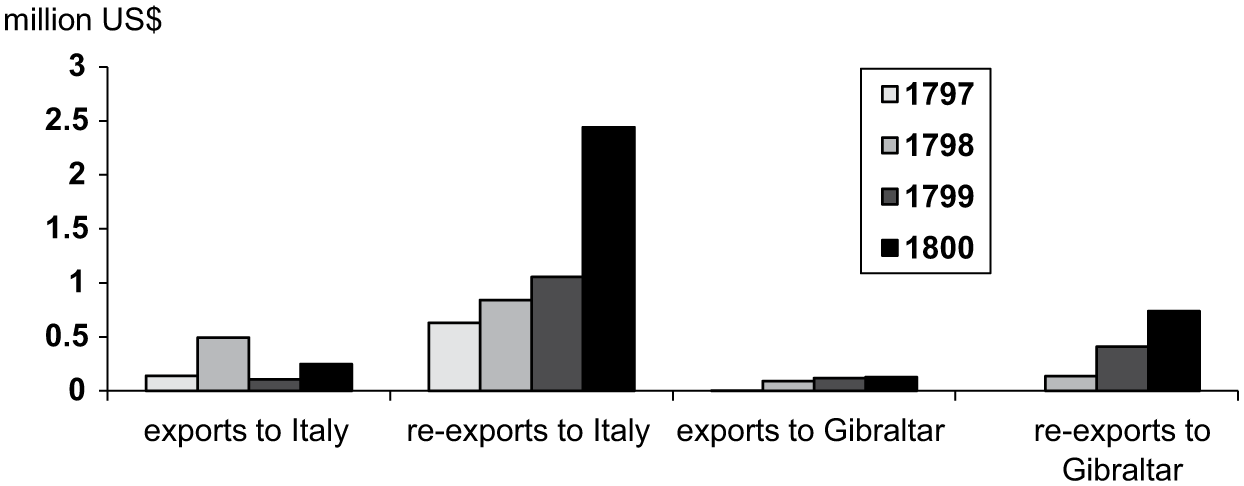
United States’ exports to selected Mediterranean ports/ regions, 1797–1800.
As time passed, besides increasing re-exports, American ships in the Mediterranean took part in Mediterranean tramping trades. Whereas in 1804 only one American ship out of four left Leghorn bound for another Mediterranean port, the figure was one ship in two in 1807; similarly, when arriving at Leghorn, one ship out of six came from another Mediterranean port in 1804, compared to one in three in 1807. American ships clearing Tunis were also mainly destined to other Mediterranean ports. 4 American merchants and shipowners clearly adopted the model of Mediterranean tramping trade on which the Scandinavians had prospered in the eighteenth century.
American Mediterranean shipping grew significantly. Provisional proxy estimates suggest a fivefold increase in the number of United States’ ships frequenting the Mediterrenean in 1807 – when it peaked – compared to late colonial times or the late 1780s: by 1807, I estimate that approximatively 500 American merchant ships were involved in the Mediterranean. 5 The balance of trade confirms that Mediterranean ports played a significant role in United States’ trade. By 1806, American ships carried US$5.3 million worth of goods into Leghorn, consisting mainly of West Indian products. This corresponds to a striking 5 percent of total US exports for that year. Although American ships left occasionally in ballast, their exports of silk, soap and wine were significant, amounting to US$2.5 million in 1806. 6 By that time, Leghorn was the main port for United States shipping and trade in the Mediterranean – a position it held until its annexation to the French Empire at the end of 1807.
In confirming the advantages of neutrality, these figures and trends tend to support the idea that being neutral was a clearly defined status, implying a recognized set of rights that produced uniform responses in similar situations. By looking more closely at American shipping and trade in the Mediterranean in the 1790s, I contend that the reality was much more complex than the clear-cut divide offered by theoretical distinctions between neutrals and belligerents. Such distinctions were blurred in practice when agents dealt with situations in which the principles of neutrality were constantly challenged and compromised.
A fragile neutrality?
To secure its trade and shipping in the Mediterranean, the United States relied on conventional instruments: consular services, diplomacy and a deterrent naval presence. The United States consular service was established during the 1790s in the Western Mediterranean, with an outpost in the Adriatic, where Trieste absorbed approximately one-tenth of the value of exports to Italy.
7
As far as diplomacy was concerned, the United States succeeded in the 1790s, though the mediation of representatives of other European countries, to ratify peace with the three Barbary regencies, whereas a treaty with Morocco had been signed as early as 1786 and confirmed in 1795. Naval protection was recognized as potentially useful, but the lack of an American Navy before 1797,
8
and the Quasi-War with France, made it impossible to dispatch a fleet to the Mediterranean before 1801. Commenting after the battle of Aboukir on the consequences of British naval mastery in the Mediterranean, David Humphreys, the United States Minister to Spain, was one of the many Americans pleading in those years for naval units to protect trade: A combat of so decisive a nature, in which the English have gained the complete command of the Mediterranean, can scarcely fail to open the Mediterranean again for the commerce of that nation. But the Dutch, who had formerly so lucrative a share of the carrying trade in that sea, cannot now, if ever, expect to recover it. The Swedes and Danes are wisely endeavouring to give countenance to their Merchant vessels by constantly keeping some armed vessels in the Mediterranean. Considering the enterprising character of our Citizens, it appears to me that the United States might profit extremely of the actual circumstances by encreasing [sic] their trade to the ports which they have been accustomed to frequent, and extending it much farther, if Government could send one frigate and three or four strong sloops of war to protect our Merchant vessels against French Privateers.
9
However, consuls, diplomacy and the Navy could not protect United States’ ships from seizure by European belligerents. Between the late 1790s, when treaties with the Barbary States should have procured optimal conditions in which to exploit neutrality, and the declaration of war between the United States and Britain in June 1812, frequent international tensions challenged the theoretical frame of American neutrality in the Mediterranean with regard to European belligerents. Even if during the war against Tripoli (1801–1805) an additional threat came from Barbary privateering, the main danger for American interests came from France, Spain and Britain.
The Quasi-War seriously strained United States’ ships. After France ratified peace with Spain in 1795, Frenchmen used Spanish ports as bases for their privateering and did not hesitate to seize vessels in Spanish territorial waters. At the end of December 1797, State Secretary Timothy Pickering remarked that ‘few of our vessels are so fortunate as to escape condemnation, when they fall within the power of a French court’. 10 French consuls were authorized to judge in the first instance the captured ships carried into their ports, and according to foreign consuls in the Mediterranean, they condemned cargoes and ships as good prize under the lightest pretext. 11 Between April and May 1797, at least 15 American ships were captured and condemned by French consuls at Malaga, Alicante and Cartagena, and the civil court in Aix-en-Provence confirmed their sentence in appeal in January to March 1798. As the Swedish consul in Marseille, François Philip Fölsch, reported: the United States consul obtained the reversal of the condemnation in one instance only, whereas he lost all other lawsuits. In this, he was not alone, as 30 ships belonging to Ragusa and Genoa had also been captured, tried and condemned. 12
Under such unfavourable circumstances, the American consul at Marseille wrote on 24 May 1798 to the Secretary of State concerning the agreement Captain Stephen Sweet had ratified with the privateer that had captured him on his way to Marseille. After pleading before the commercial court in Marseille – which, in the first instance, judged seized ships carried to a French port – the American captain was restored in his ship and cargo by paying to the privateer the sum of 50,000 francs, plus 14,000 francs for the lawsuit. The consul commented: ‘I cannot Blame this agreement – considering that not only the Americans, but the Danes, Swedes, Russians, Genoese etc. etc. are almost all condemned, under various motives; and on more than 100 Prizes not Six till now, have been Returned to their owners.’ 13
A few days later, he happily informed the Secretary of State that the civil court in Aix-en-Provence had rejected the appeal of a Corsican privateer that had captured the Flora of Gloucester on her way to Leghorn, and confirmed the payment of damages and interests to the American captain. The ship had been taken in Tuscany’s territorial waters, an action that made the seizure illegal.
14
The consul recognized that the court had strictly applied: treaties with Tuscany in short to the rights of Nations & neutral Property, without any kind of consideration whatever, moreso, as the owner of the privateer is Cit. Lucien Buonaparte, now legislator at the five Hundred, who was doing Every Thing in his power at Paris, to have the Ships & Cargo Condemned or Causing it to be done at Aix, he is a brother of the great General Buonaparte.
15
Whenever the risk of capture was considerable, American captains sailed together and took advantage of any available naval escort. In June 1797, the United States’ consul at Malaga reported that fourteen American ships had managed to leave the port, where they had been blockaded by French privateers for a considerable time. Thanks to the protection of two English frigates that Nelson had sent from Gibraltar, all but one sailed safely home. 16 In 1801, when Barbary privateering again constituted a danger, only five of 24 American ships cleared Leghorn without the company of another American ship. 17 Americans carried weapons to increase their ability to defend themselves, at least when faced with smaller assailants: in September, Humphreys noticed that ‘the French Privateers have as yet kept at a respectful distance from our armed merchant vessels in the Mediterranean; but it is reported to me that French Privateers of a larger size are about being fitted out to attack them’. 18 What official reports omitted to mention, was that privateering attracted sailors of all countries, so that Americans serving on French privateers helped to capture American ships – which suggests that contemporary agents adopted a nuanced approach to national allegiance. 19
Convoys were another conventional means of safeguarding merchant shipping. This required a permanent naval presence, however, which none of the neutral States could afford financially. A possible solution entailed mutualizing naval forces. Agreement among neutral States for mutual convoying had already occurred in 1794 between Denmark and Sweden
20
– two countries which had been jointly convoying their merchant ships since the 1690s – and on 2 October 1798, Humphreys reported his attempt to obtain Swedish protection for American merchant ships: The Commander of a Swedish armed vessel at Malaga, having lately declined to take American vessels under his convoy in going out of the Streight of Gibraltar, because he had no Instructions for the purpose, the Swedish Minister here has written to his Government (at my instance) to suggest the expediency of having such Instructions given for the future.
21
It was not until late 1801, however, that the American and Swedish navies collaborated to protect their shipping. 22 By that time, the United States was able to offer some naval protection on their own, as they had dispatched their infant Navy to the Mediterranean, consisting of five units ranging from 12 to 44 guns, to fight against Tripoli. 23 One of their objectives, which continued in the following years, was to convoy American merchant ships. 24
Once differences between France and the United States were settled in 1800, the conflict with Tripoli, starting in 1801, presented a new threat to American interests in the Mediterranean. The war against Tripoli, however, did not come as a surprise, and in this specific instance the consular service played a role in securing American shipping. On 3 January 1801, the American consul to Tripoli, James Leander, sent a circular letter to all of his colleagues in Europe asking them to warn all American captains of the imminent danger of capture by Tripolitan privateers. The Bashaw of Tripoli had in fact warned he would enter into war against the United States six months after the 22 October 1800, but the news of the ratification of peace between Sweden and Tripoli – with Sweden accepting to pay US$250,000, plus US$20,000 annually – induced him to believe that hostilities might begin earlier, so that he wanted all captains in the Mediterranean to be aware of the risk. 25
Problems with the Barbary Regencies were merely a part of the persistent difficulties American captains met when entering the Mediterranean. In October 1801, for instance, commodore Richard Dale, in command of the first Mediterranean Squadron aboard the United States Navy frigate President, reported that the ship American Packet had been captured by a Spanish privateer and bought to Algeciras. He explained that the local governor of the province was not only the owner of three of the city’s privateers, but also the ‘Chief Judge of the Cause’, and that any slight evidence of the ships calling at Gibraltar – a port captains generally entered after having crossed the Atlantic in order to get information on the safety of Mediterranean waters, but which the Spanish king declared blockaded in retaliation for the British blockade of Cadiz – would lead the cargo to be condemned. He lamented that even if the ship was released, the owners of the privateers ‘have to pay no damages’ for the loss of time of the captured ship, which he estimated as no less than a month. 26 By that time, he had obviously lost hope of justice that he had held a few weeks earlier when, after learning that ‘privateers belonging to Spain had carried a number of American Vessels into Algeziras’, he believed that ‘no court of Justice, agreeable to the Laws of Nations I think, can say that Gibraltar is Blockaded at present’. 27 As neutrals learned to their own cost, the interpretation of the rules of the game changed constantly in the course of a conflict, and there was hardly anything they could do, for instance, to counter the notion of ‘paper blockade’, which the British applied in the Napoleonic Wars to long stretches of Europe’s coasts. 28
As an agent and observer of the Mediterranean, commodore Dale experienced one of the many situations that caused hundreds of neutral ships to be arrested and carried to a port, judged and eventually condemned – their fate being unpredictable. Not all captures realised a loss: for example, the Joseph Harry, belonging to Willings & Francis, was released after having been carried into Algeciras, where her cargo of Caracas cocoa was expected to ‘yeald a very handsome profit […] so that her capture, which at first appeared unfavourable, will, in the event, prove very beneficial’. 29 However, two other vessels belonging to the same shipowners, and carried to the same Spanish port, were less fortunate: if the Sophia, ‘escaped with the confiscation of only a few Chest’s of Tea, & some Candles’, the Molly experienced an ‘unfortunate fate’. Spanish privateers were particularly active: accordingly, on 26 July 1801 the American consuls at Gibraltar reported that three American brigs had been carried into Algeciras during the past four days. 30
The British, for their part, posed a danger to American ships, especially due to the protection they afforded Minorcan and Tripolitan privateers. At least, the ambassador of the United States in Spain strongly suspected them of doing so: [T]he chargé des Affaires of his Swedish Majesty at this court […] has received intelligence from the Captain of a Merchant Vessel of his Nation, dated the 24 Ult. at Mahon, that a Tripoline Corsair had gone out of that port and that two others were preparing to sail, all of them having English Colours and Minorcan Crews, for the Purpose of avoiding, under that mark the searches of the American Frigates. His informant adds, that these three Corsairs are furnished with English Documents. However illegal, extraordinary or almost incredible such conduct might be, I have thought it a duty to place this information exactly as I have received it, in your knowledge.
31
Alliances against neutral shipping could prove fatal. The Swedish consul at Marseille reported in 1797 the existence of an informal agreement among French, British and Spanish privateers close to Gibraltar, allowing them to capture those neutral ships that were most likely to be condemned by their national legislation, without molesting each other. 32 Although it is difficult to establish whether such rumours were accurate, the very fact that contemporaries believed they were possible sheds light on their perceptions of the factors determining risks for neutral shipping. Trade conditions were determined by the latitude belligerents were willing to grant to any given neutral flag, and also by the capacity of privateers to promote informally their interests in a complex international arena.
There is an obvious bias in sources, which identify seizures and reveal problems more than success stories. This makes it extremely difficult to assess the statistical relevance of privateering against American shipping in the Mediterranean, as there is hardly any possibility of coming to a proxy of both the number of ships trading in this region and the number of those seized by different belligerents (Barbary regencies, France, Spain, Britain), incurring condemnation or losses. In 1797, a year corresponding to the peak of French privateering against American vessels, the French seized at least 32 American ships in, or bound to, the Mediterranean, and Spanish privateers under French letters of marque probably took just as many. Whereas most of the seizures made by Spanish privateers were released, the majority of those made by the French were condemned. 33 In 1797, American shipping in the Mediterranean undoubtedly met with consistent risks, which might explain why American citizens freighted a number of Scandinavian ships to trade to the Mediterranean. 34
Such examples emphasize the fragility of a flag’s neutrality, which should be conceived not so much as a clearly positive status, but rather as a continuous struggle to have it recognized by different parties within changing configurations. In this game, neutral agents did not appeal exclusively to their government for assistance, and nor did they expect support exclusively from their state agencies. Rather, they turned to other belligerents or neutrals for protection, offering, in turn, their own protection to other agents who might be experiencing difficulties, often on the basis of personal acquaintance. In doing so, however, they exposed their neutrality to belligerent’s attacks, as the case of the Fortune shows.
Covering belligerents’ property: The unfortunate fate of the Fortune and the multiplicity of legal principles in the Mediterranean world
In 1796, the United States managed to rescue approximately 90 American sailors who had been kept in captivity in Algiers, some of them for more than ten years. Once American agent Joel Barlow obtained their release in the context of peace negotiations, he looked for the first available ship to embark them, as the Regency was affected by the plague – a justified concern, as three rescued American sailors died just before embarking, and another passed away aboard. Barlow chartered a ship belonging to Bacri & Busnach, one of the most prominent Jewish merchant and banker firms scattered around the Mediterranean. The ship itself was a former prize, the Bridget of London, which had been captured by the French aviso La Foudre, 35 on her passage from Sicily to England with a cargo of wheat. She was carried into Algiers in June, where she was condemned and renamed the Fortune. 36 The Bacri intended to send her to Leghorn to Solomon Bacri. As Joel Barlow explained to Joseph Donaldson junior, another American agent in Algiers, who was at that time in Leghorn: ‘the people go to Leghorn in a ship of Baccry’s. It is the only way in which I can get them from this place’. He hoped the ship could immediately sail thereafter to Philadelphia if Donaldson could make an arrangement with Bacri; otherwise, ‘Capt. Smith is to take the command of her for the Baccrys for a farther destination’. 37
Although the ship belonged to a firm in Algiers, Barlow provided her with the American flag to avoid problems, given the fact that Algiers was at war with Tuscany. Plague casualties during his journey induced the captain to enter Marseille, rather than Leghorn, to perform quarantine. The Fortune arrived in Marseille on 20 July, with seven crew members, 84 Americans and four foreign sailors redeemed by the United States, as well as with 47 redeemed captives from Naples. 38 The former American captives were allowed into Marseille on 7 October, after a long quarantine in Pomègue. 39 No less than 71 of them were then put on board the Jupiter, a Swedish ship bound to Philadelphia which had arrived in September from Algiers with at least another American redeemed captive on board, who was the servant of the Swedish consul, Skjöldebrand. 40 Fifteen men were recruited to man the Fortune, which was put under the command of Captain Smith, himself a rescued American captive. 41 An agreement was signed at the end of October 1796 in Marseille between Jacob Bacri acting as ‘agent and factor’ of Joseph Donaldson junior, merchant and citizen of Philadelphia, and Captain Smith, for a return voyage to Bona [today’s Annabi]. The Fortune cleared from Marseille under American colours. In reality, neither the ship nor the cargo belonged to Donaldson, and Captain Smith had already been hired before leaving Algiers, as a letter of John Barlow found on board revealed: ‘Sir, the Jews who own the ship wish you to take the command of her after the Americans leave her. I wish you to keep this a secret for the present’. 42
The Fortune was captured on her passage from Bona to Marseille by the British ship Inconstant on 5 February 1797 and carried to Porto Ferraio, in Tuscany. Captain Smith entered his protests at the consulate of Leghorn on 15 March 1797. 43 The ship was condemned. Without waiting for the result of the appeal, the Dey of Algiers forced the United States consul in Algiers to pay back the value of the ship and the cargo, following the principle that the flag protected the property – a principle Britain had rejected since the seventeenth century, although accepting ad hoc and bilateral exceptions. 44 The Dey expected foreign governments to take responsibility for the security of ships sailing under their flag.
The case is particularly interesting as it reveals how neutrals in the Mediterranean had to cope with contradictory principles of neutrality. For the British, the Fortune was clearly a case in which neutrals abused their rights. The reasons that induced a leading British Admiralty Judge, Sir William Scott, to condemn the ship consisted in the ‘series of falsehood […]: false property, false destination, and false description of the national character’. 45 The ship was bound to Marseille with a cargo of wheat, although the official declared destination was Genoa. The captain recognized he had ‘signed five bills of loading one of which was for Genoa, with an intent to produce to any English Cruizers, being bound to a French Port, which was the only one found on board the s.d vessel at the time of the capture, the others were left in possession of the shipper Giovanni Vigo, and made out for Marseille’. 46 Moreover, the ship and her cargo belonged to the Algerian firm of Bacri & Busnach, although she sailed under American colours.
The case of the Fortune is extreme in the sense that it directly implies that America’s official representatives. American merchants, however, frequently agreed to cover belligerents’ property, both cargoes and ships, for a commission. Moreover, Frenchmen who had recently acquired American citizenships participated in Mediterranean trade as neutrals. 47 In doing so, merchants were abusing, from the British and the French point of view, their rights as neutrals. If discovered, enemy ships and cargoes under neutral cover were condemned, but similar consequences could befall neutral property as well, notably neutral ships carrying enemy goods.
From the Algerian point of view, however, the principle that the flag protected the cargo was strongly and firmly claimed and maintained. It was therefore expected that European governments and the United States were accountable for any attack on Algerian property sailing under their flag – even in the case of a fake flag on an Algerian ship, as in the case of the Fortune. Europeans and Americans complied with Algerian expectations for reasons that are clearly explained by the American Agent in Algiers, Joel Barlow, to the United States Minister in Paris: It is well known that the nations who purchase peace with Barbary are the carriers for those who remain at war. And this is one of the principal advantages purchased with the Peace. These States (contrary to those of Europe) consider it as the law of nations that the persons and property of enemies are sacred under the flag of a friend. If by our folly they should be taught to adopt the contrary principle, the carrying trade is at an end.
48
The tramping trade conducted by Europeans on account of the Ottoman Empire and the Regencies, and also on account of merchants of those states at war with them, was lucrative enough to mobilize joint consular diplomatic efforts to prevent risks of retaliation. At the same time, neutral agents tried to assert the principles that belligerents should not carry neutral prizes into Barbary ports. Barlow faced this problem in 1797, when Jean Bon Saint-André, a former member of the Committee of Public Safety despatched as French consul to Algiers in 1796, started promoting French privateering in Algiers,
49
and used his position to foster his own private interests: Jean Bon St Andre, who armed a privateer some time ago in this place, gave her orders to take every neutral she could find; and, wherever taken, to send them to this port to his tribunal. A few days ago they began to come in. When the Dane arrived she brought news of an American taken the same day and likewise ordered to this place. The Swedish consul and myself agreed to unite our influence with the Danish consul in vindicating a principle so extremely delicate in Barbary that goods on board a neutral vessel under capture should not [be] discharged in this place. We therefore agreed, 1st to use every argument that can be used with a madman to engage the French Consul to send the vessel back to Spain or France […]. 2nd If we failed in this, to engage the Dey to order her off, alleging that it was a question between his friends that he could not decide and in which justice could not be done here. 3rd If he would not do this, to engage him to take no part in the affair nor suffer his people to lend any aid on either side […].
50
Having managed to convince the Dey not to let the prizes enter Algiers, Barlow continued: You will be pleased to observe that in this business we have paid no attention to the nature of the cargoes, or what degree of evidence or suspicion there may be that they might belong to the enemies of France. The only point was the honour of the flag in Barbary, for which we pay so much money.
51
This letter perfectly illustrates the complexity of Mediterranean neutrality, in which agents were induced simultaneously to take different systems of laws into account and to apply conflicting principles of international right depending on the specific case they were facing.
Conclusion
The plurality of rights and jurisdictions, the multinational character of many well-connected merchant families, the facility with which merchants agreed to cover enemy’s cargoes and ships, and the recourse to crews of different nationalities were all contributory factors in the blurring of the theoretically clear divide line between neutral and belligerent maritime trade. When courts had to decide on the validity of a given capture, they had to assess the degree of proximity of the evidence to a model-like neutral venture. Privateers carried neutral ships away in the belief that a competent authority would condemn them. These authorities might do so because they were personally interested in privateering, or because the political context induced them to adopt a harsh approach to neutrals in general or a specific flag in particular. The availability of other flags, or possibilities of carrying goods, and the country’s needs also affected decisions. Under such complex circumstances, neutral and belligerent merchants gained some room for manoeuvre to take advantage of warfare trade opportunities. Neutrality was a card they could play, to a certain extent, in negotiations with other agents.
Footnotes
Appendices
1.
Anne Clauder, American Commerce as Affected by the Wars of the French Revolution and Napoleon, 1793–1812 (Philadelphia, 1932; reprint, 1972); Douglass C. North, ‘The United States Balance of Payments, 1790–1860’, in Trends in American Economy in the Nineteenth Century, Studies in Income and Wealth, vol. 24 (Princeton, 1960), 573–627; Silvia Marzagalli, Bordeaux et les États-Unis, 1776–1815: politique et stratégies négociantes dans la genèse d’un réseau commercial (Geneva, 2015).
2.
James A. Field, From Gibraltar to the Middle East: America and the Mediterranean World, 1776–1882 (Chicago, 1991).
3.
John J. McCusker, ‘Worth a War? The Importance of Trade between British America and The Mediterranean’, in Silvia Marzagalli, John J. McCusker and Jim Sofka, eds., Rough Waters: The United States Involvement in the Mediterranean, 18th–19th centuries (St. John’s, Newfoundland, 2010), 7–24.
4.
Silvia Marzagalli, ‘American Shipping into the Mediterranean during the French Wars: A First Approach’, in Marzagalli, McCusker and Sofka, Rough Waters, 43–62.
5.
Marzagalli, ‘American Shipping’.
6.
United States National Archives and Record Administration [hereafter NARA], RG 59, Leghorn, T 214, reel 1. Official US exports to ‘Italy’ were lower: American State Papers, House of Representatives, 9th Congress, 2nd Session, Commerce and Navigation, Vol. I, 693–698, No. 119, Exports for the year ending 30 September 1807 [sic, but 1806]. As the latter were based on declarations made when the ships cleared, they are overall less accurate than data collected in Leghorn itself upon arrival. See also Charles A. Keene, ‘American Shipping and Trade, 1798–1820: The Evidence from Leghorn’, Journal of Economic History, 3 (1978), 681–700.
7.
Silvia Marzagalli, ‘Le réseau consulaire des États-Unis en Méditerranée (1790–1815): logiques étatiques, logiques marchandes?’, in Arnaud Bartolomei, Guillaume Calafat and Jörg Ulbert, eds., De l’utilité commerciale des consuls : L’institution consulaire et les marchands dans le monde méditerranéen (XVIIe–XIXe siècle) (Rome-Madrid, forthcoming).
8.
The United States decided in 1794, at the peak of its diplomatic conflict with Great Britain, to build six frigates, but without allocating the necessary funds. Three were finally launched in 1797, and dispatched against France during the Quasi-War.
9.
Naval Documents related to the Quasi-War between the United States and France, vol. I, Naval Operations from February 1797 to October 1798 (Washington, 1935), 484–5, Letter of David Humphreys, United States Minister to Spain, to the Secretary of State, Madrid, 2 October 1798. Other letters in the same volume express similar opinions as to the necessity of deterrent forces.
10.
Pickering recognized that ‘Few complaints have been made of American vessels being captured by the British’, but lamented that French privateers acted within Spanish territorial waters and were ‘permitted to lie in wait in the ports of Spain for the Sailing of American vessels, & immediately on their departure to sally forth, capture & bring them back as prize’ where ‘French Consuls, which hitherto have assumed & exercised the powers of Courts of Admiralty within the Spanish Territory, examining witnesses, hearing causes. & pronouncing formal Sentences of confiscation & sale of American property’: Naval Documents related to the Quasi-War, I, 20–1, Pickering to Samuel Wewall, 27 December 1797. On the legal framework of French prize courts, see Florence Le Guellaff, Armements en course et Droit de prises maritimes (1792–1856) (Nancy, 1999).
11.
Stockholm, Riksarkivet, Diplomatica Gallica, 512, consul Fölsch to Fredrik de Sparre, Sweden’s Lord High Chancellor, Marseille, 23 August 1797.
12.
Stockholm, Riksarkivet, Diplomatica, Gallica, 512, consul Fölsch to the Board of Trade, in Swedish, Marseille, 11 May 1798. On the Swedish prizes, see the case of the Quintus, discussed by Pierre-Yves Beaurepaire in this Forum, ‘No law ever prohibited neutral caravans in time of war’, International Journal of Maritime History 29 (2016).
13.
Naval Documents related to the Quasi-War, I, 79.
14.
Greg H. Williams, The French Assault on American Shipping, 1793–1813: A History and Comprehensive Record of Merchant Marine Loss (Jefferson, NC, 2009), 147. The Flora’s master was Samuel Calder, who had taken command after being rescued in 1796 from Algiers. See below for more on this captain.
15.
Naval Documents related to the Quasi-War, I, 98, Stephen Cathalan to Secretary of State, Marseille, 31 May 1798.
16.
Naval Documents related to the Quasi-War, I, 27, Extracts from the Consular letters respecting captures by the French.
17.

18.
Naval Documents related to the Quasi-War, I, 419, David Humphreys to the Secretary of State, Madrid, 18 September 1798.
19.
See, for instance, Williams, French Assault, 241. More generally, the maritime labour market was in some instances largely international: the Rebecca, a 567-tons American ship leaving Marseille for Tranquebar, in the Dutch East Indies in September 1801, had 64 seafarers on board, including thirteen Lascars (‘East India citizens’), five Portuguese, three Genoese, three Neapolitan, one Dane, one Spaniard and one German: NARA, RG 74–6, Manifests and Crew Lists.
20.
Pierrick Pourchasse, ‘La guerre de la faim: L’approvisionnement de la République, le blocus britannique, et les bonnes affaires des neutres au cours des guerres révolutionnaires (1793–1795)’ (Unpublished HDR thesis, Université de Bretagne Sud, 2013), 239–41. See also an armed neutrality project, including Sweden, Denmark, Turkey, Poland, Venice, Genoa and the United States, fostered by France in those years in Samuel Flagg Bemis, ‘The United States and the Abortive Armed Neutrality of 1794’, American Historical Review, 24 (Oct., 1918), 26–47.
21.
Naval Documents related to the Quasi-War, I, 484–5, David Humphreys to the Secretary of State, Madrid, 2 October 1798.
22.
Naval Documents related to the United States Wars with the Barbary Powers, vol. I, Naval Operations including diplomatic background from 1785 through 1801 (Washington, 1939), 599, copy of a letter of the Swedish chargé d’affaires in Tunis, Frumerie, to William Eaton, United States consul at Tunis, 14 October 1801, confirming Swedish orders to mutual protection.
23.
‘Until the differences between the United States and France shall be so far accommodated as that actual hostilities shall cease between them, to station American frigates in the Mediterranean would be a hazard, to which our infant navy ought not perhaps to be exposed’. Naval Documents related to the United States Wars with the Barbary Powers, vol. I, 364–5, Secretary of State to John Quincy Adams, US Minister to Berlin, Washington, 24 July 1800.
24.
For instance the Siren protected six American ships from Gibraltar into the Atlantic in October 1803: Naval Documents related to the United States Wars with the Barbary Powers, vol. III, Naval Operations including diplomatic background from September 1803 through March 1804 (Washington, 1941), 123, ‘A list of Merchant Ships & Vessels under the Convoy of the U.S. Sloop Siren’.
25.
Naval Documents related to the United States Wars with the Barbary Powers, I, 404–05.
26.
Naval Documents related to the United States Wars with the Barbary Powers, I, 600 and 601, letters of 18 and 19 October 1801.
27.
Naval Documents related to the United States Wars with the Barbary Powers, I, 590, Dale to US minister in Madrid, 1 October 1801.
28.
In May 1806, an Order in Council declared that the coast from the Elbe to Brest was under blockade. Napoleon’s Berlin Decree of November 1806 presented the continental blockade as a legitimate answer to British pretentions to blockade hundreds of kilometres of coastline.
29.
Naval Documents related to the United States Wars with the Barbary Powers, I, 585, Clement Humphreys to Captain Richard Dale, Algesiras, 28 September 1801.
30.
Naval Documents related to the United States Wars with the Barbary Powers, I, 530, United States consul John Gavino to Secretary of State, Gibraltar, 24 July 1801.
31.
Naval Documents related to the United States Wars with the Barbary Powers, I, 602, circular letter of David Humphreys, United States Minister in Madrid, to William Kirkpatrick, United States consul in Malaga, Madrid, 24 October 1801.
32.
‘On assure qu’il croise à l’entrée du détroit quelques corsaires anglais, français et espagnols, qui ont établi entre eux un nouveau code maritime ou plutôt un pacte de piraterie, en vertu duquel ils vivent entre eux en bonne intelligence, se laissant mutuellement capturer les navires de différentes nations soit ennemies au pavillon du capteur soit neutres venant ou allant dans un port ennemi, en sorte qu’il est bien difficile qu’aucun bâtiment n’échappe à cette avide association’: Stockholm, Riksarkivet, Diplomatica, Gallica, 512, consul Fölsch to Fredrik de Sparre, Marseille, 7 May 1797.
33.
Their owners recovered a part of their claims in the 1820s. For annual data on American prizes, see Ulane Bonnel, La France, les États-Unis et la guerre de course (1797–1815) (Paris, 1961). I have calculated the total of prizes in the Mediterranean in 1797 by cross-checking information provided by the document entitled ‘A List of the American Vessels Captured by French Privateers & Condemned by the Tribunal of Appeal at Aix’, published in Naval Documents related to the Quasi-War, I, 81, and information provided by Bonnel, La France, 319–67, and Williams, French Assault. None of these sources offer a complete set of data. Williams also provides information on ships captured by Spanish privateers and judged by French consuls in Spain, without explaining the reason. I assume such privateers were operating under French letters of marque.
34.
NARA, RG 84, Marseille Consulate, vol. 96, passim: certificates of American property. Ten of the 16 certificates delivered in 1796 and 1797 concerned cargoes carried by Danish and Swedish ships.
35.
NARA, RG 59, Marseille, T 220/1, copy of the deposition of captain Samuel Calder […] in the Pratick House of Marseille, 2 thermidor year IV (20 July 1796).
36.
London, Kew, The National Archives (hereafter TNA), HCA 32/648, part I, n° 316, prize papers of the Fortune, interrogation of Captain Smith.
37.
Naval Documents related to the United States Wars with the Barbary Powers, I, 161–2, Algiers, 12 July 1796.
38.
NARA, RG 59, Marseille Consulate, T 220/1, letter of US consul Stephen Cathalan jr. to the State Secretary, Marseille, 22 July 1796. See also a copy of the letter of Captain Samuel Calder to consul Cathalan, 20 July 1796, written from the Lazzareto. Calder was one of the rescued American captives. He had been captured by Algerians in 1793 aboard an American ship returning from Malaga to Boston: he was caught, like a dozen other ships, by the unexpected peace between Portugal and Algiers, which provoked the retrieval of the Portuguese Navy from the Straits, and the arrival of Algerian privateers in the Atlantic. See ‘A List of American Vessels Captured by the Algerines in October & November 1798’, Naval Documents related to the United States Wars with the Barbary Powers, I, p. 56.
39.
NARA, RG 84, Marseille Consulate, vol. 96, 4 November 1796, Certificate to 70 American sailors; RG 76, Marseille Consulate, vol. 4, declaration of Captain Samuel Calder, 7 October 1796.
40.
NARA, RG 84, Marseille Consulate, vol. 96, 9 November 1796, Certificate to Hans Christian, United States sailor, ‘as a servant attendant to the consul of Sweden’. The Jupiter left Algiers on 3 September and arrived at Marseille on 15 September in ballast, with seven passengers: Archives départementales des Bouches-du-Rhône, Santé, 200 E 551, 9 fructidor IV.
41.
Manifest of clearance of the Fortune on departure from Marseille in NARA, RG 76 Spoliation Claims, Marseille Consulate, vol. 6.
42.
TNA, HCA 32/648, part I, n° 316, prize papers of the Fortune, letter of John Barlow, dated [Algiers] 11 July [1796] to Captain Smith.
43.
Naval Documents related to the United States Wars with the Barbary Powers, I, 195–196, Protest of Michael Smith, master of the ship Fortune of Newburyport, Leghorn, 15 March 1797.
44.
On French and British policies towards neutral shipping, which evolved according to the changing interests and needs of each of the belligerents, see Éric Schnakenbourg, Entre la guerre et la paix: Neutralité et relations internationals, XVIIe-XVIIIe siècles (Rennes, 2013), 99–103.
45.
Christopher Robinson, Reports of Cases argued and determined in the High Court of Admiralty (London, Butterworth & White, 1799–1808, 6 vols., reprinted Boston, 1853), II, 83.
46.
TNA, HCA 32/648, part I, n° 316, prize papers of the Fortune, preparatory examination, 16 February 1797.
47.
For examples in Bordeaux, see Marzagalli, Bordeaux et les États-Unis, 302–30. For instance, sales of French ships to American citizens occurred in Marseille; see also the transcription of the American naturalization of Joseph Lazarus Icard of Marseille, dated Philadelphia, 1 March 1799. NARA, Marseille, RG 84, vol. 97, Records of legal acts, 11–15, 31–2, 33.
48.
Naval Documents related to the United States Wars with the Barbary Powers, I, 199, United States Agent Joel Barlow to the United States Minister to Paris, Algiers, 14 March 1797.
49.
This is confirmed by Swedish consul Fölsch, who reported the friendly attitude of the Dey: ‘Les mêmes lettres d’Alger rapportent encore que le nouveau consul de France y était arrivé et avait été parfaitement bien accueilli par le dey; c’est l’ex conventionnel Jambon Saint André’. Stockholm, Riksarkivet, Diplomatica Gallica, 512, consul Fölsch to Fredrik de Sparre, Marseille, 10 July 1796.
50.
Naval Documents related to the United States Wars with the Barbary Powers, I, 200, United States Agent Joel Barlow to the United States Minister to Paris, Algiers, 14 March 1797.
51.
Naval Documents related to the United States Wars with the Barbary Powers, I, 200, United States agent Joel Barlow to the United States Minister to Paris, Algiers, 14 March 1797.