




Abstract
The goal of this article is to study the great Spain–Portugal supply area as part of the international deployment of the Etappenorganisation before and during the Second World War. To accomplish this objective, the records of the German Naval War Command are analysed to demonstrate three hypotheses: Spain was part of the Etappenorganisation long before the beginning of the war; she played an important role in the preparation of supply vessels and blockade runners, supported by Spanish non-belligerence; the dismantling of the Etappenorganisation in Spain provisionally began in 1942 and continued in the following years.
The foreign policy of neutral countries in the Second World War was influenced by pressure from the great powers and the economic opportunities offered by the war. 1 Spain was no exception in this respect, but does present notable differences when compared to other neutral parties. Indeed, the Franco regime owed its existence in large part to the military support of Germany and Italy during the Spanish Civil War (1936–1939), maintaining an important economic debt to those countries from that period onward. 2 It also aligned itself with them internationally through a series of accords, such as the Spanish–German Protocol of 20 March 1937, and Spanish adherence to the Anti-Comintern Pact, which it signed on 27 March 1939. 3 Thus, as the Second World War began, the Spanish Government was economically and diplomatically committed to the Axis. This helps to explain why Spain flouted its obligations as a neutral country by organizing and sending a volunteer division to fight against the USSR, recruiting workers for the Third Reich, collaborating with the intelligence services of the Axis, and distributing war propaganda, among other things. 4
Another factor that explains this collaboration with the Axis was the temptation to participate in the war during the summer and autumn of 1940, after German victories in Scandinavia and Western Europe, and Italy’s entry into the war. The Spanish declaration of non-belligerence in June 1940 is interpreted as pre-belligerence, given that it was accompanied by negotiations for Spain to enter the war. 5 Franco’s intention to intervene in the war on the side of Italy and Germany and against France and Great Britain can be documented from 1938, with a clear objective: to extend the Spanish colonial empire in Africa. 6 However, the lack of German guarantees for Spanish claims, the precarious situation of the country after the Civil War, and the economic and military consequences of a conflict with the Allies eventually deterred Spain from entering the conflict. The economic pressure applied by the United States and Great Britain, especially from mid-1943, subsequently forced the Spanish Government to begin abandoning its collaboration with the Axis. 7
When the conflict ended the Franco regime was marked with an ‘Axis stigma’ that it attempted to conceal. 8 The manipulation of the recent past thus became a necessity for survival, covering up Spain’s non-compliance with its obligations as a neutral country, including the regime’s consent to supply German submarines in Spanish ports. This issue, denied by the Spanish Government during the war, was one of the Allies’ main complaints. 9 However, in 1970 Charles B. Burdick published an article demonstrating the preparation of these activities between 1938 and 1941 and their execution with Spanish consent. 10 Shortly thereafter, historians Ángel Viñas and Robert H. Whealey investigated the organization of the Etappendienst or Etappenorganisation between 1934 and 1938, the organization charged with preparing the supplies for German submarines in Spain. 11 Several decades later, Manuel Ros Agudo updated and expanded the investigation, starting with the war diary of Commander Kurt Meyer-Döhner, the German naval attaché in Spain during those years, and using Spanish naval and diplomatic sources. 12 Other more recent contributions have added new facts in regional scenarios. 13
These investigations show that the issue of logistical support for the Kriegsmarine in Spain is neither unpublicized nor unknown, but it has not been exhausted either. Among the pending questions for study, there are three that stand out as especially relevant. The first is Spain’s role in the international deployment of the Etappenorganisation and its activities before the beginning of the Second World War. The second is its performance between 1939 and 1942, especially in those activities not explored in the abovementioned studies, such as the preparation of supply vessels for auxiliary cruisers and surface warships. The third and last is the slow dismantling of the Etappenorganisation in Spain between 1942 and 1944, after the suspension of supplies to German submarines.
The answer to these questions, at least in part, is found in the documentation of the German Naval War Command (Seekriegsleitung, Skl) in Freiburg im Breisgau (Germany). A large part of the documentation generated during those years, detailing the clandestine activities for supplying the German naval forces overseas, has been preserved. Records including extracts from the war diary of the Etappenorganisation, which have enough information to contextualize Spain in the international deployment of this service and to study some of the lesser-known aspects, stand out. Other Naval War Command records, also revised by the British Naval Intelligence Division at the end of the conflict, bring to light new facts about the first activities of the Etappenorganisation before the Second World War.
Using these sources, this article aims to demonstrate three hypotheses. First, that Spain was part of the international deployment of the Etappenorganisation long before the beginning of the war. Second, that the great Spain–Portugal supply area (Grossetappe Spanien/Portugal) played an important role in the preparation of supply vessels and blockade runners between 1939 and 1942. Finally, that the dismantling of the Etappenorganisation in Spain provisionally began in 1942, but it continued during the following years as the chances of restarting supply operations decreased.
Spain in the international deployment of the Etappenorganisation
At the end of the nineteenth century, the colonial aspirations of Kaiser Wilhelm II required the support of a great naval force and a series of bases that allowed for deployments thousands of kilometres from Germany. Given the vulnerability of the German colonies in relation to their rivals, in the case of war, they could not be counted on for very long. It was thus imperative to find an alternative that would be safe from enemy action. This alternative consisted of the territories of neutral countries, from which stop-over or supply services, called Etappendienst or Etappenorganisation, for auxiliary cruisers and submarines could be clandestinely organized. Thus, it occurred with Spain in the Great War, with Lieutenant Wilhelm Canaris organizing the supply of U-boats on the Spanish Mediterranean coast or the Canary Islands, a Spanish territory strategically located in the eastern Atlantic. 14
The German defeat led to the dismantling of the Etappenorganisation, but it was reconstructed, starting in 1930, by Lieutenant Commander Frisius. 15 Admiral Canaris, head of the Abwehr, the intelligence service of the High Command of the Armed Forces (Oberkommando der Wehrmacht, or OKW) from 1935 onward, continued extending the service throughout the world, creating a station or War Organization (Kriegsorganisation, KO) in Spain in 1937. 16 Nevertheless, the Etappenorganisation was present in Spain at least from 1934, 17 and Canaris had visited Spain in 1922 and 1925–1931, developing strong contacts with key Spanish businessmen, such as Horacio Echevarrieta, and high government officials of the Primo de Rivera Government, such as General Severiano Martínez Anido. 18 Indeed, in that same year the Abwehr sent Skl a report from retired Lieutenant Commander Vermehren about meeting points for supplying the naval forces in the eastern Atlantic, which included two in the Canary Islands: Puerto Naos, on the island of El Hierro, and El Río, in the north of the island of Lanzarote. 19
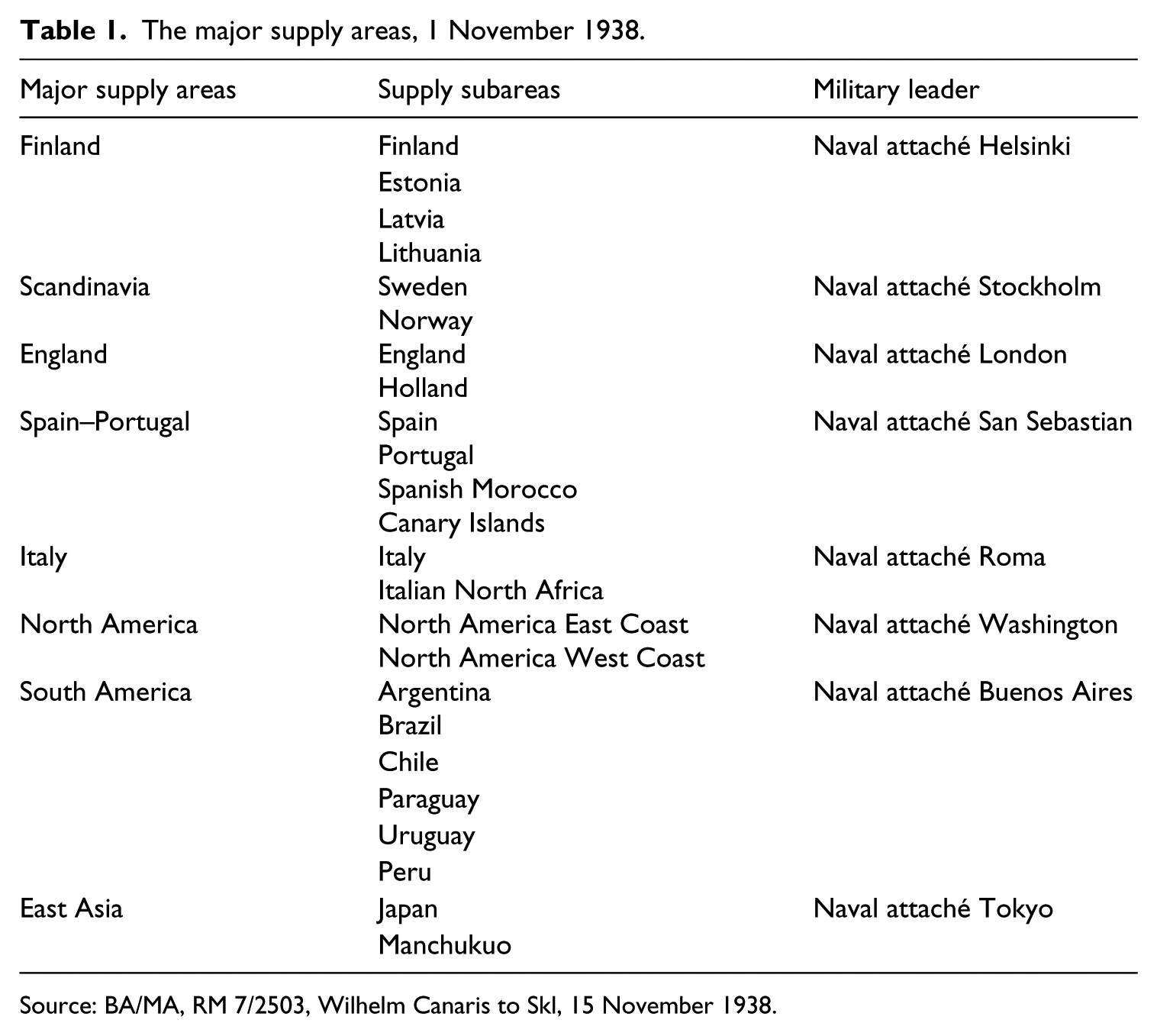
In October 1936, the Etappenorganisation formed part of Group IV of the Abwehr, but from June 1938, it was part of Group IX of the Ausland Section of the OKW (OKW/Ausl. [IX]), and it was transferred to Group IV of that section in November. 20 In that final year, it was deployed throughout the world (Tables 1 and 2), with eight large supply areas (Grossetappen), each under the command of a naval attaché acting as a military chief and encompassing a total of twenty-four supply subareas (Subetappen). In addition, there were seventeen individual supply areas (Einzel-Etappen) and seven independent stations (Selbstängige Etappen-Stationen). 21
The major supply areas, 1 November 1938.
Source: BA/MA, RM 7/2503, Wilhelm Canaris to Skl, 15 November 1938.
Independent supply areas and call stations, 1 November 1938.

Source: BA/MA, RM 7/2503, Wilhelm Canaris to Skl, 15 November 1938.
The Etappenorganisation had been created to act in times of war, the prospect of which loomed large in September 1938 during the Sudeten Crisis. The risk of the crisis ending in war provoked the deployment of German submarines in the Atlantic, just as had occurred in March with the annexation of Austria and in May with the first attempt to take the Sudetenland. 22 In addition, during the first three weeks of September, preparations were made to send the pocket battleships Deutschland and Graf Spee to Spain. On 16 September the motor ship Samland was loaded with supply materials with the purpose of accompanying the Deutschland, and four days later the motor ship Schwabenland was made available to the Etappenorganisation in the Azores. 23
During this crisis, Franco initially showed his favourable position toward Germany and considered the possibility of using Spanish ports to supply German naval forces in the event of war, but quickly reconsidered his position and declared Spain neutral. 24 The Spanish dictator’s quick change of attitude was confirmed by Commander Kurt Meyer-Döhner, German naval attaché in Spain, who communicated to OKW that the Chief of Staff of the Spanish Navy had promised him whatever support the country could provide, consistent with maintaining neutrality. 25 Nevertheless, this situation did not impede the preparation of the Etappenorganisation in Spain, as the naval attaché reported shortly thereafter. Despite the need to improve the organization, he did not foresee any problem in its functioning, provided that political conditions in the country did not change significantly. 26
The words of the naval attaché implied a Spanish neutrality favourable to Germany, as General Wilhelm Keitel, chief of the OKW, affirmed in March 1939. 27 This expectation predated the crisis of September 1938, as already, in April of that year, the commander in chief of the Kriegsmarine, Admiral Erich Raeder, had sent the OKW a report on the advantage of an accord with Spain after the Civil War. Given the strategic position of the country and its territories beyond the Iberian Peninsula, it was essential that the Spanish Government should not cede to other powers or permit their forces’ presence without first informing Germany. The latter would also benefit from a benevolent neutrality if Spain abandoned the League of Nations, although that should be fomented in peacetime through accords for maritime trade, air transport, reconstruction of the war fleet, etc. that would allow the German influence to expand. 28
Benevolent Spanish neutrality would prove to be of considerable use in supplying German naval forces. From 1934, the Etappenorganisation had attempted to obtain fuel in Spain, encountering great difficulties when the Civil War began. However, in August 1938, an important effort was made to acquire shares in the Spanish Petroleum Company (Compañía Española de Petróleos Sociedad Anónima, CEPSA) through the Spanish businessman Juan March. 29 Doing so would allow Germany to have fuel available at the refinery located in Tenerife, one of the Canary Islands, but the operation was unsuccessful. Although March signed a protocol on 10 October 1939, promising to defend German interest in CEPSA, scepticism about the operation and doubts about March led the Auswartiges Amt to withhold the money necessary to perform the operation. 30
The Grossetappe Spanien/Portugal in action
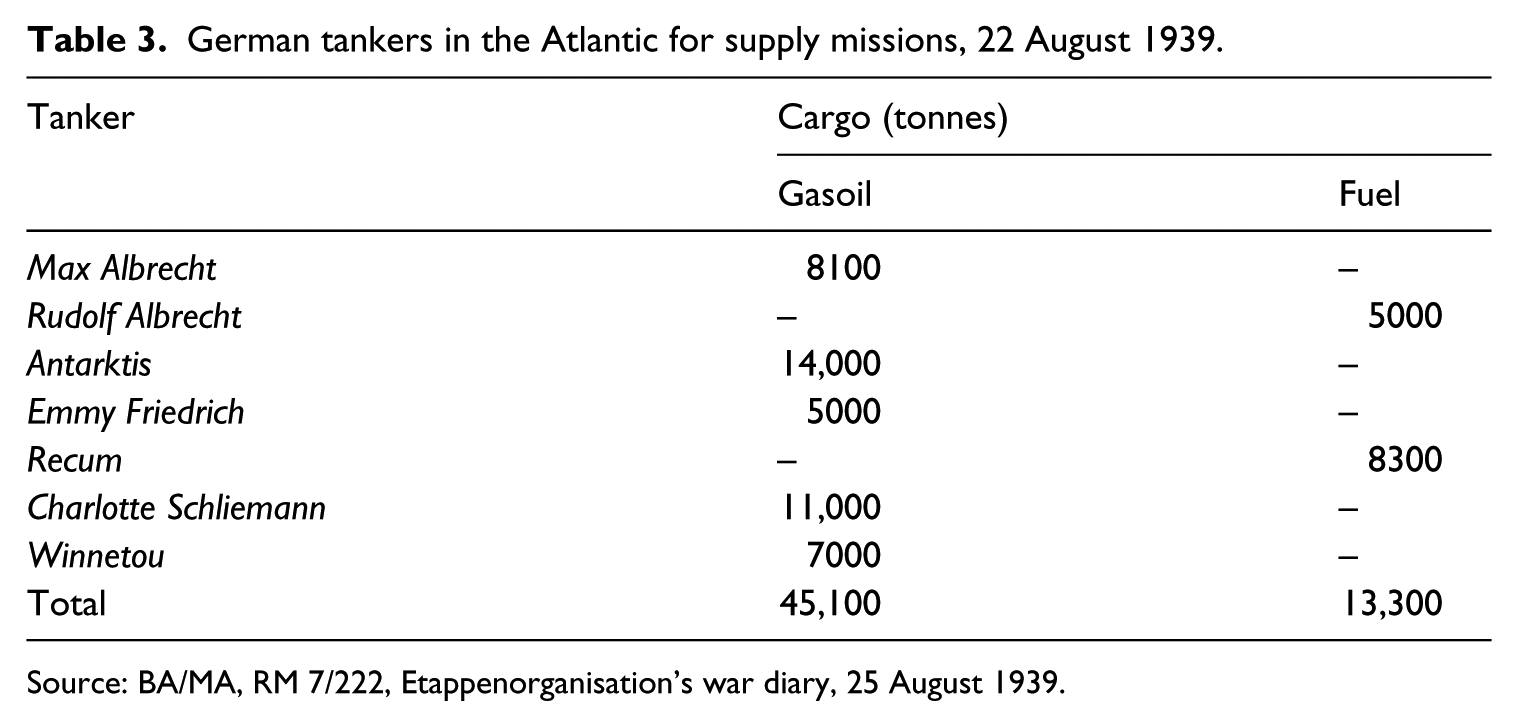
German preparations for a possible conflict with France and Great Britain included planning for a naval war in the Atlantic. Consequently, German submarines were deployed in the Atlantic from the middle of August 1939, in addition to the pocket battleships Deutschland and Graf Spee, the latter two with the supply vessels Westerwald and Altmark. 31 The High Command of the German Navy (Oberkommando der Kriegsmarine, or OKM) also considered the possibility of supplying the German submarines in Spain; thus, on 15 August, the German naval attaché in Spain received instructions to make the necessary preparations. Shortly thereafter, seven oil tankers returning to Germany were rerouted to neutral ports, principally Spanish ports, with the aim of using them for supply missions (Table 3). 32 Of the twenty oil tankers that were in the Atlantic at that time, seven had been chartered by the Kriegsmarine and the rest by the companies Jung and Eurotank. 33 Nine of the tankers harboured in ports in the great Spain–Portugal supply area, including six of those chartered by the German Navy.
German tankers in the Atlantic for supply missions, 22 August 1939.
Source: BA/MA, RM 7/222, Etappenorganisation’s war diary, 25 August 1939.
The naval attaché’s attempts to obtain the Spanish Government’s consent to supply German submarines in Spain did not yield immediate results. Despite the favourable attitude of the Marine Minister, Salvador Moreno Fernández, and the Foreign Affairs Minister Juan Beigbeder y Atienza, Franco decided to postpone Spanish support at the beginning of September as a consequence of British surveillance. The naval attaché continued with preparations to use the German vessels harboured in Spain, with the goal of supplying submarines and auxiliary cruisers. Despite appearing on various occasions before the Marine and Foreign Affairs Ministers, his work was done to a large extent extra-officially and with difficulty. 34
At the end of November, the naval attaché and the ambassador, Gerhard Stohrer, again turned to the Spanish Foreign Affairs Minister, and succeeded in inducing him to secure Franco’s approval of their proposals. The supplying of German submarines would occur at night and with German means, with Spanish involvement limited to transport from one Spanish port to another and the consent of local authorities. Franco rejected a plan to charter Spanish vessels to supply the auxiliary cruisers and also refused to create a coordinator for these operations. Information would be given to the Foreign Affairs Minister, who would transfer it to the Marine Minister so that it would reach the corresponding authorities. 35 The Spanish decision to assist was not a response to German pressure but rather was offered voluntarily as a logical consequence of the secret protocols signed with Germany in 1937, the friendship treaty of 1939, and Spanish military planning, which was considering participation in a future conflict on the side of the Third Reich. 36
By about 10 January 1940 preparations for the supply operation had been completed. There were seven basic supply units for submarines in San Sebastian, Gijon, El Ferrol, Cadiz, and Las Palmas and another for battleships in Vigo. The basic supply unit for submarines contained provisions for thirty-nine men for six weeks, whereas the unit for battleships was composed of provisions for 1000 men for fourteen days. Half of these units were aboard the Max Albrecht, Nordatlantik, Corrientes and Winnetou. The Winnetou and the Charlotte Schliemann had also been prepared to supply auxiliary cruisers. In addition, there were stockpiles of provisions in Madrid and Barcelona. The Etappenorganisation’s activities included unloading the oil tanker Gedania, whose crude oil was given to CEPSA in Tenerife, and which needed to be loaded in Las Palmas with the whale oil that the Norwegian vessel Jaspis was carrying. 37
During the night of 30–31 January 1940, the U-25 was supplied by the Thalia in Cadiz, which represented the first supply of German naval forces overseas after the failures of the Emmy Friedrich and the Dresden. The Spanish Foreign Affairs Minister had been informed prior to the operation, and the result was communicated to the Marine Minister. 38 Nevertheless, the capture of the Altmark by the Royal Navy in Norwegian waters, the sinking of the Spanish steamboat Banderas by a German submarine, and the Spanish authorities’ lack of enthusiasm imposed a pause until June. Between June and July, four more supply operations were performed, but operations then ceased for the rest of the year whilst the Spanish Government weighed up its strategic options. 39
The British rejection of a negotiated peace after the fall of France led Hitler to decide to attack the USSR, his principal objective and also a means of putting pressure on Great Britain. However, the attack was postponed until May 1941 whilst consideration was given to alternative strategic options. Among these was the ‘peripheral strategy’ advocated by the head of the Kriegsmarine, Admiral Erich Raeder. Under this plan Operation Felix, which entailed the conquest of Gibraltar and occupation of the Portuguese Atlantic archipelagos, in addition to Spain’s cession of one of the Canary Islands to Germany, would weaken Great Britain by expelling it from the Mediterranean and diverting its navigation routes in the south Atlantic toward the west. This option offered the attractive possibility of constructing an empire in central Africa after the fall of France, it was encouraged by American help to Great Britain and the deferral of the German invasion of England. However, for Hitler all of this remained only a prelude to an attack on the USSR, which, together with the limited capabilities of the Kriegsmarine and Franco’s decision not to enter the war in that moment, caused the ‘peripheral strategy’ to be discarded. 40
Franco’s reservations about entering into the conflict did not prevent the naval attaché from soliciting more Spanish support for supply operations in February 1941. Indeed, these operations intensified over subsequent months, although the British intelligence services were suspicious of them, and supplies were interrupted in the Canary Islands in July and in the Iberian Peninsula in December as a result of British protests. The Spanish Government had not only consented to these operations but had also transported provisions and torpedoes to the Canary Islands in Spanish war vessels, aiming to evade Great Britain’s navigation controls. Despite this early interruption, Burdick and Ros Agudo both highlight the importance of the twenty-three submarine-supply operations in Spain because they were vital for increasing the U-boats’ radius of action and the amount of time they could spend at sea. 41 The majority of these operations were concentrated between March and December 1941, including six of the twenty-three patrols that attacked British navigation in the waters of the south Atlantic that year. 42
The Etappenorganisation also attempted to obtain fuel in Spain after the failed efforts of Juan March. March ended up exchanging gold from the Kriegsmarine for dollars to acquire petroleum. It was even possible to agree to two exchanges of fuel with Spain. The first was negotiated between May and July 1940, with CEPSA mediating, to obtain 4100 tonnes of gasoil for the submarines that were to be supplied in the Canary Islands, in exchange for gasoline from the oil tanker Brake, harboured in Vigo. 43 On 3 September, the Eurofeld set sail from Tenerife with 2510 tonnes of gasoil from CEPSA’s refinery, aiming to supply the auxiliary cruisers Widder and Thor. It should have received another 500 tonnes, but the American restrictions and the Anglo–Spanish Accord of 23 August impeded the completion of the exchange. Nevertheless, it was possible to load the Rudolf Albrecht in Tenerife with 4162 tonnes of gasoil and 528 tonnes of fuel from the Italian oil tanker Taigete, also harboured there. 44
The second exchange occurred in March 1941 after the supply of three U-boats in Puerto de la Luz, and with the intention of exchanging the 13,500 tonnes of gasoline from the oil tanker Germania for an equivalent quantity of gasoil. 45 On 18 March, the Spanish Marine Minister agreed to furnish 4000 tonnes of gasoil, which the Spanish Navy oil tanker Plutón would take to El Ferrol for the German oil tankers Antarktis and Nordatlantik, thereby evading the Royal Navy. However, by the end of October, only 230 tonnes of gasoil had been received, and the petrol embargo ordered by the United States shortly thereafter impeded the completion of the delivery. Nevertheless, in November, the Plutón transferred gasoil from the Max Albrecht, harboured in El Ferrol, to Cadiz; 403 tonnes for the Thalia, 800 tonnes for the Lucy Essberger, and 96 tonnes for a deposit on land that would provide supplies for twelve submarines. 46
Another activity of the Etappenorganisation, which has received less attention in Spain, was the preparation of blockade runners and supply vessels for naval surface forces, of which more than eighty set sail between October 1939 and March 1942 alone. There were changes in the deployment of the Etappenorganisation such as the creation of the Etappe Bourdeaux, which was organized in the spring of 1941 to supervise the supply vessels. 47 However, the great Spain–Portugal supply area played an important role during those first years, surpassed only by Japan. If the four submarine supply vessels in Spain (Thalia, Bessel, Max Albrecht and Corrientes) are added to Table 4, in addition to the vessels prepared for the same purpose but which did not end up furnishing provisions or fuel to the U-boats (Lipari and Kersten Miles), the great Spain–Portugal supply area would have prepared a total of twenty-five vessels, compared to Japan’s twenty-seven, to which another seven supply vessels would need to be added to the eleven that set sail from its ports. 48
Blockade runners and supply ships of the Etappenorganisation, 1939–1942.

Source: BA/MA, RM 7/223, OKW/Ausland IV to Skl, 13 April 1942.
Note: Panama includes two from Curaçao and one from Costa Rica.
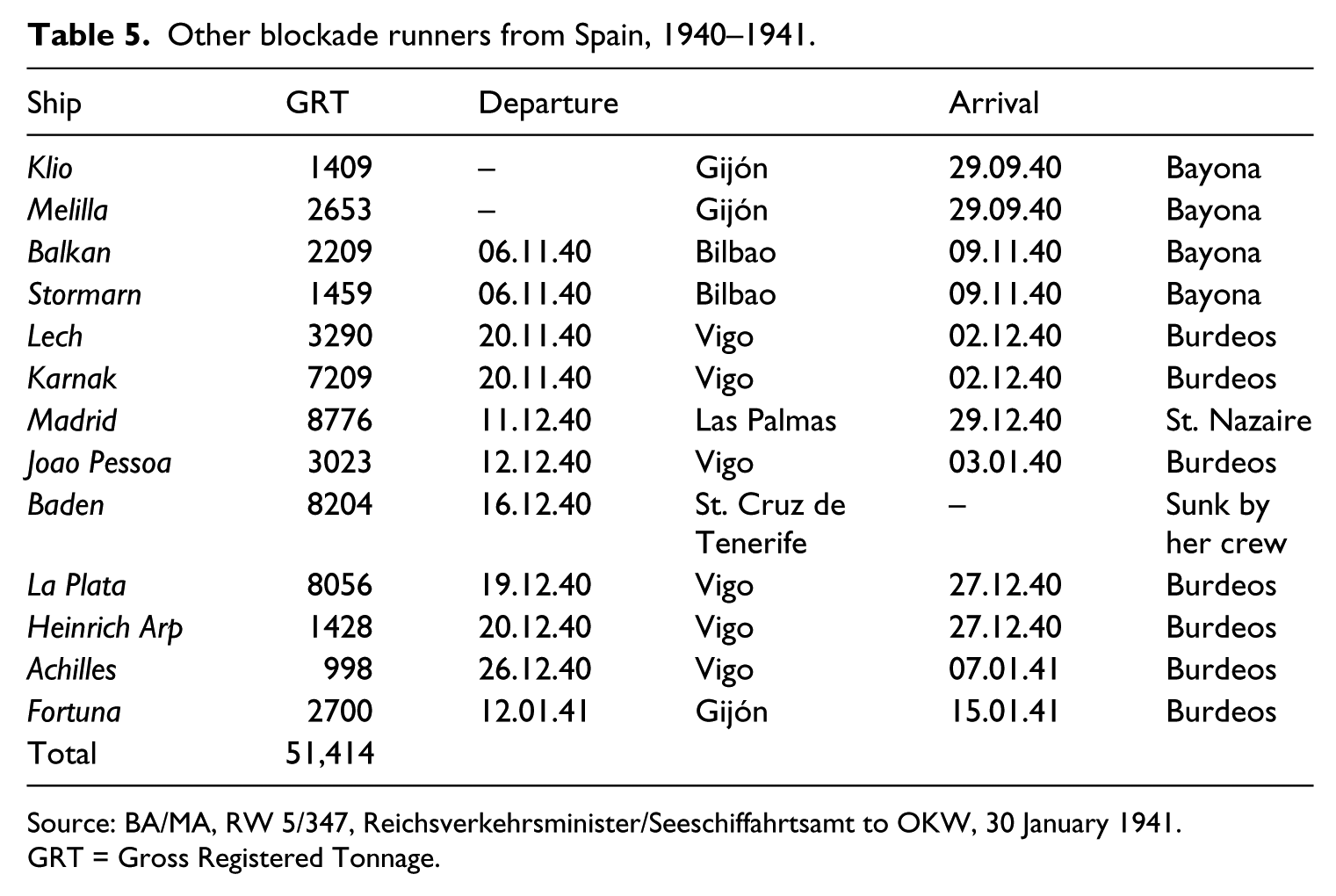
Nevertheless, when analysing the activity of the different supply areas, based on the report produced by OKW/Ausland IV in April 1942, it is necessary to consider two questions. First, the report refers to the missions that were performed, and because many vessels performed more than one mission the actual number of blockade runners decreases to forty-one and the number of supply vessels to twenty. Some of the boats counted in the number of blockade runners are repeated in the number of supply vessels. Thus the total of both, eliminating repetitions, is fifty-five. Second, the number of blockade runners does not include the total number of boats that attempted to reach German-occupied Europe, but only those that were prepared by the Etappenorganisation. In the case of Spain the number of blockade runners is greater than the number indicated in the 1942 report because at least thirteen would need to be added, of which only one was lost (Table 5). 49
Other blockade runners from Spain, 1940–1941.
Source: BA/MA, RW 5/347, Reichsverkehrsminister/Seeschiffahrtsamt to OKW, 30 January 1941.
GRT = Gross Registered Tonnage.
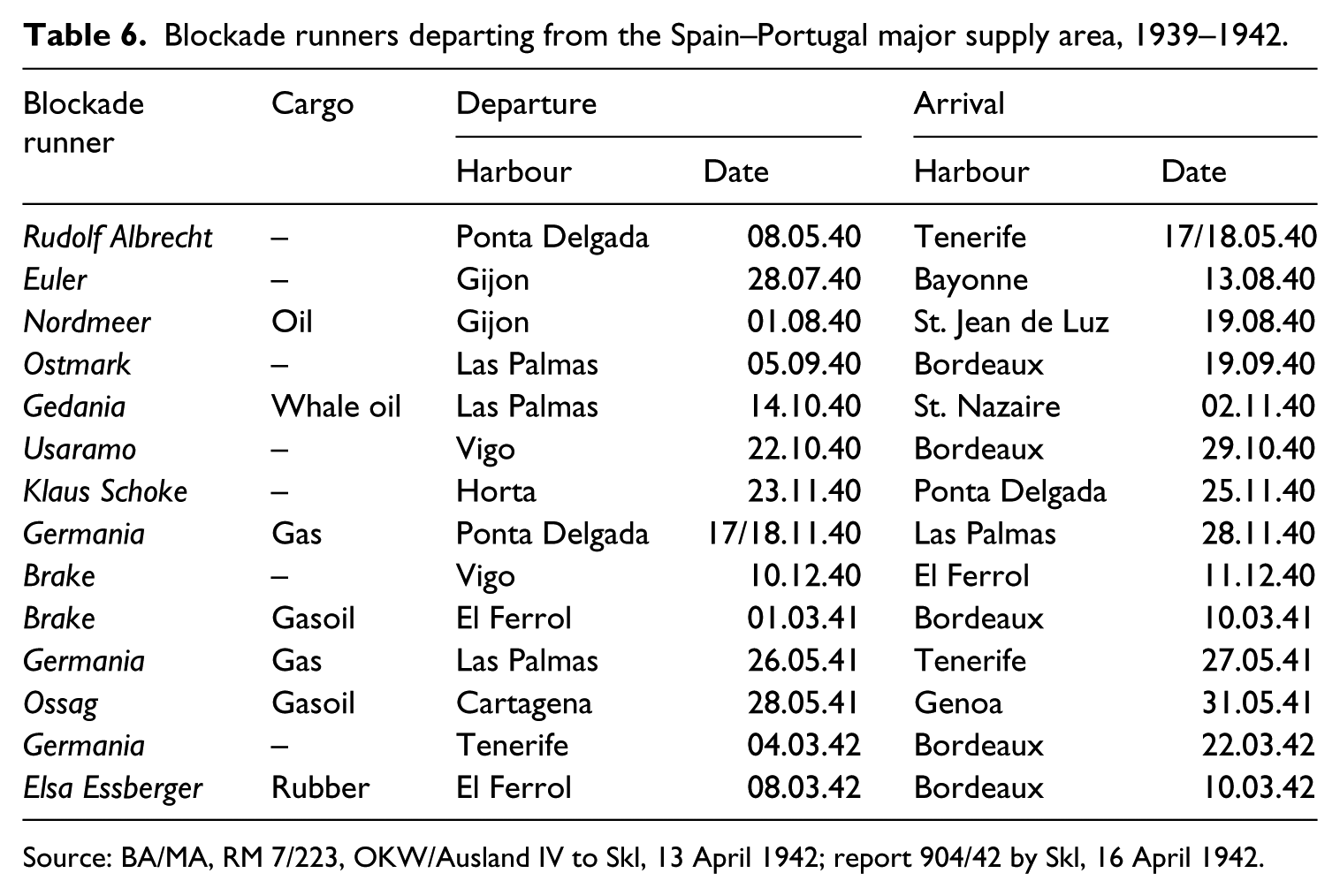
The majority of the ships that the Etappenorganisation prepared in Spain were blockade runners (Table 6), which were harboured in Spain and Portugal at the beginning of the war and whose transport capacity was necessary for the German marine. The only exception is Elsa Essberger, which was in Japan at the beginning of the war and which arrived at El Ferrol in 1942 during its return trip to Europe. 50 Most of these ships attempted to reach the French Atlantic ports occupied by Germany, which is why they set sail in the months after the fall of France. Half of them had no cargo, but others, such as the Nordmeer, Gedania, Brake, and Elsa Essberger, carried important shiploads of petroleum, whale oil, gasoil, and rubber, respectively.
Blockade runners departing from the Spain–Portugal major supply area, 1939–1942.
Source: BA/MA, RM 7/223, OKW/Ausland IV to Skl, 13 April 1942; report 904/42 by Skl, 16 April 1942.
Other boats moved between the ports of the greater Spain–Portugal supply area. Notable among these is the Rudolf Albrecht, which was transferred from the Azores to the Canary Islands to be prepared as a supply vessel for auxiliary cruisers. Some months later, in the Azores, the Klaus Schoke moved from Horta, on the island of Faial, to Ponta Delgada, on the island of São Miguel, to be repaired. In November 1940, before Hitler cancelled operation Felix, the Germania was transferred from the Azores to the Canary Islands with an important shipload of gasoline that was unloaded in Tenerife. In May 1941, the Ossag was sent from Trieste to Cartagena to prepare the Lipari as a submarine supply vessel, having four units of basic supply in January 1942. 51
The majority of these operations were performed successfully, except two in which the ships were lost. One was led by the mother ship for seaplanes, Ostmark, which was torpedoed and sunk on 24 November 1940, southeast of St. Nazaire whilst attempting to reach Brest. The other loss was the steamship Klaus Schoke, which was captured by the Royal Navy on 26 December 1940, when attempting to reach Vigo from Ponta Delgada. Despite these setbacks, the Etappenorganisation’s success in Spain was considerable: of the twelve Italian blockade runners that left Spain only eight arrived at German-occupied French ports, whereas another three were intercepted by the Royal Navy and one was sunk by a German submarine. 52
Not all of the vessels prepared by the Etappenorganisation in Spain and Portugal had reaching German-occupied Europe as their objective. Five of them were converted into supply vessels (Table 7) and set sail from the Canary Islands, situated at the southern end of the great Spain–Portugal supply area, because the auxiliary cruisers that they were to support mainly acted in the southern Atlantic and the Indian Ocean. Three of them set sail in the months following the fall of France and arrived in German-occupied Atlantic ports after supplying various auxiliary cruisers. However, the first, the oil tanker Winnetou, left before the French armistice and arrived in Japan almost five months later after supplying the auxiliary cruiser Orion. 53 The last vessel, the oil tanker Charlotte Schliemann, also arrived in Japan after some eight months at sea during which it supplied the auxiliary cruiser Michel three times and the Stier once. 54 In contrast to U-boat supply operations in Spanish ports, Spanish authorities were not necessarily informed of the departure or real destination of these supply vessels. Thus, the German consul in Las Palmas (Canary Islands) communicated to the local authorities that the Winnetou had set sail for Hamburg 55 when in reality it was a supply ship for the auxiliary cruiser Orion and its destination was Kobe, in Japan.
Supply ships departing from the Spain–Portugal major supply area, 1940–1942.

Source: BA/MA, RM 7/223, OKW/Ausland IV to Skl, 13 April 1942; report 2704/42 by Skl, 12 December 1942.
The dismantling of the Grossetappe Spanien/Portugal
Secrecy had been vital for the activities of the Etappenorganisation in Spain, but despite all efforts to maintain it the Etappenorganisation could not prevent the British intelligence services from discovering its activities in support of German submarines. Despite a lack of hard evidence British diplomats protested, and in July 1941 the Marine Minister suspended the supply of German submarines by the Corrientes in Puerto de la Luz (Canary Islands). Two months later, the capture of the wreck of the U-434, which had been supplied by the Bessel in Vigo, gave Britain the necessary evidence to force the Spanish Government to stop these operations across the whole country. 56 The fear that the British or Americans could retaliate by strangling Spanish grain and fuel imports was evident. Indeed, the oil restrictions imposed by the United States from November 1941 were not lifted until July 1942, when the Spanish Government accepted American control of the production and distribution of CEPSA’s fuel to prevent it from falling into German hands. 57
Initially, the Etappenorganisation and the Spanish authorities considered the suspension of submarine supply in Spain to be temporary. On 16 July 1941 the Spanish Marine Minister spoke with the German naval attaché, communicating the suspension of supplies in Puerto de la Luz. During that conversation the attaché asked for the transport of forty to fifty torpedoes in a Spanish war vessel to the same port for future supply operations, although the minister agreed to move only eight. 58 However, the suspension continued month after month, which made reactivation of the service increasingly difficult. In February and March 1942 the Charlotte Schliemann and the Germania abandoned the Canary Islands, the latter without the gasoil or the fuel that it had hoped to obtain in exchange for its gasoline, while the Corrientes held torpedoes and hoses for the fuel. 59 By September the decision had been made to relinquish the supply point in Puerto de la Luz altogether. The torpedoes that had been transported there were sold to the Spanish marine, and 200 tonnes of gasoil were accumulated for an emergency supply. 60
In May 1942 the Etappenorganisation’s stocks of gasoil in Spain were reduced to 25,000 tonnes. 61 This quantity did not change much until December of that year, when the Antarktis moved to Saint Nazaire with 9500 tonnes of gasoil, reducing the Etappenorganisation’s stocks in Spain to some 15,000 tonnes. 62 Shortly thereafter, the logistical support vessel Spichern successfully moved from El Ferrol to Brest, and in August 1943, the Etappenorganisation attempted to take the Nordatlantik to France with some 10,000 tonnes of gasoil on board. However, the ship grounded in the Camariñas estuary. The Spanish marine participated in its salvage, saving 4000 tonnes, but the Allies did not permit it to be sold to Spain. 63 In summary, between May 1942 and October 1943, the Etappenorganisation reduced its supplies of gasoil in Spain from 25,000 to 5000 tonnes, with most of it being sent to France.
Moving stocks of fuel to France was one consequence of the decreasing likelihood of restarting supply operations in Spain; another was the deactivation of some of the remaining supply ships. In March 1943, the Etappenorganisation dispensed with the Corrientes as a supply vessel in the Canary Islands, offering it to the Spanish Government as compensation for the Monte Gorbea, which had been torpedoed by a German submarine. 64 In its place the Etappenorganisation stored gasoil on land in Puerto de la Luz and intended to use the Kersten Miles as an emergency supply, but at the end of July it decided that it would be very difficult to use that vessel. In addition, American pressure forced the gasoil to be moved to storage controlled by the Spanish authorities. 65 In Vigo the situation was no better, with the supply vessel Bessel having to carry a Spanish guard and being moved to a pier that was inadequate for supplying submarines. 66
Despite this situation, the Spanish Government did not entirely abandon its support for German naval operations. The two final supply operations to submarines in 1942, to the U-66 and U-68, were performed with the consent of the Marine Minister, and the U-68 was even repaired in the arsenal of the Armada in El Ferrol. 67 The Nordatlantik and the Antarktis were moved with Spanish consent, and the latter was even equipped with four 20 mm anti-aircraft guns in El Ferrol before heading to St. Nazaire. 68 Similarly, in April 1943, the Spanish Government allowed the crew of U-167 to escape after it was sunk in Spanish waters south of Gran Canaria. 69 In reality, the Spanish Government only restricted the operations of the Etappenorganisation in response to British and American pressure; a pressure that increased after the British and American landings in Northwest Africa and further intensified after mid-1943 with the conquest of Sicily and the fall of Il Duce. 70
The position worsened still further at the beginning of 1944. The Bessel was moved again to the interior of the port, and British pressure forced the Spanish authorities to dismantle some of its machinery to impede its exit. This action and the general course of the war made the Etappenorganisation consider a further reduction of its structure in Spain. No more supply operations were planned, and nor were they considered possible in the future. 71 Thus, on 14 March, the Skl decided to execute the proposal of the naval attaché in Madrid, which reduced the eight existing supply vessels to three. In the north, they would maintain only the Max Albrecht, decommissioning the Bessel and the Nordatlantik; the former would be sent to transport minerals and the latter would be offered to Spain as compensation for the Badalona. The Thalia would remain in Cadiz, although without either its torpedoes or maintenance personnel, and the Lucy Essberger would be decommissioned. The last supply vessel that would remain operational was the Lipari in Cartagena, although its crew would be repatriated. In Puerto de la Luz the Kersten Miles and the Corrientes were deactivated, and plans were made to sell the former and to cede the latter to Spain as compensation for the Monte Gorbea. 72
Given the ever-decreasing likelihood of restarting supply operations with the remaining vessels, the question arises whether the Etappenorganisation sought some alternative means of providing fuel to the U-boats between 1942 and 1945. The documentation of the Allied intelligence services suggests that it did. They thought that Alfred Menzell, associate of the German naval attaché in Madrid, and the Etappenorganisation office in Barcelona would acquire small boats whose crews would be infiltrated by Juan March, who had passed this information to British intelligence. The Etappenorganisation would also have bribed captains of Spanish oil tankers and fishing boats to supply submarines, in addition to buying munitions and torpedoes from a Spanish munitions factory, organizing a Spanish–German transport company and using radio operators on board Spanish fishing boats to obtain information on Allied maritime traffic. 73
However, the German documentation consulted does not confirm the suspicions of the Allied intelligence services. The only action performed in this vein and noted in German documentation is the exchange of the Galiana for a seventy-tonne vessel for small-scale supply operations in the Mediterranean, although it was thought that British pressure would seriously hamper its activities. 74 There are no more references to this operation or to the acquisition of other vessels, or to the bribery of Spanish crews to provide fuel to German submarines. Nevertheless, it is possible that the Vertrauensmänner bribed captains and crews of Spanish vessels to obtain information on Allied maritime traffic, which may be the source of reports that the naval attaché in Madrid received from the Canary Islands on 6 May and 19 June 1944. 75
Nevertheless, the documentation of the Etappenorganisation reflects the progressive dismantling of its structure in Spain during 1944. Of the three supply vessels that it maintained after March of that year two were soon rendered useless. One, the Max Albrecht, was moved to the interior of El Ferrol, making any offer of provisions or fuel to U-boats impossible. 76 The other was the Lipari, which had Spanish guards on board until June 77 and which in October had to discharge the 250 tonnes of gasoil that it still had on board. These were transferred to the Spanish Navy. The last news of the Etappenorganisation in Spain describes the transfer of the oil tankers Brösen and Frisia to Pasajes and Bilbao at the end of August 1944, fleeing the Allied advance in France. 78
Conclusions
During the Second World War the Etappenorganisation had to adapt to the international situation, particularly with regard to the foreign policy of neutral countries. Preparations for extending it throughout the world had been developed during the 1930s, allowing for the creation of a series of supply areas to facilitate the deployment of German naval forces in all theatres of war. The Grossetappe Spanien/Portugal was one of the eight great supply areas in existence in 1938, when the crisis in September of that year caused the Etappenorganisation to mobilize. Its activities during the 1930s included the search for adequate places to supply submarines in the archipelagos of the Iberian Atlantic, in addition to the attempt to acquire shares in CEPSA to ensure the availability of liquid fuel in the Canary Islands.
Despite these preparations, the operation of the Etappenorganisation during the Second World War did not go exactly as planned for a variety of reasons. One was that the supply areas were reduced until, in 1941, the only areas in operation were Spain–Portugal, Japan, and Bordeaux. Another, no less important, reason was that the supply service had to be organized from German vessels harboured abroad. In this sense, it is important to note that towards the end of August 1939 the Kriegsmarine ordered several oil tankers that were returning to Germany to be rerouted to Spanish ports. Therefore, when the war finally broke out, Germany already had fuel for submarines and auxiliary cruisers in the great Spain–Portugal supply area. Finally, it was necessary to negotiate with the Spanish authorities for months to obtain their consent to supply submarines, as Charles B. Burdick and Manuel Ros Agudo have shown.
The Grossetappe Spanien/Portugal prepared supply vessels and blockade runners between 1939 and 1942, being one of the most prominent areas for the number of vessels that left from its ports. In this sense it was surpassed only by Japan. The majority of the blockade runners set sail in 1940, especially during the months after the fall of France. Similarly, only one of the supply vessels for auxiliary cruisers set out in the first months of that year. However, this type of operation has not received much attention from investigators, who have been more concerned with a type of activity exclusive to the Spain–Portugal supply area: the supply of submarines in neutral ports. This activity best distinguishes this supply area from the others, and also presents a clear difference with the preparation of supply vessels for auxiliary cruisers and blockade runners. The supply of fuel and provisions to U-boats in Spanish ports required the consent of the authorities of the Franco regime, whereas the launching of blockade runners and supply vessels for auxiliary cruisers could occur without prior warning. Nonetheless, in both cases, the preparations constituted a violation of Spanish neutrality because they implied the use of Spanish territory as a base of operations.
The Spanish proved more reluctant to collaborate than initially expected, due to the risk of economic reprisals by the Allies. However, Spanish cooperation was essential if the Etappenorganisation was to be able to act and, above all, to supply fuel and provisions to U-boats in Spanish ports. Anglo–American pressure reduced the activity of the great Spain–Portugal supply area from July 1941, until it finally brought about the provisional suspension of submarine supplies at the end of that year. The Etappenorganisation harboured hopes of restarting those operations in 1942, but as a result of Allied pressure on the Spanish Government and the wider course of the war, the tide of which turned in the Allies’ favour from the end of that year, it ended up retiring the fuel that it still held in the Iberian Peninsula and cancelling the supply point in the Canary Islands. German documentation does not confirm the rumours that circulated after 1942 about the supply of German submarines by other methods, although the Etappenorganisation still maintained some vessels for this purpose in 1944 and even attempted to find an alternative by acquiring a small vessel. Therefore, the support of the Spanish Government was essential for the operation of the Etappenorganisation, constituting an example of collaboration with the Third Reich that was not observed in other neutral countries.
Footnotes
1.
Christian Leitz, Nazi Germany and Neutral Europe during the Second World War (Manchester, 2000), 188–9.
2.
Rafael García Pérez, Franquismo y Tercer Reich: Las relaciones económicas hispano-alemanas durante la segunda guerra mundial (Madrid, 1994), 59–89; Christian Leitz, Economic relations between Nazi Germany and Franco’s Spain 1936–1945 (Oxford, 1996).
3.
Manuel Ros Agudo, La guerra secreta de Franco (1939–1945) (Barcelona, 2002), 28–34.
4.
Xavier Moreno Juliá, La División Azul: Sangre española en Rusia, 1941–1945 (Barcelona, 2005); Stanley G. Payne, Franco y Hitler: España, Alemania, la segunda guerra mundial y el Holocausto (Madrid, 2008), 183–202 and 229–42; García Pérez, Franquismo y Tercer Reich, 257–63 and 350–4; David Wingeate Pike, Franco y el Eje Roma-Berlín-Tokio (Madrid, 2010), 146–62, 182–94, 227–9 and 237–8.
5.
Víctor Morales Lezcano, Historia de la no-beligerancia española durante la segunda guerra mundial (Las Palmas de Gran Canaria, 1995), 241–73; Wayne H. Bowen, Spaniards and Nazi Germany: Collaboration in the New Order (Columbia, 2000), 81–2.
6.
Ros Agudo, La guerra secreta, 34–41; Morten Heiberg, Emperadores del Mediterráneo: Franco, Mussolini y la guerra civil española (Barcelona, 2004), 195–200.
7.
Enrique Moradiellos, Franco frente a Churchill: España y Gran Bretaña en la Segunda Guerra Mundial (1939–1945) (Barcelona, 2005), 276–81 and 321–84.
8.
David Wingeate Pike, ‘Franco and the Axis Stigma’, Journal of Contemporary History 17, No. 3 (1982), 369–407.
9.
José María Doussinague, España tenía razón (Madrid, 1949), 66–8.
10.
Charles B. Burdick, ‘Moro: The resupply of German submarines in Spain, 1939–1942’, Central European History 3, No. 3 (1970), 256–84.
11.
Ángel Viñas, La Alemania Nazi y el 18 de julio (Madrid, 1977), 312–5; Robert H. Whealey, Hitler and Spain: The Nazi role in the Spanish Civil War 1936–1939 (Lexington, 1989), 95–134.
12.
Ros Agudo, La guerra secreta, 72–117.
13.
Juan Carlos Salgado, Marea roja, marea negra: Guerra en el mar (Valladolid, 2008); Juan José Díaz Benítez, La Armada española y la defensa de Canarias durante la II Guerra Mundial (Las Palmas de Gran Canaria, 2008).
14.
Richard Bassett, El enigma del almirante Canaris: Historia del jefe de los espías de Hitler (Barcelona, 2006), 59–70. Francisco Javier Ponce Marrero, ‘Logistics for commerce war in the Atlantic during the First World War: The German Etappe system in action’, The Mariner’s Mirror 92, No. 4 (2006), 455–64.
15.

16.
David Kahn, Hitler’s spies: German military intelligence in World War II (New York, 2000), 242–3.
17.
Whealey, Hitler and Spain, 96 and 121–2.
18.
Pablo Díaz Morlán, ‘Aeroplanes, torpedoes and submarines: German interests in Spain in the interwar period’, International Journal of Maritime History 11, No. 2 (1999), 31–59; Angel Viñas, Franco, Hitler y el estallido de la guerra civil: Antecedentes y consecuencias (Madrid, 2001), 34–76; Bassett, El enigma, 97–102.
19.
Bundesarchiv/Militärarchiv (BA/MA), RM 20/1865, Abwehr to Skl, 21 March 1934.
20.
21.
BA/MA, RM 7/2503, Wilhelm Canaris to Skl, 15 November 1938.
22.
Clay Blair, Hitler’s U-boat war: The Hunters 1939–1942 (London, 2000), 45.
23.
BA/MA, RM 7/2503, Wilhelm Canaris to Skl, 15 November 1938.
24.
Burdick, ‘Moro’, 257–8.
25.
BA/MA, RM 7/1348, naval attaché to OKW/Ausland, 30 September 1938.
26.
National Archives & Record Administration (NARA), T-1022, R-3009, PG-48843-NID, naval attaché to OKW/Ausland, 7 October 1938.
27.
Burdick, ‘Moro’, 258.
28.
BA/MA, RM 7/1923, Skl to OKW, 26 April 1938.
29.
Whealey, Hitler and Spain, 122–4.
30.
Burdick, ‘Moro’, 269–270; Ros Agudo, La guerra secreta, 84–6.
31.
Blair, The Hunters, 53–6.
32.
BA/MA, RM 7/222, Etappenorganisation’s war diary, 25 August 1939.
33.
BA/MA, RM 7/2480, OKM/BB C to Skl, 22 August 1939.
34.
Burdick, ‘Moro’, 261–74.
35.
Burdick, ‘Moro’, 274–5.
36.
Ros Agudo, La guerra secreta, 81.
37.
BA/MA, RM 7/222, OKW/Ausland to Skl, 19 January 1940.
38.
BA/MA, RM 7/222, extract of Etappenorganisation’s war diary, January 1940.
39.
Burdick, ‘Moro’, 278–9.
40.
Ian Kershaw, Decisiones trascendentales: De Dunquerque a Pearl Harbor (1940–1941). El año que cambió la historia (Barcelona, 2008), 115–32.
41.
Burdick, ‘Moro’, 279–82; Ros Agudo, La guerra secreta, 100–10.
42.
Blair, The Hunters, 724–6.
43.
Ros Agudo, La guerra secreta, 84–6 and 99–100.
44.
BA/MA, RM 7/222, extracts of Etappenorganisation’s war diary, August, September and October 1940.
45.
Ros Agudo, La guerra secreta, 100.
46.
BA/MA, RM 7/222, extract of Etappenorganisation’s war diary, March 1941; report 1950/41 by Skl, 31 October 1941; and report 2101/41 by Skl, 1 December 1941.
47.
48.
BA/MA, RM 7/222, report 1950/41 by Skl, 31 October 1941.
49.
BA/MA, RW 5/347, Reichsverkehrsminister/Seeschiffahrtsamt to OKW, 30 January 1941.
50.
Ludwig Dinklage and Hans Jürgen Withöft, Die Deutsche Handelsflotte 1939–1945 (vol. 2) (Hamburg, 2001), 46.
51.
BA/MA, RM 7/222, Skl to OKW/Ausland, 16 November 1940; report 114/42 by Skl, 13 January 1942.
52.
Carlo de Risio, La Marina Italiana nella seconda guerra mondiale, XVII: I violatori di blocco (Roma, 1993), 41–86.
53.
BA/MA, RM 7/222, extract of Etappenorganisation’s war diary, August–September 1940.
54.
BA/MA, RM 7/223, report 2704/42 by Skl, 12 December 1942.
55.
BA/MA, RM 7/222, extract of Etappenorganisation’s war diary, March 1940.
56.
Ros Agudo, La guerra secreta, 107–10.
57.
William H. N. Meddlicott, The economic blockade (vol. 2) (London, 1978), 291–305; Joan Maria Thomàs, Roosevelt y Franco: De la guerra civil española a Pearl Harbor (Barcelona, 2007), 443–53; NARA, RG 59, Decimal File, Box 5262, American Ambassador in Madrid to State Secretary, 3 August 1942.
58.
NARA, RG 242, T-1022, R-3013, File PG-48852-NID, German naval attaché’s war diary, 16 July 1941.
59.
BA/MA, RM 7/223, reports 658/42 and 904/42 by Skl, 25 March and 16 April 1942.
60.
BA/MA, RM 7/223, report 2308/42 by Skl, 5 November 1942.
61.
BA/MA, RM 7/223, report 960/42 by Skl, 15 May 1942.
62.
BA/MA, RM 7/223, report 1196/43 by Skl, 10 March 1943.
63.
BA/MA, RM 7/223, report 1195/43 by Skl, 10 March 1943; Salgado, Marea negra, 82–87.
64.
BA/MA, RM 7/223, report 1464/43 by Skl, 19 May 1943.
65.
BA/MA, RM 7/223, report 2206/43 by Skl, 26 July 1943.
66.
BA/MA, RM 7/223, report 242/43 by Skl, 19 January 1943; report 1196/43 by Skl, 10 March 1943.
67.
BA/MA, RM 7/223, extract of the Etappenorganisation’s war diary, 10 June 1942; report 2308/42 by Skl, 5 November 1942.
68.
BA/MA, RM 7/223, report 1196/43 by Skl, 10 March 1943; Ros Agudo, La guerra secreta, 110.
69.
César O’Donnell Torralba, ‘Hundimiento del submarino alemán U 167 en aguas de Gran Canaria durante la II Guerra Mundial’, Revista Española de Historia Militar 3 (2000), 156–66.
70.
Moradiellos, Franco frente a Churchill, 321–84.
71.
BA/MA, RM 7/225, report 838/44 by Skl, 9 March 1944.
72.
BA/MA, RM 7/225, report 837/44 by Skl, 14 March 1944.
73.
Ros Agudo, La guerra secreta, 111–15.
74.
BA/MA, RM 7/223, report 1195/43 by Skl, 10 March 1943.
75.
NARA, RG 242, T-1022, R-3014, File PG-48857-NID, German naval attaché’s war diary, 6 May and 19 June 1944.
76.
BA/MA, RM 7/225, report 1171/44 by Skl, 6 April 1944.
77.
BA/MA, RM 7/225, report 1764/44 by Skl, 14 June 1944.
78.
BA/MA, RM 7/225, report 3396/44 by Skl, 25 October 1944.