



Abstract
Shipbuilding was an essential element in the creation of overseas empires during the early modern period. It generated demand for raw materials, technology and manpower, and in many cases received direct support from the state. The Portuguese shipbuilding industry enjoyed various incentives from the Crown, but was always a mix between state and private enterprise. With Portugal expanding overseas, building and repairing ships in the various Portuguese possessions became an option. Initially, it was viewed critically by the metropolitan authorities, as they feared losing control. Soon, however, the logistical needs of empire meant that public and private agencies began providing shipbuilding facilities in Portugal’s overseas territories. In Brazil, the abundance of high-quality wood militated in favour of the establishment of shipyards. Wood cut there or on the Atlantic coast of Africa was also transported to metropolitan Portugal. Shipbuilding specialists were sent out to Brazil to supervise the selection of suitable wood, and soon started to operate shipyards there. Little is known about shipbuilding in the Portuguese possessions in western Africa, while more can be said about the industry on the shores of the Indian Ocean. Shipyards in India, particularly in Goa and Cochin, were developed to meet the challenges and needs of formal and informal ‘empire’, particularly regarding ship repairs. The Ribeira de Goa replicated first the Ribeira das Naus of Lisbon, but soon individual shipyards took over specific functions. Crown control, initially tight and systematic, proved difficult to maintain. Indian woods were known for their hardness and durability and were shipped to Europe to build ships for the Indian Route. Expert labourers migrated from Portugal to overseas possessions, with specialists in metallurgy joining the shipbuilders. The scope of the operation also required the recruitment of local shipbuilders. In general, and for its financial resources, Portuguese colonial shipbuilding soon relied on a cooperation of state and private initiative, much as at home.
Portuguese maritime expansion in the early modern age was a pioneering enterprise. The increasing tonnage of vessels and the demand for ships forced most Portuguese and overseas ports into modifications of their layouts, dockyards and commercial facilities in order to adapt to a growing shipbuilding industry. The process started in the fifteenth century, lasting well into the nineteenth. There were technical innovations, morphological transformations and adjustments to meet environmental challenges, all of which seriously affected the logistics and sustainability of short- and long-distance navigation. The arrival of the Portuguese in distant continents inspired new strategies for the use of overseas maritime spaces, which led to harbour construction and technical and environmental adaptations in order to accommodate the needs and requirements introduced by these European newcomers. This chapter approaches the specific dimensions of maritime empire-building from the sixteenth through the eighteenth centuries, in direct connection with shipbuilding in overseas territories – a topic hardly touched upon in Portuguese and European historiography.
There have been very few studies of shipbuilding in Brazil, Africa or India during the consolidation of the Portuguese presence in those regions, especially when compared with the volume of research on shipbuilding in metropolitan Portugal, which has focused on specific shipyards, port cities or naval routes. 1 Crown, city and private control over shipyards, labour force and labour markets, production levels and the provision of raw materials are some of the topics examined. Other studies have concentrated instead on the legal and otherwise regulatory provisions for shipbuilding, as well as the workforce required. 2
Shipbuilding in Portugal: Developing a maritime empire from the metropolis
Shipbuilding is required to support overseas navigation and trade. In Portugal, it was undertaken in shipyards in various locations within the kingdom. The Ribeira das Naus (the Carracks Shipyard), based in Lisbon from the sixteenth century, was under the Crown’s control and the vessels it produced were essentially used on the Cape Route. The existence of a royal shipyard did not, however, prevent the use of other spaces, especially during times of dire need. The placing of orders and payment to dockyards other than Lisbon were the consequences of the Ribeira das Naus’ lack of output. Still, the Crown did not subject all the shipyards to a standard policy and central control.
Different models of shipyards coexisted: Ribeira das Naus, a mixed Crown and private shipyard, 3 and Ribeira do Ouro in Porto, a shipyard controlled by the municipality, were exceptional in terms of size, complexity and public control. The shipyards in small seaports often did not even have a space exclusively allocated for their activities. Depending on municipal regulations, shipbuilders would often position their wharves along rivers, preferably in places where the launching of the vessels would be easier (or even feasible at all). 4 Several medium-sized shipyards that could meet the needs of local and non-local customers can be identified. From the sixteenth to the eighteenth centuries, a myriad of shipbuilding enterprises dotted the Portuguese coast.
One of the first requirements for naval enterprises is a proper supply of timber. Therefore, the Crown promulgated several laws with the clear intention of actively encouraging forestation in the kingdom. Before 1499, ordinances were published and ratified by Manuel I calling for the people to plant trees. 5 Among others, the so-called ‘Law of the Trees’ of 1565 established a leading position in the kingdom’s forestry legislation. 6 Whether this legislation led to any tangible results is still unclear. Repeated claims suggest that it was never implemented. Thirty thousand units of timber were imported from Galicia in 1627, leading Tomás de Ibio Calderón to comment that in Portugal ‘there is not much more timber left for shipbuilding, since they cut wood without planting new trees to reforest’. 7
Shipbuilding was responsible for labour market dynamism, even in small villages. 8 Raw material supply did not depend, however, only on the Portuguese hinterlands. The regular imports of northern European tree species were also essential for the construction of large carracks or galleons, as were the deliveries of northern European tar for ship caulking. 9 During the fourteenth and fifteenth centuries, Portuguese merchants had established important contacts with the Hanseatic League. These were essential for the provision of wood and other raw materials for shipbuilding. 10
This general pattern can be identified in metropolitan Portugal, and it seemed to suffice for launching a process of overseas expansion. Yet it was not wholly adequate to guarantee the sustainability of the process over a long period or on a multicontinental scale. Shipbuilding and naval repairs were no longer carried out only by the metropolitan-based industry. The emergence of shipyards in Portuguese possessions overseas was a condition for the sustainability of the seaborne empire. Overseas settlements – in several Atlantic archipelagos, Madeira, the Azores, Cape Verde and S. Tomé; the settlement on the west coast of Africa, providing for the slave trade (extremely demanding in terms of naval logistics); and Brazilian colonization, side by side, since the beginning of the sixteenth century, with the growth of the Estado da India, which in fact took the Portuguese presence as far as Macao and Japan – caused the Portuguese crown to produce a massive corpus of laws and regulations to promote shipbuilding. However, specific references to shipbuilding overseas are scarce. Only from the reign of Philip II do records survive of deliberations that explicitly determined aspects of the construction of naus (carracks) in India. 11
The control and standardisation of the shipbuilding process, with deliberations regarding the raw materials required, along with the regulation of the various functions of the myriad of craftsmen working in the various subsectors of shipbuilding, are prime examples of Crown directed policies. Of a total of 1546 regulations promulgated concerning naval logistics between 1481 (the beginning of the reign of John II) and 1640 identified in systematic research, about 105 regulated the activity of shipbuilding. 12 The workforce, the granting of privileges and workplaces, along with the raw materials employed, were the sectors that were much more heavily regulated (see Figure 1). The formal prohibition of cutting wood, combined with privileges awarded exclusively for the purpose of building vessels of a certain tonnage, together with incentives for reforestation, are common threads throughout the period. 13
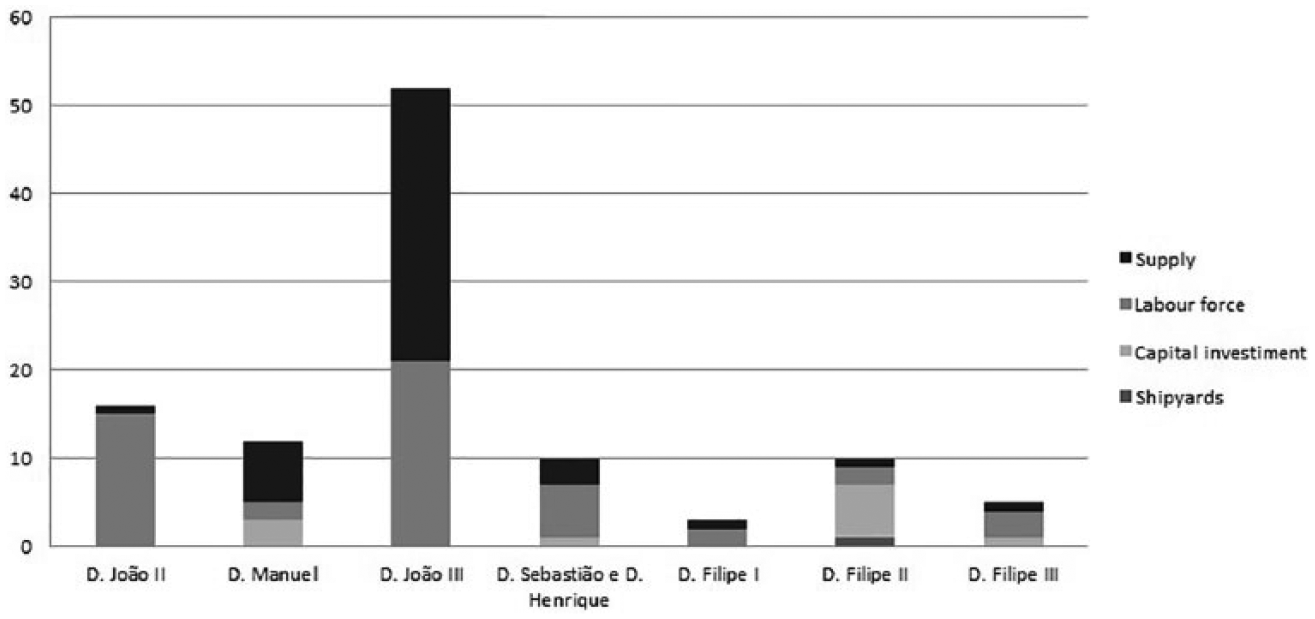
Legislative production on shipbuilding.
The defence of vessels was yet another aspect that the Crown attempted to regulate. King Sebastian’s entire reign was marred by issues regarding defence and the need to strengthen the navy. French, English and, later on, Dutch privateers were a constant threat to Portuguese overseas territories which, along with the hindrances put in place by the Turkish Empire, weakened the Portuguese empire, mostly the State of India. The Cape Route management was given to private companies, under construction and shipping contracts, from 1570 onwards. 14 The continuous dependence of the Crown on private entrepreneurs became obvious, and the Crown’s rewards and tax exemptions were of utmost strategic importance to promote private involvement in a sector that often was not particularly attractive to investors due to the risk of overwhelming losses.
In various domestic ports, a multitude of elite carpenters, caulkers and ropemakers made up the workforce. The Ribeira das Naus, in particular, maintained a fixed number of contracted technicians and acquired the necessary raw materials for them to ply their trades. The Crown, on the other hand, had an interventionist role in socio-professional relationships, by undertaking forced recruitment processes when the need for craftsmen arose, and by granting privileges and perks to attract and maintain professionals in its service. One other way of ensuring the availability of manpower to meet the needs and demands of the Crown was by granting bonuses and exemptions. 15
The recognition of the vital role played by this group of craftsmen in the continuity and safeguarding of the desired shipbuilding contracts led the Crown to regulate their functions and obligations. 16 The lack of labour and the desire to recruit all those who could operate within the shipbuilding sector, were at the heart of these statutes. The Statutes of 1591 and 1626 established a mandatory census, in the fashion of a large-scale registration of both carpenters and caulkers. More than to merely know and record their numbers, the aim was to know who and where these craftsmen could be recruited, to ensure the continuity of this type of highly-skilled manpower, as well as to be able to request their services as and when needed. As a mechanism of attracting craftsmen to serve the Crown, it was stipulated that the carpenters and caulkers would receive, in addition to the day’s salary, the amount corresponding to the days of their journey from their respective hometowns to Lisbon, and the possibility of traveling to India, Malacca or El Mina. The circulation of these men between the kingdom and the overseas territories was thus a reality, guaranteed both by their inclusion, as crew members, on board ships and their presence in overseas shipyards.
Summing up, the Portuguese Crown assumed a reactive but also a pro-active attitude towards shipbuilding, as shown by the legislative production between 1481 and 1640. 17 Performance over time reveals a lack of continuity or of a coherent policy. The Crown did not maintain a detailed and structured plan for political intervention, but it did play a flexible and proactive role by which it contributed to some of the successes that the expansionist enterprise achieved. Its policy to promote shipbuilding and to attract private investment is proof of this intervention, made through the granting of privileges and subsidies. On the other hand, this performance brings to light yet another facet of the Crown: the central power’s awareness of its dependence on the private agents and on their investment to achieve the monarch’s intended goals. Those private agents performed a crucial role in this industry. 18
Shipbuilding in overseas territories
The colonial system’s dependency on overseas shipyards, both in terms of production and ship repairs, seems undeniable. However, there is a need to understand how the central power organized this activity and what role did individual agents play in those overseas spaces in three contrasting contexts: Brazil, the African-Atlantic complex, and the East, including India, the East African coast, southwest Asia and the Far East. This discussion focuses on key topics: the choice of location and management of shipyards, the production systems, raw materials and labour recruitment.
A first question concerns normative regulations issued by the Crown and its agents. Secondly, how did a production system, known and tested in the kingdom, adapt to new spaces and environmental conditions? Thirdly, how was it possible for the shipbuilding industry to function in those territories, given issues of supplies of raw materials, labour and knowledge – both local and from the metropole? This focus builds on the latest theories about the production and circulation of knowledge between Europe and the overseas spaces being colonized, resulting in new paradigms for the construction of syncretic forms of knowledge. 19 Finally, while it would be desirable to study the environmental impacts and consequences of that activity in overseas territories, taking into account ecological systems and flows of raw materials, this cannot be addressed here.
The discussion of these questions can produce a significant contribution to an approach that compares the models established for the territories under Portuguese, Dutch and English colonial rule, for example, in the East, or the Portuguese and Spanish models in the Americas. That will only be possible if one uses a systematic survey to discuss issues concerning operational strands, levels of efficiency, regulation and management of activities, bearing in mind the traditional dichotomy between imperial systems governed directly by the Iberian Crowns and their representatives, and those of trade companies sponsored by the state and managed by private entities, such as the Vereenigde Oostindische Compagnie (Dutch East India Company) (VOC) and East India Company (EIC), with intermediary evidence provided by the Dutch West India Company (WIC) (see below).
We will begin by systematizing the state of the art of shipbuilding in the territories under Portuguese rule, first outlining briefly the case of the Atlantic possessions, and then focusing on the East. Studies of shipyards in Bahia, Salvador, Pernambuco and Rio de Janeiro, including their production systems, raw material supplies, labour force, as well as building and repair sites, 20 indicate that the Crown recognised the good quality and abundance of local timber during the entire colonial period. Even so, the government is assumed to have limited shipbuilding in Brazil for fear of losing control over trade. This, however, was not always applied, since shipbuilding was allowed in Brazil in times of need, 21 and when new trade systems were introduced, as was the case when the Trade Companies of Grão-Pará, Maranhão, Pernambuco and Paraíba, were established during the second half of the seventeenth century. 22
At an early stage, activities in the shipyard of Ribeira da Naus of S. Salvador da Bahia seem to have been limited to small repairs. The fact that the Capitania (administrative division) of Salvador was surrounded by abundant forests allowed, in a first phase, the building of ships intended to defend the coastline and for cabotage, and in a second phase, during the period of the first general government, from 1549 onwards, for long-distance shipping. 23
Trade flows between Brazil and Europe began with the export of timber, subject to heavy duties paid upon entering Portugal. The greater the need for timber in the Lisbon shipyard and at other shipbuilding sites, the greater the exports. The quality and abundance of resources in Brazil seem to have overtaken other national resources, such as those traditionally referred to as the Leiria pine forest. 24 In Brazil, the deforestation of the coastal regions, caused by the systematic exploitation of Brazilian wood, 25 had a significant impact on the shore. Due to the difficulty of transporting huge quantities of unwieldy and large trees in a still wild territory, the trees along the coast were cut down in a systematic manner, changing for good the forests’ ecosystems and projecting unavoidable geomorphological changes into coastal dynamics. Shipbuilding in eighteenth-century Brazil benefitted as well as from the woods of the Amazon, as they were abundant along the banks of the Amazon River and easily harvested at a low cost, using water courses as a means of transportation. 26
Therefore, on top of wood exports, the intense depletion of tropical forests to meet European demands occurred in the Portuguese settlements, both in Brazil, where building and repair shipyards operated, and in Africa (mostly in the Atlantic archipelagos). This was directly connected to the overall dynamics of maritime flows and cheap maritime transportation, which resulted in an active process of transfers based on navigation circuits. 27 Needless to say, just as indigenous people did not have legal status in the eyes of most of the Portuguese colonisers, likewise, native ecosystems were not considered to have fallen under any kind of regulation (unlike Portugal) that might have prevented their depletion and extinction.
Shipyards in the colonies were organized according to the model established in the Kingdom. Master carpenters were sent to Brazil from very early on, where they were also responsible for choosing, cutting, preparing and transporting the wood, as labour for shipbuilding in Brazil was hard to find and costly. As they were few in numbers, craftsmen asked for high wages, so others had to be recruited in the Kingdom. At the same time, centuries-old experience and knowledge of fauna and flora resulted in a praxis of assimilating techniques and extraction processes used by the natives. 28
The royal appointment of Brazil shipyard superintendents is documented, for example, by the presence of Manuel Gonçalves Travessão, a Vila do Conde resident, for the position of superintendent at the Pernambuco shipyard in the 1590s, a position also held by his brother, Gaspar Jorge, a resident of Póvoa de Varzim. 29 The same applied to Gonçalo Dinis, from Porto, superintendent of the Rio de Janeiro and Espírito Santo shipyards, and referred to as such in 1570. 30 There are also documents reporting the existence of organized structures in shipyards in Brazil, as for example, those concerning the presence of a surgeon from Ribeira das Naus in the city of Bahia in the mid-eighteenth century. 31
There are some individual cases of Portuguese agents who held notable and prominent offices in the colonies as well as in the mainland. Many other anonymous craftsmen were hardly referred to in documents, as they were socially and economically less representative. They left Portugal either by royal order or voluntarily, permanently or temporarily, to work as shipbuilders. There is also reference to Portuguese shipbuilding technicians travelling in areas under Spanish colonial control, such as the two carpenters, father and son from Vila do Conde, both living in Havana in 1607, 32 and five other shipbuilding carpenters from the same town, identified as working in the Spanish Indias. 33 These examples represent two connected realities: the circulation of shipbuilding technicians between Portugal and the American colonies, and their circulation throughout imperial territories, confirming the trends documented in other activities resulting from the legal or illegal emigration routes of Portuguese workers to the Castile Indies. 34
Portuguese historiography has paid very little attention to the study of building, repair and naval maintenance activities on the western coast of Africa, these being decisive to the success of navigation and trade transactions. 35 Studies of shipbuilding production in the State of India are also scarce when compared to what we do know about shipbuilding in Asia in association with the activity of other maritime powers, in particular the Dutch and the English. 36 Some literature is available, still, about the processes of Portuguese shipbuilding in the East. 37 Within the framework of the Portuguese presence in the East, territorial settlement was not a uniform process, as shown by their status. Some territories were ‘possessions’ or ‘conquests’ that had been taken through war and over which Portugal had full sovereignty (for example, Goa and Malacca), whilst others were gained through contractual arrangements (Ormuz, Ternate and Ceylon) and peace treaties (Baçaim, and the lands of Bardez and Salcete). 38 Fortresses and feitorias (trading posts) were also forms of settlement that confirmed the Portuguese presence and control in the region, ensuring the supervision and handling of commercial traffic. The Portuguese occupied and built several feitorias in Eastern Africa, Socotra, the Gulf of Aden, Muscat, the Gulf of Oman, on the western coast of India and elsewhere. 39 Different status implied different models of settlement, which reverberated in the kind of activities allowed and led by the Portuguese, including shipbuilding.
The appointment of viceroys and governors by the Portuguese Crown was also noteworthy, originating what would eventually become the ‘State of India’. Other bodies of the government and central administrative authorities ensued from this position of royal representation, with powers in civil and criminal jurisdiction. 40 This kind of authority and supervision included shipbuilding, taken as a crucial activity for the maintenance of the State of India, part of Portugal’s ‘seaborne’ empire. Along with the institutional and formal presence, powerful informal networks grew up in these settlements. Individual initiative and private interests interacted to drive the real dynamics of the Portuguese presence in the East, as indicated in the evolution of the State of India and the eventual Portuguese decline. 41
In the East, trans-imperial and cross-border networks were essential for the sustainability of the Cape Route trade, 42 for the provisioning of the Armadas, for accessing local markets, for labour force recruitment, and to guarantee what was to become even more important to the sustainability of Portuguese presence in the East: their role as intermediaries in intra-Asian trade. The complexity of these operations were implicit in the number of routes – at least 27 – that, circa 1570, radiated from Goa, Malacca and Macao. 43 In the quest for Ceylonese cinnamon, cloves from the Moluccas, nutmeg and mace from the Bandas, or luxury goods such as sandalwood from Timor, silk from China, or lacquer from Pegu, or simply as transporters of textiles, rice or wood, the Portuguese became mediators in a vast range of inter-cultural contacts. 44
These networks depended on settling in strategic points, not only for supply purposes, such as Salcete and Bardez, but also for accessing profitable maritime straits like Ormuz and Malacca, and other inland trade routes (for example, Goa, which was the gateway for horses from Arabia and Persia into the kingdoms of Daquan and Bisnaga), and required logistical support, including almoxarifados and warehouses as well as shipbuilding and ship repair facilities. 45 Shipyards in India were developed to meet the challenges and needs of this formal and informal ‘empire’.
In the late sixteenth century, officially there were two shipyards under the control of the Portuguese Crown – Cochin and Goa. We do know, however, of other shipyards engaged in shipbuilding and ship repair activities associated with fortresses, as was the case of Diu, 46 in 1508, and after 1630, of Baçaim and Daman. The first shipyard in the East was established in the Cochin region, 47 which remained operational up to the seventeenth century, when the fleets from the Kingdom began to sail to and from Goa, rather than Cochin. The occupation of Goa and the change of the administrative capital was a strategic move, since in addition to being centrally located and easily defensible, Goa was self-sufficient in food supply. 48
The Ribeira de Goa thus became the preferred place for the building of large vessels for the Cape Route. It was an exact replication of the Ribeira das Naus of Lisbon. The morphological conditions of the river mouth and the fact that an industrial complex was located next to the Ribeira (Casa da Fundição – the foundry, Casa da Pólvora – the gunpowder facility, and equipped warehouses), justified the use of this shipyard for the completion of ships that were begun elsewhere, including in shipyards of the Kingdom and others in India. Due to the morphology of the Cochin and Baçaim river mouths, the construction of hulls above the third deck was not possible. The division of labour allowed the Cochin and Baçaim shipyards to specialise in the first phase of shipbuilding, thus reducing production costs. 49
At first, the Crown had a decisive role in choosing the shipbuilding site, the types of ships built, preferably galleons and rowed vessels. Between 1605 and 1615, the King’s representatives would choose the site according to the availability of raw materials. From 1615 to 1617, the shipbuilding sites chosen were mostly in the north, including Baçaim and the Ribeiras in Goa and Cochin. 50 When we analyse the data collected, we notice that in the 1630s Ribeira de Goa continued to be the preferred shipyard. The Bay of Mormugao and Panelim played a comparatively lesser role.
Letters from 1630 to 1637 confirm the traffic of vessels and galleons to shipyards other than the one in Goa, including those yards along the Cape Route. 51 That the Mormugao shipyards were used for specific services – caulking, repairs – suggests that specific shipyards were assigned specific functions. In contrast, shipbuilding orders in the Ribeira de Goa continued, as can be seen from letters written in 1631 and 1636. 52
Orders for the building and repair of ships have been identified in official Portuguese documentation between 1514 and 1641, showing the sustained shipbuilding production in Indian shipyards. In 1514, D. Afonso de Albuquerque, in a letter addressed to King Manuel I, reported the building of two galliots and three caravels in India, 53 ship types that continued to be built there until 1608. In 1636, shipbuilding production focused on the building of ships for trading with China, 54 in a period of commercial decline, due to the Dutch threat to Portuguese possessions. 55
The threats posed by other powers – Holland and England – led to the use of private merchant ships as defensive forces, as ships were scarce, in particular on the Cape Route. Between 1594 and 1596, the king also ordered the viceroy to conclude contracts for the building of ships, or to buy ships from private individuals so that they could serve that maritime route, then under heavy attack by corsairs. 56 In 1631, new complaints revealed the lack of ships, galleys, rowing ships 57 and galleons in India, 58 affecting the trade routes, while fortresses, symbols of the Portuguese presence and dominance, were gradually conquered or abandoned. When the Dutch arrived in India in 1596, they first attacked the Molucca islands, Java and Sumatra, knowing too well that this was a profitable, peripheral and vulnerable military region for the Portuguese and their presence in the East. From Cochin, conditions of navigation and, consequently, trade with Malacca, China and Bengal deteriorated as a result of the lack of ships, of the attacks and competition of the Dutch, and the loss of the ports of Ugulim and Dianga, in Bengal. Macau resisted as an isolated site up to and after 1622, at the time of the siege of the city by the Dutch. The Insulindia and Far East experienced times of crisis from 1620, due to naval conflicts and ship seizures, making travel between Malacca and the China Seas, between Malacca and the Sunda Islands, and between Macau and Manila quite dangerous, 59 with corresponding losses. As a consequence, the Crown had a direct say in choosing which ships should be built to serve in the naval fleets. 60 In 1629, the construction of galleons in Bengal for sailing the Straits of Malacca was ordered, since they were faster and lighter, indicating the continuous instability in Eastern waters. 61 This was the situation as late as 1638, as on 2 March a request was made for the building of galleons in India for the seagoing armada. 62
In parallel with shipbuilding, the Eastern shipyards specialized in ship repair. In Ribeira de Goa, shipbuilding sometimes had to be stopped while vessels were being urgently repaired. Once the ships came in for repair, the labour and raw materials had to be immediately available, on the grounds of compliance with the deadlines to meet the round trip journeys and the continuous annual flow between Asia and the Kingdom. 63 The king ordered the viceroys to stock raw materials necessary for ship repairs, so as to comply with the round trip schedule to the kingdom. Mombasa, Panelim, Mormugao, Bombay and the Island of Mozambique were described as ship repair sites, less important than Ribeira de Goa, but nevertheless decisive for supporting the Cape Route.
The timbers used most in shipbuilding were teak and angelim, 64 especially for hull construction and components such as the mastheads, pulley blocks and anchor shafts. Indian woods were highly resistant to teredine (a fungus that rotted the hulls) and known for their hardness and durability. Soon, insistent requests emerged for them to be shipped to the Kingdom for the fabric of ships for the Indian Route, initially in the form of raw material, and later as manufactured rigging. 65 References in contracts to timber acquisition, both in loco, in India, and to be exported to the Kingdom are evident from 1524 to 1640. The high volume of timber exports to the Kingdom between 1629 and 1630, and between 1636 and 1637, is clear from the records. 66
The amount of wood varied from region to region and its use matched its suitability for specific parts of the ship. 67 The largest reserves of timber were found in Cochin and in northern cities such as Daman and Baçaim. The quality and amount of timber in Cochin was sufficient for obtaining wood to manufacture masts, yards and rudders. 68 The supply of timber in the State of India declined around 1630, as a result of long periods of drought, which also had an impact on the availability of labour. Droughts led to the starvation and death of local populations, increasing the problems of raw material supply in a market that was essential to support shipbuilding, ship repair and rigging. The building of rowing boats was even suspended in the north due to the lack of available resources, as demonstrated by the decision of 11 August 1631 referring to ‘the lack of timber from Baçaim this year and no ploughing due to starvation’. 69 A year later, the solution to the problem was to enter into wood supply contracts with the ‘moors’ of Ancolá and Cadará, as Baçaim, Cochin and Cannanore were unable to meet the demand. 70
Coir was obtained from coconut fibres, abundant in the State of India, and was used for manufacturing cables, anchor chains and for caulking, instead of flax. Besides being cheaper, it was technically more effective due to its elasticity and durability. It was supplied to Ribeira de Goa from the Maldives, from where ships loaded with this material every year. The involvement of private agents in trade deals, which very often disregarded the agreements with the sultan, the local deal broker, and the problems arising during conflicts of power between sultans jeopardised the levels of supply of this product and led to periods of shortage. 71 To address this problem, orders were given for the cultivation of coir in the lands of Salcete, as shown in a letter dated 14 March 1632. 72 Although it was fit for manufacturing cables and anchor chains, Indian coir did not have sufficient quality to produce shroud-laid rope. In the 1620s, an attempt was made to manufacture shroud-laid rope in the State of India from flax from China, which required sending expert officials from the Kingdom to the Indian shipyards, so that they could work with pitch and flax, together with tar, necessary for manufacturing shroud-laid rope and pitch. The available amount of tar was insufficient, and as there were not enough specialized rope-makers from the Kingdom available in the East, this limited the production of shrouds and so shipyards in the State of India depended on supplies from Portugal. 73 However, a letter dated 23 February 1629 mentioned the ‘amount of flax available in the North and in Sinde that could be used for making shrouds for the royal cables’, 74 indicating that the State of India was not as dependent on the supply from the Kingdom as the literature suggests. It seems clear that the shipyards in Portuguese India made use of raw materials from different markets – from Asia to Europe – and knew how to make the best use of available local resources, such as coir.
As for labour, Ribeira Grande of Goa had a fixed group of paid technical staff, who depended on the central government, and another group of workers under contract who performed their duties according to cyclical needs. Among the permanent officers, there was the chief warder and the superintendent of the shipyard, in charge of the technical aspects of shipbuilding and repair, the master of the Ribeira, on a higher level in the hierarchy, and other officers, such as the caulking master, the foundry master, the rope-maker master, the oar master and the ironwork master.
Some staff at Ribeira were responsible for coordinating the specialist labour force on site, although this did not apply to all sectors, as was the case of the cooperage master, who had to work under contract only when necessary. 75 Leadership positions were taken by individuals from the Kingdom, whilst others were occupied by the local labour force, in larger numbers than the number of workers arriving from the Kingdom. Local shipbuilders had vast experience in the trade since the industry in India had preceded the arrival of the Europeans. Many carpenters and caulkers from the northern regions of Canará and Cochin did seasonal work at Ribeira de Goa, for about six months, and then returned to their places of origin for another three to four months. 76
This seasonality of trade is evident in the royal resolutions, when payments were made to shipbuilders for services rendered. In 1523, a charter ordered Pantalião Dias to deliver to Pero Lopes, treasurer of the India Company, 10,000 réis to pay Diogo Fernandes, caulker of the ships of India, as salary. 77 In 1526, an order was issued to Fernão Rodrigues so that the Goa supervisor could pay a turner for services provided over a period of 15 days in the Ribeira, 78 as well as the salary of carpenters and other officers who worked at the Ribeira and Gunpowder House of Goa. 79
At the same time, other contracts were concluded with some officers for continued work. In 1527, by order of Lopo Vaz de Sampaio, the governor of India, the Goa supervisor was told to pay the caulkers living in Ribeira ‘meio vintém’ in silver per year for their lunch. 80 Likewise, almost a century later, a 1616 letter ordered a salary to be paid to Lopo de Noronha for his work as rope-maker of Cochin for three years, noticing that he ‘was not a native’. 81 The duties performed could also be acknowledged through favours or benefits given to the officers concerned or to their children. 82 The payment and recognition strategies do not seem to have changed much over time. On the other hand, labour recruitment within the Empire, from the mainland, is recorded in particular in the sixteenth century, during the first phase of Portuguese settlement in the East. 83 In times of greater need, local workers were also employed, even in the early days of the Portuguese settlement in India, as shown in the resolutions of 1525 that refer to Malabar carpenters working in the Ribeira of Cochin, 84 and the resolution of 1526 concerning the payment to nine Canará caulkers working in Ribeira de Goa. 85
Labour mobility across the Indian and Pacific oceans also occurred during the seventeenth century. In 1626, the captain of Macao requested the help of iron artillery founders to teach those who were to perform the same function in the colony. 86 Requests for founders were also sent to China, to either teach the trade, or to work in Portuguese shipyards in India. On 6 March 1627, D. Francisco da Gama reported the arrival of two Chinese founders in Goa. 87 A letter dated 17 March 1628 noted that foundrymen from China and Japan were needed to work on artillery and pig iron cannon balls. 88
Despite the fact that the Crown bore most of the costs of shipbuilding and ship repair in India, 89 efforts to stimulate local shipbuilding in India implied resorting to private funding, due to the lack of capital. As is well documented, the income from the State of India and from the lands of Salcete were used, 90 and loans were obtained from the Misericórdia of Goa and other private sources. 91
Final remarks
The policy of incentives to shipbuilding, both in the kingdom and overseas, was in line with the maritime predicaments of an empire in the making, competing against other empires. It was also based on knowledge transfer and the levels of appropriation/exploration of natural resources and local labour markets.
When we focus specifically on the East, there are two considerations to think through: one has to do with the trade flows and warfare levels, which substantially changed with the arrival of the Dutch and the English in the Indian Ocean, thus also affecting the Atlantic routes; the second has to do with the trade and, at the same time, naval defence required by the intense Portuguese participation in the intra-Asian trade.
Shipyards were spread all over the State of India, in its broadest sense. 92 In spite of their dissemination, and in terms of organisation and centrality of building spaces, Ribeira de Goa stands out as a shipyard controlled by the Crown, compared to other shipyards along the Malabar coast, that were known for their special and complementary functions, depending on their strategic position, and the availability of raw materials and skilled labour in local markets. The fact that there is an abundance of information on Goa, based on official and more or less systematic written records, which supports this observation, should not blind us to the reality of other shipyards, under local or Portuguese administration, that supported the required repair and building of ships needed for the goal of dominance and the call of commerce in a maritime-based empire.
During the first phase, shipbuilding relied on supplies received from the Kingdom. Later on, the East, and India in particular, was able not only to supply Portuguese local shipbuilding and ship repair needs, but also to feed export flows to Portugal. Moreover, Indian sources were even able to replace the materials traditionally used by Europeans, such as flax and tow for caulking purposes, with local products, such as coconut bark for producing coir.
The labour force consisted of a body of paid officials on deployment, or performing seasonal work, according to the needs and work in progress. At the same time, the use of local labour was necessary with the recruitment of Canará and Malabar workers, among others, often related to knowledge-mobility processes, as proven by the recruitment of Chinese and Japanese foundrymen. The importance of recruiting specialised labour, so relevant to the shipbuilding industry in overseas territories, led the central government to try to attract these specialists, in particular the Portuguese, through official incentive policies and benefits, as was done in the Kingdom.
While our study is a preliminary approach to the issues under discussion, there are many questions that remain unanswered, in particular those relating to the role of private individuals in the process as a whole. Documents have shown that there were private ship-owners active in the Bay of Bengal and in Southwest Asia, often encouraged by the central government, which granted them trading voyages as a benefit and payment for services rendered. 93
Borrowing by the representatives of the State of India from the Misericórdia of Goa bears witness to the involvement of private entities in shipbuilding in the State of India. Although the Crown tried to assume responsibility for the management and financing of ship repair and shipbuilding in Indian shipyards, there is also documentary evidence of other financial resources, such as those from private individuals, or the use of income generated in, and from, the State of India. Another theme to be explored is the environmental implications of the new raw material requirements, of changes in infrastructures and port geomorphology, and of the introduction of new or more imposing industries, such as those producing shipbuilding-related iron or bronze. Those topics have been dealt with elsewhere, though they still require further work. 94
The still scarce, yet significant indicators used in this article are nevertheless relevant in that they interrelate with three other topics of investigation, which in turn pinpoint other focal points in the construction of empires during modern times: the role of self-organised networks, responsible for either informal or illegal mechanisms involved in the consolidation of colonial empires, on one hand; 95 and the role of transcultural exchanges on the other hand, which facilitated knowledge production, circulation and reconfiguration, 96 implied by knowledge transfer processes upon which this article sheds some light and which are to be explored in the future.
Footnotes
Acknowledgements
The authors are grateful for the many comments received on an earlier version of this paper, by the editor, Richard Unger and Winfried Heinemann. Funding acknowledgments are due to CITCEM (Transdisciplinary Research Centre Culture, Space and Memory – U.Porto). Liliana Oliveira acknowledges funding from FCT (Portuguese Foundation for Science and Technology), for her PhD fellowship (SFRH/BD/132432/2017).
1
See Leonor Freire Costa, Naus e Galeões na Ribeira de Lisboa. A Construção Naval no Século XVI para a Rota do Cabo (Lisbon, 1997); Amândio Barros, Porto: A Construção de um Espaço Marítimo nos Alvores dos Tempos Modernos (Lisbon, 2016); and Amélia Polónia, A Expansão Ultramarina Numa Perspectiva Local. O Porto de Vila do Conde no Século XVI (Lisbon, 2007), 2 vols., for analyses of the management of such enterprises.
2
Liliana Oliveira, Políticas Régias de Logística Naval (1481–1640) (Porto, 2017); ‘Naval Logistics and Imperial Consolidation: Powerplays between the central powers and private entrepreneur’ (forthcoming); ‘Crown policies of Naval Management in the Context of Sea Power (1481–1640): The case of shipbuilding’, in Third International Eurasian Maritime History Congress on ‘History of Shipbuilding’ (forthcoming).
3
Costa, Naus, 134–7.
4
Barros, Porto: A Construção, 235–42; Polónia, A Expansão, vol. I, 264–6.
5
Nicole Devy-Vareta, ‘Para uma Geografia Histórica da Floresta Portuguesa: Do Declínio das Matas Medievais à Política Florestal do Renascimento (séc. XV e XVI)’, Revista da Faculdade de Letras – Geografia, I serie, No. 1 (1986), 5–37.
6
Nicole Devy-Vareta, ‘Fomento e Ordenamento Florestal nas Regiões Litorais Durante a Época Moderna’, in Amélia Polónia, Helena Osswald and Inês Amorim, eds., O Litoral em Perspectiva Histórica, Secs XVI-XVIII (Porto, 2002).
7
Quotation in Barros, Porto: A Construção, 320.
8
Amélia Polónia, ‘Tecelagem de Panos de Treu em Entre-Douro-e-Minho no Século XVI: Contributos para a Definição de um Modelo de Produção’, in Jorge Fernandes Alves, ed., in A Indústria Portuense em Perspectiva Histórica: Actas do Colóquio (Porto, 1997), 11–23.
9
Ana Sofia Ribeiro, Amélia Polónia, Cátia Antunes and Miguel Nogueira, ‘Portugal and the Baltic Trade. An Overview, 1634–1800’, in Amélia Polónia and Cátia Antunes, eds., Seaports in the First Global Age: Portuguese Agents, Networks and Interactions (1500–1800) (Porto, 2017), 115–62.
10
Luís Crespo Fabião, ‘Alguns Dados Sobre o Contributo de Vila do Conde para o Comércio Marítimo de Importação Entre Midelburgo-Arnemuiden (Zelândia) e a Península Ibérica no Século XVI (1543–44)’, Boletim Cultural da Câmara Municipal de Vila do Conde, No. 6 (1968), 11–49.
11
Carta régia de D. Filipe II para o bispo vice-rei, D. Pedro de Castilho, sobre se fabricarem as naus na India por lá haver abundância de materiais bons e menos dispendiosos para a Fazenda (BA, Cartas d’ el-rei D. Filipe II para o bispo D. Pedro de Castilho, 1581–1614, nº 108).
12
Oliveira, Políticas, 78–92.
13
Oliveira, Políticas, 80–2.
14
António Baños-Garcia, D. Sebastião. Rei de Portugal (Lisbon, 2008), 63–4; Maria Augusta da Lima Cruz, D. Sebastião (Mem Martins, 2012), 100–3; Amélia Polónia, D. Henrique (Mem Martins, 2005), 191–203.
15
Polónia, A Expansão, Vol. I; Amélia Polónia, ‘Os Náuticos da Expansão Portuguesa. Perfis de Actuação Económica, Estratégias de Investimento e Funções Sociais. Um Estudo Micro-Analítico’, in Avelino de Freitas de Menezes and João Paulo Oliveira e Costa, eds., O Reino, as Ilhas e o Mar Oceano: Estudos em Homenagem a Artur Teodoro de Matos (Lisbon, 2007), vol. I, 377–400; Amélia Polónia, ‘Técnicos de Navegação Portugueses, Desempenhos e Perfil Socioprofissional na era Quinhentista’, in Mari Álvarez Lires, Ánxela Bugallo Rodríguez, José Maria Fernández Álvarez, Rafael Sisto Edreira and Carlos Valle Pérez, eds., Estudios de Historia das Ciencias e das Tecnicas (Pontevedra, 2001), I, 245–55; Barros, Porto: A Construção; Costa, Naus; Manuel Moreira, Os Mareantes de Viana e a Construção da Atlantidade (Viana do Castelo, 1995).
16
See the ‘Statute concerning the officials of navigations and of the Ribeira and bombardiers to be registered’ (1591) and the ‘Statute concerning the registration of seafaring people in this kingdom, officials from the ship factory, carpenters and caulkers, constables, bombardiers, ropemakers that His Majesty orders for it to be used in its declared form’ (1626). Published by Costa, ‘Os Regimentos Sobre a Matrícula dos Oficiais da Navegação da Ribeira e Bombardeiros de 1591 e 162’, Revista de História Económica, No. 25 (1989), 89–107, 108–22.
17
Oliveira, Políticas, 133–4.
18
Polónia, A Expansão, vol. I, 264–6; Amélia Polónia, ‘Indivíduos e Redes Auto-Organizadas na Construção do Império Ultramarino Português’, in Álvaro Garrido, Leonor Freire Costa and Luís Miguel Duarte, coord., Estudos em Homenagem a Joaquim Romero de Magalhães (Coimbra, 2012), 349–71; Amélia Polónia, ‘Portuguese Seafarers. Informal Agents of Empire Building’, in Maria Fusaro, Bernard Allaire, Richard Blakemore and Tijl Vanneste, eds., Law, Labour, and Empire: Comparative Perspectives on Seafarers, c. 1500–1800 (New York, 2015), 215–35.
19
Kapil Raj, ‘Introduction: Circulation and Locality in Early Modern Science’, BJHS, 43, No. 4 (2010), 513–517; Kapil Raj, ‘Beyond Postcolonialism … and Postpositivism: Circulation and the Global History of Science’, Isis, 104, No. 2 (2013), 337–347.
20
José Lapa, A Bahia e a Carreira da Índia (São Paulo, 1968); Lucy Hutter, A Madeira do Brasil na Construção e Reparos de Embarcações (Lisbon, 1985); Lucy Hutter, Navegação nos Séculos XVII e XVIII. Rumo: Brasil (São Paulo, 2005).
21
Hutter, Navegação, 349–56.
22
On the Trade Companies and their impact on the logistics of the Brazil route, see Costa, O Transporte no Atlântico e a Companhia Geral do Comércio do Brasil (1580–1663) (Lisbon, 2002).
23
Hutter, Navegação, 355–6; Lapa, A Bahia, 25.
24
Lapa, A Bahia, 26.
25
Warren Dean, With Broadax and Firebrand: The Destruction of the Brazilian Atlantic Forest (Berkeley, 1995).
26
Hutter, Navegação, 353.
27
José Augusto Padua, Um Sopro de Destruição. Pensamento Político e Crítica Ambiental no Brasil Escravista (1786–1788) (Rio de Janeiro, 2004).
28
Hutter, Navegação, 354; Lapa, A Bahia, 26, 85.
29
ADP, Fundo Notarial. V. Conde, 1º cart., 1ª sr., lv. 17, fl. 41–3, lv. 19, fl. 5v–8v.; lv. 22, fl. 63; lv. 24, fl. 95–7v.; 3ª sr., lv. 3, fl. 104–6 e lv. 7, fl. 91–91v.
30
ADP, Po1º, 3ª série, liv. 36, fl. 88. See Barros, Porto: A Construção, 232.
31
AHU-Bahia, cx. 134 doc. 69; AHU_ACL_CU_005, Cx. 126, D. 9851; AHU-Bahia, cx. 135 doc. 25 AHU_ACL_CU_005, Cx. 127, D. 9891; AHU-Baía, cx. 48 doc. 02 AHU_ACL_CU_005, Cx. 48, D. 4267.
32
ADP, Fundo Notarial. V. Conde, 1º cart., 1ª sr., lv. 25, fl. 1–2.
33
AGI, Indif. 2074, n. 22; Contrat., 5576, n. 21; 384, n. 1, r. 10; 513B, n. 4, r. 6; 941B, n. 12; 273, n. 13; 5317, n. 1, r. 38; 237, n. 3, r. 1; 526, n. 1, r. 1; 506, n. 5; 950, n. 28; 523, n. 16; 313A, n. 2.
34
Polónia, A Expansão, vol. II, 237–68.
35
Filipa Ribeiro da Silva, ‘Dutch, English and African Shipbuilding Craftsmanship in Precolonial West Africa: An Entangled History of Construction, Maintenance and Repair’, in this volume, takes a comparative look at the changes which followed from the Portuguese, Dutch and English presence in West Africa.
36.
For the EIC, see Ian Burnet, East Indies: The 200 Year Struggle Between the Portuguese Crown, the Dutch East India Company and the English East India Company for Supremacy in the Eastern Seas (New South Wales, 2017); for the VOC, see Robert Parthesius, Dutch Ships in Tropical Waters: The Development of the Dutch East India Company (VOC) Shipping Network in Asia 1595–1660 (Amsterdam, 2010). See also the papers in this volume by Matthias van Rossum and Erik Odegard.
37
For the Goa and Cochin shipyards, including repair, rigging, the formation of Armadas (fleets) etc., see Patrícia Carvalho, ‘Os Estaleiros na Índia Portuguesa (1595–1630)’ (Unpublished Master thesis, FCSH, 2008). K. S. Mathew, Ship-building and Navigation in the Indian Ocean Region: AD 1400–1800 (New Delhi, 1997) gives an insight into Portuguese naval architecture on the Malabar Coast and its relation with native shipbuilding from 1400–1800. See Ernestina Carreira, ‘From Decline to Prosperity: Shipbuilding in Daman 18th–19th Centuries’, in Lotika Varadarajan, ed., Indo-Portuguese Encounters. Journeys in Science Technology and Culture (New Delhi; Lisbon, 2006), vol. II, 593–629, for Portuguese shipbuilding in Daman in the eighteenth and nineteenth centuries.
38
Thomaz, De Ceuta, 224–7.
39
West Coast of India: Angediva, Cannanore, Cochin, Chaul, Diu, Daman and Baçaim; also in Negapatan, Coromandel, Ceylon, Maldives, Indonesia, Ternate and Tidore. See Thomaz, De Ceuta, 233; A. J. R. Russell-Wood, The Portuguese Empire, 1415–1808: A World on the Move (Baltimore, 1998), 50–1.
40
Thomaz, De Ceuta, 211–4, 216, 233–4.
41
Luís Filipe Reis Thomaz was one of the first Portuguese historians to stress the important results of these dynamics. See also Anthony Disney, Twilight of the Pepper Empire: Portuguese Trade in Southwest India in the Early Seventeenth Century (Cambridge, MA, 1978); Anthony Disney, The Portuguese in India and Other Studies, 1500–1700 (Farnham, 2009); Sanjay Subrahmanyam, The Portuguese Empire in Asia, 1500–1700: A Political and Economic History (London; New York, 1993); Sanjay Subrahmanyam, Improvising Empire: Portuguese Trade and Settlement in the Bay of Bengal, 1500–1700 (Delhi, 1990); Michael Pearson, The Indian Ocean (London; New York, 2003); Michael Pearson, India and the Indian Ocean, 1500–1800 (New Delhi, 1999); Michael Pearson, Port Cities and Intruders: The Swahili Coast, India and Portugal in the Early Modern Era (Baltimore; London, 1998); James C. Boyajian, Portuguese Trade in Asia Under the Habsburgs, 1580–1640 (Baltimore, 1993).
42
Amélia Polónia, ‘Brokers and Go-Betweens within the Portuguese State of India (1500–1700)’, Asian Review of World Histories, 5, No. 1 (2017), 113–39.
43
Russell-Wood, The Portuguese, 32.
44
Russell-Wood, The Portuguese, 15; Bethencourt and Chaudhuri, História da Expansão, vol. II, 285–6.
45
Thomaz, De Ceuta, 216, 233.
46
Carta de Dom Francisco Vise Rey da India no anno de 1508 (BA, 51–VII–30).
47
Cochin was conquered by the Dutch in 1662. Their control of the formerly Portuguese shipyards is a subject discussed in Erik Odegaard’s contribution to this volume.
48
Carvalho, ‘Os Estaleiros na Índia’, 52; Thomaz, De Ceuta, 216.
49
Carvalho, ‘Os Estaleiros na Índia’, 53–4.
50
Carvalho, ‘Os Estaleiros na Índia’, 15–6, 53.
51
Letter dated 26 February 1630 on ‘not being convenient to repair more galleons in the Bay of Mormugao and only one vessel if need be’ (ANTT, Livro das Monções, no. 27, fl. 137). Another letter dated 4 August 1635 ‘on the fire aboard the Madre Deus galleon, of Daman, which was having its hulls caulked in Panelim’ (ANTT, Livro das Monções, no. 33, fl. 37; 55. And a third letter dated 10 October 1637 ‘on gathering the galleons being repaired in Mormugao’ (ANTT, Livro das Monções, no. 40, fl. 118).
52
Carta sobre se fabricarem dois galeões em Goa (ANTT, Livro das Monções, no. 29, fl. 70.); Carta sobre dois galeoens que se fabricarão em Goa e a necessidade que havia de mais para defensa do Estado (Letter on two galleons to be built in Goa and the need for more to defend the State [of India]) (ANTT, Livro das Monções, no. 37, fl. 135.)
53
ANTT, Corpo Cronológico, Part 1, mç. 16, nº 61.
54
Carta para se enviassem as relaçoens das despezas que fizerão as galeotas que se fabricarão por conta da Fazenda para a navegação da China (ANTT, Livro das Monções, no. 36, fl. 176); Carta sobre se fazerem navios armados para o comercio da China (ANTT, Livro das Monções, no. 37, fl. 73); Carta sobre as galeotas que se fizerão por conta de sua Magestade para a navegação da China (ANTT, Livro das Monções, no. 37, fl. 129).
55
Bethencourt and Chaudhuri, História da Expansão, II, 284; Russell-Wood, The Portuguese, 52–4.
56
Carvalho, ‘Os Estaleiros na Índia’, 47–8.
57
Carta sobre a necessidade que havia de galés e remos para elas. De 22 de Julho de 1631 (ANTT, Livro das Monções, no. 29, fl. 13, no. 3).
58
Carta sobre os galeões estarem podres e necessidade que havia deles. De 21 de Agosto de 1631 (ANTT, Livro das Monções, no. 29, fl. 11–11v, no. 2).
59
Bethencourt and Chaudhuri, História da Expansão, II, 289, 292–3.
60
In a 1608 letter to D. João Forjaz Pereira, Count of Feira, the King ordered the construction of four galleons per year ‘do porte dos de Inglaterra’ (with the size of the English galleons), to better serve the war in the South (Raimundo Bulhão Pato, Documentos remetidos da Índia ou Livro das Monções, vol. I, 239). In a letter on whether to build light ships to form a fleet to fight against the pirates, and to make peace with the neighbouring kings, of 1615, identical strategy is identified (ANTT, Livro das Monções, no. 8, fl. 229).
61
Carta para que se fizesse huma armada de galeoens de Bengala para andar no Mar de Malaca por serem embarcações mais ligeiras (ANTT, Livro das Monções, no. 26, fl. 48).
62
Carta sobre se fabricarem galeões na India para a armada de alto-bordo. De 2 de Março de 1638 (ANTT, Livro das Monções, no. 44, fl. 154; 239).
63
Carvalho, ‘Os Estaleiros na Índia’, 72–80.
64
According to the secondary literature and established wisdom, angelim trees grow in south and central America and Brazil (Hutter, Navegações,19) and still are a standard source for shipbuilding wood. Adding to this, according to Fernando Oliveira and João Lavanha, Indian teak and Brazilian angelim were the woods highly recommended for shipbuilding (Carlos Sousa in ‘O Livro da Fabrica das Naos de Fernando Oliveira. Princípios e Procedimentos de Construção Naval’ (Unpublished Master’s thesis, FCSH, 2009), 85. That being the case, Portuguese builders were not likely to use angelim, shipped from Brazil, in Asia. The fact is, though, that viceroys of the State of India were ordered by the Portuguese crown and ordered themselves the shipping of angelim, from India to Portugal. This is profusely documented in several letters to and from the viceroys of India, as, for example, the Alvará para que nas naus que daquele estado viessem para este reino se embarcassem nela quantidade de pau angelim. A 20 de Março de 1617 (ANTT, Livro das Monções, no. 10, fl. 422); Alvará para o vice-rei ou governador e vedores da Fazenda da India para fazerem embarcar para este reino em cada um ano eixos de estrincas, caluzes, cadernais, e cabrestantes de angelim para aparelhos das naus. A 26 de Março de 1619 (ANTT, Livro das Monções, no. 12, fl. 603); Alvará que manda ao vice-rei ou governador da India que envie todos os anos para o reino madeira de teca e angelim já desbastada para calcezes, cadernais, etc. Lisboa, 10 de Março 1614 (Pato, Documentos, vol. III, 131). Idem de D. Garcia de Noronha ao feitor de Calecut Gonçalo Mendes para entregar ao mestre da dita nau Belem cento trinta e seis covados de tabuado de angelim (Pato, Cartas de Afonso de Albuquerque, Seguidas de Documentos que as Elucidam, vol. VI, 219); Conhecimento de Martim Fernandes, mestre da nau Belem de haver recebido de Gonçalo Mendes, feitor de Calecut cento e trinta e seis covados de madeira de angelim (Pato, Cartas de Afonso, vol. VI, 219). Alvará que manda que nas naus que partem de Goa e de Cochim venham todos os anos eixos de estrinca, calcazes, cadernais e cabrestantes de angelim para apresto e aparelho das naus da carreira da India. Lisboa, 30 de Março de 1617 (Pato, Documentos, vol. IV, 218). This issue undoubtedly deserves further research.
65
A few examples: Alvará para da India se enviar eixos de estrincas, calcezes para o serviço da Ribeira e das armadas reais deste reino. De 3 de Abril de 1635 (ANTT, Livro das Monções, no. 32, fl. 173); Carta para o vice-rei e vedor da fazenda enviarem para o Reino anualmente eixos, estrincas para serviço da Ribeira das naus e armadas. De 1 de Abril de 1637 (ANTT, Livro das Monções, no. 39, fl. 120); Alvará para o vice-rei fazer embarcar nas naus que forem à India eixos, calcetes e outras coisas para o serviço da Ribeira das Naus. De 28 de Março de 1638 (ANTT, Livro das Monções, no. 44, fl. 204).
66
Carta do Vedor da Fazenda com o traslado dos registos da madeira que se embarcou para o reino. De 24 de Novembro de 1636 (ANTT, Livro das Monções, no. 38, fl. 529); Relação da madeira que no ano de 1636 e 1637 se remeteu para este reino. De 24 de Fevereiro de 1637 (ANTT, Livro das Monções, no. 38, fl. 440).
67
For example, timber from Cochin was stronger than timber from the north, therefore it was best suited for cordage.
68
Carvalho, ‘Os Estaleiros na Índia’, 125–6, 129. This does not seem to have been sustainable in the long run: Odegaard, in his contribution to this volume, notes supply problems at Cochin in the late eighteenth century, when the shipyards were under Dutch control.
69
ANTT, Livro das Monções, no. 29, fl. 77.
70
Carvalho, ‘Os Estaleiros na Índia’, 127–9.
71
Carvalho, ‘Os Estaleiros na Índia’, 141–4.
72
Carta sobre se lavrar cairo nas terras de Salsete (ANTT, Livro das Monções, no. 30, fl. 200).
73
Carvalho, ‘Os Estaleiros na Índia’, 144–5.
74
ANTT, Livro das Monções, no. 26, fl. 331.
75
Carvalho, ‘Os Estaleiros na Índia’, 154–60.
76
Carvalho, ‘Os Estaleiros na Índia’, 154–68.
77
ANTT, Corpo Cronológico, Part I, mç. 29, no. 46.
78
ANTT, Corpo Cronológico, Part II, mç. 132, no. 204.
79
ANTT, Corpo Cronológico, Part II, mç. 133, no. 46.
80
ANTT, Corpo Cronológico, Part II, mç. 140, no. 108.
81
ANTT, Livro das Monções, no. 9, fl. 186.
82
In 1526, the good offices of João Anes, master of Ribeira de Goa, were acknowledged by the King (ANTT, Corpo Cronológico, Part I, mç. 34, no. 138). In 1605, the King ordered Viceroy Martim Afonso de Castro to give, at his discretion, a benefit to Francisco do Souto, master of carpenters of Ribeira de Goa (Pato, Documentos, vol. I, 46). In 1628, Diogo Luis, master of Ribeira de Goa, received the Dabaul trading post, for three years, for his son, since there was news that he was doing his job well (ANTT, Livro das Monções, no. 25, fl. 258).
83
In 1513, for instance, Lopo Carvalho informed King D. Manuel about the carpenters that had been sent to build galleys, requesting confirmation of their salaries (ANTT, Corpo Cronológico, Part I, mç. 12, no. 74).
84
Alvará de Afonso Mexia, vedor da Fazenda Real na India, para João Fernandes Nateira ser encarregado do servir de chamador dos carpinteiros malabares na Ribeira de Cochim e de ter cargo dos elefantes (ANTT, Corpo Cronológico, Part II, mç. 124, no. 12).
85
Certidão pela qual consta os dias em que trabalharam nove calafates canarins, na Ribeira de Goa (ANTT, Corpo Cronológico, Part II, mç. 137, no. 115).
86
Carta para o capitão da cidade de Macau mandar oficiais fundidores de artilharia de ferro para ensinarem aos que fundem as de bronze. De 15 de Abril de 1626 (ANTT, Livro das Monções, no. 23, fl. 5.
87
Carta sobre Dom Filipe Lobo mandar dois chinas bons oficiais de fundidores de ferro e duzentos e cinquenta polouros. De 6 de Março de 1627 (ANTT, Livro das Monções, no. 24, fl. 70).
88
ANTT, Livro das Monções, no. 25, fl. 31.
89
Em que se recommenda todo o disvello e brevidade em completar a factura das naos para o que se havia remetido dinheiro para aquelle estado. 1619 (ANTT, Livro das Monções, no. 12, fl. 391).
90
A few examples: Carta d’ El Rei Filipe II para o Vice Rey da India Dom Jeronymo d’ Azevedo sobre o concerto das naus do dito anno se fazer do producto das rendas do Estado sem se tocar no cabedal da pimenta. 1612 (ANTT, Livro das Monções, no. 5, fl. 111); Carta para se executar a provisão a respeito de se concertarem as naos de viagem na India com o dinheiro do rendimento do dito Estado. 1618 (ANTT, Livro das Monções, no. 11, fl. 388); Alvará para os 60 xarafins do rendimento de Salsete aplicados para as despesas da Ribeira de Goa, se despendessem conforme a Provisão e no concerto e aparelho das naus. De 22 de Fevereiro de 1613 (ANTT, Livro das Monções, no. 6, fl. 229).
91
Carta sobre se pedir certo dinheiro emprestado a Misericórdia daquele estado para feitura de duas naus que nele se haviam de fazer. A 4 de Abril de 1615 (ANTT, Livro das Monções, no. 8, fl. 143); Carta régia ao mesmo (vice-rei D. Jerónimo de Azevedo). Ordena-lhe que do dinheiro depositado na Misericórdia de Goa para ser enviado ao reino tome por empréstimo o necessário para a construção das naus mandadas fazer na India, se por algum caso não chegarem ali as que levam o cabedal para esse efeito. Lisboa – 4 de Abril – 1615 (Pato, Documentos, vol. III, 358).
92
‘The State of India in the 16th century designated (...) a collection of territories, establishments, assets, individuals and interests that were administered, managed or governed by the Portuguese crown in the Indian Ocean and neighbouring seas, and the coastal territories from the Cape of Good Hope to Japan’. Thomaz, De Ceuta, 207.
93
Thomaz, De Ceuta; Bethencourt and Chaudhuri, História da Expansão, vol. I and vol. II; Luiz F. Reis Thomaz, ‘Portuguese Control over the Arabian Sea and the Bay of Bengal: A Comparative Study’, in Om Prakash and Denys Lombard, eds., Commerce and Culture in the Bay of Bengal, 1500–1800 (New Delhi, 1999), 115–65.
94
Amélia Polónia, ‘The Environmental Impacts of the Historical Uses of the Seas in the First Global Age: Connection Between Environmental History and Maritime History’, in Vladislav Kotchetkov, ed., Encyclopedia of Life Support Systems (EOLSS): Developed Under the Auspices of the UNESCO (Oxford, 2014),  ; Amélia Polónia, ‘Environmental Impacts of Colonial Dynamics in the First Global Age and the Anthropocene’, in G. Austin, ed., Economic Development and Environmental History in the Anthropocene (London, 2017), 23–50; Amélia Polónia, ‘Environmental Impacts of the Historical Uses of the Sea: The Case of Seaports’, in Amélia Polónia and Cátia Antunes, eds., Seaports in the First Global Age. Portuguese Agents, Connections and Networks (Porto, 2016), 37–58.
95
Amélia Polónia and Cátia Antunes, eds., Beyond Empires: Global, Self-Organizing, Cross-Imperial Networks, 1500–1800 (Leiden, 2016); Amélia Polónia and Cátia Antunes, eds., Mechanisms of Global Empire Building (Porto, 2017).
96
Raj, ‘Introduction: Circulation’; Raj, ‘Beyond Postcolonialism’.