




Abstract
From 1595 up until 1640, the slave trade to the Spanish Indies was under the asiento system, monopolized by Portuguese new-Christian traders. This paper analyses the naval logistics of this specific transatlantic slave trade from 1604 to 1624, based on documentation in the Archivo General de Índias in Seville. In accordance to the data available, it is possible to present tendencies about this specific slave trade, the typology of the ships involved, and the crews’ age and provenance. The new data presented in this paper is a complement to the Trans-Atlantic Slave Trade Database, as it is based solely on evidence from the Archivo and has a different focus, specifically its naval logistics. Although it was a monopolized trade, it was only made possible by a multitude of participants.
The Iberian Union is the period in which the crowns of the kingdoms of the Iberian Peninsula were united under the same monarch. The Union began in 1580, with the reign of Philip II of Spain (I of Portugal) and ended in 1640 with Philip IV (III of Portugal). It was a time of complex interactions between the two kingdoms, especially for a much smaller Portuguese kingdom in relation to its bigger neighbour. In pursuing the economic exploitation of its American colonies, the Spanish crown came to depend on African slave labour, especially after the demographic collapse of the indigenous populations. By the Treaty of Tordesillas of 1494, however, Spain had abdicated access to the principal African regions of embarkation. Portugal controlled most of the world’s slave trade (at least until the creation of the Dutch West Indies Company (WIC) in 1602), mainly because it was the first European power to establish maritime trade relations with the Western African coast.
As subjects of the same king, Portuguese merchants received permission to trade with the Spanish Indies (Índias de Castela), the name given to the Spanish American empire. This trade was under the monopoly of the Casa de Contratación in Seville, and the Sevillian traders fiercely guarded their prerogatives. Lacking direct access to African labour, they grudgingly accepted the Portuguese newcomers; but the Sevillians always tried to control this trade. For example, all vessels, whatever their owners’ nationality, were obliged to start their voyage in Seville and to be controlled by employees from the Casa de Contratación. According to the Portuguese this was a waste of time, but the king needed this control, if only for tax revenues, and so he accepted this limitation. The slave trade to the Spanish Indies was carried out under these two conflicting sets of interests: those of the Portuguese merchants who controlled the slave trade in Africa, and those of the Sevillian merchants who resolved to retain control of the trade to the Spanish American colonies.
Although the slave trade has been very widely discussed, the period in question here does not have the same depth of treatment. Work dealing with the agents who enabled this human traffic is even scarcer, more so with any focus on maritime logistics. This paper proposes a fresh consideration of documents that have been studied before by collecting and analysing data for individual slaving voyages and their crews. Using this method, a series of findings emerge and new avenues of research are made possible.
A note on the Trans-Atlantic Slave Trade Database (TSTD)
Due to the nature of the documentation, there will be discrepancies between the data presented in this paper and those given in the TSTD for this specific period (1604–24). 1 One must not forget that the data were collected from the records of a state institution based in Seville (the Casa de Contratación), and they refer to official licenses concerning the slave trade allowed for a specific asiento. There is no assurance that all these ships arrived at their destinations (either due to shipwreck or through diverting to some other port). Whenever there were multiple references to a place (port of departure/arrival or region of embarkation of slaves), we chose to count each of them because there is no assurance which specific place was really chosen by the masters. Although there was only one port of departure, there could be multiple ports of arrival and regions of embarkation. This will overestimate some of the references to these places and cause the main discrepancies with the TSTD. Nonetheless, the bulk of the data collected (concerning naval logistics) are new and complement very well what is presented in the TSTD. This is, in our opinion, a contribution to a deeper knowledge and better understanding of the men and ships that carried on this inhuman trade.
The slave trade to the Spanish Indies to 1640
As noted above, in 1494 the kingdoms of Portugal and Spain signed the Treaty of Tordesillas, in which their respective limits of maritime and colonial expansion were defined. Under the terms of the treaty the Spanish lost access to West Africa. 2 Needing slaves for mining and development of its Central and South American colonies, the Spanish Crown soon allowed their import under free trade conditions. In 1513, however, because of the high value of the slave trade, the Crown established a monopoly and so began the system of asientos. The asiento was a public contract in which the Crown leased to a private person, for a fixed period of time and a maximum price, the exclusive right to sell slaves in the Spanish Indies. Anyone wishing to sell slaves there had to buy licenses from the holder of the asiento, who had to set up offices in Seville and Lisbon. The role of the asientista was to find buyers for the licenses, and he operated as a middleman between the Crown and the slave traders. Of course, if he had the capacity, he could take all or some of the licenses for himself and control the trade or participate in it. The asientista also had to have overseers (at the points of embarkation and disembarkation) to control the shipments of slaves and help regulate the slave trade by producing records for submission to the Casa de Contratación in Seville. This veritable commercial network was designed to provide the Crown with the highest revenue for the lowest outlay. Parallel to the asiento system, the Casa de Contratación sold independent slave import licenses which belonged to the king under the clauses of the asiento. These licenses were dispatched by royal officials and controlled by the asientista overseer to prevent fraud, and they could be sold, given as a royal boon or as a reward to zealous officials. 3
The Casa de Contratación in Seville was founded in 1503 and was inspired by the Portuguese model of the Casa da Guiné e Mina. It was a royal institution and managed all trade with the Spanish Indies, controlling goods, shipping and maritime labour. It also functioned as a warehouse, collected specie imported from America, controlled emigration, acted as court of justice (with jurisdiction over anything pertaining to trade with the Spanish Indies), and as a centre of research and teaching of nautical and geographic sciences. 4 The slave trade came under the supreme legislative authority of the Consejo de Índias (the Council of the Indies). The Council was a legislative and political organ which reached its definite composition only during the reign of Philip II (r. 1556–98). All councillors were literate and most of them were clergymen. The Council also boasted an inspector, a cosmographer and a chronicler. It was the supreme court for all criminal and civil lawsuits concerning the Spanish territories in America and was responsible for adapting metropolitan laws to colonial circumstances. It made decisions by a simple majority, which were then presented to the king for approval. 5
The administration and control of the system was enforced by both parties. The Council of Indies administered, organized and facilitated the running of the asientos. Because it was a lease, the asiento also fell under the jurisdiction of the Consejo de Hacienda (Council of the Treasury). To avoid conflicts between these two councils, the Junta de Negros (Board of Negroes) was created. It was formed by members of both councils and had a special role during the negotiation of a new asiento. The execution of the decisions of both councils fell to the Casa de Contratación. Through their overseers, the asientistas controlled the slave trade in all the ports to prevent smuggling. This control was also enforced by the local colonial authorities, who were supposed to defend the Crown’s interests. For a merchant to load a ship with slaves, he had to buy licences from the asientista (usually in lots larger than 80 slaves). The commercial relationship between these two parties was stipulated in a private agreement. The slave trader then had to pay a number of fees (departure permits, custom’s licenses, insurance, etc.) and ask to be registered with the Casa de Contratación, for which previous documentation was required. Finally, the vessel was inspected three times by officials from the Casa, so as to ensure everything was in compliance with the regulations. Only then could the voyage commence. 6
In 1580, Philip II became king of Portugal and this created a favourable conjuncture for the predominantly Portuguese merchants to monopolise the slave trade, in spite of strong opposition of the Casa de Contratación. By then, slaves were urgently required for the sugar plantations on the Pacific coast of Guatemala, the harvesting of indigo in El Salvador and in the many silver mines. 7 The first asiento of monopoly was signed in 1595 with the Portuguese New-Christian trader, Pedro Gomes Reinel. From then to 1615 there were disputes about the control of this lucrative trade between the Portuguese slave traders, the Casa de Contratación and the Council of Indies. Between 1609 and 1615, the Casa gained the upper hand and won the right to sell slaves. Because it had no foothold on the African coast and no way of getting there, the slave trade incurred significant losses for the Royal treasury, and smuggling was rife. In 1615 the slave trade reverted to the Portuguese and to the status quo ante. The system ended in 1640 with the separation of the Portuguese and Spanish Crowns and the return of all Portuguese traders officially working in Seville. The consequent blow to the slave trade was so severe that it fell into abeyance for 10 years. 8
Evidence and findings
The evidential basis of this paper is a series of documents produced by the Casa de Contratación pertaining to the slave trade asientos and royal licenses during the period 1604 to 1624. This material is held in the Arquivo General de Indias, and amounts to over 21,000 pages of travel registries, crew lists, cargo lists (artillery and provisions), ships’ surveys and contracts (asientos and licenses). Our focus here is on the registries, surveys and crew lists.
The travel registries are essential for collecting data about the voyages (year, routes, personnel) and the volume of the slave trade. They are the most common type of source, which makes them central to our conclusions (see Table 1). The ships’ surveys provide information about tonnage, the size of crew allowed, their roles and, in some cases, the type of ship and place of construction. Fewer surveys survive, which places a constraint on the analysis. Crew lists are the least common of the three types of source, yet they yield rich and unique data on seafarers engaged in the trade (age, place of birth and capacity). Taken together, the three series of documents offer more potential than they do individually.
Distribution of the document types.
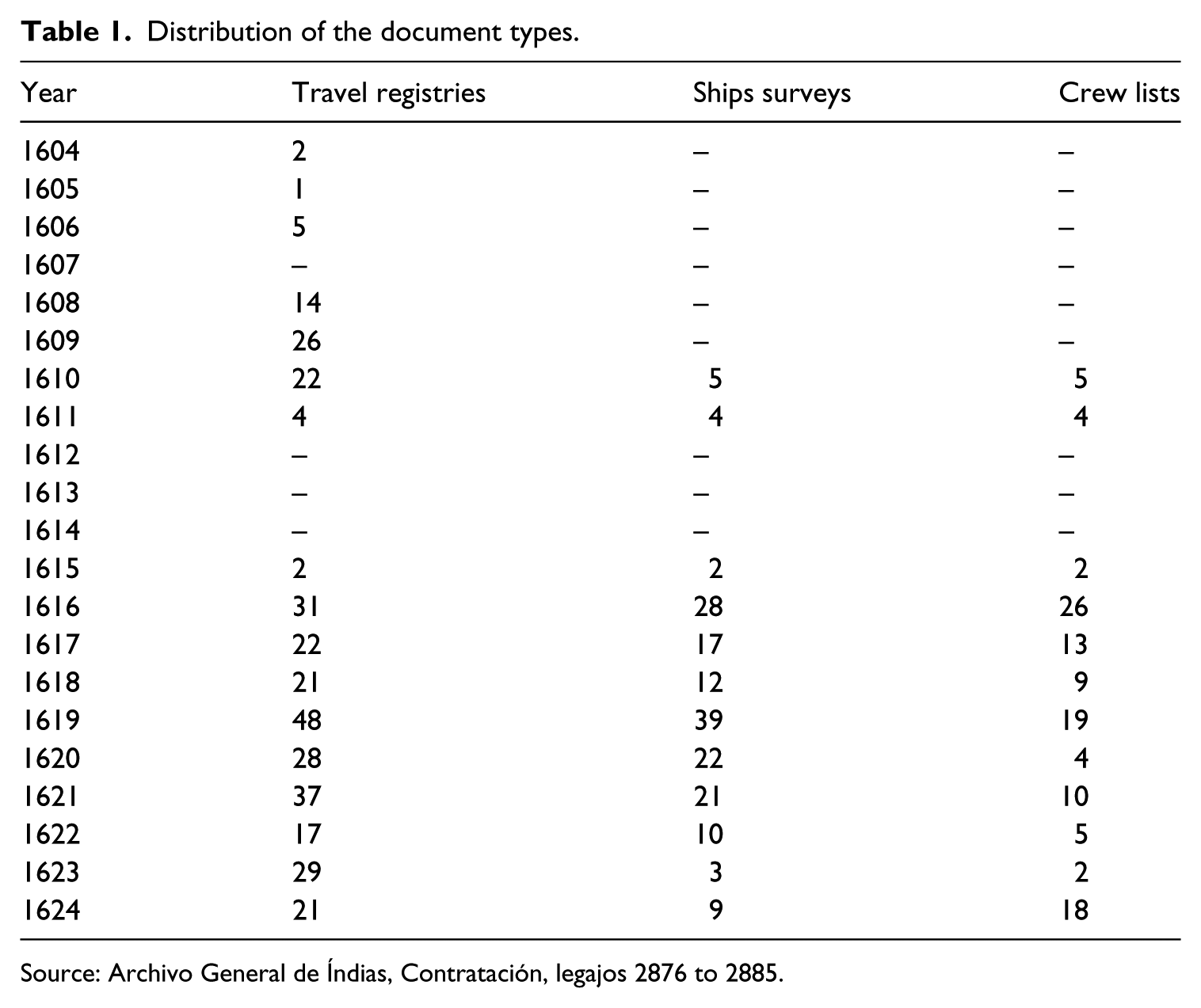
Source: Archivo General de Índias, Contratación, legajos 2876 to 2885.
Routes and itineraries
Like all navigation in the seventeenth century, the transatlantic slave trade depended on the winds and currents of the North and/or South Atlantic Ocean, depending on the ports of call. The first leg started from the Iberian Peninsula and, without major setbacks, would end in Cape Verde or São Tomé. After embarking the slaves, all ships were carried to the American coast by the north-equatorial current. The voyage to Angola was longer and more complicated because, following the Gulf of Guinea, the ships entered an area of contrary winds which forced them to navigate close-hauled. Usually the ships made a wider volta (almost reaching the Brazilian shore) to catch more favourable winds of the Capricorn anticyclone. Crossing the Atlantic Ocean (to Cartagena or Veracruz) from Guinea took 35 to 40 days, and from Angola 50 days. We should remember that the time spent on the African coast could be long – obtaining a full cargo of slaves was not an easy task – and so the total duration of the voyage, including the return to Europe, usually took one and a half years, and could be as long as four years. 9
Speaking of ports, Seville was the navigational centre to the Spanish Indies, supported by the secondary ports of Sanlúcar de Barrameda (also in the Guadalquivir River) and those in the Bay of Cádiz. Lisbon also played a role from the outset of the asiento system up until 1610 (when the departure of slave ships from Lisbon was forbidden), and from 1622 (when Philip IV conceded the right of departure once again). 10 To comply with the rules of the slave trade monopoly, after 1615 ships were obliged to sail for Veracruz (the port of entry to the entire northern subcontinent, or Nueva España) or Cartagena de Índias (the port of entry for South America). 11
Cartagena was the main port for the trade between the American continent and the Iberian Peninsula. It was from there that the well-defended Spanish fleets, carrying South American silver and many other colonial goods, began their voyages back to Europe, with a final stop in Havana. This silver, mined from the Potosí mines, left the ports of Callao and Paita, reached Panama, crossed the narrow isthmus to Portobello (to get to the Caribbean) and then arrived at Cartagena. Cartagena, during the period covered by this paper, was the principal and most prosperous port of disembarkation for African slaves, who were then trans-shipped around the Spanish Indies. 12
The data collected refer to a grand total of 332 voyages, distributed across the period as shown in Table 2. Considerable fluctuations in navigation are revealed, though, in part at least, this likely reflects missing records.
Distribution of voyages per year.

Source: Archivo General de Índias, Contratación, legajos 2876 to 2885.
Regarding ports of departure, their distribution is shown in Figure 1. All multiple references are counted simultaneously in each port of departure listed. Sanlúcar de Barrameda clearly stands out and was the closest port to Portugal for this kind of trade (compared to Cádiz). This new city (it attained this status only in 1579) was the political and economic centre for the House of Medina Sidonia. Does this underline the influence of the Duke of Medina Sidonia in the organization of the slave trade to the Spanish Indies? Lisbon stands out too, confirming what might be expected from the existing literature, because the Portuguese asientistas persistently wanted to depart from there. The changing pattern of departures over time is shown in Figure 2.
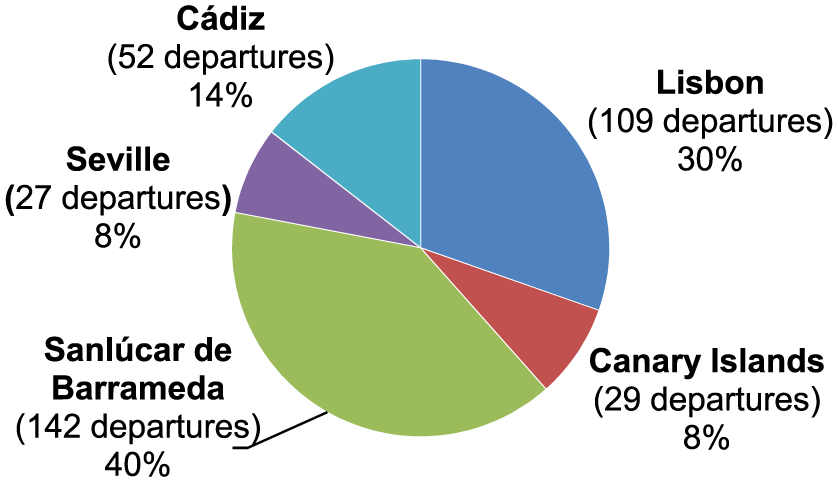
Ports of departure.
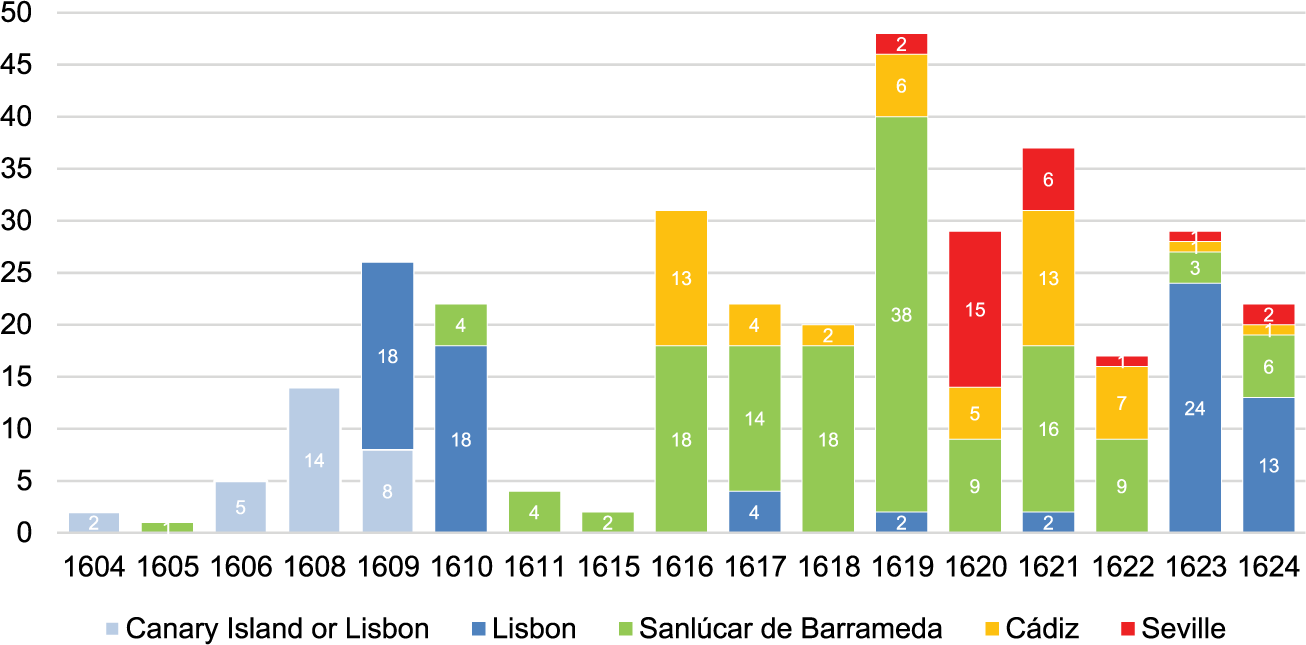
Number of departures per port in each year.
Ports of arrival are shown in Figure 3. In the 231 observations for Veracruz are included 87 to San Juan de Úlua and 18 to Nueva España. In the 144 observations for Cartagena are included three to Tierra Firme. It is also possible that one voyage had several ports of disembarkation: 37 voyages give both San Juan de Úlua and Cartagena as their final destinations. In such cases both ports were counted. According to David Wheat, between 1595 and 1640 there were only 173 slave voyages heading for Veracruz (and 140 of them started in Angola). 13 The present analysis suggests a far higher figure.
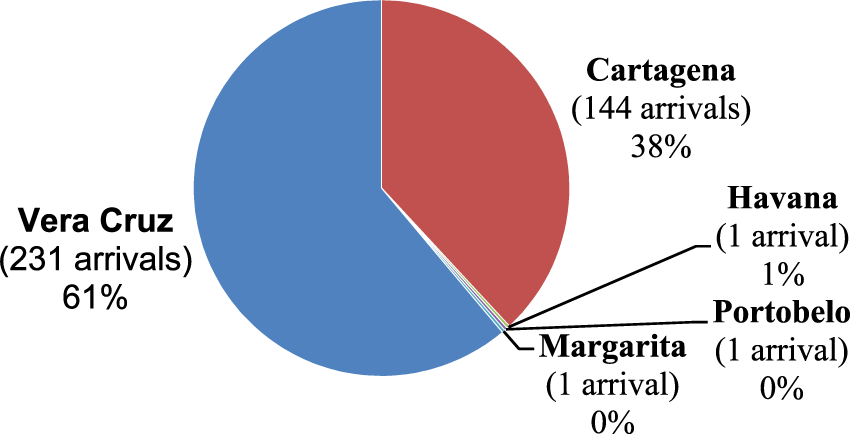
Ports of arrival.
The distribution of the quantity of slaves carried each year is shown in Figure 4. The shaded portion of each bar represents the total number of slaves identified from the sources, while the white portion reflects the expected values by asiento (between 1604 and 1606, 4,250 slaves were to be carried each year, and 3,500 slaves each year between 1615 and 1624). In the only comparable asiento (see Table 2), the one for the period between 1615 and 1622, the volume of slaves was greater than expected (31,741 as against 28,000). If we add the extra licenses that were a personal prerogative of the king, which were expressed in the asiento’s clauses, then this number returns to what is expected.
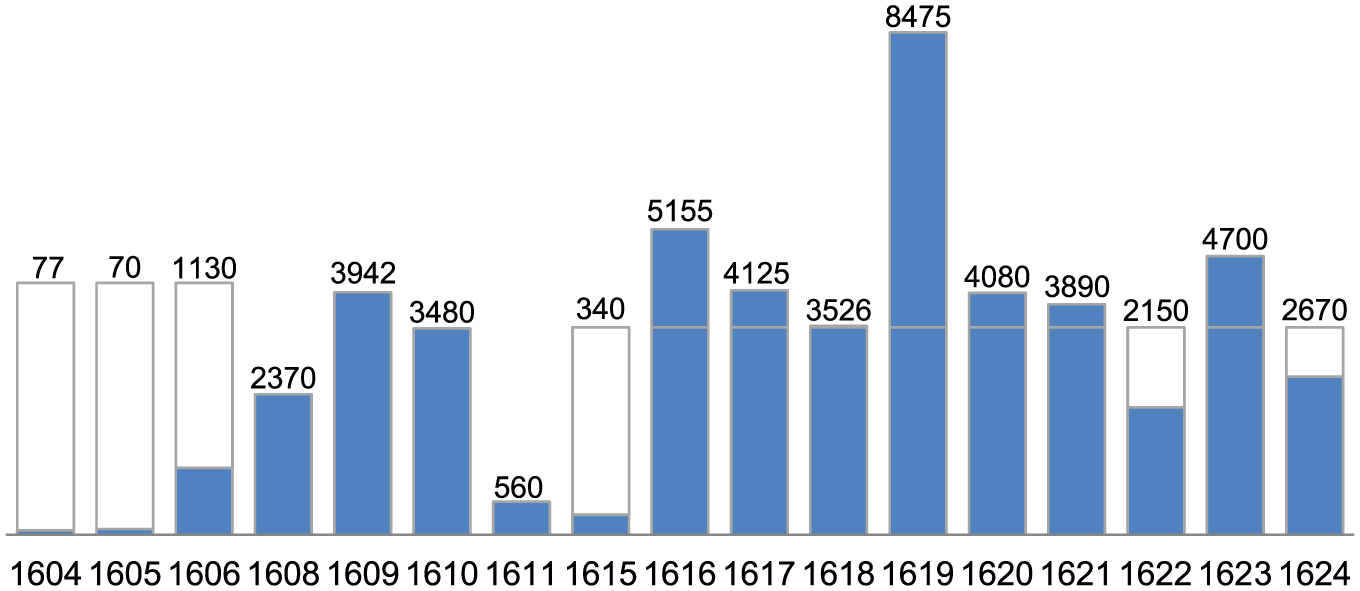
Slaves carried per year.
For 332 voyages we have data about the origins of the slaves (Figure 5). Each reference to an origin is accounted for, even if there are several origins in the same voyage.
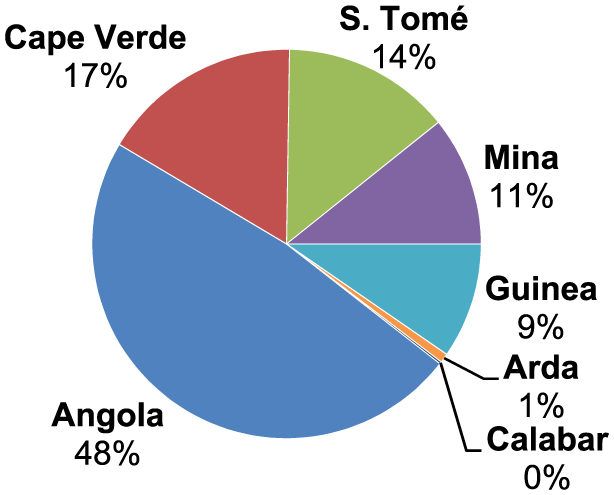
Origins of slaves carried (percentage of voyages).
Angola clearly stands out, more so if combined with the island of Sao Tomé, which served as a base for supplies and the ‘bulking’ of slaves for vessels trading in Angola. Table 3 disaggregates the data by year, and Figure 6 adds the variable of slave origin. Once again, Angola is the main region of origin, although there is no discernible pattern for the points of embarkation of slaves. Even in terms of slave numbers Angola prevails. But we cannot say that its importance increased as the years went by, because there are some issues for the years 1606, 1608, 1609, 1610, 1618, 1623 and 1624 to identify precisely the actual area of slave’s embarkation. All in all, according to the data collected, almost two-thirds of all the slaves came from this region. Mina (or Elmina) only represented 11 per cent of this traffic. Maybe this explains why the Portuguese were so keen in recovering possession of Luanda and Loango after being conquered by the Dutch in 1641 (reconquered in 1648) and never tried to recover Elmina after losing it in 1637.
Total of slaves carried per year.
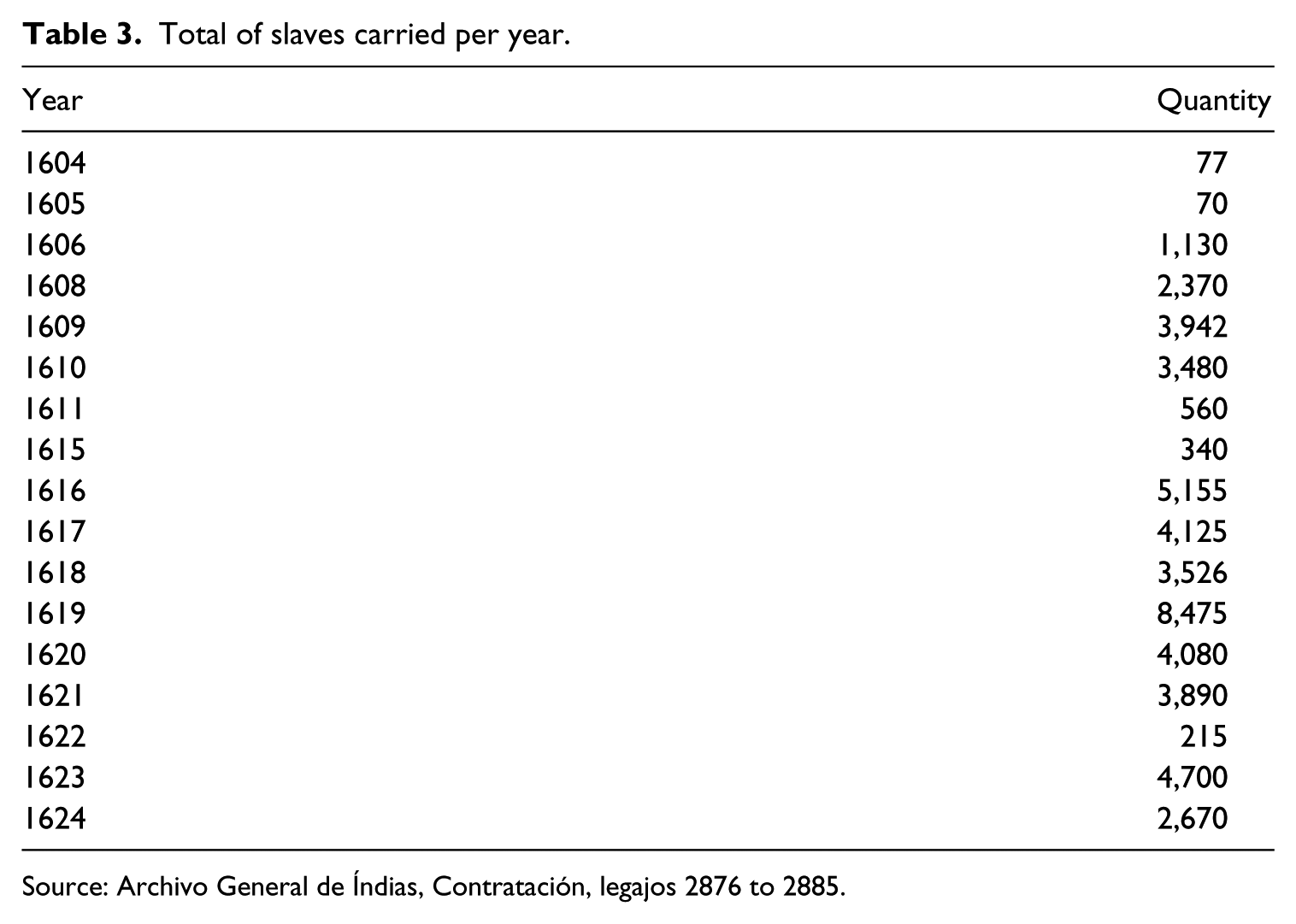
Source: Archivo General de Índias, Contratación, legajos 2876 to 2885.
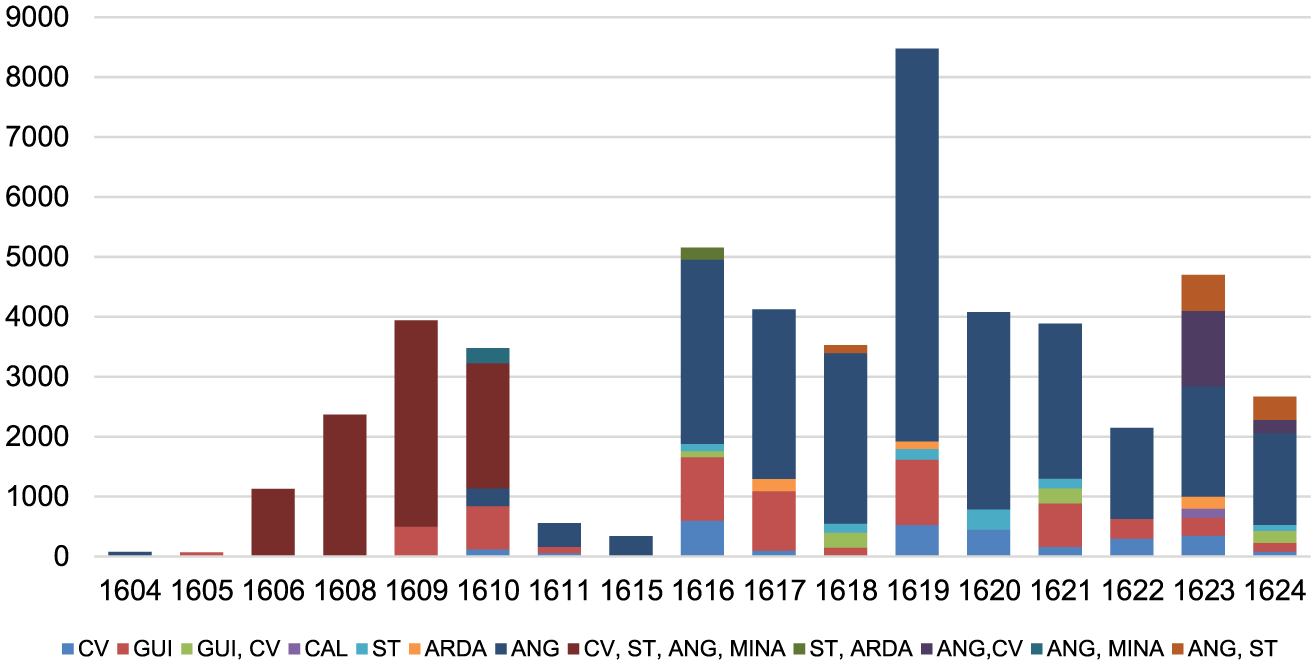
Number and origin of slaves carried per year.
Shipping
The ships of the transatlantic slave trade of the sixteenth and seventeenth centuries usually sailed alone, therefore increasing the risk of the voyage (no help from other ships in case of attack, rough weather, shipwreck, etc) and the chances of profit (less competition when arriving at their destination). According to James Rawley, slave trade vessels of the seventeenth century were almost always small, averaging 118 tons. 14 The tonnage was a measure of volume and was calculated by measuring the space occupied by two barrels of about 443.5 litres used in sea transportation. 15 The problem is that these barrels differed according to region and that it is therefore impossible to define a universal value for it. According to Rawley, each ton roughly equalled 2.8 cubic meters 16 and a ship of 106 tons had between 150 to 180 square meters. 17 To transport slaves with less risk to health, each ton could take a maximum of three adults. 18
These ships had no special architecture for transporting people. They were fast commercial ships (Portuguese caravels, fluyts from Flanders, American frigates, patachos and zabras) and could reach all kinds of embarkation points on the western African coast. The designation ‘navio’ is omnipresent in the documentation. Sometimes it is used as a generic type, and the actual type is specified when relevant. In other documents, it seems that ‘navio’ is a specific form of vessel, and the scribe never uses other types throughout (or when he does, he never duplicates the usage of the term). Henrique Lopes Mendonça suggests that ‘navio’ could mean a specific kind of ship depending of the document in question. 19 Conversely, José Cervera Pery argues that ‘navios’ are the same as naus or round caravels. 20 In most voyages, all these types of ships carried other types of goods. Because they sailed alone, they were obliged by law to protect themselves, carrying guns and artillery for defence (varying according to tonnage). 21
The fluyts were bulgy round ships, with a stern similar to the bows and with a large cargo capacity, which made them especially suited to stop at river mouths and ports in Angola. 22 The caravel was an elegant ship, with only one hold, a castle at the stern and large lateen sails on two or three masts, with the possibility of using oars for propulsion if necessary. The round caravel had four masts with a square sail on the foremast and lateen sails on the others, with good manoeuvrability, cargo and military capacity. 23 The frigate was a smaller and leaner ship than the nau, without aftcastles, and had two holds. The nau was a somewhat large vessel with three square-rigged masts, castles at the bow and stern, and three or four holds. The patacho was a small ship with two masts with a square sail at the bow and a lateen sail at the stern, and a castle at the bow. The zabra was an Arabic ship in its original form, normally used for cargo transport and fishing. 24
Table 4 reflects the average tonnage and average crew size for each type of ship found in the documentation. The average tonnage for all these 218 ships is 89.3 tons and the total average crew size for 174 ships is 23.4 men. The crew per ton ratio is 0.26. These numbers should be compared to other types of trade, namely commodities, to assess if the carrying of slaves required bigger crews, as the literature suggests. In the documents, crew sizes never include the master, the pilot and the scribe. For a more realistic calculation of the crew size, these were added to the values collected in the documents.
Average tonnage and crew size by vessel type.
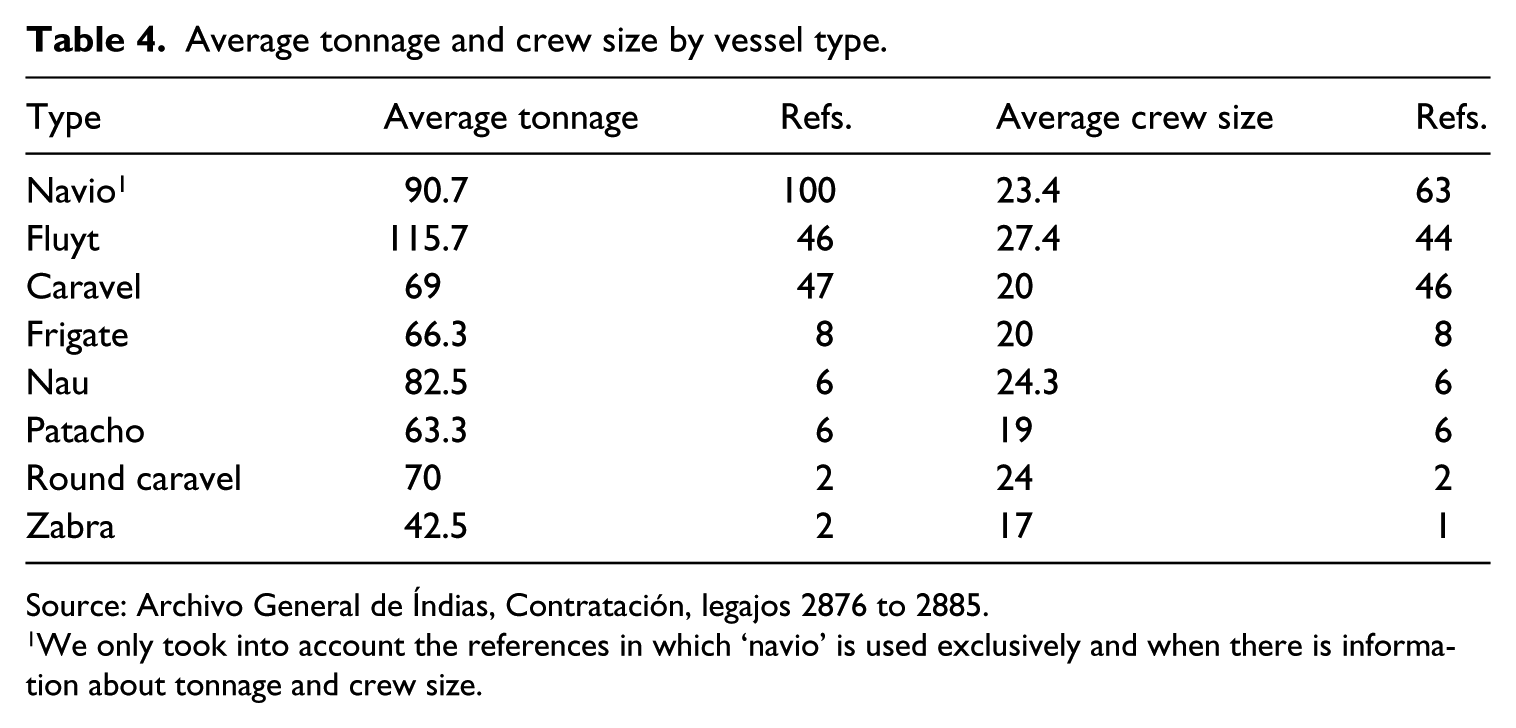
Source: Archivo General de Índias, Contratación, legajos 2876 to 2885.
1 We only took into account the references in which ‘navio’ is used exclusively and when there is information about tonnage and crew size.
For 150 vessels, we have information about their place of construction. As shown in Table 5 there was a clear specialization in some of these types. The fluyts were almost all built in Flanders, the caravels were all Portuguese-built and, most interestingly, all the frigates were built in the Spanish Indies. Fluyt and caravel designs are often referred in the literature as specific to the regions identified, but not the frigates. We may ask, for example, what advantages there were in building this specific design in the Americas?
Origin of vessels by type.
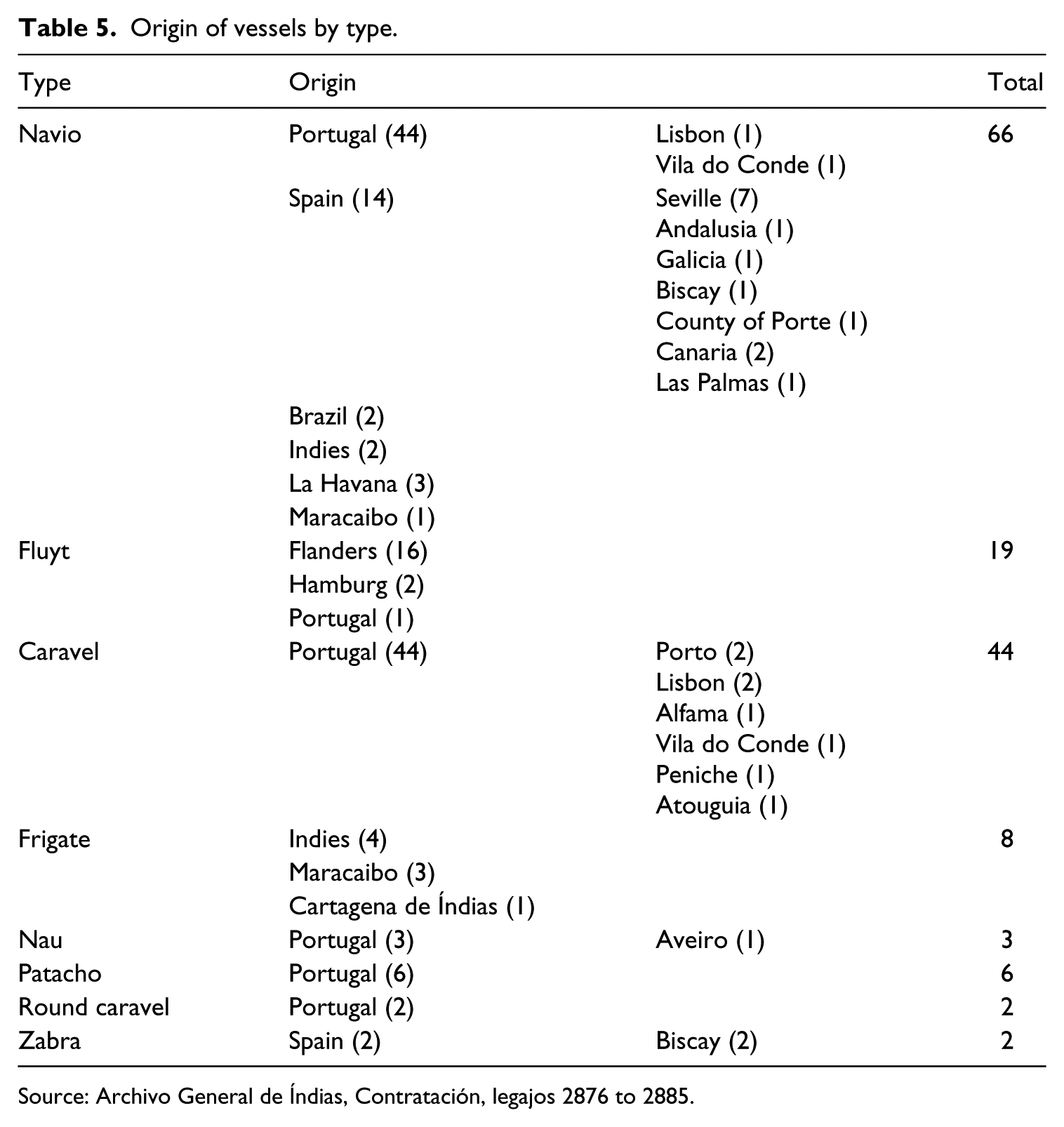
Source: Archivo General de Índias, Contratación, legajos 2876 to 2885.
In Table 6, for a total of 218 voyages, the slave per ton ratio is 1.76. This value is according to the data available in the literature (very close to the value of 2 presented by Enriqueta Vila Vilar). 25 Because of its specific relevance, we present this ratio by year in Table 6. It is interesting to note that 1619 is the year when more voyages were registered and that the number of slaves carried per journey was largest. Combining this information with Figure 4, we see easily how this year stands out in terms of the total of slaves carried. The slave per crew member ratio is 6.7 (collected from information about 174 voyages).
Slave per tonnage ratio (per year).

Source: Archivo General de Índias, Contratación, legajos 2876 to 2885.
Crew
Ships were the most advanced machines of the period, and navigating entailed many tasks, made possible only by an efficient and effective division of labour among the crew members. Ships were a veritable jungle of cables and pulleys, so the sails could be raised and lowered as fast as possible in all weathers. Furthermore, the pumps used to remove sea water from the bilges had to be operated continuously, to keep the ship and its cargo out of danger. It was also very important to keep the steering system free of impediments and tuned to respond to the pilot’s orders. Thus, the ship was a machine that required constant attention, without hours or even days of rest. 26 Having an adequate crew, in size and quality, was crucial.
A vessel’s crew was relatively diverse and varied according to its size. It included three major categories: sailors, apprentices and ship’s boys, besides the pilot and the shipmaster. As we can see in Figure 7, out of 1,558 seamen identified, there were 844 sailors, 522 apprentices and 192 boys.

Distribution of crew by role.
The data collected also allows us to be more specific in terms of crew roles, as listed in Table 7. We must bear in mind that an experienced seaman could perform multiple roles (for example master and captain, sailor and steward). Adding to this multi-functionality, some roles were always paired together with another (all coopers are also sailors). As such, we chose to count every reference to a role, even if attributed to one man. It is interesting to note the presence of surgeons and barbers among the sample. Slaves were valuable, and some merchants chose to invest in these skilled roles to limit the mortality rate and improve conditions, whether the vessel was when stationed off Africa or during the Atlantic crossing, the so called ‘Middle Passage’.
Distribution of crew capacities.

Source: Archivo General de Índias, Contratación, legajos 2876 to 2885.
The roles in a ship could be divided into two major groups: those who could order a task and those that executed it. Usually the owner was not present aboard, but when he was he had absolute power. It was also relatively common that the owner took with him one or more personal slaves. 27 Shipmasters were the owner’s representatives and had power over commercial matters and supervision of the cargo. 28 Pilots had supreme authority in navigational decisions, as for example, which course to take or the best time to dock. 29 The captain had exclusively military duties in the defence of the vessel and retained absolute power when the ship was under attack. These were the usual senior officers in a crew, and so they had private quarters at the stern, the place with more prestige in the ship. 30
The evidence also allows collection of data about the ages of the seamen. We find that for a total of 1,989 observations the average age was 25.1 years. If we analyse age against capacity, as in Table 8, it is no great surprise to learn that roles requiring more expertise were held by older crew, pilots in the hazardous African trade being a very good example. We may well ask if the crew aboard slavers, especially the older hands, tended to build up experience in that extremely distinctive branch of trade.
Average age by capacity (in years).
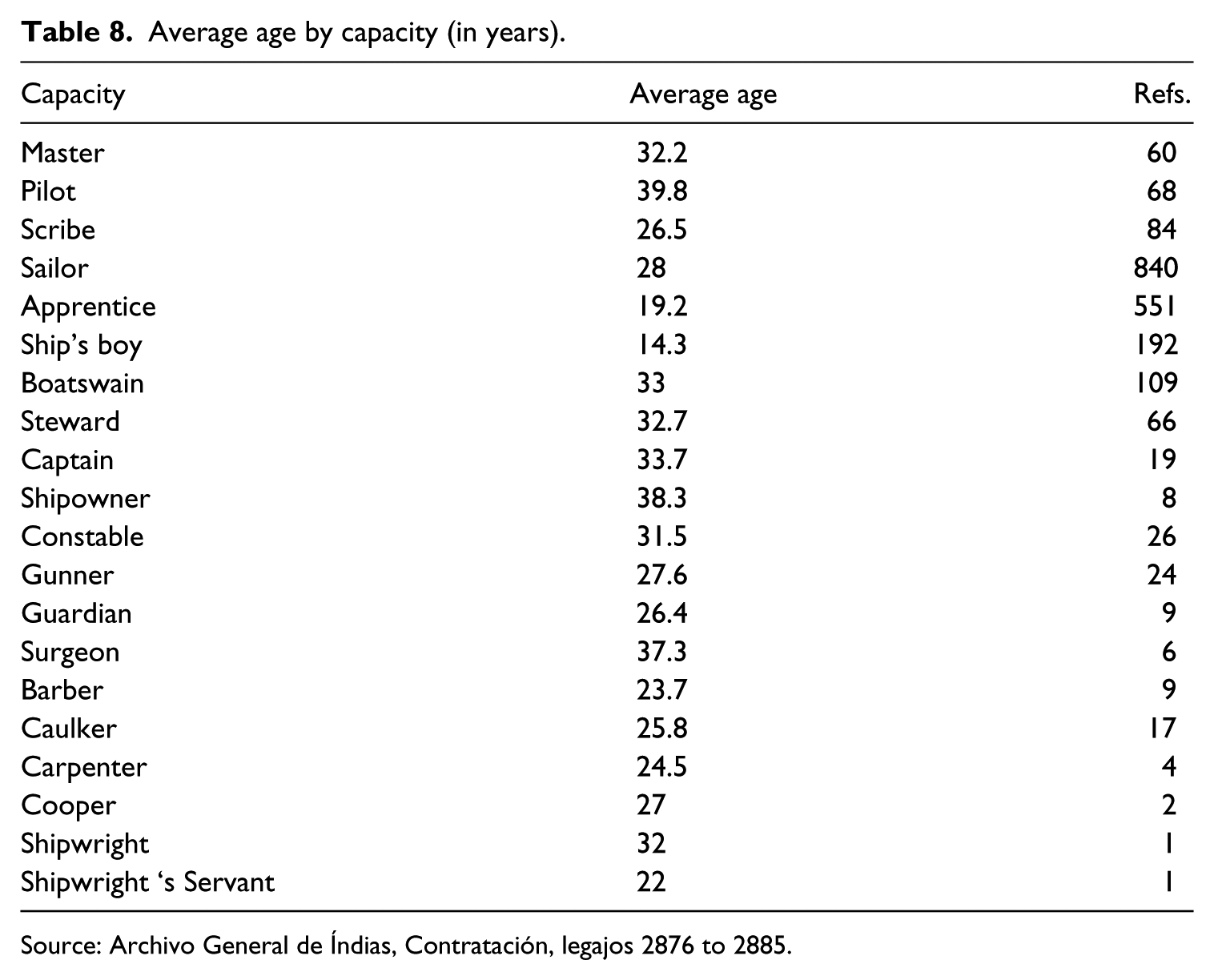
Source: Archivo General de Índias, Contratación, legajos 2876 to 2885.
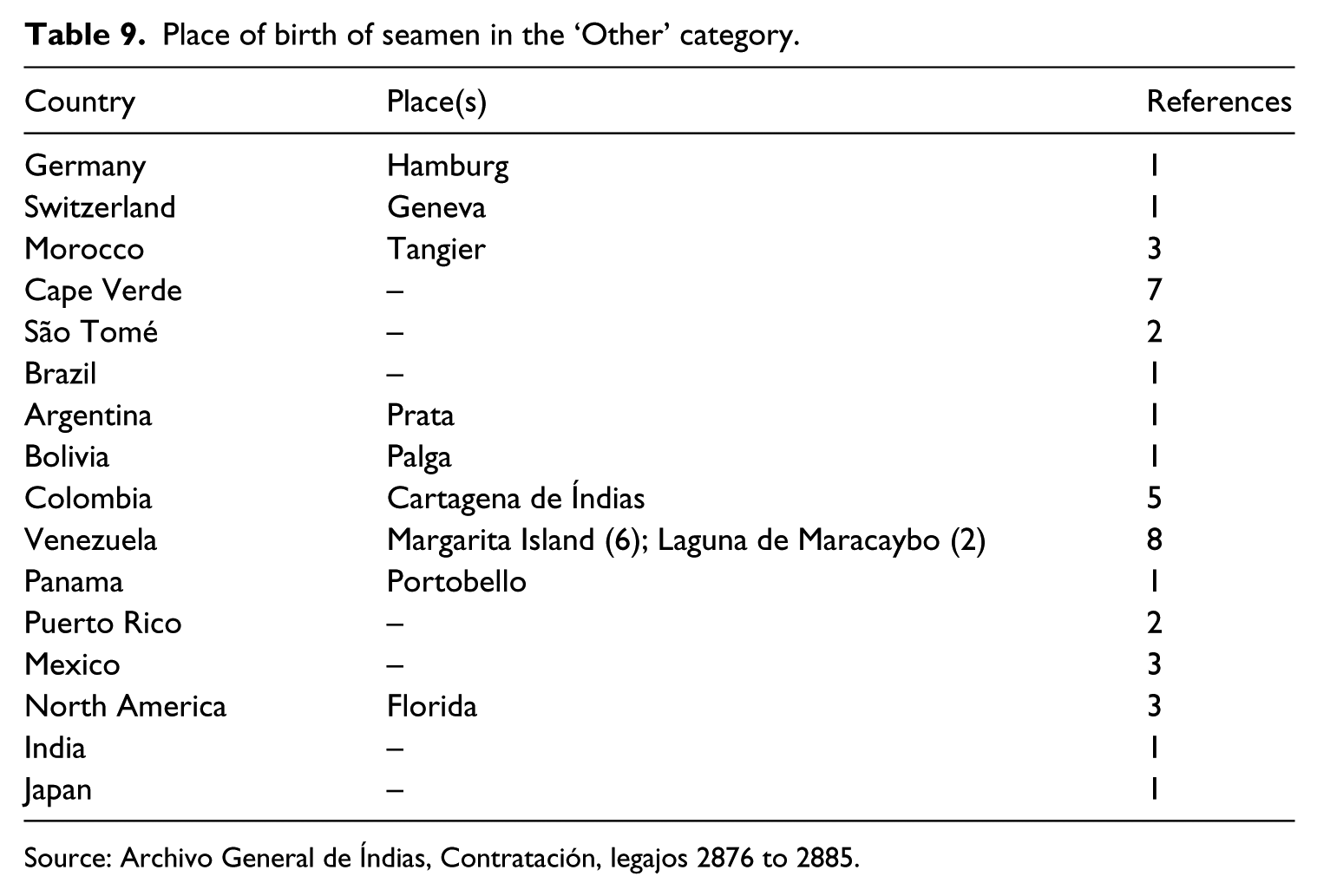
The distribution of nationalities can be seen in Figure 8. 31 Of 2,227 seamen, 1,528 were Portuguese, 643 were Spanish, 15 were Italian and 41 were of other nationalities (see Table 9). The Portuguese clearly dominated these crews, comprising more than two-thirds of the seamen identified in the documents. Existing research suggests that the slave trade during this early period was dominated by Portuguese merchants. This was echoed by the crews. We should clarify that the references to ‘blacks’ and ‘mulattos’ were to freedmen. Does this mean that slaves could work among these crews and buy their freedom this way? Or were they hired specifically to control the enslaved during the voyage? Perhaps they performed specific roles in the business, like translation or haggling with the African traders.
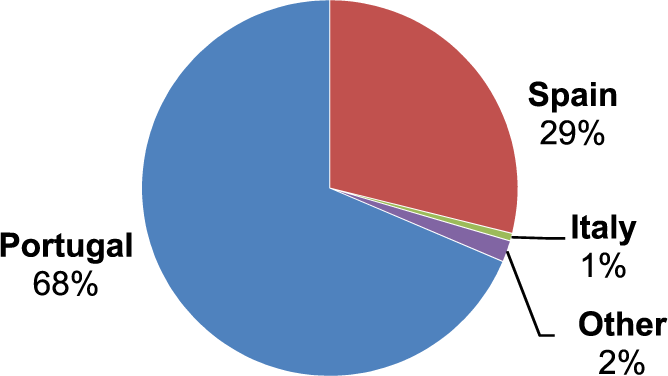
Nationalities of seamen.
Place of birth of seamen in the ‘Other’ category.
Source: Archivo General de Índias, Contratación, legajos 2876 to 2885.
A more detailed picture can also be formed of the Portuguese crew, as shown in Table 10 and Figure 9. For both, only places with more than five references were considered.
Place of birth of the Portuguese seamen.

Source: Archivo General de Índias, Contratación, legajos 2876 to 2885.
1 References to Portimão (14) and Vila Nova (78) were aggregated.
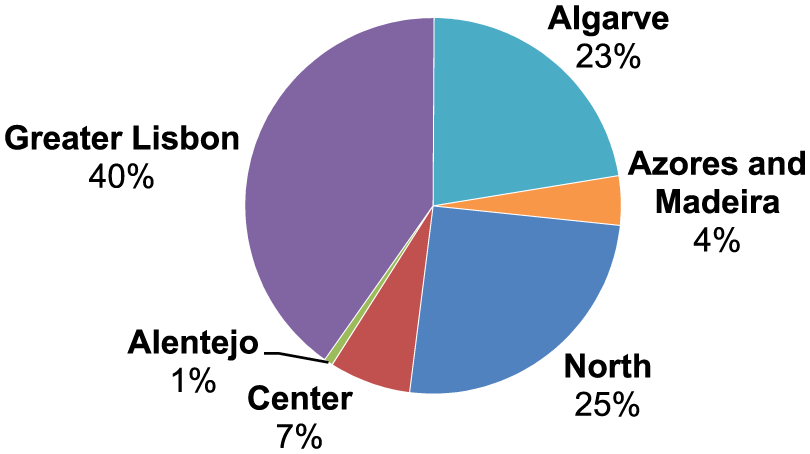
Region of birth of the Portuguese seamen 1 .
Lisbon, by some margin, was the most common place of origin for Portuguese crew, with Porto a distant second. These were the two largest Portuguese cities at the time (and still are). Lisbon was the kingdom’s capital and home of the biggest deep-water port in the river Tagus estuary. If we consider the whole of Portugal, we see that there is a clear prevalence for the Greater Lisbon region and southern regions, providing two-thirds of the seamen. Does this show regional prevalence of the crews for this specific trade? Were these ships used in the regional trade between Portugal and the Andalusian coast before making the long voyage to Africa and the Spanish Americas? Does this mean that there are more trading affinities between the southern half of Portugal and Seville?
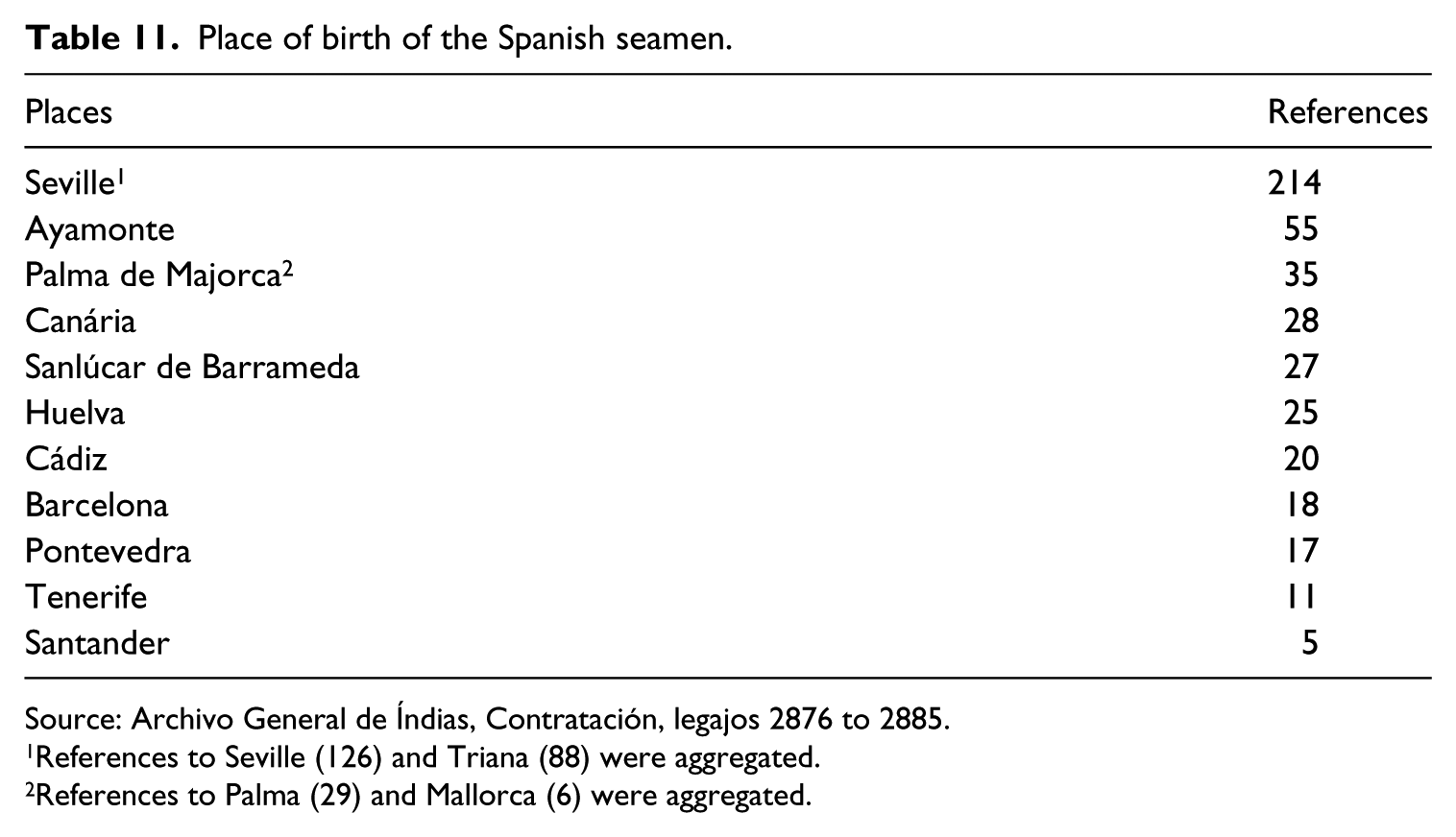
As for Spain, the distribution of the more prominent places of birth is shown in Table 11. There was a clear prevalence of locations on the southern coast, especially near Seville. The importance of the south of Spain mirrors Portugal. It is also important to note the many seamen born in the Canary and Balearic Isles. These islanders had a long history of trade with the African coast.
Place of birth of the Spanish seamen.
Source: Archivo General de Índias, Contratación, legajos 2876 to 2885.
1 References to Seville (126) and Triana (88) were aggregated.
2 References to Palma (29) and Mallorca (6) were aggregated.
It is also possible to present data about the diverse nationalities among the same crew (Figure 10), from a set of 116 voyages. In 29 crews, more than half of the seamen had the same region of origin as the master of the ship. But it is relevant to point out that in 69 crews (about two-thirds of the total), we can find three or more seamen from a nationality different from that of the master. This means that almost two-thirds of the crews were multinational (especially with Portuguese and Spanish seamen, and obviously limited to the kingdoms belonging to the Spanish Crown). Some of the literature, especially Enriqueta Vila Vilar, claims that the nationality of the crew’s members depended on the nationality of the master of the ship. The data collected cannot confirm this statement. Could it be possible that these crews reflect a first globalized world? Are we in the presence of national specialization in terms of roles in a ship’s crew?
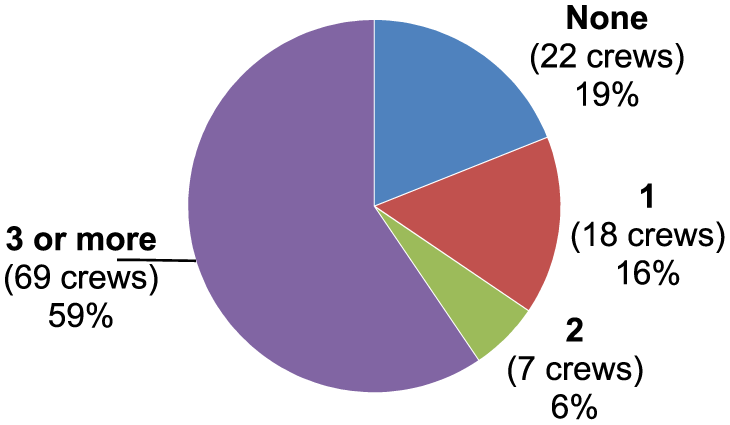
Number of other nationalities in a crew.
Looking into the nationality of both masters and pilots (Figures 11 and 12), we can see an overwhelming majority of Portuguese. Nonetheless, it is interesting to note that 28 per cent of the masters were Spanish or came from Spanish colonial territories (every master in the ‘Other’ category was born in the Spanish Indies). This confirms that this trade, despite being monopolized by wealthier Portuguese merchants, could accommodate Spanish players. Even more interesting is the fact that 88 per cent of the pilots sailing to the Spanish Indies were Portuguese. Considering the great control that the Spanish Crown enforced in terms of access to its colonial empire, the percentage of Spanish pilots should be much bigger, even in the context of a dynastic union. Could this mean the cooperation and sharing of knowledge between Portuguese and Spanish institutions (because most of these pilots were examined in Lisbon)? Or are we seeing evidence of an informal sharing of knowledge between pilots of both nationalities?
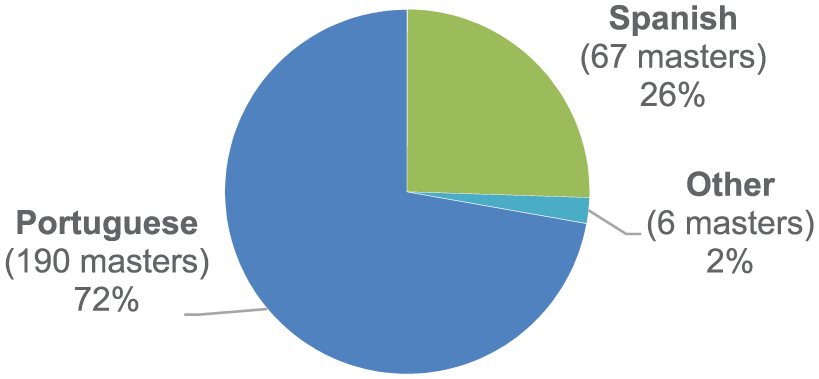
Nationalities of masters.
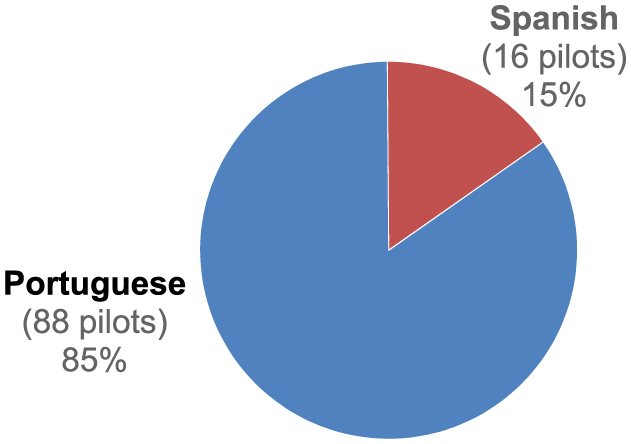
Nationalities of pilots.
Conclusions
To summarise the paper’s main findings (see Table 12), it is clear that the slave trade in this period was conducted in small ships, which allowed them to reach shallow, inshore embarkation points and also to disembark in more obscure destinations of the New World, if required. Crews typically originated from many places: more than 60 per cent of all vessels had three or more crewmen coming from different kingdoms. Lisbon and Seville proved to be major sources of labour. Indeed, a clear prevalence of birth places south of the river Tagus can be seen, amounting to more than two-thirds of all places mentioned. Shipboard roles requiring more technical expertise tended to be filled by older men, and this leads us to believe that this knowledge was acquired through practice and empirical teaching. That is why length of service (reflected in someone’s age) was probably the main criterion for progression in a nautical career.
Summary of the main data (1604–24).

Source: Archivo General de Índias, Contratación, legajos 2876 to 2885.
The total slaves carried is within the expected range according to the available literature, as is the slave per ton ratio. The year with the most voyages was 1619 and the port with the most departures was Sanlúcar de Barrameda. Angola is clearly the region where the largest number of slaves were embarked (almost half of the total voyages) in this period, together with Veracruz as the destination (with 61 per cent of references). It is always important to say that these data only give us tendencies about the characteristics of this specific slave trade and its naval logistics. We should never forget the limitations of the information contained in the documents, as well as its limited compass, when compared with the much larger and longer reach of the Atlantic slave trade.
Footnotes
Acknowledgements
I would like to publicly acknowledge the help of Professor Amélia Polónia (Faculdade de Letras da Universidade do Porto/CITCEM) in providing access to the documentation. Moreover, this article would not have been possible without her guidance and revision. I would also like to thank Professor Winfried Heinemann (Brandenburgischen Technischen Universität Cottbus-Senftenberg) for some insightful remarks and careful revision.

2
James A. Rawley and Stephen D. Behrendt, The Transatlantic Slave Trade: A History, Revised Edition (Lincoln NE, 2009), 20.
3
Enriqueta Vila Vilar, Hispanoamérica y el Comercio de Esclavos: Los Asientos Portugueses (Seville, 1977), 2, 30, 33, 54–6, 59–60.
4
Pablo Emilio Pérez-Mallaína, ‘La carrera de Índias’, in Maria da Graça M. Ventura, ed., Viagens e Viajantes no Atlântico Quinhentista (Lisbon, 1996), 27–8.
5
Bartolomé Bennassar, La América Española y la América Portuguesa, Siglos XVI-XVIII, 4th Ed. (Madrid, 2001), 86–8.
6
Vila Vilar, Hispanoamérica, 59–68, 141–4.
7
Paul Lokken, ‘From the “Kingdoms of Angola” to Santiago de Guatemala: the Portuguese Asientos and Spanish Central America, 1595–1640’, Hispanic American Historical Review, 93, No. 2 (2013), 183–97.
8
Vila Vilar, Hispanoamérica, 28–54.
9
Vila Vilar, Hispanoamérica, 147–53.
10
Vila Vilar, Hispanoamérica, 137.
11
Pérez-Mallaína, ‘La Carrera de Índias’, 21–7. Enriqueta Vila Vilar, Aspectos Sociales en América Colonial: De Extranjeros, Contrabando y Esclavos (Bogotá, 2001), 154.
12
Jorge Caro and Antonino Ortega, ‘La Desmemoria Impuesta a los Hombres que Trajeron. Cartagena de Indias en el Siglo XVI y XVII. Un Depósito de Esclavos’, Cuadernos de Historia, 37 (2012), 9–13.
13
David Wheat, ‘The First Great Waves: African Provenance Zones for the Transatlantic Slave Trade to Cartagena de Indias, 1570-1640’, Journal of African History, 52, No. 1 (2011), 7.
14
Rawley and Behrendt, Transatlantic Slave Trade, 51.
15
Pablo Emilio Pérez-Mallaína, Spain’s Men of the Sea (Baltimore, 1998), 66.
16
Rawley and Behrendt, Transatlantic Slave Trade, 51. See also Arlindo M. Caldeira, Escravos e Traficantes no Império Português (Lisbon, 2013), 117.
17
Pérez-Mallaína, Spain’s Men of the Sea, 130–1.
18
Caldeira, Escravos, 116-19. Enriqueta Vila Vilar says that, considering the average tonnage of slave ships, they carried two slaves per ton (Vila Vilar, Aspectos, 116, footnote 22).
19
Henrique Lopes de Mendonça, Estudos Sobre Navios Portugueses nos Séculos XV e XVI (Lisbon, 1971), 5–7.
20
José Cervera Pery, La Casa de Contratación y el Consejo de Indias (Las Razones de Un Superministério) (Madrid, 1997), 168.
21
Vila Vilar, Hispanoamérica, 127–34.
22
Vila Vilar, Hispanoamérica, 133–4
23
Francisco Contente Domingues, Navios Portugueses dos Séculos XV e XVI (Vila do Conde, 2007), 30-36
24
Humberto Leitão and J. Vicente Lopes, Dicionário da Linguagem de Marinha Antiga e Actual, (Lisbon, 3rd edn. 1990), 137, 273–4, 368, 398, 546.
25
Vila Vilar, Aspectos, 116, footnote 22.
26
Pérez-Mallaína, Spain’s Men of the Sea, 63–75.
27
Caldeira, Escravos, 119–20.
28
Masters were obliged to pay a bond of 200,000 maravedis to guarantee their compliance to the voyage plan (Europe to Africa, then to America, and then return to Europe), without additional calls (except those necessary for taking on water and firewood). On their return to Europe they had to go to the Casa de Contratación in Seville and show the records for all the ports visited, as well as guarantee the return of every crewman (Vila, Vilar, Hispanoamérica, 135).
29
Pilots were required to show proofs of their navigational knowledge, and had to supply their own instruments (Vila Vilar, Hispanoamérica, 136).
30
Pérez-Mallaína, Spain’s Men of the Sea, 83.
31
The nationalities used are current ones.
Author biography
Fernando Mouta was born in Luanda, but has always lived in Porto. He holds a degree in Marketing and Advertising from Instituto Superior de Ciências Empresariales e Turismo. He graduated in History (2015), and completed his Master’s in Medieval Studies in 2017 and completed a specialization in African Studies (2018), all from the Faculty of Arts and Humanities of the University of Porto. He is a PhD candidate at the University of Porto with a thesis entitled “Commerce, cooperation and conflict in the West African coast (XV–XVI centuries). Beyond the transatlantic slave trade”.