



Abstract
Crown policies and private enterprise combined to increase efficiency levels in Portuguese overseas expansion. Within this framework, this paper will emphasize three themes. Firstly, the dependence of the Portuguese empire on shipping efficiency; while the debate largely focuses on shipbuilding and seafarers, we show how crown policies and individual enterprises adapted to the evolving requirements of an empire based on sea power. Secondly, we demonstrate how informal and self-organized mechanisms at times contributed to, and sometimes blocked, state-oriented policies. Thirdly, we gauge the extent to which local inputs, such as raw materials, labour and techniques, contributed to efficiency levels within a universe that became multi-continental.
During the sixteenth century, Portugal was the first European power to develop regular maritime routes, which allowed global exchanges. Maritime efficiency levels were paramount in order to ensure a successful enterprise. The idea that this was a process driven by the state is still commonplace, yet the Portuguese crown lacked the financial sustainability and the institutional, bureaucratic and administrative apparatus needed to effectively control this process and to provide the logistics required by such enterprise.
New perspectives have been suggested by Portuguese historians in their studies of seaport dynamics, 1 and the maritime logistics (technical means, agents, knowledge), 2 driven by a focus on micro rather than macro analysis, and by a scrutiny on people as actors, and not only on structures and systems. An agent-based approach, centred on the performance of individuals and groups, together with assumptions of the theories of cooperation and self-organization, have proved promising when proposing new interpretations of the processes of empire building. 3 These theories will not be debated here, since they have already been extensively presented in other published works.
The end of the fifteenth and beginning of the sixteenth century is for several reasons considered a key period, as it is assumed to have marked the zenith of Portuguese maritime expansion, before and after the arrival in India and the discovery of Brazil.
Between 1481 and 1640, the legislative action of the Portuguese crown was characterized by an acute incentivization of maritime logistics, which was designed to expand the merchant fleet, to ensure there were sufficient ships for crown armadas and to increase the number of large vessels that offered large capacity at lower average cost. It was marked, on the one hand, by protectionism of the Portuguese naval fleet, and by the attribution of privileges, tax exemptions and subsidies to shipbuilders, shipowners and seafarers alike. These provided positive levers for the modernization of the Portuguese navy, both merchant and military ships alike, in accordance with the changes and demands of a maritime empire in the making (see Table 1, Figure 1, and Figure 2).
Crown regulations distributed by categories.

Source: Liliana Oliveira, Políticas Régias de Logística Naval (1481-1640), 62.

Crown regulations by reigns.

Crown regulations by reigns (%).
From a total of 1,546 deliberations concerning maritime logistics promulgated between 1481 and 1640, and identified by recent research, 4 about 105 regulated the activity of shipbuilding. The most heavily regulated areas were those pertaining to the workforce, specifically the granting of privileges, workplaces and corresponding regulation, together with the management of raw materials and prices.
At the beginning of the sixteenth century, King Manuel I ordered the creation of the Ribeira das Naus shipyard in Lisbon, mainly to provide carracks for the Cape route. It became the crown’s main shipyard, but still the Portuguese crown did not have enough capital, infrastructure and technical expertise to construct sufficient vessels. Shipbuilding was distributed among and handled by shipyards in various locations within the kingdom, such as Lisbon, Porto, Vila do Conde, Aveiro and Algarve.
In the period under analysis, a policy of shipbuilding incentives sought to increase the numbers and load capacities of merchant ships. The measures taken focused on specific tonnage and particular naval typologies. The regulations produced during the reigns of Manuel I, Sebastian, Henry, Philip II and Philip III seem to support this conclusion, first promoting the building of carracks, then of galleons. In the late sixteenth century, knighthoods were awarded to those who built galleons. 5
However, a policy of incentives for shipbuilding, in the form of privileges and subsidies, had appeared in an earlier period. In 1474, King Afonso V (or most probably his son, the future John II) established monetary rewards corresponding to the tonnage of vessels to be built. Beyond that, fiscal privileges, or even exemptions, were granted in respect of materials required for shipbuilding, such as pitch, iron, nails and timber. The transportation and supply of these resources were also protected by law. 6
A 1569 provision by King Sebastian introduced new regulations, both in terms of shipbuilding and defence, with provisions concerning the organization of all fleets including those involving only private merchants. The mandatory inclusion of artillery on board ships required technical interventions in ship design. In this context, the chief supervisor of the Crown Warehouse and the Chief Ship Master were to define the characteristics of the vessels before their construction in order to accommodate artillery. 7 This very same provision prohibited the selling of vessels to foreigners, a fact that attests to the sovereign's intention of protecting and safeguarding the Portuguese fleet. None of the regulations seems to have been effectively applied.
The recognition of the vital role played by shipbuilders, seafarers and bombardiers in safeguarding Portuguese sea power is perfectly clear in two Regiments, one from 1591, 8 the other from 1626, 9 both from the Iberian Union period. Both Regiments established a mandatory census, in the form of the large-scale registration of carpenters, caulkers, seafarers and bombardiers. The aim was to record where these seamen could be recruited, to ensure the continuity of this highly skilled manpower, as well as to request their services as and when needed.
As a way of attracting craftsmen to the crown’s service, it was also agreed that the carpenters and caulkers would receive the amount corresponding to the days of their journey from their respective hometowns to Lisbon in addition to their daily wage, and the possibility of traveling to India, Malacca or El Mina. The Crown also granted bonuses and exemptions. 10 Between 1481 and 1640, some 29 letters of privilege were granted to local shipyard officers all over Portugal: 16 to carpenters, 12 to caulkers, and one to the general group that performed functions in the Ribeira das Naus in Lisbon. 11
In essence, the Portuguese Crown assumed a reactive attitude to shipbuilding regulation, as shown by the laws adopted over time. Likewise, the documents in question reveal (see Figure 3 and 4) the implementation of measures catering to contextual needs in order to guarantee overseas trade and navigation as well as the endurance, or just the safeguarding, of Portuguese sea power. The crown played a proactive role that may have contributed to the successes achieved by maritime enterprise. The policy of promoting shipbuilding, the social rewards granted to officers connected with shipbuilding, and the measures taken to attract private investment are proof of this interference through privileges and subsidies. On the other hand, it also reflects the awareness of the central power of its dependence on private agents and their investment to achieve the monarchs’ intended goals.
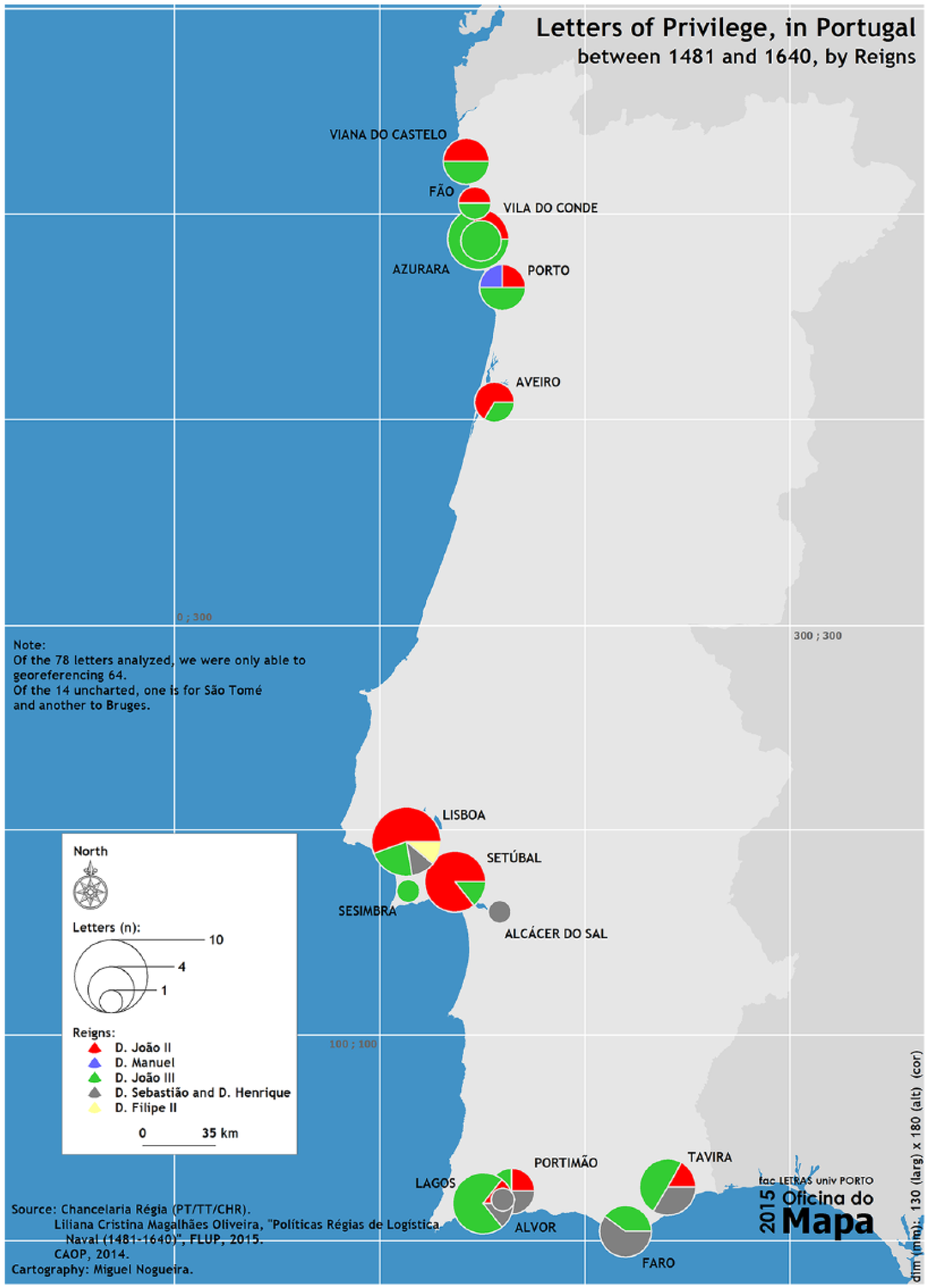
Seafarers and shipbuilders: Letters of privilege by reigns.

Seafarers and shipbuilders: Letters of privilege by categories.
That leads us to the second part of this paper: the role of individuals, private entrepreneurs and self-made men (and women) on the increasing (or decreasing) efficiency levels in Portuguese overseas expansion. Monographs on Portuguese seaports indicate that all the logistical means of maritime expansion (fleets, crews, nautical knowledge, capital and entrepreneurial skills), with some exceptions for the India Run, were provided by individuals acting on their own initiative, when this suited them. For example, the number of seamen grew due to internal migration from the hinterland to the seaports, and Lisbon was supplied with voluntary migration from every coastal area to the capital. Ship freights were provided by informal companies of merchants and shipowners, with pilots, shipmasters and seafarers joining in variable numbers, putting together small amounts of capital to build ships in which they also played technical roles. Technical knowledge was provided by endogamic family transmission, and by apprenticeship contracts following the longstanding craft model.
Although there was a huge concentration of population in Lisbon, seafarers, nautical officers and vessels were widely distributed in Portuguese seaports. The centre was dependent on the peripheries, and the capital relied on maritime communities distributed along the coast. Even the small city ports and maritime villages contributed significant inputs to maritime logistics.
With regard to the Portuguese seafaring workforce during the sixteenth and seventeenth centuries, there was no distinction between a royal navy (which did not exist as such) and a parallel merchant fleet or merchant navy: they were one and the same. Multifunctionality is an appropriate term to describe the role of both sailors and the naval fleet in Portuguese overseas expansion. Private merchant ships were engaged in war from the earliest Portuguese conquests of Moroccan strongholds right through to the attempt to recover Brazilian possessions from the Dutch in the seventeenth century. Private ships and crews were recruited for coastal surveillance, and, with exception of the Cape route, sailors themselves constituted the only protection for their ships, just as improvised fleets were the only way of creating defence mechanisms against French, British or Dutch privateers. 12 The first crown attempt to recruit and then maintain a body of 300 permanent sailors dates from 1676, 13 and its success is unclear. The functioning of the overall system depended on private parties and on the convergence of their actions with the needs and aims of the central power.
As for nautical personnel, we should remember that no formal training of subjects related to navigation and shipping took place in Portugal until the late sixteenth century. The first known regulations of the main cosmographer of the kingdom date from 1592, when the first voluntary class opened in Lisbon. 14 However, compulsory attendance at nautical classes for those who wished to apply for the pilots’ examination was only introduced by regulation in 1626. 15
This is why the crown regulation of 1591, published when there were not enough seafarers to make up crews, appealed to the traditional family-based, generational models of recruitment.
16
In addition, the embarkation of children from the age of 10 was stipulated, as well as the employment of orphans or abandoned children, which was the responsibility of crown officers: I commission and order to the purveyor of my warehouses and to the magistrates and purveyors to take particular care in commissioning the navigation officials and sailors in their jurisdictions who have sons to teach them, to apply them from a young age to the art of the sea, taking them to all the places they go.
17
. . . the sons of the men of the sea who accompany their fathers on the voyages they take on ships and on the India Route and in other ships of my armadas or any other voyages on which they serve by account of my exchequer, and are of ten years of age, shall have pay and rations like their fathers.
18
The crown also tried to obtain their commitment by granting privileges, which were increased when their contributions were most needed. Used from the beginning of overseas maritime expansion in the late Middle Ages, these central authority initiatives tended to increase significantly when the crown did not have sufficient ships or sailors to sustain regular voyages to India or naval fleets to respond quickly to Dutch attacks on Brazil. This is documented by the hundreds of accolades given by the king to those who applied for favours in the aftermath of naval operations, invoking services rendered or simply repeated missions as pilots on the overseas maritime runs. 19 Lacking both capital to reward services and personnel to satisfy the needs of maritime transport and navigation, the Portuguese crown used a redistributive policy of favours and privileges to attract and maintain maritime agents in accordance with the needs of the empire.
What started as a royal policy promoting the active participation of individuals in shipbuilding and navigation developed into a more coercive policy in the late sixteenth and early seventeenth centuries, during the Iberian Union, when warfare at sea was more intense as the Iberian empires were challenged by other European powers. 20 The multiplicity of royal recruitment orders all along the Portuguese coast, and the drastic increase in the penalties for those who evaded recruitment or attempted to desert, including imprisonment of family members and relatives, 21 were indicative of the fragility of a maritime empire. The repetition of these orders and the increasing harshness of the penalties suggest a lack of compliance and the virtual impossibility of coercing the desired response.
We should not forget that, in a context of dominant multifunctionality, seafarers were also performing as soldiers on the ships, when attacked. That meant that when seafarers evaded recruitment, they increased the effects of an ongoing crisis that was not only commercial, but also military. This can be documented by the king making it compulsory to form ‘armadas’ of private ships departing together, instead of leaving individual ships to set sail on their preferred date. In 1557, for example, when the crown made it compulsory for ships to carry artillery on board, shipmasters and captains would depart from Lisbon with the necessary artillery on board, but then unload it in Cascais, just a short distance away, to get rid of the excess weight, the inconvenience of having cannons on board and the reduction in cargo capacity. 22 One assumes that this artillery was then sent back to Lisbon for loading onto other ships.
In addition, case studies focussing on Portuguese seaports show a relentless flow of smuggled ships. Lawsuits and local disputes hint at the active smuggling of ships built in Portugal to Spain and other countries; the practice took place both in northern Portugal and the Algarve and is documented throughout the sixteenth century. 23 Such profitable commerce greatly reinforced local shipbuilding activity, and it improved the output of strategic individual investments. However, it was also a cause of significant damage to the Portuguese crown.
Furthermore, if we analyze pilot examinations overseen by the king’s cosmographer between 1596 and 1648, the only period for which there is an almost continuous data series, we can observe the impact of individual decisions. At times when the central authority depended most on these individuals, there was a notorious lack of candidates, especially for the maritime routes considered to be in crisis: the Cape route (theoretically controlled by the crown), on which the Portuguese fleets suffered persistent Dutch and British attacks throughout the entire period, and the Brazilian route, during Dutch attacks, mostly in the period from 1630 to 1637. 24 These events spurred alternatives to the routes considered to be high risk. When the Brazilian route was dangerous, and thus avoided, seamen proposed travelling on routes to Spanish South America, where their presence was permitted during the Iberian Union (Figure 5).

Portuguese pilots’ examinations in Lisbon.
This shift in preference for certain routes reflects economic choices and strategic investments that also come up when analyzing other sources, such as pilots’ examinations for the Spanish Indies run overseen by the Spanish cosmographer in Seville. An analysis of those pilots’ examinations reveals that between 1574 and 1650 (before and after the Iberian Union 25 ) five per cent (41 out of 851) were Portuguese. The most striking observation is that 51 per cent of those came from the Algarve. A very different pattern can be seen in the pilots’ examinations in Lisbon between 1596 and 1648 under the responsibility of the Portuguese Cosmographer. Here, pilots from the Algarve make up only 1.2 per cent of the Portuguese total (six in 353 examinations). This is illustrative of the decision by Algarve pilots to seek new career opportunities in Spain rather than in Portugal, moving to Seville rather than to Lisbon, pointing to opportunistic choices that had nothing to do with national allegiance and even less with crown dirigisme (Figure 6).

Portuguese pilots’ examinations in Seville.
To sum up, the study of Portuguese seafaring communities provides examples of individual or group participation in state processes in which they were essential to guarantee some degree of success, but we also find testimonies of resistance to, and defection from, crown orders and policies, which were partly responsible for the failure of central power strategies dependent on them. Consequently, we have to identify the actors’ individual commitments and strategies in order to comprehend the build up and collapse of a colonial power for which maritime transport and sea power were essential.
That said, and underscoring the idea that Portuguese maritime communities, and seaports, no matter how small, became active agents of empire building, an important question remains, and requires further in-depth research regarding the local seaports and communities all over the Portuguese empire. The extent of the contribution made by those overseas universes to the Portuguese empire building in terms of maritime logistics, within or outside Portuguese crown policies, merits further attention.
Researchers are eagerly awaiting a systematic study of the functioning of shipyards all over the Portuguese settlements, which would shed light on a long list of topics that deserve further attention: how many shipyards were there, and under which model did overseas shipyards ruled by the Portuguese function, over time? Was the prevalent raw material provisioning local or imported from Europe? Which were the models of knowledge building and knowledge circulation in the shipbuilding industry? While the subject is partially elucidated in the light of literature based on Dutch and British sources, mostly for the East, a PhD thesis is ongoing, pursuing a preliminary approach to some studies on the Goa shipyard, 26 parallel to some Brazilian contributions on the topic. 27 Besides monographic approaches, comparative studies between different spaces and strategies of colonialization are now slowly taking shape. 28
In fact, Portuguese expansion favoured and even depended on active exchanges between European and autochthonous worlds. In terms of the performance of maritime agents, in the East, the Portuguese crossed unknown waters with the assistance of local pilots. When exploring the Indian Ocean, they largely used the services of Arabs. Guajarati, Javanese and Malay pilots were also present on Portuguese voyages from Malabar to Ceylon, Melaka, the Sunda Islands, Java, the Maluku islands, Sumatra and Siam. As Russell-Wood stresses, Chinese pilots were frequently taken on board for the Melaka-Macau-Japan run. 29 Similarly, when the Portuguese arrived in the Indian Ocean, they were conducted from Sofala to Calicut by a Muslim pilot. 30 When they arrived in Japan, they came on Chinese ships.
In a reciprocal dynamic, biographies, chronicles, travel literature and adventure narratives point to mobility in the opposite direction. 31 When in the East, Portuguese soldiers were not paid for their services and had to find an additional occupation to make a living. Some never returned to Portugal and disappeared into a world of enterprise that promised more than the Portuguese crown was able to offer them. Many used their training and expertise at the service of local rulers and performed leading roles in interregional trade or as soldiers in local and regional wars – for or against the Portuguese. 32
Portuguese narratives also point to the employment of men from the East or Far East, both as sailors and soldiers. The absence of a systematic census of Portuguese crews makes it impossible to measure the amplitude of this phenomenon. The data used for studies of maritime labour markets, including the Prize Papers at the National Archives in Kew, London, make no mention of the Portuguese case. References to Portuguese crews are not representative and concern only the late seventeenth century. Moreover, they mostly refer to the intra-Asiatic trade, in which the Portuguese were very active. 33 Nonetheless, the figures point to a trend that may well have been a reality in trans-oceanic navigation, considering both free and forced labor. All of these became essential elements in the building of an empire based on sea power and the dominium of the seas, both in the Atlantic and the Indian Oceans.
To sum up, these agents, from such diverse oceans and continents, came to be indispensable players in the construction of colonial economies and in the building of ‘European empires’. Also crucial were the roles performed by the complex network of seaports, which greatly exceed those in Europe.
In fact, empire building was supported by an uninterrupted movement of men (and women), knowledge and capital, between continents and along oceanic circuits. Shipbuilders and nautical personnel were, among others, central agents in all these technical, economic, anthropological, cultural and religious transfers and key elements of a globalized world built upon maritime hubs. Those hubs, seaports under Portuguese influence or not, were simultaneously economic, social and cultural spaces of intermediation, whether among Europeans or between the worlds of the Atlantic, the Indian and the Pacific oceans. They all played central roles as the seat of empire builders, economic brokers, cultural mediators and entrepreneurs. They were also the basis of the accomplishment of maritime expansion on a global scale.
This perspective has enabled us to reframe the analysis of seaport performance, which has hitherto been based on models that focus on spaces traditionally considered centres in Europe, by now considering the ‘peripheries’ as central players in economic development. This approach is taken as applicable both to the internal spaces and political territories, in Portugal and Europe, by recovering ‘the importance of unimportant ports’ 34 on a global scale, thus contributing to a revision of models of analysis of economic development based on seaports that brings overseas seaports, under colonial dominium or not, to the forefront as major players at a global level.
Footnotes
1.
Amélia Polónia, ‘Seaports as Centres of Economic Growth: the Portuguese Case, 1500–1800’, in Richard Unger, ed., Shipping Efficiency and Economic Growth, 1350–1800 (Leiden, 2011), 379–409; Amélia Polónia, ‘The Northwestern Portuguese Seaport System in the Early Modern Age’, in Tapio Bergholm, Lewis R. Fisher and Elisabetta Tonizzi, eds., Making Global and Local Connections: Historical Perspectives on Ports (St John’s, NL, 2008), 113–36.
2.
Francisco Contente Domingues, ‘A Prática de Navegar. Da Exploração do Atlântico à demanda do Oriente: Caravelas, Naus e Galeões nas Navegações Portuguesas’, in Francisco Bethencourt and Kirti Chaudhuri, eds., História da Expansão Portuguesa (Lisbon, 1998), vol. 1, 62–72; Os Navios do Mar Oceano: Teoria e Empíria na Arquitectura Naval Portuguesa dos Séculos XVI e XVII (Lisbon, 2004); Amélia Polónia, A Expansão Ultramarina numa Perspectiva Local: O Porto de Vila do Conde no Século XVI (Lisbon, 2007), 2 vols.; Amândio Barros, Porto: a Construção de um Espaço Marítimo nos Alvores dos Tempos Modernos (Lisbon, 2016); Leonor Freire Costa, O Transporte no Atlântico e a Companhia Geral do Comércio do Brasil (1580–1663) (Lisbon, 2002), 2 vols.
3.
This theoretical and methodological approach was followed by DynCoopNet-Pt (the project of the Portuguese team coordinated by Amélia Polónia) under the international and multidisciplinary research project DynCoopNet (an ESF-EUROCORES project). For the Portuguese project see  . The Portuguese project team hypothesized that the constitution of overseas empires, in terms of administrative control and military organisation, required complex logistics and substantial financial capacity, which were unavailable to individuals or isolated groups. However, the complex systems produced and coordinated by the central powers often depended on cooperation from individuals. More often than not, individuals and groups blocked central power strategies or resisted them, changing the ways those policies were pursued in the field or defeating them altogether.
4.
Liliana Oliveira, Políticas Régias de Logística Naval (1481–1640) (Porto, 2017).
5.
See J. Pinto Ferreira, ‘Certas Providências Régias Respeitantes à Guarda da Costa do Reino e ao Comércio Ultramarino no Século de Quinhentos’, Boletim Cultural da Câmara Municipal do Porto, No. 30 (1967), 337–60. As for privileges and exemptions in order to promote shipbuilding, as well as for their environmental impact, see Amélia Polónia, ‘Environmental Impacts of the Historical Uses of the Sea: The Case of Seaports’, in Amélia Polónia and Cátia Antunes, eds., Seaports in the First Global Age: Portuguese Agents, Networks and Interactions (1500–1800) (Porto, 2016), 37–59.
6.
Polónia, A Expansão, vol. 1, 347–9; Oliveira, Políticas, 78–92.
7.
Ferreira, ‘Certas Providências’.
8.
Leonor Freire Costa, ‘Os Regimentos sobre a Matrícula dos Oficiais da Navegação da Ribeira e Bombardeiros de 1591 e 1626’, Revista de História Económica, No. 25 (1989), 89–125.
9.
Costa, ‘Os Regimentos’, 89–125.
10.
4150–564, A Expansão; Amélia Polónia, ‘Os Náuticos da Expansão Portuguesa. Perfis de Actuação Económica, Estratégias de Investimento e Funções Sociais. Um Estudo Micro–analítico’, in Avelino de Freitas de Menezes and João Paulo Oliveira e Costa, eds., O Reino, as Ilhas e o Mar Oceano: Estudos em Homenagem a Artur Teodoro de Matos (Lisbon, 2007), vol. 1; ‘Técnicos de Navegação Portugueses, Desempenhos e Perfil Socioprofissional na Era Quinhentista’, in Maria Álvarez Lires, Mari Álvarez Lires, Ánxela Bugallo Rodríguez, José Maria Fernández Álvarez, Rafael Sisto Edreira and Carlos Valle Pérez, et al., eds., Estudios de Historia das Ciencias e das Tecnicas (Pontevedra, 2001), vol. 1; Barros, Porto: a Construção; Leonor Freire Costa, Naus e Galões na Ribeira de Lisboa. A Construção Naval no século XVI para a Rota do Cabo (Lisbon,1997); Manuel Moreira, Os Mareantes de Viana e a Construção da Atlantidade (Viana do Castelo, 1995); Oliveira, Políticas.
11.
Oliveira, Políticas, 92–9.
12.
Costa, O Transporte; Ana Ferreira, Problemas Marítimos entre Portugal e a França na Primeira Metade do Século XVI (Redondo, 1967).
13.
Alvará e Regimento de criação do troço de trezentos marinheiros pagos (4 May 1676), in Costa, ‘Os Regimentos’, 122–5.
14.
It was promulgated by Philip II (Philip I of Portugal), when José Baptista Lavanha held the position. Changes in Portuguese naval operations and logistics during the Habsburg rule in Portugal are noticeable and have already been addressed by several authors. See, among others, Rita Cortez de Matos, ‘O Cosmógrafo-Mor: O Ensino Náutico em Portugal nos séculos XVI e XVII’, Oceanos, No. 38 (1999), 55–65; and Nuno Martins Ferreira, ‘Luís Serrão Pimentel (1613–1679): Cosmógrafo Mor e Engenheiro Mor de Portugal’ (Unpublished MA thesis, FLUL, 2009).
15.
‘Regimento sobre a matricula da gente da navegação deste Reyno, officiaes de fabrica de nauios, carpinteiros e calafates, condestables, bombardeiro, cordoeiros que Sua Mag.de manda que se use na forma declarada’, in Costa, ‘Os Regimentos’, 108–22.
16.
‘Encomendo e mando ao provedor de meus almazens e aos ditos Corregedores e provedores que tenhão especial cuidado de encomendarem e mandarem aos offiçiaes da nauegação e marinheiros que ouuer em suas comarcas e tiverem filhos que os ensinem, e apliquem desde pequenos na arte do mar leuando os consiguo as partes aonde forem, in Costa, ‘Os Regimentos’, 103.
17.
Translation of the ‘Regimento sobre os offiçiaes da Nauegação, e da Ribeira e bombardeiros que se hão de matricular’, in Costa, ‘Os Regimentos’, 103.
18.
Translation of the ‘Regimento sobre os offiçiaes da Nauegação, e da Ribeira e bombardeiros que se hão de matricular’, in Costa, ‘Os Regimentos’, 103.
19.
The Portuguese National Archive/Torre do Tombo (ANTT), Royal Chancelleries, series Registo Geral de Mercês and Habilitações, conceding titles of knights, are eloquent about that path. Even if there are no systematic studies on this topic, the work of Fernanda Olival, As Ordens Militares e o Estado Moderno (Lisbon, 2001), provides an important approach to the question.
20.
For a summary, see Costa, Naus, 29–52, and ‘Os Regimentos’, 99–125; José Frazão de Vasconcelos, ‘Subsídios para a História da Carreira da Índia no Tempo dos Filipes’, Boletim Geral do Ultramar (1960), offprint; Polónia, A Expansão, vol. 1, 347–50, 416–22.
21.
Polónia, A Expansão, vol. 1, 416–22.
22.
Ferreira, ‘Certas Providências’, 341–2.
23.
Polónia, A Expansão, vol. 1, 340–2; Joaquim Romero de Magalhães, Para o Estudo do Algarve Económico Durante o Século XVI (Lisbon, 1970), 191.
24.
Amélia Polónia, ‘Mestres e Pilotos’. This is also true for pilots’ examinations on the Spanish Indies at the Casa de la Contratación of Seville, for the period between 1574 and 1650. In this sample, 5 per cent of the candidates were Portuguese, mostly from the Algarve: ‘O Porto nas Navegações Ultramarinas Quinhentistas. Embarcações e Náuticos’, Revista da Faculdade de Letras, História, No. 1 (2000), 29–52.
25.
Archivo General de Indias (AGI), Contratación, leg. 5783.
26.
Patrícia Carvalho, ‘Os Estaleiros na Índia Portuguesa (1595–1630)’ (Unpublished MA thesis, FCSH, 2008).
27.
José Lapa, A Bahia e a Carreira da Índia (São Paulo, 1968); Lucy Hutter, A Madeira do Brasil na construção e reparos de embarcações (Lisbon, 1985); Navegação nos séculos XVII e XVIII. Rumo: Brasil (São Paulo, 2005).
28.
See, Amélia Polónia and Liliana Oliveira, ‘Shipbuilding in Portuguese Overseas Settlements, 1500–1700’, International Journal of Maritime History, No. 31 (2019), 539–58.
29.
A. J. R. Russell-Wood, The Portuguese Empire, 1415–1808: A World on the Move (Baltimore, 1998), 15.
30.
Álvaro Velho, Roteiro da primeira viagem de Vasco da Gama (1497–1499) (Lisbon, 1960).
31.
See Amélia Polónia and Rosa Capelão, Primeira Obra de Aventura e Contactos Intercivilizacionais (Lisbon, 2018); Fernão Lopes de Castanheda, História do Descobrimento e Conquista da India pelos Portugueses (Lisbon, 1833).
32.
Predee Phisphumvidhi, ‘La Société d’Ayutthaya aux XVIe et XVIIe Siècles: Aspects Culturels, Economiques et Politiques’ (Unpublished PhD thesis, FLUP, 2008), 398–401.
33.
Matthias van Rossum, Lex Heerma van Voss, Jelle von Lottum and Jan Lucassen, ‘National and International Labour Markets for Sailors in European, Atlantic and Asian Waters’, in Maria Fusaro and Amélia Polónia, eds., Maritime History as Global History (St John’s, NL, 2010), 47–72.
34.
Gordon Jackson, ‘The Significance of Unimportant Ports’, The International Journal of Maritime History, No. 13 (2001), 1–17.