




Abstract
The Korean shipping industry has developed swiftly since the 1960s, and by 2018 Korea had become one of the world’s top seven shipowning countries. From 1945 to the 1960s, the Korea Shipping Corporation, as a national shipping company, played a crucial role in leading the development of the shipping industry. Since the privatization of this national shipping company in 1968, Korean shipping has been led by private companies. This article analyzes the forces that drove the rapid expansion of private shipping companies between 1960 and 1981, and contends that government policy and the entrepreneurship of merchant marine officers were the main causal factors.
Introduction
The Korean shipping industry has developed swiftly since the 1960s, and by 2018 Korea had become one of the world’s top seven shipowning countries, with a fleet of 1,626 ships measuring 77,277,000 dwt. 1 At an early stage in its development, from 1945 to the 1960s, the Korea Shipping Corporation, as a national shipping company, played a crucial role in leading the development of the shipping industry. The Korea Shipping Corporation possessed the majority of the ocean-going vessels, transported cargoes for seaborne trade, earned foreign currency, and offered jobs for onshore and offshore staff despite the financial burden placed on the government through constant deficit spending. Since the privatization of the national shipping company in 1968, Korean shipping has been led by private companies.
This article analyzes the forces that drove the rapid expansion of private shipping companies between 1960 and 1981. The Korea Shipping Corporation, from its foundation as a national company in 1950, had taken the lead in developing the country’s ocean-going shipping industry, and therefore a midpoint in this period, 1960, was chosen as the starting year of this research. Due to the second oil crisis and global economic slump in the late 1970s and the early 1980s, the author chose 1981, which was the closing year of the fourth Five-year Economic Development Plan, as the last year of the research. The Korean shipping industry survived due largely to the Rationalization Plan, by which 111 shipping companies merged into 33 companies from 1983 to 1988.
Research has been undertaken into this topic by Tae-hyun Sohn (1982 & 1997) and Tae-woo Lee (1996). Tae-hyun Sohn conducted a macro-perspective analysis of the Korean shipping business from the earliest times to 1981. He described the period from 1965 to 1981 as a phase of capitalistic growth in the shipping industry in Korea, marked by rapid expansion in the number and aggregate tonnage of vessels, and investment by shipowners in industrial capital. He regarded the increase in the volume of international trade, favourable government policy, the enhanced supply of seafarers, and a complementary relationship with Japan’s shipping interests, as the major causes of this quick development. Sohn also emphasized the role of the merchant marine officer’s ethos for leading the rapid expansion of the Korean shipping industry. According to him, the pioneers of the merchant marine officers in Korea believed that the shipping is not for personal profit, but for national prosperity. They were also on a mission to dedicate themselves to constructing the shipping industry. This kind of psychological attitude is called ‘ethos’ of the maritime officers in Korea. 2
Tae-woo Lee analyzed Korean shipping for the period 1962–1981 by applying the Gerschenkron model. He concluded that various tax exemptions and direct and indirect subsidies, the government-financed shipbuilding programme (Keihek Zoseon) and bare-boat charter with purchase option (BBCPO), together with an anti-Japanese nationalist, Confucian and anti-communist ideology, and a maritime educational institution to provide skilled labour, combined and interacted to foster the Korean ocean-going fleet. 3 The starting year of his study is 1962, which was the first year of the Five-Year Economic Development Plans (hereafter FyEDP) in Korea. With the implementation of the Plans, the Korean economy experienced rapid growth.
This article basically supports these arguments with regard to the active role of government and the seafarers in the rapid development of the Korean shipping industry. The author emphasizes the entrepreneurship of merchant marine officers, who took a leading role in the rapid expansion of private shipping companies in Korea. To achieve this aim, Section II provides a statistical outline of the quick development of the private shipping companies. Section III identifies the main causes of the fast expansion of private shipping companies, focusing on export-driven government policy and the development of international trade and entrepreneurship from 1960 to 1981. On entrepreneurship in particular, the author compares the brief history of major private shipping companies that have survived for more than 50 years in order to confirm how entrepreneurship has contributed to their survival. Finally, Section IV summarizes the results of study.
This article enhances understanding of how and why the rapid expansion of the Korean shipping industry occurred, and the implications that this experience has for developing and underdeveloped countries intent on fostering and strengthening their shipping industries.
The expansion of private shipping, 1960–1981
In this section, the rapid expansion of private shipping companies is described in terms of the number of firms, the tonnage they owned, and their methods of acquiring vessels. For a clear understanding of the quick growth of private shipping companies, the period before the privatization of the Korea Shipping Corporation (hereafter KSC) in 1968 will be considered separately from the period after privatization.
The co-existence of state and private shipping, 1960–1968
The period of 1960–1968 can be depicted as the descent of the KSC’s role and the slow rise of private shipping companies in the ocean-going shipping business. As seen in Table 1, membership of the Korea Shipowners’ Association (hereafter KSA) doubled, and their gross tonnages quadrupled, from 1960 to 1968. The main reason for this was the increase in private shipping companies entering in the market. Annually, on average, 2.1 shipping companies were established, and 2.2 new shipping companies joined as members of the KSA, whereas 1.2 shipping companies left the KSA or went into bankruptcy in the 1960–1968 period. The increase in the number of private shipping companies was due to the growth of international seaborne trade and shipping since the implementation of the FyEDP in 1962 (see Table 8).
Membership of Korea Shipowners’ Association, 1960–1968.

The figures in ( ) indicate the number of newly established shipping companies every year. Cited from Tae-woo Lee, Shipping Developments, 79.
Source: Korea Shipowners’ Association, KSA 30-nyeon Sa (A 30 Year History of the Korea Shipowners’ Association, 1990), 174–82.
With the growth in private shipping companies, the composition of the Korean ocean-going fleet altered. In 1960, KSC, a nationalized company and a leading member of the KSA, owned 44% of the ships, and 70% of the tonnage, that comprised the fleet owned by the KSA members. Ten private firms owned the remainder of the fleet; that is, 56% of the ships, and 30% of the tonnage. By 1968, the share of KSC had fallen to 22% of the total number of vessels, and 23% of total tonnage, with the share owned by 20 private operators rising to 78% of the vessels, and 77% of the tonnage (refer to Table 2). This was the year in which the KSC was privatized by the Korean military government, which also privatized eight other national companies, including the Korea Shipbuilding Corporation and Korea Airlines Corporation in 1968. The main reason for KSC’s privatization was political rather than economic. 4
Composition of Korean ocean-going fleets, 1960–1968.
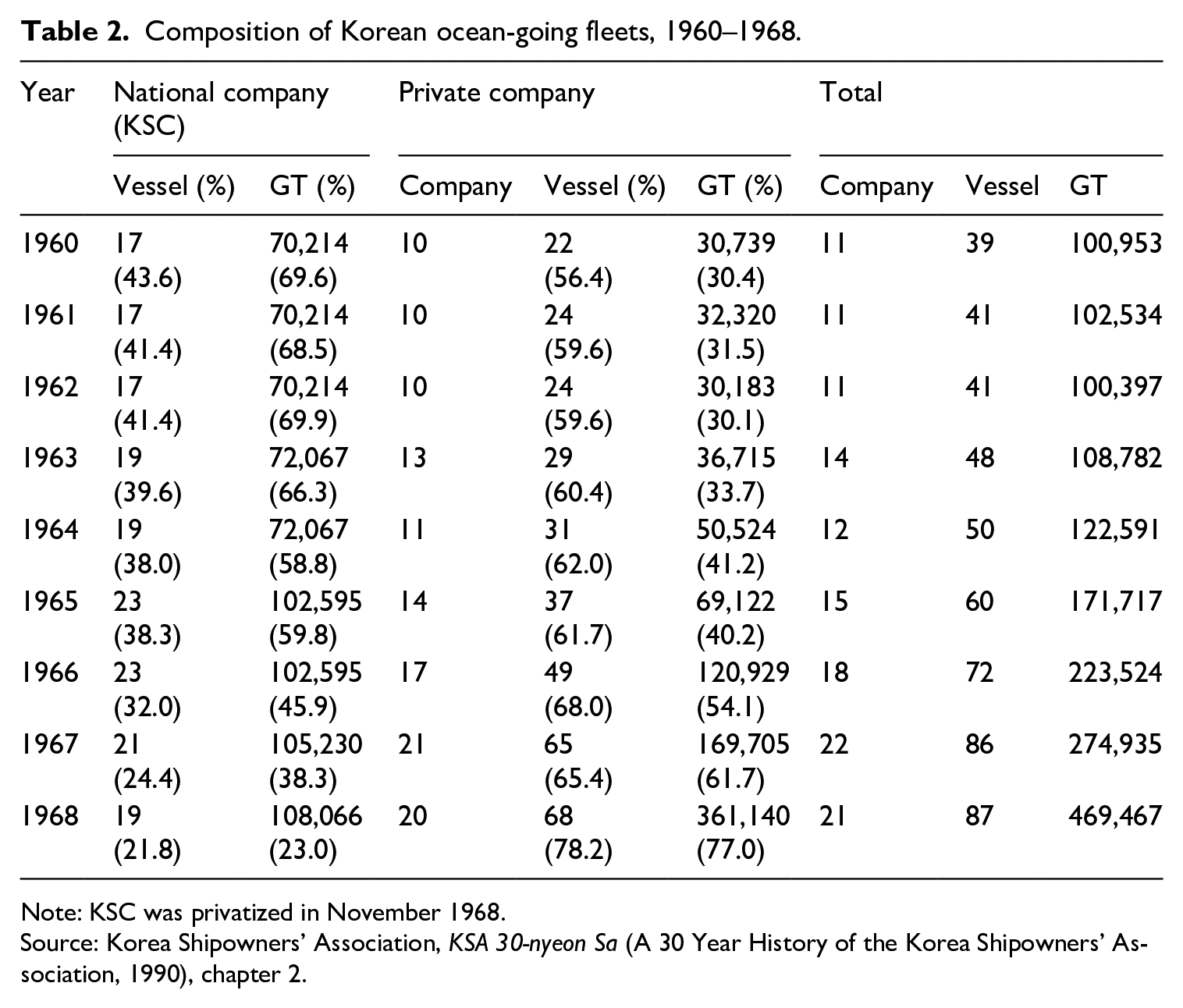
Note: KSC was privatized in November 1968.
Source: Korea Shipowners’ Association, KSA 30-nyeon Sa (A 30 Year History of the Korea Shipowners’ Association, 1990), chapter 2.
As it accounted for a smaller portion of the ocean-going shipping market in Korea in the late 1960s, the privatization of KSC did not pose any severe problems. In reality, all the Korean national flagged ships, including KSC’s tonnage, transported around one-quarter of total seaborne cargo through the 1960s, with around 75% of international cargoes carried by foreign vessels (see Table 9).
During the 1960–1968 period, the means of acquiring vessels were to build vessels with a Korean government loan and to purchase Japanese second-hand vessels with a Japanese loan. Since the military government implemented the FyEDP from 1962, shipowners, the purchasers of the ship, were provided with a shipbuilding loan in order to develop the shipbuilding industry through the Five-year Shipbuilding Plan. As shown in Table 4, the consumers were selected for three years from 1962 to 1964. As a result, Shin Tae-bum, the Korea Marine Transport Company (hereafter KMTC), and the Pungkuk Shipping merged into the umbrella of KMTC with three newly built ships. KMTC owned only one ship of 833 GTs in 1963, but its tonnages grew to five ships of 15,515 GTs in 1966, making it one of the top three shipowning companies in Korea. 5 CK Line, founded in 1962, bought its first ship with a government shipbuilding loan, and then grew into one of the major shipowners, focusing on near-sea liner services. 6 Namsung Shipping, established in 1954, operated one ship of 670 DWTs and added one newly built ship of 500 GTs in 1964. Choyang Shipping entered into the business by taking over two second hand vessels of 3,876 GTs from Yian Shipping in 1963 and was also able to able to expand by securing one newly built ship of 2,600 GTs, and two Japanese second-hand vessels of 7,287 GTs, in 1965 and 1966. 7
The government’s shipbuilding loan programme was the cornerstone of its shipbuilding development policy, and was therefore incorporated into the Planned Shipbuilding (Keihek Zoseon) 10 years later, which became the basic policy for fostering shipbuilding and shipping industries in Korea (refer to Table 3). The four companies selected as customers in the Five-year Shipbuilding Plan were quite small-scale at the time of selection, but they used this project to establish themselves as ocean-going shipping companies by acquiring newly built vessels. They succeeded in achieving capital accumulation in the boom due to the increase in seaborne trade volume that followed the consecutive implementation of the FyEDP and the Normalization of Diplomatic Relations with Japan from 1966. Many shipping companies founded in the 1950s and 1960s were bankrupt and extinguished in a short time, while these four companies grew into medium-sized ocean-going shipping companies in Korea By 2019, the three companies, excluding Choyang Merchant Marine, which was broken up in 2001, had been in operation for more than 60 years.
Government Shipbuilding Loan Programme, 1962–1966.

Source: Korea Shipbuilding Corporation, Daehan Chosun Gongsa 30-nyeon Sa (A History of Korea Shipbuilding Corporation, 1968), 192; CK Line, Chunkyung Haewoon 50-nyeon Sa (A 50 year History of CK Line, 2012), 68.
The other way of acquiring vessels was to purchase Japanese second-hand vessels with a Japanese loan. The mid-1960s was a period of rapid economic growth in Japan, which entailed the modernization of merchant fleet and the disposal of older, inefficient vessels. Accordingly, Japanese trading companies such as Mitsui and Iwai offered loans to assist Korean shipping companies in the purchase of second-hand vessels. According to Sohn, ten Korean private shipping companies purchased 13 ships of 35,693 GTs in 1965–1966. The average age of these ships was 16.7 and the average size 2,745 GTs. Whereas four ships were bought with the shipowners’ own capital, nine were purchased with loans of up to 80% of the cost at an interest rate of 5.75%. 8 The main buyers of Japan’s older vessels were underdeveloped countries like Taiwan, Thailand, the Philippines, China and Korea, along with flag of convenience states such as Hong Kong, Panama and Liberia. Korea was very proactive in this market.
In sum, with hindsight, 1960–1968 was essentially the preparation period for the takeoff of the Korean ocean-going shipping industry that took place in the next decade.
The rise of private shipping companies, 1969–1981
The KSC led the Korean ocean-going shipping industry until 1968, but the private shipping companies were to take responsibility for carrying seaborne trade from 1969 to 1981. As shown in Table 4, KSA membership increased nearly three times, the number of ships 5.6 times, and the gross tonnage 8.4 times from 1969 to 1981. The main reason for this was the surge in Korean economic growth, the increase in the volume of seaborne trade, government policy that sought to foster imports, exports and the shipping industry, and the active response of the shipping industry to these favourable conditions. Annually, on average, 5.8 new shipping companies joined the KSA, and 3.5 shipping companies per year were founded in the 1969–1981 period. Meanwhile, 1.6 shipping companies left the KSA or went out of business. There are two main reasons why the number of newly joined shipping companies was more than the number of newly established shipping companies. First, in the 1970s, the industrial corporations such as Hyundai, LG, Kukje, SK and Samik established shipping companies as subsidiaries that soon became KSA members. Second, the nominal shipping companies secured ships through the BBCPO and joined KSA. In particular, 1973–1975 marked the highest increase in the number of newly established shipping companies and new KSA members. As Table 4 shows, nine companies were established in 1973, five each in 1974 and 1975, and there were nine new KSA members in 1973, 16 in 1974 and five in 1975. As Tae-woo Lee confirmed, 9 it is clear that 1973–1975 was the take-off period for the Korean shipping industry in terms of the number of newly established companies and the number of shipping companies that joined the KSA.
Membership of Korea Shipowners’ Association, 1969–1981.
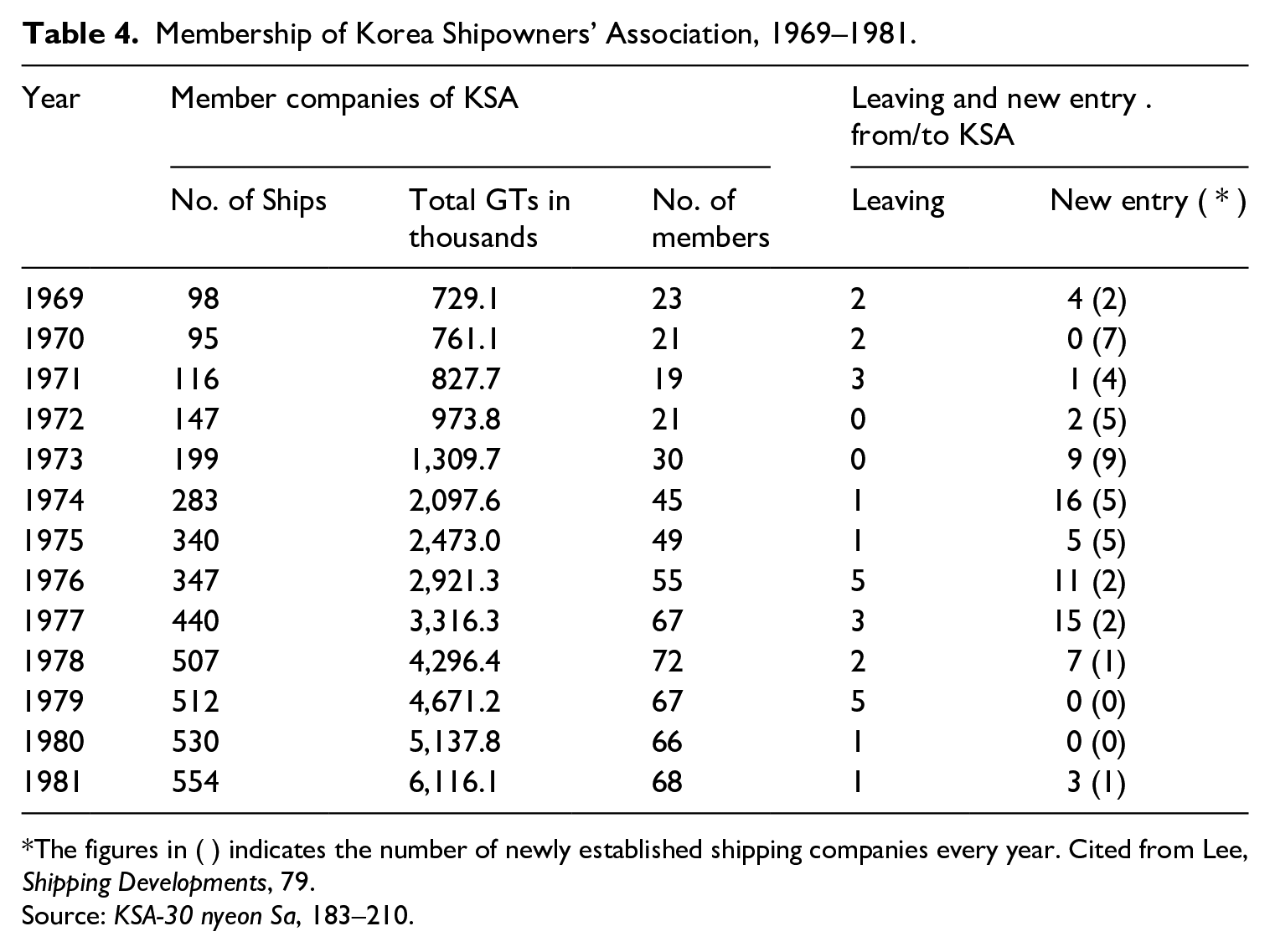
The figures in ( ) indicates the number of newly established shipping companies every year. Cited from Lee, Shipping Developments, 79.
Source: KSA-30 nyeon Sa, 183–210.
During the 1969–1981 period, the major methods of securing vessels were to acquire the vessels by bare boat charter with a purchase option (hereafter BBCPO) and to build ships through government-financed shipbuilding programme (Keihek Zoseon, planned shipbuilding). The method of acquiring ship by BBCPO started in 1964 with the Seoul Shipping Company chartering M/V Seoul and finally purchasing her under the Korean flag in 1967 (See Table 5 and Figure 1). 10
Composition of the Korean ocean-going fleets, 1969–1985.
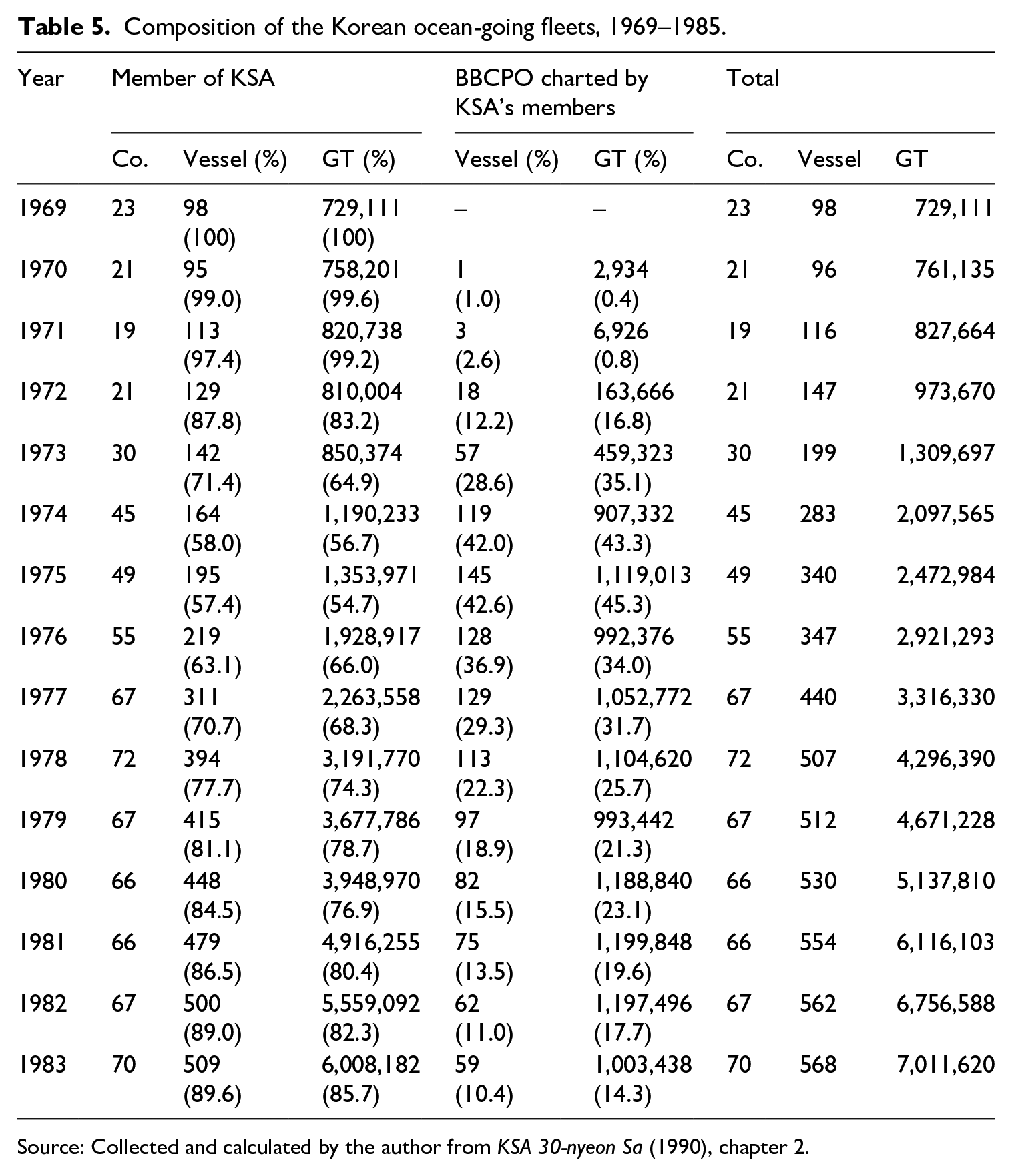
Source: Collected and calculated by the author from KSA 30-nyeon Sa (1990), chapter 2.
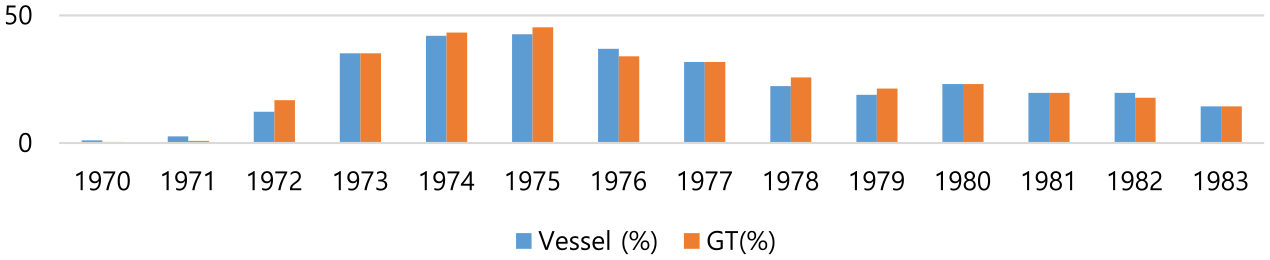
Percentage of the vessels acquired by BBCPO.
The acquisition of ships by BBCPO was regularized in 1970 when KMTC acquired one vessel of 2,934 GTs. This became widespread among the Korean shipowners after Choyang Shipping and CK Line acquired ships through BBCPO in 1971. 11 Table 5 shows that the tonnage acquired by virue of the BBCPO method rose from one ship of 2,934 GTs in 1970, to 145 ships of 1.1 million GTs in 1975, to 59 ships of 1.0 million GTs in 1983. The share of the tonnage acquired through BBCPO rose from under 1% of the total gross tonnages owned and controlled by KSA members in 1970 to 45% in the peak year of 1975. Thereafter, the share of the tonnage acquired through BBCPO decreased to 14% of the total gross tonnages owned and controlled by KSA members in 1983. The tonnage then dramatically decreased to 2,000 GTs in 1985, only 0.7% of newly acquired vessels in that year, due to the second oil crisis and a deep slump in the world shipping market. Of course, the tonnage acquired by BBCPO recovered to increase after 1985 and reach its highest point of 83% of newly acquired vessels among Korean shipowners in 1993 and 1995. 12
The other means of acquiring vessels in this period was to build the tonnage with the help of the government-financed shipbuilding programme (Keihek Zoseon). As a result of the development of heavy and chemical industries during the Third FyEDP (1972–76), the Korean shipbuilding industry expanded its capacity rapidly and became a strategic exporting industry. In 1973, as the Arab embargo increased oil prices, demand for tankers decreased and orders for tankers were cancelled in Japan and Europe. In this situation, the Korean shipbuilding industry also experienced a contraction in overseas shipbuilding demand. This was the background to the Korean government’s decision to establish the government-financed shipbuilding programme (Keihek Zoseon), the main aims of which were to develop the shipbuilding industry, link the industry to the shipping industry, and foster both industries together. 13
Thanks to Keihek Zoseon, Korean shipping companies acquired 1,259 ships of 4.81 million GTs from 1975 to 1993, which constituted 14% of the total orders submitted to Korean shipbuilders. 14 In the 1975–1981 period, a total of 97 new ocean-going ships amounting to 1,365 million GTs were ordered under this scheme (see Table 6). According to Tae-woo Lee, the tonnage of bulk carriers amounted to about 1 million GTs; that is, 78.5% of the total tonnage ordered under the scheme. Container ships accounted for 0.2 million GTs or 17.9% of the total tonnage, and tankers only 45,600 GTs or 3.6% of the total tonnage. The deadweight tonnage completed during the same period amounted nearly 11% of the Korean merchant fleet at the end of 1981. The government-financed shipbuilding scheme contributed to the expansion of the Korean merchant fleet, resulting in a 13.8% expansion in fleet capacity in 1975–1981. 15
Tonnage acquired by planned shipbuilding (Keihek Zoseon), 1975-1981.

Note: Based on the end of February 1982.
Source: KOMARES, Hyundai Haewoon Baljeon 40-nyeon Sa (A 40 year History of the Development of the Modern Korean Shipping Industry, 1984), 582.
The rules for the planned shipbuilding programme included the shipowners’ self-finance of 10% (8% of all container carriers), 50% of domestic fund loan at an initial interest rate of 13–14% at the initial stage of Keihek Zoseon Scheme for a total of 10.5 years including two and a half year grace period, and the rest with a foreign currency re-loan for a total of seven years including a two year grace period. Table 7 shows the details of the financing source for the planned shipbuilding from 1975 to 1981.
Sources of finance for planned shipbuilding (Keihek Zoseon), 1975–1981.
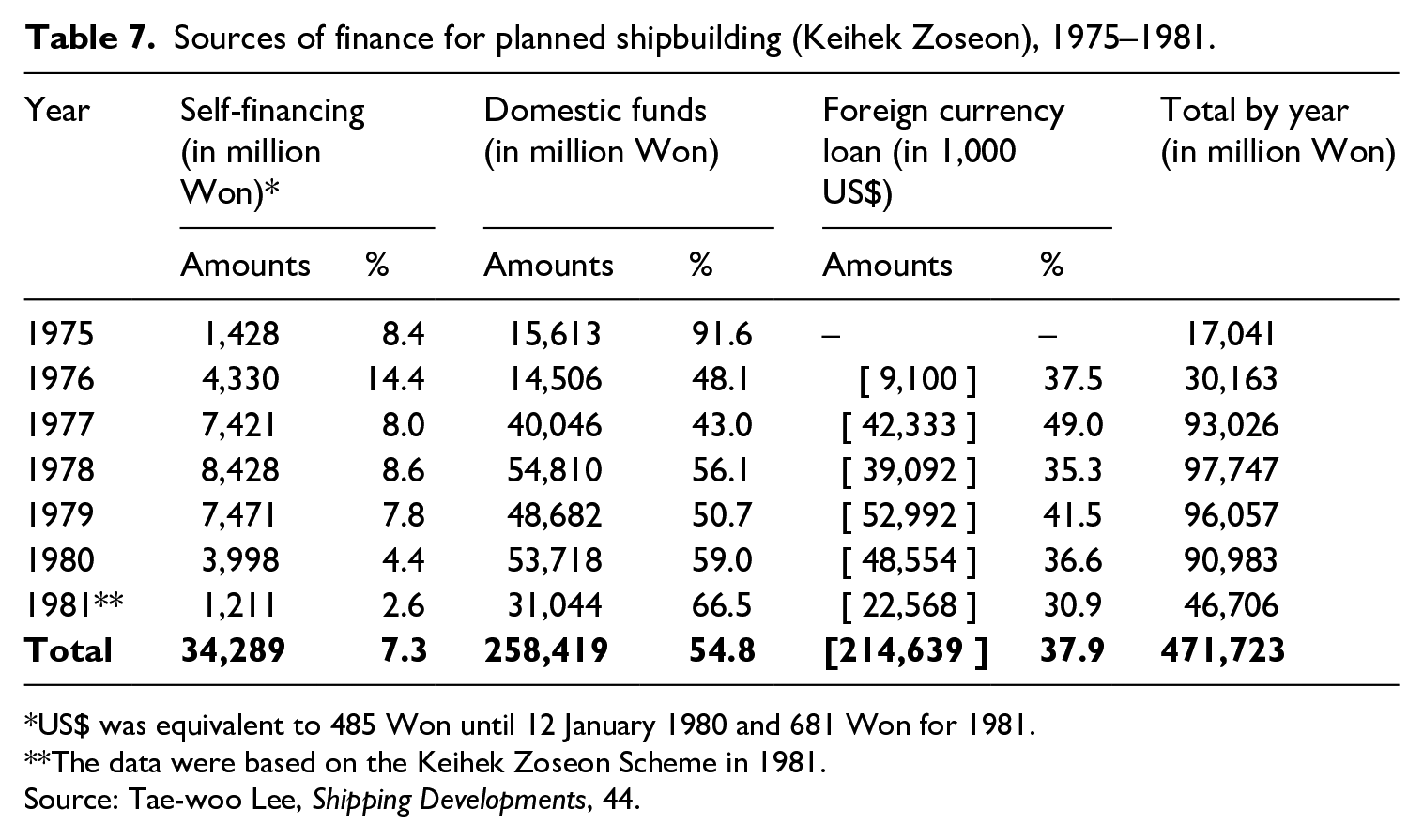
US$ was equivalent to 485 Won until 12 January 1980 and 681 Won for 1981.
The data were based on the Keihek Zoseon Scheme in 1981.
Source: Tae-woo Lee, Shipping Developments, 44.
In sum, this was the takeoff period for the Korean ocean-going shipping industry.
Private shipping enterprise in Korea: Drivers of change
Although some authorities, such as Sletmo and Goss and Marlow, argue that state policy in Britain was counter-productive as far as shipping was concerned in the age of free trade, 16 there is little doubt that government policy can exert a positive influence on the economic development of countries in the early stage of industrialization. 17 Korea offers a very good example of this, especially with regard to its maritime interests. Sohn insisted that government policy played a great role for the expansion of the shipping industry in Korea. According to him, the Korean government implemented various policies such as the foundation of a national shipping company, tax exemption, waiver system, financial supports and government-financed shipbuilding (Keihek Zoseon) in order to promote the shipping industry, which was indispensable in the economy’s development. 18
Tae-woo Lee also reviewed the role of government on the rapid growth of the Korean shipping industry in terms of financial assistance, taxation, the government-financed shipbuilding program (Keihek Zoseon), port investment and the waiver system. He described it as follows: An export-oriented industrialization policy brought about rapid export growth, which in turn increased the imports of raw materials in Korea since the early 1960s. As a result, the extensive expansion of foreign trade has been achieved and has caused the government to accelerate the expansion of the merchant fleet . . . thanks to the export-led economic industrialization, rapid export growth in the period of 1962–1981 was a relevant factor which helped to determine shipping growth . . . The expansion of shipping in Korea was a response to the export-oriented industrialization policy.
19
S. June Kim has also contended that there was a close inter-relationship between government policy and the rapid growth of the Korean ocean-going shipping industry in the 1967–1999 period. 20
The statistical expansion of the international imports and exports and seaborne trade volume will now be reviewed to establish the context in which the rapid growth of private shipping companies occurred, with particular emphasis the entrepreneurial role of merchant marine officers.
The expansion of trade in an export-driven economy
Korea has experienced rapid economic growth in a short period of time. In particular, the Korean economy grew quickly as the military government pursued export-led economic development through the FyEDP from 1962. In the 1962–1981 period, the government implemented four successful FyEDPs. Table 8 shows the trends in exports and imports, and economic growth rate by year from 1960 to 1981. The Korean economy grew annually by 7.88% on average during the first FyEDP (1962–66), 9.74% during the second FyEDP (1967–71), 10.18% during the third FyEDP (1972–-76), and 5.7% during the fourth FyEDP (1972–81). According to Tae-woo Lee, ‘the essence of the outward-looking strategy adopted in the early 1960s was to promote labor-intensive manufacturing exports in which Korea had a comparative advantage. Moreover, the expansion of Korea’s exports necessitated a corresponding increase of imports for the export production.’ 21
International Trade and Economic Growth by Year (Units: US$ Million).

Source: The Bank of Korea, Economic Statistics Year Book 1983, pp.6;9, at ecos.bok.or.kr.
As a consequence, the volume of seaborne trade grew by 17.6% per year in the 1960–1981 period, as Table 9 indicates, rising from 3.03 million tons in 1960 to 11.5 million tons in 1967 and 105.3 million tons in 1981. Unlike international trade, which showed a deficit through the 1960–1981 period, the volume of seaborne trade transported by the Korean flagged ships steadily increased. The percentage of trade volume transported by the Korean merchant fleet fluctuated in the range of 20% from the 1960s to the mid-1970s, then increased to 33% in 1976, and 38% in 1977, reaching a record high of 50.6% in 1978. These growth trends of international trade and trade volume were parallel with the expansion of the Korean national merchant fleet in the same period, as seen in Table 2 and 4. The latter was mainly due to the support of the government policy. Tae-woo Lee pointed out that among the various government policies to foster the ocean-going shipping industry, particularly the waiver system, which reserves major cargoes of imports and exports for the Korean flag, contributed to the growth of the Korean merchant fleet. 22 However, rapid fleet growth did not result simply from the waiver system, but from a broad range of supportive policies necessary to implement an export-driven policy. These policies included financial subsidies, the government-financed shipbuilding programme (Keihek Zoseon), waiver system, taxation and the education of seafarers, including merchant marine officers. In essence, the Korean government implemented all means to support the development of the shipping industry in the context of an export-led economy. 23
Seaborne trade volume and percentage of trade volume by flag, 1960–1981.

Source: Hyundai Haewoon Baljeon 40- nyeon Sa, 453, 498, 509, 531.
Figure 2 compares imports and exports, seaborne trade volume, and shipping tonnage owned by the KSA’s members. It is clear that the volume of seaborne trade rose as imports and exports grew, and the shipping tonnage also followed their increasing trends. While imports and exports rose moderately from 1960 to 1972, they increased sharply from 1972, whereas maritime trade volume showed a relatively modest upward trend over the 1960–1980 period. The tonnage owned by the KSA’s members increased moderately until 1964, but the rate of increase accelerated from 1964 to 1972, increasing sharply after 1972. As a result, Korean shipping tonnage in the 1960–1981 period tended to be more closely linked to the increase in imports and exports than seaborne trade volume.

Comparison of export and import, trade volume and shipping tonnage.
Sohn believes that the Korean shipping industry, which experienced stagnation until 1964, entered the period of capitalist development from 1965 in terms of a rapid growth of tonnage, a noticeable increase in the number of newly established ocean-going shipping companies, the entry of industrial capitalism into the shipping industry, and an increase in the capital of shipping companies. 24 Tae-woo Lee also confirmed that from 1962 to 1981, the Korean shipping industry was ‘very rapidly growing’ in terms of tonnage from 1966 to 1970, while 1966–1971 and 1975–1981 exhibited ‘very rapid growth’ in terms of the value added index, as shown in Table 10. 25
Comparison of the growth rate of shipping tonnage and index of value added.

Computed on the assumption of a geometric rate of growth between the first and last years of the specified periods.
Recalculation of the average index of value added in the specified periods including the specified first and last years.
Source: Tae-woo Lee, Shipping Developments, 25, 27.
Researchers have identified different phases of ‘very rapid growth’ in the Korean shipping industry because of the different tonnage statistics they have used. Sohn and Tae-woo Lee used the statistics of Lloyd’s Register of Shipping to calculate the tonnage, which includes small-sized vessels of more than 100 gross tons. However, the author includes the ocean-going tonnage just owned by KSA’s members and excludes all the coastal ships and very few ocean-going vessels owned by non-KSA operators. In order to analyze the driving forces for the rapid growth of the ocean-going shipping business, this study focuses only on the tonnage owned by KSA’s members, which includes most of the Korean ocean-going vessels.
There are several reasons for the rapid growth of the Korean ocean-going fleet from 1972. First, as shown in Table 5 and Figure 2, the acquisition of vessels by BBCPO began to regularize from 1972, and the government-financed shipbuilding programme started from 1975. Second, the ‘Act for the Promotion of Marine Transport’ was enacted in 1967 and various direct subsidies were provided to shipping companies, amounting to 1.235 billion Won (3.6 million US dollars) in 1968–1973. 26 Third, since the success of the first (1962–66) and second (1967–71) FyEDPs, the third FyEDP (1972–76) focused on the development of heavy and chemical industries, which required a large volume of shipping, with the industrial firms, including Hyundai, GS Caltex, Kyungin Energy (present SK Incheon Petroleum), Kukje and Samik, establishing subsidiary shipping companies between 1972 ad 1976. Taking these into consideration, it is reasonable to conclude that 1972 witnessed the start of the ‘very rapid growth’ of Korea’s ocean-going fleet.
Entrepreneurship
If it is accepted that ‘the rapid growth of shipping industry in Korea was a response to the export-driven industrialization’, 27 which group led this rapid expansion? While Sohn stated that the expansion of the Korean shipping industry was led by the merchant marine officers, 28 Tae-woo Lee also pointed out that the merchant marine education institution provided the maritime officers required to drive the expansion of the Korean shipping industry. 29 Here, the author will examine the entrepreneurship of the merchant marine officers who led the rapid growth of the ocean-going shipping industry. To this end, the meaning of entrepreneurship will be reviewed and the emergence of entrepreneurial spirits of merchant marine officers will be analyzed through a case study of shipping companies that have survived for more than 50 years.
Entrepreneurship may be defined as the ‘capacity and willingness to develop, organize, and manage a business venture along with any of its risks in order to make a profit'. According to this definition, ‘the most obvious example of entrepreneurship is the starting of new businesses’. 30 Riitta Katila et al. defined ‘entrepreneurial firms as those firms that start from weak market positions with few resources’. 31 From this point of view, entrepreneurship is mainly concerned with taking risks and establishing new enterprises. Of course, entrepreneurship does not only function in business start-ups, but is a factor in the development of existing companies.
According to David B. Audretsch et al., ‘the entrepreneur is able to recognize the commercial potential of the invention and organize the capital, talent, and other resources that turn an invention into a commercially viable innovation’. 32 In this sense, the term ‘entrepreneurship’ also captures innovative activities on the part of established firms, in addition to similar activities on the part of new businesses. Nonetheless, they are also more involved in the creation of a new company or industry. Peter F. Druker said that ‘entrepreneurs create something new, something different – they change or transmute values’. 33
The entrepreneurial ability of the maritime officers has played a role in the growth process of Korea’s ocean-going shipping industry. As shown in Table 11, 12 private shipping companies were founded during the 1950s, with 31 established in the 1960s and 39 in the 1970s. Table 11 also shows that the share of commercial capital decreased from 75% in the 1950s to 39% in the 1960s and 22% in the 1970s, whereas industrial capital increased rapidly from nil in the 1950s to 23% in the 1960s and 36% in the 1970s. This pattern infers that in the 1950s the size and scope of the Korean economy and ocean-going shipping industry was relatively small, so it was easy to enter into the shipping business with commercial capital alone. However, as the Korean economy and ocean-going shipping industry developed at a rapid rate, major industrial enterprises such as Hyundai, Daewoo, Hanjin, GS Caltex, Kyungin Energy, Kukje and Samik invested capital in the shipping business to carry their own cargoes and enhance their profits by establishing subsidiary shipping companies from the early 1970s.
Number of newly established shipping companies.
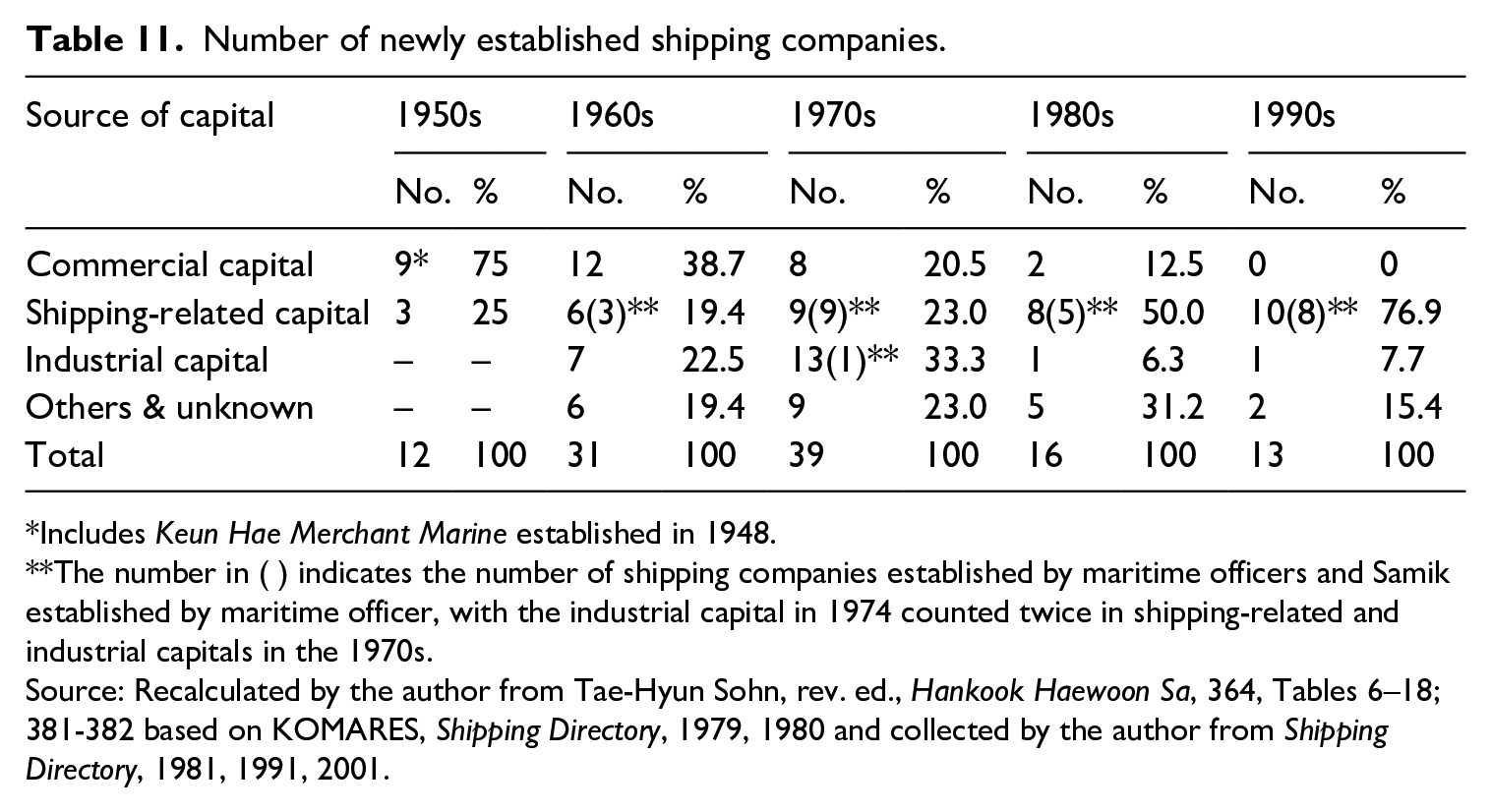
Includes Keun Hae Merchant Marine established in 1948.
The number in ( ) indicates the number of shipping companies established by maritime officers and Samik established by maritime officer, with the industrial capital in 1974 counted twice in shipping-related and industrial capitals in the 1970s.
Source: Recalculated by the author from Tae-Hyun Sohn, rev. ed., Hankook Haewoon Sa, 364, Tables 6–18; 381-382 based on KOMARES, Shipping Directory, 1979, 1980 and collected by the author from Shipping Directory, 1981, 1991, 2001.
Trends of the tonnage owned by five shipping companies over 50 years.

Notes: The gross tonnage includes BBCPO from 1971.
The data from 1964 to 1974 are based on the records of Namsung Shipping Co. and exclude one ship of 670 dwt from 1955 to 1970. Namsung owned six ships, 6,817 GTs in 1974, based on the record of KSA 30-nyeon Sa, 92.
Corrected from 1,046 in KSA 30-nyeon Sa, 178.
Sources: 1958-1983 = KSA 30-nyeon Sa, chapter 2; Heung-A Haewoon 50-nyeon Sa, 77.
Table 11 also indicates that shipping-related capital initiated shipping companies through the period, accounting for 25% of start-up shipping companies in the 1950s, 19% in the 1960s and 23% in the 1970s. It is also remarkable that the percentage of shipping companies established by maritime officers increased over time. There were no shipping companies established by merchant marine officers in the 1950s, but three in the 1960s and nine in the 1970s. This means that 10% of newly established shipping companies in the 1960s, and 23% in the 1970s, were founded by maritime officers.
Generally speaking, shipping-related capitalists, most of whom were originally merchant marine officers (the operators of shipping agencies and coastal shipping companies), are familiar with the shipping business, but they do not have enough capital to acquire a large-sized ship required for overseas transportation. Therefore, to overcome these disadvantages and acquire an ocean-going vessel seafarers and managers of small businesses needed to deploy entrepreneurial skill. In Korea, maritime officers and managers of small shipping-related firms had business acumen, which explains why shipping-related capital accounted for 22.5% of newly established shipping companies in the 1950s, 1960s and 1970s.
The proportion of ocean-going shipping companies established by maritime officers increased sharply during the 1980s and 1990s. Based on the records listed in the Shipping Directory published by the Korea Maritime Research Institute, eight (50%) of the newly established 16 shipping companies in the 1980s were founded by shipping-related capital, of which five (31.2%) were established by merchant marine officers. In the 1990s, 10 (77%) out of 13 newly established shipping companies were initiated by shipping-related capital, and eight (61.5%) of them were established by maritime officers. This lends support to Sohn’s assertion that the Korean ocean-shipping industry was led by maritime officers. In this respect, Korea’s experience contrasted markedly with that of other emerging industrial countries such as Japan, Taiwan and China.
Entrepreneurship extends beyond establishing a company by overcoming difficulties and taking risks, and is important to the survival of firms. In 2019, five of Korea’s ocean-going shipping companies had been in business for more than 50 years. As their outline histories demonstrate (see Tables 12 and 13), entrepreneurial skills has enabled these five companies to survive longer than other shipping companies.
Types of development of five shipping companies over 50 years.
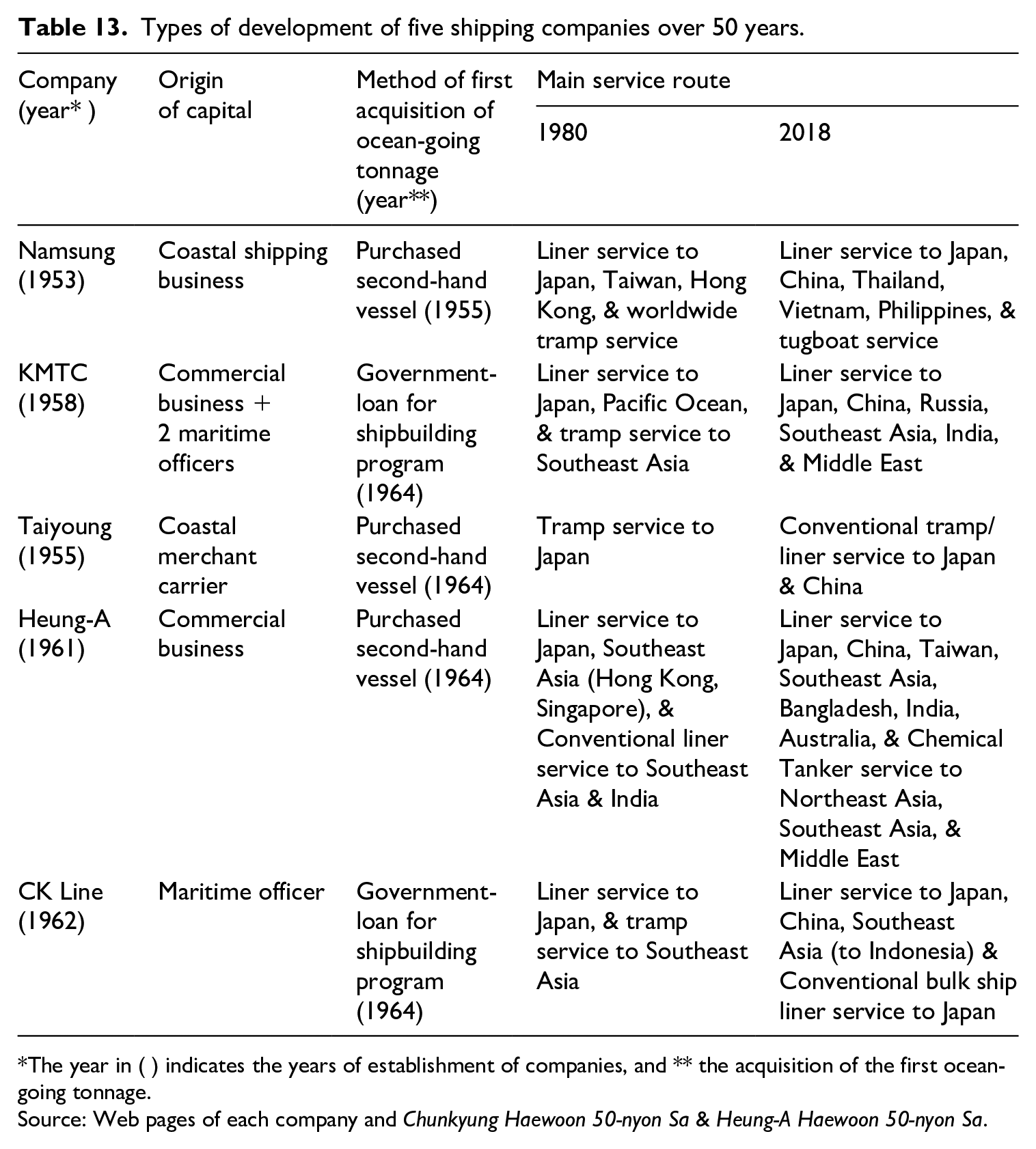
The year in ( ) indicates the years of establishment of companies, and ** the acquisition of the first ocean-going tonnage.
Source: Web pages of each company and Chunkyung Haewoon 50-nyon Sa & Heung-A Haewoon 50-nyon Sa.
Namsung shipping
This company started as a coastal passenger and cargo transport business with a small ship in 1953. In 1955, it expanded to ocean-going shipping business by deploying a ship of 670 DWTs to the irregular Busan-Osaka/Kobe route. It was selected as the first real customer by the government-loan for shipbuilding programme in 1962, acquiring a ship of 500 GTs in 1964. The company then expanded its services to include the regular Korea-Japan route in 1970, the Korea-South East Asia route in 1973, and the Korea-Taiwan route in 1976. In 1978, the firm entered into a full-fledged growth period by launching an irregular route around the world. As of 2019, it has been serving regular Japan, South East Asia, and Vietnam routes from Korea, and has been operating a regular Hong Kong-Vietnam-Thailand route. It also serves a worldwide tramp route. The company is the only coastal passenger carrier to develop into an ocean-going shipping company, 34 which is conservative and stability-oriented, enabling it to join the KSA as late as 1974, 20 years after it first deployed an ocean-going service (www.namsung.co.kr).
KMTC
The founder (Mr. Lee Hakcheol), who had conducted an oil storage business, started a coastal passenger transport business in 1958, and converted to ocean-going shipping business in 1964 upon being selected as the second purchaser of a ship with a loan from the government’s shipbuilding programme. The company merged with two firms that had been run by maritime officers – Shin Tae-bum, and then Pungkuk Shipping (owned by Park Hyun-kyu). As a result, it became the third largest ocean-going shipping company, which owned five ships of 15,515 GTs in 1966. 35 From 1970, the company began to expand its tonnage by acquiring vessels with BBCPO, and in 2018 operated regular services on the Korea-Japan, Korea-China, Korea-Southeast Asia, Korea-India and Korea-Middle East routes. KMTC has developed into a comprehensive logistics company including KCTC, KMTC Air-Sea Service, Korea Ferry, Camelia Line and KCTC International (www.kmtc.co.kr).
Taiyoung shipping
It began as a coastal merchant carrier in 1955 and became a coastal cargo carrier. In 1964, it became an ocean-going shipowner. This is the only firm in Korea that has developed from a coastal carrier to ocean-going carrier. 36 In 1976, it started to provide regular services between Korea and Japan. Currently, the company is also operating liner services on the Korea-Japan and Korea-China routes (www.taiyoungship.co.kr).
Heung-A shipping
This company started as a cement wholesaler (commercial capital) in 1953 and converted to a coastal cargo transport business in 1961. In 1964, it grew into an ocean-going shipping entity. In the early days, the company concentrated on the near-sea conventional tramp service (Korea-Japan route). However, it commenced a conventional feeder service between Korea and Japan in 1972 and added a chemical tanker service in 1976. It was also listed on the Korea stock market in 1977 as the first Korean shipping company. However, the death of its founder in 1980, and the bankruptcy crisis of its subsidiary company in 1984, caused a huge economic shock to the stock market and the local economy of Busan where it was based. The firm was eventually placed under legal management in 1985. The company sought normalization under a professional manager from 1986 and was out of court receivership in 2004. As of 2018, it was operating liner ships between Korea and Japan, China, Southeast Asia (Taiwan, Thailand, Vietnam, Philippines, Malaysia, Indonesia), and Indian routes under the name of Intra-Asia Shipping Company (www.heung-a.com). 37
CK Line
The founder, Mr. Kim Yunseok, was a merchant marine officer whose first venture was a marine refueling business in 1958. The company was selected as the second real customer for the ship by a government loan for shipbuilding programme in 1963, and as an ocean-going ship operator, deploying a ship of 512 GTs on an irregular Korea-Japan route in 1964. It became a member of the KSA in 1965, just one year after the first ocean-going ship was put into service. 38 It accumulated capital by offering Korean seafarers a supply service to Eastern Shipping, a subsidiary of Sanko Steamship in Japan, from 1967. In 2015, it was ranked 59th in terms of world container tonnage. As of the end of 2018, the company had established itself as one of the major carriers providing liner services on the Korea to Japan, China, Russia and Southeast Asia (Thailand and Vietnam) routes (www.ckline.co.kr).
Table 13 reveals a number of contrasts in the development of the five shipping companies that have survived for more than 50 years. Namsung and Taiyoung grew to be ocean-going shipping companies operating liner and tramp services to Vietnam and Japan/China respectively from small coastal shipping companies. Generally speaking, it can be said that they have been successful family businesses for the last two generations. Heung-A was founded as an ocean-going shipping company with commercial capital, but was under legal management for 20 years from 1985 to 2004 after the death of its founder (Mr. Yoon Jongkeun) and the bankruptcy of its sister company. Generally speaking, it can be said that Heung-A has survived due to its economic status as a listed company in the stock market and court receivership. On the other hand, KMTC and CK Line had different starting points, but when they were growing as ocean-going carriers, the merchant marine officers participated as partners or founders. These two companies have grown to become major ocean-going shipping companies operating liner services to India/Middle East and Indonesia respectively with the help of maritime experts’ management. This is because unlike the three other companies, the maritime officers have demonstrated their entrepreneurial qualities in overcoming the difficulties and taking risks by acquiring tonnage, opening new service routes, and developing their business to the fields of shipping agency, container yard operation, warehousing, cargo handling, freight forwarding business and inland transportation.
Concluding Remarks
The development process of ocean-going shipping industry focusing especially on the rapid growth of private shipping companies in Korea from 1960 to 1981 was examined. The author divided this period into two periods based on the privatization of KSC in 1968. As a result, during the period of 1960–1968, KSC, the state-owned shipping company, dominated the Korean shipping industry down to 1968, when it was privatized. Thereafter, private shipping companies led the way, with the crucial support of the government’s industrial policy, which was designed to deliver ‘export-driven industrialization’ through the import and processing of raw materials and the export of final goods. Stimulated by FyEDPs, international trade and trade volume increased steadily. In particular, in the third FyEDP period (1972–1976), the number of shipping companies increased rapidly as industrial concerns such as Hyundai, Daewoo, SK, GS Caltex, Samik and Kukje established subsidiary shipping companies to transport their own cargoes.
Sohn suggested that 1965 witnessed the onset of capitalist growth in the Korean shipping industry, 39 whereas Tae-woo Lee asserted that the Korean shipping industry experienced two great spurts in 1967 and in 1975 in terms of the tonnage and value added index respectively. 40 However, this article reveals that 1972 was the starting point of the rapid growth of the Korean shipping industry in terms of ocean-going tonnage owned by the KSA’s members. This was spurred by an entrepreneurial group in which merchant marine officers and managers of shipping-related businesses were prominent. This aligns with the academic literature on entrepreneurship, which infers that entrepreneurs are mainly concerned with establishing new enterprise by overcoming difficulties and taking risks, but are also instrumental to the survival of existing companies.
‘Entrepreneurship is an essential part of a manager’s ability to succeed in an ever changing and increasingly competitive global marketplace', such as the shipping industry. 41 As E. P. Lazear mentioned, ‘entrepreneurs differ from specialists’. 42 The maritime officer is a specialist in ship operation, but he is not a specialist in management. Generally speaking, a merchant marine officer has expertise and experience in ship operation and management, cargo management, and crew management and tends to have a dream of becoming a shipowner. Of course, most of the maritime officers are satisfied with the social status of high-salaried master mariners or pilots, but some of them attempt to move into ship ownership, a notable example being Mr. Chang Yung-fa, the founder of the Evergreen group in Taiwan. The Korean case suggests that a number of maritime officers with such vocational characteristics were willing to take risks and overcome difficulties in order to transform their stable seafarer’s position into the uncertain shipowner’s status by purchasing a ship requiring a large amount of capital. Even if the risk failed, there was the safety net of and onboard job to which the seafarers could return. Therefore, shipowners originated from the maritime officers, who had skill and know-how in the management of ships, cargoes and crew members, and were more likely to succeed in shipping business by demonstrating entrepreneurship in acquiring a vessel, opening new routes and developing new services. KMTC and CK Line in Korea support this contention. Many scholars classify entrepreneurship as ethnic, institutional, cultural, social, nascent, project-based and millennial. Reynolds and White, for example, defined nascent entrepreneurship as ‘the use of the start up companies and other entrepreneurs to develop, fund, and implement solutions to social, cultural, or environmental issues’. 43 The entrepreneurship of former merchant marine officers in develoing KMTC and CK Line conformed to the nascent entrepreneurship model.
This contribution of maritime officers as an entrepreneurship in Korea shipping industry can be interpreted in the development economics perspective. Since Arrow showed the importance of externality in ‘learning by doing’, the role of human capital in economic development has been extensively examined. 44 Moreover, advocates of industrial policy such as Rodrik pointed out the significance of information externalities, especially in new ventures in developing countries. 45 The common logic of ‘learning by doing’ and information externality is that groups, such as maritime officers in the shipping industry, can accumulate productive capacity in the economic development process. In this case study, maritime officers had learned from their initial employment in shipping companies and could then deploy their knowledge and understanding in founding new shipping ventures.
The experience of the Korean shipping industry suggests that developing and under-developed countries not only need to concentrate on the external and quantitative growth of the economy and seaborne trade in order to promote their shipping interests, but should also seek to encourage the internal and qualitative entrepreneurial spirit of those engaged in manning, as well as owning, their main capital assets.
Footnotes
Funding
The author(s) disclosed receipt of the following financial support for the research, authorship, and/or publication of this article: This work was supported by the Korea Maritime and Ocean University Research Fund (2017-2018) and by the Ministry of Education of the Republic of Korea and the National Research Foundation of Korea(NRF-2018S1A6A01081098).
1.
UNCTAD, Review of Maritime Transport 2018 (Geneva, 2018), 30.
2.
Tae-hyun Sohn, original ed., Hankuk Haewoon Sa (A History of the Korean Shipping) (Busan, 1982) and revised ed., Hankuk Haewoon Sa (A History of the Korean Shipping) (Busan, 1997).
3.
Tae-woo Lee, Shipping Developments in Far East Asia: The Korean Experience (Avebury, 1996).
4.
Sung-june Kim, ‘A State–run Enterprise: a Bane or a Boon? A Case of the Korea Shipping Corporation, 1950–1968’, The Asian Journal of Shipping and Logistics, 31 (2015), 398.
5.
Sung-june Kim, MukamJehaeRok (A Life of Mukam Park Hyun-kyu) (Seoul, 2017), 114.
6.
CK Line, Chunkyung Haewoon 50–nyeon Sa (A 50 year History of CK Line) (Seoul, 2012), 59.
7.
Tae-hyun Sohn, rev. ed, Hankuk Haewoon Sa, 367; Korea Shipowners’ Association, KSA 30-nyeon Sa, 177.
8.
Tae-hyun Sohn, rev. ed, Hankuk Haewoon Sa, 367.
9.
Tae-woo Lee, Shipping Developments, 98.
10.
Won-cheol Lee, ‘A Study on Influence of BBCPO upon the Korean Shipping Industry’, Journal of Korean Shipping Association, 6 (May 1988), 19.
11.
KSA 30-nyeon Sa, 186.
12.
Sung-sook Song, ‘A Study on Contribution of the Bareboat Charter with Hire Purchase to the Development of the Shipping and the Shipbuilding Industry in Korea’ (Master’s dissertation, Hankuk University of Foreign Studies, 1997), 27.
13.
Tae-woo Lee, Shipping Developments, 42–3.
14.
Bong-min Jung, Maritime Economics (Seoul, 2015), 361.
15.
Tae-woo Lee, Shipping Developments, 43–5.
16.
Gunnar K. Sletmo, ‘The Rise and Fall of National Shipping Policies’, in Costa Th. Grammenos, ed., The Handbook of Maritime Economics and Business (London, 2002), 471–94; R. O. Goss and Peter Marlow, ‘Internationalism, Protectionism and Interventionism in Shipping’, in K. M. Gwilliam, ed., Current Issues in Maritime Economics (Dordrecht, 1993), 44–56.
17.
Bong-min Jung and Sung-june Kim, ‘Change of Shipping Industry Circumstances and Shipping Policy Directions of Developing and Developed Countries’, The Asian Journal of Shipping and Logistics, 28 (2012), 135–60.
18.
Tae-hyun Sohn, rev. ed, Hankuk Haewoon Sa, 367.
19.
Tae-woo Lee, Shipping Developments, 403–8.
20.
Sung-june Kim, ‘Government policy and the rise of a national shipping industry: Korea’s experience, 1967-1999’, The International Journal of Maritime History, 31 (2019), 285-307.
21.
Tae-woo Lee, Shipping Developments, 98.
22.
Tae-woo Lee, Shipping Developments, 98.
23.
See Sung-june Kim, ‘Government Policy’.
24.
Tae-hyun Sohn, rev. ed, Hankuk Haewoon Sa, 374–81.
25.
Tae-woo Lee, Shipping Developments, 25–7.
26.
Sung-june Kim, ‘Government Policy’.
27.
Tae-woo Lee, Shipping Developments, 61.
28.
Tae-hyun Sohn, rev. ed, Hankuk Haewoon Sa, chapter 6.1.
29.
Tae-woo Lee, Shipping Developments, 93.

31.
Riitta Katila, Eric L. Chen and Henning Piezunka, ‘All the Right Moves: How Entrepreneurial Firms Compete Effectively, Strategic Entrepreneurship Journal, 6 (2012), 117.
32.
David B. Audretsch, Barry Bozeman, Kathryn L. Combs, Maryann Feldman, Albert N. Link, Donald S. Siegel, Paula Stephan, Gregory Tassey & Charles Wessner, ‘The Economics of Science and Technology’, The Journal of Technology Transfer, 27 (2002), 157.
33.
Peter F. Drucker, Innovation and Entrepreneurship: Practice and Principles (London & New York, 1985), 22.
34.
Tae-hyun Sohn, rev. ed, Hankuk Haewoon Sa, 369.
35.
Sung-june Kim, MukamJehaeRok, 114.
36.
Tae-hyun Sohn, rev. ed, Hankuk Haewoon Sa, 369.
37.
Heung-A Haewoon 50-nyeon Sa.
38.
Chunkyung Haewoon 50-nyeon Sa, 61.
39.
Tae–hyun Sohn, rev. ed, Hankuk Haewoon Sa, 374.
40.
Tae-woo Lee, Shipping Developments, 98.
42.
Edward P. Lazear, ‘Entrepreneurship’, Journal of Labor Economics, 23 (2005), 650.
43.
P. D. Reynolds and S. White, The Entrepreneurial Process (Westport, CT, 1997).
44.
Kenneth Arrow, ‘The Economic Implications of Learning by Doing’, Review of Economic Studies, 29 (1962), 155–73.