



Abstract
Background:
Interleukin-37 (IL-37) can prevent liver damage and may be an important candidate for use as a novel therapeutic tool in hepatitis B virus (HBV) infection. This study aimed to evaluate the serum levels of IL-37 in individuals with chronic HBV (CHB) infection, those who spontaneously cleared (SC) HBV infection, compared with healthy control (HC) subjects.
Materials and Methods:
This case-control study included 30 patients with CHB (17 males, 13 females; mean age, 50.13 ± 14.51), 30 subjects with SC HBV infection (16 males, 14 females; mean age, 51.50 ± 16.85), and 42 HC subjects (22 males, 20 females; mean age, 53.52 ± 14.44). Blood samples were collected, and then serum IL-37 levels were measured using an enzyme-linked immunosorbent assay kit.
Results:
Our results showed that serum IL-37 levels were significantly higher in the CHB (96.99 ± 13.39 pg/mL) than in the HC group (37.85 ± 2.99 pg/mL, p = 0.02). No statistically significant differences were found in IL-37 serum levels between CHB group and SC group (91.93 ± 17.11 pg/mL, p = 0.43). Correlation analysis showed a significant negative correlation between serum IL-37 levels and age in SC subjects (p = 0.02, R = −0.42).
Conclusion:
Our results suggest that increased production of IL-37 may biologically act as a negative feedback loop to attenuate the release of pro-inflammatory cytokines and subsequently alleviate disease symptoms in CHB. The negative correlation between the cytokine and age may indicate that higher levels of IL-37 in younger individuals may lead to the spontaneous clearance of HBV.
Introduction
Hepatitis B virus (HBV) is an incomplete double-stranded DNA virus belonging to the Hepadnaviridae family that causes hepatitis B disease (Tsukuda and Watashi, 2020). Chronic hepatitis B (CHB) infection is defined by the presence of Hepatitis B surface antigen (HBsAg) in the sera of infected individuals for more than 6 months. This condition can cause a range of liver damage, from mild inflammation to severe complications such as fibrosis, cirrhosis, and even hepatocellular carcinoma (HCC) (Makuza et al., 2024; Wilkins et al., 2019). Samples showing anti-HBc antibody but negative for HBs antigen are considered HBV cleared (Burns and Thompson, 2014). The HBV virus can evade both adaptive and innate immune responses. There is clear evidence that HBV is able to drive the exhaustion of both HBV-specific T and B cells through peripheral tolerance. However, its interaction with innate immunity, particularly with myeloid cells, is highly contradictory (Kuipery et al., 2020). Interferons (IFNs) and cytokines may play an important role in the outcome of HBV. Viral clearance in HBV infection is supposed to be mediated by a broad range of immune cells (e.g., T and B lymphocytes, neutrophils, and natural killer cells) and cytokines (e.g., IFN-α, IFN-β, IFN-γ, IL-1β, and IL-6) (Ma et al., 2024; Xia and Protzer, 2017). IL-37 is a new cytokine of the IL-1 family with an anti-inflammatory property. IL-37 has some protective effects against infectious diseases, autoimmune diseases, and some types of cancer (Allam et al., 2020; Jia et al., 2018). IL-37 effectively inhibits tumor necrosis factor-alpha (TNF-α)-induced neutrophil activation and could potentially reduce liver injury by suppressing these cells (Jiang et al., 2023; Sakai et al., 2012). In addition, IL-37 enhances the Th2 immune response by increasing levels of IL-4 and IL-13. This promotes the activation of M2 macrophages, which increase anti-inflammatory markers such as IL-10 and IL-1Ra (Jiang et al., 2023). In addition, IL-37 suppresses M1 polarization by inhibiting the Notch1 and nuclear factor kappa B (NF-κB) pathways. This action effectively attenuates the Th1 response and reduces hepatic IFN-γ expression, thereby alleviating liver injury (Jiang et al., 2023; Zhou et al., 2020). Due to the novelty of this cytokine, very few studies have investigated serum IL-37 levels in immune-related diseases, especially in infections and cancers. Our previous studies have shown that elevated serum levels of IL-37 in patients with endometrial cancer, primary brain tumors, and transitional cell carcinoma of the bladder might affect disease outcomes (Haghshenas et al., 2021; Haghshenas et al., 2022; Haghshenas et al., 2023). IL-37 consists of five different isoforms (IL-37a, IL-37b, IL-37c, IL-37d, and IL-37e) (Su and Tao, 2021). IL-37b is a specific variant of IL-37 and has been shown to be a functional anti-inflammatory cytokine. IL-37b is generated by alternative splicing of the IL-37 gene. Of all the IL-37 variants, IL-37b has been the subject of the most extensive research and is the most widely expressed isoform. The other isoforms (e.g., IL-37c and IL-37e) are generally nonfunctional or functionally indeterminate (Gu et al., 2023). A few studies have demonstrated the significant role of IL-37 and/or its isoforms in HBV infection. In a Chinese population, serum IL-37b levels were found to be higher in patients with CHB but were lower in patients with HCC-HBV, particularly those with portal venous tumor thrombus (Pu et al., 2018). Furthermore, another Chinese study found that the serum levels of IL-37 were elevated in patients with CHB with high viral loads. However, the IL-37 levels decreased during telbivudine-based antiviral treatment (Li et al., 2013). It has been reported that IL-37 significantly reduced the expression of pro-inflammatory cytokines in chronic active hepatitis B (CAHB). (Meng et al., 2020). In infectious diseases, however, IL-37 may play an important role in dampening infection-associated inflammation, thereby benefiting inflammation-induced pathology (Allam et al., 2020). Accordingly, IL-37 may be a promising candidate for use as a novel therapeutic tool in HBV infection, particularly in the CHB (Feng et al., 2019; Li et al., 2013). However, the exact roles of IL-37 in infectious diseases, particularly HBV infection, remain largely unknown. Given the importance of this cytokine in inflammatory diseases, our study aims to investigate the serum IL-37 levels in patients with CHB and those who have successfully cleared the infection.
Materials and Methods
Subjects
This study included 30 patients with CHB who were recruited from the Gastroenterohepatology Research Center at Motahari Clinical Center, in Shiraz, Iran. Also, 30 subjects with spontaneously cleared (SC) HBV infection were selected from the national Kavar cohort study (Fattahi et al., 2014). SC status was additionally confirmed using enzyme-linked immunosorbent assay (ELISA) assays (Dia.Pro.Milano, Italy) for the presence of HBsAg and hepatitis B core antibody (HBcAb) according to the manufacturer’s instructions. All patients with CHB were diagnosed and selected based on clinical and laboratory findings. Exclusion criteria were simultaneous infection with hepatitis C virus (HCV), hepatitis D virus (HDV), and human immunodeficiency virus (HIV), as well as autoimmune diseases, cancers, and recent acute infectious diseases. The study also included 42 age- and gender matched healthy controls (HCs) from the population of southern Iran, with no history of chronic HCV, HDV, HIV infection, autoimmune diseases, cancers, and recent acute infectious diseases. This study was conducted according to the Ethics Committee of Shiraz University of Medical Sciences (IR.SUMS.MED.REC.1399.092), and written informed consent was obtained from all participants before sampling.
Measurement of IL-37 in serum by the ELISA method
Blood samples were collected and centrifuged at 2500 × g for 10 min at 4°C to separate the serum. Serum was stored at −70°C until assayed. Serum IL-37 levels (all isoforms) were measured using an IL-37 sandwich ELISA kit (Shanghai Crystal Day Biotech Co., Ltd., Shanghai, China). This commercial ELISA kit had an assay range of 7–400 pg/mL with a sensitivity of 4.5 pg/mL.
Statistical analysis
Data were analyzed using SPSS 22 software. The normal distribution of the data was tested using the Kolmogorov–Smirnov test and, due to non-normality, the nonparametric tests (e.g., Mann–Whitney U and Kruskal–Wallis H) were used. The Spearman rank correlation test was used to compare the correlation between serum IL-37 levels and age. Variables are presented as median and mean ± standard error of the mean. p-Values less than 0.05 were considered statistically significant.
Results
Demographic results
The mean age of CHB, SC, and HC groups was 50.13 ± 14.51 (ranging from 29 to 85), 51.50 ± 16.85 (ranging from 18 to 86), and 53.52 ± 14.44 (ranging from 20 to 86), respectively, which was not significant among the groups (p ≥ 0.05). Moreover, 17 (56.7%) patients of CHB group, 16 (53.3%) subjects of SC group, and 22 (52.4%) of individuals of HC group were male. Furthermore, 13 (43.3%) patients of CHB group, 14 (46.7%) subjects of the SC group, and 20 (47.6%) individuals of HC group were female.
Comparison of serum IL-37 levels between CHB, SC, and HC groups
The serum levels of IL-37 in 30 patients with CHB were 96.99 ± 13.39 pg/mL, in 30 patients of the SC group were 91.93 ± 17.11 pg/mL, and in 42 healthy subjects of the control group were 37.85 ± 2.99 pg/mL. Statistical analysis showed that serum levels of IL-37 were significantly higher in the CHB than in the control group (p = 0.02). Our results showed that serum levels of IL-37 were higher in the SC subjects than in the control group. However, the difference was not statistically significant. (p = 0.16). No statistically significant differences were found in IL-37 serum levels between CHB group and SC group (p = 0.43). The serum levels of IL-37 in the investigated groups are shown in Figure 1.
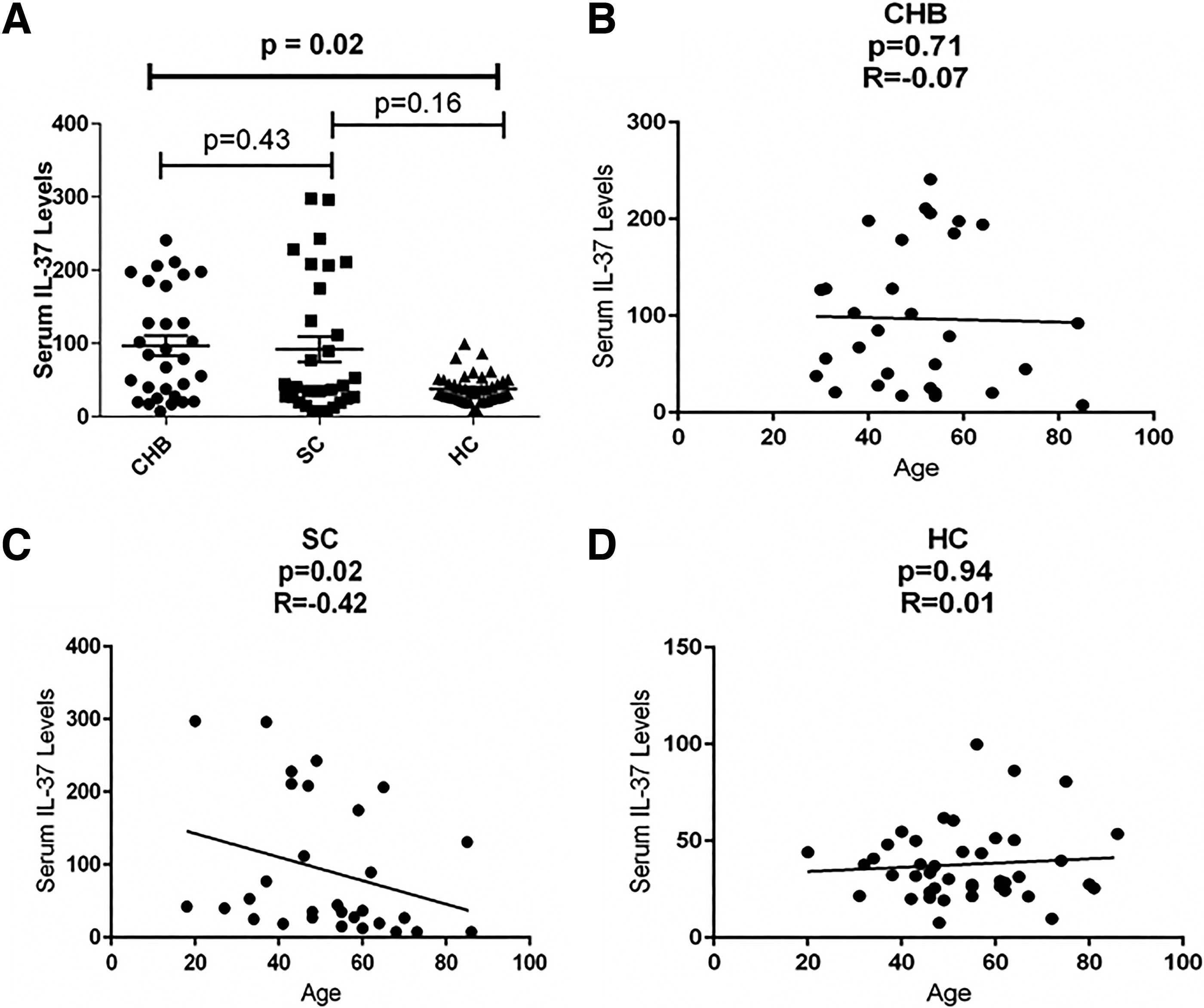
Serum IL-37 levels and correlation analysis in chronic hepatitis B, spontaneously cleared, and healthy control groups:
Investigation of serum IL-37 levels in investigated groups based on gender
The serum levels of IL-37 in the CHB group were 84.70 ± 18.74 pg/mL in men and 113.06 ± 18.67 pg/mL in women. However, this difference was not statistically significant (p = 0.21). The mean serum levels of IL-37 in the SC group were 75.81 ± 19.77 pg/mL in men and 110.36 ± 28.91 pg/mL in women. Similarly, this difference was not statistically significant (p = 0.42). The serum levels of IL-37 in men in the HC group (40.93 ± 5.25) were higher than in women (34.47 ± 2.40 pg/mL), but not statistically significant (p = 0.76). The serum levels of IL-37 in the investigated groups according to gender are shown in Table 1.
Serum IL-37 Levels in the Investigated Groups According to Gender
SEM, standard error of the mean.
Correlation analysis between serum IL-37 levels and the age variable in the investigated groups
Correlation analysis using Spearman’s test showed that there was a significant negative correlation between serum IL-37 levels and age in SC subjects (p = 0.02, R = −0.42, n = 30). However, no significant correlation was found between the serum IL-37 levels and age in CHB subjects (p = 0.71, R = −0.07, n = 30) and HC groups (p = 0.94, R = 0.01, n = 42). Data are shown in Figure 1.
Discussion
Our study showed that serum IL-37 levels were significantly elevated in patients with CHB compared with HC groups. It has been reported that the serum levels of IL-37 were higher in HBe-antigen (HBeAg)-positive patients with CHB with high virus load; however, the differences were not statistically significant. Interestingly, cytokine levels decreased during telbivudine treatment (Li et al., 2013). Interestingly, the increase in IL-37 concentration in HBV infection was related to virus load, HBeAg, and/or other unknown factors (Li et al., 2013). Correspondingly, the other study concluded that levels of IL-37 significantly increased in the supernatant of peripheral blood mononuclear cells (PBMCs) from CAHB (Meng et al., 2020). The increase in serum IL-37 levels is probably a protective mechanism of the body to suppress the inflammatory response in CHB. The evidence has exposed that IL-37 exerts a protective effect in tissue damage; however, the consequence of IL-37 on liver injury in patients with CHB and/or chronic hepatitis C virus (CHC) infection is still unrevealed (Li et al., 2013). Additionally, the serum IL-37 levels were found to be increased in patients with CHB and CHC with abnormal levels of serum alanine transaminase (ALT) (Li et al., 2013). The increase in serum IL-37 levels following the increase in ALT is probably to prevent the excessive inflammatory damage in CHB. In other words, IL-37 probably acts as a regulatory cytokine in immune tolerance in CHB infection (Li et al., 2013). IL-37 could fundamentally suppress the sustained intrahepatic production of IFN-γ and TNF-α, two key cytokines for the induction of hepatocyte apoptosis and liver fibrosis in T-cell-dependent liver injury (Feng et al., 2019). Furthermore, it has been reported that IL-37 can significantly downregulate the expression of IL-1b, IL-6, and TNF-α in CAHB PBMCs (Meng et al., 2020). Accordingly, our results may suggest that increased production of IL-37 in CHB may biologically act as a negative feedback loop to attenuate the release of pro-inflammatory cytokines and subsequently alleviate disease symptoms. Our project and the majority of previous studies detected all isoforms of IL-37 (not the individual isoforms). However, a study explored the b isoform of IL-37 in patients with CHB among the Chinese population. Their results showed that IL-37 b serum levels were higher in patients with CHB compared with healthy individuals (Pu et al., 2018). A detailed study is needed to determine the exact role and therapeutic efficacy of IL-37 and/or its isoforms particularly IL-37b in CHB. In addition, our results showed that serum levels of IL-37 were higher in the SC subjects than in the control group; however, this difference was not significant. This finding may suggest that the increased IL-37 secretion in SC subjects might be a physiological mechanism that facilitates spontaneous clearance of HBV. Genetic factors as well as the innate and adaptive immune responses of the host are the most important determinants of the outcome of HBV infection (Zhang et al., 2019). Cytokines play a critical role in regulating the differentiation, proliferation, and function of immune cells. The balance between pro-inflammatory and anti-inflammatory cytokines is likely responsible for the clearance or persistence of HBV infection (Ribeiro et al., 2022; Wu et al., 2015; Xia and Protzer, 2017; Zhong et al., 2021). Additionally, the high variability in IL-37 levels in the SC group (standard deviation [SD] = 17.11 pg/mL) may suggest that cytokine levels might be influenced by factors such as age or time since HBsAg seroclearance. Consistent with this, our data revealed a significant negative correlation between IL-37 levels and age in the SC group. Cytokine dysregulation has been shown to contribute to immune system remodeling in older age (Rea et al., 2018). Circulating IL-37 was associated with various health span indicators, suggesting its potential role in biological aging (Brunt et al., 2023). Despite elevated pro-inflammatory markers, IL-37 levels were found to decrease with age. (Brunt et al., 2023). Therefore, lower levels of IL-37 may indicate a reduced ability to control inflammation in older people. Our findings may suggest that in younger people, with a more efficient immune system, high levels of this cytokine may contribute to effective viral clearance. However, data on time since HBsAg seroclearance were unavailable in this study, limiting our ability to assess its impact.
In addition to HBV, this cytokine has been shown to have a significant role in other viral infections. In this regard, a study demonstrated that serum IL-37 levels were significantly higher in HIV-infected individuals compared with those of HCs, a situation that was associated with certain clinical parameters of the disease. Interestingly, recombinant human IL-37 was found to be associated with a reduction in inflammation as well as HIV replication (Samarani et al., 2019). In viral pneumonitis caused by the influenza A (H1N1) virus, administration of L-37 was associated with increased survival and decreased lung injury and production of pro-inflammatory cytokines in a mouse model (Qi et al., 2019). IL-37 was considered for its potential role in the immune pathogenesis of COVID-19. IL-37 was found to be downregulated in the serum of patients with severe COVID-19 compared with HCs. This downregulation may increase the risk of disease severity and progression and may be influenced by factors such as gender, BMI, blood group, and chronic disease status (Ahmed and Ad’hiah, 2021). In addition to the detection of total IL-37 in infectious diseases, a previous study has demonstrated that the serum levels of the IL-37b isoform, as well as the number of IL-37b-producing monocytes, were significantly higher in patients with dengue fever caused by dengue virus than in the HC group. However, there was no correlation between C-reactive protein, an index of tissue damage, and IL-37 levels. (Zhang et al., 2023). The data regarding infectious disease may suggest that IL-37 could inhibit inflammation as well as excessive immune responses and thereby could have a protective role against a variety of infectious diseases.
In summary, our results indicate that serum IL-37 levels are significantly elevated in patients with CHB compared with the HC group. Our results may suggest that increased production of IL-37 may biologically act as a negative feedback loop to attenuate the release of pro-inflammatory cytokines and subsequently alleviate disease symptoms in CHB. The negative correlation between the cytokine and age may indicate that higher levels of IL-37 in younger individuals may lead to the spontaneous clearance of HBV. The unavailability of additional markers (e.g., ALT and nucleos(t)ide analogues (NUCs) treatment status) represents a limitation of this study. Consequently, the findings should be regarded as preliminary observations, requiring validation in larger cohorts, particularly for SC cases, with further investigation into their association with clinical and viral markers.
Footnotes
Authors’ Contributions
S.K.: Methodology (equal); Software (lead); Formal analysis (equal); Writing—original draft (equal). E.R.: Methodology (equal); Formal analysis (equal). A.K.: Methodology (equal); Formal analysis (equal). M.B.: Methodology (equal); Writing—original draft (equal). V.M.: Sample collection and clinical information (supporting); Methodology (equal). J.S.: Conceptualization (supporting); Sample collection and clinical information (lead); Supervision (supporting); Review and editing (supporting). M.R.H.: Conceptualization (lead); Supervision (lead); Funding acquisition (lead); Software (supporting); Formal analysis (equal); Review and editing (lead). All authors have read and agreed to the published version of the article.
Author Confirmation Statement
All authors are from Shiraz University for Medical Sciences (Shiraz, Iran), where education and research are the primary functions.
Author Disclosure Statement
No competing financial interests exist.
Funding Information
This project was conducted as the MD thesis of Erfan Rostami, and it was financially supported by grants from Shiraz University of Medical Sciences, Shiraz, Iran (Grant No. 21495), as well as Shiraz Institute for Cancer Research, Shiraz University of Medical Sciences, Shiraz, Iran (ICR-100-503).