




Abstract
Planners and elected officials may not be familiar with employment or educational barriers faced by immigrants or understand cultural traditions and practices or how to handle the issue of an increase in unauthorized immigrants. We identify policy gaps, a growing body of research on planning for unauthorized immigrant communities, and some emergent best practices for immigrant incorporation. What can the city do, and how are cities limited? What models developed for planning with and for immigrant communities, adapting to immigrant needs, and managing change in cities that have not traditionally had large immigrant populations?
Keywords
A demographic hallmark of the twenty-first century in the United States has been the increasing dispersion of foreign-born populations from traditionally multicultural “gateway cities” like Los Angeles, New York, and Miami to a wide diversity of communities, whether urban, suburban, or rural. Approximately one-quarter of these foreign-born individuals are estimated to be unauthorized, or undocumented, immigrants (Zong and Batalova 2016; http://www.migrationpolicy.org/article/frequently-requested-statistics-immigrants-and-immigration-united-states). They represent not only an undeniable presence but also, in many communities, a key component of the local economy. Unauthorized immigrants remain, however, an extremely vulnerable population (Restaurant Opportunities Center of New York and New York City Restaurant Industry Coalition 2005; Varsanyi 2008). Not only are they primarily low income, have low educational attainment, and frequently confront a significant language barrier, but they also face additional challenges specifically related to their precarious legal situation.
As the demographics of smaller towns and cities have changed to include larger numbers of permanently settled immigrants, local leaders are advocating for new plans and policies that welcome immigrants to their communities. At times, these public efforts by cities across the country to become more inclusive are met with resistance or resentment by other residents (Welcoming America: Dayton, Ohio), and in some cases, efforts to attract immigrants are deliberate campaigns to deal with population loss (Welcoming America: Minneapolis, Minnesota). That a large portion of the immigrant community includes and encompasses unauthorized individuals and “mixed-status” families (families with varying levels of citizenship and residency status) presents city and county officials with additional challenges for “immigrant integration” efforts (Pastor and Mollenkopf 2012).
While planning literature has begun to address general issues pertaining to immigrant communities with greater specificity around issues of local economic development, demographic change, available services, and/or resources for immigrants, very little has focused on the role that planners can play in creating more livable communities for residents regardless of their citizenship status.
What is the planner’s role in incorporating and addressing the needs of this vastly underserved population, given the responsibility of planners to “seek social justice by working to expand choice and opportunity for all persons.” 1 How have planners conceived of this issue, and how have practitioners addressed or ignored unauthorized immigrant communities? This article examines how planners and planning scholars can recognize undocumented people as stakeholders with specific needs and accompanying challenges. It reviews how planning scholarship conceives of planners’ relationship to undocumented immigrant communities, looks to the history and present-day best practices of equity and advocacy planning to derive a mandate for incorporating this population into the planning dialogue, outlines specific issues that planners should be attuned to, and offers recommendations for practice and further research.
Scaling Responses to Unauthorized Immigration
Economic growth in the United States that is linked to unauthorized immigrants in the workforce is remarkable: 11.2 billion in taxes were paid by individuals with mismatched tax identification numbers, with the largest portion of that coming from California. 2 Across the board, all US states have become more and more reliant on the tax dollars of unauthorized immigrants, and this includes personal income taxes paid to the state and federal government, sales taxes, and property taxes—a total of about 12 billion dollars per year (Kim 2015). While California leads in the amount of taxes generated from estimates of the work of unauthorized households, Texas, Florida, New York, Illinois, Georgia, New Jersey, Arizona, and North Carolina round out the top ten states in collected taxes from unauthorized immigrant workers. 3
These dollars are the footprints of an “invisible” immigrant workforce that gives—quite a lot— perhaps much more than it receives (Pastor et al. 2010). There is a well-established body of literature in economics, urban sociology, ethnic studies, and related fields concerning unauthorized immigrants as part of the labor force. Immigrants are very much a part of a global city’s public image (Light and Bonacich 1988; Waldinger 1994), and it has long been recognized that immigrants are also essential to economic growth (Zhou 1992; Logan, Zhang, and Alba 2002; Pastor et al. 2010). As local and regional economies continue to grow and benefit from its diverse immigrant contributors, thus far federal immigration reform policies like Deferred Action for Childhood Arrivals (DACA, 2012) and Deferred Action for Parents of Americans (DAPA 2014) have not yet moved toward providing unauthorized immigrants with permanent pathways to US citizenship.
Additionally, there remains noteworthy policy disconnects at the state, regional, and local levels that address immigrant needs (Varsanyi 2010). While most migration research is done on the national scale, the effects of human migration are most acutely felt on the local level (Friedmann and Lehrer 1998). In particular, the need for unauthorized immigrant integration in rural communities is pressing—and comes not without local conflict (Simpson 2015; Sandoval 2015). In addressing these concerns, scholars note that the United States is experiencing a “rescaling” of powers regarding immigration. Gilbert’s (2009) study of Hazleton immigrant integration efforts describes a “rebordering” process that moves the effective border from that of the nation to that of the local jurisdiction.
Varsanyi (2010) makes the argument that local governments’ development of immigration policy is a new trend which “blur[s] and cross[es] the line between a politics of immigrant integration and—public policy—and a politics of immigration control—technically considered foreign policy in the United States” (p. 4). This immigration policy creation on a local level is reflected not only in the actions of policy makers but also in the practices of planners, community leaders, and service providers as they adapt to the changing demographic conditions.
In place-based analyses of immigrant involvement with local planning processes, Schaller and Modan (2005) and Harwood (2005) note that older, white residents use local planning mechanisms to exclude residents of color and immigrants from using public and private spaces as they see fit. The actions are justified on the grounds that the federal government’s inability to regulate immigration on a national level, leaves localities to shoulder the responsibility of making appropriate land use and budgetary decisions (Gilbert 2009).
Exclusionary state laws like Arizona’s SB 1070 (Archibald 2006) and Georgia’s ban on access to higher education (American Civil Liberties Union (ACLU) of Georgia 2009) attempt to drive undocumented people underground, as immigration reform is constantly volleyed back and forth by national lawmakers, and the issue of “illegal” immigrants, driven by localities, continues to be heavily politicized in the media (Harwood and Myers 2002; Nyers 2010). Proposition 187, a piece of Californian legislation spearheaded by a nativist group called Save Our State, was approved by voters in a 1994 ballot initiative. Had it not been ruled unconstitutional by the federal government, it would have prevented undocumented immigrants from using social services including health care and public education.
Other jurisdictions have passed pieces of legislation known as “Illegal Immigration Relief Acts” on the city level starting with Hazleton, Pennsylvania (Varsanyi 2011). The passages of antiimmigrant laws like Alabama’s HB 56, Georgia’s copy-cat HB 87, and the Alabama Taxpayer and Citizen Protection Act (http://www.msnbc.com/msnbc/undocumented-workers-immigration-alabama) point to the continued criminalization of the presence and needs of unauthorized immigrants and immigrant workers. Propositions like the above are arguably an extension of neoliberal dismantling of the state and thus aligned with Varsanyi’s (2011) theory that these initiatives are a contestation of neoliberal realities. Essentially, local actors are responding to the impacts of neoliberal economics on the national level. These bills work to dismantle the state by coming up with state-level policies that police unauthorized immigrant bodies and either collude with or contest federal power to decide what happens in localities.
Smith and Tarallo (1995) point out that aside from California, other states that followed with restrictive initiatives, like Arizona and Texas, have comparatively poor provision of services. Sandoval (2015) documents the shadow context that exists in communities that rely on the low-wage labor force undocumented immigrants provide but maintain the precariousness of undocumented immigrants lives through legal and informal strategies that require immigrants to make little to no demands for economic, political, and cultural integration into local communities. Gilbert (2009) notes the disenfranchising power of the nativist movement over the lives of undocumented people: “Over the last year, (unauthorized) migrants and their families, particularly Latinos/as, have retreated from community and public life to avoid being detected and deported” (cf. Loukaitou-Sideris 1999: 32).
Perhaps most importantly, planners and local officials need to fully recognize that unauthorized immigrants do not stand alone, live alone, or work alone and are a fully contributing class of workers and one part of the larger immigrant community: most families with unauthorized immigrant members are “mixed-status” families—a family status that has become even more common with the selective passage federal immigration reforms like DACA and DAPA. In the post–9/11 United States, documentation status figures as an increasingly important factor in immigrants’ lives. According to the courts, representative Hammon, who drafted Alabama’s HB 56, conflated “race” and “immigration status”—clearly making wide assumptions about “immigrants” in general. 4
Pijpers and Van Der Velde (2007) document instances in Poland and Germany where intervention at the local level allows for a more immigrant-inclusive environment than the federal government outlines. Similar to this are the municipalities in the US offering local identification for undocumented immigrants or who accept the Mexican government’s matricula consular as valid ID (Varsanyi 2007). California now leads the way in immigrant-friendly legislation that has addressed a number of the barriers discussed above (California Immigrant Policy Center and the ACLU 2014).
Data Needs: Focus on Unauthorized Immigrants
Despite the documentation of local- and state-level policies that impact the realities of unauthorized immigrants’ lives, there is limited research on the relationship between planners and unauthorized immigrant communities (Pastor and Marcelli 2003). A major difficulty in naming the planner’s relationship to the diversity within immigrant communities is the conflating of authorized and unauthorized immigrants in the public imagination. While these conflations are sometimes necessary due to the difficulty of reliable data collection specific to unauthorized individuals, there is still much value in looking at how unauthorized individuals and communities interact with various planning and decision-making apparatuses. There is a significant body of planning practice and theory literature on marginalized populations and even immigrant communities, but much of the literature does not clearly delineate challenges or make recommendations for planning specifically for immigrants who are without an official immigration status or documentation
Vitiello’s (2009) historical overview of the US planning profession’s relationship with immigration and immigrants notes that when immigrant issues are raised and written about they are often discussed in a way that is applicable to immigrants regardless of legal status. Turner and Murray (2001) discuss community diversity and spatial planning in South Florida and mention the significance of large local undocumented populations but do not address the specificities of this grouping. This is a natural tendency, as despite the significance of status, it is frequently invisible in everyday life. An undocumented person who risks driving without a license, works using a false Social Security number, and has a child with US citizenship may live in a way that is indistinguishable from an authorized immigrant of similar background. And yet, documented and undocumented immigrants’ experiences are deeply intertwined: “the fate of undocumented immigrants, to a large degree, is dependent on established migrant communities” (Burgers 1998, 1856). 5
Across diverse immigrant groups, cities, regions, and countries, concerns about immigrants and their economic contributions have gained increased momentum among scholars and advocates, ranging from perspectives and worries about immigrant exploitation, criminalization, and poor work regulation (Valenzuela 2003; Theodore et al. 2008) to the more recent expositions on both the importance of immigrant and informal business endeavors (Sandoval 2010; Rosales 2013). Still, planners such as Lee and Leigh (2007) have pointed to the methodological difficulties inherent in dealing with the data gaps left by immigrants’ unauthorized status. Division and discussion of documentation status as a social and demographic category in planning literature has significant implications for planning research and practice.
Undocumented immigrants represent a lacuna of sorts in the United States’ demographic surveillance of its residents. Whatever challenges, biases, and gaps are present in the US Census and American Community Survey for the population at large are amplified when it comes to undocumented people, because these individuals often have significant stake in not being counted. “Neither the Census Bureau nor any other U.S. government agency counts the unauthorized migrant population or defines their demographic characteristics based on specific enumeration” (Passel 2005, 1). Thus, available data vary; for example, the 1980 Census captured 50–60 percent of undocumented Mexican immigrants, whereas in 1990 and 2000, census undercount of this population was only about half as much (Orrenius and Zavodny 2000).
Much of planning practice depends on analyzing conditions in the present to project future contexts, however, secondary data about unauthorized immigrants are limited, inaccurate, or underestimates (Romero and De la Puente 1992). Although we have begun to have better sources of information on unauthorized population estimates and workforce contributions due to the applications for DACA and DAPA, it is also important to pay attention to the ways national- and state-level policing policies create barriers for communication with unauthorized immigrants and immigrant communities more generally.
New data sets are currently emerging for greater study on a population that has often been considered invisible in the data. This has also created problems and challenges for scholars and planners, sometimes in ways that lead toward discriminatory policies. The court case put forward through the courts by the Southern Poverty Law Center clearly demonstrated how the impreciseness of secondary data has led to conflations of illegal with “Hispanic,” subsuming the experience of unauthorized immigrants with native-born Hispanic/Latino citizens and vice versa. This valuable data from populations newly eligible for temporary residency through DACA also illustrate the diversity of the immigrant community. Although the majority of applicants come from Mexico, there are a growing number of South American and Asian immigrant youth who are DACA-eligible (Table 1).
DACA Applicants by Country of Birth in Year 1 (2012-2013)
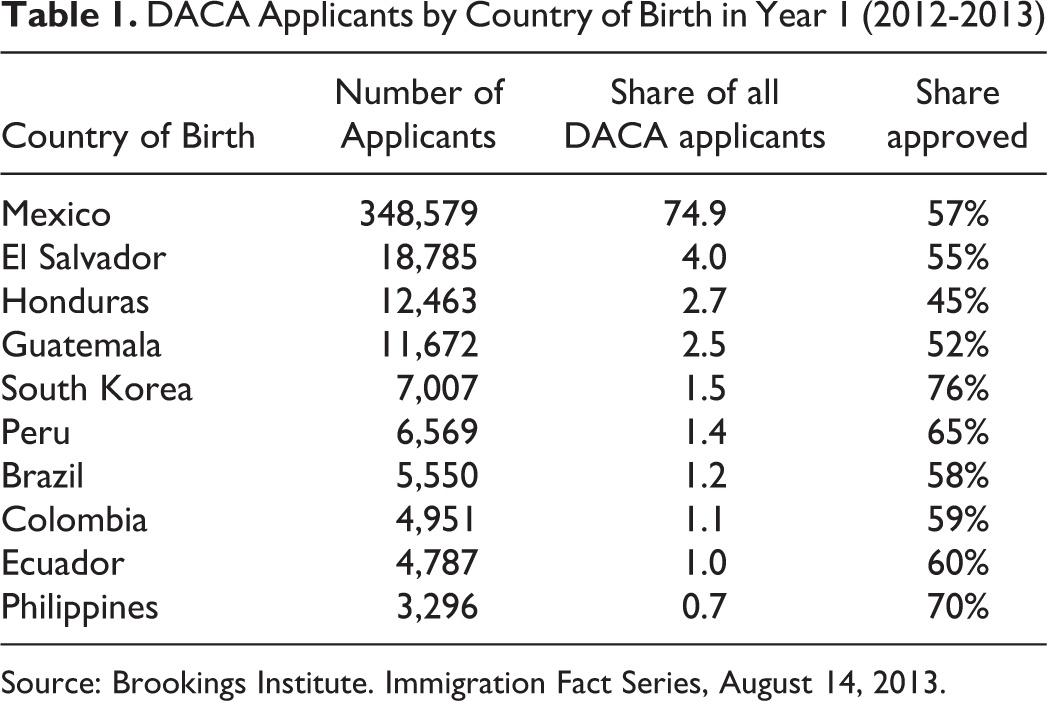
Source: Brookings Institute. Immigration Fact Series, August 14, 2013.
Ensuring that all voices are at the metaphorical table in the planning process is not simply an ethical or political concern (though it is, to be sure, a huge one) but also a pragmatic concern. While the rational planning model, wherein data and technical expertise were the sole relevant variables in planning processes, has been primarily placed firmly in the past, it is no less true today that planners rely on accurate and comprehensive data in order to make good decisions. While the social and communicative context in which planners make decisions has changed enormously, the ultimate fidelity of the data used to make these decisions is as crucial as ever. Where good data are lacking, due diligence in addressing a community’s needs becomes even more important.
Beyond traditional gateway cities, including rural areas and suburbs, research shows that immigrants have changed the demographic makeup of rural areas and suburbs across the country (Vo and Danico 2004; Singer 2004). Many of the initial inhabitants of new immigrant destinations include refugee populations from Asia, Africa, and Latin America—and intensive migration often coincides with where government resettlement agencies found a supply of affordable apartments in the 1970s, and this practice continues today. Early immigrant settlements continue to influence recent immigration patterns because of a process called “chain migration” (Charles 2003). Residential choices made by immigrant groups by 1990 cemented immigration choices in subsequent years, as “new minority residents moved to suburbs where co-ethnics were already present” (Charles 2003: 175). This explains in part the rapid concentration of Asian and Latino immigrants in a small number of suburban areas, and within specific neighborhoods, but has also led to increased “isolation and decreasing exposure to out-groups” (Charles 2003, 172).
Even in more traditional immigrant destinations (Los Angeles or New York, e.g.), immigration continues to shape cities in new and expanded ways. In Southern California, immigrants’ social, economic, and political networks move beyond simple boundaries of ethnic neighborhoods and have shifted toward majority–minority population changes at the scale of the city as a whole (Carpio, Irazabal, and Pulido 2011). Not all residents are citizens and not all civic engagement occurs at the level of voter participation. This can lead to a tension, for some cities, in terms of elected representation; what should be the modus operandi for outreach and engagement with a constituency that cannot vote for you? For example, in refugee-dense Clarkston, Georgia (population 12,000), there are approximately 500 voters in an average annual election. 6 The city of Clarkston is one of an emerging cluster of Georgia’s new immigrant cities (Kim 2015), and is actually Georgia’s number one most immigrant city, with a foreign-born population of 54 percent (ACS 2014). As one of the more popular destinations for refugees, Clarkston has a significant legal permanent resident populations who are ineligible to vote. One alternative proposal, albeit as yet unofficial, is adopting a citywide policy allowing legal permanent residents to vote in local elections. 7 And there is precedent for noncitizen voting in places like Takoma Park, Maryland (local elections and ballot measures), Chicago (school board elections), and San Fransciso (school board elections but not municipal elections)—and of course, in contrast, similar efforts have failed in other places like Rockville, Maryland, and Cambridge and Amherst, Massachusetts (Jimenez, Suggett, and Werhner 2015). However, the message sent by local initiatives is clear: making sure to work directly with populations who are not sufficiently accounted for in the polls can help cities improve their services—and access to local officials. Direct engagement with unauthorized immigrant communities, or refugee groups, particularly, via service providers and other local entities, can also greatly improve access to information about populations who may not engage through traditional forms of civic participation.
Challenges, Barriers, and Impacts of Unauthorized Immigration Integration
The role of the planner in the lives of undocumented people, or vice versa, is framed partly by the fact that while immigration policy has traditionally been set nationally, the effects reverberate most strongly on the local or municipal level, as a number of authors are noted. Harwood and Myers’s (2002) work is foundational to establishing the increasing local reorientation in immigration issues based on land-use conflicts involving immigrant communities in Santa Ana, California. Varsanyi’s (2008) article builds on this argument and analyzes how municipalities obliquely exercise power on immigrant issues, citing four different methods: (1) the creation of formal day labor centers to formalize the day labor process, (2) the enforcement of existing ordinances in such a way that has implications for the undocumented, (3) the adoption of new ordinances that have implications for the undocumented, and (4) unofficial enforcement techniques, including various forms of harassment and intimidation (Levin 2013). Planners’ housing and community and economic development strategies play a strong role in the mobilization of the first three of these methods. The interaction of all four methods challenges planners’ call to plan for and with unauthorized communities.
Employment, Education, and Economic Development
Planners are especially interested in the intersections of immigration and the city—in particular, from an economic development perspective—for a multitude of reasons: on the one hand, both historic ethnic enclaves and newly formed “ethnic neighborhoods” are of interest to cities, who would like to harness small business growth opportunities and make linkages for economic development (Portes 1987; Light and Karageorgis 1994; Waldinger 1994). On the other hand, unauthorized immigrants also represent a uniquely entrepreneurial group, as research on street vending and other self-employment strategies has shown (Sandoval 2010; Rosales 2013).
Overwhelmingly, the primary motivation for unauthorized immigrants making the dangerous journey to the United States is economic (Sandoval 2013). Consequently, perhaps the chief need for undocumented immigrants in the United States is for appropriate jobs. However, a number of barriers exist, for the undocumented, in finding employment (Orrenius and Zavodny 2010). Unauthorized immigrants have developed solutions for finding employment, and can and do work (Kim 2012), evidenced by the dollars paid into property tax, sales tax, and income tax, however, there are some significant employment barriers for immigrant workers (Liu 2011).
One analysis (Fiscal Policy Institute [NY] 2007) estimates that over half of all dishwashers in New York City are undocumented, in addition to a third of all food preparation workers and construction laborers, among other occupations. In many rural areas, undocumented immigrants constitute an overwhelming majority of temporary agricultural workers; as of the early 2000s, according to the National Agricultural Workers Survey, 52 percent of farmworkers were undocumented immigrants (Thompson and Wiggins 2002). The ubiquity of undocumented workers in crop work was brought most recently to the nation’s attention when exclusionary laws in states like Alabama (Guarino 2011) and Georgia (Dixon 2011) led to severe and costly labor shortages in those state’s agricultural economies as workers fled the state.
The second means of employment for unauthorized immigrants is to assume a false Social Security number under which to work. For a long time, due to lack of coordination between government agencies, working with false identification or an incorrect social security number has not been uncommon (Leland 2006). This has become perhaps more difficult since the emergence, in the latter half of the 2000s, of E-Verify, a mostly voluntary service through which employers can check for discrepancies between a worker’s identity and his or her supposed social security number. However, only one in the five new workers undergoes this screening, and serious doubts have been raised about its basic efficacy (Rosenblum 2011).
While some legitimate concerns have been raised about cases in which undocumented workers knowingly or unknowingly work under an actual living citizen’s social security number, by and large unauthorized employees who work under an assumed number are paying into a system from which they will never reap the benefits: between 1996 and 2003, the US government received US$50 billion in Social Security and Medicare taxes from mismatched W-2 forms, considered mostly to be those from undocumented workers. One press officer with the Social Security Administration bluntly stated, “Overall, any type of immigration is a net positive to Social Security. The more people working and paying into the system, the better” (Kasperkevic 2012).
In addition to documentation status itself, undocumented jobseekers face additional barriers to employment. Unauthorized immigrants have, on average, lower educational attainment than either legal immigrants or native-born citizens (Amuedo-Dorantes and Sparber 2012). Given that even well-educated legal immigrants frequently find themselves having to take jobs far below their educational attainment, the types of work available to unauthorized immigrants are even more limited.
The employment struggle for unauthorized immigrants does not end with the search for a job; abuse and exploitation of undocumented workers are endemic. A 2009 survey conducted by the Southern Poverty Law Center of mostly undocumented Latino laborers in the Southeast United States found that 41 percent of respondents had experienced wage theft, 80 percent “had no idea how to contact government enforcement agencies such as the Department of Labor” or “did not know such agencies even exist,” and 32 percent reported on-the-job injuries. In her work interviewing undocumented laborers, Gleeson (2010) explored the effect documentation status has on a worker’s feeling of agency to initiate a claim against an employer and found that significant fears of deportation or other legal repercussions largely prevented unauthorized workers from doing so.
Given this context, and the fact that undocumented immigrants are primarily restricted to low-wage work, whether or not planning discusses the cultivation of a diversity of high-quality jobs or career pathways also constitutes a criterion for a local community’s ability to address the needs of the undocumented. In cities like Los Angeles, the presence of unauthorized workers in multiple industries, occupations, across the city and suburb has been well-documented (Sandoval 2010; Pastor and Mollenkopf 2012; Kim 2012). According to Sandoval (2015), community developers, leaders, and planners “need to understand the structural constraints facing [unauthorized immigrant] communities, such as issues of illegality and the fear this creates, if they want their immigrant integration efforts to go beyond superficial immigrant ‘welcoming’ strategies” (p. 684).
Housing Density and Housing Segregation
Many of the needs of undocumented immigrant communities—such as skill-appropriate jobs, above—are not significantly different from those of other marginalized, poor populations. Affordable housing is one of these. Widespread stigmatization of the undocumented, however, including local policies that regulate housing density and overcrowding, unfairly targets, and restricts housing access for unauthorized people (Harwood and Myers 2002; Basolo and Nguyen 2009; Sarmiento and Sims 2015).
A study by historian Mary Odem (2008), looking specifically at the contestation of undocumented Latino social membership in the Atlanta region, sheds some light on the issue. She explains that initially, the landlords Chamblee and Doraville neighborhoods of northern Dekalb county, “during a period of economic slowdown and population decline in the late 1970s and 1980s…welcomed immigrant renters to fill empty apartments” (p. 370). Local people were not as welcoming in the face of continued demographic change and immigrant influx: “The different household arrangements of Latino immigrants (larger households with extended family members and boarders)…led many residents to file complaints with local housing authorities. In response, government officials have pursued stricter enforcement of existing housing codes and passed new or revised ordinances to tighten regulation of immigrant households” (Odem 2008, 371).
Research supports the idea that housing density is, broadly speaking, a characteristic of the United States’ unauthorized population. Standish et al.’s (2010) study of undocumented Mexican immigrants in New York City, for example, found that population to generally live in “conditions of marked household density,” with the trend becoming even more noticeable in cases of linguistic marginalization or food insecurity. The study concluded that “undocumented Mexicans live in much denser conditions than other US residents.” While studies explicitly looking at household density of undocumented immigrants appears to focus solely on Latinos, the attested correlation between poverty and housing density (see Federman et al. 1996; Evans, Saegert, and Harris 2001) viewed in light of undocumented immigrants’ high likelihood to be poor implies that undocumented immigrants are, in general, likely to live in denser households and also to be both economically and socially segregated from other groups (Liu 2011; Yu and Myers 2007).
The initial segregation of new immigrants has been exacerbated by job loss, housing inequality, and the most recent recession has also disproportionately impacted immigrants (Ellis, Wright, and Matt Townley 2014). Because housing density tends to be characteristic of undocumented immigrant settlement patterns, and because so many undocumented immigrants make minimum wage or lower, in order to address the needs of this population, plans need to consider ensuring that a community contains ample dense, affordable housing units. This, thus, should be included as a criterion in evaluation of a plan for relevance to the undocumented.
Language, Engagement, and Service Barriers
As immigrants locate in areas outside of center cities, it is important for planners to understand these emergent conflicts and new problems of suburban segregation: Segregation of immigrant groups and spatial mismatch (jobs–housing). Service and resource access issues for linguistically isolated populations. Employment and economic development opportunities, including support for ethnic entrepreneurs and small businesses owners.
One of the most distressing opportunity gaps in current engagement practice, in a preliminary analysis, was the lack of attention to language issues. As the United States—a nation with, notably, no official language—becomes rapidly more multilingual, sole reliance on English becomes less and less excusable. Data from the 2000 Census showed that almost half of the foreign-born workforce is “limited English proficient” (Capps et al. 2003); it can be assumed that for the undocumented population, this figure is yet significantly higher, which, coupled with low educational attainment, would further limit employment options (Loh and Richardson 2004).
A few studies have looked at the growing role nonprofit organizations play in the day-to-day political and civic life of immigrants. Hum (2010) analyzes nonprofits’ role concluding that they are “key to materializing a political voice and the civic engagement of immigrants, including those who are undocumented.” Kondo (2012) analogizes their role even further, specifically positing nonprofits as serving a role as advocacy or equity planner. This subsumption of the planning role into the nonprofit sphere may be another clue to the diminished dialogue in the planning field about unauthorized immigrants. Cordero-Guzmán (2005) looks at the role of community-based organizations as a tool for undocumented immigrants, while Schaller and Modan (2005) examine business improvement districts and they challenges they can pose to immigrant organizing.
Immigrant Integration and Welcoming Cities Model
Regionally, and nationally, the image of a city that embraces its immigrant communities has become very important. This is an especially timely area of study on US metropolitan area, particularly as the White House launches its first Welcoming Communities campaign, in partnership with Welcoming America. At what levels of governance should we be creating more “welcoming” immigrant communities? At the city level, county level, or state?
In just a few short years over, 57 cities have joined the Welcoming America initiative and more than 300 local governments have drafted immigrant integration policies. Atlanta metro, a historically nonimmigrant metropolitan area, have become one of the most popular destinations for new immigrants, adding more immigrants total to the population than New York, Los Angeles, Chicago, or Boston Metropolitan Statistical Area (MSA) between 2000 and 2013.
These changes are what motivated Georgian cities like Norcross, Clarkston, Decatur, and Atlanta to join welcoming immigrant initiatives and develop policy platforms for becoming welcoming communities—thus helping metro Atlanta to keep pace with cities that have already implemented their own plans for immigrant integration. However, it is also evident that state policies play a large role in how far the impact of executive action extends; for example, in Illinois may obtain drivers licenses (Guerrero 2013), and in California, unauthorized immigrants may obtain in-state tuition and access health care under the Affordable Care Act in most counties in the state.
Compare this to Georgia, where unauthorized immigrants are barred from attending public universities and obtaining drivers licenses or identification cards and are ineligible for almost all government services. It is clear that despite these city-level policies that look toward immigrant integration, there are clear barriers to economic integration of immigrants, particularly unauthorized immigrants without pathways to legalization at the federal level. It is important for planners to understand and articulate the social and economic benefits of immigrant integration, welcoming attitudes toward immigrants, and how harmful policies are that hinder unauthorized immigrants from accessing educational opportunities and jobs (Pastor and Mollenkopf 2012).
Immigrants play an important role in the urbanization process, particularly as many enclaves are not occupied by a singular ethnic group, and yet are important cultural place markers for satellite communities (Hum 2014). Recent state-level changes in California have improved unauthorized immigrant access to drivers’ licenses and identification cards (Poston 2013), public education access at in-state universities, and health insurance. These are important interventions as the nation awaits more comprehensive federal immigration reform, but what is the likelihood of passing along similar state-level reforms to Georgia, Ohio, or Alabama? And, what can cities and regions do in the meantime?
As noted earlier, immigrant documentation status is a little-acknowledged demographic attribute among planners—or at least among planning academicians. There is scant to say on this matter except that one would expect a clear link between recognition of the existence of undocumented individuals within the community and planning decisions that begin to address their needs. If a plan recognizes the presence of undocumented people and their legal status that could be a significant indicator that steps were taken elsewhere throughout the process to address undocumented communities.
Recommendations: Equity Planning with Immigrant Communities
On the broadest and perhaps most obvious level, planners need to recognize undocumented immigrants as community stakeholders within the planning process and anticipate and serve their needs. This gap in planning practice has been exacerbated by the diversity of roles and skills within the planning field, which is accompanied by a certain confusion around what planners do and are authorized to do. As Vitiello (2009) outlines, “while countries in Europe and the British Commonwealth have established traditions of social planning, including national immigrant integration programs, in the United States most community development in migrant communities is done by social workers[,] not planners” (p. 246). As the US planning field excitingly renews historic yet underappreciated links to professional traditions such as public health (Botchwey et al. 2009; Botchwey and Trowbridge 2011), it needs to invest, as well, in understanding the role of planners within communities’ social infrastructure, and our relationship to professions such as social work and community organizing.
In an assessment of ten Atlanta area’s plans from areas with the highest percentages of foreign-born residents, Levin (2013) finds that while six of the plans mention having a diverse community, only one plan discusses outreach to immigrants, and none of the plans discuss outreach to undocumented populations specifically. Only one plan discusses community policing in a positive light, and only two plans discuss small business and entrepreneurship support. Four of the plans discuss appropriate job development and training. None of the plans Levin analyzed recognizes alternative documentation status (legal permanent residents, refugees, work visa holders, and unauthorized immigrants), in their localities, or mention the need for facilities or provision of services to undocumented populations. Furthermore, none of the plans address potential or apparent location or language access issues, despite that the plans Levin analyzed included five or more cities with close to majority foreign-born residential populations (approximately 40–54 percent foreign-born).
The recommendations we offer below, therefore, are a mix of strategies that have been put forth to support planning with marginalized communities, undocumented immigrant communities specifically. This should not be surprising as unauthorized communities exist at a nexus of many identities. Unauthorized communities fall within the gaps left when some strategies are implemented, for example, small business support, without the inclusion of complementary strategies that provide greater access to unauthorized communities (i.e., partnering with local leaders to conduct outreach and/or having public meetings translated). We highlight recommendations that are specific to cities and local agencies, although they can be scaled to the region and the state.

Support of Small Business Entrepreneurship
Immigrants in general, including undocumented immigrants, are more likely to work for small or “mom-and-pop” businesses (e.g., see Lillie-Blanton and Hudman 2001). The lower likelihood of documentation enforcement makes these businesses more realistic employment options for those who cannot present legal papers. Social networks also lead to undocumented immigrants working more frequently for businesses run by individuals from similar ethnic backgrounds (e.g., see Villar 1992; Zhou 2006; Zhou, Tseng, and Kim 2008); this fits within a wider literature on “ethnic enclaves” (Logan, Zhang, and Alba 2002).
Encouraging small business and entrepreneurship has been a key component of planners’ toolboxes in generally encouraging the vibrancy and economic sustainability of low-income and minority neighborhoods. Because small businesses are sometimes frequent employers of immigrants, especially in ethnic enclaves (Kim 2012) or ethnoburbs (Li 1998; Zhou, Yen-Fen, and Kim 2008) with additional implications specifically for the undocumented, this recognition could serve as a criterion for a plan’s ability to serve the undocumented. It is important, however, given the vulnerability of unauthorized workers in the workforce (Valenzuela 2003; Rosales 2013) and continued employment barriers for immigrant workers (Liu 2011) to keep in mind the needs of employees as well as employers.
Huerta (2011), writing in the American Planning Association’s New Planner magazine, offers planners recommendations on undocumented workforce development—one of the few articles to directly address the planning community on these issues. Rather than remaining silent on policies that criminalize and further limit immigrants’ employment options, he suggests advocating for “the immigrant workforce that takes on the most difficult and least respected jobs in America’s cities, suburbs, and rural areas” (Huerta 2011) and supporting their organizing efforts to protect their livelihoods. He also notes that planners should promote the legitimacy of immigrant work and business “when creating and advocating for greener communities, such as building more parks and planting more trees in urban areas ” (Huerta 2011).
Outreach to Immigrant Communities, Specifically Undocumented Immigrant Communities
As mentioned, there are a number of reasons that reaching out to undocumented immigrants within a community is both difficult and important. Where there are not progressive measures in place such as community policing and other efforts that show good faith toward undocumented immigrants on the part of institutional actors, undocumented people may fear taking part in processes that force them into the public sphere. Building trust and making connections with organizations that serve immigrant communities rather than simply holding public meetings is an important first step (e.g., see Bernstein 2012). Sandoval and Rongerude (2015) also offer examples of processes for community development indicators that validate unauthorized immigrants’ narratives and creates space for them in the planning process.
While specifically making connections that encourage undocumented immigrants to take part in the planning process would be, obviously, the most effective tool in bringing these individuals’ voices to the table, reaching out to local immigrant communities in general would help toward making sure the interests of the undocumented are at least partially represented. Thus, it would be vital to examine whether or not the engagement component of a plan specifically discusses (a) outreach to immigrant communities, (b) outreach to unauthorized immigrant communities, and (c) accurate documentation and incorporation of their specific concerns and needs.
Location Issues in the Engagement Process
A good engagement plan should include locational considerations that are most inclusive. The location of public meetings has a powerful effect on who shows up and the type and quality of resident input obtained. Planners should be attuned to the implications of different sorts of space; as undocumented immigrants often have reason to fear particular institutional entities. Thus, holding a meeting in a space tied to these actors may have a deterrent effect on participation by undocumented individuals. For example, Kondo (2012) recounts a planning process in which county officials decided to hold two out of four planning meetings at a police station in ignorance of local fears toward law enforcements.
A community-based or neutral space may be more effective in helping undocumented immigrants to feel comfortable participating in the planning process. Thus, as a criterion in the evaluation of a plan’s ability to address the needs of the undocumented, one might examine whether the engagement discussion explicitly recognized meeting siting as an important issue for consideration.
Language Issues in the Engagement Process
As has been discussed earlier, English-language proficiency can be a major barrier to undocumented immigrant participation in a number of spheres of American life. Research shows that two-thirds of low-wage immigrant workers in the United States, many of whom are undocumented, do not speak English proficiently (Capps et al. 2003). There is now a robust literature on language access issues within the health literacy field, but an understanding of these issues does not seem to have sufficiently penetrated the planning community. It is not only undocumented immigrants that have low English proficiency, but a substantial number of immigrants with legal status as well; thus, ensuring that local residents can access the planning process in their own language benefits immigrant communities in general, regardless of status.
Because language can present such a basic barrier to social and political entry for participants in the planning process, whether or not a plan’s engagement process discusses provision of non-English services would be a key indicator of that process’ ability to address undocumented communities.
Community Policing and Other Progressive Criminal Justice Initiatives
Fear of arrest and deportation can prevent undocumented immigrants from taking advantage of a wide range of resources, including health care (Bauer et al. 2000; Berk and Schur 2001; Okie 2007) and legal claims-making (Bloomekatz 2007; Gleeson 2010; Abrego 2011). While these barriers are extremely detrimental to the undocumented immigrant population, perhaps that with the greatest community-wide effect is the barrier often preventing unauthorized immigrants from interacting with the police. While the federal government technically has sole purview over immigration, a landscape of continually shifting relationships between local law enforcement and federal authorities has left many undocumented people wary of interacting with the police.
Since September 11, 2001, state and local police departments have come under increasing pressure to participate in the arrest of unauthorized immigrants. Wishnie (2004), writing a few years after 9/11, describes the increasing insistence with which Alberto Gonzales’s Department of Justice encouraged the coordination of federal, state, and local efforts on immigration enforcement. Section 287(g) of the 1996 Immigration and Nationality Act enables state and local law enforcement agencies to sign a memorandum of understanding with the federal government and receive training from Immigration and Customs Enforcement. In the mid-2000s, however, in the climate of an increasingly politicized immigration debate, the 287(g) program took on new vigor as law enforcement agencies—overwhelmingly in the South and with higher-than-average Latino populations (ACLU of Georgia 2009)—opted in to these memoranda. It was within this context that in 2010 the state of (Campbell 2011) passed SB 1070, which requires state and local law enforcement agents to incorporate immigration enforcement into their essential duties. The following year, at least twenty-four state legislatures across the country considered adopting a copycat law (Lacayo 2011). Ultimately, similar laws passed in Alabama, Georgia, Indiana, South Carolina, and Utah.
Where individuals are afraid to expose their own legal status to scrutiny and thus potential deportation, serious problems arise for community security. Crime retreats behind closed doors, and victims suffer in silence. Lines of communication between unauthorized immigrant communities and law enforcement are essentially cutoff. Fears around deportation also disproportionately affect individuals who are doubly vulnerable; for example, undocumented women who are suffering domestic abuse are often fearful of reporting it and thus opening their and their families’ documentation status up to the scrutiny of law enforcement (Kasturirangan, Krishnan, and Riger 2004).
“Community policing” is a paradigm within criminal justice that emphasizes collaborative links between law enforcement officials and communities, including undocumented immigrants communities. While the term can be used euphemistically to describe policies that are, in fact, ultimately immigrant-hostile, community policing can have major benefits when applied correctly—especially as an alternative to county police departments that voluntarily comply with 287(g). For example, Torres and Vogel (2001) found that fear of crime diminished noticeably within Latino and Vietnamese immigrant populations after a community policing policy was put into place in one California community.
In the contemporary world, planners have a role in encouraging just and community-based approaches to criminal justice. Community policing as a plan recommendation could, therefore, serve as a significant indicator of a plan’s recognition of the undocumented population. As a response to the growth in Norcross, GA, foreign-born population, the city police department launched a Hispanic Citizen Police Academy (Kim et al. 2015).
Planner Diversity
Finally, the planning profession needs to increase its internal diversity in order to confront the challenges of today and tomorrow. The planning profession has recognized a deleterious lack of diversity along racial and gender (Ross 1990) as well as linguistic (Stiftel and Mukhopadhyay 2007) lines. For example, though they make up an increasingly large percentage of the American public, as well as a plurality of recent immigrants to the United States, Latinos are underrepresented in the planning field; a 2001 analysis of New York Metro American Planning Association chapter found that only 6 percent of members were Latino/Latina, comprising a 15.7 percent “representation gap” when compared to the area’s general population.
Planners growing up in a Spanish- or, say, Korean-speaking household would be more likely to possess those language skills—a crucial benefit, given the language access problems identified above. Further, a more diverse planning field would reduce historic tensions between communities and planners and increase the sense that planners are of the community rather than foreign to it. For example, a Latino community might be more likely to engage actively in a planning process if they see that the staff includes Latino/Latina planners. According to Nguyen (2013), “When we look at the pressing complex social problems or demographic shifts in American society, all trends point toward the need for more heterogeneity within the planning profession—both in the academy and in the field.”
Conclusion: Notes for the Field
This review of the scholarship on immigration as it intersects with planning literature gives examples of how planners do and should position themselves in the context of undocumented communities. Future research is needed to assess what this relationship between planners and undocumented immigrants looks like from both ends. Direct qualitative investigations with actual stakeholders would reveal much of what lies behind the surface and collect additional information that is not readily available in the secondary data on immigrant populations.
As planners enter the twenty-first century in full force, planning is a field renewed: with deepened connections to serving the historically underserved, changing cities, as well as making unjust situations more equitable, and ensuring public input into the projects that affect their lives (Zapata and Bates 2015). And whether or not we are ready for it, we are ever more planning for “majority–minority” cities and counties across the country. Many, if not most, newly majority–minority cities and counties have changed due to immigration—and increasing immigrant preferences for new and emergent metropolitan destinations outside of traditional destinations like Los Angeles and New York (Pew Research Center 2016). How do towns in Georgia, for example, serve Latinos who compose greater than 40 percent of the city’s residential population, where 60 percent of households speaking a language other than English, without providing basic city services in other languages than English? (Kim 2015). What staff will translate documents or interpret at the police station or City Hall? And if capacity is lacking—which in many new immigrant places, particularly small or rural ones, what is the responsibility of local government to its new constituency?
In addition to looking to the evolution of planning, and the current and future reality of US cities, we can derive a clear mandate for advocacy planning (Davidoff 1965; Mazziotti 1974) for the underserved from today’s professional code for planners. In no ambiguous terms, the American Institute of Certified Planners’ Code of Ethics and Professional Conduct (2016) states: “We shall seek social justice by working to expand choice and opportunity for all persons, recognizing a special responsibility to plan for the needs of the disadvantaged and to promote racial and economic integration. We shall urge the alteration of policies, institutions, and decisions that oppose such needs” (p. 2).
Our planning principles first recommend—as a basis for engagement—a focus on encouraging the active participation of city residents and should participation be lacking—supplying the tools and services necessary for those without access to gain access to the public meeting. Or as written eloquently elsewhere: “Participation should be broad enough to include those who lack formal organization or influence.” The clarity of these words should make it obvious that the needs of undocumented community members fall indisputably under the purview of today’s planner (Smith 2008; Benner and Pastor 2015). Advocacy planners in particular can play a critical role in outreach and service to undocumented immigrant communities (Lung-Amam et al. 2015).
Finally, few planning scholars have offered their thoughts on the theoretical and ethical implications of unauthorized migration. Friedmann and Wolff (1982), in looking at the configuration of the future’s world-class cities, asked “whose interests” would be served by this metropolis. They mention an immigrant underclass as one of the key elements of a world city and clearly stake this topic as one important to the planning field: “Planners are directly engaged on this contested terrain.” Roy (2011), too, in her article outlining a vision for a “critical transnationalism,” also affirms the centrality of planners in the immigrant struggle: what might it mean, practically speaking, for a planning document or process to incorporate the needs of unauthorized immigrants and the many families whose lives intersect with immigrants of varying documentation status?
Any attempt to bring undocumented immigrants into city planning discourse first necessitates the basic ability to address the question of the immigrant community at large and the adoption of an attitude that celebrates rather than problematizes human diversity. There is no question that attempting to understand and embrace diversity in the planning process introduces challenges, but the body of literature on multiculturalism and the city contends that these challenges are of key importance to engage the planning academy and practitioners.
The planning profession has made clear, at least in aspiration, the importance of a diversity of voices in forging the contemporary city. Because a positive attitude toward interculturalism is such a foundational building block of any pluralistic planning process, the recognition, and embrace of diversity—particularly regarding immigrant communities—would be an important indicator of a plan that meets the needs of local unauthorized immigrants. Further, a demonstrated understanding of immigrant groups’ diversity is a key feature of an engagement process that successfully involves immigrant communities. Through reviewing the existing literature, the authors have explored the challenges, and the opportunities, of planning for unauthorized communities—and other vulnerable communities who are too often excluded by law, policy, poverty, or discrimination from civic engagement and the planning process.
Footnotes
Acknowledgment
The authors would like to thank graduate research assistant Nene Igietseme (doctoral student, City and Regional Planning, Georgia Institute of Technology) for her assistance in editing this article.
Declaration of Conflicting Interests
The author(s) declared no potential conflicts of interest with respect to the research, authorship, and/or publication of this article.
Funding
The author(s) received no financial support for the research, authorship, and/or publication of this article.