



Abstract
Although the importance of parental support for child sexual abuse victims is well documented, the nature of parental support for victims sexually abused by adolescents is less understood. In this exploratory study, we examine whether parents differ in their levels of blame or doubt for their child when sexually abused by adolescents versus adults. Data included 161 reports of child sexual abuse. Parental blame toward their child was higher when sexually abused by an adolescent versus an adult suspect. In the bivariate and multivariate analysis, parental blame was significantly higher as victim age increased, for Black, non-Hispanic children, and when there was an adolescent suspect. Practitioners need to recognize that high levels of blame and doubt could exist for adolescent victims of sexual abuse and when children are sexually abused by adolescents.
Parental support is central in promoting better outcomes for child sexual abuse victims (Elliott & Carnes, 2001; Spaccarelli & Kim, 1995), but the circumstances of the abuse may complicate parents’ provision of support in a number of situations. Parental feelings might lead to divided loyalties if the perpetrator and victim are siblings. The perpetrator and victim could be close in age, potentially leading parents to consider sexual acts to be consensual and discount the possibility of abuse. Parents could also discount the culpability of the perpetrator if older children are abused by younger ones (Doyle, 1996). The perpetrator in all these situations is typically an adolescent. Yet, understanding the extent to which parental support differs when children are sexually abused by adolescents versus adults is not well understood and has not been the focus of research. This information could enhance the system’s response to sexual abuse because it may help identify situations in which child victims are particularly vulnerable. Greater understanding of parents’ responses would also improve counselors’ abilities to help distressed children and their families. This article specifically compares parental blame or doubt in child sexual abuse cases when the suspect is an adolescent versus an adult.
Parental Support
Parental support has consistently been associated with child adjustment following the disclosure of sexual abuse (Cohen & Mannarino, 2000; Feiring, Taska, & Lewis, 1998; Lovett, 1995; Tremblay, Hebert, & Piche, 1999). Research suggests that parental support is a multidimensional construct encompassing believing the child, providing emotional support, and taking protective actions such as contacting professionals or restricting contact between the suspect and child.
Research also suggests that some parents feel ambivalence following a disclosure of child sexual abuse (Bolen & Lamb, 2004, 2007). Bolen and Lamb describe ambivalence as a normal reaction that can occur when mothers feel strong positive emotions toward both the child and the alleged suspect. Bolen and Lamb’s (2007) study suggests that ambivalence and support may be independent constructs and that emotional support may be distinct from blaming or doubting a child (Smith et al., 2010). Yet few studies have examined factors associated with blame or doubt following a disclosure and none to our knowledge look at whether doubt is greater when the suspect is an adolescent.
Studies that have examined factors predicting parental belief, support, and protection have not yielded consistent results (see Elliott & Carnes, 2001 for a review). Some studies indicate that mothers 1 are more likely to believe and support younger children (Heriot, 1996; Lyon & Kouloumpos-Lenares, 1987; Salt, Myer, Coleman, & Sauzier, 1990; Sirles & Franke, 1989) but others have not found this difference (De Jong, 1988; Everson, Hunter, Runyon, Edelsohn, & Coulter, 1989; Pintello & Zuravin, 2001). Salt et al. (1990) found that mothers reported more concern and protective behaviors with younger child victims and were more likely to be angry and punitive with older child victims. Heriot (1996) suggests that perhaps belief and support for the sexually abused teenager can be undermined by anger about other problems or by a belief that the teenager should have known better or could have done something to prevent the abuse.
Some studies suggest that mothers are less supportive and less protective when the offender is a current partner of the mother (Everson et al., 1989; Faller, 1988; Pintello & Zuravin, 2001). And some research indicates that mothers are less supportive of the child when the alleged perpetrator lived with the mother or when the family was financially dependent on the perpetrator (Elliott & Briere, 1994; Leifer, Kilbane, & Grossman, 2001). All of the studies reviewed (Elliott & Carnes, 2001), however, explored the mother’s romantic relationship with the perpetrator (biological father, stepfather, live-in partner, mother’s boyfriend, another nonfather figure relative, or extrafamilial offender), without considering whether support would be compromised for sexual abuse by adolescent perpetrators.
Sexual Abuse by Adolescents
It is important to understand how parents respond when the abuser is an adolescent because a significant minority of sexual abuse is committed by youth. In 2004, 36% of all sex offenses against minors and known by police were committed by juveniles (Finkelhor, Ormrod, & Chaffin, 2009). Other research estimates that approximately 25% of all rapes and between 30 to 50% of all known cases of child sexual abuse are perpetrated by adolescent males (Davis & Leitenberg, 1987; Fehrenbach, Smith, Monastersky, & Deisher, 1986; Ryan & Lane, 1997). It is important to note that such estimates are most likely conservative because of the reluctance to report adolescent offenders (Kempton & Forehand, 1992). The characteristics of cases in which adolescents commit sex offenses vary (for a review see Righthand & Welch, 2001 and Veneziano & Veneziano, 2002). Although female children are targeted most frequently, male victims comprise up to 25% of some samples. Most adolescents who commit sex offenses are male, although a literature on adolescent females as offenders is emerging (Vandiver & Teske, 2006). Studies of relationships indicate that adolescent sex offenders generally know their victims with approximately 40% involving family members (Johnson, 1988; Ryan, Miyoshi, Metzner, Krugman, & Fryer, 1996).
Although the literature on sexual abuse by adolescents is slowly growing; the majority of research focuses on these areas: why adolescents engage in abusive sexual behavior, best practices for the treatment of adolescents, or on the criminal justice response (Barbaree & Marshall, 2006; Righthand & Welch, 2001; Vandiver & Teske, 2006; van Wijk et al., 2006; Veneziano & Veneziano, 2002). Parental responses when children are sexually abused by adolescents have not been a focus of study.
Current Study
In this exploratory study, we first examine whether sexual abuse case characteristics with adolescent versus adult suspects differ. Next, we explore whether parents have higher levels of blame or doubt toward their child when minors are sexually abused by adolescents versus adults. Because few studies have examined correlates of parental blame and doubt of the child, we also examine whether other case characteristics, such as suspects and victims being the same sex or the severity of the sexual abuse are associated with parental blame and doubt.
Method
Procedures
The data analyzed for this article were collected as part of a multisite evaluation of Children’s Advocacy Centers (CAC; see Cross et al., 2008; Cross, Jones, Walsh, Simone, & Kolko, 2007). Data were collected from 10 communities in Alabama, Pennsylvania, South Carolina, and Texas. The sample included every available sexual and serious physical abuse case reported in the research communities to child protective services, police, or the Children’s Advocacy Center depending on the community between December 2001 and December 2003. When the number of cases exceeded resources, a process of systematic sampling was used (e.g., taking every third case). The total sample included 1,452 cases. Data from case files were collected on all cases and in-person research interviews were conducted on a subsample of cases. Because only some law enforcement and child protective service investigators cooperated in recruiting subjects for the research interviews, 825 caregivers were invited to participate. The interview sample included 358 cases, a 43% participation rate. Nonparticipation was due to a combination of direct refusals, disconnected contact numbers, nonresponse, or difficulty scheduling the interviews (see Jones, Cross, Walsh, & Simone, 2007 for more information). Most research interviews (92%) were conducted within 3 to 6 months of the first forensic interview. Families who participated in the interview were given US$50 to compensate them for their time. The University of New Hampshire (UNH) Institutional Review Board (IRB) for the Protection of Human Subjects in Research approved the informed consent procedures and protocols for protecting subjects’ rights for the research conducted at each site.
Sample
The current analysis included cases with a report of sexual abuse in which the suspect was 12 or older and the child victim was 5 or older and a research interview was conducted (N = 161). The sample was limited to sexual abuse cases because the theory and research on parental support pertains to this type of case. The age restriction for child victims was necessary because the Maternal Self Support Questionnaire was designed for parents of verbal children (see Measures section). The vast majority of respondents were the child’s biological parent (89%), usually the mother. The distribution across the research locations of this subsample was similar to the distribution of sexual abuse cases in the larger study, with 25% of cases from the PA communities, 35% from the TX communities, 19% from the SC communities, and 20% from the AL communities.
Measures
Parental blame or doubt
Parental blame or doubt was assessed using the Maternal Self-report Support Questionnaire during the research interviews (MSSQ; Hsu & Smith, 2000; Smith et al., 2010). Parents were asked to rate the degree to which they experienced the feeling described in each item at any time since the abuse (from 6 = very much like me to 0 = not at all like me). Although other research (Hsu & Smith, 2000; Smith et al., 2010) identified two factors of the MSSQ, Emotional Support (Cronbach’s α = .76) and Blame and Doubt (Cronbach’s α = .71), the Cronbach’s α for Emotional Support in this study was .36. Because the low Cronbach’s α indicates poor internal consistency in this sample, this factor is not used in the current analysis.
The Blame and Doubt scale consists of eight items reflecting a parent’s tendency to doubt a child’s disclosure and question the role the child may have played in the sexual abuse. The eight items were (a) believed child about everything that happened, (b) could not help feeling angry with child, (c) questioned child’s honesty about the abuse, (d) wondered what child might have done to stop the abuse from happening, (e) wondered if child could have stopped the abuse if she or he wanted to, (f) could not help resenting all the trouble child’s disclosure caused, (g) wondered if child somehow brought the abuse on herself or himself, and (h) wondered if the abuse really happened to your child. The total score on the Blame/Doubt scale ranged from 0 to 45 (out of a possible 48) with a mean of 10.62 (SD = 10.57). The internal consistency for this scale was adequate, with a Cronbach’s α of .74.
Case characteristics
We collected data on several child, suspect, and abuse characteristics from case files. Variables selected either had demonstrated a relationship to parental support in previous research or could plausibly be related to parental support. Child characteristics included sex and age. Suspect characteristics included sex, age, the number of suspects, relationship to child, and whether the suspect lived with child at the time of the alleged abuse. Abuse characteristics included whether or not penetration was alleged and whether the child was physically hurt or injured as part of the abuse.
Analysis
Pearson χ2 tests were used to examine bivariate relationships between suspect type (adolescent or adult) and case characteristics. Independent sample t tests were used to examine bivariate relationships between case characteristics and the blame and doubt total score. One-way analysis of variance was used to examine the relationship between multicategory case characteristics and the blame and doubt score. We used analysis of covariance to explore whether cases with adolescent suspects had significantly higher levels of blame and doubt as compared to those with adult suspects even controlling for other case characteristics. Variables whose correlation with blame and doubt were statistically significant at p < .05 were included in the model. An additional analysis of covariance with an interaction term was calculated to test whether victim age moderated the effect of having an adolescent suspect on parent’s blame and doubt because such a reaction could be an effect of the relative ages of the suspect and victim.
One variable, victim race, had 9% missing data. To increase the number of cases in the model and account for differences in cases with and without missing data on this variable, a series of orthogonal contrasts were created representing whether cases had valid or missing data for this variable, following the method described by Cohen and colleagues (Cohen, Cohen, West, & Aiken, 2003).
Results
Adolescent and Adult Suspects
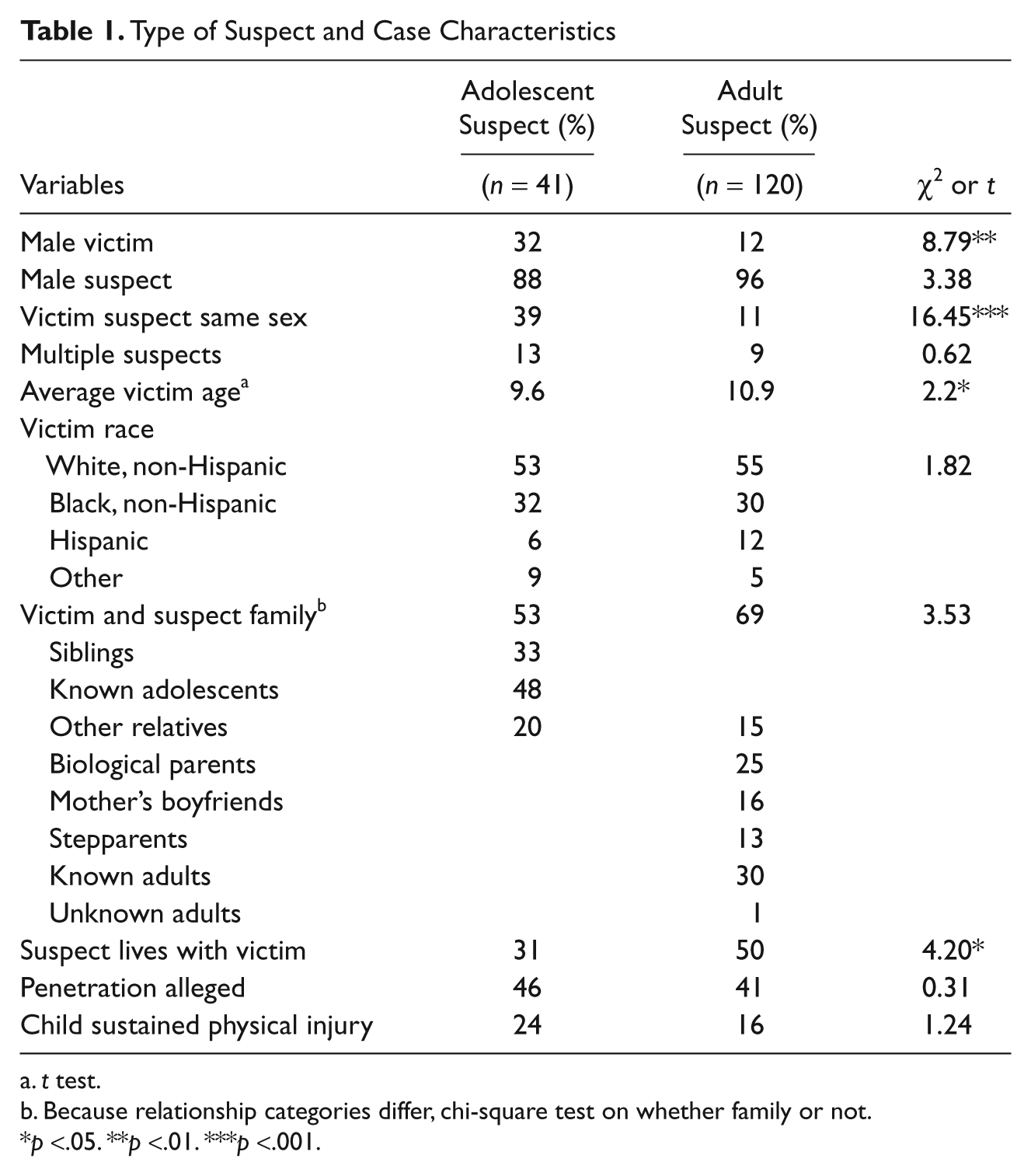
Cases with adolescent suspects were more likely to include male victims and to have suspect and victims who were the same sex and were less likely to have suspects who lived with victims (see Table 1). Cases with adolescent suspects involved younger child victims, 9.6 years (3.3), compared to those with adult suspects, 10.9 years (3.3), t(159) = 2.2, p <.05.
Type of Suspect and Case Characteristics
t test.
Because relationship categories differ, chi-square test on whether family or not.
p <.05. **p <.01. ***p <.001.
As shown in Table 1, there was no difference in whether penetration was alleged or whether the child was physically hurt and injured by type of suspect (adolescent or adult). There was no difference in whether the suspect was a family member by type of suspect (adolescent or adult). The majority (53%) of adolescent suspects were family members, either siblings (33%) or other relatives (20%), usually cousins. The remaining 48% were adolescents known to the victim. The majority (69%) of adult suspects were family members, including biological parents (25%), mother’s boyfriends (16%), other relatives (15%), and stepparents (13%). (Mother’s boyfriends were included as family members because the vast majority lived with the family). The remaining 30% were known adults and 1% were unknown adults.
The age of adolescent suspects ranged from 12 to 17 and the average age was 14.3 (SD = 1.5). The majority (63%) of adolescents were less than 6 years older than their victims (including 3 cases with suspects younger than their victims). The age of adult suspects ranged from 18 to 72 and the average age was 35.8 (SD = 11.3). The majority (65%) of adult suspects was 21 years or older than their victims, 20% were 11 to 20 years older, 10% were 6 to 10 years older, and 5% were less than 6 years older.
Parental Blame and Doubt
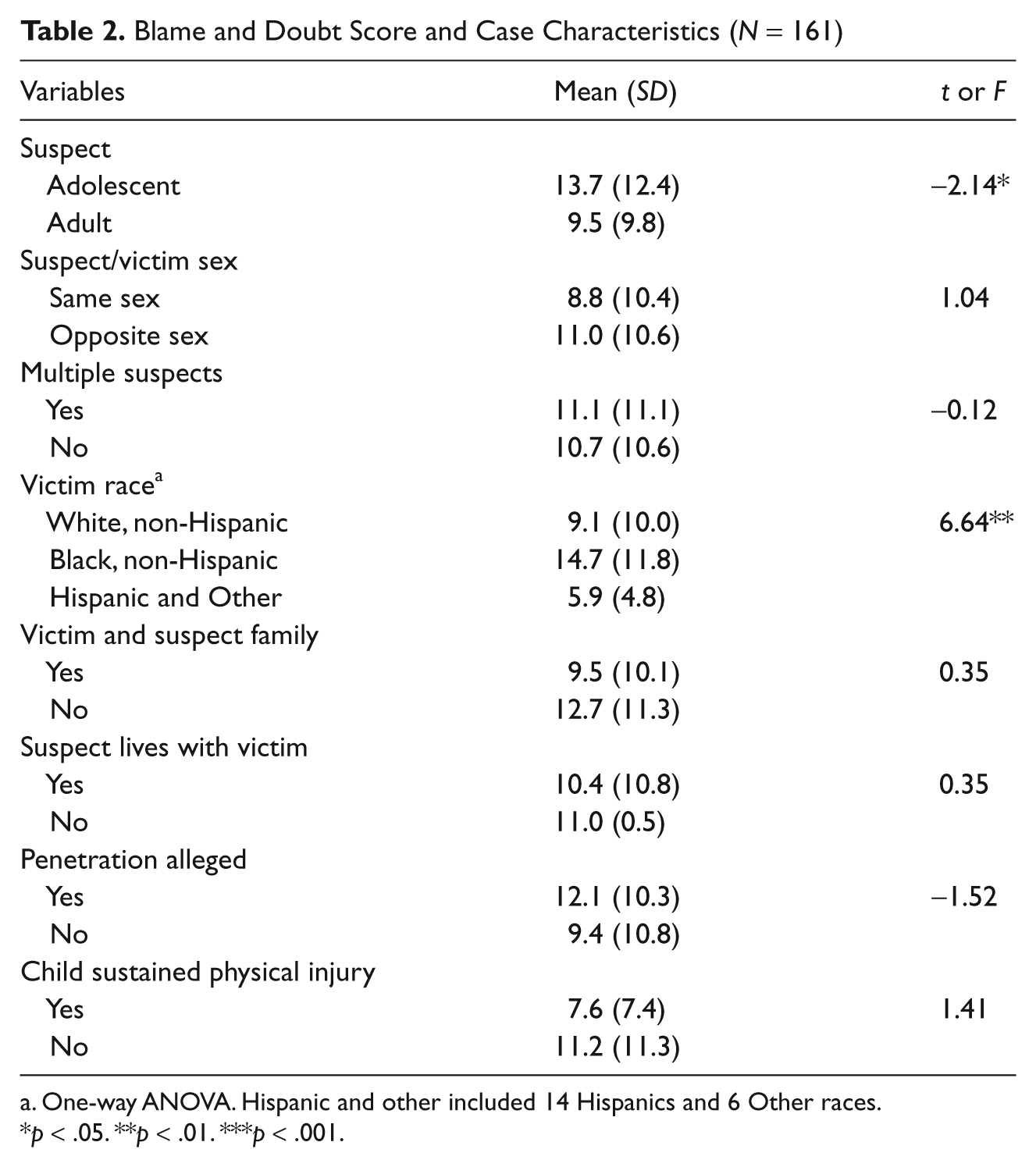
Parents were significantly more likely to blame and doubt their child when their child was sexually abused by an adolescent versus an adult (see Table 2). The Cohen’s d was .40, indicating close to a medium effect size for the relationship between blame and doubt and type of suspect (medium Cohen’s d effect size = .5; Cohen, 1988). A one-way ANOVA found significant differences in blame and doubt scores among the race/ethnicity groups with F(2, 138) = 6.64, p = .002. Tukey HSD post hoc comparisons of groups indicated that parents of Black, non-Hispanic children had significantly higher levels of blame and doubt compared to parents of White, non-Hispanic children, p = .01 and compared to parents of Hispanic and other children, p = .005. Because the majority of parents of Black, non-Hispanic children were from the Texas location, we examined whether cases from the four research locations differed in blame and doubt. The four research locations were communities in AL, PA, SC, and TX with and without Children’s Advocacy Centers (demographics did not differ for CACs and comparison communities within the same state). A one-way ANOVA found no differences in blame and doubt among the four research locations. This suggests that differences among the race/ethnicity groups are not due to differences in location.
Blame and Doubt Score and Case Characteristics (N = 161)
One-way ANOVA. Hispanic and other included 14 Hispanics and 6 Other races.
p < .05. **p < .01. ***p < .001.
Increases in victim age were associated with higher levels of blame and doubt (r = .23, p < .01). To explore the association between victim age and blame and doubt, we created age groups (5 to 9; 10 to 12; 13 to 15; 16 to 18). A one-way ANOVA found significant differences in blame and doubt scores among the age groups with F(3, 153) = 3.41, p = .019. Tukey HSD post hoc comparisons of groups indicated that parents of 13- to 15-year-olds had significantly higher levels of blame and doubt compared to parents of 5- to 9-year-old children, p = .012.
As shown in Table 2, other tests were nonsignificant, but the fact that they had small cell sizes suggests that special attention should be paid to effect sizes, which can be noteworthy even if results for small samples are nonsignificant. There was a small relationship between the victim and suspect being the same sex and higher parental blame and doubt scores (d = .20). There was a slightly stronger relationship between higher parental blame and doubt scores when the victim and suspect were family members (d = .30), penetration was alleged (d = .25), and the child sustained physical injury (d = .34). This suggests that with a larger sample size there could be statistically significant differences for these variables and future research should consider these variables.
Multivariate Results
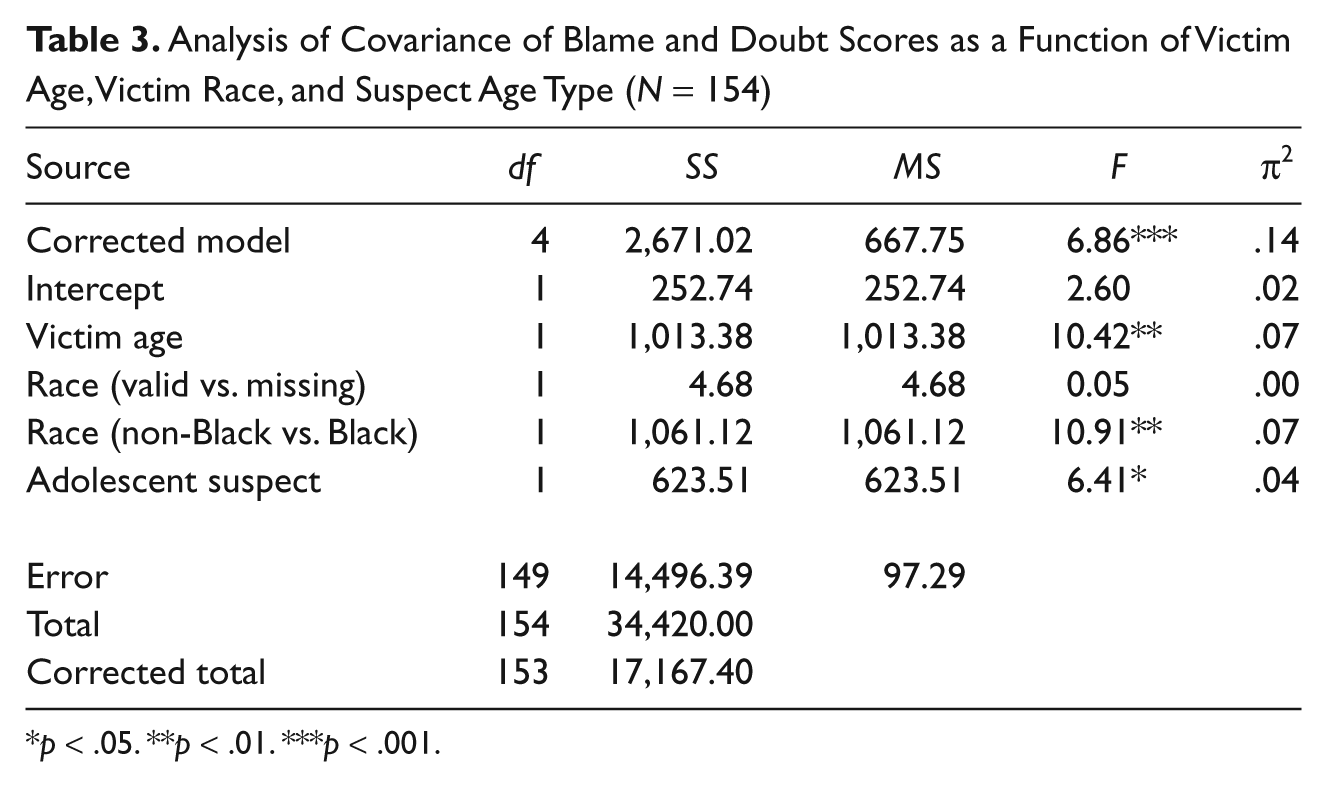
As shown in the analysis of covariance results presented in Table 3, as a victim’s age increased, so did parents’ levels of blame and doubt, controlling for other case characteristics. An eta squared of .07 indicates a medium relationship between victim age and blame and doubt, controlling for other variables. Parents with Black, non-Hispanic children had significantly higher levels of blame and doubt, even controlling for other case characteristics. An eta squared of .07 indicates a medium relationship between race and blame and doubt, controlling for other variables. Last, parents with an adolescent suspect had significantly higher levels of blame and doubt as compared to those with an adult suspect, even controlling for other case characteristics. An eta squared of .04 indicates a small to medium relationship (Cohen, 1988) between offender type and blame and doubt, controlling for other variables.
Analysis of Covariance of Blame and Doubt Scores as a Function of Victim Age, Victim Race, and Suspect Age Type (N = 154)
p < .05. **p < .01. ***p < .001.
A second analysis of covariance (not presented here) was conducted to explore whether victim age moderated the effect of an adolescent suspect on parent’s blame and doubt. The interaction term was not statistically significant, F(1, 148) = 2.1, p = .149, and eta squared was .01, indicating a minimal relationship.
Discussion
Parents were significantly more likely to report higher blame and doubt for their child when she or he was reported to have been sexually abused by an adolescent versus an adult suspect. Parents may have higher levels of blame toward their child when sexually abused by adolescents because parents have difficulty with the concept of adolescent sex offenders. Some parents may still expect the offender to be an older stranger rather than someone who their child knows, trusts, and is close in age to their child. Parents may feel their child could have done something to prevent any association with a troubled adolescent. Some parents might consider sexual acts between those close in age to be consensual and discount the possibility of abuse. Because parental responses when children are sexually abused by adolescents have not been a focus of study, more research is needed to help contextualize the results from this exploratory study.
This study also identified a number of additional factors associated with increased levels of blame and doubt toward the child about the sexual abuse. At both the bivariate and multivariate analyses, parents had significantly higher levels of blame and doubt as the victim’s age increased and when children were Black non-Hispanic children. Victim age has been found to be associated with parental support in some previous research, with mothers more likely to believe and support younger children (Heriot, 1996; Lyon & Kouloumpos-Lenares, 1987; Salt et al., 1990; Sirles & Franke, 1989) but others have not found this difference (De Jong, 1988; Everson et al., 1989; Pintello & Zuravin, 2001). We considered the possibility that the differences in parental support by both victim and offender age were related more to an age difference between the victim and offender, but that was not supported by the data. The interaction term for victim age and type of suspect (adolescent vs. adult) was not significant, suggesting that parents have higher levels of blame and doubt toward adolescent victims of sexual abuse regardless of whether the suspect is an adolescent or adult. Some research has suggested that adolescent victims of sexual abuse are relatively less supported because others feel they should have been able to stop it or because the victims actually did consent to some part of the sexual activity (Elstein & Davis, 1997; Lanning, 2002).
It is concerning that mothers of Black, non-Hispanic children had significantly higher levels of blame and doubt. More research is needed to help explore how blame and doubt is associated with race/ethnicity. The one other study that we are aware of that explored this relationship found similar results, with parents of minority children having significantly higher levels of blame and doubt about their child’s sexual abuse (Sawyer & Smith, 2008). It may be that there are particular ethnic and cultural factors that contribute to expressions of more blame and doubt by parents when a child has been reported as a possible sexual abuse victim. It is also possible that unmeasured covariates such as socioeconomic status contribute to the identified differences. More research will be needed to understand the relationship between parental support and race and ethnicity more fully.
Implications
A number of implications emerge from the findings. Professionals involved in child sexual abuse cases with adolescent suspects need to work to counteract blame and unwarranted doubt of victims, while still maintaining respect for nonoffending parents and understanding that ambivalence or even doubt is an expected parental response in many cases. Professionals need to be alert to the possibility that high levels of blame and doubt could affect a parents’ appreciation of the negative effect of sexual abuse on their child. One result of blame and doubt could be a failure to recognize that their child could benefit from counseling services.
Although how a family reacts when the existence of sibling abuse has been recognized as an important part of the recovery process for a victim (Doyle, 1996; Kiselica & Morrill-Richards, 2007), more research and services should be devoted to understanding how best to help a family recover when the suspect is an adolescent or the victim is an adolescent. Despite great advances in therapy for adolescent sex offenders (Bonner, 2008; Chaffin et al., 2006), we know less about how to support a family with an adolescent offender or victim. It is possible that because the law assumes that adolescent criminals are less culpable compared to adult criminals, this affects how parents perceive crimes with adolescent offenders. On the other hand, developmental research shows that adolescents are experiencing an immense period of growth and discovery and this time period generally is associated with a mix of feelings by parents toward adolescents.
The results of this study suggest that parents view this particular type of sexual abuse differently from that committed by an adult who is 20 years older than the victim. Given these findings and the high rates for illegal sexual behavior committed by adolescents (Finkelhor et al., 2009), more needs to be done to educate parents and professionals about the rates of adolescent sexual abuse and why adolescents might be engaging in this type of behavior, Given the exploratory nature of this study and the paucity of studies that have examined this issue, more research is needed to fully understand how and why parents may blame and doubt their child about sexual abuse committed by adolescents versus adults.
Limitations
A number of limitations should be noted. First, parents with low support and high blame may have been less likely to participate in the research interview, meaning that findings may skew toward greater support and underestimate the relationship between the included variables. Second, the in-person research interviews were conducted approximately 3 to 6 months after the forensic interview. Parental blame and doubt may fluctuate over time and this should be a focus of future research. Some variables were not statistically significant in their association with parental blame and doubt (victim and suspect family, penetration alleged, victim sustained physical injury), but the strength of the relationship was moderate and should be considered in future research. Third, the sample included too few cases involving sibling abuse to conduct multivariate analysis exploring how this group of suspects differed from other types. Although theoretical models of sibling abuse are emerging (Hoffman & Edwards, 2004; Wiche, 1997), future research should continue to explore the special dynamics of sibling abuse and ways to best support the family.
Conclusion
Despite the recognition that some parents may feel conflicted about the child victim’s role in the alleged sexual abuse or feel torn between supporting the suspect and victim (Bolen & Lamb, 2004, 2007), few studies have examined factors associated with increased levels of blame or doubt. This is in part because of a lack of available instruments to measure this construct. The current study used a relatively new instrument, the Maternal Self-report Support Questionnaire (MSSQ) during the research interviews (Hsu & Smith, 2000; Smith et al., 2010) to assess parental blame and doubt. More research is needed to better understand the complex postdisclosure feelings of parents because feelings are generally linked to actions and to better understand what is normative. Future research should take into account both the victim and parent perceptions regarding parental response and support (Cyr et al., 2003).
In conclusion, the findings from this exploratory study suggest that children may be in particularly vulnerable positions because a parent doubts or blames them when sexually abused by an adolescent or when they themselves are victimized as an adolescent. Future research and practice should explore ways to ensure that all victims of sexual abuse receive the support needed to enhance the recovery process.
Footnotes
The authors declared no potential conflicts of interest with respect to the research, authorship, and/or publication of this article.
The authors disclosed receipt of the following financial support for the research, authorship, and/or publication of this article: For the purposes of compliance with Section 507 of PL 104-208 (the Stevens Amendment), readers are informed that 100% of the funds for the program of research supporting this study were derived from federal sources (the research was supported by Grant No. 1999-JP-FX-1101, 01-JN-FX-0009, 2002-J W BX-0002 awarded by the Office of Juvenile Justice and Delinquency Prevention, Office of Justice Programs, U.S. Department of Justice). The total amount of federal funding involved is US $1,923,276. Findings and conclusions do not necessarily represent the official position or policies of the U.S. Department of Justice.