



Abstract
Particularly over the past two decades, the terms sex offender and juvenile sex offender (JSO) have attained increasingly common usage in media and public policy discourse. Although often applied as factual descriptors, the labels may evoke strong subconscious associations with a population commonly presumed to be compulsive, at high risk of re-offense, and resistant to rehabilitation. Such associations, in turn, may exert considerable impact on expressions of support for certain policies as well as public beliefs and opinions about adults and youth who have perpetrated sexual offenses. The current study systematically evaluated the impact of the “sex offender” and “JSO” labels through series of items administered to a nationally stratified and matched sample from across the United States. The study employed an experimental design, in which one group of participants (n = 498) ranked their levels of agreement with a series of statements utilizing these labels, and a control group (n = 502) responded to a matched set of statements substituting the labels with more neutral descriptive language. Findings support the hypothesis that use of the “sex offender” label strengthens public support for policies directed at those who have perpetrated sexual crimes, including public Internet disclosure, residency restrictions, and social networking bans. The “JSO” label is demonstrated to produce particularly robust effects, enhancing support for policies that subject youth to public Internet notification and affecting beliefs about youths’ propensity to re-offend as adults. Implications for public policy, media communication, and research are explored and discussed.
Keywords
In contemporary American society, the term sex offender has assumed a distinctive place in the popular lexicon. Although commonly used as a value-neutral descriptor, the term is laden with connotations and beliefs promulgated and reinforced through media and public policy narratives. For example, surveys of the public suggest that the “sex offender” label is commonly associated with a population of individuals who are at high risk of re-offense and non-amenable to treatment (Katz-Schiavonne, Levenson, & Ackerman, 2008; Levenson, Brannon, Fortney, & Baker, 2007).
Scholarly critiques of contemporary sex offender policies have suggested that legislators and the general public tend to view sex offenders as a homogeneous population, despite significant intra-group variation in offense profiles, behavioral patterns, motivations, and risks of re-offense (Levenson et al., 2007; Sample & Bray, 2006). Critiques of public policies directed toward youth collectively labeled as “juvenile sex offenders” (JSOs) have similarly concluded that such policies are often predicated on myths and fallacies regarding JSO population characteristics and risk profiles (Chaffin, 2008; Letourneau & Miner, 2005).
Research has supported the general notion that such a “myth of homogeneity” regarding the sex offender population has permeated the domains of media and public policy (Galeste, Fradella, & Vogel, 2012; Harris, Lobanov-Rostovsky, & Levenson, 2010; Sample & Bray, 2006). Yet such monolithic ideas may also be reinforced through the use of the “sex offender” label in the context of scholarship and research. A critical reading of public opinion research literature reveals that many studies and instruments have routinely employed the label in their framing of survey items. Prompts such as “What percentage of sex offenders do you think commit new sexual crimes after their release from prison?” or “Do you think that the names and addresses of convicted sex offenders should be made available to the public?” implicitly force respondents to make general inferences and statements about a knowingly diverse population. Ultimately, it may be that the resulting research tells us more about respondents’ visceral reactions to the “sex offender” and “JSO” labels than it does about rational assessments regarding adults or youth who have perpetrated sexual offenses.
In this general context, the current study aims to systematically evaluate the impact of the “sex offender” and “JSO” labels on public beliefs and opinions about those who perpetrate sexual offenses. We begin the article with a discussion of the labels’ general usage over time, with a particular emphasis on their usage over recent decades in the context of public policy developments. We then set the stage for the current study by situating it in the context of the existing body of public opinion research and presenting the theoretical foundations for the study hypotheses.
Usage of the “Sex Offender” and “JSO” Labels
Although used routinely in contemporary discourse, the terms sex offender and juvenile sex offender have experienced significant changes in usage over the past century. To analyze and depict these changes, the terms’ usage was plotted through Google’s NGram Viewer system, an online graphing tool that permits the quantitative analysis of linguistic and cultural trends over time. The system utilizes a dataset encompassing more than 500 billion words appearing in approximately 5.2 million volumes published between 1600 and 2008 and digitized through Google Books (Michel et al., 2011).
The NGram graph depicted in Figure 1 shows the relative usage of the “sex offender” term between 1908 and 2008. Data are normalized to account for variation in the number of words published in a given year (i.e., data points reflect the percent of the overall text corpus for a given year that includes the sex offender term), presented as 3-year rolling averages to smooth year-to-year fluctuations. The graph indicates two modest surges and declines during the first part of the 20th century—the first in the wake of the Progressive Era and the onset of World War I, and the second concurrent with the 1950s “sex crime panic” and the associated rise of sexual psychopath statutes. After a decline in the early 1960s and three decades of relatively stable usage, “sex offender” references began a steady ascent in the late 1980s, with usage more than tripling between 1990 and 2008. Although data are not available after 2008, the indicated trajectory suggests a sustained pattern of growth.
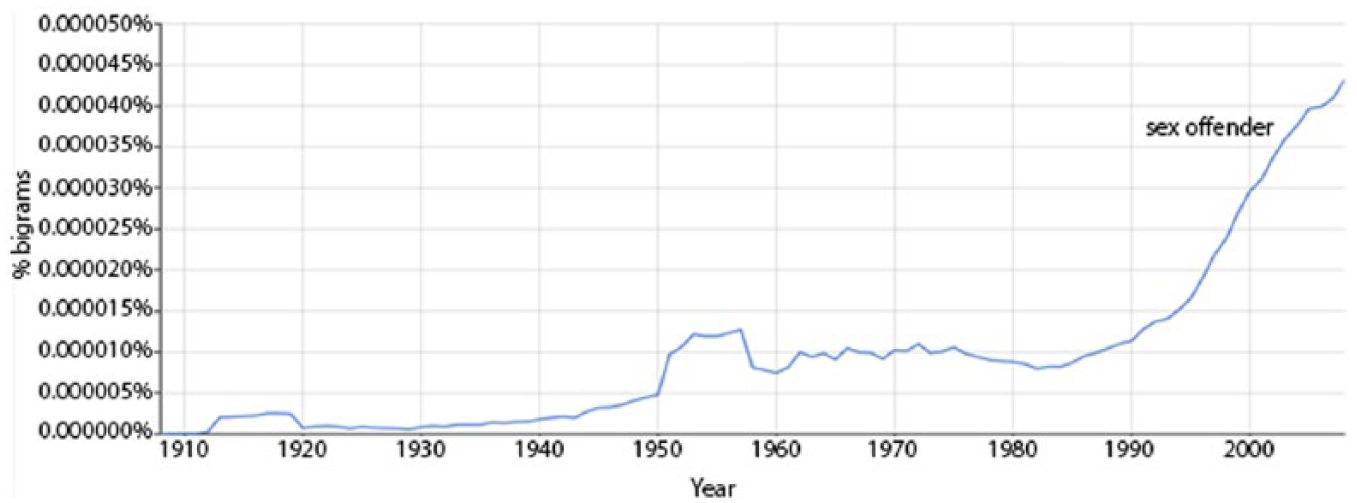
Historical usage of “sex offender” terminology.
Figure 2 plots the usage of the related term juvenile sex offender from its first appearance in 1940 until 2008. After several decades of relative stability, this term’s usage experienced a dramatic surge beginning in the late 1980s—a sevenfold increase between 1989 and 1996—followed by a period of decline. These shifts are consistent with the rise and fall of the “juvenile super-predator” construct that rose to prominence in the late 1980s and early 1990s (Pizarro, Chermak, & Gruenewald, 2007). After a period of modest decline, the term witnessed a resurgence beginning around 2003.

Historical usage of “juvenile sex offender” terminology.
Not coincidentally, the growing use of both the sex offender and JSO terms over the past quarter-century has occurred concurrently with a steady expansion of public policies directed at those who perpetrate sexual offenses. Beyond incapacitation-based strategies such as expanded prison sentences and sexual predator civil commitment, state and federal lawmakers have promulgated a range of policies designed to control, monitor, and restrict the activities of those with histories of sexual offending who live within the community (see Socia & Stamatel, 2010). These have included continued growth of the nation’s systems of sex offender registration and notification (SORN), including public Internet sex offender registries; passage of state and local statutory restrictions on where registered sex offenders (RSOs) may live or congregate; imposition of lifetime GPS monitoring for certain categories of offenders; and restrictions on Internet usage.
It is also notable that the expanded use of these labels has occurred amid the ascent of 24-hr news cycles and the growing ubiquity of the Internet and social media—developments that have transformed the general public’s relationship with information in fundamental ways. Although communication media have often been effectively deployed to promote awareness and societal dialogue surrounding the nature of sexual violence and victimization, analyses of media coverage pertaining to sex crimes have documented the tendency for news reports to focus on sensationalized cases and to reinforce many of the commonly held myths surrounding the perpetrators of sexual offenses (Dowler, 2006; Galeste et al., 2012). These factors may partially explain why, despite considerable evidence showing a decline in overall rates of sexual victimization across society (Finkelhor & Jones, 2012), the majority of the public maintains the belief that sexual violence is on the rise (Levenson et al., 2007).
Labels’ Usage in the Context of Public Opinion Research
Amid the shifting policy and media landscape, a growing body of research has examined public views and perceptions surrounding sex offenders, as well as public support for common sex offender management policies. Such public opinion research has employed a range of sampling methods, and survey items have been framed in varying ways. However, the “sex offender” label has been utilized across a majority of such studies, both in the context of eliciting views and perceptions surrounding the population and in gauging support for particular policies. Of note, two instruments developed specifically for evaluating public beliefs and opinions each liberally employ the “sex offender” terminology in the framing of their items. The 35-item Attitudes Toward the Treatment of Sex Offenders (ATTSO) scale (Wnuk, Chapman, & Jeglic, 2006) utilizes the “sex offender” terminology in all 32 of its items that refer directly to the population of those who have committed sexual offenses. The Community Attitudes Toward Sex Offenders (CATSO) scale (Church, Wakeman, Miller, Clements, & Sun, 2008) employs the alternative “people who have committed sex offenses” for its first three items, but subsequently reverts to the use of the “sex offender” terminology for most of its remaining items.
In general, public opinion research has revealed that the majority of the public believes that, as a collective group, sex offenders are at high risk of re-offending compared with other types of offenders and that they are generally resistant to treatment and rehabilitation (Center for Sex Offender Management, 2010; Katz-Schiavonne et al., 2008; Levenson et al., 2007). Similar findings have been observed through public surveys in the United Kingdom (Brown, Deakin, & Spencer, 2008), Australia (Shackley, Weiner, Day, & Willis, 2014), and New Zealand (Thakker, 2012). Research further suggests that citizens typically overestimate the percentage of sexual assaults that are committed by strangers, contrary to existing evidence (Craun & Theriot, 2009; Levenson et al., 2007).
Beyond reflecting these general beliefs about the perpetrators of sexual violence, survey research has also indicated robust levels of support for public policies that provide for enhanced monitoring, restrictions, and sentencing of sex offenders. For example, a 2005 survey of Florida citizens revealed that 76.3% of respondents supported community notification for all sex offenders, and only 6.3% favored exempting low-risk sex offenders with no history of violence. A national phone survey conducted in 2006-2007 produced higher levels of support for such policies, with 92% of respondents expressing support for making the names and addresses of convicted sex offenders available to the public. In addition, 76% of respondents to that survey supported policies that restrict where sex offenders can live (Mears, Mancini, Gertz, & Bratton, 2008).
Such levels of support are connected with high levels of belief in the effectiveness of these and related public policies. A 2010 survey indicated that 79% of respondents felt that registration and notification was an effective public safety investment, 82% expressed belief in the effectiveness of GPS monitoring, and 63% felt that restricting where sex offenders can live served to protect the public (Center for Sex Offender Management, 2010). The Florida survey placed these figures at 83% for community notification, 62% for electronic monitoring, and 58% for restricting where residents can live. Of note, nearly half of the respondents in this latter study indicated that they would support these sex offender management policies even in the absence of scientific evidence showing that they actually reduce sexual abuse (Levenson et al., 2007).
Notably, the findings cited above are based on survey queries that have framed sex offenders as a collective entity. However, research has demonstrated differential levels of policy support based on situational and offender characteristics. A phone survey of 733 Michigan residents indicated that citizens supported registration policies at varying rates depending on perpetrator and offense scenarios (Kernsmith, Craun, & Foster, 2009). The highest levels of support for registration were pegged to a scenario involving sexual abuse of children (97% of respondents supported registration for this type of offender), and the lowest to scenarios involving spousal rape (71% support) and a statutory rape scenario involving a 21-year-old perpetrator and a 16-year-old victim (65% support). The study also found that respondents’ reported levels of fear varied similarly across these scenarios. The aforementioned study by Mears and colleagues (2008) revealed differences in public assessment of the appropriateness of prison sentences for various sexual offenses, with 97% supporting incarceration for sexual assault of a minor, 94% for sexual assault of an adult, 80% for indecent exposure to a child, 46% for indecent exposure to an adult, and 68% for accessing child pornography.
Findings such as these suggest that public opinions and perspectives surrounding sex offender policies may be influenced in part by the framing of survey items and the extent to which respondents consider potential variation within the population to which the policies are targeted. Related to this, one might hypothesize that associations evoked by the “sex offender” and “JSO” terminology may have a direct bearing on how people respond to public opinion surveys that utilize these labels.
Heuristics, Cognitive Bias, and the “Sex Offender” Label
The current study aims to evaluate the effects of the “sex offender” and “JSO” labels on public beliefs and opinions about individuals who have perpetrated sexual offenses and on support for common sex offender management policies. Framed in terms of cognitive dynamics, the study posits that (a) invoking these labels will produce an instinctual and visceral response that is tied to established cognitive associations with those labels and (b) utilizing alternative and more neutral terminology will prompt responses based on a more nuanced and rational consideration of facts and circumstances, and in turn more moderate views.
These hypothesized effects are based on the theory that the labels will trigger a series of subconscious processes known as heuristics—cognitive “shortcuts” that facilitate rapid, intuitive judgments. Table 1 describes three commonly cited heuristics and sets forth their theoretical relevance to the potential impacts of the “sex offender” label. The first, the availability heuristic (Tversky & Kahneman, 1973), refers to a process in which significance is assigned based on the immediacy with which ideas or associations are evoked—that is, “if it comes to mind, it must be important.” Particularly given the media attention paid to high-profile sexual offenses, it might be surmised that hearing the term sex offender produces a range of immediately accessible ideas, images, or anecdotes that might drive sentiments or opinions.
Heuristics and the Sex Offender Label.

The second, the representativeness heuristic (Tversky & Kahneman, 1974), posits that people make judgments based on an intuited similarity with phenomena they have previously encountered. Applied to the effects of the “sex offender” label, one might speculate that media and policy narratives have promulgated a stereotypical profile of those who fall under this designation, including those related to uniformly high risk of re-offense and non-amenability to treatment. These assumptions, in turn, can be expected to guide peoples’ judgments and assessments regarding the population as well as levels of policy support.
The third, the affect heuristic (Slovic, Finucane, Peters, & MacGregor, 2007), refers to judgments made on the basis of particularly positive or negative emotional associations with a particular stimulus. For current purposes, the “sex offender” terminology may trigger a range of negative emotions in respondents, including fear (which may influence the ways in which respondents perceive risk and danger) and revulsion (which may influence punitive attitudes).
Although described here as distinct processes, the noted heuristics may often work closely in tandem in shaping reactions to the “sex offender” label. Consider, for example, the public’s tendency to overestimate the threat of “stranger danger” and underestimate that of more common acquaintance scenarios when assessing risks of sexual assault and victimization (see Best, 1990; Finkelhor, Hotaling, & Sedlak, 1992). Framed in terms of heuristic effects, “stranger-danger” scenarios are generally more likely to be highlighted in the media, and thus come more easily to mind (availability), and are more likely to be associated with the stereotypical “sex offender” (representativeness). Moreover, media narratives associated with stranger-perpetrated crimes against children are often laden with themes of tragic randomness, evoking strong negative emotions associated with fear and uncertainty (affect; see Cheit, 2003; Kitzinger, 2004).
Placed into a policy context, heuristic-induced biases have been cited by researchers investigating the effects of framing on public views related to political preferences and policy issues. Bizer and Petty (2005) discussed the particular role of “valence framing” effects, in which negative frames exert a powerful influence on how people respond to particular issues. Studies of valence framing have suggested that intensity and certainty of opinion might be influenced by negative labels more than positive ones. For example, a study by Bizer and colleagues indicated that respondents asked to rate their agreement statements of opposition to a political candidate (“I oppose candidate X being elected”) indicated significantly higher levels of certainty for their position than those presented with positively framed alternatives (e.g., “I support candidate X being elected”; Bizer, Larsen, & Petty, 2011).
Focus of the Present Study
The current study was designed to test the extent to which the “sex offender” and “JSO” labels influence public opinions and perceptions. The study employed an experimental design, in which one group of participants received a series of statements utilizing these labels, and a control group received a parallel set of statements substituting the labels for more neutral descriptive language. The study hypotheses may be summarized as follows:
Method
Data for this study were collected through a national web-based panel survey commissioned by the University of Massachusetts Lowell Center for Public Opinion and administered through YouGov in April 2014. Survey respondents were compensated for their participation. The survey protocol and data collection instruments were reviewed and approved by a University Institutional Review Board prior to administration.
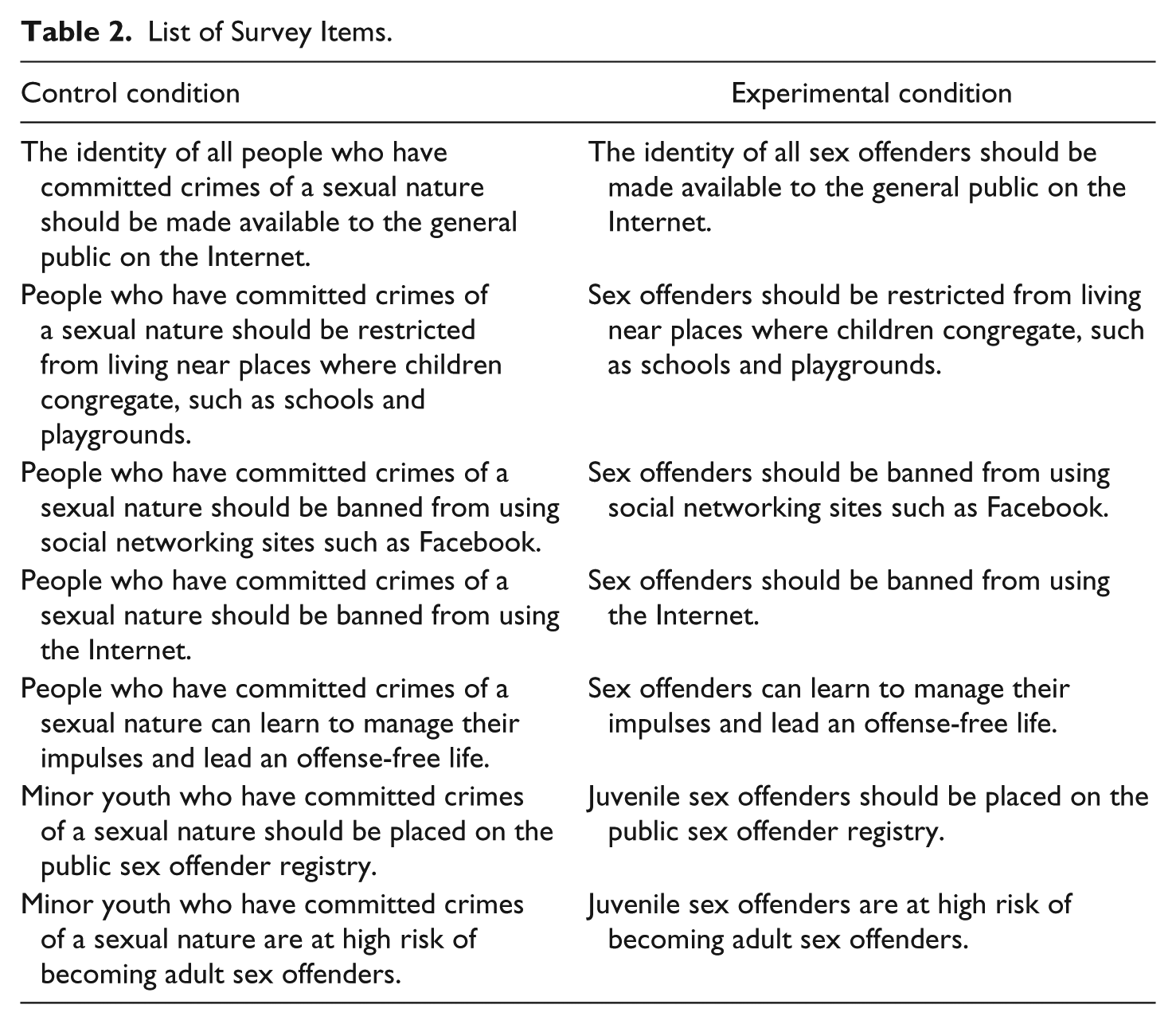
Survey respondents were asked to rank their levels of agreement with seven statements involving support for sex offender management policies, amenability to rehabilitation, and risk of future offending. Using random assignment, half of the total sample (the experimental group) received survey items that utilized the term sex offenders (Items 1-5) and juvenile sex offenders (Items 6 and 7) as the statement subjects. Those in the control group received a similar battery of items that substituted the more neutral descriptions for the “sex offender” subject terminology, “people who have committed crimes of a sexual nature” and “minor youth who have committed crimes of a sexual nature.” Levels of agreement were specified based on a 5-point scale, utilizing the following categories: (1) strongly agree, (2) somewhat agree, (3) neutral/not sure, (4) somewhat disagree, and (5) strongly disagree. The two survey item batteries are included in Table 2.
List of Survey Items.
Study survey items were embedded in a broader national survey designed to evaluate citizen perspectives on several political and policy issues. As such, additional respondent data were collected capturing a range of demographic characteristics, political affiliations, and opinions on a range of policy issues.
Study Sample
YouGov utilizes a two-stage sampling process—(a) surveys are administered to a non-probability “over-sample” drawn from an opt-in Internet panel, and (b) the initial sample is reduced to a representative final sample by algorithmically matching respondent characteristics to an established sampling frame (Rivers, 2006). The YouGov system has been validated in election studies within both the United States (Vavreck & Rivers, 2008) and Great Britain (Twyman, 2008), and has been utilized for U.S.-based polling conducted by media outlets including the New York Times/CBS News (Cohn, 2014) and the Economist (YouGov, 2014).
For the current study, the survey was administered to 1,172 respondents drawn from YouGov’s online panel of more than 100,000 adult U.S. residents. Respondents were matched to a sampling frame based on gender, age, race, education, political party identification, ideology, and political interest. The frame was constructed by a stratified sampling from the full 2010 American Community Survey (ACS), with selection within strata by weighted sampling with replacements (using the person weights on the ACS public use file). The matched cases were weighted to the sampling frame using propensity scores based on age, gender, race/ethnicity, years of education, and ideology. The propensity scores were grouped into deciles of the estimated propensity score in the frame and post-stratified according to these deciles. Additional details on the sampling frame are available from the authors on request.
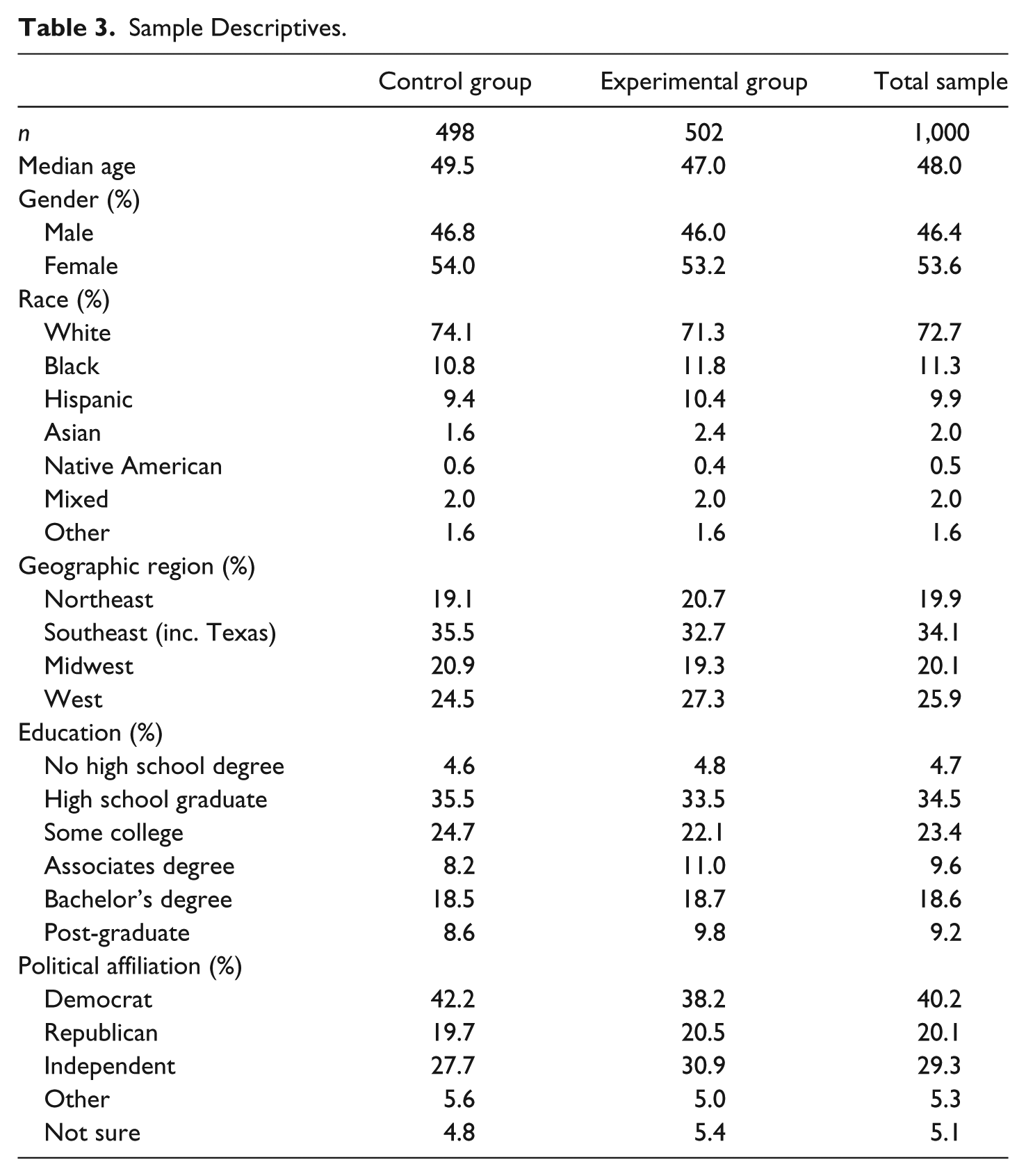
Based on the above-referenced matching process, a final sample of 1,000 cases was identified as offering the closest “fit” with the sampling frame. This included 502 cases that had received the experimental condition question battery and 498 that had received the control condition battery. Sample demographics for each of these groups are provided in Table 3.
Sample Descriptives.
Results
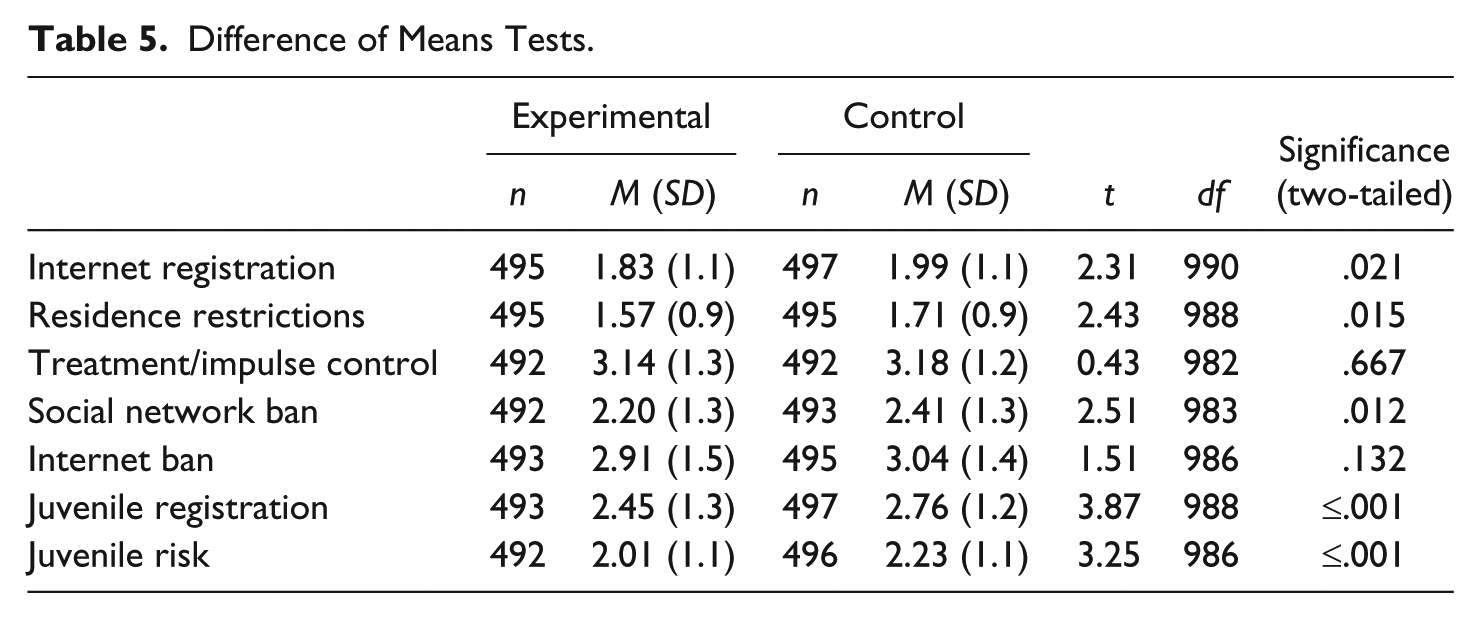
Respondents noted their level of agreement with the seven statements based on a 5-point scale. Considering that such data might be treated as either ordinal (with unknown distances between points on the scale) or fixed interval data, effects were tested utilizing both non-parametric and parametric methods. The results are summarized in Tables 4 and 5.
Response Distributions and Non-Parametric Results.

Difference of Means Tests.
General Sex Offender Items
As noted in Table 4, Mann–Whitney tests identified statistically significant differences between the groups on levels of support for three of the four policy items—inclusion on public Internet registries, residency restrictions, and social network bans. An examination of the proportional distributions across response categories suggests that the experimental effects were most pronounced at the nexus of the strongly agree and somewhat agree categories. That is, although the “sex offender” label appeared to have a moderate effect on respondents’ general support for the noted policies, effects were more pronounced with regard to the strength and certainty of that support.
A similar pattern can be observed in the fourth policy item (support for a general Internet ban), although this difference fell short of the threshold for statistical significance. Of note, the overall response distribution for this item was more centrally dispersed and produced a comparatively high level of neutrality or disagreement than the other three policy items.
The weakest effects of the “sex offender” label were in response to the statement “Sex offenders can be taught to manage their impulses and lead an offense-free life.” Although a slightly higher percentage of the experimental group expressed strong disagreement with that statement (the hypothesized direction), this difference did not reach statistical significance. Among the seven items in the experiment, this particular survey item produced the highest percentage of respondents selecting the “neutral/not sure” category, within both the experimental (31.3%) and control (30.7%) conditions.
For all five general items, independent-sample t tests based on the mean scores of each group (1 = strongly agree to 5 = strongly disagree) produced results that were generally consistent with the non-parametric tests.
JSO Items
Compared with the five general “sex offender” items, the two statement pairings utilizing the “JSO” label produced the most robust experimental effects. In response to the statement, “Juvenile sex offenders should be placed on the public sex offender registry,” 32.5% expressed strong agreement, and more than half (53.6%) expressed some level of agreement (either strongly agree or somewhat agree). Among the cohort presented with the neutral alternative, 19.7% expressed strong agreement and 42.4% expressed some level of agreement.
In response to the statement, “Juvenile sex offenders are at high risk of becoming adult sex offenders,” 42.5% expressed strong agreement, and more than two thirds (69%) expressed some level of agreement (either strongly agree or somewhat agree). Among the cohort presented with the neutral alternative, these figures were 31.7% and 60.5%, respectively.
Mann–Whitney tests indicated significance levels of <.001 for both items. Independent-sample t tests based on mean scores were generally consistent with the non-parametric results.
Tests for Moderating Factors
To evaluate potential effects of moderating variables, ordinary least squares (OLS) coefficients were generated to assess interactions between the experimental condition and three sets of respondent characteristics: age, gender, and education. Table 6 presents the coefficients and significance levels of the interaction effect between the experimental condition and each of the three respondent characteristics for each of the seven survey items. As noted, neither age nor educational level significantly moderated the experimental impacts. Gender did significantly (p < .02) moderate the experimental effects for the social network ban item, with females showing more sensitivity to the “sex offender” label than males. Although falling just outside of conventional significance levels (p = .06), support for Internet-based registration followed a similar pattern. These potential sources of moderation, along with a range of variables related to political ideology and media consumption, are under more comprehensive multivariate examination via a separate study.
Moderation Tests.
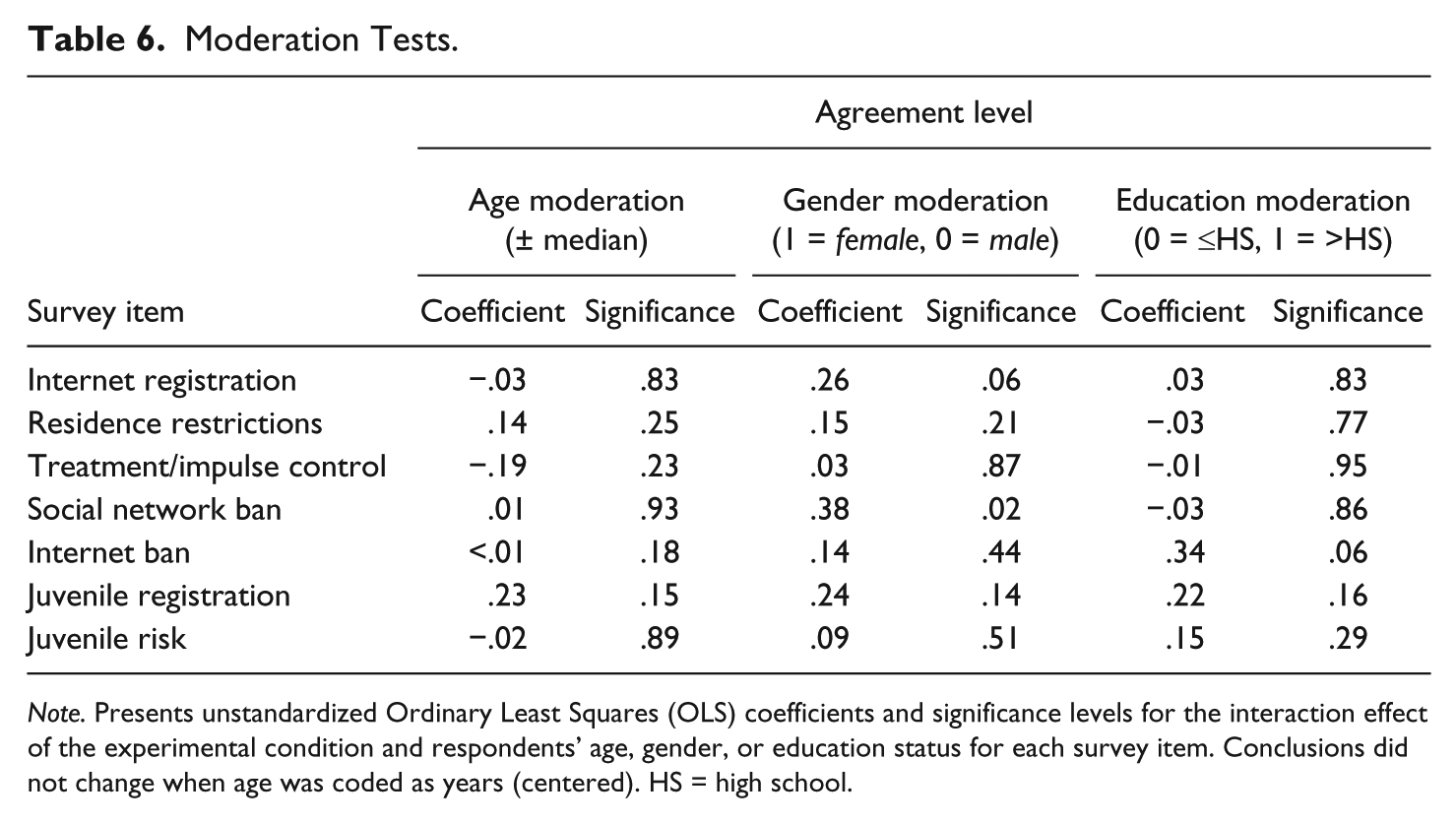
Note. Presents unstandardized Ordinary Least Squares (OLS) coefficients and significance levels for the interaction effect of the experimental condition and respondents’ age, gender, or education status for each survey item. Conclusions did not change when age was coded as years (centered). HS = high school.
Discussion
This study evaluated the impact of the “sex offender” and “JSO” labels on public support for sex offender management policies and on public beliefs about adults and youth who have sexually offended. Our findings support the hypothesis that the “sex offender” nomenclature is positively associated with public support for policies directed at those who have perpetrated sexual crimes, specifically public Internet disclosure, residency restrictions, and social networking bans. The “JSO” label appears to carry a particularly powerful effect, enhancing public support for policies that subject youth to public Internet notification and affecting beliefs about youths’ propensity to re-offend as adults.
Across these findings, the noted experimental effects were most pronounced at the nexus of strongly agree and somewhat agree categories. That is, the “sex offender” and “JSO” labels seem to exert more profound influence on the strength and certainty of one’s opinions than on the direction of those opinions. These findings are consistent with research on “valence framing” effects, as described in the literature review, suggesting that the use of negative frames increases attitude certainty and intensity (Bizer & Petty, 2005; Bizer et al., 2011).
Two of the seven statements did not produce statistically significant differences, although one of these items did produce a response pattern consistent with the hypothesized effects. The prompt, “Sex offenders (people who have committed crimes of a sexual nature) should be banned from using the Internet entirely,” was more centrally dispersed than the other policy items but did elicit stronger levels of agreement among the experimental cohort. Of note, this item followed the prompt related to support for a social network ban, suggesting that respondents may have moderated their views regarding Internet bans based on awareness of a less draconian alternative. Had this item been presented in isolation (i.e., without the social network ban alternative presented), it may have produced a more robust result.
The remaining prompt, “Sex offenders (people who have committed crimes of a sexual nature) can learn to manage their impulses and lead an offense-free life” produced the least robust experimental effects. There are multiple plausible explanations for this finding. First, this prompt was qualitatively different from the other items within the experiment—in contrast with the other four general (non-juvenile) items, which elicited opinions on specific policies or practices, this statement asked respondents to reflect and speculate on individual psychological and behavioral attributes. In addition, the item is comparatively complex, essentially asking respondents to the matters of both individual capacity for impulse control and efficacy of treatment interventions. Although the policy items may have evoked intuitive, heuristic-driven responses, it may be that the multi-faceted dimensions of this item produced a more rational and contemplative cognitive process.
Another factor to consider is that the scale for this item operated in a reverse direction than the other six items. Although the hypothesized effects for the other six items were that higher levels of agreement associated with the sex offender label, the hypothesized effects for this item involved higher levels of disagreement. This may be fairly viewed as a limitation in the study design—it is possible that this reversal of the scale may have produced some confusion among respondents and introduced some respondent error into the results. Further study of the effects of the sex offender label on this and similar items appears warranted.
Specific Effects of the “JSO” Label
Across the study results, those related to the “JSO” label were demonstrated to be the most robust. Not only does this particular designation appear to increase public support for subjecting youth who have sexually offended to registration and public Internet notification, but it also appears to influence the way in which the public views and characterizes such youth and their future propensities. These findings are consistent with prior research indicating that respondents viewing “JSOs” as an aggregate population express higher levels of support for juvenile registration and higher perceived threat than respondents who are induced to consider specific individual scenarios of youth-perpetrated sexual abuse (Salerno et al., 2010).
It is notable that respondents in both the experimental and control conditions seem to overestimate the probability that youthful sexual offenders will go on to offend as adults. Across the entire study sample, almost two thirds of respondents (69% of the experimental group and 60% of the control group) expressed some level of agreement that youth who have sexually offended are at high risk of becoming adult sex offenders. As others have noted, this commonly held sentiment is inconsistent with a substantial body of research indicating that the recidivism rates for youth who sexually offend is significantly lower than that of adults, and that the vast majority do not go on to offend sexually as adults (Caldwell, 2010; Letourneau & Miner, 2005).
The study’s findings related to the power of the “JSO” label lends support to claims that public policies and interventions aimed at minor youth who sexually offend may be profoundly influenced by the “misperceived homogeneity” of this population (Chaffin, 2008). Beyond the obvious relevance and applicability to the ongoing debates about subjecting youth to public sex offender registries, the finding surrounding the propensity for re-offense suggests that the use of the JSO label may carry ripple effects that may exert a profound influence on public policies and on daily practice decisions related to prosecution, sentencing, supervision, and treatment.
Reflecting on the general use of the “JSO” label, Chaffin (2008) wrote, As a taxonomic category, the term (juvenile sex offender) has virtually no value other than as an administrative classification for crimes. Taxonomically, the term misleads more often than it informs . . . it has little value as a risk marker, as a prognostic indicator, or prescriptively for intervention purposes. (p. 117)
Along these general lines, the present findings surrounding the power of the “JSO” terminology, coupled with the pervasive myths surrounding the population of youth to whom the label is applied, should serve as a significant cause for reflection regarding the term’s use in the context of media narratives, policy discourse, and research.
Implications for Policy and Research Communication
From a communications perspective, the sex offender and juvenile sex offender terms are undoubtedly convenient. Whether in the context of legislative deliberations, political communications, reporting a news story, or disseminating research results, these terms offer succinct descriptors that are easily understood with little additional elaboration. More nuanced alternatives, such as the “people who have committed crimes of a sexual nature” terminology utilized for this study, are comparatively cumbersome and rife with ambiguity—characteristics that often do not translate well into the “sound bite” domains of media and politics.
At the same time, policymakers and journalists who are legitimately concerned about “getting it right” would be well-advised to consider the ways in which these labels may affect public views and perceptions. Moreover, those engaged in advocating for more strategic and evidence-driven policies should be especially vigilant about how their choices of language may inadvertently feed into the public policy narratives that conceptualize the sex offender population as a monolithic entity.
Looking beyond the domains of politics and media, the present findings call for vigilance related to the conduct of research and the interpretation of research findings. As previously noted, a substantial portion of the existing public opinion survey research to date has employed such labels in querying the public about its viewpoints on policies and those who perpetrate sexual offenses. The current findings suggest the need for caution in interpreting the results of such research, and for future public opinion research to account for the effects of such labels in their research designs.
Finally, the current findings also suggest a need for judiciousness surrounding the usage of the “sex offender” and “JSO” terminology in scholarly writing. Certainly, strict avoidance of this terminology is neither practical nor appropriate in all instances—similar to journalists, scholars often face editorial or stylistic demands calling for brevity in communication. Moreover, there often are instances in which the terms may be legitimately evoked in the description and study of certain legal or policy phenomena (e.g., “policies intended to control sex offenders in the community” or “trends in sex offender sentencing”). At the same time, however, researchers must remain attuned to the terms’ potential effects on how readers will evaluate and interpret presented research results.
Limitations and Directions for Future Research
In interpreting the study results, certain limitations should be noted. First, the study utilized a non-probability sample of U.S. residents recruited via an opt-in online panel. Although the YouGov matching method produced a sample that was representative of the U.S. adult population across key demographic dimensions, the findings drawn from the online panel may not be fully generalizable to the broader U.S. population.
Second, although the findings demonstrated robust experimental effects, the reasons for these effects remain a matter of speculation. The study’s hypotheses were based on the theory that the “sex offender” and “JSO” labels would exert their effects through heuristic mechanisms, specifically those related to availability, representativeness, and affect. Although many of the observed effects might indeed be heuristic-induced, the study did not explicitly examine the role of such cognitive mechanisms.
An alternative explanation for the observed effects may relate to the grammatical construction of the experimental and control conditions. Specifically, the experimental condition utilized a noun as the primary descriptor (“sex offender”), whereas the control condition evoked a verb as part of the description (“people who have committed offenses of a sexual nature”). Semin and Fiedler (1988) presented evidence suggesting that describing people using different linguistic categories (e.g., nouns vs. adjectives) may evoke different cognitive processes and associations. A related body of research has explored the notion of “linguistic intergroup bias,” specifically demonstrating how grammatical framing may influence the transmission and persistence of social stereotypes (Maass, 1999; Maass, Salvi, Arcuri, & Semin, 1989). In sum, although care was taken to employ neutral language that would remove sources of bias within the control condition, there remains the possibility that certain elements of the control verbiage may have exerted their own independent effects. Future research might address this through creating alternative wording scenarios that might further test for the observed effects.
Third, this study was primarily focused on the labels’ influence on public support for specific sex offender management policies, and gave only limited attention to public beliefs pertaining to the propensities and characteristics of those who commit sexual offenses. Although the one general item related to treatment and impulse control did not yield any significant results, there are potential methodological reasons for this finding, as explored in the “Discussion” section. Future research might further examine the role of the “sex offender” label on public views of those who perpetrate sexual offenses, the characteristics of their offenses, their risk of repeating those behaviors, and their amenability to rehabilitation.
Finally, it should also be recognized that “sex offender” is just one of many terms that can be expected to exert the type of valence framing effects studied here. Recent research testing the effects of the “pedophile” label has demonstrated similar effects to those observed here (Imhoff, 2014), and common usage terms such as sexual predator, child molester, or rapist may also exert strong effects on public perceptions and opinions. Future research on the relative effects of these and similar labels may provide additional insights surrounding the policy and media discourse involving those who have perpetrated sexual offenses.
Footnotes
Acknowledgements
The authors extend thanks to Joshua Dyck, Roland Imhoff, SAJRT Action Editor Michael Seto, and the anonymous reviewers for their extremely helpful comments and feedback.
Declaration of Conflicting Interests
The author(s) declared no potential conflicts of interest with respect to the research, authorship, and/or publication of this article.
Funding
The author(s) disclosed receipt of the following financial support for the research, authorship, and/or publication of this article: This study was conducted with the support and assistance of the UMass Lowell Center for Public Opinion Research.