



Abstract
We examine what types of violent offenses tend to be planned using self-report data from a nationally representative sample of state and federal inmates. We find mixed support for the idea that predatory offenses are more likely to be planned than dispute-related offenses. As expected, robbery offenders are much more likely to report that they planned their crime ahead of time than homicide and physical assault offenders. However, sexual assault offenders are no more likely to report planning than homicide offenders. We also find mixed support for the idea that domestic violence—the supposed crime of passion—is less likely to be planned than violent offenses involving strangers. Finally, we find substantial demographic variation depending on type of crime. Robberies involving offenders of lower socioeconomic status and homicides and assaults involving African American offenders and victims are less likely to involve planning.
The question of premeditation—whether a crime was planned ahead of time—is important to those who judge offenders and those who study them. Prosecutors are likely to apply more serious charges and judges are likely to punish more severely when the evidence suggests premeditation. The issue of planning also has important theoretical implications for theories that assume offenders commit their crimes on impulse. A planned offense cannot be an impulsive offense. Studying whether offenses are planned therefore reveals information on the scope of these theories.
The assumption that most crime is spontaneous and unplanned is central to Gottfredson and Hirschi’s (1990) general theory of crime. They claim that the attitudes of criminals are no different from the attitudes of law-abiding citizens. The reason they commit crime is that they lack self-control. Their problem, then, is a faulty time perspective: they think about immediate benefits and fail to consider future costs. As crime typically has immediate benefits and long-term costs, those with low self-control are more likely to commit crime than those who have a broader temporal perspective. They commit a variety of crimes depending on opportunity—they are versatile offenders, not specialists.
Gottfredson and Hirschi’s (1990) theory has a problem explaining crimes that are planned or premeditated. Offenders who plan their offenses are more attentive to the task and have more time to think about the risks. 1 It seems unlikely that premeditated offenses can be attributed to low self-control. One would therefore expect that low self-control has a much stronger impact on the commission of crimes that are impulsive than those that are planned. Gottfredson and Hirschi’s general theory of crime may not be as general as they claim.
Planning is also relevant to the routine activities approach and its policy application—situational crime prevention (Cornish & Clarke, 1986; M. Felson, 2002). From this perspective, crime is likely when routine activities produce contact between motivated offenders and vulnerable victims in the absence of capable guardians. Offenders commit their crime when an opportunity presents itself—they rarely plan ahead of time. Impulsive offenders do not go out looking for opportunities to commit crime; they are opportunists.
Offenders who plan their crime, however, are not opportunists. They seek out their victims according to plan. In other words, they go to the victim, the victim does not come to them. For these offenders, contact produced by routine activities should be less important in determining whether a crime takes place. In addition, to the extent offenders plan their crimes, situational crime prevention will not be as effective in reducing crime rates. When a crime opportunity is blocked, they will search for alternatives. In other words, to the extent offenders plan their crimes, displacement is more likely. Research suggests that, in general, crime prevention efforts in one location do not lead crime to be displaced to other locations (e.g., Hesseling, 1993). Still, some displacement does occur and it is much more likely to occur for crimes that involve planning. The impulsiveness of crime is, therefore, a key assumption in the study of routine activities and situational crime prevention.
Only a few studies have examined the extent to which particular violent offenses are planned. None of them compare different types of offenses. In addition, the studies have produced widely disparate estimates of planning probably because they rely on different measures (see Birkbeck & Lafree, 1993; Erez, 1980; Gill, 2000).
Most of the studies focus on robbery. For example, Petersilia, Greenwood, and Lavin (1978) found that 25% of incarcerated robbers reported that they had planned their offense in detail, 50% planned some aspect of their crime, and 25% did not plan at all. Walsh (1986) found that 52% of armed robbers planned their offense, whereas Feeney (1986) found that only 15% planned their offense. Finally, ethnographic studies suggest that many robberies involve some level of planning (e.g., Wright & Decker, 1997).
Research on planning sexual assault has also found inconsistent results. Amir (1971) reported that 71% of rapes in his sample were planned, whereas Glueck and Glueck (1956) found that only 40% of rapes involved planning. Monahan, Marolla, and Bromley (2005) interviewed 33 incarcerated rapists and found that most used minimal planning (see also Hazelwood & Warren, 2000).
We move beyond prior research by examining variation in planning across different types of violent offenses. We also examine social-demographic differences in the tendency to plan offenses. No one, to our knowledge, has examined these issues. They are important theoretically because they have implications for understanding the scope of the general theory of crime and the routine activities/situational crime prevention approach. We think the literature has clearly established that self-control and opportunity factors affect crime. For us, an important issue is to determine when these factors are likely to have stronger or weaker effects. We suggest that the effects of self-control and opportunity factors depend on the degree to which particular types of crime by particular types of offenders are planned.
We first suggest why planning is likely to vary by the type of offense. We then discuss why the offender’s relationship to the victim might be related to whether the crime is planned. Finally, we discuss why social-demographic and other characteristics might be associated with whether offenses are planned or spontaneous.
Type of Offense
Conventional wisdom suggests that homicides and assaults are less likely to be planned than robbery and sexual assault. The argument is based on the well-known distinction between reactive aggression and instrumental aggression (e.g., Berkowitz, 1989). 2 Bushman and Anderson (2001) describe reactive aggression as “‘hot,’ impulsive behavior that is motivated by a desire to hurt someone,” whereas instrumental aggression is “‘cold,’ premeditated behavior used as a means to some other end” (p. 273). Reactive aggression is typically viewed as a reflexive response to frustration or aversive stimuli (e.g., Berkowitz, 1989; Dollard, Doob, Miller, Mowrer, & Sears, 1939). It is much more likely to involve anger during the event and regret afterward than instrumental aggression (Barratt, Stanford, Dowd, Liebman, & Kent, 1999). Most homicides and assaults are considered reactive aggression, whereas most robberies and sexual assaults are considered instrumental aggression (e.g., Berkowitz, 1989).
Bushman and Anderson (2001) dispute the idea that reactive aggression is impulsive and instrumental aggression is planned. They argue that either type of aggression can involve consciously controlled information processing and either type can involve automatic or overlearned behavior based on schemas and scripts. Tedeschi and Felson (1994) also challenge the distinction between reactive and instrumental aggression, arguing that what some scholars describe as reactive aggression actually involves instrumental behavior. Offenders are motivated to achieve social influence, retribution, thrills, and the enhancement of identities. They acknowledge that offenders are often impulsive, but they claim that impulsive violence reflects careless decision making rather than an automatic response to frustration or aversive stimuli. Offenders fail to consider costs because they are highly aroused, intoxicated, or because they lack self-control.
Felson (1993) distinguishes between dispute-related and predatory behavior rather than between reactive and instrumental aggression. Homicide and assault usually stem from disputes, whereas robbery and sexual assault are usually predatory. Dispute-related offenses may be less likely to be planned than predatory offenses because offenders are angry, and because the motivation to commit violence is more likely to arise during the situation, after a verbally aggressive exchange (e.g., Felson & Steadman, 1983; Luckenbill, 1977). In other words, dispute-related offenses are more likely to be spontaneous and context driven. In contrast, the motivation for predatory offenses is more likely to reflect relatively stable long-term goals that precede the criminal event. Offenders are more likely to select the victim and the situation than offenders involved in a dispute (Birkbeck & Lafree, 1993). Robbers, for example, may search for opportunities with low risk or high yield and plan their offense beforehand.
Victim–Offender Relationship
The description of intimate partner violence and other domestic violence as “crimes of passion” implies that these offenses are less likely to be planned than violence involving people outside the family. Why this should be the case is not clear. Perhaps, it relates to stronger inhibitions about assaulting family members than assaulting strangers (Felson, Ackerman, & Yeon, 2003). People will commit the offense on impulse, while a time delay associated with planning leads them to reconsider. It may also be that disputes between intimate partners or other family members are particularly intense and offenders strike out impulsively.
Characteristics of Offenders
A number of small-scale studies suggest that older offenders are more likely to plan their offenses than younger offenders. Shover (1985) found this pattern in his ethnographic study of property offenders. In discussing their criminal career, the offenders described their more recent offenses as calculated and their juvenile offenses as more impetuous. In a study of 49 incarcerated armed robbers, Petersilia et al. (1978) also found that older offenders were more likely to have planned their offense. A similar finding was reported in a study of older burglars (Reppetto, 1974). 3
Planning may be more common among career criminals if they are more willing to commit violent offenses in “cold blood.” In addition, Shover (1985) suggests that offenders with extensive records are more careful in their offending because they anticipate receiving a long prison sentence if they are caught. In support, Petersilia et al. (1978) found that incarcerated offenders with more extensive records were more likely to plan their offenses. Erez (1980), however, did not find a significant difference in planning of the offenders’ first and last offense.
Finally, it may be that offenders with higher socioeconomic status (SES) are more likely to plan their offenses than those with lower SES. Educational attainment and more lucrative jobs require self-control and the ability to plan and delay gratification. SES has been shown to be related to impulsiveness in the general population (Flory et al., 2006; Lynam et al., 2000), so it is plausible that this pattern will also be observed among convicted offenders, even if the variance of impulsiveness is attenuated.
Current Study
This study used data from a national sample of inmates to examine whether the planning of violent crimes depends on the characteristics of the offense and the offender. We predicted that homicide and assault are less likely to be planned than sexual assault and robbery based on distinctions between reactive and instrumental aggression and between dispute-related and predatory violence. Homicides and assaults are more likely to be committed in anger and in response to events that arise in the immediate situation. In addition, we expected that homicides are more likely to be spontaneous than assaults because there are stronger inhibitions to overcome.
We also predicted that domestic violence is less likely to be planned than violence involving strangers. We suggested that domestic violence may be more likely to be spontaneous because of the intensity of emotions or stronger inhibitions about attacking family members. We also examined the possibility of a statistical interaction between gender and intimate partner relationship. Some scholars suggest that the contexts in which men and women assault their intimate partners are different (e.g., Dobash & Dobash, 1979; but see R. Felson, 2002). For example, they claim that men are motivated to control their partners, whereas women are motivated by self-defense.
We also examined demographic differences in the tendency to plan offenses. We predicted that younger offenders are less likely to plan their offenses than older offenders, given the greater impulsiveness of youth. We also predicted that offenders with more extensive records are more likely to plan their offenses, as Shover (1985) and Petersilia et al. (1978) suggest. In addition, we predicted that offenders who are educated or earn higher incomes are more likely than their counterparts to plan their offenses, given that SES is related to impulsiveness in the general population. We also examined race and ethnic differences, although we made no hypotheses about the relationships. Note that a study of 164 male homicide offenders found no race difference in whether their offenses were impulsive or premeditated (Heilbrun, Heilbrun, & Heilbrun, 1978).
We include controls in our equations for the victim’s demographic characteristics, whether there were multiple victims, and whether the offender was intoxicated during the crime. One would expect that intoxicated offenders are less likely to plan their crimes than sober offenders as alcohol results in careless decision making and more spontaneous behavior. 4 In addition, some offenses are more likely to be committed while intoxicated than others. For example, Felson, Burchfield, and Teasdale (2007) found that offenders who assaulted strangers were more likely to be intoxicated than offenders who assaulted people they knew.
Finally, we examine whether the effects of social-demographic characteristics are similar for homicide, assault, robbery, and sexual assault. If offenders who are young or of lower SES are more likely to be impulsive than their counterparts, then they should be less likely to plan all types of offenses. If we find that age and SES only predict some types of offenses, it will suggest that different demographic groups encounter different situations associated with planning.
Data and Method
Our analyses are based on a representative sample of 14,000 inmates in state prisons and 4,000 inmates in federal prisons taken during the 1997 Survey of Inmates of State and Federal Correctional Facilities (Bureau of Justice Statistics, 2000). The inmates were randomly selected to participate in the survey. At the state level, approximately 1 in every 75 males and 1 in 17 females were selected. In the federal system, 1 in every 13 males and 1 in every 3 females were selected. The survey had high response rates with more than 90% of federal inmates and slightly less than 93% of state inmates responding.
Each interview took approximately 1 hr and elicited information on a wide range of demographic, social, and behavior indicators. In addition, offenders were asked about details of the offense for which they were most recently incarcerated. The analyses was restricted to inmates with a violent offense (N = 7,130) as only these inmates were questioned about whether they planned their offense. After the removal of missing data, our final sample included 6,988 cases.
It is possible that a sample of incarcerated offenders undersamples planned offenses because offenders who plan their crime are less likely to be apprehended. However, it could be that an inmate sample oversamples planned offenses as offenders who are thought to have committed their crime with premeditation are more likely to receive prison terms or longer prison terms. However, even if we have over- or undersampled planned offenses or impulsive offenders, it seems unlikely that this selection is related to our independent variables. The tendency for offenders who plan their offense to have a higher or lower risk of incarceration should be observed regardless of the offense.
We may also be undersampling certain types of offenses. For example, evidence suggests that sexual assaults are somewhat less likely to be reported to the police than physical assaults (e.g., Felson & Paré, 2005). In addition, assaults involving people who know each other are less likely to be reported than physical assaults involving strangers. Thus, inmate data are likely to undersample sexual assaults and nonstranger violence to some extent. 5 However, the strength of these effects should not be exaggerated—offenders often avoid incarceration regardless of the type of offense. For example, offenders who target strangers often avoid prison because they are difficult to identify. In addition, the biases of inmate samples should only affect our results if they are related to planning, and there is no strong reason to think they are related.
Finally, research shows that key predictors of crime (e.g., marriage and employment) are similar for inmate samples and samples of nonincarcerated individuals and other high-risk groups (e.g., high school dropouts, drug addicts; Horney, Osgood, & Marshall, 1995; Sampson & Laub, 1993; Uggen, 2000). In addition, research based on official statistics and research based on general population surveys tend to yield similar results, when one takes into account that official statistics focus on more serious offenses (e.g., Hindelang, Hirschi, & Weis, 1979). These studies suggest that findings from inmate samples have some external validity. Nevertheless, we must acknowledge that the generalizability of our results to offenders outside of prison is unknown.
Measuring Planning
Our measure is based on whether inmates answered “yes” or “no” to a simple question: “Did you plan the (offense) ahead of time?” We recognize the potential limitations of such a measure. Respondents may have different interpretations of what constitutes a “plan” and what is meant by “ahead of time” (see, for example, Erez, 1980). Their plans may be specific or general, vague or detailed, conscious or unconscious, developed at the scene of the crime or before. Perhaps, they planned the crime but did not plan such a serious outcome. There are likely to be mixed cases and degrees of premeditation. In addition, some offenders may be reluctant to admit that they planned their offense as it makes them appear more blameworthy. Like other criminologists who have attempted to measure planning, we are unable to address these complexities.
The measurement problem, in part, reflects the fact that there is no clear definition of what is meant by a “plan.” Mead’s (1934) description of “the act” implies that all human behavior involves at least a rudimentary plan of action. Before acting on impulses (the “I”), the actor imagines consequences (the “Me”) before engaging in the behavior. Heider (1958) also suggests that some planning is involved in all intentional behavior as an intention is a plan that guides action. Similarly, Tedeschi and Felson (1994) argue that all cognitively mediated action, as opposed to reflexes and automatic responses, involve some forethought. They view aggression committed on impulse as “bounded” rational choice in which an actor engages in careless decision making and fails to consider consequences. In sum, according to these theorists, even impulsive actions involve a rudimentary plan immediately preceding behavior. We must assume that respondents rule out such rudimentary planning when they interpret a question about planning “ahead of time.”
Most importantly, we think our measure of planning is suitable for our purposes. First, we are interested in the relative levels of planning, not absolute levels. There is no compelling reason to suspect measurement error varies systematically across offense types or for offenders with different demographic characteristics. For example, respondents may vary in their interpretation of what is meant by “ahead of time” but this should not vary by type of offense. In other words, the error in our measure is likely to be random not systematic. Second, although measurement error on the dependent variable can influence the intercept or increase the size of standard errors, it does not bias parameter estimates (Alwin, 2007). In a regression framework, it is measurement error in independent variables that can potentially bias parameter estimates in the model. Third, we think the motivation to deny planning an offense in this sample is likely to be low. The survey is anonymous, the case has already been adjudicated, and the offenders are describing offenses they admit that they have committed. Finally, Barratt et al. (1999) provide evidence that self-reports of whether an aggressive behavior was premeditated have construct validity.
Independent Variables
Offense type involves a series of dummy variables indicating whether the current offense was a homicide, a physical assault, a sexual assault, a miscellaneous offense, or a robbery (the reference category). The most frequent violent offenses in our miscellaneous category are weapons offenses, involuntary manslaughter, and kidnapping.
We code the victim–offender relationship as intimate partners (current and former spouses, current and former boyfriends or girlfriends), other family members (parents, children, uncle, aunt, cousin, brother, sister, in-laws), other persons known (friends and acquaintances), and strangers, which serves as the reference category.
The social-demographic variables include the offender’s gender, race/ethnicity, education, income, and age at the time of the offense. Race/ethnicity are dummy variables coded as White (the reference category), Black, Hispanic, and Other. Education is based on the highest grade of school attended and ranges from 0 to 18. Income is based on the inmate’s personal monthly income prior to the offense, measured on a scale that ranges from no income to US$7,500 or more per month.
The equations include measures of the victim’s gender and race. Victim’s race was coded as Black, White (the reference category), or Other. If the incident involved multiple victims, we used a dummy coding scheme in which we set the victim’s characteristics to zero. We include a measure of whether multiple victims were involved to distinguish these incidents from incidents involving single victims. The reference category for multiple victims is therefore single victims who are White, poor, and female.
Offenders reported whether they were drinking alcohol during their most recent offense. They also provided data on prior convictions that resulted in incarceration or probation, either as an adult or a juvenile. We produced a count of the number of offenses based on this history and used mean substitution in cases with missing variables. Supplementary analysis indicated that respondents who were missing data on these items did not differ significantly from respondents who did not have missing data.
Results
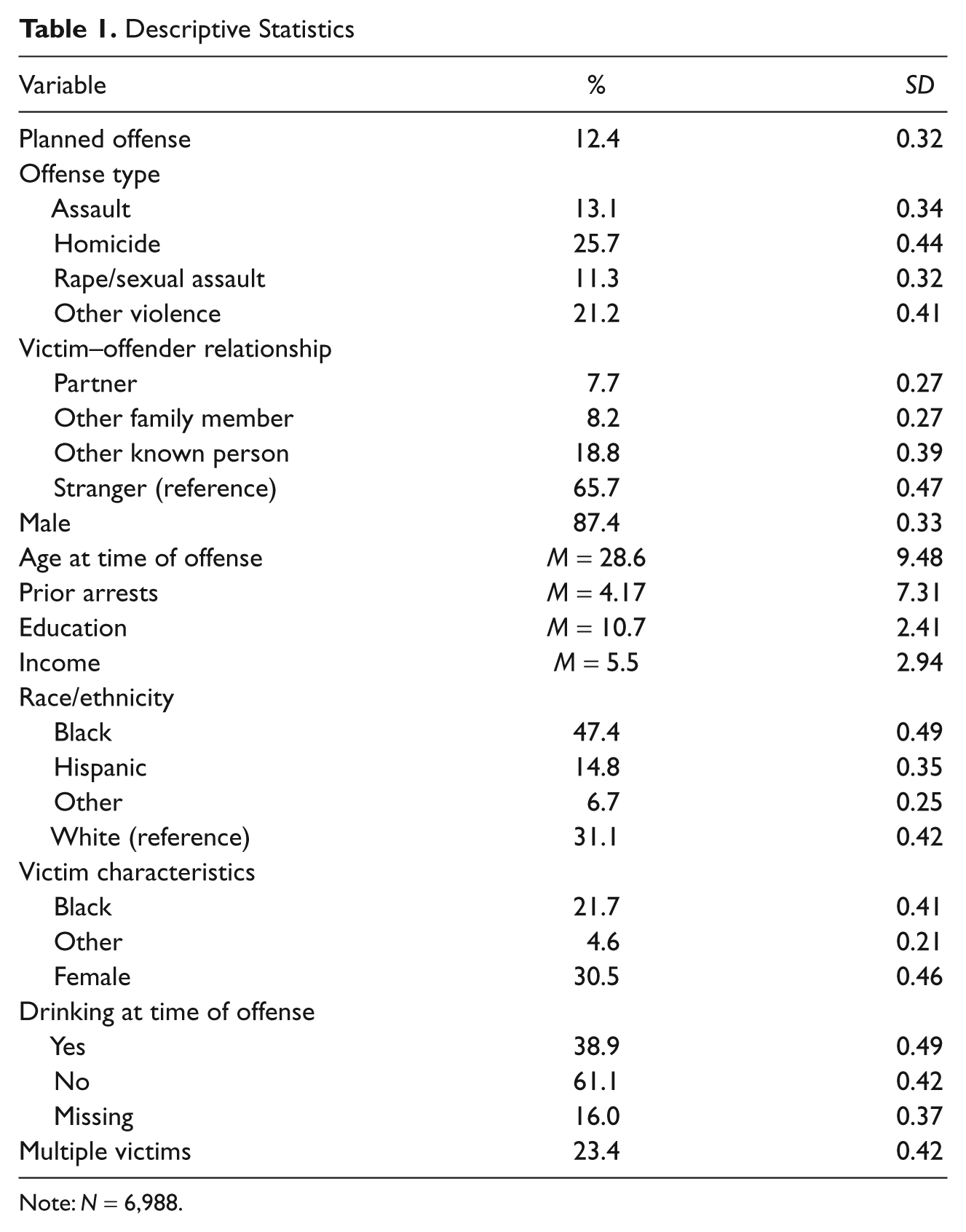
Descriptive statistics are presented in Table 1. The table shows that only 12.4% of the inmates reported that they planned their most recent offense ahead of time. Almost 40% reported that they were drinking at the time of their offense. Like other inmate samples, this sample includes a disproportionate number of males, Blacks, and people with not much education. Their victims tended to be male, White, and someone whom they did not know.
Descriptive Statistics
Note: N = 6,988.
The estimates from logistic regression equations are presented in Table 2. The results show mixed support for the hypothesis that dispute-related offenses are less likely to be planned than predatory offenses. As predicted, homicide and assault offenders are much less likely than robbery offenders to report that they planned their offense ahead of time. For example, physical assaults are 13% as likely to be planned as robberies. In addition, as predicted, sexual assault offenders are significantly more likely to report that they planned their offense ahead of time than physical assault offenders. The difference is statistically significant, according to a test of differences (p = .001; Clogg, Petkova, & Haritou, 1995). However, reported planning is not significantly different for sexual assault and homicide. The fact that sexual assaults are no more likely to be planned than homicide contradicts the hypothesis about dispute-related violence.
Predictors of Planning an Offense Based on Logistic Regression

Note: N = 6,988. –2 log likelihood = 4340.887. Equations also included dummy variables for missing data on drinking and income at time of offense.
p < .05. **p < .01. ***p < .001.
We also find variation within the categories of predatory and dispute-related offenses. Sexual assaults are 71% less likely to be planned than robberies, according to these reports. 6 Homicides are significantly more likely to be planned than physical assaults (p < .001). The latter pattern contradicts the idea that serious offenses are less likely to be planned.
The analyses suggest mixed support for the hypothesis that domestic violence is less likely to be planned than other violence. Violence against family members other than intimate partners is less likely to be planned than violence against strangers, according to offender reports. The effect for violence against intimate partners appears to depend on gender, however. We observe a gender–partner interaction of borderline statistical significance (p = .057, two-tailed test). The pattern of means suggests that male violence against partners, like other domestic violence, is less likely to be planned than violence against strangers. Female violence against male partners, however, is just as likely to be planned as violence against strangers.
The hypothesis regarding age differences is not supported. Younger offenders are more, not less, likely to plan their crime, according to these reports. Also, we did not find support for the hypothesis that offenders with longer records are more likely to plan their offenses. The number of prior convictions is unrelated to whether offenders reported that they planned their offense.
The hypothesis about SES is supported. Offenders who are less educated and who earn lower incomes are less likely than their counterparts to report that they planned their crime. We also find effects of race and ethnicity. African American and Hispanic offenders are less likely than White offenders to plan offenses. Violence against African Americans is also less likely to be planned than violence against Whites.
As expected, offenders who are drinking are more likely to commit the offense without planning. Finally, offenders who attack multiple victims are more likely to plan their crime than those who attack single victims. Perhaps offenses against multiple victims require more planning because of the greater risks involved. 7
Analyses of Offense Subsamples
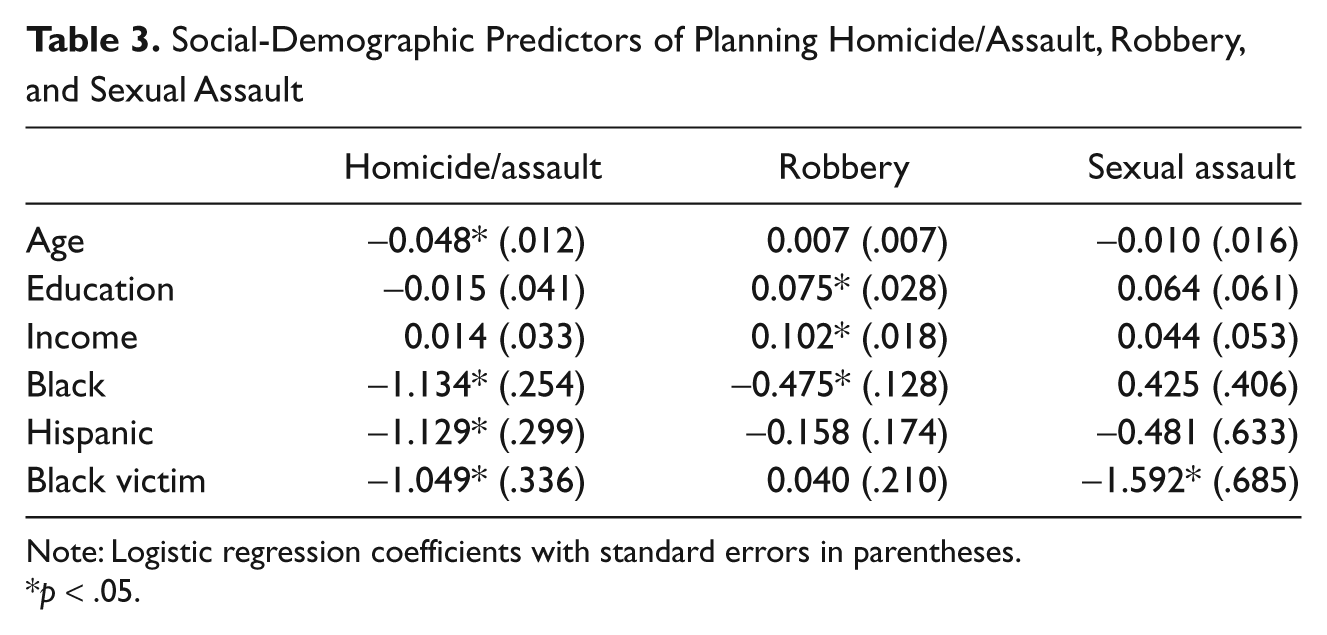
In Table 3, we present the results separately for the different types of offenses. We combine homicide and assault because preliminary analyses indicated that the results were similar. The results indicate that age effects are observed for homicide and assault, but not robbery and sexual assault. Older offenders are less likely to plan these dispute-related offenses. For example, a 40-year-old offender is approximately 62% less likely to plan a homicide or assault than a 20-year-old offender, other things being equal. Note that the difference in the age effect for homicide/assault and robbery is statistically significant (p < .01) but the difference in the age effect for homicide/assault and sexual assault is not.
Social-Demographic Predictors of Planning Homicide/Assault, Robbery, and Sexual Assault
Note: Logistic regression coefficients with standard errors in parentheses.
p < .05.
The results also show that education and income are strongly associated with planning robberies but not the other offenses. Holding all else equal, robbers who have completed high school but not attended college and who earn US$2,400 a month of income are approximately 42% more likely to plan their offense than robbers who dropped out of high school in 10th grade and who earn US$1,200. The difference in the effects of education and income for homicide/assault and robbery are statistically significant (p < .01) but the difference in their effects for homicide/assault and sexual assault are not.
The effects for race are stronger for dispute-related offenses. All comparisons across crimes are statistically significant (p < .01). The results suggest that dispute-related incidents involving Whites as either offenders or victims are more likely to be planned than incidents involving Blacks. For example, holding all else equal, an attack by a White offender is approximately 68% more likely to be planned than an attack by a Black offender. An attack on a White victim is approximately 65% more likely to be planned than an attack on a Black victim. Finally, dispute-related offenses committed by White offenders are more likely to be planned than dispute-related offenses committed by Hispanic offenders.
Discussion
This is the first study to compare different types of offenses in terms of whether they were planned or not. It is also the first study to examine the relationship between planning and the social-demographic characteristics of offenders. Although difficulties in conceptualization and measurement are a challenge in studying the planning of offenses, the topic is important for understanding the scope of some major criminological theories and therefore merits research attention. We argued that our self-report measure is precise enough to examine the relative importance of planning and noted that random error in the dependent variable does not systematically bias parameter estimates. Our results provide further support that our measurement is adequate. We predicted and found some strong effects suggesting that our measure has predictive validity. We also found some statistical interactions between social demographic variables and type of crime that are difficult to attribute to a reporting bias. Nonetheless, we see this analysis as a first step. Future research is necessary to examine planning in a more nuanced way. Such an effort will require the collection of new data with questions about the offenders’ thought processes before they committed their crime. Future research should also examine planning among offenders who are outside of prison.
We hypothesized that offenders would be less likely to plan homicides and assaults than robberies and sexual assaults. This hypothesis was based on the notion that dispute-related violence is more likely to involve an emotional response to provocation. The evidence provided mixed support for the hypothesis. As predicted, homicides and assaults were much less likely to be planned than robbery, and assaults were less likely to be planned than sexual assaults. However, sexual assaults were no more likely to be planned than homicide and they were much less likely to be planned than robberies. Sexual assault is apparently more likely to be an opportunistic crime than robbery. Its motivation is more likely to arise out of the immediate situation.
It is important to keep in mind that we are making claims about relative rates of planning, not absolute rates. For example, we are not claiming that robbery is typically planned ahead of time. Robbery is much more likely to be planned than any of the other crimes, but only 23% of the robbers in this study reported that they planned their offense. Statements about absolute levels of planning are difficult to make because of measurement problems and the ambiguous nature of the concept.
We found mixed support for the hypothesis that domestic violence is less likely to be planned than other violence. Male violence against partners and other family violence were less likely to be planned than violence against strangers. The exception was female violence against partners—a relatively rare offense in this inmate sample. It was just as likely to be planned as violence against strangers. Perhaps, women’s violence against male partners requires more planning because of the risks associated with their disadvantage in physical strength. Recall that offenders were also more likely to plan offenses against multiple victims. However, as the gender–partner statistical interaction is of borderline significance, we cannot be certain that women’s violence against their partners is actually an exception. In addition, the differences between domestic violence and stranger violence are small. The characterization of domestic violence or intimate partner violence as “crimes of passion” has some support but appears to be overstated.
We also found that physical assaults are less likely to be planned than homicides. This was unexpected, given that homicide is a more serious crime. It may be that homicides are more likely to have a tactical motive. Felson and Messner (1996) found evidence that homicide offenders sometimes killed the victim to avoid retaliation and to prevent the victim from serving as a witness to the crime. Note that the pattern is inconsistent with the argument that our results reflect a reporting bias, that is, a tendency for offenders to falsely claim than an offense was unplanned if it was particularly serious. If respondents who committed the most serious offenses were more highly motivated to excuse their behavior, one would expect them to report less planning for homicide than assault.
Demographic Effects
We predicted that offenders of higher SES would be more likely to plan their crime as SES is related to impulsiveness in the general population. The evidence was mixed: offenders of lower economic status were much less likely to plan robberies, but not the other offenses. The explanation for the interaction is unclear but the strength of the robbery effect suggests that it deserves further investigation. As robbery is an economic crime, presumably the explanation has to do with the financial situation faced by impoverished offenders.
We also observe strong effects of race and ethnicity. Homicides and assaults involving Blacks and Hispanics are much less likely to be planned than homicides and assaults involving Whites. The strong effect of the victim’s race suggests that situational factors rather than group differences in impulsivity account for the pattern. Perhaps, the effect is due to the nature of disputes in minority neighborhoods. Perhaps, the code of the streets requires a quick response to provocation and so these attacks are less likely to involve planning (Anderson, 1999).
The hypothesis that younger offenders would be less likely than older offenders to plan their offense was not supported. 8 In fact, younger offenders were much more likely to plan dispute-related violence than older offenders. The explanation may be related to the fact that all of our respondents have committed a crime. As older people tend to have more self-control, when they do commit a crime, it is more likely to be unplanned. When they attack someone, it tends to involve a spontaneous reaction during a dispute rather than a planned offense. Again, we can only speculate about the explanation, but the strength of the age effect suggests that further investigation is warranted.
Finally, we found no evidence that chronic offenders were more likely to plan their offenses. The absence of a relationship between number of prior offenses and planning also suggests that we have not over- or undersampled impulsive offenders. If this were the case, we would have expected offenders who planned their offense to be different in terms of prior convictions.
Theoretical Implications
Both the general theory of crime and routine activity theory propose that the typical offender commits his crime on impulse. Our evidence that most offenders did not plan their offense ahead of time is consistent with this assertion. However, we think that absolute frequency is likely to depend on the wording of questions; recall the variation in estimates of planning observed in the literature. We were instead interested in making comparative statements, that is, in determining whether some offenses are more likely to be committed on impulse than others and whether some demographic groups are more likely to plan their crime. We suggested that self-control and variables that affect opportunity are more important causal factors for crimes that are committed impulsively than crimes that are planned.
Regarding Gottfredson and Hirschi’s (1990) general theory of crime, our results suggest that the effects of self-control may not be as “general” as the theory implies. Our evidence suggests that self-control plays a less important role in robbery than in other violent crime as robbery is more likely to be planned. The role of low self-control should be greatest in homicide and assault—violence usually stemming from disputes—as these offenses are most likely to be committed on impulse. Self-control should also play a more important role in sexual assault than in robbery as sexual assault is a more impulsive crime. The pattern is consistent with evidence that many sexual assaults occur during consensual sexual activity, when the man wants to go farther than the woman and uses force when she resists (Kanin, 1985). 9 Finally, these results address the versatility-specialization issue. Evidence suggests that offenders are not as versatile as Gottfredson and Hirschi argued (Deane, Armstrong, & Felson, 2005; Osgood, Johnston, O’Malley, & Bachman, 1988). One reason specialization may occur is because offenses vary in the extent to which they are committed on impulse. Those with low self-control commit more impulsive offenses but they are not necessarily more likely to commit planned offenses.
The results also have implications for routine activity theory and situational crime prevention. We suggested that the approach treated crime as an impulsive act committed in response to opportunity. Motivated offenders stumble on criminal opportunities when they are engaged in their routine activities. Motivated offenders who plan ahead, however, search for and create their own opportunities. They are more difficult to deter by situational crime prevention because they are more likely to change targets. In other words, displacement is more likely when offenders are planners.
Our results suggest that although many robbers commit their crime on impulse, they are much more likely than other violent offenders to plan their offenses. Robbery, therefore, should be more difficult to deter with situational crime prevention than other violent offenses. In addition, we should be more likely to observe displacement for robbery than for other violent offenses. Localized situational crime prevention strategies may affect robbery rates, but they should be less effective than strategies that target other violent crimes. However, situational crime prevention should be particularly effective in deterring violence stemming from disputes as these offenses are least likely to be planned. In general, attempts to design environments to avoid crime should take into account the impulsiveness of the crime being targeted.
In sum, we have argued that planning is a critical factor in the study of crime. Although most violent offenses may be unplanned, there is significant variation across different violent offenses. Our research, although preliminary, supports conventional wisdom in some instances but not in others. The unexpected results were that sexual assaults are just as likely to be planned as violence stemming from disputes and that domestic violence is almost as likely to be planned as violence involving strangers. Finally, substantial variation in planning is observed depending on the social-demographic characteristics of offenders and victims. Criminological theories that focus on self-control and opportunity factors should take these patterns into account.
Footnotes
The authors declared no potential conflicts of interest with respect to the research, authorship, and/or publication of this article.
The authors received no financial support for the research, authorship, and/or publication of this article.