



Abstract
Many criminologists have considered the role of groups in the commission of crime to gain insight into offender decision-making. Additional research is needed, however, that examines the likelihood of arrest as a function of whether an offense is committed by a group of offenders (two or more offenders in a criminal incident) or a lone offender, as well as the number of offenders in the group. Using 3 years of data from the National Incident-Based Reporting System for robbery incidents, assault incidents, and sexual offenses, the study finds that the relative likelihood of arrest for group-offender incidents, compared with lone-offender incidents, varies by incident type. For robbery incidents, the likelihood of arrest increases when committed by a group of offenders. Yet, for assault incidents and sexual offenses, the likelihood of arrest decreases when committed by a group of offenders. Further analysis looks more closely at incidents committed by a group of offenders and how the number of offenders in the group affects the likelihood of arrest. A consistent finding is that for each incident type, the likelihood that all offenders in a group will be arrested is lower as the number of offenders increases, which may justify offenders’ perceptions of “safety in larger numbers.”
Group offending has been a focus among criminologists for many decades (Erickson, 1971, 1973; Reiss, 1988; Shaw & McKay, 1931; Thrasher, 1936a, 1936b; Warr, 2002). Because much of this focus has been on why individuals offend in groups, there has been little research on group offending as a predictor of arrest (Tillyer & Tillyer, 2015). As it stands, the arrest consequences of offenses committed by a group of offenders, compared with offenses committed by a lone offender, are largely unknown (McGloin & Nguyen, 2012) despite that arrest can affect offenders’ likelihood of further offending. Group offending is often perceived by offenders as less risky than committing crimes alone (McGloin & Thomas, 2016), yet little is known about the likelihood of arrest for group offending across diverse crimes. In this study, we examined the likelihood of arrest for offenses committed by a group of offenders, compared with offenses committed by a lone offender, for robberies, assaults, and sexual offenses. We also examined how the number of offenders in the group affects the likelihood of arrest for the same offenses.
Explanations of Group Offending
Many criminologists have considered how group influence causes crime (e.g., Akers, Krohn, Lanza-Kaduce, & Radosevich, 1979; Cloward & Ohlin, 1960; Shaw & McKay, 1942; Sutherland, 1947; Thrasher, 1936a, 1936b). Building on Bentham’s utilitarian principle of decision-making to avoid painful consequences, additional cognitive processes related to group influence have been identified (Vider, 2004), including conformity to peer pressure (Warr, 1996, 2002) and adherence to a collective consciousness, which allows people to disassociate from their moral misgivings (Freud, 1960).
Comparing group offending with lone offending, Tillyer and Tillyer (2015) highlighted Clarke and Cornish’s (1985) application of bounded rationality and stated, “co-offending may be part of a rational attempt to increase the rewards and minimize the risks associated with offending” (p. 1065). With regard to increasing rewards, researchers have found that offenders perceive greater profitability when committing crime in groups (Weerman, 2003). Central to Sutherland’s (1947) differential association theory and learning theories in general, the attitudes, values, techniques, and motives to commit crime are often learned in criminal groups. Group offending can also generate greater efficiencies (Felson, 2003) that can lead to greater personal rewards. Likewise, knowing others who are motivated to commit crime can provide steady opportunities for offending (Ouellet, Boivin, Leclerc, & Morselli, 2013). Psychological benefits have also been identified, including positive emotions, such as exhilaration (Mintz, 1951) and feelings of inclusion (Cotterell, 1996).
Only a few researchers have directly compared group offenses with lone offenses. These researchers have found that there are important differences between the two that can affect arrest risks. For example, Van Mastrigt and Farrington (2009) and da Silva, Woodhams, and Harkins (2014) found that, compared with lone-offender crimes, group-offender crimes involve younger offenders. It also has been found that group hate crimes (Lantz & Kim, 2019), group rapes (Hauffe & Porter, 2009), and other group violence (Terranova & Vandiver, 2014) are more violent than the same crimes committed by lone offenders. Moreover, Alarid, Burton, and Hochstetler (2009) indicated that “co-offending [in robberies] increased planning and the sense of control that offenders experienced” (p. 1).
Group Offenders/Group Offenses and Arrest
Erickson (1973) proposed the group hazard hypothesis that “violating the law in groups increases the likelihood of official [police] detection and reaction” (p. 128). Others have similarly posited that group offending is more likely to come to the attention of police when interrogation of one offender in a group leads to arrest of other group members (Ouellet et al., 2013). Erickson’s (1973) group hazard hypothesis was proposed to assess the extent to which official data overrepresented group offenders because they were more likely to come to the attention of law enforcement officials.
Erickson (1973) estimated how many times each of 336 juveniles committed a list of crimes and how many of these crimes they committed alone or in a group (two or more offenders acting together to commit a crime). He then examined official records to determine how many times the offenders had been arrested. After controlling for age and socioeconomic status, he found that the greater the percentage of crimes a juvenile committed in a group, the greater the frequency of arrest.
Similarly, Hindelang (1971, 1976) found that juveniles who “usually” or “always” committed crime in groups had a higher likelihood of arrest, when compared with juveniles who “always” committed crime alone. For example, urban males who “usually” offended in groups reported being arrested for 43% of their crimes, while those who “always” offended in groups reported that 63% of their crimes resulted in arrest. In contrast, those who “always” offended alone had only 20% of their crimes resulting in arrest (Hindelang, 1976; also see Erickson & Jensen, 1977).
Shift From Offenders to Offenses
In the Erickson/Hindelang research, the unit of analysis is offenders (Erickson, 1973; Hindelang, 1971, 1976). By shifting the unit of analysis from offenders to offenses, different questions can be asked: Of offenses known to law enforcement officials: (a) Do group offenses have a higher likelihood of arrest than lone offenses; and (b) Does the number of offenders in the group affect arrest risk? While there may be an increased likelihood of arrest for offenders who violate the law in groups, as found by Erickson (1973) and Hindelang (1971, 1976), it does not necessarily follow that offenses committed by a group of offenders will have a higher arrest risk than offenses committed by a lone offender, nor that offenses committed by a larger group of offenders will have a higher arrest risk than offenses committed by a smaller group.
Reflecting this shift in unit of analysis, Tillyer and Tillyer (2015) used National Incident-Based Reporting System (NIBRS) data and found that robberies committed by a group of offenders were more likely to result in arrest than robberies committed by a lone offender. Compared with lone-offender robberies, the odds of arrest were 48% higher when committed by two offenders, 106% higher when committed by three offenders, and 228% higher when committed by four or more offenders. A strength of the Tillyer and Tillyer (2015) study was its use of NIBRS data, which included official reports of crime other than just those that resulted in arrests. Their study was limited, however, in its use of only 1 year of NIBRS data and examination of only robberies. We addressed these limitations by using 3 years of NIBRS data and examining not only robbery, which tends to involve monetary rewards, but assaults and sexual offenses as well, which are more likely to involve cognitive mechanisms that influence offenders, such as peer acceptance and acquiescence to peer pressure (Cotterell, 1996; Warr, 1996, 2002).
Method
In this study, we first compared arrests for offenses committed by a group of offenders with arrests for offenses committed by a lone offender. This was done with NIBRS data for robberies, assaults, and sexual offenses for 2011, 2012, and 2013. The robberies included all robberies and aggravated robberies, while assaults included all assaults and aggravated assaults. The sexual offenses included rapes, sodomy, sexual assaults with an object, and fondling.
Next, we conducted a second set of analyses among the group-offender incidents only to assess the extent to which the number of offenders in a group affected the likelihood of arrest. For those analyses, we examined the following pairings: (a) offenses with three offenders compared with offenses with two offenders and (b) offenses with four or more offenders compared with offenses with two offenders.
Data
NIBRS data were used, which included crime records from the Uniform Crime Reporting Program submitted by law enforcement agencies. Although all agencies could participate, only those from 33 states participated in 2013 (U.S. Department of Justice–Federal Bureau of Justice, 2013). A limitation of NIBRS data, then, was agency non-response, which could have caused sampling bias depending on agencies’ reasons for non-participation. Researchers, however, have found few systematic differences between NIBRS data and data in the Uniform Crime Reports (e.g., Addington, 2008; Maxfield, 1999; Pattavina, Carkin, & Tracy, 2017), so the differences between agencies that did and did not participate and what crimes were captured were likely minimal, reducing the chances of bias.
Another limitation of NIBRS data is that they are generalizable only to crimes known to law enforcement officials. An important factor in crime victim reporting is the seriousness of the offense, which is a function of such variables as victim injury and the amount of monetary loss (Goudriaan, Lynch, & Niewbeerta, 2004). Situational characteristics, such as weapon use, also affect victim reporting as do victim characteristics, including age and sex. Although many of these variables were considered in this study, the findings remain generalizable only to those group-offender and lone-offender offenses included in the records submitted to the Uniform Crime Reporting program.
Data Flattening
The advantage of NIBRS data for this study is that they provide considerable information at the incident level (Akiyama & Nolan, 1999; Maxfield, 1999). The original NIBRS dataset contained information about different units of analysis—incidents, offenses, offenders, victims, and arrests. The offense-, offender-, victim-, and arrest-level variables were converted into incident-level variables by a “flattening” process (see Tillyer & Tillyer, 2015, for a description).
Flattened variables included hierarchical information. Lower level variables were collapsed into a higher level flattened variable that is characterized by the lower level characteristic’s presence. The flattening approach to variable construction is advantageous for including multiple levels of information in one analysis. The flattened variables used in this analysis were expressed as dummy variables by the lower level characteristic’s presence in two ways: (a) all offenses, offenders, victims, or arrests per incident contain a non-zero value or (b) at least one offense, offender, victim, or arrest per incident contains a non-zero value. Incident characteristics that can be influential as a result of their presence were flattened by the first way. The characteristics of incidents that can be influential as a result of the amount of their presence were flattened by the second way.
Flattening was first used for offender and victim demographic information. These variables were dichotomously coded according to all incident participants’ characteristics. For example, the variable for female offender was assigned a value of 1 (yes) if all offenders in a criminal incident were female and 0 (no) if there was at least one male offender. Flattening offender sex in this way was appropriate given that the sex composition of group-offender incidents, such as male–female, female–female, or male–male, may affect the seriousness of offending, especially for incidents involving violent crimes (Bell-Holleran & Vandiver, 2016; Cunningham & Vandiver, 2018; Terranova & Vandiver, 2014).
Flattening was also used for offense type, offense characteristics, and victim age. These variables were dichotomously coded according to at least one incident participant having a certain characteristic. For example, the flattened variable for a criminal incident occurring in public was assigned a value of 1 (yes) if at least one offense in an incident occurred in public and 0 (no) if no offense(s) in the incident occurred in public.
Control Variables
Different offense-, offender-, and victim variables were used as control values to account for additional sources of variation affecting the likelihood of arrest. These variables were representative of the other offenses in a criminal incident, characteristics of the arrest event, sex composition of offenders in the incident, and sex and race composition of victim(s) and offender(s).
Offense characteristics
Incidents were included if they were comprised of at least one of the offenses of interest (i.e., robbery, assault, sexual offense). Each incident, however, may also have involved other offenses, which could affect the likelihood of arrest. Other offenses in an incident were coded as separate dichotomous variables and included in the analyses—assault (yes/no), robbery (yes/no), sexual offense (yes/no), or any other type of offense (yes/no). For example, if a robbery incident also involved an assault, the assault variable was assigned a 1 (yes); if no assault was also involved in a robbery incident, the assault variable was assigned a 0 (no). Other incident-level offense characteristics were treated as control variables, including whether the incident (or any offense involved in the incident) involved a weapon 1 (yes/no), occurred in public (yes/no), or occurred during the daytime between 7:00 a.m. and 7:00 p.m. (yes/no).
Offender characteristics
Offender characteristics associated with each incident included the following: all female offenders (yes/no); male and female offenders (yes/no); all Black offenders (yes/no); all offenders of Other race(s), including American Indian, Alaska Native, Native Hawaiian, and Pacific Islander (yes/no); offenders of multiple races (yes/no); and offenders suspected of being under the influence of drugs or alcohol at the time of the offense (yes/no).
Victim characteristics
Several variables describing the victim(s) in an incident were also included. These included at least one victim under the age of 13 (yes/no), at least one teenage victim age 13 to 17 (yes/no), number of victims, all female victims (yes/no), male and female victims (yes/no), all Black victims (yes/no), all victims of Other race(s), including American Indian, Alaska Native, Asian, Native Hawaiian and Pacific Islander (yes/no), and victims of multiple races (yes/no). Offender and victim composition was controlled by including offenders and victims of the same sex (yes/no), offenders and victims of the same race (yes/no), and victims known to offenders (yes/no).
Research Questions and Analytical Models
The research questions are based on counterfactual circumstances. The counterfactual hypothetical represents what would have happened if the causal variable (in this case, an incident committed by a group of two or more offenders) had not occurred (Morgan & Winship, 2012), and this is compared with the outcome (i.e., arrest) when the causal variable did occur.
Research Question 1
The first research question asked whether robbery incidents, assault incidents, and sexual offenses committed by a group of offenders had a higher likelihood of arrest, compared with incidents committed by a lone offender. The dependent variable in a group-offender incident was assigned a 1 (yes) if any offender in the group was arrested, regardless of how many were arrested; otherwise, it was assigned a 0 (no). The dependent variable in a lone-offender incident was assigned a 1 (yes) if the offender was arrested; otherwise, it was assigned a 0 (no).
Research Question 2
The second research question focuses on the likelihood of arrest for robbery incidents, assault incidents, and sexual offenses committed by a group of offenders only and asked whether the number of offenders in the incident affected the likelihood of arrest. The counterfactual hypothetical for the second research question was represented by several comparisons and research questions. The independent variables of interest represented the number of offenders in the incident: three offenders in the incident (yes/no) and four or more offenders in the incident (yes/no).
There were three sub-questions with different dependent variables. One dependent variable represented whether any offender in the group was arrested (yes/no). Incidents in which any offender in the group was arrested encompassed incidents in which some in the group were arrested, as well as incidents in which all in the group were arrested. The last two possibilities were represented in the second and third dependent variables: whether some offenders (at least one offender, but not all) in the group were arrested (yes/no) and whether all of the offenders in the group were arrested (yes/no).
Research Question 2a
Do incidents committed by three offenders, compared with two-offender incidents, have a higher likelihood of any offender in the group being arrested? Likewise, do incidents committed by four or more offenders, compared with two-offender incidents, have a higher likelihood of any offender in the group being arrested?
Research Question 2b
Do incidents committed by three offenders, compared with two-offender incidents, have a higher likelihood of some offenders in the group being arrested? Likewise, do incidents committed by four or more offenders, compared with two-offender incidents, have a higher likelihood of some offenders in the group being arrested?
Research Question 2c
Do incidents committed by three offenders, compared with two-offender incidents, have a higher likelihood of all offenders in the group being arrested? Likewise, do incidents committed by four or more offenders, compared with two-offender incidents, have a higher likelihood of all offenders in the group being arrested?
Logistic regression was used in the analyses for all of the research questions because of its appropriateness for models with dichotomous dependent variables. Also, it allowed for controls of the effects of other variables. Collinearity was assessed in all of the regression analyses by variance inflation factors (VIFs). The VIF values in all of the analyses were less than four (the conventionally accepted cut-point), indicating no problematic associations among the covariates. Due to the large sample sizes, a p value of less than .001 was used as the threshold for statistical significance.
Findings
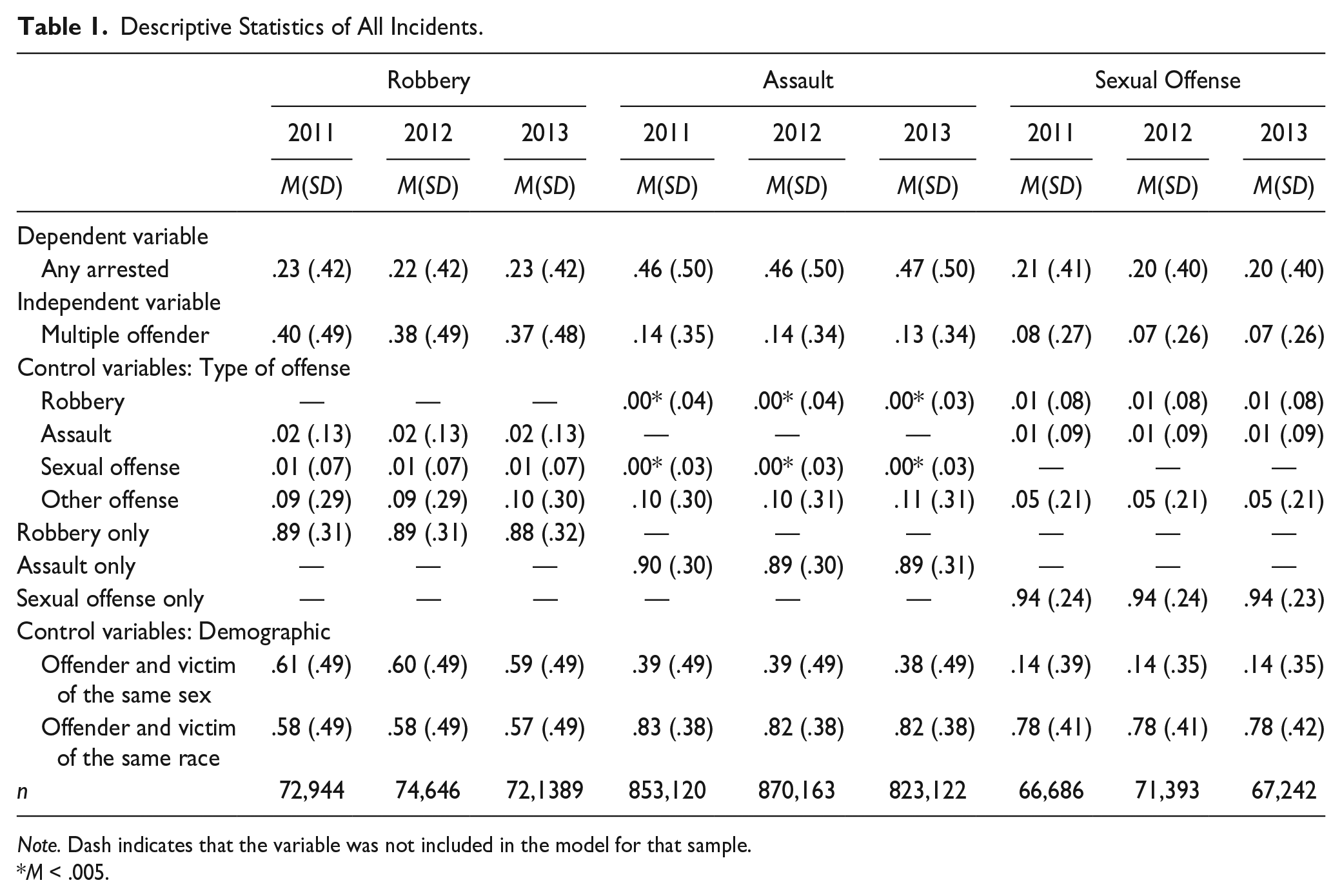
The means in Tables 1 and 2 can be multiplied by 100 to calculate the percentage arrested. There was variation among the three incident types in the percent that resulted in any arrested (the offender in lone-offender incidents and at least one of the offenders in group-offender incidents). As shown in Table 1, less than 25% (22%-23%) of robbery incidents over the 3 years resulted in arrest. This was true of 46% to 47% of assault incidents and 20% to 21% of sexual offenses.
Descriptive Statistics of All Incidents.
Note. Dash indicates that the variable was not included in the model for that sample.
M < .005.
Descriptive Statistics of Incidents With Group Offender Only.

Note. Dash indicates that the variable was not included in the model for that sample.
M < .005.
A minority of robbery incidents, assault incidents, and sexual offenses were committed by a group of offenders. Only 37% to 40% of robbery incidents over the 3 years were committed by a group of offenders, while this was so with 13% to 14% of assault incidents and 7% to 8% of sexual offenses.
Most of the findings for the control variables are not reported in the tables (but are available upon request) and are only briefly discussed here. The information about the type of other offense(s) in the criminal incident, however, is reported in Table 1, along with whether the incident involved offenders and victims of the same sex and same race. A control variable for type of offense was not included in certain models as indicated by dashes (Table 1). The reason was they did not vary. For example, all incidents in the robbery incident sample included at least one robbery offense. Most of the incidents involved only one type of offense: a robbery, or an assault, or a sexual offense. In robbery incidents, 88% to 89% involved only a robbery and no other offense. Similarly, in assaults, 89% to 90% involved only an assault, and in sexual offenses, 94% included only a sexual offense.
Most (59%-61%) of the robbery incidents involved same-sex offenders and victims, but only 38% to 39% of assault incidents and only 14% of sexual offenses involved offenders and victims of the same sex. A large percent of the incidents (57%-83%) across the three incident types involved same-race offenders and victims.
Only two other control variables differed considerably across the three types of incidents—weapon and incident location. A majority of robbery incidents and assault incidents involved a weapon (robbery—59%-61%; assault—70%-72%). Only 7% of sexual offenses involved a weapon. In regard to the location of the incident, 70% to 71% of robbery incidents occurred in public, while this was true of 29% to 30% of assault incidents and 21% to 23% of sexual offenses.
Several findings were revealed by an assessment of group-offender incidents only and summarizing across the three incident types and years (Table 2). Between 23% and 42% of the incidents resulted in any offender being arrested; 14% to 15% resulted in some (at least one offender, but not all) in the incident being arrested; and 9% to 27% resulted in all of the offenders in the incident being arrested. For every year, each incident, on average, was more likely to be committed by two than three or more offenders, and most involved only a robbery, or an assault, or a sexual offense and no other offense. While a majority of robbery incidents involved offenders and victims of the same sex, this was true of slightly less than half of the assault incidents and only about 15% of the sexual offenses. Offenders and victims in robbery incidents were almost as likely to be different races than the same race, but most assault incidents and sexual offenses involved same-race offenders and victims.
There are only slight variations in the results of the logistic regression analyses across the 3 years. All of the variables that significantly predict arrest in 1 year also do so for the other 2 years. The regression coefficients are also very similar from year to year. Hence, for simplicity, we report the regression results only for the most recent year, 2013.
Research Question 1: Comparing Group-Offender Incidents With Lone-Offender Incidents
The first research question was whether there was a higher likelihood of arrest in group-offender incidents, compared with lone-offender incidents. As shown in Table 3, the findings differed markedly across the three incident types. Assault incidents with multiple offenders decreased the odds of arrest 27% (odds ratio [OR] = 0.73) compared with those with lone offenders. In contrast, the robbery and sex offenses models do not meet statistical significance at a .001 level.
Logistic Regression Results—Incidents With All Offenders, Any Arrested.

Note. Dash indicates that the variable was not included in the model for that sample. OR = odds ratio.
χ2 = 4,383.69, df = 26, log likelihood = 47,991.31, Nagelkerke R2 = .137.
χ2 = 15,828.02, df = 26, log likelihood = 259,880.73, Nagelkerke R2 = .102.
χ2 = 1,727.47, df = 26, log likelihood = 49,692.57, Nagelkerke R2 = .054.
This control variable dropped out of the robbery and sexual offense models due to low variation.
p < .001.
To conserve space, only Table 3 includes findings for all of the control variables. For each incident type, most of the coefficients for the control variables are significant, though fewer are significant across all three incident types. Three of the control variables increased the odds of arrest—other offense, number of victims, and offender suspected of using drugs or alcohol. Five of the control variables decreased the odds of arrest for some of the incident types and increased the odds of arrest for other incident types. For example, a female offender in the incident increased the odds of arrest for robbery incidents and assault incidents but decreased the odds of arrest for sexual offenses.
The findings regarding the control variables for race are largely mixed. For example, the presence of a Black offender decreased the odds of arrest for the three incident types. A Black victim, however, decreased the odds of arrest only in robbery incidents and assault incidents; a Black victim had no significant effect on the odds of arrest for sexual offenses. When victims and offenders were the same race, there were higher odds of arrest in assault incidents, but no significant effect on the odds of arrest in robbery incidents and sexual offenses. The findings are similarly mixed for same-sex offenders and victims. This produced lower odds of arrest in assault incidents and sexual offenses, but had no significant effect on the odds of arrest in robbery incidents.
Each of the logistic models includes the Nagelkerke R2, a pseudo-R2 that approximates the amount of variation explained. The most variation is explained in the robbery model. The goodness-of-fit statistics reported in the tables (χ2 and log-likelihood values) are sensitive to large sample sizes, as in NIBRS data, and should be interpreted with caution.
Comparisons Among Group-Offender Incidents Only
Research Question 2a, any arrested
As the number of offenders increased in robbery incidents committed by a group of offenders, so, too, did the odds of any in the incident being arrested (Table 4). Three offenders in a robbery incident, as compared with two offenders, resulted in 18% higher odds of arrest (OR = 1.18). Robbery incidents committed by four or more offenders, compared with two-offender incidents, had an even higher odds of arrest (112%, OR = 2.12). For assault incidents, the odds of any arrest decreased 16% (OR = 0.84) as the number of offenders increased from two to three. The odds of any arrested were 9% lower (OR = 0.91) in incidents committed by four or more offenders, compared with two-offender incidents. Similarly, in sexual offenses, the odds of arrest were 20% lower (OR = 0.80) when there were three offenders, compared with when there were two offenders. The odds of arrest were 11% lower (OR = 0.89) in incidents committed by four or more offenders than in incidents committed by two offenders, though the difference was not statistically significant.
Logistic Regression Results—Incidents With Group Offenders Only, Any Arrested.

Note. Dash indicates that the variable was not included in the model for that sample. OR = odds ratio.
χ2 = 2,161.82, df = 26, log likelihood = 23,042.08, Nagelkerke R2 = .141.
χ2 = 1,653.09, df = 26, log likelihood = 39,124.21, Nagelkerke R2 = .073.
χ2 = 216.70, df = 25, log likelihood = 4,031.14, Nagelkerke R2 = .083.
p < .001.
In regard to the control variables, having an assault or another offense (not a sexual offense) involved in a robbery incident produced higher odds of arrest. Same-sex offenders and victims decreased the odds of arrest in assault incidents, but not in the other two incident types. Offenders and victims of the same race produced significantly higher odds of arrest only in robbery incidents.
Research Question 2b, some arrested
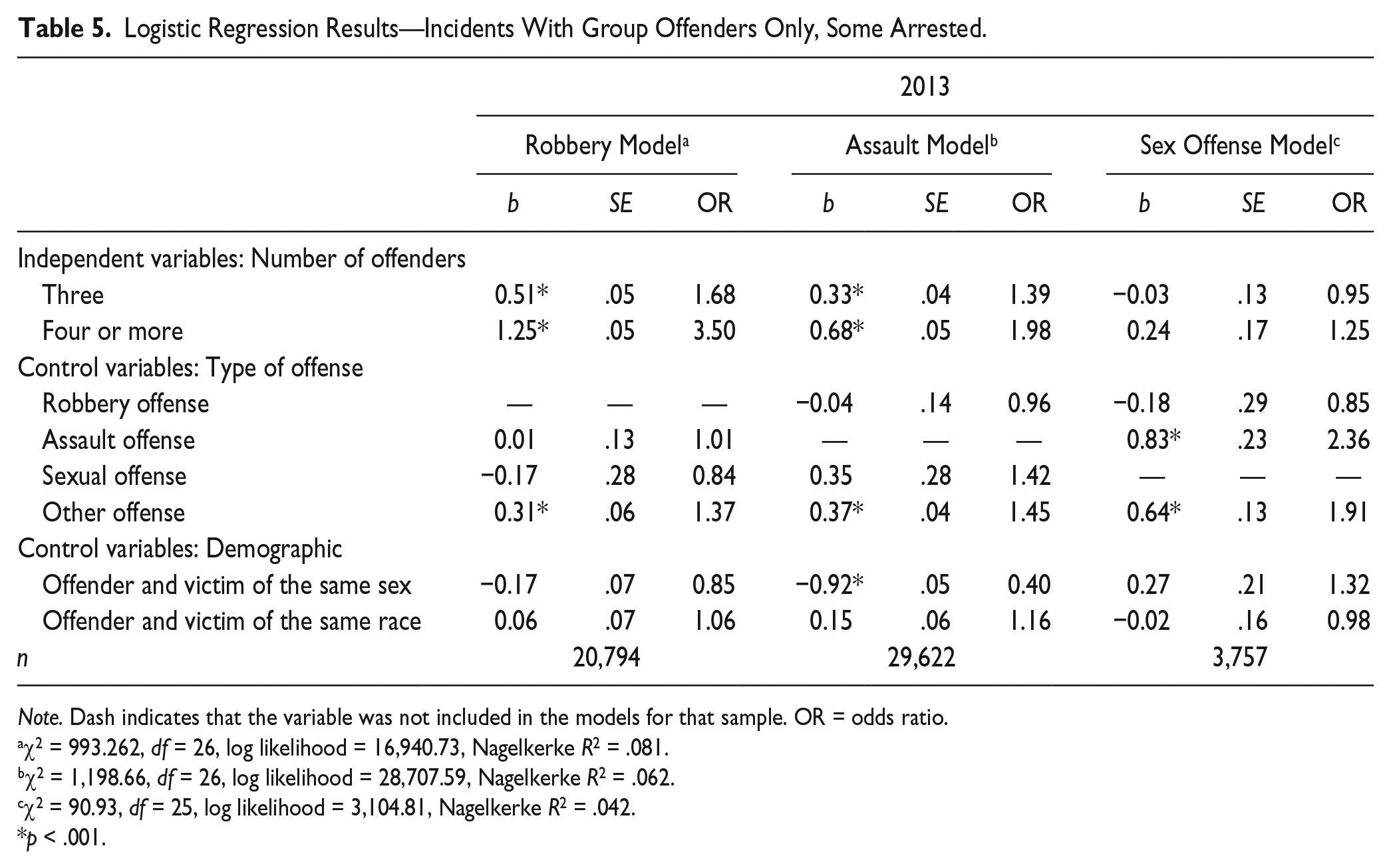
In robbery incidents and assault incidents, the odds of some offenders (at least one, but not all) in the incident being arrested were higher as the number of offenders increased (Table 5). In robbery incidents, the odds of some arrested increased 68% (OR = 1.68) in three-offender incidents, compared with two-offender incidents. Also, the odds of some arrested were 250% higher (OR = 3.50) in robbery incidents with four or more offenders, compared with two-offender incidents. Among assault incidents, the odds of some arrested were 39% higher (OR = 1.39) when comparing three-offender incidents with two-offender incidents. The odds of some arrested were even higher, 98% (OR = 1.98), in assault incidents with four or more offenders, compared with two-offender incidents. The coefficients for the number of offenders for sexual offenses did not reach statistical significance.
Logistic Regression Results—Incidents With Group Offenders Only, Some Arrested.
Note. Dash indicates that the variable was not included in the models for that sample. OR = odds ratio.
χ2 = 993.262, df = 26, log likelihood = 16,940.73, Nagelkerke R2 = .081.
χ2 = 1,198.66, df = 26, log likelihood = 28,707.59, Nagelkerke R2 = .062.
χ2 = 90.93, df = 25, log likelihood = 3,104.81, Nagelkerke R2 = .042.
p < .001.
Having an offense other than a sexual offense or an assault involved in a robbery incident resulted in higher odds of some in the incident arrested for the robbery incident, and having an offense other than a sexual offense or a robbery involved in an assault incident resulted in higher odds of some arrested for the assault incident. For sexual offenses, the odds of some in the incident being arrested were higher when there were also an assault and another offense (not robbery) involved in the incident.
There were significantly lower odds when offenders and victims were the same sex in assault incidents, but not in robbery incidents and sexual offenses. Offenders and victims of the same race did not significantly affect the odds of some arrested for all three types of incidents.
Research Question 2c, all offenders arrested
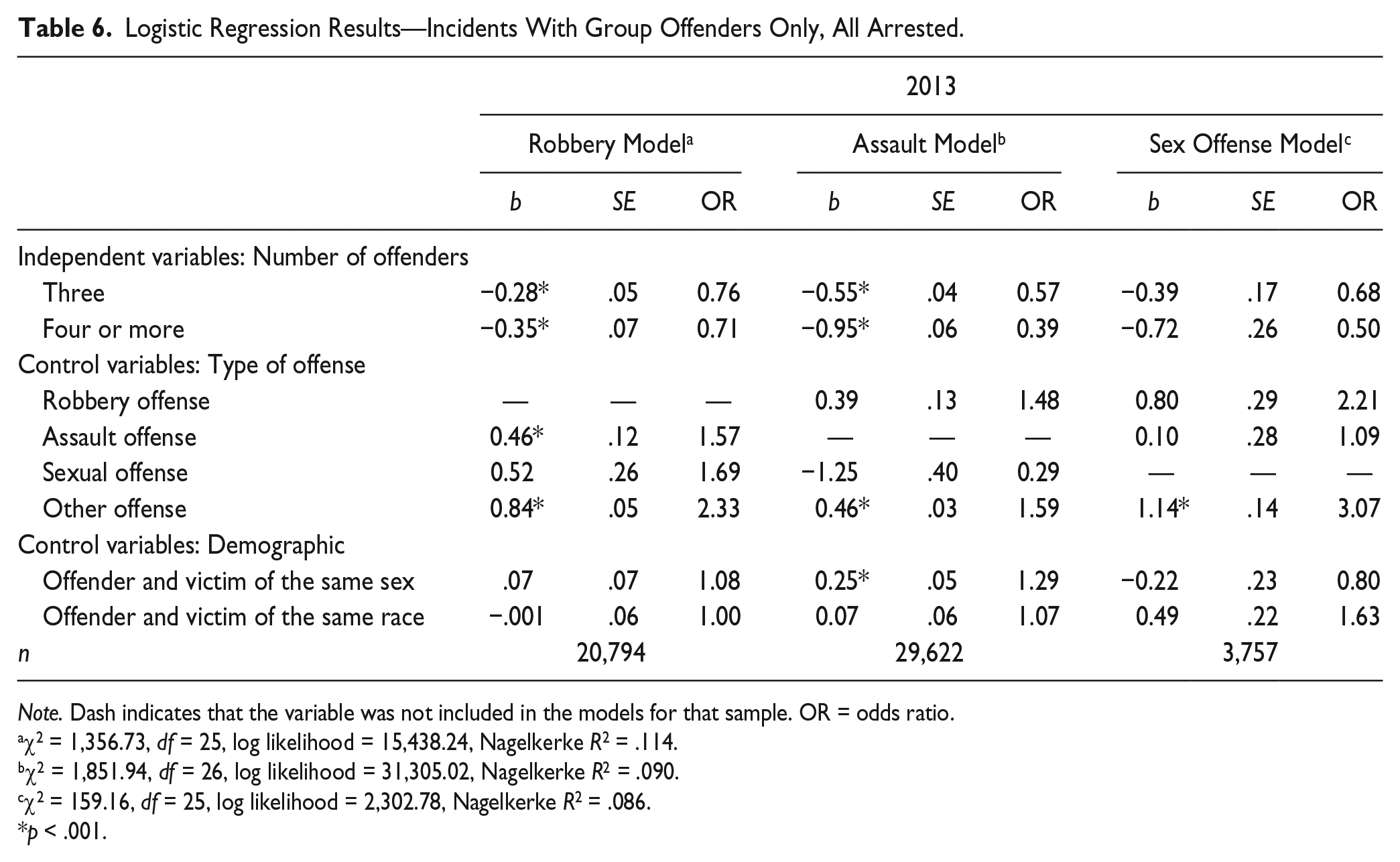
Across all incident types, the odds of all offenders in the incident being arrested were lower as the number of offenders increased (Table 6). The odds of all arrested were 24% lower (OR = 0.76) in robbery incidents with three offenders, compared with two offenders, and the odds were 29% lower (OR = 0.71) in robbery incidents with four or more offenders, compared with two offenders. Among assault incidents, the odds of all arrested were 43% lower (OR = 0.57) in three-offender incidents, compared with two-offender incidents. The odds of all arrested were 61% lower (OR = 0.39) in assault incidents with four or more offenders, compared with two offenders. For both three- and four-offender sexual offenses, the difference in the odds of all being arrested did not meet statistical significance at a .001 level.
Logistic Regression Results—Incidents With Group Offenders Only, All Arrested.
Note. Dash indicates that the variable was not included in the models for that sample. OR = odds ratio.
χ2 = 1,356.73, df = 25, log likelihood = 15,438.24, Nagelkerke R2 = .114.
χ2 = 1,851.94, df = 26, log likelihood = 31,305.02, Nagelkerke R2 = .090.
χ2 = 159.16, df = 25, log likelihood = 2,302.78, Nagelkerke R2 = .086.
p < .001.
In robbery incidents and assault incidents, having another crime involved in the incident increased the odds of all offenders in the incident being arrested. The exception was assault where a robbery or sexual offense involved in the incident did not significantly affect the odds of all arrested. For sexual offenses, having another offense (not assault or robbery) involved in the incident resulted in higher odds of all arrested. The only significant control variable shown in Table 6 was same-sex offenders and victims in assault incidents, which increased the odds of all in the incident being arrested.
Offense Seriousness and Group Offenses
The seriousness of an offense is a strong predictor of the likelihood of arrest and may condition the effects of group offending. For example, it may be that group offending increases or decreases the likelihood of arrest only for serious offenses. With that possibility in mind, additional analysis was conducted, examining different types of assaults and sexual offenses that varied in seriousness and whether they statistically interacted with group offending to affect the likelihood of arrest. Assault incidents were categorized as either aggravated or non-aggravated (i.e., simple assault). Sexual offenses were not designated as aggravated or non-aggravated in NIBRS data. Two types of sexual offenses were, therefore, distinguished that roughly approximated aggravated and non-aggravated sexual offenses: (a) rape and sodomy (aggravated) and (b) all other sexual offenses (non-aggravated). NIBRS data for 2011-2013 did not distinguish between aggravated and non-aggravated robberies, nor provide other information about offense seriousness.
Two dichotomous variables were created, one for aggravated assaults (yes = 1; no = 0) and another for aggravated sexual offenses (yes = 1; no = 0). The values of these dichotomous variables were then multiplied by the values of the multiple-offender variables used to generate the findings for Table 3. If an assault incident was aggravated (yes) and committed by multiple offenders (yes), an Aggravated Assault × Multiple Offender variable was assigned a value of 1. If the assault incident was non-aggravated and/or was not committed by multiple offenders, the variable was assigned a value of 0. The same procedure was used to create an Aggravated Sexual Offense × Multiple Offender variable. The dependent variable in the analysis was whether any offender in the incident was arrested. The interaction variables were included along with the other variables shown in Table 3. None of the interaction variables had a significant effect on the likelihood of arrest, either for assaults or sexual offenses.
Discussion and Conclusion
Researchers have previously focused on group offenders and how they were more likely than lone offenders to be arrested (Erickson, 1973; Hindelang, 1971, 1976). Consistent with the strategy of later studies, we shifted the focus from group offenders to group offenses (McGloin, Sullivan, Piquero, & Bacon, 2008; Tillyer & Tillyer, 2015), and building upon this, we had two aims. The first aim was to assess the likelihood of arrest for robberies, assaults, and sexual offenses committed by a group of offenders, compared with when the same offenses were committed by a lone offender. The second aim was to assess how the number of offenders in group-offender incidents (i.e., two, three, and four or more offenders) affected the likelihood of arrest.
There were three notable findings in this study. First, the likelihood of arrest varied by type of offense for group-offender and lone-offender incidents. There was a lower likelihood of arrest when assaults were committed by a group of offenders, compared with when they were committed by a lone offender. Second, the likelihood of any arrested and some arrested was higher in robberies committed by three offenders, as compared with two offenders. The findings were mixed with regard to the likelihood of arrest when there were more than two offenders in assault incidents and sexual offenses. In assault incidents, there was a lower likelihood of any arrested when there were three offenders and no meaningful difference in odds when there four or more offenders, compared with when there were two offenders. In contrast, there was a higher likelihood of some arrested when there were three offenders and an even higher likelihood when there were four offenders compared with two-offender incidents. Only one of the four relevant coefficients was significant for sexual offenses—a lower likelihood of any arrested when there were three offenders, compared with when there were two offenders. Third, for robberies, assaults, and sexual offenses committed by a group of offenders, there was a lower likelihood that all offenders in the incident would be arrested as the number of group offenders increased, suggesting, at least for some of the offenders in a group, there is safety in larger numbers.
The first finding suggests that there is a limit to Tillyer and Tillyer’s (2015) finding that offenses committed by a group of offenders are more likely to result in arrest. While this is the case with assaults, it is not the case with robberies and sexual offenses. The reason may have to do with different motives for different crimes. The apparent motive for robbery is monetary, while the apparent motives for assault and sexual offenses are typically non-monetary and more difficult to identify. These offenses, therefore, may require different explanations, especially when considering the role of group offending. Moreover, different motives may affect the kind of corroborating evidence provided by victims, and, in turn, affect investigations by law enforcement officials and the resulting likelihood of arrest.
In regard to the second finding, although there was a higher likelihood of any arrested and some arrested in robberies committed by three offenders, as compared with two-offender robberies, there was an even higher likelihood of these outcomes when the size of the offending group increased to four or more offenders. The likelihood of some arrested was a remarkable 250% higher for robberies committed by four or more offenders, as compared with two-offender robberies. There was a different pattern of findings, however, for assaults and sexual offenses. There was a lower likelihood of any arrested for assaults and sexual offenses committed by three or more offenders, compared with when they were committed by two offenders (though the coefficient for four or more offenders was not significant for sexual offenses). There was, however, a higher likelihood of some arrested in assaults committed by more than two offenders. Neither of the two coefficients were significant for sexual offenses. The findings, therefore, indicated the likelihood of arrest depended not only on whether an offense was committed by a group or a lone offender but also on the type of offense.
In regard to the third finding, the greater the number of offenders in a group-offender incident, the lower the likelihood that all offenders would be arrested; this was true of robbery and assault incidents. This suggests possible safety in numbers in larger offender groups. An offender may believe that while someone in a large group may be arrested, it may not be him or her. Central to routine activity theory (Cohen & Felson, 1979), the presence of capable guardians can prevent a crime from occurring. For an offender, however, committing crimes with others may provide a protection from arrest. The presence of other offenders in a crime may provide a safety barrier between the offender and an arresting law enforcement official.
These findings, however, must be considered with several limitations in mind. Many crimes go unreported, and the crimes that are reported in these data may not include all offenders in a criminal incident. In addition, a limitation of NIBRS data is that a lone-offender incident may actually have been committed by a group of offenders and not reported or recognized as such. Also, the likelihood of arrest depends on other variables not available in these data, such as corroborating evidence. In regard to the relationship between offense seriousness and arrest likelihood, the distinction between aggravated versus non-aggravated was not made in NIBRS for robbery offenses and only designated aggravated and non-aggravated for assault and sexual offenses. These limitations prohibit meaningful inferences about any potential interaction between the seriousness of a robbery and the odds of arrest. Furthermore, the dichotomous measure of offense seriousness used for assault incidents and sexual offenses fails to capture the seriousness of the offense that may affect the odds of arrest. Additional data sources may be useful in mitigating these limitations. Future research should consider the arrest outcomes of committing crimes in groups for an even larger number of crimes, not just those examined here.
Footnotes
Acknowledgements
The authors would like to thank the anonymous reviewers for their thoughtful and helpful review of the manuscript.
Declaration of Conflicting Interests
The author(s) declared no potential conflicts of interest with respect to the research, authorship, and/or publication of this article.
Funding
The author(s) received no financial support for the research, authorship, and/or publication of this article.
