



Abstract
Although much research has focused on the function of social support in adult intimate partner violence, little is known about the role of social support in adolescent dating violence. This study is an exploratory analysis of the independent impact of social support from friends and family on the risk of adolescent dating violence perpetration and victimization among a large sample of youth (n = 970). Approximately, 21% of the sample reported experiencing victimization in a dating relationship whereas 23% indicated perpetrating dating violence. Male youth reported significantly more involvement in dating violence as both perpetrators and victims. Negative binomial regression modeling indicated that increased levels of support from friends was associated with significantly less dating violence perpetration and victimization; however, when gendered models were explored, the protective role of social support was only maintained for female youth. Family support was not significantly related to dating violence in any model. Implications for dating violence curriculum and future research are addressed.
Dating violence has been recognized as a pervasive problem for adolescents and has been linked to negative emotional and physical outcomes (Carlson, 1987; Munoz-Rivas, Grana, O’Leary, & Gonzalez, 2007; Silverman, Raj, Mucci, & Hathaway, 2001). Currently, research has focused on uncovering the prevalence of dating violence (O’Keefe, 1998; Wolitzky-Taylor et al., 2008) as well as risk factors associated with both perpetration and victimization (Raiford, Wingood, & Diclemente, 2007; Silverman et al., 2001); however, there are few investigations aimed at revealing factors that may protect youth from involvement in dating violence as perpetrators and/or victims.
Given that social support has been linked to resilient outcomes for youth (Erath, Flanagan, Bierman, & Tu, 2010) and has been extensively documented as a moderator in cases of adult intimate partner violence (IPV; Carlson, McNutt, Choi, & Rose, 2002; Coker, Watkins, Smith & Brandt, 2003; Dobash, Dobash, Cavanaugh, & Lewis 1998; Kocot & Goodman, 2003; Larance & Porter, 2004), the current study focused on social support as a protective factor against experiencing adolescent dating violence victimization and perpetration. Specifically, this research explored the independent impact of social support from friends and social support from family on the risk of dating violence perpetration and victimization as well as the differential impact across gender.
Adolescent Dating Violence
Research on adolescent dating violence began with Makepeace’s (1981) seminal study almost three decades ago. Since that time, a voluminous literature has accumulated suggesting that dating violence may affect from 2% (Wolitzky-Taylor et al., 2008) to 55% (O’Keefe, 1998) of adolescents. Even at the lowest estimates, these numbers demonstrate that roughly 400,000 U.S. teens experience dating violence each year. As such, adolescent dating violence has been recognized as a significant public health concern (Lewis & Fremouw, 2001).
Existing literature demonstrates consistent gender differences in the perpetration of dating violence. Girls perpetrate more overall dating violence than boys but boys commit more severe violence against their partners whereas girls are more likely to perpetrate violence in self-defense. For example, a study by Foshee and colleagues (1996) found that nearly twice as many girls perpetrated violence against their dating partner compared to boys (27.8% versus 15%). However, those same girls reported perpetrating more physical violence in self-defense than their male partners (14.9% versus 5.4%). More recently, Swahn, Simon, Arias, and Bossarte (2008) used questions adapted from Foshee and colleagues’ (1996) study that included 18 questions about physical dating violence victimization and perpetration and 14 questions about psychological dating violence victimization and perpetration. Their results indicated that of adolescents who dated in the past year (n = 2,888), girls were significantly more likely than boys to report perpetrating physical violence (30.3% versus 18.6%) and psychological violence (39.8% versus 28.1%) within dating relationships. However, boys were significantly more likely than girls to indicate physically injuring a date.
Negative Outcomes Associated With Dating Violence
Experiencing dating violence victimization has been linked to a variety of negative emotional outcomes for youth. For example, research by Carlson (1987) suggests that adolescent dating violence is linked to increased feelings of anger and sadness as well as diminished self-esteem. In addition, Holt and Espelage (2005) observed that youth who had experienced dating violence victimization reported higher levels of depression and anxiety than nonvictim youth. Dating violence has also been linked to an array of physical health problems for female youth. One survey of nearly 4,000 ninth to twelfth-grade girls by Silverman et al. (2001) observed that experiencing physical violence by a partner was associated with heavy smoking (more than 10 cigarettes per day), cocaine use, taking diet pills, using laxatives, or vomiting to lose weight, as well as, both considering and attempting suicide.
Risk Factors for Dating Violence
Prior research has uncovered multiple factors that may increase an adolescent’s risk of dating violence perpetration and/or victimization (Lewis & Fremouw, 2001; Vézina & Hébert, 2007). One of the most salient risk factors for youth is previous experience with violence such as child abuse (Makepeace, 1986; O’Keefe, 1997) and/or exposure to interparental violence (Foshee, Bauman, & Linder, 1999; O’Keefe, 1997); however, such risk seems to differ by gender. For example, Windle and Mrug (2009) found that harsh parental discipline predicted dating violence perpetration in males but not females whereas Carr and VanDeusen (2002) observed that men exposed to interparental violence were more likely to be violent toward their spouse compared to men spared from such violence. Research also demonstrates that female youth but not male youth exposed to parental aggression were more likely to become victims themselves (Doumas, Margolin, & John, 1994).
Existing research also suggests that youth involved in risky behaviors such as delinquency or substance use may experience an increased risk of adolescent dating violence. Participation in delinquent behavior has been shown to predict dating violence perpetration for both male (Brendgen, Vitaro, Tremblay, & Wanner, 2002) and female youth (Ellis, Crooks, & Wolfe, 2009). In addition, delinquent youth may experience recurrent aggressive dating relationships (Williams, Connolly, Pepler, Craig, & Laporte, 2008). Substance use, specifically, alcohol use, is also frequently cited as a correlate of dating violence. For example, research by Temple and Freeman (2011) found that the odds of dating violence victimization were 1.62 times higher for teens that drank alcohol compared to their nondrinking peers. However, these associations may vary by gender. Eaton, Davis, Barrios, Brener, and Noonan (2007) gendered analysis found that female youth but not male youth who had drank alcohol and/or smoked marijuana were at an increased odds of dating violence victimization.
Although isolating risk factors for dating violence is important to understanding the phenomenon, it is also imperative to investigate factors that may protect youth from experiencing such violence. Borrowing from the model of resiliency, the present research argues that simply knowing a youth is at risk for dating violence is not easily integrated into prevention and/or intervention strategies. Conversely, uncovering key factors that protect youth from dating violence may be successfully translated into effective programming initiatives. One such factor may be the level of social support from friends and family available to adolescents.
Social Support
El-Bassel, Gilbert, Rajah, Foleno, and Frye (2001) define social support as an individual’s belief that they are “cared for, loved, esteemed, and valued and is a member of a network of common and mutual obligation” (p. 247). A considerable body of literature has established that for adult women who have been victims of IPV, social support serves as a buffer from experiencing negative outcomes associated with such violence (i.e., depression, anxiety; Carlson et al., 2002; Dobash et al., 1998; Larance & Porter, 2004). Branch (2008) also found that social support protects against involvement in IPV victimization and perpetration among adult women. Results indicated that participants with higher levels of social support from family indicated less IPV victimization compared to women with lower levels of social support whereas women with higher levels of social support from friends reported less IPV perpetration compared to women with lower levels of social support from friends. These findings suggest that social support is a protective factor against partner violence victimization and perpetration among adult women and that there may be qualitative differences between social support from friends and from family in regards to its protective role. These differences may be particularly salient for adolescents who are just beginning to create identities independent of their parents, and thus, may place greater reliance on their peers for support.
Research regarding the relationship between social support and adolescent dating violence is limited. The existing research does indicate that social support from parents serves as a buffer between dating violence victimization and the negative consequences of experiencing such violence and that these associations may vary by gender. For example, a study by Holt and Espelage (2005) found that maternal social support moderated the effects of physical dating violence victimization on African American male youth’s level of anxiety and depression and paternal social support moderated the effects of physical dating violence victimization on White female’s levels of anxiety and depression. No study to date has considered social support’s effect on the risk of dating violence victimization or perpetration.
Gender and Social Support
Research has documented gender differences in social support for adolescents (Colarossi & Eccles, 2003; Malecki & Demaray, 2003; Robinson, 1995). First and foremost, female youth are significantly more likely than male youth to seek out social support (Colarossi & Eccles, 2003; Malecki & Demaray, 2003) and perceive higher levels of social support than boys (Malecki & Demaray, 2003). In addition, adolescent females report higher levels of support from friends than from parents (Malecki & Demaray, 2003) whereas adolescent males indicate more parental social support than peer support (Frey & Rothlisberger, 1996). These differences can be explained, at least in part, by prescribed gender roles and the way gender differences inform youths’ socialization practices. Boys and girls grow up in different peer cultures: girls’ peer culture emphasizes dyadic relationships, intimacy and self-disclosure, and close exclusive relationships (Maccoby, 1998) whereas boys are socialized to have a large circle of less intimate friendships (Underwood & Rosen, 2009). As such, Clark and Ayers (1993) suggest that adolescent boys and girls expect different levels of loyalty, commitment, and understanding from friends. Girls expect friends to be high in empathetic understanding and thus their friendships are characterized by more intimacy and self-disclosure, however, a small network of intimate friends for boys is rare (Kutler, La Greca, & Prinstein, 1999).
The Present Study
Although the relationship between social support and the risk for IPV victimization and perpetration has been examined, to date no such investigation of social support and adolescent physical dating violence exists. This study will explore the effects of social support on male and female adolescent’s victimization and perpetration of physical violence in a dating relationship. It is expected that social support will be negatively associated with both victimization and perpetration, even after controlling for correlates of dating violence. Specifically, it is expected that adolescents who report greater levels of social support will be less likely to be victimized by their intimate partner and less likely to use physical aggression against their intimate partner. In addition, given the inherent relationship between social support and the female gender role, it is expected that social support will be a more salient protective factor for females compared to males.
Method
Data and Sample
The data for this study was drawn from Wave I (2001) of the Toledo Adolescent Relationship Study (TARS), a 5-year investigation regarding the context and significance of adolescent relationships (e.g., family, peers, and dating partners). The TARS data consists of a stratified, random sample (n = 1,316) drawn from all 7th-, 9th-, and 11th-grade youth residing in Lucas County in the fall of 2000. Participants were identified using public and private school enrollment records for Lucas County, Ohio; school attendance was not a requirement for inclusion in the research. Structured, in-home interviews were conducted utilizing laptop computers preloaded with the questionnaire. Interviewers administered the demographic questions whereas participants operated the computer independently to complete personal survey questions. The current research included all participants (n = 970) who indicated they had previously or were currently in a dating relationship.
Measures
Social support from parents and friends were independently assessed for each participant using two scales developed for the present research. The level of parental social support was assessed by a five-item scale asking participants how much they agreed or disagreed with the following statements about their parents: My parents often ask me what I am doing in school; My parents give me the right amount of affection; I can go to my parents with concerns about the opposite sex; I feel close to my parents; and My parents trust me. The level of Friends’ Social Support was assessed by a six-item scale asking participants how much they agreed or disagreed with the following statements about their friends: I can tell them private things and I know they won’t tell other people; They care about me; My friends make me feel good about myself; I feel comfortable talking with my friends when I have a problem; I feel close to my friends; and I talk to my friends about my private thoughts and feelings. For both scales the response format was 0 = strongly disagree to 4= strongly agree. Answers were summed for a total score. Internal consistency reliability analysis for each of the measures indicated that the two social support scales had acceptable Cronbach’s alphas: Parental Social Support (α = .763) and Friend Social Support (α = .702).
Family violence was assessed by asking participants how they react to their parents and how their parents react to them during disagreements. Participants were asked how often during a disagreement they do the following things to their parents and their parents do the following things to them: call them names or insult them; push, slap, or hit them; yell at them? Each item was coded so that 0 = never to 5 = two or more times a week. Adolescents’ responses were summed yielding a measure of perpetration of family violence (α = .865) and victimization of family violence (α = .673).
Each respondent’s experiences with dating violence perpetration and victimization were obtained using four items from the Revised Conflict Tactics Scale (Straus & Gelles, 1990). Physical dating violence victimization was assessed by a four-item scale asking participants how often their current (or most recent) boyfriend/girlfriend had done the following things: Thrown something at you; Pushed, shoved, or grabbed you; Slapped you in the face or head with an open hand; Hit you? Physical dating violence perpetration was assessed by a four-item scale asking participants how often they had done the following things to their current (or most recent) boyfriend/girlfriend: Thrown something at him or her; Pushed, shoved, or grabbed him or her; Slapped him or her in the face or head with an open hand; Hit him or her? For each scale the response format was 0 = never, 1 = hardly ever, 2 = sometimes, 3 = often, 4 = very often. Answers were summed for a total score. Internal consistency reliability analysis indicated the dating violence scales had strong Cronbach’s alphas: physical dating violence victimization (α = .804) and physical dating violence perpetration (α = .905).
Several demographic variables as well as behavioral risk factors were included in the analyses as control variables. Demographic variables included age in years, gender, race/ethnicity, and average grade earned (measured on a nine-point scale from mostly F’s = 1, mostly D’s and F’s = 2, to mostly A’s = 9). Behavioral risk factors included participant alcohol and drug use and participation in delinquency. Alcohol and drug use was assessed by two dichotomous variables coded 0 if participants reported never using alcohol or drugs and 1 if the respondent reported ever using alcohol or drugs. Delinquency was measured by asking participants how often, in the past 12 months, they had participated in the following: damaged or destroyed property; stolen something worth more than US$50 dollars; attacked someone with the idea of seriously hurting them; sold drugs; and broken into a building or vehicle. Each item was coded so that 0 = never to 8 = more than once a day. Adolescents’ responses were summed yielding a measure of involvement in delinquency (α = .869).
Analytic Strategy
To explore the role of social support in the perpetration and victimization of adolescent dating violence, a series of negative binomial regression models were conducted. Negative binomial regression is well suited for dependent variables with an excess of zeros (such as dating violence perpetration or victimization) and a substantial positive skew (a minority of respondents reporting very high levels of dating violence perpetration or victimization). The results of negative binomial regression models are easily understood by exponentiating coefficients so that a standard deviation increase in a youth’s perception of social support from friends or family is associated with a percent increase or decrease in either dating violence perpetration or victimization.
Analyses unfolded over three phases. First, bivariate analyses were used to examine possible differences in mean levels of social support and other covariates across sex. Second, negative binomial regression was used to explore the impact of social support net of other covariates on adolescent dating violence perpetration and victimization. Finally, a second set of negative binomial regression models were estimated to examine any differential effects of social support on dating violence perpetration and victimization for girls compared to boys.
Results
Descriptive statistics revealed nearly the same number of boys (n = 475) and girls (n = 495) in the sample. The average age for respondents was approximately 15.5 years old. In regards to race/ethnicity, 64% of the sample was White, 23% was African American, 11% was Hispanic, and 1% indicated “Other” as their race/ethnicity. When asked about their average grades, approximately 7% of participants indicated earning mostly A’s, 19% A’s and B’s, 10% mostly B’s, 26% mostly B’s and C’s, 11% mostly C’s, 15% mostly C’s and D’s, 5% mostly D’s and mostly D’s and F’s, and 3% earning mostly F’s. Nearly 23% of the sample indicated perpetrating physical dating violence against a partner whereas 21% revealed being the victim of physical dating violence. Male youth reported greater involvement in adolescent dating violence as both perpetrators and victims compared to female youth. Specifically, 126 male youth indicated perpetrating dating violence compared to 96 female youth and 139 male youth reported being victims of dating violence compared to 69 female youth. Similar to past research, the majority of adolescents who reported experiencing dating violence were involved in mutual violence. Specifically, 121 boys and 59 girls reported both perpetrating dating violence and experiencing dating violence victimization. However, 37 girls and 5 boys reported only perpetrating dating violence whereas 7 girls and 17 boys reported only experiencing victimization.
Bivariate Analyses
As a first step in this analysis, Table 1 presents the mean differences for each variable between those reporting ADV perpetration/no perpetration and ADV victimization/no victimization for males and females. This analysis is important because it provides evidence at the bivariate level whether there are significant differences among variables for victimization and perpetration defined by gender. Beginning with the analyses concerning perpetration, male perpetrators do not demonstrate significantly different levels of social support from friends and/or family compared to their nonperpetrator counterparts, at least at the bivariate level. Male perpetrators report significantly more dating violence victimization (4.19 versus 0.07, p ≤ .001), parental family violence (3.93 versus 2.95, p ≤ .001), alcohol use, (0.52 versus 0.41, p < .05) and drug use (0.29 versus 0.16, p ≤ .001) than their nonperpetrator counterparts. Male perpetrators also report being significantly older (15.90 versus 15.28, p ≤ .001) and earning average higher grades (4.79 versus 3.98, p ≤ .001) than males who do not report perpetrating dating violence. In regards to females, female perpetrators report significantly lower levels of friend’s social support (18.46 versus 19.17, p < .05) than females who do not report dating violence perpetration; there are no significant differences between the two female groups concerning level of family social support. In addition, similar to male perpetrators, female perpetrators report more dating violence victimization (2.43 versus 0.02, p ≤ .001), more delinquency (1.22 versus 0.37, p < .05), and higher average grades (4.14 versus 3.32, p ≤ .001) compared to their nonperpetrator counterparts.
Mean Comparisons Across Gender
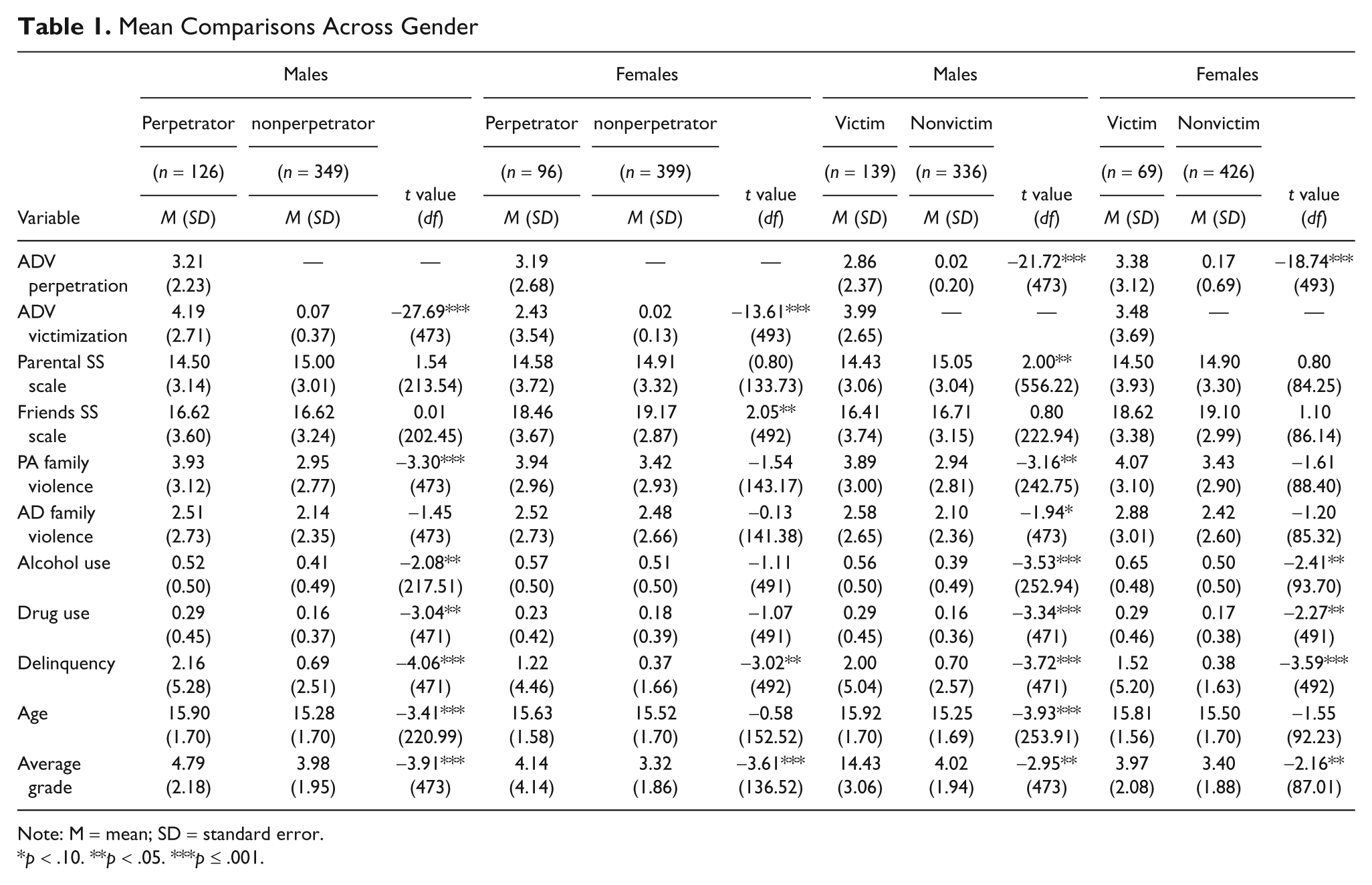
Note: M = mean; SD = standard error.
p < .10. **p < .05. ***p ≤ .001.
Turning to the bivariate analyses concerning victimization, male victims report significant bivariate differences in their levels of social support from family compared to nonvictims (14.43 versus 15.05); however, similar to male perpetrators, male victims do not report significantly different levels of social support from friends compared to their nonvictim counterparts. Male victims also report significantly more dating violence perpetration (2.86 versus 0.02, p ≤ .001) and both parental family violence (3.88 versus 2.94, p ≤ .05) and adolescent family violence (2.58 versus. 2.10 p < .10) than their nonvictim peers. In addition, male victims indicate higher levels of alcohol use (0.56 versus 0.39, p ≤ .001), drug use (0.29 versus. 0.16, p ≤ .001), and delinquency (2.01 versus 0.70, p ≤ .001) compared to nonvictims. Male victims are also significantly older (15.92 versus 15.25, p ≤ .001) and earn higher grades (4.62 versus 4.02, p < .05) than nonvictims. In regards to females, female victims did not demonstrate significant bivariate differences in their levels of social support from friends and/or family compared to nonvictim females. In addition, female victims report significantly more dating violence perpetration (3.38 versus 0.17, p ≤ .001), alcohol use (0.65 versus 0.50, p < .05), drug use (0.29 versus 0.17, p < .05), and delinquency (1.52 versus 0.38, p < .05) compared to their nonvictim peers. Female victims also report earning higher average grades (3.97 versus 3.40, p < .05) than nonvictims.
Multivariate Analyses
Turning to the multivariate analyses, Table 2 presents the results of two negative binomial regression models (one for males and one for females) predicting dating violence perpetration using the measures of social support and the control variables. Results indicate friends’ social support is significantly related to lower levels of dating violence perpetration for adolescent females but not males. For female youth, each unit increase in our friend’s social support measure (0 = strongly disagree to 4= strongly agree) is associated with an 11% decrease in the perpetration of dating violence (0.11 = 1 – (exp(–0.120)). However, parental social support is not significantly associated with dating violence perpetration for male or female youth. Older males and male youth who experience more parental family violence and perpetrate adolescent family violence are significantly more likely to perpetrate dating violence compared to male adolescents who are younger and those who experience less parental violence and perpetrate less adolescent family violence. However, non-White female youth are significantly more likely to perpetrate dating violence compared to white female youth. Additionally, male and female youth who report higher delinquency and higher average grades are more likely to perpetrate dating violence compared to those who reported lower delinquency and lower average grades.
Negative Binomial Regression Coefficients for Dating Violence Perpetration Across Genders
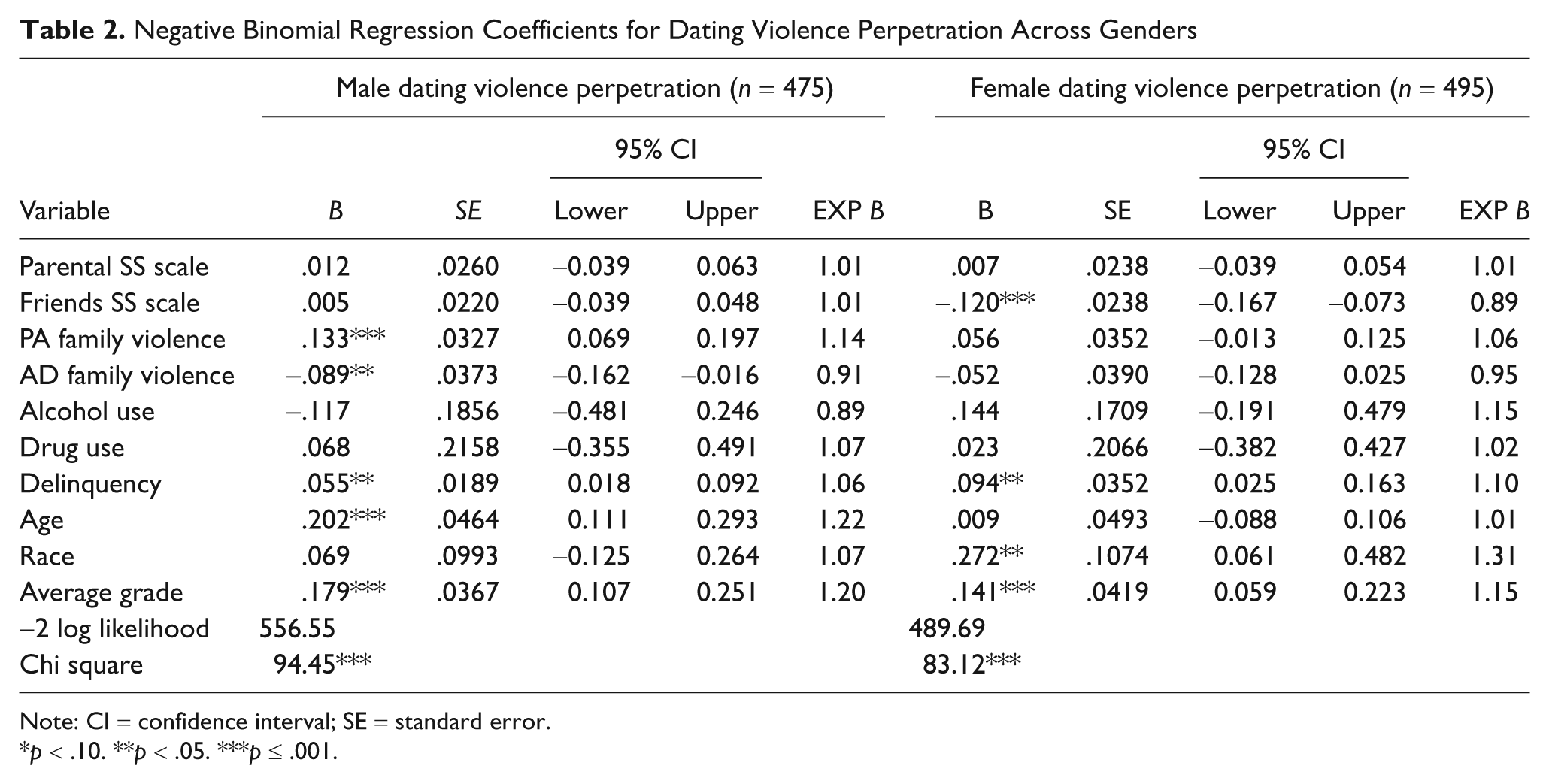
Note: CI = confidence interval; SE = standard error.
p < .10. **p < .05. ***p ≤ .001.
Table 3 presents the results for dating violence victimization across genders. Findings demonstrate that friends’ social support is significantly related to lower levels of adolescent dating violence victimization for females. For female youth, each unit increase in our friend’s social support measure is associated with an 11% decrease in dating violence victimization. However, friends’ social support is not significantly related to dating violence victimization for males. Parental social support is not significantly related to male or female dating violence victimization. For males, being older, experiencing more parental violence, and earning higher average grades is significantly related to dating violence victimization compared to younger males, males with less parental violence, and earning lower average grades. In addition, for male youth, higher levels of adolescent perpetrated family violence is associated with a decrease in dating violence victimization compared to male youth with lower levels of adolescent perpetrated family violence. Finally, higher levels of delinquency are associated with experiencing dating violence victimization for both male and female adolescents.
Negative Binomial Regression Coefficients for Dating Violence Victimization Across Genders

Note: CI = confidence interval; SE = standard error.
p < .10. **p < .05. ***p ≤ .001.
Limitations
As in all research, this study is not without limitations. Given the cross-sectional design of the study, inferences as to the causal relationship between social support and dating violence victimization and/or perpetration cannot be ascertained. Longitudinal investigations are needed to address the temporal ordering of individual’s levels of social support from family and friends and their involvement in dating violence. In addition, youth were not asked about their friends’ attitudes towards or friends’ involvement in dating violence. Previous research has indicated that teens that have friends who perpetrate dating violence are at an increased risk of also perpetrating such violence (Foshee et al., 2011). Furthermore, the present study did not include a measure of emotional dating violence, which as prior research indicates, may exist in relationships where no physical violence takes place. Social support may be an even more important factor for teens that experience emotional violence because they may minimize the abuse because there is no physical injury.
Discussion
Consistent with previous literature, the current study revealed that dating violence perpetration and victimization is pervasive among adolescents who were currently in or had previously been in a romantic relationship. Nearly 23% of the sample reported they had used violence against a dating partner and 21% indicated they had been the victims of dating violence. The majority of dating violence was mutual violence such that youth were both perpetrators and victims. In contrast to prior research (for a review, see, Vézina & Hébert, 2007), more males than females reported being involved in dating violence as both perpetrators (36% and 24%, respectively) and victims (38% and 16%, respectively).
Means tests were conducted to examine differences in the relationship between levels of social support and dating violence perpetration and victimization across gender. Participants of both genders who reported involvement in dating violence as either a perpetrator or victim reported lower levels of social support from friends and family; however, important gender differences were noted. Female perpetrators reported significantly lower levels of social support from friends compared to nonperpetrators whereas male victims reported significantly lower levels of parental social support compared to their nonvictim counterparts. In addition, male perpetrators experienced significantly more parental violence than nonperpetrators.
Gender-specific negative binomial regression models revealed that higher levels of social support from friends were significantly associated with less dating violence perpetration for female youth but not for male youth. Previously, Branch (2008) demonstrated a similar relationship between higher levels of social support from friends and a reduced use of IPV by adult women. Research on adolescent help-seeking behavior demonstrates that oftentimes adolescent girls do not utilize their families as support systems but instead rely on their friends (Belle, 1989; Schonert-Reichl & Muller, 1996). Consistent with previous findings with adult women (Branch, 2008), higher levels of parental support were not significantly associated with dating violence perpetration for either male or female youth.
Analyses also revealed that higher levels of social support from friends were significantly related to lower levels of dating violence victimization for girls but not boys. This finding is consistent with past work demonstrating that adult women with higher levels of social support experience less IPV victimization (Branch, 2008). However, youths’ level of parental social support was not significantly related to dating violence victimization for boys or girls. Taken together, these findings suggest that female youths’ friends, as opposed to parents, may function as “guardians” over the dating relationships of adolescent girls. As such, girls with strong peer support may be protected from entering into relationships with male partners who are known to be violent.
The findings from the current study suggest that social support does play a role in the likelihood an adolescent girl would use violence against her dating partner. Specifically, girl’s that do not perceive high levels social support from friends may be at increased risk for dating violence perpetration. As such, peer counselors and peer educators may be especially effective with this age group. Interestingly, perceptions of social support from family do not appear to play a role in girl’s dating violence perpetration. This suggests that there may be qualitative differences between social support from family and social support from friends with the different sources of social support serving different functions for girls. Research has often combined “informal sources” to include both family and friends. The current research demonstrates the utility of examining different sources of social support separately. This distinction may be particularly relevant for research concerning youth samples since adolescence is a time when friends begin playing an increasingly important role in an individual’s life.
Implications and Future Research
We have demonstrated that increased social support from friends is related to a decrease in dating violence victimization and perpetration among adolescent girls. This research has important implications for dating violence intervention and prevention programs. School-based dating violence programs have emerged nationwide in an attempt to educate students about the dynamics and consequences of violent dating relationships. However, the success of such programs in changing student’s attitude toward dating violence is still unclear (Foshee et al., 2004). One resource that remains largely untapped is the integration of social support into such programming. Dating violence curriculum should focus on strengthening girls’ peer networks especially girls who indicate low levels of social support from friends. Such programs may encourage girls to engage in school- or community-based activities that will allow them to expand their peer social support networks.
Prior research suggests that the formation of supportive peer relationships can be facilitated in an institutional context (Stanton-Salazar & Spina, 2005). Adolescents need opportunities to interact in environments where they can get to know and learn to trust one another such as school sponsored sports, clubs, music, and/or arts programs. Extracurricular and after-school programs provide ideal settings for teens with similar interests to form close bonds. Adolescents’ involvement in such activities may also provide an avenue for strengthening parental social support. Parents may participate by acting as volunteers or coaches for their teen’s sport or activity creating a space to bond with their teens as well as meet their teen’s peer network.
Existing research indicates that adolescents are more likely to approach their friends about relationship problems than their parents or other formal support providers (Ashley & Foshee, 2005; Jackson, 2002; Jackson, Cram & Seymour, 2000; Tishby et al., 2001). The present study highlights the importance of friendships in the demonstration of lower levels of dating violence victimization and perpetration among girls who perceive more support from their friends. However, support from friends may be ineffective if an adolescent girl’s friends are uneducated about dating violence and mistake abuse for signs of love and caring. Thus, efforts to combat adolescent girls’ involvement in dating violence should target all students not just those identified as victims or perpetrators. If all students are educated on signs of dating violence they will be in a better position to identify abuse and get help for their friends. Efforts aimed at educating adolescents about signs of abuse could be incorporated into high school and junior high school curriculum as well as through community-wide initiatives.
These findings also suggest that we need systematic research as to why adolescent boys and girls do not utilize their parents as social support providers. It may be that parents unknowingly perpetuate the problem of dating violence by dismissing adolescent behavior, trivializing the attachment of their child to the abusive boyfriend or girlfriend, and/or not identifying the signs of abuse. Future research may focus on how best to change parental attitudes and behavior concerning adolescent dating violence. Parents must be educated on the signs of adolescent dating violence and the potential negative consequences of such violence. Research demonstrates that youth experiencing dating violence may not ask for help, but instead, parents may have to take the initiative and reach out to their teen. Similar to educational programming for youth, dating violence information could be widely disseminated to parents through the school system by including educational programming during parent nights and/or open houses. In addition, community-level campaigns against dating violence could include a parent component that helps parents identify signs of violence and local resources.
In summary, although a high percentage of adolescents reported that they had inflicted and/or were the recipients of dating violence, many reported violence-free dating relationships. The present study was an initial step in uncovering the relationship between social support from friends and family and dating violence in adolescent boys and girls. Findings indicate that social support from friends may be an important factor in understanding girls’ victimization and perpetration of dating violence. At the same time, results demonstrate that social support from friends and/or family may be less significant in regards to boys’ involvement in dating violence. This finding raises questions as to who may provide support to male youth in violent dating relationships. The greatest strength of the current study is its creation of dialogue about the role of social support in adolescent dating violence. This increased awareness can provide a foundation for additional research and the development of programs and policies that address this population’s specific needs. Programs that promote healthy dating relationships and educate youth about dating violence must be developed and implemented.
Footnotes
Acknowledgements
The authors wish to thank the anonymous reviewers for their helpful input on this manuscript.
Portions of this research were presented at the 2010 meeting of the American Society of Criminology in San Francisco, CA.
The authors declared no potential conflicts of interest with respect to the research, authorship, and/or publication of this article.
The authors disclosed receipt of the following financial support for the research, authorship, and/or publication of this article: This research uses data from TARS, whose PIs included Peggy C. Giordano, Monica A. Longmore, and Wendy D. Manning. The TARS is a longitudinal study and data collection is funded by multiple grants R01-HD036223-01 from the National Institute for Child Health and Human Development. Persons interested in obtaining data files from TARS should contact the Inter-Consortium for Social and Political Research, The University of Michigan, Institute for Social Research, P.O. Box 1248, Ann Arbor, MI 48106-1248,