



Abstract
This mixed-methods study describes the norms supporting male-to-female and female-to-male dating violence in a diverse sample of ninth graders. The quantitative study, based on student surveys (n = 624), compared norms supporting dating violence by sex, race/ethnicity, and dating status, and it examined the relation between dating violence norms and physical aggression and victimization. The qualitative study, based on 12 focus groups, explored participants’ views of dating aggression. Findings revealed more support for female-to-male aggression, greater acceptance of norms supporting dating violence by non-White students, a strong association between norms and physical aggression but only in males, and a high correlation between victimization and perpetration. Participants rejected male-to-female dating aggression because of peer pressure not to hit girls, parents’ beliefs that denounce dating violence, the superior physical advantage of boys over girls, and legal consequences. Results highlight the importance of culturally sensitive and gender-specific interventions.
Introduction
Engagement in romantic relationships is an important step for adolescents in their journey to adulthood. In the transition from mixed-gender friendships to romantic relationships adolescents face many challenges (Connolly, Craig, Goldberg, & Pepler, 2004) as they learn new skills in relating to a partner, such as defining limits, expressing affection, exploring intimacy, and balancing dependency/individuality. Unfortunately these emerging relationships are not always healthy, caring, or positive. A number of researchers have reported surprisingly high levels of dating victimization during the high school years. Between one fifth and one half of dating adolescents have revealed being victims of physical aggression by their partners although estimates range widely because of differing time frames, contexts, types of questions asked, and methods used (Carver, Joyner, & Udry, 2003). In one study of high school students, for example, the proportion of students reporting physical aggression almost doubled when a cumulative assessment method was used as compared to a single, retrospective assessment over the same 8-week period (Jouriles, McDonald, Garrido, Rosenfield, & Brown, 2005).
Estimates about the pervasiveness of teen dating aggression are further complicated by the complex role that gender plays in understanding teen dating violence. Contrary to adult relationships where women report the highest victimization (Tjaden & Thoennes, 2000), researchers have consistently found that adolescent girls report more perpetration of physical and psychological violence in dating relationships (Arriaga & Foshee, 2004; Foshee, 1996; O’Leary & Slep, 2003; Sears, Byers, & Price, 2007; Swahn, Simon, Arias, & Bossarte, 2008) and that boys report more victimization, particularly nonsevere aggression (Holt & Espelage, 2005; Molidor & Tolman, 1998; Swahn, Simon, Hertz, et al., 2008). However, girls are more likely than boys to be injured as a result of dating aggression and to be the victims of sexual violence (Foshee, 1996; Swahn, Simon, Arias, et al., 2008).
That gender has been a major focus in understanding dating violence is evident by even a cursory review of the dating violence literature, and much is known about its influence. The same, however, cannot be said for race/ethnicity. Lewis and Fremouw (2001), in a comprehensive review of the dating violence literature, reported inconsistent findings about the prevalence of dating aggression by racial and ethnic groups; some studies reported higher prevalence of dating violence among African Americans, others higher among Whites, while others revealed no racial differences. Differences among racial and ethnic groups, when reported, may be due to varying cultural expectations, socioeconomic status (SES), and early-life exposure to aggression, to name but a few of the attributing factors suggested in the literature. Ten years later, however, there remains a lack of consensus about the association of race/ethnicity with dating aggression.
Similarly, little is known about whether the experience of dating influences norms supporting physical aggression. Simon, Miller, Gorman-Smith, Orpinas, and Sullivan (2010) were among the first to point to the salience of this factor, finding that norms supporting dating violence from boys to girlfriends and from girls to boyfriends were higher among those who were actively dating than those without a partner. Furthermore, Simon et al. underscored the “strong association observed between attitudinal acceptance of dating violence and involvement in recent dating violence” (p. 403). Two strong predictors of violence are justification of aggression and conflict in a relationship; thus, it is likely that youth who have been dating and have experienced conflict may be more inclined to accept violence (O’Keefe, 1997).
Clearly researchers and practitioners need a better understanding of adolescents’ perceptions of dating aggression, and how sex, race/ethnicity, and dating status (defined as whether or not the student reported dating in the 3 months prior to the survey) influence the context of aggression as well as the meanings ascribed to it. A better understanding of teen dating aggression could aid in the development of successful dating violence prevention programs. Extant violence prevention programs have been informed by the dating violence literature, which suggests that dating violence is related to an overall pattern of risky behaviors such as drug use, past dating violence, early sexual activity, and not using condoms (Magdol, Moffitt, Caspi, & Silva, 1998; Wingood, DiClemente, McCree, Harrington, & Davies, 2001). However, the role that social norms play in dating violence has received scant attention in the research literature yet may be especially important for violence prevention in adolescence.
Norms are cultural phenomena that prescribe and proscribe behavior and are partly responsible for regulating social behavior. Lapinski and Rimal (2005) classified norms as collective (operate at the social or institutional level) or perceived (operate at the individual level). The authors also differentiated norms as descriptive or injunctive. Descriptive norms refer to beliefs about what is actually done by individuals in one’s social group, and injunctive norms concern what ought to be done. Injunctive norms, unlike descriptive norms, typically involve social sanctions. Hechter and Opp (2001) noted that attention to social norms has varied in the social sciences, and interest in the role norms play in understanding human behavior has increased in recent years. They added that although much is known about the effects of social norms, less clear are the conditions responsible for their emergence. Mulford and Giordano (2008) suggested that peers set the social norms for what is acceptable in dating relationships. Peers also play a critical role in the development of romantic relationships during the teen years (Furman, 2002), and may directly influence the acceptance of violence in dating relationships by modeling or verbally endorsing aggressive behaviors (Williamson & Silverman, 2001).
A few cross-sectional studies have found that students in violent dating relationships are more likely to associate with abusive peers and hold norms that do not support healthy interactions (Sears et al., 2007; Wingood et al., 2001). Safe Dates, a successful school-based dating violence prevention program for adolescents, identified correcting norms that support dating violence as an important mediator of change (Foshee et al., 2005). However, how norms differ by sex, race/ethnicity, and dating status, and their impact on boys’ and girls’ behaviors, was not investigated and remains unclear. Thus the purpose of this mixed-methods study is to examine the role of social norms and their association with physical aggression in dating relationships, specifically the norms that support male-to-female and female-to-male dating violence. The participants in this study represent a diverse sample of ninth graders, all of whom participated in the Healthy Teens study.
In this article, we report the results of a quantitative study based on student surveys and a qualitative study based on student focus groups. The quantitative study describes the characteristics of norms that support aggression and the prevalence of dating violence among all students. Because previous research reveals that norms related to dating violence may vary by demographic characteristics and dating experience (Simon et al., 2010), we compared the norms supporting dating violence by sex, race/ethnicity, and dating status. Furthermore, we examined the association between norms supporting dating violence and the reported physical aggression and victimization in dating relationships in the subgroup of students who reported dating.
The qualitative study investigated the meaning of dating violence from the perspectives of the adolescents themselves. Most of what has been reported in the dating violence literature is based on quantitative research. A more comprehensive understanding of the phenomenon requires including the voices of adolescents who could speak knowledgeably about the experiences of ninth graders. One qualitative study (Sears, Byers, Whelan, & Saint-Pierre, 2006) particularly relevant to our research found that students define aggressive behaviors (such as hitting or name calling) as abusive depending on the context, and recognize a double standard in how aggressive behaviors are judged: Boys’ physical aggression was heavily sanctioned while girls’ was less often deemed abusive. We conducted focus groups to further illuminate adolescents’ perspectives and, more specifically, to explore their support for male-to-female and female-to-male aggression within dating relationships. The goal was to understand students’ beliefs and explanations of dating behaviors from the emic (or insider’s) perspective, rather than the etic (or researcher’s/outsider’s) perspective.
This study is the first to combine quantitative and qualitative methods in examining the role of norms and their association with physical aggression in dating relationships. In doing so, it adds to the extant literature by providing a more holistic understanding of dating violence.
Method
Participants
We collected data as part of Healthy Teens, a longitudinal, mixed-methods study that followed a cohort of students yearly from Grades 6 to 12. Students attended one of nine middle schools, which fed into eight high schools, located in six counties in Northeast Georgia. Students who moved to other schools (n = 44) or dropped out of school (n = 3) were also assessed. The counties where the schools are located had a slightly higher proportion of students living in poverty and a much higher prevalence of juvenile arrests for violent crime than in the United States as a whole (Henry, Farrell, & Multisite Violence Prevention Project, 2004). Individually, the schools in this study were very different in terms of the demographic characteristics of students, urban versus rural location, and level of poverty, but collectively the sample reflects the diversity of schools in Northeast Georgia. The middle school (Grades 6 to 8) assessments were part of the Multisite Violence Prevention Project (MVPP, 2004, 2009), which included two samples of sixth graders: (a) a large, random sample of students, and (b) a small high-risk sample identified by teachers as having problems with aggression as well as being influential among peers. The MVPP study used a cluster randomized design to examine the effects of a universal and a targeted program on peer violence among sixth graders. Thirty-seven schools from four states participated in the MVPP study, and Healthy Teens followed the students from Georgia into high school. The MVPP sixth-grade intervention did not address dating or dating violence and, in ninth grade, control and intervention groups did not differ in the prevalence of dating or norms supporting dating violence. No other intervention was part of the study.
The sixth-grade response rate was 78%. Of these students, 82% reconsented in high school. No information was obtained on students who declined to participate. Differences by consent status were minimal. Among sixth graders, the prevalence of dating and norms that support boys aggressing girlfriends did not differ by consent status. Mean scores of norms supporting girls aggressing boyfriends only differed by consent status among African American boys: The small number who did not reconsent to participate in ninth grade had significantly lower scores in sixth grade than those who reconsented (F = 9.59, p = .002).
This study presents results from surveys and focus groups when the students were in the ninth grade. We report the results from this grade because it was the 1st year we collected quantitative and qualitative data. Although our analysis of the middle school data (quantitative) indicated that dating and dating aggression were common among boys and girls, we believed our understanding of these phenomena would be enhanced by exploring the perspectives of the students themselves. Healthy Teens added a qualitative component to capture students’ experiences, in their own words.
The final sample (surveys) comprised 624 students (53% boys, 47% girls; 47% White, 38% African American, 11% Latino, and 5% other ethnicity; the race distribution of participating students was similar to that of the schools). Schools varied in the proportion of minority students: Two schools had less than 20% of non-Caucasian students, three schools had between 30% and 60%, and three schools had between 70% and 92%. Of these students, 466 (75%) were randomly selected in sixth grade, 52 (8%) were identified by teachers as having problems with aggression, and 106 (17%) were both randomly selected and identified by the teachers. Data were analyzed for the total sample because dating norms from the small number of students (n = 52) who were not part of the random selection did not differ significantly from those randomly sampled. The large majority of students reported dating someone of the opposite sex although one girl reported dating another girl and five students reported dating both girls and boys.
Ninety students (51 girls, 39 boys; 60 White, 24 African American, 6 other) participated in 12 focus groups, two in each of six participating schools. (Two schools did not permit focus groups. Students from these two schools did not differ from other schools in the prevalence of dating or mean scores of norms for girls hitting boys. However, African American boys in the nonparticipating schools reported significantly higher mean scores of norms for boys hitting girls.) Six focus groups were with boys and six with girls. Within each school and gender group, 9 to 12 students were randomly selected (76% participation rate) because random sampling strengthens external validity or the transferability of findings to the larger student population (Merriam, 2009). Absence from school and scheduling conflicts were the main reasons for nonparticipation.
Data Collection
Data consisted of student surveys and focus groups. Students completed surveys online in the schools’ media centers and received a US$20 gift card. We conducted focus groups on site and gave students a healthy snack. Research assistants monitored all data collection activities. Parents signed a permission form (active consent) for child participation in Grades 6 and 9, and students signed an assent form at every data collection point. The university’s Institutional Review Board approved all protocols.
Student Survey Measures
Dating violence norms
Norms measured the acceptability of physical aggression by boys and girls toward a dating partner in specific circumstances. Norms were assessed with four items that measure support for girls aggressing boyfriends (α = .85) and four items that measure support for boys aggressing girlfriends (α = .88): (a) boys/girls sometimes deserve to be hit by the boys/girls they date; (b) OK to hit if she or he insulted him or her in front of friends; (c) OK to hit if she or he made him or her mad; or (d) OK to hit if she or he made him or her jealous on purpose. The scale was adapted from Foshee et al. (2005) so that half of the items measure norms supporting dating violence from boys to girls, and the other half measure norms supporting dating violence from girls to boys. Confirmatory factor analysis was used to test two competing models regarding the hypothesized scale structure. A comparison of the relative fit of a one-factor (all items) and a two-factor (norms for boys hitting their date; norms for girls hitting their date) model suggested that the two-factor model fit the data better and provided better information to understand gender differences. Students rated the items on a 4-point Likert-type scale ranging from strongly disagree (1) to strongly agree (4), with high scores reflecting stronger support for dating violence.
Dating
Participants stated whether they had a boy/girlfriend (defined as “someone who you dated, have gone out with, or gone steady with”) in the 3 months prior to the survey. Response categories were yes or no.
Physical dating violence perpetration and victimization
Those who indicated they had a recent boy/girlfriend reported how often they had perpetrated or been the victim of seven types of physically aggressive behavior with their partner in the 3 months prior to the study (i.e., kicked, pushed or shoved, scratched, slammed or held against a wall, slapped, punched or hit with something that could hurt, and threw something at the person that could hurt). The measure was adapted from an existing scale designed for assessing adolescent dating violence (Foshee et al., 1996), by reducing the number of items and changing the time frame from 12 months to 3 months. Participants were instructed to exclude behaviors that they or their partner had committed in self-defense. The internal consistency of the scores, measured by Cronbach’s alpha, was .92 for perpetration and .91 for victimization.
Focus Groups Interviews
We invited randomly selected students (within gender groups) to participate in 60-minute focus group at their schools. The purpose was to understand how they view dating and how they learn about appropriate and inappropriate dating behaviors. We also asked about their perceptions of aggression, probing for gender-based beliefs in particular. Toward the end of the session, we invited students to participate in a think-aloud protocol that “walked us through” what precipitates dating aggression and the ways it might manifest. The IRB advised that we instruct students not to share personal experiences but, instead, to respond as if they were speaking for ninth-grade students in general. This strategy allowed us to tap into perceived norms, which represented focus group participants’ interpretations of the “prevailing codes of conduct” (Lapinski & Rimal, 2005, p. 129) of ninth-grade students. The first author of this article led the focus groups, supported by a research assistant who cofacilitated the groups and took notes. Six research assistants participated in the collection of focus group data, and each focus group was co-facilitated by a research assistant of the same gender as the students. Focus groups were audiotaped, and tapes were transcribed verbatim. To promote confidentiality, students selected fake names.
Results
Student Survey
Overall support for dating violence was low. Mean scores for the four items measuring dating violence norms from girls to boys ranged between 1.40 (SD = .77) and 1.84 (SD = 1.02), and means scores for the four items measuring dating violence norms from boys to girls ranged between 1.24 (SD = .63) and 1.40 (SD = .81). For the regression analysis, strongly agree or agree responses to at least one of the four statements for each type of violence (male-to-female or female-to-male) were coded as endorsing that type of dating violence. We used a generalized mixed model with school as a random effect; random effect can be viewed as reflecting natural heterogeneity due to many unobservable factors. A logit link function was used to model the effects of sex, race/ethnicity, and dating status on the probability of reporting norms that support dating violence. Sex, race/ethnicity, and dated during the 3 months prior to the survey were defined as fixed effects, the areas of interest in this study (Table 1). Only data from students attending the eight participating schools were included in this analysis. Statistical analyses were performed with SAS 9.2 PROC GLIMMIX. The result was expressed as an adjusted odds ratio (AOR). If the 95% confidence interval of the AOR does not include 1, the difference between the groups is considered statistically significant.
Norms Supporting Dating Violence by Sex, Race/Ethnicity, and Dating Status Among Ninth Graders
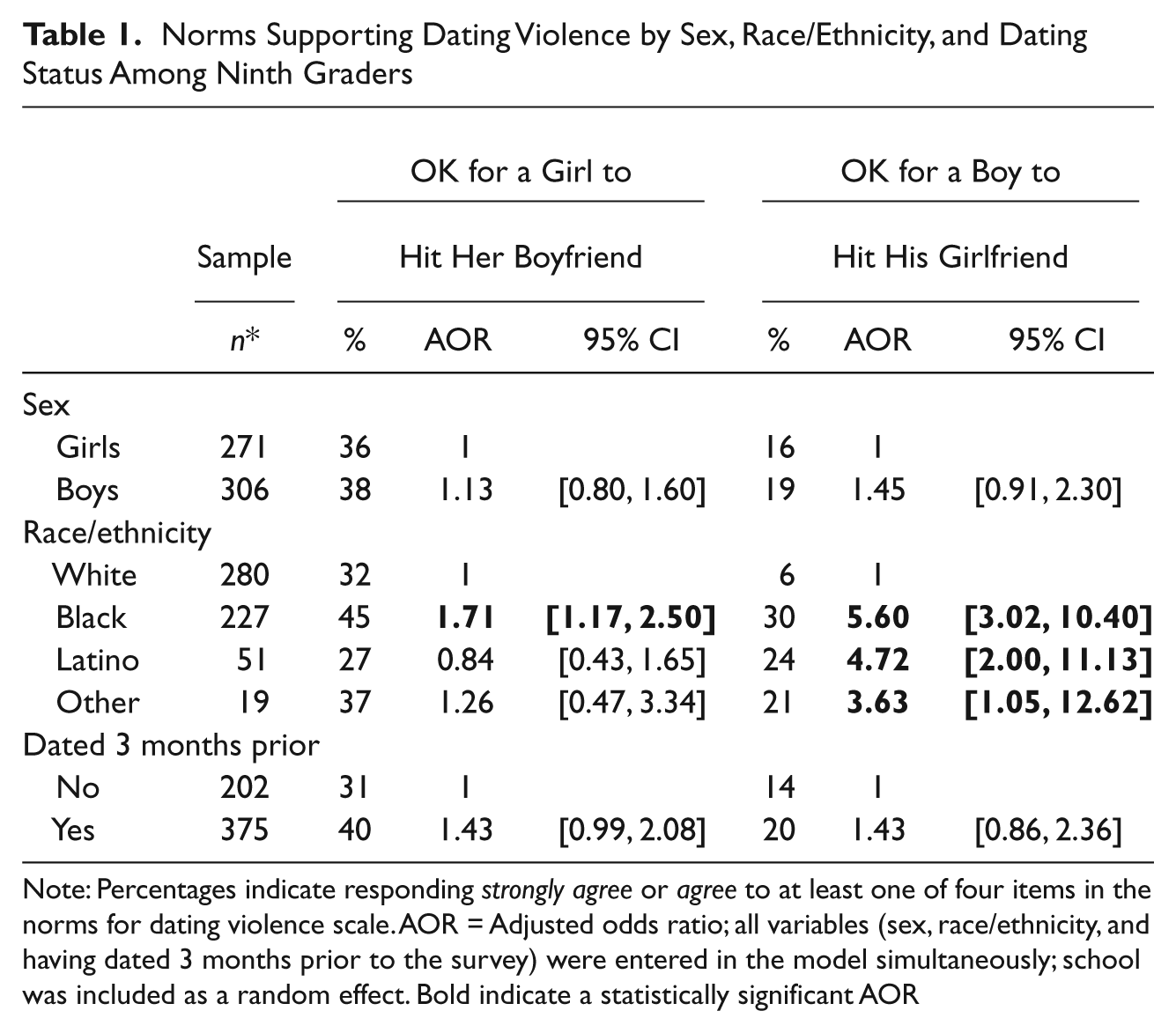
Note: Percentages indicate responding strongly agree or agree to at least one of four items in the norms for dating violence scale. AOR = Adjusted odds ratio; all variables (sex, race/ethnicity, and having dated 3 months prior to the survey) were entered in the model simultaneously; school was included as a random effect. Bold indicate a statistically significant AOR
As detailed in Table 1, one third of the participants reported some support for girls hitting boyfriends, while only one-sixth reported support for boys hitting girlfriends. More boys (19%) than girls (16%) supported boys hitting girlfriends, but this difference was not statistically significant after controlling for having dated in the 3 months prior to taking the survey and race/ethnicity. Strong racial differences were observed in the support for dating violence. Support for violence from girls to boyfriends was significantly higher for African American students, and support for violence from boys to girlfriends was significantly higher for all non-White students. In addition, students who had dated reported slightly more acceptance of norms supporting dating violence, but the difference was not statistically significant (Table 1).
To examine whether beliefs supporting violence are associated with action, we correlated support for violence with physical dating violence perpetration and victimization among students who had dated. Two thirds of the students reported dating during the 3 months prior to the survey. Of the students who had dated, one-fourth reported at least one act of physical aggression toward their date, and one-third reported at least one act of physical victimization. Table 2 illustrates prevalence by sex and race/ethnicity.
Prevalence of Dating and Dating Aggression Among Ninth Graders by Sex and Race/Ethnicity
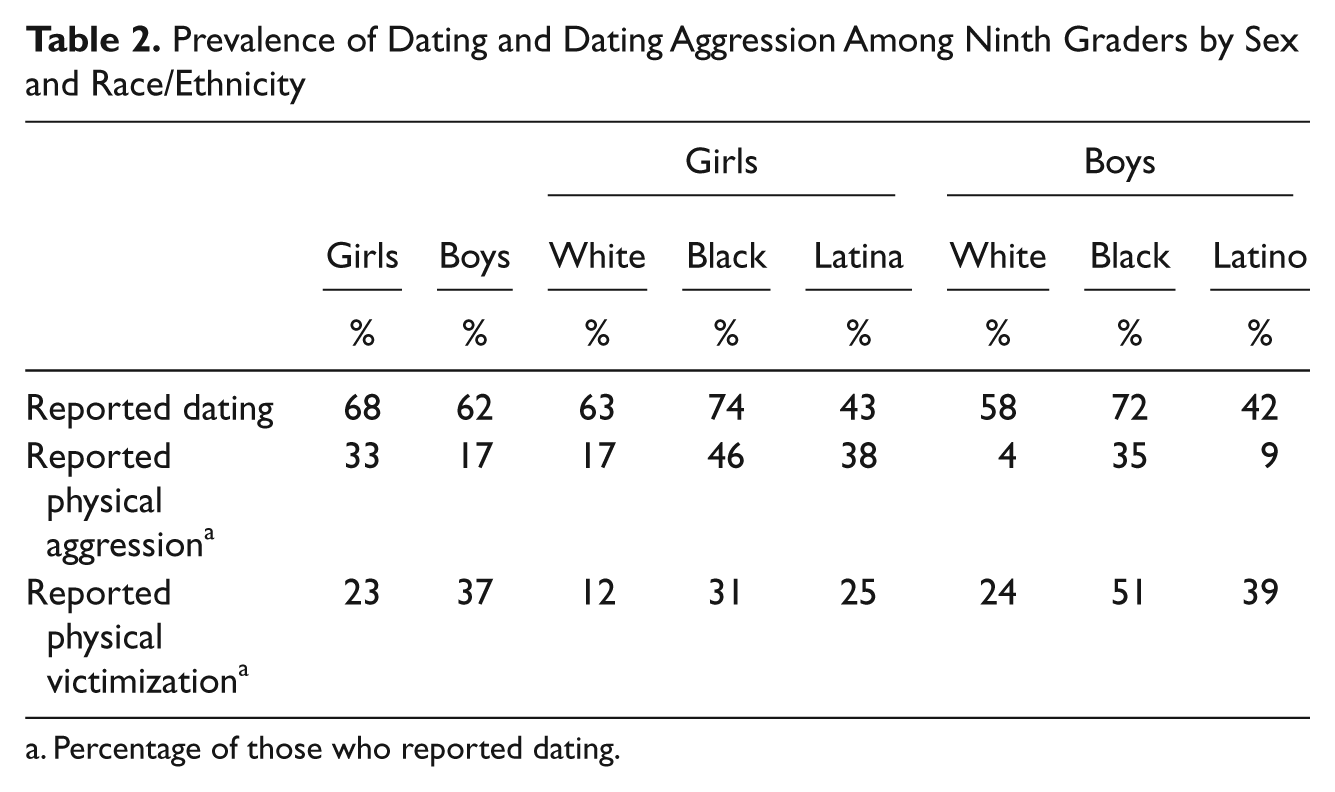
Percentage of those who reported dating.
As shown in Table 3, the correlation between victimization and perpetration was very high for boys and girls, suggesting that violence at this age is bidirectional. The high correlation between beliefs that support female-to-male violence and male-to-female violence (r = .62) deserves further explanation: 75% of students reported consistency with regard to the acceptability of violence (i.e., they supported both types of violence or did not support either type); 22% supported girls hitting boyfriends, but not vice versa; and less than 3% supported boys hitting girls but not girls hitting boys.
Correlation Coefficients (Pearson) Between Study Variables and Sex Among Ninth Graders
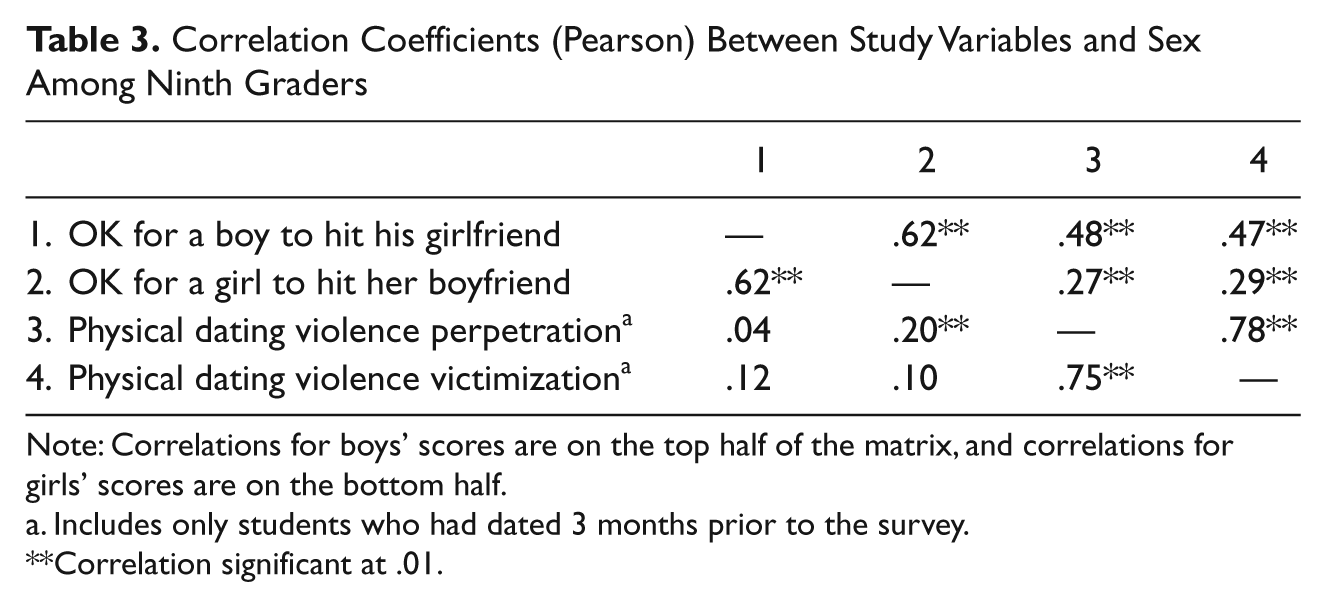
Note: Correlations for boys’ scores are on the top half of the matrix, and correlations for girls’ scores are on the bottom half.
Includes only students who had dated 3 months prior to the survey.
Correlation significant at .01.
Among girls, beliefs that support boys hitting girlfriends were not associated with girls’ dating aggression perpetration (r = .04) or victimization (r = .12); beliefs that support girls hitting boyfriends were significantly, although weakly, associated with dating violence perpetration (r = .20). Among boys, beliefs that support boys hitting girlfriends were significantly and strongly associated with boys’ dating violence perpetration (r = .48) and victimization (r = .47), and beliefs that support girls hitting boyfriends were significantly associated with dating violence perpetration (r = .27) and victimization (r = .29; Table 3). In other words, the association between norms and behaviors was weak to nonexistent for girls, while it was relatively strong for boys.
Focus Groups
We analyzed focus group data using the constant comparative method (Glaser & Strauss, 1967) although the intent of the research was not to build grounded theory. Consistent with the constant comparative method, data collection and analysis occurred simultaneously. Two graduate assistants who co-facilitated the focus groups assisted with data analysis. Investigators and students individually read, reread, and coded the transcripts for key points and possible themes, meeting on numerous occasions to discuss the analyses. By constantly moving between the data and the interpretations within the same transcript and across different transcripts, a tighter structuring of the data emerged. This process resulted in findings that reflect our interpretation of students’ perceptions of dating aggression. To insure the trustworthiness of the findings, we employed three types of triangulation suggested in Denzin’s (1978) seminal work: data triangulation, methodological triangulation, and investigator triangulation. We also collected and analyzed data over a 3-month period, and we employed thick, rich description to contextualize the findings. Finally, the first author kept a detailed audit trail, an account of the methods, procedures, and decision points in conducting the study.
Three themes emerged in using the constant comparative method of analysis. Boys and girls: (a) defined dating aggression broadly and viewed all forms negatively; (b) considered male-to-female physical aggression particularly unacceptable; and (c) perceived female-to-male physical aggression as less offensive.
All Forms of Dating Aggression Were Viewed Negatively
Participants asserted that dating aggression is an issue for most high school students. They noted that it is particularly salient “when 9th graders are dating an older guy,” and commented that it usually takes place in a “nonpublic place,” that is, “not at school.” As one of the males put it, “I really don’t see it [aggression] in action, but I’ve known people that have done it or been through it.” As this comment suggests, students first associated the word “aggression” with behavior of a physical nature. When asked what came to mind when they thought about the word “aggression,” students responded with words such as “force,” “violence,” and “being rough.”
It should be noted, however, that on further reflection, participants indicated that aggression can be verbal as well and stated that it can take many forms, from “yelling” to “cussing out” to “putting somebody down.” Of especial note is that most participants considered “rumors” or “gossip” particularly problematic among teens. They were divided as to whether rumors would be considered a form of verbal aggression, but were united in the belief that rumors can lead to verbal aggression. In addition, they unanimously concurred that rumors are “a very big thing” for high school students. A comment by one of the males, “it [spreading rumors] is pretty much all they [students] do around here,” captured a sentiment shared by all focus group participants.
Given that participants viewed rumors/gossip as particularly pervasive, it is not surprising that they perceived verbal aggression more commonplace in dating relationships than physical aggression. Statements such as “it [aggression] is more verbal than like what they [students] do with their actions . . . [it is] more with their words,” and dating aggression is “mainly verbal abuse, sometimes physical” are representative of the kinds of comments shared. The more ubiquitous nature of verbal aggression, however, did not inure participants to its insidious effects. Female participants were particularly aware of how injurious verbal aggression can be. Finishing one another’s thoughts in what became a single stream-of-consciousness sentence, one group of female focus group participants somberly noted that verbal aggression will
always be in the back of your head . . . a bruise, it will go away . . . verbal aggression will still be in your mind . . . you never think that your boyfriend is going to [say something mean to you] and then one day he just blows off and does . . . it really hurts inside when he does.
Interestingly, male participants were less certain about the lasting effects of verbal aggression. Some maintained that it “could be just as dangerous” as physical aggression because “their [victims’] self-esteem drops,” whereas others believed that “if you call a girl something [bad name], that can always be fixed. You can always talk it out and, you know, apologize. If you hit a girl, smack her in the face, there’s no ‘I’m sorry.’”
Male-to-female Aggression Was Particularly Unacceptable
One of the more salient findings in this study is the near unanimous intolerance by males and females of male-to-female aggression, especially physical aggression. Males shared a clear belief that “you don’t hit girls . . . period,” and they did so with a strong sense of conviction. Emphasizing the point that hitting a female is not acceptable, two males commented that “you don’t hit girls even [if] they, like, start beating the crap out of you,” and you “wouldn’t hit a girl for anything.” And even though, as one participant said, “it’s kind of alright for a guy to hit a guy if he deserves it, if it’s a girl you don’t do anything about it. You just try to talk it out as much as you can and try to get her to understand what you’re trying to say.”
Four factors exerted considerable influence over the way male participants perceived aggression toward females: peer pressure, legal prohibitions, parents’ (especially fathers’) beliefs about aggression, and the physical advantage of males. That peers wield influence in shaping the beliefs of adolescents is not surprising, given the pivotal role peers play in identity development during the high school years. The sway of one’s peers is graphically illustrated in the comment by one male participant: “You don’t hit a girl or else you’re gonna get . . . some guy’s gonna come kick your butt really bad.” Peer influence is also conveyed in the more subtle, yet equally powerful comment by the male who stated that a “guy who is hitting [a girl] wouldn’t definitely be my friend.” Even if hit first by a female or provoked in some other way, male participants maintained that “you would just resist . . . you wouldn’t want to hit her back.” Several referred to this tacit understanding about behavioral expectations as “common sense,” with one participant commenting, “I think any guy, no matter, the race or religion, knows not to hit a girl.”
Some of the male participants attributed a healthy respect for “the law” as a primary reason for their perspective on male-to-female aggression. One in particular evidenced an especially keen awareness of the real-world consequences of aggression in his remark that “in the movies, they make it okay to show aggression . . . but when you do it in real life, it’s like the worst thing possible . . . you can go to jail for hitting your girl.”
If the prospect of legal sanctions failed to sufficiently impress on these young men society’s intolerance of aggressing females, legal sanctions coupled with parental disapproval, particularly from fathers, did not. In a chorus of laughter as other group members nodded in agreement, one male stated, “The law and my Dad say you are not supposed to hit girls.” Similarly, others noted that their fathers communicated a “don’t do anything I wouldn’t do” message that was impossible to miss—a message translated by one participant as “you’re on a short leash.” And, with eyebrows raised, eyes opened wide, and a shake of the head another male participant uttered the single word, “Whoa . . .” to communicate a clear understanding of his parents’ response if he hit a girl. Perhaps the influence of parents is best captured by the remark of the participant who said, “We always follow our parents because, I guess, they’re gonna find out anyway. And, besides, your parents are practically the law.”
Males commonly noted superior physical advantage as another reason why male-to-female aggression is not acceptable. In a particularly poignant expression of this belief one male remarked,
You don’t need to hit a girl . . . no matter how angry you are. They’re not strong. If a guy gets hit, it’s not gonna hurt him as bad as if a girl gets hit because . . . her bones are kind of tender and . . . she’s weak. It’s gonna hurt her really bad. You learned that from Day One—since you were born.
Similarly, another participant indicated that because males are typically stronger than females, they “could really hurt them [girls] and if you’re a guy you just don’t really want to hurt anybody like that.” Some of the males noted that physical aggression often has consequences beyond bodily injury, as the remark by one participant underscores: “And it’s mental stuff, too. If you ever did [hit a girl] she might be afraid to go out with another guy . . . it could damage her mentally.”
The females in this study were equally emphatic in their belief that male-to-female aggression is unacceptable. As one commented, boys “are not supposed to hit girls . . . period.” Interestingly, she, as did one of the males referenced above, used the word “period” to underscore this position, adding that not hitting girls “is all about respect.”
So strongly did the females in this study believe that male-to-female aggression is unacceptable that there is no mention in any focus group of a time when it would be justified. Even when they are the aggressors, female participants maintained that boys “should never hit” them. For females, male hitting involves a level of violence completely unacceptable because boys “don’t have to hit a girl to get her off. They can push her off.” As did the male participants, the females emphasized boys’ physical advantage: “Boys are so much stronger. Anything that they want they can get.” It should be noted that participants were given considerable breadth in the topics explored. Male participants did not focus on male violence although two tentatively suggested that there might be a situation when male-to-female aggression could be justified. When pressed by the lead author for a fuller response, they did not elaborate, possibly constrained by the strong anti-physical-aggression sentiment expressed by other male participants.
Female-to-male Aggression Was Less Offensive
In contrast, male and female focus group participants evidenced more nuanced perspectives about female-to-male aggression. How “hitting” was defined varied according to which gender perpetrated the aggression. When males were the perpetrators, “hitting” was narrowly defined by male and female focus group participants alike as physical aggression with the intent to harm, “more directly as hurt” as one participant explained, or to force submission in some way (e.g., sexual). However, when females were the perpetrators, “hitting” was defined more broadly by both gender groups and included “playfulness,” “joking around,” even a “love tap.” Whatever the intent underlying female aggression, the males commonly believed that “you [males] just have to take it”—an expectation that neither gender had for females. According to one of the female participants,
This double standard doesn’t make sense when you think about it, [but] it is the way of the world. If a man hits a woman, then he can go to jail, but if a woman hits a man, she won’t get such a harsh punishment.
The tone of the male and female focus groups was very different when the discussion focused on female-to-male aggression. Although both acknowledged greater acceptance of female-to-male aggression, female participants were puzzled by this disparity, as the comment from one female indicates: “It just confuses me!” The males, however, were not similarly confused. Neither puzzled by the existence of a double standard nor outraged by the injustice of it, comments about female-to-male aggression were often accompanied by laughter, a you-know-what-I-mean look, and a roll of the eyes. One participant, for example, making a joke about female-to-male aggression, said, “I’m in an abusive relationship . . . with my sister (laughter). She hits me all the time.” Similarly, another male, provoking laughter by members in his focus group, commented, “Apparently it’s okay [for girls to hit boys] because they do it all the time!” Still another, implicitly invoking a “boys will be boys” assumption about behavior, noted that “they [males] kind of have it [aggression by females] coming, so it’s okay. That’s also kind of expected because of pop culture.”
Discussion
The complementary quantitative and qualitative methods employed in this study yielded mutually supportive findings. These strategies strengthen the credibility of the findings, thus advancing knowledge about dating aggression in general and the role of dating violence norms in particular.
Not surprisingly and consistent with extant literature, the student survey and focus group data revealed little support for physical violence in dating relationships. Among the few participants who sanctioned physical violence, support for girls aggressing boys was much greater than for boys aggressing girls. In fact, there was approximately twice as much support for female aggression. Stronger support for girl-initiated aggression, noted by Price, Byers, and the Dating Violence Research Team (1999) more than a decade ago, has been a clearly identifiable trend in the growing body of literature on adolescent dating violence. Straus’s (2009) recent summarization of the female dating violence literature underscored the traction of this trend. Our focus group data, however, suggest that this trend may be better understood as a proscription against physical violence perpetrated by boys rather than support for physical violence perpetrated by girls. Although focus group participants emphatically denounced male-to-female aggression, views on female-to-male aggression lacked similar strength of conviction, revealing more nuanced perspectives about how violence is defined, interpreted, and punished when girls are the aggressors. Moreover, female focus group participants were keenly aware of a double standard that views female aggression less harshly—a double standard similarly noted by Sears et al. (2006, 2007) in studies of abusive behaviors in adolescent dating relationships.
From a prevention perspective, of particular importance are the reasons why our participants rejected male-to-female dating aggression: peer pressure not to hit girls, parents’ beliefs that denounce dating violence, the superior physical advantage of boys over girls, and legal consequences. Boys expressed fear of physical retaliation by peers if they hit a girl, clearly indicating that young people hold a social norm that does not support male-to-female dating violence. Decisive repudiation by parents of violence against girls was also an important deterrent, as research about parental influences on smoking initiation by teens has similarly shown (Jackson & Henriksen, 1997). The superior physical advantage of boys, recognized by both sexes, suggests teens understand that male violence is not necessary, but allows for circumstances where girl-initiated violence may be understandable (e.g., self-defense). Neither boys nor girls explicitly stated that violence is wrong although it may be implicitly understood from the reasons given. The discussion of the superior physical advantage of boys also reflects a narrow perspective of aggression; in the absence of physical contact boys may not view certain actions, such as pressuring girls to submit sexually, as aggressive. More research is needed to explore how students, both male and female, perceive the relationship between persistent efforts to engage in sexual behavior and aggression.
Among the few students who approved of physical dating violence, there was not a significant difference on the basis of sex, but there was for race/ethnicity. Compared to White students, African American students were significantly more likely to hold norms that support girls hitting boyfriends. In addition, all non-White students were more likely to hold norms that support boys hitting girls than White students. That non-White participants endorse greater use of violence in dating and intimate partner relationships has been previously reported (Chase, Treboux, & O’Leary, 2002; Lehrer, Buka, Gortmaker, & Shrier, 2006). Howard and Wang (2003) identified “ethnicity, specifically being Black” (p. 1) as a factor associated with dating violence. Our survey study underscores this racial divide to an even greater extent, suggesting the need for more quantitative and qualitative research to better understand the reasons why dating violence appears higher among minority youth. Most importantly, better information is needed to differentiate the influence of SES and race.
Although students who dated within 3 months prior to completing the survey (approximately two thirds of the sample) were more likely to hold norms that support dating violence, this difference did not reach statistical difference. Literature about the influence of dating status on aggression is still in its infancy; more research is needed to better understand the relationship between dating status and beliefs/behaviors pertaining to dating violence.
We also examined the relation between norms and dating violence. We found the association between dating violence norms and physical aggression especially strong for males but not females. The absence of a strong association for females may be due to the variety of ways they described their aggressive behaviors, including “play” or acts of affection. Moreover, aggressive behaviors may represent a form of conflict management for females, albeit an unhealthy one. Reports of “aggressive acts” in the survey by females may have a very different meaning than reports by males, which may account for the lack of association between norms supporting aggression and dating violence among female participants.
Lastly, the correlation between dating violence perpetration and victimization was very strong, suggesting that physical dating violence during adolescence is bidirectional. Fineran and Bolen (2006) also found a strong association between perpetration and victimization. Although female dating aggression clearly does not have the public health implications that male aggression poses in terms of the potential for injury or even death, it is possible that female aggression could provoke male aggression, or that behaviors that start as play could escalate to aggression.
The findings of this study must be considered in light of a few limitations. First, data were collected from high school students in Northeast Georgia. Although the schools collectively represent a wide range of student characteristics and locations, the extent to which the findings can be generalized to students from other high schools in Georgia and beyond is unknown. Second, the quantitative findings were drawn largely from self-report student surveys. Although scales measuring the frequency of behavior, referred to as “Acts” scales, are the most common way to obtain partner violence information (Foshee, Bauman, Linder, Rice, & Wilcher, 2007), they fail to capture the contextual information or patterns of abuse necessary for understanding a phenomenon as complex as dating violence. Furthermore, our study did not include an individual measure of SES, and focus group composition was determined solely on the basis of sex. More attention to methodological considerations (e.g., focus groups by sex, race, and SES) may have helped untangle the influence of cultural and demographic variables on reported beliefs and actions. Finally, because students were assured confidentiality rather than anonymity due to the broader aims and objectives of Healthy Teens, they may have been less candid in revealing information about a topic as sensitive as dating violence. If so, the prevalence of violence perpetration and victimization is likely to be higher than that reported.
Our findings have several implications for practice and research. First, they point to the need to examine the content of evidence-based dating violence programs currently in schools to insure that they go beyond a one-size-fits-all approach. To do justice to a phenomenon as complex as dating aggression, these curriculums must be reviewed regularly and infused with incremental gains in knowledge about cultural, social, and gender-based influences on behavior. Educational programs must also go beyond focusing on the lethality of male-to-female aggression. They must address greater acceptance of female-to-male aggression by teaching problem-solving skills that expressly reject violence as an option for dealing with conflict, and they must include education about collective norms (Lapinski & Rimal, 2005), such as laws, pertaining to violence. Given our findings that parents’ beliefs about male-to-female aggression shape the norms of their sons, parental training should also be considered as part of a comprehensive approach to violence prevention. In addition, these educational programs must help students learn to differentiate aggressive behaviors from nonaggressive behaviors, that is the “love tap” that feels anything but loving or the unkind remark that is hastily excused by “just kidding.” Our findings also point to a critical need for culturally sensitive prevention programs developed for specific populations, differentiated by gender, race/ethnicity, and other cultural and economic influences. Focus group participants in our study were of the same sex, which was an asset to the discussion. However, given the demonstrated importance of race/ethnicity in the student surveys, further research should consider organizing focus groups by relevant demographic factors. Finally, our research adds to a growing body of literature calling for more exploration into the phenomenon of female aggression—what accounts for it, why it is deemed tolerable-to-acceptable by adolescents today, and what must be done to halt this trend.
Footnotes
The authors declared no potential conflicts of interest with respect to the research, authorship, and/or publication of this article.
The authors disclosed receipt of the following financial support for the research, authorship, and/or publication of this article:
This study was funded by the Centers for Disease Control and Prevention, National Center for Injury Prevention and Control, research grant R01-CE001397.