



Abstract
Understanding the developmental precursors of juvenile violent sex offending can contribute to the promotion of effective early intervention and prevention programs for high-risk children and youth. However, there is currently a lack of research on the early characteristics of adolescents who commit violent sex offenses. Drawing on the literature regarding the generalist and specialist positions of criminal behavior, the aim of the present study was to compare childhood risk factors for three groups of juvenile offenders: (a) pure sex offenders (PSO; n = 28); (b) violent non-sex offenders (VNSO; n = 172); and (c) versatile violent sex offenders (VVSO; n = 24). Nineteen risk factors comprising four life domains (individual, family, peer, and school) were identified from a file review. Three hierarchical logistic regression analyses examined associations between risk factors and offender groups. The results reflected the underlying heterogeneity of the sample, offering support for both the specialist and generalist positions of criminal behavior. PSOs differed from VNSOs on the basis of higher odds for precocious sexual behavior. Second, VVSOs differed from VNSOs on the basis of higher odds for precocious sexual behavior, criminal family members, and an adolescent mother, as well as lower odds for poor school behavior. Third, PSOs were marginally more likely to have engaged in early overt antisocial behavior compared with VVSOs. Fourth, many of the childhood risk factors examined were not associated with any offender group. In conclusion, VVSOs appeared to differ on the greatest number of risk factors from VNSOs, suggesting that VVSOs share a more similar developmental pathway with PSOs. The prevention and future research implications of these findings are discussed.
Keywords
Sex offenses are devastating crimes. According to the National Institute of Justice, the total estimated cost of sexual assault (excluding the cost of child sexual abuse) in the United States was US$127 billion per year (Miller, Cohen, & Wiersema, 1996). Yet this staggering figure may be an underestimate of the scope of the problem. In fact, reports suggest that over 70% of all sexual assaults remain unreported to authorities (Du Mont, Miller, & Myhr, 2003; Rennison, 1999). The past decade has seen a growing interest in childhood antecedents and developmental models of criminal behavior, with respect to both general offending (Farrington, 2003; Ward et al., 2010) and specific sexual offending patterns (Johnson & Knight, 2000; Simons, Wurtele, & Durham, 2008). Identification of salient childhood risk factors may elucidate the developmental pathways of sex offending behavior and inform early intervention and crime prevention programs.
Generalist Versus Specialist Models
Generalist models emphasize the influence of criminogenic environments on the development of all offending behaviors, and maintain that sex offending is part of a larger nomological network of antisocial cognitions and behaviors (Gottfredson & Hirschi, 1990; Lussier, Leclerc, Cale, & Proulx, 2007). Indeed, risk factors associated with delinquency and antisocial behaviors (including sexual offending) are well documented in the psychological and criminological literature (Farrington & Welsh, 2007; Leschied, Chiodo, Nowicki, & Rodger, 2008; Lipsey & Derzon, 1998). In support of the generalist position, a 10-year review of the literature from 1995 to 2005 found few differences between sex offenders and non-sex offenders on a wide range of variables, including exposure to domestic violence, school performance, and problems with peer relations (van Wijk et al., 2006). Furthermore, juveniles who offend sexually and those who offend nonsexually often have lower intellectual abilities, higher levels of alcohol and drug use, more antisocial behaviors, and increased familial dysfunction (e.g., parental divorce, criminal justice system involvement, and psychopathology) than nondelinquent peers (Seto & Lalumière, 2010; van Wijk et al., 2005).
In contrast to the generalist position, other theorists hold that individuals who commit sex crimes are “specialists,” or fundamentally different than non-sex offenders (Harris, Mazerolle, & Knight, 2009; Simon, 1997). In support of this theory, Lussier et al. (2007) noted that adult sex offenders were characterized by high levels of sexual preoccupation, impersonal sex, and sexual compulsivity. Moreover, the observation that both juvenile and adult sex offenders are more likely than non-sex offenders to be victims of childhood sexual abuse has been quite robust, as evidenced by multiple studies (Seto & Lalumière, 2010; Simons et al., 2008). A recent meta-analysis found that, across 17 studies, sex offenders were over three times more likely than non-sex offenders to report sexual abuse histories (Jespersen, Lalumière, & Seto, 2009). Adult sex offenders have also reported higher rates of poor childhood attachments, early atypical sexual interests, and precocious sexual experiences than non-sex offenders (Fagan, Wise, Schmidt, & Berlin, 2002; Simons et al., 2008). When considering adolescent offenders, studies have found sex offenders to be uniquely distinguished from non-sex offenders by higher rates of early-onset masturbation and atypical sexual interests, along with higher levels of psychopathology, such as depression and anxiety (Marshall & Marshall, 2000; Seto & Lalumière, 2010). In addition, a meta-analysis by Seto and Lalumière (2010) reported that, compared with their non-sex offending counterparts, juvenile sex offenders tended to score lower on measures of criminal involvement, conduct problems, and self-esteem.
Versatile Violence Among Juvenile Sex Offenders
One avenue for examining the explanatory strength of the generalist and specialist theories is to explore the unique correlates associated with subgroups of offenders, particularly with respect to violence and versatility among sex offenders. For instance, Butler and Seto (2002) differentiated between types of adolescent offenders by further dividing both sex offenders and non-sex offenders into subgroups. The sex offenders were split into those with only sex offenses (sex-only) and those having additional non-sex offense criminal histories (sex-plus). Non-sex offenders (all of whom had nonviolent offenses) were categorized into two subgroups according to whether they had ever committed a violent offense. Results indicated that sex-only offenders exhibited fewer childhood conduct problems than both sex-plus and non-sex offenders, with the sex-plus offenders better resembling versatile offenders than sex-only offenders. Finally, van Wijk et al. (2005) compared juvenile violent sex offenders with juvenile violent nonsex offenders and found the sex offenders had better academic performance, received more inconsistent parental discipline, and were more likely to have a younger, less educated mother. The existing literature has contributed greatly to our understanding of potential adolescent offender subtypes. However, one area requiring further investigation is whether unique developmental risk factors differentiate youth who commit violent sex offenses from those who commit violent non-sex offenses and from those who commit both types of violent offenses.
The Present Study
The current study contributes to the literature in several important ways. First, we focused exclusively on childhood risk factors. Many studies do not specify whether observed risk factors emerged during childhood, adolescence, or adulthood (e.g., Lussier et al., 2007). This is an important distinction, as behaviors seen in adolescence would be better conceptualized as correlates than developmental risk factors should they violate the temporal precedence required for the determination of a risk factor (Kraemer et al., 1997). In addition, the present study used a more exploratory, empirically driven approach to the data analyses by including less extensively researched factors for sex offending (e.g., health problems). Finally, it appears to be the first empirical investigation to compare the childhood criminogenic risk factors for three groups of adolescent offenders: violent sex offenders, violent non-sex offenders (VNSO), and versatile violent sex offenders (VVSO).
On the basis of our review of the current literature, the generalist position would predict few differences across these three groups in terms of childhood risk factors. Conversely, the specialist position would anticipate the versatile violent sex offender group to differ from the remaining groups on several variables. In line with the specialist position, we hypothesized that the versatile and pure sex offenders (PSO) would have greater odds than the VNSO of exhibiting precocious sexual behavior, low self-esteem, young maternal age at birth, and sexual abuse history. Furthermore, we hypothesized the versatile sex offenders would have greater odds than the PSO of engaging in childhood antisocial behavior. However, although we expected differences among the three subtypes on the aforementioned variables, we anticipated a number of commonalities among the groups. In accordance with the generalist position, no differences were expected for the following factors: academic performance, substance use, criminal family members, parental psychopathology, peer relations, and family disruptions or transitions. Thus, we posited that both the generalist and specialist positions would contribute to the identification of developmental precursors characteristic of each adolescent offending groups.
Method
Sample
Participants were 224 male youth who were part of a larger longitudinal study on the predictors of trajectories of offending (Ward et al., 2010). These youth were sentenced as juvenile offenders between 1986 and 1995 to one of two open custody facilities in Toronto, Ontario, Canada. The youths’ average age at admission was 17.6 years (SD = .8), with an average sentence length of 132.0 days (SD = 124.4). Official criminal records for juvenile offenses were examined up to age 17 years. These data were collected from four official sources, including the (Ontario) Ministry of Community Safety and Social Services (MCSS), the (Ontario) Ministry of Correctional Services (MCS), the Canadian Police Information Centre (CPIC), and predisposition reports (PDRs) from client files maintained by the two open custody facilities.
The offenders were divided into three groups based on offense history: (a) those who had committed violent non-sex offenses (VNSO; n = 172), (b) those who had committed violent sex offenses (labeled “pure” sex offenders or PSO; n = 28), and (c) those who had committed both violent non-sex and sex offenses (labeled “versatile violent” sex offenders or VVSO; n = 24). Violent sex offenses included sexual assault and related charges. Violent non-sex offenses included murder and related charges, assault, robbery, and weapons offenses.
Procedure
Before the study commenced, the study was approved by a research ethics board, and permission to access the youth’s offender records and client file data were obtained. Extensive personal and background information was extracted from the young offenders’ client files, which included intake forms, PDRs, psychological and psychiatric reports and notes, discharge reports, and other pertinent sources such as case notes, social work reports, and police synopses.
Childhood Risk Factors
A detailed, dichotomized (i.e., present/absent) coding scheme was developed to extract psychosocial variables occurring between birth and age of 12 years. Given the varied sources and styles of information contained in the clients’ files, dichotomization represented an efficient and objective method of extracting the data and was best suited for the analyses with the outcome variable (Farrington & Loeber, 2000). Variable selection was based on a comprehensive review of the literature and reflected four life domains: individual, family, peer, and school. The individual domain included poor academic performance, hyperactivity-impulsivity-inattention, alcohol and/or drug use, health problems, low self-esteem, and extrafamilial sexual abuse, as well as covert antisocial behavior (e.g., stealing or firesetting), overt antisocial behavior (e.g., physical or verbal aggression), and precocious sexual behavior. The family domain measured criminal family members, parental psychopathology, poor child-rearing methods, child maltreatment, family relationship problems, family disruption or transitions, involvement with alternative care, and adolescent motherhood (≤17 years). The peer and school domains contained poor peer relations (e.g., peer rejection, antisocial peer associates) and poor school behavior (e.g., truancy, expulsions, suspensions), respectively. Further descriptions of the variables are available in Ward et al. (2010). Socioeconomic status and ethnicity were not coded, as this information was unavailable in the client files.
Interrater reliability was conducted by two independent raters on two separate occasions using a 20% random sample of files (11% at Time 1 and 9% at Time 2). Cohen’s κ was found to be moderate to good (Landis & Koch, 1977). Average κ’s for the childhood variables were .76 at Time 1 and .64 at Time 2.
Statistical Analyses
Offense characteristics were examined using one-way analysis of variance (ANOVA), whereas chi-square analyses tested for differences in criminal risk variable frequencies among the three offender groups. The study’s hypotheses were investigated using three hierarchical backward stepwise logistic regressions that compared the VNSOs with the PSOs, VNSOs to the VVSOs, and the PSOs to the VVSOs. For each regression model, individual domain variables were entered into the first step, and family, peer, and school domain variables were entered into the second step. The backward stepwise method is useful when important predictors have not been identified and when the association between the predictors and outcome variables is not well understood (Hosmer & Lemeshow, 2000). All statistical analyses were performed using SPSS 17.0.
Results
Offender Characteristics
Table 1 describes the offense characteristics of the three offender groups. The average ages at first contact with the justice system of the VNSOs, PSOs, and VVSOs were 15.3 (SD = 1.8), 15.6 (SD = 1.6), and 15.9 (SD = 2.0), respectively. All three groups committed other offense types, including property, drug, and breach (i.e., technical violation) offenses. One-way ANOVAs identified significant differences among the three groups for property, violent, sex, and total amount of offenses. Post hoc analyses showed that a greater number of property offenses was committed by the VNSOs compared with the PSOs (Ms = 3.0 and 1.7, respectively, p = .034), and the VNSOs also committed a greater number of total offenses relative to the PSOs (Ms = 6.4 and 3.8, respectively, p = .003). As expected, more violent offenses were committed by the VNSOs (M = 2.0, SD = 1.5, p < .05) and VVSOs (M = 1.6, SD = 1.2, p < .05) compared with the PSOs, but there was not a significant difference in the number of violent offenses committed by the VNSOs and the VVSOs. As well, there was no statistically meaningful difference in the number of sex offenses committed by the VVSOs (M = 1.1, SD = 0.4) and the PSOs (M = 1.3, SD = 0.6).
Univariate Mean (SD) Comparison Tests Across the Three Offender Groups
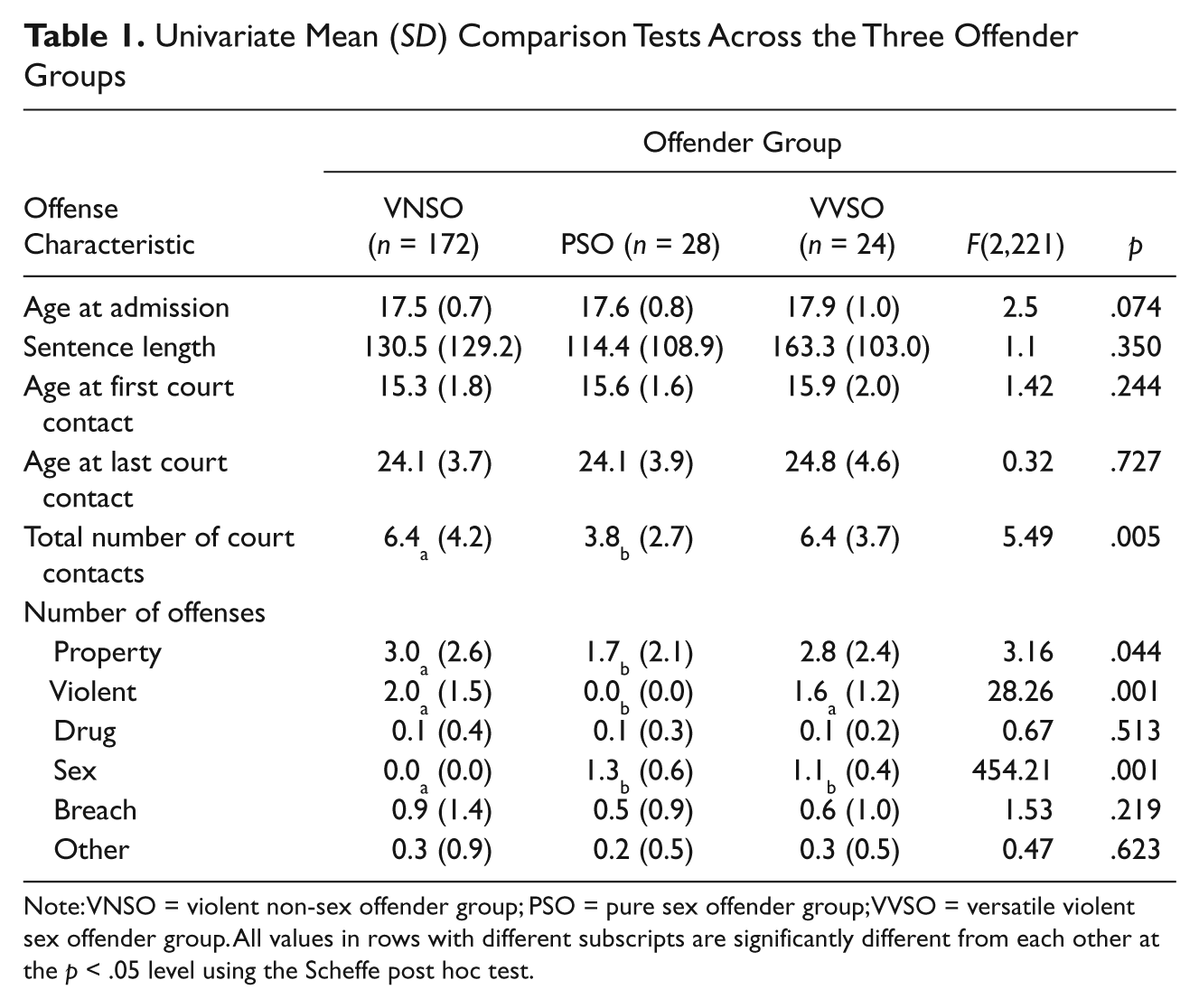
Note: VNSO = violent non-sex offender group; PSO = pure sex offender group; VVSO = versatile violent sex offender group. All values in rows with different subscripts are significantly different from each other at the p < .05 level using the Scheffe post hoc test.
Chi-square Analysis
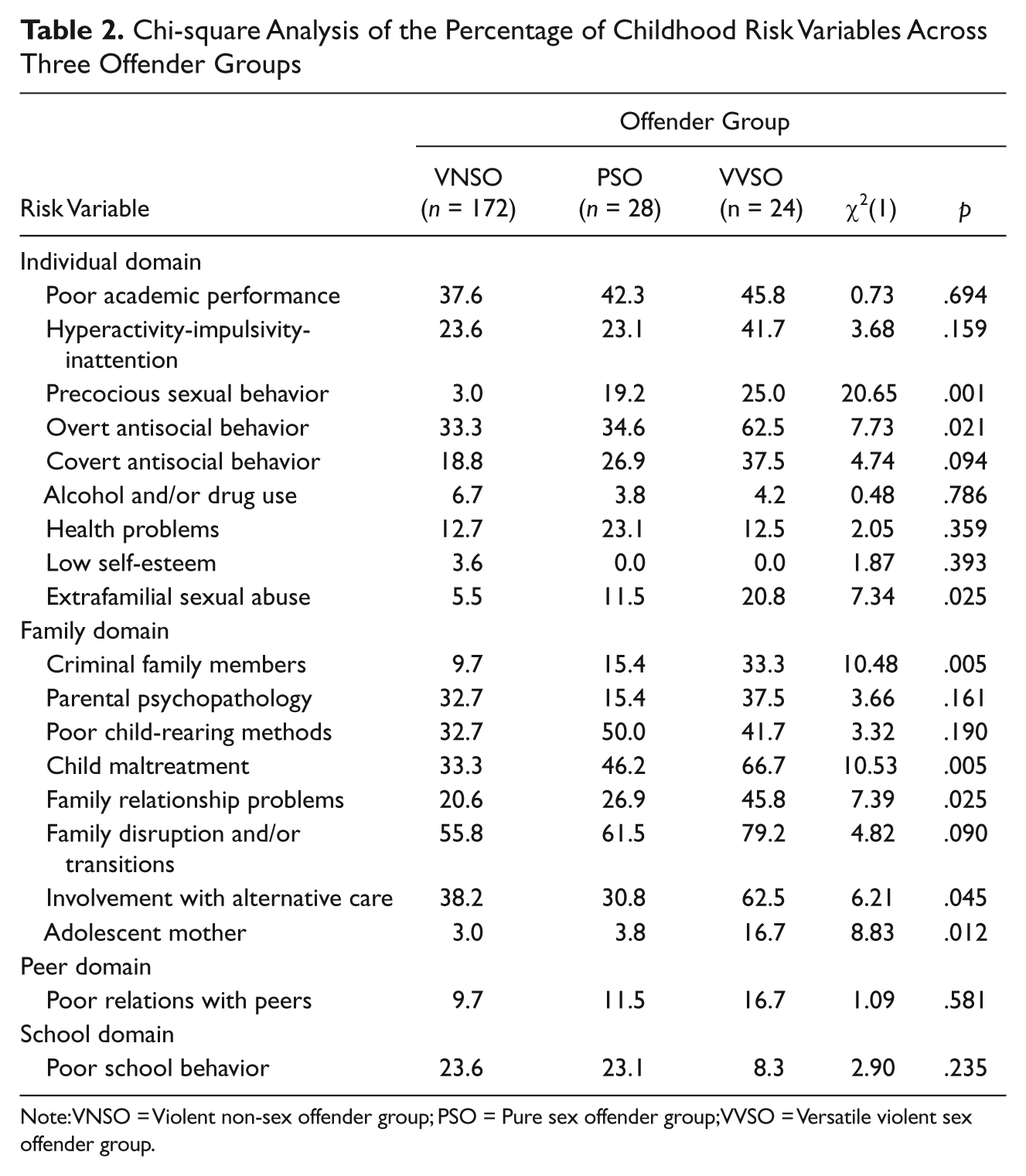
Chi-square analyses showed that the three groups differed on several risk variables from the individual and family domains, including precocious sexual behaviors, overt antisocial behavior, extrafamilial sexual abuse, criminal family members, child maltreatment, family relationship problems, involvement with alternative care, and adolescent mothers (see Table 2).
Chi-square Analysis of the Percentage of Childhood Risk Variables Across Three Offender Groups
Note: VNSO = Violent non-sex offender group; PSO = Pure sex offender group; VVSO = Versatile violent sex offender group.
Follow-up chi-square analyses were conducted on subcategories within the child maltreatment variable, as it was composed of four different types of abuse. The follow-up analyses indicated that group membership and physical abuse were significantly associated, with 50.0% of the VVSOs, 30.8% of the PSOs, and 24.8% of the VNSOs reporting physical abuse (χ2(2) = 6.61, p = .037). Similarly, group membership was significantly associated with sexual abuse, with 20.8% of the VVSOs, 11.5% of the PSOs, and 4.2% of the VNSOs reporting sexual abuse (χ2(2) = 9.84, p = .007). Finally, offender group was significantly associated with emotional abuse, with 33.3% of the VVSOs, 11.5% PSOs, and 9.7% of the VNSOs reporting emotional abuse (χ2(2) = 10.69, p = .005). Neglect was not significantly associated with group membership.
Hierarchical Logistic Regression Analyses
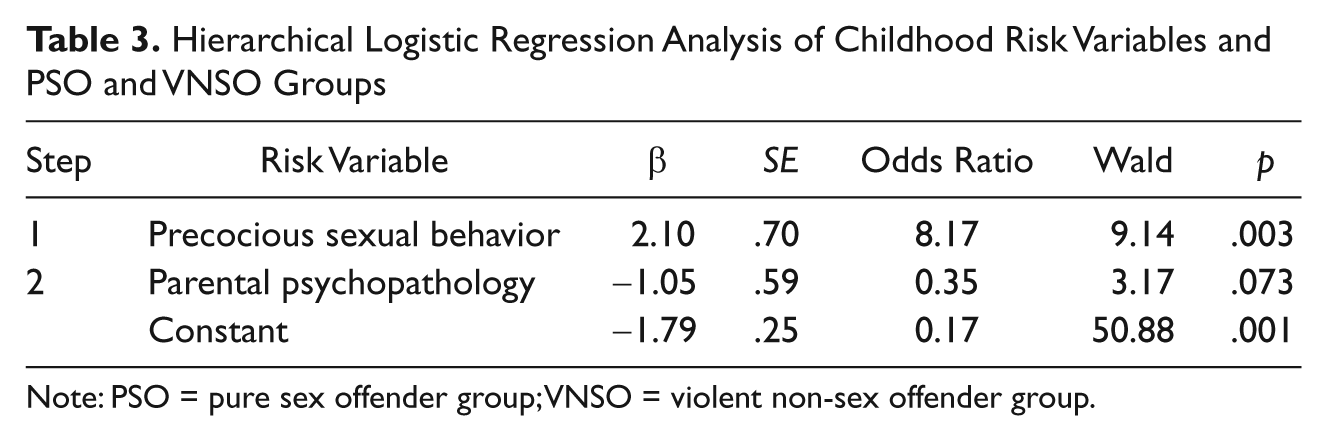
Three hierarchical logistic regression models tested the predictive associations between the childhood risk variables and the offender groups. Step 1 contained the nine individual domain variables, whereas Step 2 contained the family, peer, and school domain variables. The first hierarchical logistic regression examined the risk variables’ predictive association between the PSO and VNSO groups (see Table 3). This model was statistically significant (χ2(2) = 11.97, p = .003). The proportion of variance in offender group, as measured by Nagelkerke’s pseudo-R2, was 11.1%. The overall classification accuracy of this model was 86.9%. One risk factor distinguished the two offender groups; engaging in precocious sexual behavior as a child increased the odds of belonging to the PSO group by a factor of 8.17 (p = .003). Parental psychopathology did not contribute significantly to the model.
Hierarchical Logistic Regression Analysis of Childhood Risk Variables and PSO and VNSO Groups
Note: PSO = pure sex offender group; VNSO = violent non-sex offender group.
The second hierarchical logistic regression examined the risk variables’ predictive association with the VVSO and VNSO groups. The overall model was significant (χ2(6) = 43.03, p < .001) and the proportion of variance in offender group, as measured by Nagelkerke’s pseudo-R2, was 38.2%. The overall classification accuracy of the model was 90.5%. The factors comprising this model are displayed in Table 4. Precocious sexual behavior increased the odds of belonging to the VVSO group by a factor of 28.05 (p < .001). In addition, two family-related variables increased the odds of belonging to the VVSO group, including the presence of criminal family members (OR = 4.49, p = .02) and having an adolescent mother (OR = 67.97, p = .03). Poor school behavior was found to increase the odds of belonging to the VNSO group (OR = 0.06, p = .007).
Hierarchical Logistic Regression Analysis of the Childhood Risk Variables and VVSO and VNSO Groups

Note: VVSO = versatile violent sex offender group; VNSO = violent non-sex offender group.
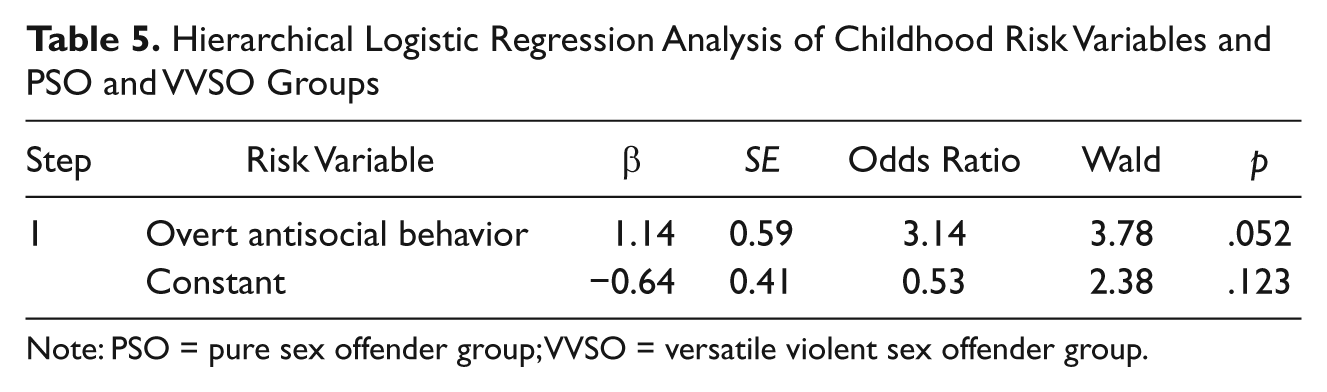
The third hierarchical logistic regression examined the childhood risk factors for the two sex offender groups (VVSO and PSO). The analysis yielded a statistically significant model (χ2(1) = 3.94, p = .047) and the proportion of variance in offender group, as measured by Nagelkerke’s pseudo R2, was 10.1%. The overall classification accuracy of this model was 64.0%. As shown in Table 5, only one variable contributed to the model, overt antisocial behavior, and its effect was marginal (p = .052). The presence of this factor increased the odds of belonging to the VVSO group by a factor of 3.14.
Hierarchical Logistic Regression Analysis of Childhood Risk Variables and PSO and VVSO Groups
Note: PSO = pure sex offender group; VVSO = versatile violent sex offender group.
Discussion
The present study aimed to identify childhood risk factors among violent offenders, with the express purpose of investigating the similarities and differences between VVSO and their violent non-sex and pure sex offending counterparts. The results reflected the underlying heterogeneity of the study sample and offered support for both the specialist and generalist positions of criminal behavior. In line with the specialist prediction, we anticipated that the VVSO and PSO groups would exhibit increased odds of precocious sexual behavior, low self-esteem, young maternal age at birth, and sexual abuse history than the VNSO group. These predictions were partially supported. Both subtypes of sex offending youth displayed higher odds of sexually precocious behaviors than the non-sex offending youth, a common finding in the sex offender literature (Marshall & Marshall, 2000; Seto, Murphy, Page, & Ennis, 2003). The VVSOs additionally exhibited higher odds of having an adolescent mother than the VNSOs. van Wijk and colleagues (2005) similarly reported that juvenile violent sex offenders were more likely to have a younger mother than VNSO. Lastly, although the childhood abuse variables were not significant predictors in the regression analyses, chi-squares indicated associations between types of abuse and offender category. Extrafamilial sexual abuse and intrafamilial child maltreatment including emotional, physical, and sexual abuse were each observed in higher frequency among the VVSO group, followed by the PSO and then the VNSO groups.
Furthermore, we hypothesized that the versatile sex offenders would have greater odds than the PSO of engaging in childhood antisocial behavior. This prediction was not fully supported. The chi-square indicated that overt antisocial behavior was associated with offender group; the percentage of VVSO youth engaging in antisocial behaviors was nearly double that of the VNSO and PSO youths. However, overt antisocial behavior contributed only marginally to the model comparing the VVSOs and PSOs, with the odds of antisocial behavior approximately three times higher among the VVSO group than the PSO group. Covert antisocial behavior did not distinguish between any of the three groups under study.
Finally, in accordance with the extant literature, we anticipated no differences across a number of predictors including poor school behavior, substance use, criminal family members, parental psychopathology, peer relations, and family disruption or transitions. This hypothesis was largely supported, lending credence to the generalist perspective. Parental psychopathology, poor school performance, substance use, peer relations, and family disruption were not significantly with an offender group in any of the analyses. However, the VVSOs had greater odds of growing up with criminal family members than the VNSOs.
Overall, the VVSOs appeared to differ from the VNSO on the greatest number of childhood risk factors and demonstrated only one marginal difference from the PSOs. This alludes to the VVSOs sharing a more similar developmental pathway with the PSOs than VNSOs. However, according to the chi-square analyses, the VVSO group is characterized by higher occurrence of a variety of different childhood risk factors, suggesting that they may comprise a more severe, high-risk subset among sex offender populations. Previous research has supported this notion, demonstrating that sex offenders with additional delinquent histories had higher rates of childhood sexual and physical abuse, childhood neglect, and parental criminology than sex offenders with no previous offenses (Way & Urbaniak, 2008).
It was somewhat surprising that childhood abuse did not predict membership in the offense subgroups, particularly because sexual abuse is a demonstrated risk factor for sexual offending (Seto & Lalumière, 2010). However, this may be a reflection of how the variables were defined, particularly with respect to intra-familial sexual abuse. Although previous authors have measured sexual abuse history by combining abuse committed by both familial and extrafamilial perpetrators (e.g., Simons et al., 2008), we captured familial sexual abuse under the broader umbrella of childhood maltreatment and analyzed extrafamilial sexual abuse as a separate variable. The relative lack of distinction between the PSOs and the VNSOs was unanticipated, potentially reflecting a lack of statistical power to find differences.
Moreover, sex offenders are a heterogeneous population and this study did not distinguish among potential subtypes. Further research could differentiate developmental risk factors for offender subgroups based on victim age (e.g., child, adolescent, adult), the nature of the offense (e.g., level of violence, presence of paraphilic interests), and age at offense onset. Observed effects of conduct problems such as social isolation, inadequate peer relations, and being victimized or bullied by peers may characterize certain subtypes of sex offenders over others. For example, child molesters have demonstrated higher levels of conduct problems compared with rapists (Lussier et al., 2007). Consideration of these factors may uncover unique developmental predictors of different manifestations of sexual offending behaviors.
Restrictions inherent in the file data made precise measurement of certain variables difficult. For example, adolescent offense history was based on the most serious offense arising from each new set of charges, rather than including all offenses related to each charge. Although this method is commonly used to identify types of offenders, future risk factor research would benefit from a more accurate depiction of offending histories. Similarly, group membership was determined using a dichotomous outcome variable specifying only whether each offense type occurred at all; thus, information regarding frequency of offense types was unavailable. This would be particularly valuable information, as examining the relative severity and frequency of offenses might further establish whether higher occurrence of various risk factors is associated with greater severity and versatility of violent, sexual, and general types of offending. Similarly, childhood risk factors were coded as either present or absent. Thus, it was not possible to determine whether a factor was absent because it was not experienced by the youth or because it was simply not mentioned in the youth’s file. The frequency and severity of each risk factor was also unknown.
The above limitations notwithstanding, the present study contributed to the literature on childhood risk factors for offending in a number of ways. By adhering to the temporal precedence required for the determination of a risk factor (Kraemer et al., 1997), we were able to elucidate potential developmental pathways for future study. Further research should investigate possible causal mechanisms linking these distal risk factors to offending outcomes through more proximal mediating risk variables, such as substance use and coping styles. In addition, our definition of group offending membership by violent offense history added unique understanding of different predictors of subcategories of violent offending and to the different pathways experienced by violent sex and non-sex offenders. Understanding the unique childhood risk factors for each subgroup may assist in early identification of high-risk children and guide the development of prevention strategies tailored to each group’s specific challenges in an effort to offset potentially devastating outcomes.
Footnotes
Acknowledgements
The authors thank Nathalie Burnier for her assistance with the data coding.
Authors’ Note
The opinions expressed in this article are those of the authors and do not necessarily represent the views of these agencies.
Declaration of Conflicting Interests
The authors declared no potential conflicts of interest with respect to the research, authorship, and/or publication of this article.
Funding
The authors disclosed receipt of the following financial support for the research, authorship, and/or publication of this article: This research was supported by grants from The Hincks-Dellcrest Centre, Ryerson University, the Samuel Rogers Memorial Trust, and the Ministry of Children and Youth Services, Youth Justice Services.