



Abstract
The use of corporal punishment has been linked to negative developmental outcomes for children. Despite this finding, Section 43 of the Canadian Criminal Code permits the use of corporal punishment by parents for children 2 to 12 years of age. Therefore, this study’s first objective is to investigate opinions toward Section 43 and spanking more generally. The second objective is to investigate predictors of opinions toward Section 43 and spanking more generally. The sample consists of 818 nonparents (70.7% female, 29.0% male) who completed an online study. Results indicate that 38.6% were favorable toward upholding Section 43. However, this decreases to 25.8% when a condition is included, stating that parents would not be prosecuted for mild slaps or spankings. For attitudes toward spanking more generally, results reveal that 16.7% of the participants held favorable attitudes. Hierarchical regression analyses reveal that planning to use corporal punishment upon becoming a parent predicted having a more favorable attitude toward Section 43 as well as toward spanking more generally (after controlling for sociodemographics). In contrast, having experienced violence during one’s childhood predicts having less favorable attitudes toward Section 43 and spanking more generally. Significant interactions are found between childhood experiences of corporal punishment and perceptions of parental warmth/support and impulsiveness during discipline in predicting attitudes toward spanking. Those who report experiencing more corporal punishment during childhood but also more parental warmth/support hold more favorable attitudes toward spanking and those who report experiencing more corporal punishment during childhood and also more parental impulsiveness hold less favorable attitudes toward spanking. Findings indicate that examining opinions toward Section 43 and spanking separately is important because these concepts are not synonymous. In addition, both more immediate factors and those related to one’s developmental history play a role in predicting opinions toward Section 43 and spanking more generally.
The corporal punishment of children is a topic that generates considerable debate because it touches on issues related to the rights of children and parents as well as on behaviors that are deemed important in the socialization of children. Corporal punishment is generally defined as an act (typically by a parent) that is carried out with the intention of causing physical pain not for injury but for purposes of correction or control (Straus, 1994). In Canada, Section 43 of the Criminal Code sanctions the use of corporal punishment, stating that the use of force by way of correction is acceptable given that it does not exceed what is reasonable under the circumstances (Criminal Code, 2011). This law applies to parents with children aged 2 to 12 years, and the punishment must not include the use of an object, such as a ruler or belt, or slaps to the head. There are also guidelines stating that the punishment must not be degrading, inhuman, or harmful and that it must be corrective and not the result of the caregiver’s loss of control (Durrant, Trocmé, Fallon, Milne, & Black, 2009).
One of the areas of controversy is that, in certain countries (including Canada), corporal punishment is permitted even though it has been linked to various negative child outcomes such as aggression, depression, anxiety, and impaired parent–child relationships (Ateah & Durrant, 2005; Benjet & Kazdin, 2003; Durrant, 2005; Durrant, Rose-Krasnor, & Broberg, 2003; Taylor, Manganello, Lee, & Rice, 2010). Gershoff (2002) conducted a meta-analysis of 88 studies conducted over a period of 62 years in an attempt to synthesize the literature examining the relationship between corporal punishment and child behavioral outcomes. Results revealed that corporal punishment was consistently linked with a range of negative child outcomes (with the exception of immediate compliance), including aggression, lower levels of moral internalization and mental health, increased child delinquent and antisocial behavior, and decreased quality of relationship between parent and child. Note, however, that these associations may not be causal because other variables (e.g., parents’ inconsistent style of discipline) might potentially be influencing this relationship. Corporal punishment may also be a possible precursor to physical abuse in that parents run the risk of intensifying their use of corporal punishment to the point where it becomes an act of violence (Clément & Chamberland, 2009). Researchers have hypothesized that this may be due to unclear guidelines concerning where to draw the line between “acceptable” corporal punishment and physical abuse (Gershoff, 2002). Nevertheless, based on research linking corporal punishment with a number of negative child outcomes, many countries around the world, including Sweden, Norway, Austria, New Zealand, Denmark, and Germany, have abolished the practice of corporal punishment completely (Gershoff, 2002).
Prevalence
Although the use of corporal punishment in North America has declined in recent years, there still remain a startling number of parents who continue to use this type of discipline (Lansford et al., 2009; Straus & Stewart, 1999; Toronto Public Health, 2003). In 2003, Canadian nation-wide data on adults’ attitudes toward Section 43 of the Criminal Code indicated that half (51%) agreed with the statement “Section 43 of the Criminal Code that allows parents to use physical punishment to correct children should be ended.” Interestingly, 45% stated that they did not agree with ending parental rights to use physical punishment whereas 4% stated that they did not know or refused to answer the question. In an earlier U.S. study of 991 parents (Straus & Stewart, 1999), six types of corporal punishment were examined: slaps on the hand or leg, spanking the buttocks, pinching, shaking, hitting on the buttocks with a belt or paddle, and slapping in the face. Results revealed that spanking was the most prevalent type of corporal punishment for children aged 2 to 8 years, with approximately 72% of parents reporting its use over a 1-year period. The use of more severe forms of punishment (e.g., hitting with an object) increased with age, jumping from 18.1% for 2- to 4-year-olds to 28.5% for 9- to 12-year-olds.
Additional Canadian studies that have examined corporal punishment based on retrospective data have found prevalence rates ranging from 50% (Ateah & Parkin, 2002) to 66% (Gagné, Tourigny, Joly, & Pouliot-Lapointe, 2007). Differences in these rates are likely due to methodological variations. Specifically, Ateah and Parkin (2002) asked participants to recall experiences before the age of 6, whereas Gagné et al. (2007), asked participants to recall childhood experiences more generally. Prevalence rates of corporal punishment may also vary as a function of other methodological differences, including retrospective versus prospective recall, the definition of corporal punishment, and the sample (i.e., age, sex). Despite these discrepancies, the bottom line is that corporal punishment remains a favored and prevalent disciplinary practice across North America.
Predictors
Due to the continued use of child corporal punishment across North America and the debate concerning parents’ right to its use, research has investigated the various factors influencing opinions toward the use of corporal punishment. Using a conceptual framework developed by Belsky (1980, 1984) and Lynch and Cicchetti (1998), influences on parental disciplinary practices can be organized into several levels that are nested within one another and that have varying degrees of proximity to the individual. These include immediate influences within one’s microsystem, such as stress and support, as well as influences related to one’s ontogenic development, such as developmental history and one’s own childhood experiences of corporal punishment. Exosystem influences refer to neighborhood and community-based variables, and macrosystem influences include broader cultural values and beliefs.
A number of variables have been consistently identified in the literature as influencing opinions toward the use of corporal punishment, most notably one’s own experience of corporal punishment in childhood (ontogenic), one’s perception of the corporal punishment as justified (ontogenic), and cultural norms (macrosystem; Ateah & Parkin, 2002; Bower & Knutson, 1996; Graziano & Namaste, 1990; Hilarski, 2005). Other variables that frequently have been found to be associated with parental attitudes toward and actual use of corporal punishment include levels of parental stress and social support (microsystem) as well as exposure to other forms of violence in childhood (ontogenic; Clément & Chamberland, 2009; Jackson et al., 1999; McCurdy, 2005).
With regard to one’s own childhood experience of corporal punishment, a number of studies have found a positive association with favorable attitudes toward the use of corporal punishment as well as its actual use. The association, however, appears to be moderated by one’s perception of the corporal punishment and its severity (Bower-Russa, Knutson, & Winebarger, 2001; Gagné et al., 2007; Graziano & Namaste, 1990; Woodward & Fergusson, 2002). For example, Gagné et al., found that in a sample of 1,000 adults, those who felt threatened or humiliated by their caregivers during episodes of corporal punishment or who reported severe physical violence held less favorable opinions toward the use of spanking. Other findings from a longitudinal study (Woodward & Fergusson, 2002) indicated that mothers who perceived their relationship with their own mother as unsatisfactory or problematic and who reported experiencing strict discipline were perceived by their offspring to have been more physically punitive in comparison to mothers who did not report this history. This finding emphasizes the importance of parents’ child-rearing histories in shaping their own abilities to adequately care for their children and also brings to light the value of early positive relationships.
Although there are a number of variables that influence current parenting practices, researchers have also investigated factors that influence plans for future parenting practices among those who currently do not have children. In a study by Graziano and Namaste (1990), 82.7% of university students who reported being spanked in childhood indicated that they would use corporal punishment in the future when they became parents. Similar results were found in a more recent study (Rodriguez & Price, 2004) where participants who indicated deserving the corporal punishment they received as children were more likely to indicate that they intended to use similar forms of physical discipline when they became parents.
Corporal punishment often occurs within the context of other forms of violence (Douglas, 2006; Gagné et al., 2007; Jackson et al., 1999). Although the research is limited, several studies have investigated the impact of exposure to additional forms of violence on attitudes toward corporal punishment later in life. Jackson et al. (1999), conducted a nationally representative U.S. telephone-based survey of 1,000 parents to determine current disciplinary practices and opinions. Results indicated that witnessing conjugal violence during adolescence predicted later use of corporal punishment with one’s own child. In a similar vein, Douglas (2006) sampled 7,371 university students to examine the impact of violence socialization on attitudes toward the corporal punishment of children. Violence socialization was measured using five items that assessed childhood experiences with or exposure to physical aggression within the family of origin. Results revealed that favorable attitudes toward corporal punishment significantly increased among participants who reported experiencing or witnessing family violence.
Summary and Study Objectives
Opinions toward the use of corporal punishment are influenced by many factors, with one of the most significant being one’s own experiences and perceptions of childhood physical discipline (Bower-Russa et al., 2001; Deater-Deckard, Lansford, Dodge, Pettit, & Bates, 2003; Gagné et al., 2007; Graziano & Namaste, 1990; Woodward & Fergusson, 2002). Additional studies have implicated other factors, including the presence of other forms of violence (Jackson et al., 1999) and parents’ perceived level of stress and social support (Clément & Chamberland, 2009; McCurdy, 2005). Most studies have examined the influence of these variables independently so that no study, to our knowledge, has investigated the ways in which these various influences might work together. Moreover, among the studies reviewed, predictors of corporal punishment opinions accounted for 7% to 24% of the explained variance (when reported), indicating the need to investigate additional variables in an effort to better understand the nature of this relationship. Finally, the majority of research participants have tended to be mothers, with few studies examining the opinions of a nonparent sample. However, examining the attitudes of nonparents is important because this information will guide psychoeducation efforts in terms of indicating who the target population of such efforts should include and what variables need to be addressed in public education campaigns.
Within this context, the first objective was to examine opinions toward Section 43 of the Criminal Code and toward spanking more generally. Second, we investigated predictors of opinions toward Section 43 and spanking more generally, including anticipated parenting practices, experiences and perceptions of one’s own childhood discipline, and exposure to other forms of childhood violence. We add to existing research by providing a current and up-to-date portrait of attitudes toward Section 43 and toward spanking more generally. We examined opinions toward Section 43 of the Criminal Code separately from attitudes toward spanking more generally because these two concepts may not be synonymous. For example, although some individuals may disapprove of the use of physical punishment, they may nonetheless be in favor of parents’ legal right to choose the manner in which they wish to discipline their children. We also add to existing research by investigating the impact of a number of variables in isolation and in combination with one another (i.e., moderating influences). We chose variables that are consistent with an ecological framework, namely, those that are more immediate to the individual (i.e., anticipated parenting practices) and those related to one’s developmental history (i.e., childhood experiences of discipline, perceptions of the experienced discipline, and other violence experiences).
We anticipated that opinions toward Section 43 of the Criminal Code and toward spanking more generally would be more or less evenly divided. We also anticipated that the following variables would predict more favorable attitudes toward Section 43 and spanking more generally: planned use of corporal punishment upon becoming a parent, positive perceptions of one’s own childhood discipline experiences, exposure to other forms of violence in childhood, and experiences of corporal punishment in childhood. However, we expected experiences of corporal punishment in childhood to be moderated by perceptions of parental warmth/support (such that opinions would be more favorable) and by perceptions of parental impulsiveness (such that opinions would be less favorable).
Method
Sample and Procedure
Participants included 818 individuals recruited from various community organizations (e.g., recreational centers, libraries) across the city of Ottawa (Canada) by way of poster announcements and from undergraduate psychology courses at the University of Ottawa by way of brief presentations. Interested individuals were provided with the website for the online study, which took approximately 20 minutes to complete. Each participant provided informed consent online prior to completing the study. The majority of participants were female (70.7%), between 18 and 21 years old (89.0%), and unmarried (82.6%). As most participants were in the early years of their university studies, the highest educational level was high school in the majority of cases (82.4%). Approximately 6 in 10 of participants (61.1%) were of European-Canadian background.
Measures
Outcomes
Opinions toward the law
Participants responded to two items adapted from the Toronto Public Health Study (2003) about opinions toward Section 43 of the Canadian Criminal Code. The items were (a) “Section 43 should be ended so that parents no longer have the right to use reasonable force (physical punishment) to discipline children,” and (b) “Section 43 should be ended but only if guidelines are developed so that parents are not prosecuted for mild slaps or spankings.” Responses for each item were scored using a 5-point Likert-type scale ranging from 0 (strongly agree) to 4 (strongly disagree). Items were summed to create a continuous score ranging from 0 to 8, with higher scores indicating more favorable opinions toward Section 43.
Attitudes toward spanking
Participants responded to the 10-item Attitudes Toward Spanking Scale; for example, “Sometimes a spank is the best way to get a child to listen” (Holden & Zambarano, 1992). Responses were scored using a 7-point Likert-type scale ranging from 0 (strongly disagree) to 6 (strongly agree). Items were summed to create a score ranging from 0 to 60, with higher scores indicating more favorable attitudes toward the use of spanking. These items showed good reliability for our sample, with a Cronbach’s alpha value of .92.
Predictors
Anticipated parenting practices
Participants responded to 26 items from the Dimensions of Discipline Inventory (Straus & Fauchier, 2007) related to anticipated parenting practices for dealing with child misbehavior, for example, “When your child misbehaved (minor or severe), how often would you put this child in “time out” or send them to their room for a period of time?” Responses were scored using a 5-point Likert-type scale ranging from 0 (never) to 4 (always or almost always), with higher scores indicating greater anticipated use of a given disciplinary practice. Items can be collapsed into the following broad scales: (a) punitive punishment (e.g., deprivation of privileges, psychological aggression), and (b) nonpunitive punishment (e.g., diversion, explain/teach, ignore misbehavior, reward; Straus & Fauchier, 2007). Scores from these two summary scales ranged from 0 to 36 (punitive) and 0 to 44 (nonpunitive), with higher scores indicating greater use of each type of discipline. We did not incorporate the corporal punishment items (n = 4) into the summary scales because of our particular interest in this type of discipline. As such, scores from the corporal punishment scale ranged from 0 to 16, with higher scores indicating greater use of corporal punishment. Each summary scale demonstrated acceptable reliability for our sample, with Cronbach’s alpha values of .72 (punitive), .65 (nonpunitive), and .71 (corporal punishment).
Childhood experiences of discipline
Participants responded to 26 items from the Dimensions of Discipline Inventory (Straus & Fauchier, 2007) on their childhood experiences of discipline when they were of grade school age (6 to 14 years of age), for example, “How often did your caregivers shout or yell at you?” Responses were scored using a 5-point Likert-type scale ranging from 0 (never) to 4 (always or almost always). Items can be collapsed into the two following summary scales: (1) punitive punishment (e.g., deprivation of privileges, psychological aggression), and (2) nonpunitive punishment (e.g., diversion, explain/teach, ignore misbehavior, reward; Straus & Fauchier, 2007). Scores from these two summary scales ranged from 0 to 36 (punitive) and 0 to 44 (nonpunitive), with higher scores indicating greater experiences of each type of discipline. Corporal punishment items (n = 4) were scored separately and could range from 0 to 16, with higher scores indicating greater experiences of corporal punishment. Each scale demonstrated acceptable reliability for our sample, with Cronbach’s alpha values of .82 (punitive), .73 (nonpunitive), and .77 (corporal punishment).
Perception of childhood discipline experiences
Participants responded to 23 items from the Dimensions of Discipline Inventory (Straus & Fauchier, 2007) related to their perceptions of their childhood discipline experiences when they were between 6 to 14 years of age (e.g., “When your caregivers corrected your misbehavior, you knew they still loved you”). Responses were scored using a 5-point Likert-type scale ranging from 0 (never) to 4 (always or almost always). Items assess 10 contexts and modes of implementing discipline perceived by the participant, but, for purposes of this study, we focused on perceptions of warmth/support (n = 3) and impulsiveness (n = 2). For each scale, the mean (with a range from 0 to 4) was computed, with higher scores indicating a higher perceived frequency of warmth/support and impulsiveness. The scales demonstrated acceptable reliability for our sample, with Cronbach’s alpha values of .80 (warmth and support) and .72 (impulsiveness).
Experiences and exposure to other violence
Participants responded to 34 items from the Adult Retrospective Version of the Juvenile Victimization Questionnaire (Hamby, Finkelhor, Ormrod, & Turner, 2004) related to exposure to violence during childhood (e.g., “Not including spanking on the bottom, when you were of a grade school age [6 to 14 years], did a grown-up in your life hit, beat, kick, or physically hurt you in any way?”). Responses were scored using a 5-point Likert-type scale ranging from 0 (never) to 4 (very often). Items examine five types of victimization, including conventional crime (n = 8), child maltreatment (n = 4), peer and sibling victimization (n = 6), sexual victimization (n = 7), and witnessing/indirect victimization (n = 9). Responses were recoded into yes or no based on the participant reporting any experience of violence and then summed to create a scale ranging from 0 to 32, with higher scores indicating greater experiences of violence. Two items from the witnessing/indirect victimization (i.e., violence between parents and violence between a parent and sibling) were kept separate because of our particular interest in the construct of witnessing violence in the home. Scores ranged from 0 to 2, with a score of 2 indicating the participant witnessed both types of violence. Each scale demonstrated acceptable reliability for our sample, with Cronbach’s alpha values of .92 (other violence experiences), and .70 (witnessing violence in the home).
Controls
Sociodemographics
Participants provided information about their age, sex, marital status, ethnicity, religion, political affiliation, living situation, income, education, and employment. Data also were collected about the household size, typical family income, and family structure during their grade school years (6-14 years of age).
Statistical Analysis
The first set of analyses presented prevalence estimates of opinions toward Section 43 of the Criminal Code and toward spanking more generally. To examine predictors of opinions, two hierarchical linear regressions were conducted, one for each outcome (i.e., opinions toward Section 43, and opinions toward spanking more generally). The first block of the hierarchical regression included sociodemographic variables to control for such influences as income and age. The second block included all 10 predictor variables, and the third block included interactions between perceptions of childhood discipline experiences and each type of discipline experienced (i.e., corporal punishment, punitive discipline, nonpunitive discipline) in order to investigate whether the type of discipline interacted with whether the individual perceived his or her parent as warm/supportive or impulsive, while controlling for all other variables in the model. Missing predictor data were low (below 10%), with the exception of anticipated nonpunitive disciplinary practices (15%), punitive disciplinary practices (10.5%), childhood experiences of nonpunitive discipline (15.9%), and childhood experiences of punitive discipline (12.2%). Expectation Maximization (EM) was used to impute missing data for all predictor variables. Assumptions of multiple regressions, as specified by Tabachnick and Fidell (2007), were tested, and adequate statistical power (>.80) was maintained with the inclusion of all variables in the third block. Analyses were conducted using PASW 18.0, and a probability level of .05 was used to establish statistical significance.
Results
Four in 10 participants (39.5%) agreed or strongly agreed with the statement, “Section 43 should be ended so that parents no longer have the right to use reasonable force (physical punishment) to discipline children,” and virtually the same percentage (38.6%) indicated disagreeing or strongly disagreeing with the statement, thereby indicating favorable opinions toward Section 43. The remaining 21.8% indicated having no opinion either way. Responses changed slightly when participants responded to the statement, “Section 43 should be ended but only if guidelines are developed so that parents are not prosecuted for mild slaps or spankings.” In this case, 45.9% agreed or strongly agreed, indicating that Section 43 should be ended; 25.8% disagreed or strongly disagreed, indicating that Section 43 should be upheld; and 28.2% indicated a neutral stance. For attitudes toward spanking more generally, the average score was 23.8 (SD = 14.9, range from 0 to 60). As such, there was considerable variability among participants. To compare the extent to which individuals held similar attitudes toward Section 43 and spanking more generally, responses for the attitudes toward spanking scale were divided using a cutoff of 1 standard deviation above the sample mean. With this criterion, findings indicated that 137 (16.7%) participants held favorable attitudes toward spanking. This finding was lower than the percentage of individuals who were favorable toward upholding Section 43 (25.8% to 38.6%)
Predictors of Opinions Toward Section 43
Table 1 indicates that greater anticipated use of corporal punishment predicted more favorable opinions toward Section 43, even after controlling for all variables (Model 2). Results also indicated that greater reported experiences of childhood violence (excluding corporal punishment and exposure to violence in the home) and greater perceptions of parental warmth/support during childhood experiences of discipline significantly predicted less favorable opinions toward Section 43.
Predictors of Opinions Toward Section 43

Note: β = unstandardized estimate; SE= standard error; Incl. = Set of measures is included in the regression. Control variables include age, sex, education, marital status, ethnicity, income, religion, and political affiliation.
p < .05. **p < .01. ***p < .001.
Predictors of Attitudes Toward Spanking
Table 2 indicates that greater anticipated use of corporal punishment and greater anticipated use of punitive disciplinary practices (e.g., psychological aggression) predicted more favorable attitudes toward spanking, even after controlling for all other variables (Model 2). Results also indicated that greater reported experiences of corporal punishment during childhood significantly predicted more favorable attitudes toward spanking. In contrast, both greater reported experiences of childhood violence (excluding corporal punishment) and greater exposure to violence in the home (i.e., couple violence and parent–sibling violence) were significant predictors of less favorable attitudes toward spanking.
Predictors of Attitudes Toward Spanking
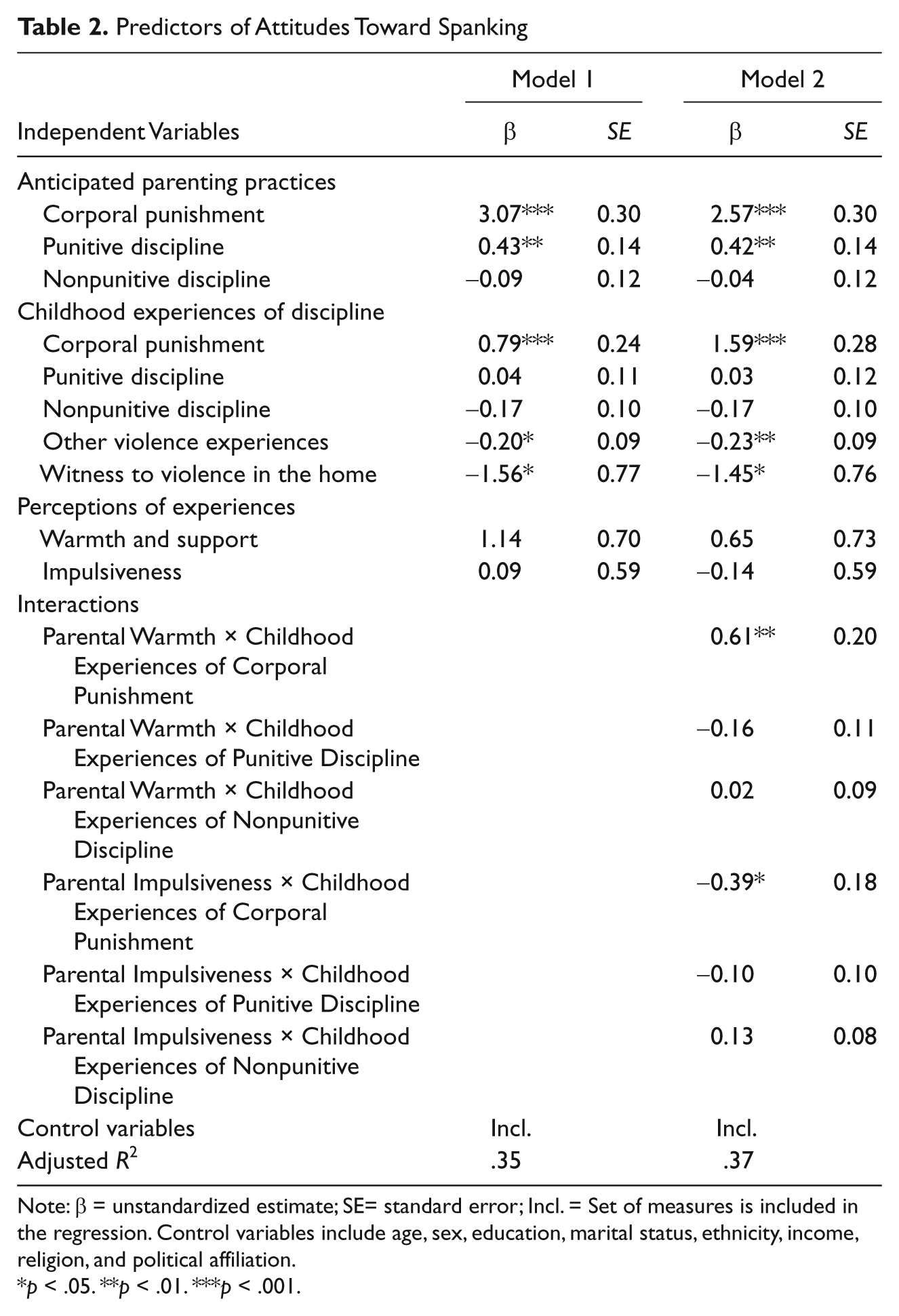
Note: β = unstandardized estimate; SE= standard error; Incl. = Set of measures is included in the regression. Control variables include age, sex, education, marital status, ethnicity, income, religion, and political affiliation.
p < .05. **p < .01. ***p < .001.
There was a significant interaction between perceived parental warmth/support and childhood experiences of corporal punishment on attitudes toward spanking (Figure 1). Specifically, individuals who reported experiencing more corporal punishment during childhood but also more parental warmth/support held more favorable attitudes toward spanking, compared to those who reported experiencing more childhood corporal punishment but in the context of lower parental warmth/support. Results also indicated a significant interaction between perceived parental impulsiveness and childhood experiences of corporal punishment on attitudes toward spanking (Figure 2). Specifically, individuals who reported experiencing more corporal punishment during childhood and more parental impulsiveness held less favorable attitudes toward spanking, compared to those who reported experiencing more childhood corporal punishment but in the context of lower parental impulsiveness.

Interaction between childhood experiences of corporal punishment and perceived parental warmth in predicting attitudes toward spanking

Interaction between childhood experiences of corporal punishment and perceived parental impulsiveness in predicting attitudes toward spanking
Discussion
This study used information from 818 nonparents to examine opinions toward Section 43 of the Canadian Criminal Code and toward spanking more generally. In line with our hypothesis, individuals were more or less evenly divided as to whether the law giving parents the right to use reasonable force in disciplining their children should be upheld or removed (38.6% were favorable and 39.5% were not favorable toward keeping Section 43). Note, however, that individuals were more willing to consider removal of the law (45.9%) if there were some sort of guarantee that parents would not face criminal charges should they use minor physical punishment (e.g., spanking). Our prevalence rates were slightly lower than those from the Toronto Public Health study (2003), which found that 45% of individuals were in favor of upholding Section 43; however, this study used data from a national sample of Canadian adults (both parents and nonparents), whereas our sample consisted exclusively of nonparents.
For attitudes toward spanking, the current study found that 16.7% held favorable attitudes, which is lower than rates found in previous research, which have ranged from 40% (Ateah & Parkin, 2002) to 61% (Yankelvich, 2000). Methodological differences (e.g., participants’ age range and composition, operational definition of favorable spanking attitudes) may partially account for the differences. Ateah and Parkin (2002) and Yankelvich (2000) both collected information regarding spanking opinions with the use of a single item, whereas the current study used the 10-item Attitudes Toward Spanking Scale (Holden & Zambarano, 1992), a validated measure for assessing attitudes. Alternatively, our findings may reflect real change in terms of decreasing favorable opinions toward child corporal punishment (Ateah & Parkin, 2002). This trend may, in part, be influenced by an increased number of educational programs being offered to parents that teach alternative methods to physical discipline (Scholer, Hamilton, Johnson, & Scott, 2010). Also, in recent years, this issue has become more salient in the media (Global Initiative to End All Corporal Punishment, 2008), contributing to an increasing awareness on the topic of child corporal punishment and its associated outcomes. For example, a number of newspaper articles have been published, and reality television shows such as “Super Nanny” have emerged, which educate the public about discipline alternatives to physical punishment.
When we compared attitudes toward Section 43 with those toward spanking, we found that whereas 16.7% held favorable attitudes toward spanking, 25.8% to 38.6% were in favor of upholding Section 43 (and therefore parents’ legal right to use reasonable force in disciplining their children). These findings suggest that individuals have stronger beliefs in a parent’s legal right to use physical discipline even though they are less in favor of using spanking as a disciplinary strategy themselves. Although this particular relationship has not been tested before, we can speculate that individuals may feel that although they are not in favor of the use of spanking, parents on a broader level should not be criminalized for using physical discipline.
Predictors
In terms of microsystem influences, results supported our hypothesis that individuals who report a greater likelihood of using corporal punishment upon becoming parents would also report more favorable attitudes toward Section 43 and spanking more generally. This finding is not surprising, and past studies have indeed found a positive association between attitudes toward physical discipline and its use (Ateah & Durrant, 2005; Durrant et al., 2003), and more generally, between attitudes and subsequent behavior (Kraus, 1995; Vittrup, Holden, & Buck, 2006). In other words, it generally follows that one’s favorable attitude toward corporal punishment will lead to behavior that supports this belief (i.e., use of corporal punishment). Interestingly, we also found that anticipated use of punitive disciplinary practices (e.g., psychological aggression) was significantly associated with more favorable attitudes toward spanking. It may be that a general predisposition toward punitive parenting practices, whether physical or not, exists among certain individuals. Finally, we controlled for a number of sociodemographic variables, with a particular interest, on the basis of past research findings (e.g., Deater-Deckard et al., 2003; Hilarski, 2005), in the influence that cultural background might have on opinions toward Section 43 and spanking more generally. However, participant ethnicity was not significant with the inclusion of predictor variables and interactions for both opinions toward Section 43 and spanking more generally.
Turning to ontogenic development influences, results supported our hypothesis that having experienced corporal punishment during childhood would predict more favorable attitudes towards its use, although there was no significant association with opinions toward the law. This is in line with past research, which has found that those who report experiencing spanking in childhood are more likely to report favorable attitudes toward its use with their own children (Deater-Deckard et al., 2003; Graziano & Namaste, 1990; Rodriguez & Price, 2004). Past findings have indicated that those who feel they deserved the punishment they received are often most in favor of using the same type of discipline with their own children (Rodriguez & Price, 2004), and it has been documented that this reflects a tendency to “favor what you have experienced” so that such practices become normalized and transmitted across generations (Barnett, Quackenbush, & Sinisi, 1996). Another important component to take into account when evaluating the influence of childhood disciplinary experiences is the perception of such experiences. We hypothesized that more positive perceptions (i.e., parental warmth/support) of childhood discipline experiences would lead to more favorable attitudes toward Section 43 and spanking whereas negative perceptions (i.e., parental impulsiveness) would lead to less favorable attitudes. Contrary to expectations, results indicated that perceptions of parental warmth/support during childhood discipline experiences decreased favorable opinions toward Section 43. In the current study, however, perceptions of parental warmth/support were not assessed specifically with regard to instances of physical punishment.
In an attempt to address this latter point, we examined the moderating effect of perceptions on the relationship between childhood corporal punishment experiences and attitudes toward spanking. Findings indicated that, among individuals who reported greater exposure to childhood corporal punishment, their attitudes toward spanking were more favorable if they perceived their disciplinary experiences as having occurred with parents who were warmer/more supportive, but their attitudes were less favorable if they perceived their disciplinary experiences as having occurred within the context of parents who behaved more impulsively. These results are consistent with past research (Bower & Knutson, 1996; Bower-Russa et al., 2001; Gagné et al., 2007; Graziano & Namaste, 1990; Rodriguez & Price, 2004) and suggest that attitudes toward child discipline are greatly influenced by the meaning and perceptions that individuals have of their own childhood experiences of discipline rather than the actual experiences of discipline themselves.
In the current study, we hypothesized that experiencing additional forms of violence in childhood and witnessing family violence would influence opinions toward Section 43 and toward spanking more generally. Results offered partial support for our hypothesis in that individuals who reported greater exposure to violence in childhood (e.g., sexual victimization, witness to family violence) also reported holding less favorable opinions toward corporal punishment. Note, however, that witnessing family violence was only significantly associated with attitudes toward spanking (and not the law). Findings from past studies have been mixed. Douglas (2006) and Jackson et al. (1999) found that exposure to violence in the form of witnessing family violence during childhood predicted favorable opinions toward the use of corporal punishment later in life. In contrast, Gagné et al. (2007) found that forms of abuse not used as discipline strategies did not contribute to the prediction of favorable corporal punishment attitudes, suggesting that links between childhood experience, attitudes, and parenting practices might be context specific. It may not be the experience of being a victim that influences attitudes, but it is the specific experience and perception of physical discipline experiences. Although the number of additional forms of violence has not been included in past research, it appears that this does influence one’s opinions toward child corporal punishment such that higher exposure leads to less favorable opinions; however, the relationship between witnessing domestic violence and child discipline opinions remains unclear. Further research replicating such findings is needed to clarify the nature of this relationship.
Limitations and Implications
It is important to note several limitations in the study’s methodology. First, we were unable to compare and contrast opinions and attitudes of parents and nonparents. This limitation, however, appears to apply to the child corporal punishment field more generally, as the majority of past studies have tended to rely primarily on maternal reports. To address this limit, we plan to replicate the current study using a sample of parents in order to compare the two groups. Second, the study was cross-sectional in nature, so the precise nature of relationships among variables cannot be determined. It would seem important to replicate the current findings as well as to conduct longitudinal investigations to see how opinions and attitudes change over time and what factors might become more or less salient in predicting such opinions and attitudes.
Turning to implications, the issue of child corporal punishment is a highly contentious one because it touches on issues related to the rights of children and parents as well as on behaviors that are deemed important in the socialization of children. The current study demonstrates that individuals may be not in favor of corporal punishment, but they are still in favor of maintaining parents’ legal right to use corporal punishment, avoiding infringing on parental rights. At the same time, perceptions of one’s childhood experiences of discipline appear to be critical. Those who reported experiencing corporal punishment had positive attitudes toward its use if they perceived their parents as warm/supportive. Perhaps this is a way to make sense of their experiences, to say that my parents hit me, but it was because they cared for me. Furthermore, it appears that the experience and exposure to other forms of violence in childhood also influences opinions toward corporal punishment, indicating that such opinions are influenced by experiences from a variety of contexts not only from within the home. The bottom line to all of this is that it will be difficult to change people’s attitudes (and subsequent behaviors). Given these findings, preventative efforts should pay particular attention to the idea that corporal punishment does not harm children by educating adults (parents and nonparents) about the potential impacts that physical discipline can have on children in terms of their behavioral and mental health. It will also be important to continue integrating information into public education campaigns about alternative, but equally effective, methods to physical punishment.
Footnotes
Declaration of Conflicting Interests
The author(s) declared no potential conflicts of interest with respect to the research, authorship, and/or publication of this article.
Funding
The author(s) received no financial support for the research, authorship, and/or publication of this article.