



Abstract
Children’s rights are about treating children with equality, respect, and dignity. Attitudes concerning children’s rights have been linked to support for nurturance and self-determination. However, there is little research on how dimensions of children’s rights are associated with other parenting constructs, such as attitudes toward physical punishment. This study examined the relationship between knowledge of and attitudes toward children’s rights and attitudes toward spanking in a Canadian sample of 329 undergraduate students who completed an online study. Hierarchical multiple regression analyses indicated a significant negative association in that more favorable attitudes toward children’s rights predicted less favorable attitudes toward spanking. There also was a significant moderating effect of child rights knowledge on this relationship, such that greater knowledge enhanced the effects of attitudes toward children’s rights on spanking attitudes. These results raise awareness of the combined role of both knowledge of and attitudes toward children’s rights in influencing spanking attitudes. The results also suggest that one pathway decreasing favorable attitudes toward spanking may be to increase the general public’s knowledge of children’s rights.
Child physical punishment (or corporal punishment) is defined as the use of physical force that is intended to cause some degree of pain or discomfort (United Nations Committee on the Rights of the Child, 2006). Although child physical punishment can encompass a range of acts (e.g., spanking, slapping, kicking), the most common form is spanking, which is defined as hitting a child’s buttocks or extremities using an open hand (Gershoff & Grogan-Kaylor, 2016). In a national longitudinal study conducted in the United States, approximately 80% of parents reported that they had spanked their 2- and 3-year-olds at least once with little variation among ethnic groups (Gershoff et al., 2012). In Canada, a significant portion of the population still supports the use of child physical punishment. Among a sample of 4,029 Canadian parents, more than one third reported spanking their children and about 11.6% agreed that parents should be allowed to use physical force to discipline their child (Clément & Chamberland, 2014). Moreover, representative data from the National Longitudinal Survey of Children and Youth indicate that one in four Canadian parents (approximately half a million) reported having used physical punishment with children aged 2 to 11 years (Fréchette & Romano, 2015).
In terms of spanking outcomes, a meta-analysis of 75 studies that focused exclusively on spanking (Gershoff & Grogan-Kaylor, 2016) found strong associations between spanking and a range of negative child outcomes that included aggression, antisocial behavior, externalizing and internalizing behavior problems, negative relationships with parents, lower moral internalization, and slower cognitive development. The effect sizes ranged from .15 (low self-esteem) to .64 (being a victim of physical abuse) and were similar in size to those found between more severe physical abuse and the same child outcomes. Recently, Afifi et al. (2017) found spanking to be an adverse childhood experience that shared common variance with more severe forms of abuse. Specifically, spanking was linked to an increased probability of suicide attempts and substance abuse in adulthood, over and above the effects of both physical and emotional abuse.
Another concern with the use of spanking (and physical punishment more broadly) is that it can progress into more serious acts that constitute physical abuse (Durrant & Ensom, 2012). To illustrate, data from the Canadian Incidence Study of Reported Child Abuse and Neglect in 2008 (Trocmé et al., 2010) suggest that about 74% of substantiated cases of physical abuse were considered by the investigating child welfare worker to have occurred within the context of a parent using physical punishment as a form of child discipline. Similarly, in a sample of Canadian university students, results indicated that those who reported having experienced spanking during childhood were also significantly more likely to have experienced childhood physical abuse (Fréchette, Zoratti, & Romano, 2015).
One of the primary factors guiding the use of spanking is holding a favorable attitude toward this form of physical punishment (Ateah & Durrant, 2005; Holden, Coleman, & Schmidt, 1995; Vittrup, Holden, & Buck, 2006). A favorable attitude toward spanking has been found to be a stronger predictor of the use of physical punishment, compared with other variables including one’s own history of physical punishment, knowledge of child development, and knowledge of nonphysical disciplinary techniques (Ateah & Durrant, 2005). In a longitudinal study conducted in the United States, favorable spanking attitudes were related to greater use of child physical punishment across different stages of development (12 through 48 months of age), thereby indicating a certain degree of stability in the relationship between attitudes and behavior (Vittrup et al., 2006). It also appears that positive attitudes toward physical punishment can influence its prospective use among nonparents. Bell and Romano (2012) found that about 16.7% of Canadian university students who were not yet parents held positive attitudes toward spanking. In this sample, favorable spanking attitudes were associated with greater anticipated use of physical punishment as parents (after controlling for various sociodemographic factors). Finally, results from a community-based sample (75% nonparents) showed that four in 10 (39%) supported Section 43 of the Criminal Code (1985) of Canada, which gives parents the legal right to use reasonable force in disciplining their children (Romano, Bell, & Norian, 2013).
Altogether, these findings suggest that there is a relatively large segment of Canadian society (both parents and nonparents) that approves of spanking and physical punishment more generally. There are a number of factors that can contribute to these favorable attitudes, including having experienced harsh discipline in childhood (Chung et al., 2009), believing that physical punishment is effective at improving children’s behaviors (Gagné, Tourigny, Joly, & Pouliot-Lapointe, 2007), and believing that physical punishment is deserved in instances of misbehavior (Durrant, Acar, McNeil, Watkinson, & McGillivray, 2018).
Sociocultural factors often cited in research on attitudes toward spanking include gender (Engulu & Harris, 2017; Gagné et al., 2007; Peterson-Badali, Ruck, & Ridley, 2003), political ideology (Ellison & Bradshaw, 2009), religion (Engulu & Harris, 2017; Ellison & Bradshaw, 2009; Hoffman, Ellison, & Bartkowski, 2017), and ethnicity (Lorber, O’leary, & Smith Slep, 2011). For instance, females were found to hold less favorable attitudes toward physical punishment than males in a sample of university students (Peterson-Badali et al., 2003). However, other studies have not reported significant gender differences among either parents (Gagné et al., 2007) or nonparents (Engulu & Harris, 2017). In terms of sociopolitical orientation, research has shown that increased levels of conservatism are related to more positive spanking attitudes (Ellison & Bradshaw, 2009). Moreover, pro-spanking attitudes are often associated with religious denominations that support the use of punishment as a form of repentance of sins, such as Conservative Protestantism (Ellison & Bradshaw, 2009; Ellison, Musick, & Holden, 2011). With respect to ethnicity, results are mixed. Several research findings indicate that parents of African American background tend to report more favorable attitudes toward spanking, compared with Caucasian and Latino parents (Lorber et al., 2011; Su, Toure, Do, & Ramos, 2019). However, other research has not found significant differences in spanking attitudes among different ethnic groups in samples of university students (Engulu & Harris, 2017).
Children’s Rights
International concern about violence against children has intensified over the past 25 years, with growing awareness of its developmental impacts alongside growing recognition of children’s rights (Durrant & Ensom, 2012). The Convention on the Rights of the Child, ratified by all United Nations member countries with the exception of the United States, has focused the world’s attention on children’s rights to dignity, physical and psychological integrity, and equal protection under the law (United Nations General Assembly, 1989). The mandate of the Convention is to ensure that governments assume an active role in the protection of children’s rights, which is important to promote their optimal growth and reach their full potential. Canada ratified the Convention in 1991, thereby upholding its commitment to fulfill its provisions with regard to children’s rights.
Despite its ratification of the Convention, Canada is still far from reaching consensus on whether parental use of child physical punishment should be banned. To date, 53 countries have prohibited all forms of child physical punishment (Global Initiative to End All Corporal Punishment of Children, 2018). In Canada, however, Section 43 of the Criminal Code still gives parents the right to use “reasonable” force for purposes of child discipline (Criminal Code, 1985). In 2004, the Supreme Court imposed several limitations to Section 43, such as restricting the use of physical force to children aged 2 to 12 years and prohibiting the use of objects/blows to the head. More recently, Canada took an important step toward the elimination of physical punishment. Specifically, in December 2015, the Liberal Government committed to addressing all 94 calls to action outlined in the Truth and Reconciliation Report that focused on repairing the Government of Canada’s relationship with Indigenous people following decades of residential schools in which children experienced separation from their families and abuse within the schools. The sixth call of the report specifies the repeal of Section 43 (Mas, 2015). In the same month, the Liberal Senator Céline Hervieux-Payette tabled a private member’s bill (Bill S-206) to repeal Section 43 (Barnett, 2016; Smith, 2015). The bill passed the second reading in the House of Parliament in May 2018 and is currently under review by the Legal and Constitutional Affairs Committee (Parliament of Canada, 2019).
The Convention generally differentiates between two main categories of rights: (a) nurturance rights pertain to the fulfillment of children’s emotional, psychological, and physical needs as well as measures to ensure children’s safety, including the elimination of physical punishment and any other form of abuse and (b) self-determination rights pertain to children’s rights to autonomous choice and participation in matters that affect them, including decision-making within the family and in society at large (Peterson-Badali, Morine, Ruck, & Slonim, 2004). Physical punishment (and as such spanking) is an issue inherent to children’s nurturance rights. Article 19 of the Convention expressly states that children have the right to be protected against any form of violence (whether physical or psychological), and Article 37 states that children have the right to be protected from any form of cruel and harmful punishment (United Nations General Assembly, 1989). In the past two decades, increasing attention has been dedicated to children’s perceptions about how their rights are respected by others around them and how this affects their general well-being (Kosher & Ben-Arieh, 2017). Research indicates that children’s knowledge of their own rights (particularly with respect to self-determination) is beneficial in that it allows for a deeper understanding of democratic processes and supports the best interests of children (Kjørholt, 2017).
Despite the recent progress in the area of children’s rights, only a handful of studies have examined adults’ attitudes toward children’s rights with the intention of better understanding their perspectives on children and parenting behavior (Campbell & Covell, 2001; Peterson-Badali et al., 2004; Peterson-Badali et al., 2003). For instance, support for children’s rights (including both nurturance and self-determination rights) has been shown to relate to maternal responsivity and warmth. Conversely, high controlling and demanding maternal behavior tends to be associated with less favorable attitudes toward children’s self-determination rights (Peterson-Badali et al., 2004). Among university students, support for nurturance rights was found to be significantly higher than support for self-determination rights. Finally, endorsement of children’s rights seems to increase significantly with the child’s age, indicating that the perceived entitlement to rights depended on whether or not children were considered mature enough to make their own choices independently from their parents (Peterson-Badali et al., 2003).
To examine the impact of increasing knowledge on children’s rights, Campbell and Covell (2001) examined young adults’ perspectives on children following participation in a child rights class. Compared with students who attended a literature class, those who completed a child rights session reported a significant increase in knowledge of and positive attitudes toward children’s rights. These students also were significantly less supportive of views around children being the property of their parents. These findings indicate that increasing exposure to information on children’s rights can contribute to promoting more positive attitudes toward these rights. These findings are also consistent with past research demonstrating the influence of knowledge on changes in attitudes and, by extension, behavior (for a review, see Albarracin & Shavitt, 2017).
Study Objectives
This study attempted to link several research findings, namely, (a) those showing a relationship between attitudes toward spanking and actual use of this behavior and (b) those showing a relationship between knowledge of children’s rights and attitudes toward these rights, to examine both the unique and combined effect of children’s rights knowledge and attitudes on spanking attitudes. To our knowledge, no study to date has investigated these relationships in this manner. We hypothesized that more favorable attitudes toward children’s rights would be related to less favorable attitudes toward spanking. Moreover, we expected this relationship to be moderated by knowledge of children’s rights. Specifically, individuals with greater knowledge of children’s rights who also hold more favorable attitudes toward children’s rights were expected to report less favorable spanking attitudes, compared with individuals with lower child rights knowledge.
Method
Sample and Procedure
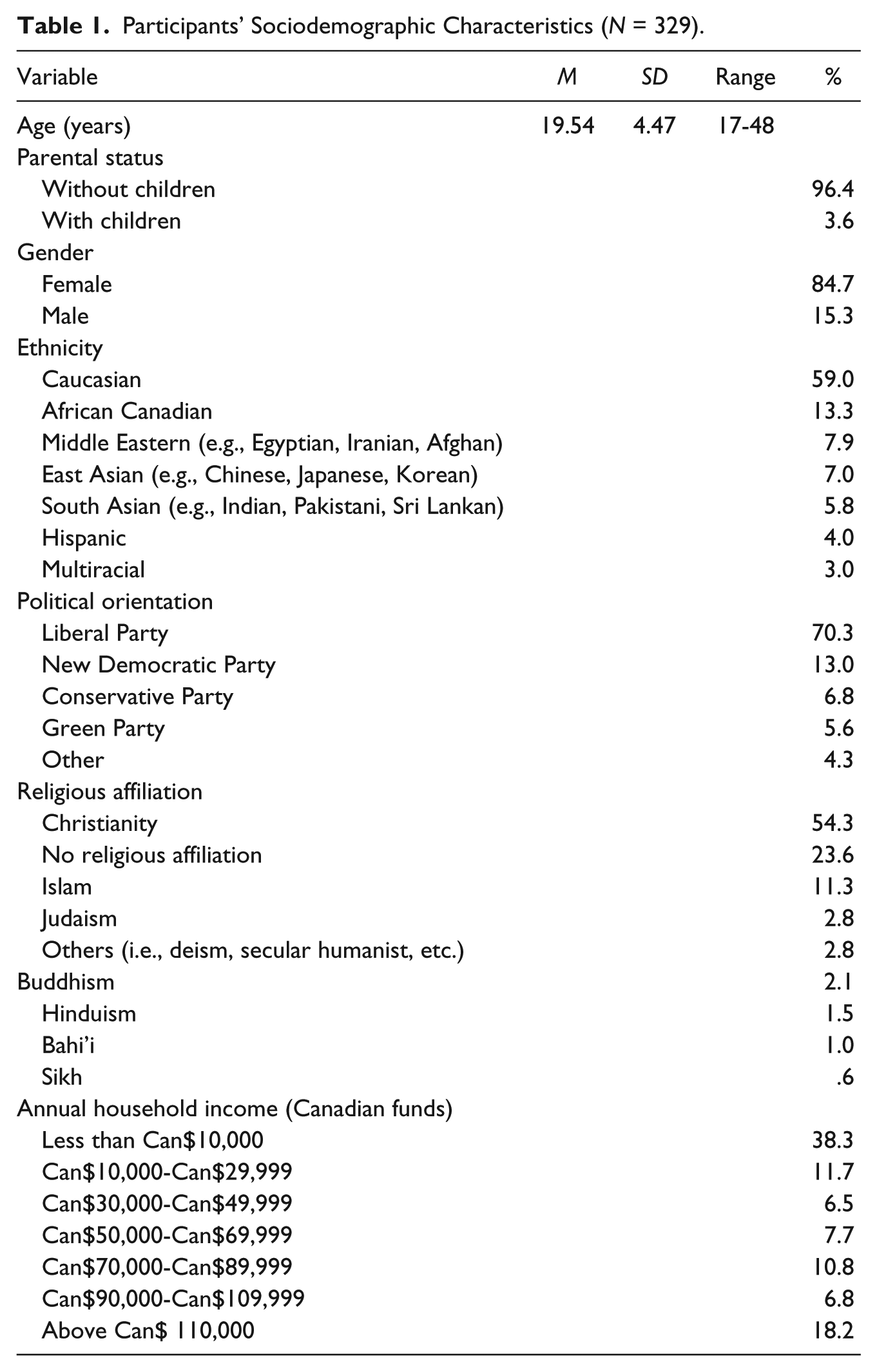
The study included 329 first-year undergraduate students from a Canadian university who completed a 30-min online questionnaire. Prior to completing the questionnaire, students read an online consent form and indicated their decision to participate. Students had the option to exit the questionnaire at any time without penalty. Data were collected from October 2016 to January 2017. The study received ethics approval from the University’s Office of Research Ethics and Integrity. Table 1 shows that the mean age of participants was 19.54 years (SD = 4.47), and almost all were not parents (96.4%). The majority identified as female (84.7%) and Caucasian (59.0%). Most also identified Christianity (54.3%) as their religious background and the Liberal party (70.3%) as their political affiliation. Most reported an annual household income of less than Can$10,000 in Canadian funds (38.3%).
Participants’ Sociodemographic Characteristics (N = 329).
Measures
Sociodemographic questionnaire
Participants provided information about their gender, age, ethnicity, political orientation, religion, personal income, and parental status.
Knowledge of children’s rights
Participants completed the What I Know About the United Nations Convention on the Rights of the Child scale (Campbell & Covell, 2001). The questionnaire contains 16 statements (e.g., under the Convention on the Rights of Children [CRC], unless they are negligent or abusive, parents have the right to care for their children; under the CRC, children involved in custody disputes have the right to provide their opinion and input; according to the CRC, parents have to allow time for children to engage in play and leisure) that are answered by selecting the true, false, or I don’t know options. A correct answer is worth 2 points, an incorrect answer is given 0 points, and I don’t know is worth 1 point. A higher score indicates greater knowledge of children’s rights. The measure demonstrated acceptable reliability with the current sample (Cronbach’s α = .65). No previous information on this measure’s internal consistency was found.
Attitudes toward children’s rights
Participants completed the How I Feel About Rights for Others scale (Covell & Howe, 2001). Although the original measure contains 30 items, we only used the 15 items that focused specifically on children’s rights. Items (e.g., the right of children to have a say in all decisions that affect them, even if adults think they are too inexperienced; the right of children whose parents are separated to maintain contact with both parents, even when one parent doesn’t want the child to see the other parent; the right of children to be protected from harmful substances, even if this means their parents must quit smoking in the house) are rated on a Likert-type scale from 1 (not at all important) to 5 (very important). A higher score indicates more favorable attitudes toward children’s rights. The measure demonstrated good reliability with the current sample (Cronbach’s α = .85). Similar internal consistency estimates were reported by a previous study conducted with a sample of university students (α = .75-.84; Campbell & Covell, 2001).
Attitudes toward spanking
Participants completed the Attitudes Toward Spanking scale (Holden et al., 1995), which includes 10 items (e.g., Sometimes a spank is the best way to get a child to listen) rated on a Likert-type scale ranging from 1 (strongly disagree) to 7 (strongly agree). A higher score indicates more positive attitudes toward spanking. The measure demonstrated excellent reliability with the current sample (Cronbach’s α = .93). This scale has shown similar excellent internal consistency in a sample of non-parent college students (Cronbach’s α = .94; Holden, Brown, Baldwin, & Caderao, 2014).
Data Analysis
Prior to running the analyses, we considered missing data, coding errors, outliers, and multivariate assumptions. Fewer than 10% of values were missing across all study variables. The Little Missing Completely at Random (MCAR) test was not significant, indicating that data were missing at random, χ2 (59) = 39.46, p > .05. Missing values were imputed using Expectation Maximization (EM) single imputation. Univariate outliers were checked by transforming the total scores for each of the study variables in standardized scores and using Z score cutoff values of ±3.29 (Tabachnick & Fidell, 2007). Multivariate outliers were inspected using standardized regression residuals with cutoff values of 4.00 (Kutner, Nachtscheim, Neter, & Li, 2005). There were no identified cases of univariate or multivariate outliers. Skewness and kurtosis values were within the acceptable range of ±2.00, thereby indicating no violation of normality assumptions. The assumptions of linearity and heteroscedasticity were also checked, and there were no major concerns.
Multiple regression was used to examine the direct and interactive effects of knowledge of and attitudes toward children’s rights with respect to spanking attitudes. Each predictor variable was initially mean centered to minimize the effects of multicollinearity, and interaction terms were formed as the product of the two centered predictors. A hierarchical order of entry of the predictor variables was used in which the control variables (e.g., age, gender, ethnicity, political, and religious affiliation) were entered first, followed by the individual predictor variables (attitudes toward children’s rights and knowledge of children’s rights) and then finally the interaction term (Attitudes Toward Children’s Rights × Knowledge of Children’s Rights). Gender, age, ethnicity, political orientation, and religion were included as control variables based on previous research (Engulu & Harris, 2017; Ellison & Bradshaw, 2009; Hoffman et al., 2017; Lorber et al., 2011). To better characterize the nature of any significant interaction effect, simple slope testing was performed (Aiken & West, 1991). A probability level of .05 was used to establish statistical significance. Semipartial correlations assessed the unique contribution and effect size of each significant variable. Effect sizes of .02 were considered small, .15 medium, and .35 large (Cohen, 1992). Analyses were conducted in SPSS 24.
Results
Table 2 shows that participants’ mean score on knowledge of children’s rights was relatively high at 22.46 (SD = 4.14), as were their favorable attitudes toward children’s rights (M = 51.67; SD = 7.58). Participants had relatively unfavorable attitudes toward spanking, with a mean score of 29.59 (SD = 15.44). There was a significant positive correlation between knowledge of and attitudes toward children’s rights (r = .19, p < .01), indicating that increasing knowledge of children’s rights was associated with more favorable attitudes toward children’s rights. There also was a significant negative correlation between attitudes toward children’s rights and attitudes toward spanking (r = −.40, p < .01), indicating that more favorable attitudes toward children’s rights were associated with less favorable spanking attitudes.
Descriptive Statistics and Correlations Among Study Variables.

Note. These values are after imputation of missing values.
p < .05. **p < .01. ***p < .001.
Table 3 presents the results of the multiple regression analysis. The first model accounted for a significant proportion of the variance in attitudes toward spanking (ΔR2 = .22) and indicated that more favorable attitudes toward children’s rights significantly predicted less favorable spanking attitudes (β = −.35, SE = 0.20, p < .001) after controlling for sociodemographic variables. This result represented a large effect size (partial r = −.35). The second model included the interaction term and accounted for a significant proportion of the variance in attitudes toward spanking (ΔR2 = .24). Attitudes toward children’s rights remained a statistically significant predictor (β = −.39, SE = 0.20, p < .001, partial r = −.35). There also was a significant interaction between knowledge of and attitudes toward children’s rights in predicting spanking attitudes (β = −.13, SE = 0.02; p < .05), with a medium effect size (partial r = .14).
The Impact of Knowledge of and Attitudes Toward Children’s Rights on Spanking Attitudes.

Note. β = unstandardized regression coefficient; R2 = coefficient of multiple determination; ΔR2 = adjusted coefficient of multiple determination; F = F test of overall significance of the regression analysis; partial r = semipartial correlation.
The following were included before the variables of interest as control variables: age, gender, ethnicity, religion, and political orientation.
Interaction term created by multiplying mean-centered predictors, namely, attitudes toward children’s rights and knowledge of children’s rights.
p < .05. **p < .01. ***p < .001.
To better characterize the nature of the interaction, we examined the simple slopes. The average score for knowledge of children’s rights, as well as scores one standard deviation below and above the average, was used to derive simple regression lines for the effects of attitudes toward children’s rights on spanking attitudes. Figure 1 presents the simple slope plots for the relationship between attitudes toward children’s rights and spanking attitudes for greater knowledge of children’s rights (β = −1.02, SE = 0.17; p < .001), average knowledge of children’s rights (β = −0.81, SE = 0.12; p < .001), and lower knowledge of children’s rights (β = −0.59, SE = 0.11; p < .001), respectively. Each of the simple slope tests revealed a statistically significant negative association between attitudes toward children’s rights and attitudes toward spanking, but attitudes toward children’s rights was more strongly related to spanking attitudes for high levels of knowledge of children’s rights.

Interaction between knowledge of children’s rights and attitudes toward children’s rights in predicting spanking attitudes.
Discussion
In this study, both the unique and combined effects of knowledge of and attitudes toward children’s rights on spanking attitudes were examined in a sample of university students. It was hypothesized that more positive attitudes toward children’s rights would predict less favorable attitudes toward spanking and that knowledge of children’s rights would moderate this relationship. The results supported both of these hypotheses. Participants who held more favorable attitudes toward children’s rights reported less favorable attitudes toward spanking, after controlling for several sociodemographic variables. There also was a significant joint effect of knowledge of children’s rights and attitudes toward children’s rights on spanking attitudes. Participants who expressed more positive attitudes toward children’s rights and greater knowledge of children’s rights reported less favorable attitudes toward spanking than participants with less knowledge. As such, child rights knowledge strengthened the effects of attitudes toward children’s rights on spanking attitudes.
These findings highlight the importance of the combined role of children’s rights knowledge and attitudes in influencing individuals’ perspectives on the acceptability of punitive disciplinary methods, such as spanking. Unfortunately, there are no other similar studies with which we can compare our findings. However, past research has indicated that positive attitudes toward children’s rights are related to parental behaviors that are warm and responsive, rather than punitive (Peterson-Badali et al., 2004). Moreover, our findings are in line with previous studies in demonstrating the moderating role of knowledge on attitude consistency and attitude strength (Davidson, Yantis, Norwood, & Montano, 1985; Wilson, Kraft, & Dunn, 1989).
We can speculate that individuals who have greater knowledge of children’s rights and hold positive attitudes toward these rights are likely to value the importance of protecting children from all forms of violence and preventing harm. Accordingly, individuals who possess greater knowledge about children’s rights and positive attitudes toward children’s rights would tend to embrace a perspective that opposes the use of physical force toward children for the purpose of behavior correction. Thus, we can assume that initiatives aimed at both improving knowledge around children’s rights and fostering positive attitudes toward children’s rights could potentially change beliefs that support the use of physical punishment. However, additional research is needed to replicate our findings and to understand the many other variables that make individuals hold on to favorable attitudes toward child physical punishment, such as the belief that children are the property of parents (McGillivray, 2011), the fear that eliminating physical punishment means parents will lose their right to make decisions regarding their children’s upbringing (Howe, 2001), and the concern that nonpunitive parenting is equivalent to condoning challenging child behaviors and increasing the likelihood of delinquency (Larzelere & Raumrind, 2010).
Limitations
There are several study limitations which need to be considered when interpreting the results. First, the sample comprised university students who were not parents, so the results may not be generalizable beyond this specific population. It would seem important to replicate this study with parent samples who experience caregiving and child discipline challenges on a regular basis. Second, most participants were females of Caucasian background, so it would be important to conduct additional research using community-based samples with greater sociodemographic diversity. Ideally, the inclusion of more representative (and diverse) samples could be achieved through the use of a random stratified recruitment strategy, where key demographic characteristics are distributed within each stratum to reflect the effective proportions of the population being studied (Bornstein, Jager, & Putnick, 2013). Third, the study relied on a correlational design which does not allow for causal inferences. Future research might benefit from experimental methodology to ascertain the presence of cause-and-effect relationships. Moreover, we did not inquire about individuals’ prior participation in activities related to children’s rights (e.g., course enrollment, reading material) so future research should take such information into account along with when any such activities were undertaken. Finally, data collection consisted of self-report questionnaires which may be subject to reporting bias. It would seem important for additional research to consider the use of mixed methods to replicate our current results.
Implications
Although preliminary in nature, the study findings have several implications with regard to decreasing parental use of spanking behavior. As attitudes influence behavior, one avenue for change could be to increase individuals’ knowledge about children’s rights as this variable was associated with more positive attitudes toward children’s rights and less favorable attitudes toward spanking (and physical punishment more generally). For students, this could take the form of course material that explores the United Nations Convention on the Rights of the Child and its link with current societal issues, including parenting behaviors. For parents, community-based agencies that routinely offer parenting programs might consider adding a component on children’s rights as part of the rationale behind positive disciplinary behaviors that do not include physical punishment. Such efforts would need to focus not only on the presentation of information around children’s rights but also on the exploration of individuals’ reactions to the information, such as concerns or misconceptions around advocating for children having rights especially with respect to voicing opinions on issues that implicate them.
Footnotes
Declaration of Conflicting Interests
The author(s) declared no potential conflicts of interest with respect to the research, authorship, and/or publication of this article.
Funding
The author(s) received no financial support for the research, authorship, and/or publication of this article.
