



Abstract
Previous research has suggested the use of corporal punishment is widely endorsed in our society (Straus, 2000; Straus & Stewart, 1999). Furthermore, perceptions of what constitutes corporal punishment vary. The present study examined social dominance orientation (SDO) and age of child as potential factors that may influence perceptions of what is viewed as corporal punishment versus physical abuse. The sample consisted of 206 undergraduate students enrolled at a Rocky Mountain University. A series of regressions were used to examine the relationships between SDO and six forms of punishment. Findings suggest, higher levels of SDO are significantly related to more ratings of physical punishment versus physical abuse. The primary findings of the present study showed SDO was significantly related to how an individual perceives corporal punishment. These results have important implications by serving as a stepping-stone into further understanding what factors may have an influence on perceptions of corporal punishment.
Corporal punishment is defined as the “use of physical force with the intention of causing a child to experience pain, but not injury, for the purpose of correcting or controlling a child’s behavior,” (Donnelly & Straus, 2005, p. 3). Parental use of corporal punishment is a common form of discipline for children in many cultures (e.g., Kim et al., 2000; Smith & Mosby, 2003). Corporal punishment is prevalent and used at least occasionally in 71% of the world’s societies (Ember & Ember, 2005). Moreover, 90% of American parents with toddlers report they have spanked their child at least once during their lifetime (Gershoff, 2002; Straus, 2000; Straus & Stewart, 1999). Furthermore, the trend for using an object is prevalent in American society and nearly one third of children are disciplined with an object (Zolotor, Theodore, Runyan, Chang, & Laskey, 2011). As evidenced, a large majority of parents in the United States endorse corporal punishment as a common form of discipline.
Perceptions of what constitutes corporal punishment vary, and there are many factors contributing to the discrepancies in perceptions of what behaviors are corporal punishments and what behaviors cross the line into abuse. Jackson and colleagues (1999) examined variables that predicted parent’s favorable attitude toward physical discipline practices. Significant predictors of favorable attitudes were religiosity, attitudes that devalue children, a conservative ideology, and the child’s age.
Sixty-one percentage of American mothers report spanking their 3- to 5-year-olds within the last week (Giles-Sims, Straus, & Sugarman, 1995). Straus & Stewart (1999) found that more than one third of corporal punishment begins during infancy and a large majority of toddlers and preschool age children experience corporal punishment. Research has further suggested the use of corporal punishment declines as the child ages (Frick, Christian, & Wootton, 1999; Wauchope & Straus, 1990). Therefore, parents are less likely to use corporal punishment as a form of discipline as their child grows older.
The purpose of the present research was to examine one potential factor that may influence perceptions of what is viewed as corporal punishment versus physical abuse. Specifically, the present study examined how social dominance orientation (SDO), the tendency for individuals to prefer the domination of inferior groups by superior groups, influences perceptions of corporal punishment and abuse.
Social Dominance Orientation
SDO in relation to interpersonal dominance, specifically corporal punishment, has been understudied. SOD according to Sidanius and Pratto (1999) is the “degree to which individuals desire and support group-based hierarchy and the domination of ‘inferior’ groups by ‘superior’ groups” (p. 48).
Past research has shown a relationship between SDO and perceptions on the use of force by police officers (Perkins & Bourgeois, 2006). Perkins and Bourgeois (2006) examined the relationship of SDO, blind patriotism, and right-wing authoritarianism (RWA) to perceptions of suspect responsibility and the use of force by police officers that resulted in the suspect’s death. It was hypothesized individuals with high levels of SDO, RWA, and blind patriotism would be more likely to assign responsibility to the suspect for their death. The study’s findings indicated individuals with higher levels of SDO were more likely to hold the victim/suspect responsible for their own death. In other words, individuals with higher levels of SDO were more likely to perceive the misuse of deadly force by the police officer as the victim’s fault. Therefore, SDO served as a personality factor that influenced perceptions of the use of force against others. SDO may further be related to perceptions of the use of force on children (e.g., punishment). Other studies have shown that SDO is positively associated with general punitiveness (Capps, 2002) and beliefs in harsh punishments for criminal defendants (Sidanius, Mitchell, Haley, & Navarrette, 2006). This work generally suggests that SDO may be related to perceptions of parental punishment, and higher SDO scores would be related to endorsements of parental punitive behavior toward children.
To date there is no research examining the effects of parenting style on SDO. However, related literature suggests that there may be a relationship. Researchers have found that high levels of SDO are related to lower levels of concerns for others and lower levels of empathy (Pratto et al., 1994; Sidanius & Pratto, 1999). Similarly, development of empathy and concern for others has been linked to parenting quality. For example, a lack of responsiveness and warmth toward the child correlates with authoritarian parenting practices (Baumrind, 1991).
Based on the previous literature, it is expected interpersonal levels of dominance may be related to the communication of dominance in the parent–child relationship. The parent–child relationship is hierarchical, and parents may view themselves as a more dominate figure to the child. Parents may differ in the degree to which they endorse dominance over children in their parenting relationship. A person high in SDO may be more likely to use aggressive behaviors (e.g., corporal punishment) on another individual (e.g., a child) to maintain dominance. Individuals high in SDO may be more likely to view aggressive acts against children as legitimates uses of parental force (i.e., corporal punishment).
The Present Study
Research in the past has primarily focused on the negative effects of corporal punishment on children and has only recently begun to focus on potential factors that influence individual perceptions of corporal punishment. No study to date has investigated SDO and its relationship to corporal punishment. The present study aimed to fill this gap in the literature by investigating the effects of SDO on individuals’ perceptions of corporal punishment.
It was hypothesized that people with higher SDO levels would see more child punishments as legitimate uses of parental authority (i.e., corporal punishment) than those with lower levels of SDO. Specifically, individuals who have a high SDO score would be more likely to rate various child punishment scenarios as physical punishment rather than physical abuse.
Method
Participants
In the present study, 206 undergraduates at a Rocky Mountain University served as participants. However, four of these participants were eliminated due to incomplete data, leaving a total of 202 participants (110 men, 89 women, and 3 who did not indicate gender) who served in the study. Participants ranged in age from 18 to 40 (M = 19.62, SD = 2.42). Only 3 of the 202 participants were parents. The participants were volunteers and received some course credit for their participation.
Measures
Social Dominance Orientation Scale
SOD was measured using the Social Dominance Orientation Scale 5 (SDO5; Sidanius & Pratto, 1999). Participants rated their level of agreement to 14 statements on a scale of 1 to 7. Participant’s ratings on each statement were then summed for the participant’s SDO score. In the present study, SDO scores ranged from 14 to 82 (M = 34.59, SD = 12.48). A score ranging from 50 to 98 was indicative of higher levels of SDO and scores of 48 or lower was indicative of lower levels of SDO (SDO5; Sidanius & Pratto, 1999). Using these criteria, 85% of our sample would be considered as having lower levels of SDO and 15% of our sample would be considered as having high levels of SDO.
Corporal punishment (CP)
A series of brief scenarios were used to assess views of corporal punishment. Participants were assigned to a 5-, 7-, or 13-year-old child. Each participant read the following:
Seven-year-old (five-year-old or thirteen-year-old) Emily was arguing with her younger sister, fighting over a toy. Emily ended up calling her younger sister an inappropriate name. Her father was very upset at Emily for her behavior and swatted her on the bottom with _____.
Following the description, participants received 6 possible endings to the brief scenario: (a) a nearby power cord, (b) a hairbrush three times, (c) his belt three times, (d) his hand three times, (e) a wooden paddle three times, and (f) a wooden spoon three times. Participants rated all of the 6 endings, and the endings were counterbalanced across participants. After each descriptor, participants were asked to rate the degree to which they believed such behavior constituted punishment or abuse on a 7-point scale (the endpoints on the scale were 1 = punishment and 7 = abuse).
Procedure
Questionnaires were administered by the principle investigator. Participants were randomly assigned to an age condition (e.g., 5, 7, or 13 years of age) and asked to complete a questionnaire packet consisting of two measures; the SDO5 and a series of brief scenarios. After completion, participants were fully debriefed, thanked for their participation, and given class credit.
Results
Overall responses and descriptive information about the six scenarios are presented first. Second, the SDO impacts on the ratings of the six scenarios are presented in a series of regressions. Ratings did not vary by age of child, so age is collapsed in the present study.
As seen in Figure 1, spanking a child with a hand was most often viewed as punishment rather than abuse. Hitting a child with a power cord, however, was more likely to be viewed as abuse rather than punishment. The other four scenarios, such as hitting a child with a spoon, hitting a child with a paddle, hitting a child with a brush, and hitting a child with a belt, yielded more mixed responses. A repeated measures ANOVA was used to determine if the ratings for the different scenarios were significantly different from one another. The analysis revealed a significant overall effect, F(5, 380) = 79.78, p < .001, η2 = .51. As can be seen in Table 1, hitting a child with a power cord was rated as significantly more abusive than any of the other scenarios. Hitting a child with a hand was considered least abusive, and ratings differed with all other ratings except for hitting a child with a spoon.

Frequency of responses for the six scenarios
Mean Ratings of Brief Scenarios (1 = corporal punishment and 7 = physically abusive)
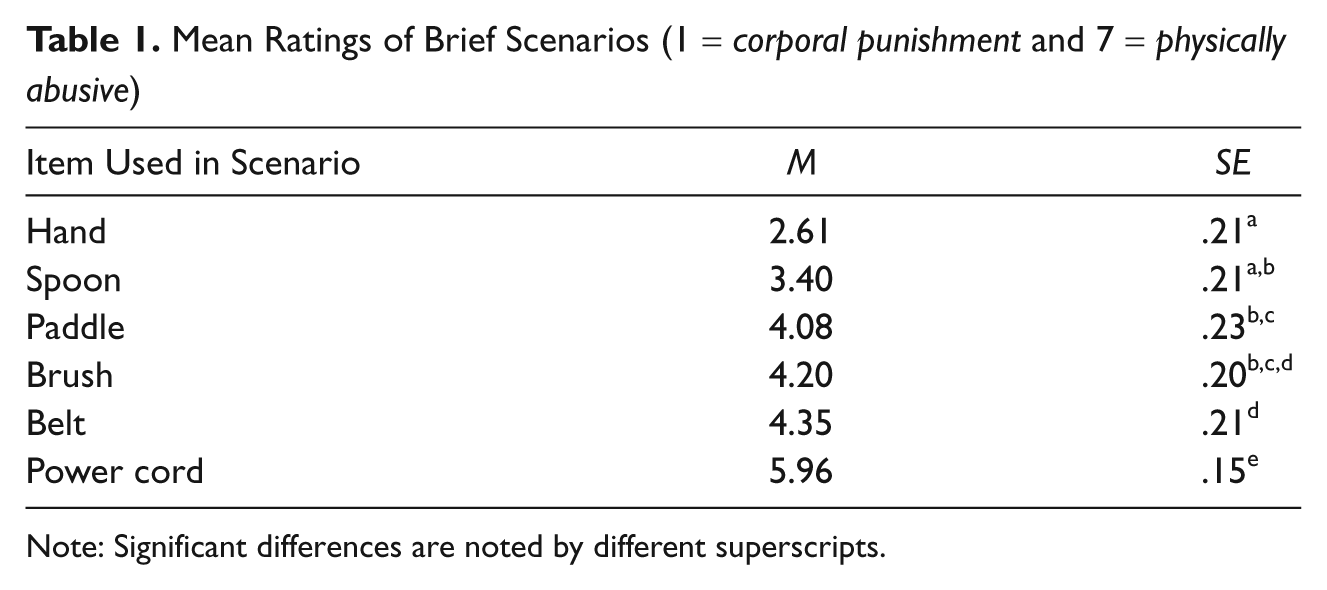
Note: Significant differences are noted by different superscripts.
A series of regressions were used to examine how SDO score and age of child affected ratings on the six scenarios. The analyses revealed that SDO was a significant predictor of ratings for five out of the six scenarios: hitting a child with a spoon (t = −2.99, p = .003, β = −.21), a power cord (t = −2.56, p = .01, β = −.18), a belt (t = −3.95, p < .001, β = −.27), a paddle (t = −2.70, p = .008, β = −.19), and a brush (t = −2.83, p = .005, β = −.20). As predicted, participants who had higher SDO scores were more likely to rate the scenarios as punishment rather than abuse. The analyses revealed that SDO did not predict ratings of the scenario which described hitting a child with a hand (t = −1.64, p = .10, β = −.12) but the results were in the expected direction. Higher SDO scores were associated with ratings that leaned toward punishment rather than abuse.
In none of the regressions was age of the child or the interaction between SDO and age of child significant. The one exception was the finding that there was a significant interaction between age of the child and SDO for hitting a child with a brush (t = 1.99, p = .05, β = .94). To tease apart the interaction, regressions were run separately for each age group. The results indicate that the relationship between SDO and ratings was significant for the 5-year-olds (t = −2.79, p = .01, β = −.50) but not for the 7-year-olds (t = −1.53, p = .14, β = −.29) or the 13-year-olds (t = −.38, p = .70, β = −.08). The results are in the expected direction for each age group with higher SDO scores being related to lower ratings. However, this relationship was most pronounced (and significant) only for the youngest age group.
Discussion
Previous research has suggested the use of corporal punishment is widely endorsed in the United States (Straus, 2000; Straus & Stewart, 1999). Furthermore, perceptions of what constitutes corporal punishment vary. The present study extends previous work by examining SDO and age of the child as a potential factors predicting perceptions of corporal punishment.
Age of the Child
Contrary to our expectations, the age of the child was not an important predictor of participant’s ratings. Rather it was the object that was used for punishment that led to differences in ratings. For example, participants tended to rate hitting a child with a hand as punishment and hitting a child with a power cord as abuse. This was true regardless of the age of the child.
One explanation for the lack of findings may have that the ages chosen for this study (5, 7, or 13 years of age) are not the critical ages where perceptions differ. For example, research previously cited (Giles-Sims et al., 1995; Straus & Stewart, 1999) has found that the greatest amount of corporal punishment occurs when children are 3 to 5 years of age. This study might have yielded different results if a younger age group was included in the study.
Another possible explanation is that hitting children with objects (such as a paddle or a belt) may be viewed as abuse (or not) regardless of a child’s age. In 1998, the American Academy of Pediatrics authored an article in which they offered guidance for effective discipline (American Academy of Pediatrics, 1998). Although they viewed physical punishment as less effective than other means of punishment, they acknowledged the wide use of such punishment and offered guidance. They viewed spanking a child with an open hand without causing injury as the only acceptable corporal punishment. All other forms of punishment, including striking children with objects, were considered unacceptable. This view may have reflected wider public views or have been adopted by the wider public in the ensuing years. If so, one might not expect to see age differences when one asks people to judge physical punishments that use objects to strike a child. People may generally view this as inappropriate regardless of age.
The one exception in our findings is that there was an interaction between age of the child and SDO for hitting a child with a brush, which participants tended to disagree on its abusiveness (the mean on this measure was 4.2). In this case, SDO played a role only for the youngest age group. Those higher in SDO were more likely to view the behavior as punishment rather than abuse. This finding meshes with our most consistent findings of a strong relationship between SOD and ratings of abuse.
Social Dominance Orientation
The results suggest higher levels of SDO are significantly related to more ratings of physical punishment versus physical abuse. In other words, individuals with higher levels of SDO were more likely to rate the brief scenarios as a form of physical punishment rather than a form of physical abuse.
SDO was a significant predictor of ratings for five of the six scenarios: using a spoon, power cord, belt, paddle, or brush to hit a child. Participants who had higher SDO scores were more likely to rate the scenarios as punishment rather than abuse. However, SDO was not a strong predictor of the scenario in which a child is hit with a hand. The lack of findings for hitting a child with a hand could be due to the common acceptance of spanking as a form of punishment. Previous research has demonstrated that 90% toddlers’ parents report they have spanked their child at least once during their lifetime (Straus, 2000; Straus & Stewart, 1999). In addition, 61% of mothers reported spanking their 3- to 5-year-olds within the last week (Giles-Sims et al., 1995). Thus, participants may have been ambivalent in their response due to normalizing and the endorsement of spanking as a common form of punishment. The fact that 75% of our sample viewed hitting a child as punishment rather than abuse supports this view.
Implications, Limitations, and Future Directions
Few studies have examined the relationship between SDO and views on corporal punishment of children. The primary findings of the present study showed SDO was significantly related to how an individual perceives corporal punishment. These results have important implications by serving as a stepping-stone into further understanding what factors may have an influence on perceptions of corporal punishment. The fact that SDO plays a role in perceptions of abuse should be followed up with studies that examine whether SDO plays a role in actual abuse and whether it may help explain why some parents grab a brush, belt, power cord, and so forth when disciplining their children. The view that using these items is not abusive may increase the risk of using these objects in child discipline and in crossing the line between punishment and abuse.
There were several limitations to the present study that should be addressed in future research. Although the present study had a reasonably large sample size, only 3 of the 202 participants who participated in the present study were parents. This is an important limitation to consider. In order to effectively measure perceptions of what constitutes as corporal punishment, it would be important in future work to include a sample including parents.
The age of participants and the use of a college sample should be noted as a limitation. The age of participants were restricted and ranged from 18 to 40 years of age. An older adult (e.g., 40 years of age) may perceive methods of corporal punishment differently than a young adult (e.g., 20 years of age). Furthermore, college student’s experiences and perceptions may differ from noncollege students.
Cultural limitations and demographic factors are important to consider. This study examined adults’ perceptions in the United States and as previously mentioned, attitudes about the physical punishment of children vary widely in the world. Thus, behaviors considered as abusive would also be expected to vary across cultures. However, it is also possible that SDO is related to harsher treatment of children across cultures. That is, whatever the general cultural values are, individuals with higher SDO might be expected to endorse harsher punishments for children than are generally adopted within their own culture. This is an intriguing question that should be addressed in future research.
The present study was the first, to the authors’ knowledge, to examine SDO’s relationship to perceptions of corporal punishment. The study’s findings suggest that SDO influences perceptions of what constitutes as corporal punishment. People who favor the domination of inferior groups by superior groups are more likely to endorse a range of potentially abusive behaviors as legitimate parental behaviors in disciplining children.
Footnotes
Declaration of Conflicting Interests
The author(s) declared no potential conflicts of interest with respect to the research, authorship, and/or publication of this article.
Funding
The author(s) received no financial support for the research, authorship, and/or publication of this article.