



Abstract
The relationship between male rape myth acceptance, female rape myth acceptance, attitudes toward gay men, a series of gender role and sexism measures, victim blame and assault severity were investigated. It was predicted that men would display more negative, stereotypical attitudes than women and that male rape myth endorsement would be related to, and predicted by, the other attitude and attribution scales. Respondents comprised 323 undergraduates (146 males and 177 females) from a large University in the Northwest of England. Results broadly conformed to predictions, with men generally more negative than women, and male rape myth acceptance significantly related to female rape myth acceptance, negative attitudes about gay men, gender role attitudes, and victim blame. Furthermore, male rape myth acceptance was predicted by female rape myth acceptance, gender attitudes, and victim blame. Methodological issues and implications for future work and those working with victims are discussed.
Traditionally, male rape has been a neglected area of study (Davies, 2002a). However, recent years have seen a flurry of research activity examining the effects of male rape, and in how people think and feel about this crime (see Davies & Rogers, 2006 for a review). Past research on the effects of male rape has shown that many men display serious psychological disturbances, even years after their assault (Davies, 2002a). Male survivors of rape experience an array of psychological problems, such as depression (e.g., Mezey & King, 1989; Walker, Archer, & Davies, 2005a), loss of self-esteem (Myers, 1989; Walker et al., 2005a), posttraumatic stress disorder (Coxell & King, 1996; Myers, 1989; Walker et al., 2005a), sexual dysfunction, loss of masculinity or confusion about their sexual identity (e.g., Coxell & King, 1996; Walker et al., 2005a), and anger and revenge fantasises (Davies, 2004a; Walker et al., 2005a).
Walker et al.’s (2005a) qualitative analysis of 40 male survivors’ reactions to rape in the United Kingdom outlined in the words of men themselves, how personally devastating rape can be. Furthermore, Walker, Archer, and Davies (2005b) compared the psychological functioning of this group of 40 male rape survivors with a matched control group of nonraped men. The survivor group showed consistently more negative psychological functioning than controls. In a more recent analysis of the Walker et al. (2005b) data, Davies, Walker, Archer, and Pollard (2010) split the original rape data by assault type, comparing the psychological effects of those who had been raped by either a stranger or an acquaintance. Findings showed that being a victim of rape was devastating regardless of assault type. Interestingly, although the stranger rapes were not more violent, based on survivor self-reports, than acquaintance rapes, the stranger rape group considered themselves less likely to be able to fight back against their attacker.
The feeling of not being able to fight back or protect oneself is a particularly pertinent issue for male victims of rape, not only in terms of their recovery (Davies et al., 2010) but also in how people perceive men who are judged not to have fought back against their rapist. Research on attributions of blame toward male rape victims has shown that men are blamed more when they are judged not to have fought back sufficiently or failed to escape (see, for example, Davies, Pollard, & Archer, 2001 and Davies, Rogers, & Bates, 2008 for empirical work; and Davies & Rogers, 2006 for a detailed review). Moreover, the limited research on myths about male rape indicates that myths about this crime in part surround issues relating to the perceived lack of masculinity in men who are raped, because they failed to fight back and thus fail to behave like “real men” (Struckman-Johnson & Struckman-Johnson, 1992). The literature on myths relating to the rape of women, sexism, and stereotypical views about gender relevant to work on rape myths will now be reviewed and then what is currently known about male rape myths will be considered, before the rationale of the current study is outlined.
In comparison to the lack of research on male rape myths, the academic literature on the myths surrounding female rape is extensive. Burt (1980) defined female rape myths as “prejudicial and false beliefs about rape, rape victims, and rapists” (p. 217). Pinpointing the underlying ideologies that develop and maintain female rape myth acceptance has generated ongoing research over four decades. Studies have shown that in general men are more likely to endorse rape myths than women (Burt, 1980; Lonsway & Fitzgerald, 1995) and do so in part because they endorse hostile views of women (Lonsway & Fitzgerald, 1995). Furthermore, individuals who maintain rigid gender role stereotypes are more likely to believe it is natural for men to dominate women (even if by force) and tend to hold more negative attitudes toward female rape victims (Burt, 1980).
There has been a great deal written about sexist attitudes in recent years. Glick and Fiske (1996) argued that sexist attitudes toward women reflect both hostile and benevolent values. Hostile sexism reflects denigrating attitudes that punish women who fail to conform to traditional gender roles, whereas benevolent sexism comprises reverent attitudes that reward women who are traditionally feminine and who enjoy “being put on a pedestal.” Individuals who have conflicting feelings about women resolve their cognitive dissonance by categorising individual women as either a “good girl” (worthy of chivalry and protection) or a “bad girl” (who should be disparaged and denied patriarchal protection).
Relating sexist attitudes with negative attitudes about rape, Glick and Fiske (1997) found that hostile—but not benevolent—sexism correlated significantly with rape myth acceptance regardless of respondent gender. However, it appears that individuals who score higher in benevolent sexism are more likely to blame female rape victims in circumstances where the victim failed to maintain “ladylike” standards following acquaintance—but not stranger—rape (Abrams, Viki, Masser, & Bohner, 2003; Viki & Abrams, 2002). Abrams and colleagues concluded that individuals who hold more benevolently sexist views about women may blame female victims of acquaintance rape to protect their own “just world” beliefs (i.e., that they live in a fair, just, and controllable world, where the same fate would not happen to them; cf. Lerner, 1980).
To date, there is little research on the conceptual factors underlying the acceptance of prejudicial and false beliefs about the rape of men or the specific attitudes that might predict them. In an early study on the structure of male rape myths, Struckman-Johnson and Struckman-Johnson (1992) highlighted three generic myths about male rape, namely, (a) male rape does not happen (e.g., “it is impossible to rape a man”), (b) male rape is the victim’s fault (e.g., “men are to blame for not escaping or fighting back”), and (c) men would not be traumatized by rape (e.g., “men do not need counseling after being raped”). Consistent with research on female rape myths, these authors found men were more accepting of male rape myths than women.
Davies and McCartney (2003) used selective items from Struckman-Johnson and Struckman-Johnson’s (1992) scale and factor analyzed them in a model comprising both these male rape myth items and items relating to victim blame, relating to the behavior of the victim during the rape (such as how much he was perceived to fight back and blamed because he did not). Davies and McCartney found that male rape myths and victim blame were closely conceptually related.
In a more recent analysis of the structure of Struckman-Johnson and Struckman-Johnson’s (1992) Male Rape Myths Scale, Chapleau, Oswald, and Russell (2008) found this scale highly correlated with acceptance of female rape myths, with male respondents particularly accepting of rape myths about victims of either gender. In the same study, Chapleau et al. (2008) examined the relationship between male rape myth acceptance and ambivalent sexist attitudes toward men; measured by Glick and Fiske’s (1999) Ambivalence Toward Men Inventory (AMI). Glick and Fiske’s (1999) work suggested that as well as ambivalent attitudes toward women, people also endorse conflicting attitudes toward men that are both hostile and benevolent. Accordingly, individuals high in benevolent sexism toward men may believe men are supposed to be invincible and that if a man is raped, he must have showed some “unmanly” weakness to provoke, or otherwise fail to resist or fight back from his attacker (cf. Davies et al., 2001, 2008). The inherent implication throughout this work is that by failing to resist or fight back, male victims of rape somehow deserve all they get (cf. Lerner, 1980).
Chapleau et al.’s (2008) work not only extended conceptual knowledge about male rape myths but also highlighted problems associated with Struckman-Johnson and Struckman-Johnson’s three-factor model. Other work on male rape myths has used other measures or individual rape myth items not associated with the Struckman-Johnson and Struckman-Johnson (1992) scale. Kassing, Beesely, and Frey (2005), for example, investigated male rape myth acceptance and its relationship with negative attitudes toward gay men, using a measure developed in Melanson’s (1999) doctoral thesis—the Male Rape Myth Scale (MRMS). This is a one-dimensional scale which, as Kassing et al. (2005) noted, is a more rigorous measure of male rape myth acceptance than Struckman-Johnson and Struckman-Johnson’s (1992) multidimensional alternative. In their 2005 study, Kassing et al. found a strong relationship between male rape myth acceptance and negative attitudes toward gay men. This is consistent with previous literature in which negative attributions toward male rape victims, such as victim blame, relate to both homophobic attitudes (Burt & DeMello, 2002; Davies, 2002b) and the particularly negative evaluation of gay victims of male rape (e.g., Davies et al., 2001; Davies, Pollard, & Archer, 2006; see also Davies & Rogers, 2006 for a review). Finally, in relation to the current literature review, a very recent study on male rape myths and victim blame toward male rape victims, Sleath and Bull (2010) found that there was a strong relationship between victim blame and Melanson’s (1999) MRMS, consistent with previous work by Davies and McCartney (2003).
There is considerable scope for more work in this area to further investigate the structure and nature of male rape myths in relation to other potentially related constructs. The present study builds on Kassing et al.’s (2005) work by investigating potential predictors of Melanson’s (1999) MRMS. It also furthers the work by Chapleau et al. (2008) by investigating the extent to which several measures relating to female rape myths and sexism predict male rape myth acceptance. This study used the ASI and AMI, plus an additional measure of gender role stereotyping, namely, the Social Roles Questionnaire (Baber & Tucker, 2006); homophobia, namely, the Affective Reactions Toward Gay Men Scale (Davies, 2004); and female rape myth acceptance, namely, Payne, Lonsway, and Fitzgerald’s (1999) Illinois Rape Myths Scale. It was predicted that men would score more negatively on these measures than women. It was also predicted that male rape myth acceptance would be predicted by female rape myth acceptance, negative attitudes toward gay men, and negative, sexist attitudes toward men and women as measured by the ASI, AMI, and SRQ, respectively.
Finally, past studies suggest male rape victims who are gay tend to elicit more negative attributions—particularly from men—than do their heterosexual counterparts (see, for example, Davies & Rogers, 2006). As such, the current study furthers current knowledge by investigating the relationship between male rape myth acceptance as measured by the MRMS and attributions of blame and perceptions of assault severity toward gay male rape victims. This was achieved by using hypothetical scenario methodology to assess blame attributions relating to a specific, hypothetical, case (see Davies & Rogers, 2006 and Pollard, 1992 for an outline of this methodology in rape attribution research). It was predicted that men would assign more victim blame and perceive the sexual assault of a gay male victim to be less serious than would women. It was further predicted that the rape myth acceptance would be predicted by victim blame and perceptions that male rape is not such a serious event.
Method
Respondents
Respondents were 323 undergraduates (146 male; 177 female) from a large university in the North West of England. Respondent age ranged from 18 to 47 years (M = 23.4 years; SD = 5.8 years) with the majority identifying themselves as White/British (74.6%) and heterosexual (90.4%).
Materials
A study booklet comprising the following questionnaires was created. All questionnaire items are rated along a 7-point Likert-type scale ranging from 1 (strongly disagree) to 7 (strongly agree) unless stated otherwise.
Male Rape Myth Scale (MRMS)
This 11-item questionnaire measures stereotypical/prejudicial beliefs about male rape and includes items such as “male rape is usually committed by homosexuals” and “a man who has been raped has lost his manhood” (Melanson, 1999). Higher MRMS scores reflected greater acceptance of male rape myths.
Illinois Rape Myths Scale (IRMS)
This is a 12-item questionnaire measuring stereotypical/prejudicial beliefs pertaining to the victims and perpetrators of female rape (Payne et al., 1999). Sample items include “a woman who is raped while she is drunk is at least somewhat responsible” and “although most women wouldn’t admit it, they generally like being physically forced to have sex,” with higher IRMS scores reflecting greater acceptance of these myths.
Affective Reactions Toward Gay Men Scale (ARGMS)
This nine-item scale assesses negative and highly emotive attitudes toward gay men and includes items such as “gay men are disgusting,” and “male homosexuality is a perversion” (Davies, 2004b). Higher ARGMS scores represent a more negative attitude.
Social Roles Questionnaire (SRQ)
This 13-item questionnaire measures negative gender stereotypes relating to the roles adopted by men, women, and children within society (Baber & Tucker, 2006). Items include “people can be both aggressive and nurturing regardless of sex” and “people should be treated the same regardless of their sex” with higher SRQ scores reflective of more negative gender role stereotyping.
Ambivalent Sexism Inventory (ASI)
This 22-item scale measures both hostile and benevolent sexist attitudes toward women (Glick & Fiske, 1996). The ASI includes items such as “No matter how accomplished he is, a man is not truly complete as a person unless he has the love of a woman” and “many women are actually seeking special favors, such as hiring policies that favor them over men, under the guise of asking for equality.” Higher ASI scores represent a greater sexist attitude against women.
Ambivalence Toward Men Inventory (AMI)
This 20-item measure measures hostile and benevolent sexist attitudes toward men (Glick & Fiske, 1999). It includes items such as “Even if both members of a couple work, the woman ought to be more attentive to taking care of her man at home” and “A man who is sexually attracted to a woman typically has no morals about doing whatever it takes to get her into bed.” Higher AMI scores reflecting greater sexist attitudes against men.
Scenario and attribution items
The hypothetical scenario used in this study was developed by and is identical to that used by Davies et al. (2001). It depicts a stranger rape carried out in a car park as the victim was walking home from his evening job. Information about the victim’s name (Steve), interests/hobbies (such as a member of his university’s Lesbian, Gay, Bisexual and Transgender Society), and the fact that he was a gay man were included to increase ecological validity while simultaneously highlighting the victim’s gender and sexual orientation. This was followed by a 12-item attribution questionnaire, again developed by Davies et al. (2001), assessing both behavioral blame toward the victim and perceptions of assault severity. All attribution items were rated on a 7-point Likert-type scale from 1 (provictim judgement) to 7 (antivictim judgement).
Procedure
Potential respondents were approached individually by the second author (JG) in social areas of the main University campus and asked to participate in a study of attitudes toward sexual crime. All volunteers were handed a study booklet and asked to complete questionnaires privately and in their own time. Completed booklets were placed in the appropriate School of Psychology pigeon-hole or else returned via (internal) post. No form of payment was made, with all aspects of the study adhering to School and British psychological Society (BPS) ethical guidelines. Overall, 72.0% of distributed questionnaires were returned.
Results
Principal Components Analyses (PCAs)
Questionnaire items were reverse coded where appropriate. A series of PCAs with Varimax rotation were then performed—one for each set of associated attitudinal/attribution items. Factors were extracted in line with Kaiser’s criterion with factor loading restricted to those above .30. As Table 1 shows, the male rape, MRMS, IRMS, and ARGMS all had unidimensional structures, whereas the SRQ, ASI, AMI, and the attribution scale each had bidimensional structures.1,2 All measures had acceptable levels of internal reliability.
Items, Eignevalues, Variance Explained, and Internal Reliabilities for All (Sub) Scales (Final Models)

Note: SRQ = Social Roles Questionnaire; ASI = Ambivalent Sexism Inventory; AMI = Ambivalence Toward Men Inventory. n = 323.
Gender Differences
Respondent gender differences were explored on all measures via a series of independent samples t tests (with alpha was set at .01 to account for multiple testing). As expected, male respondents were more accepting of both male and female rape myths and displayed more negative affective attitudes toward gay men than did female respondents. Predictions relating the gender role and sexism (sub) scales were mixed, with partial support of predictions. Specifically, male respondents endorsed more hostile sexism, although men and women were equally endorsing of benevolent sexism. Moreover, male respondents endorsed more stereotypical attitudes regarding gender transcendence, whereas females held more stereotypical views about male dominance. Men and women were equally endorsing of attitudes toward male and female relationships. Finally, and as predicted, male respondents assigned more victim blame and deemed the sexual assault (of a gay man) to be less severe than did their female counterparts. These differences are also summarized in Table 2.
Mean (Sub) Scale Ratings Across Respondent Gender or All (Sub) Scales (Final Models)
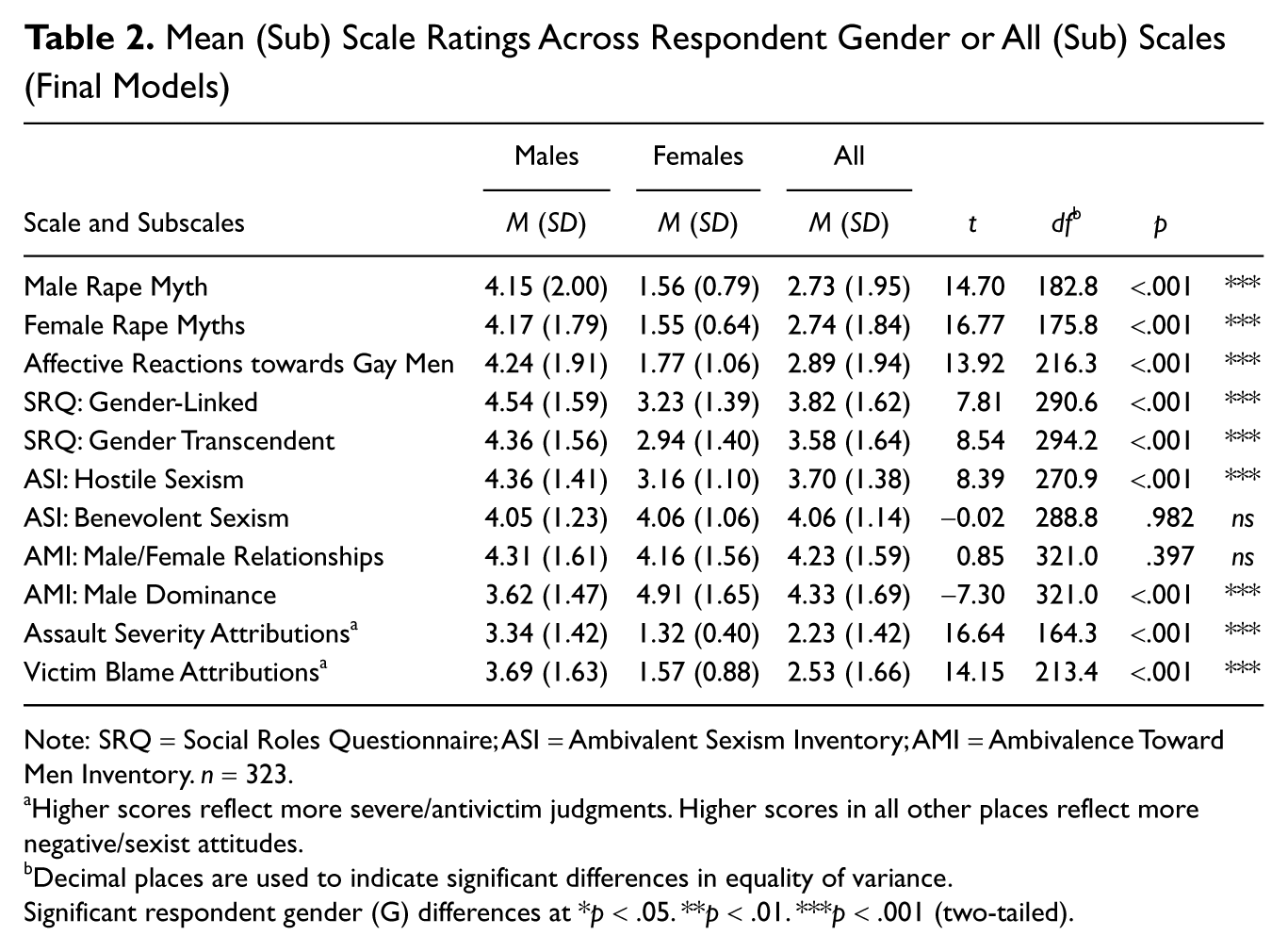
Note: SRQ = Social Roles Questionnaire; ASI = Ambivalent Sexism Inventory; AMI = Ambivalence Toward Men Inventory. n = 323.
Higher scores reflect more severe/antivictim judgments. Higher scores in all other places reflect more negative/sexist attitudes.
Decimal places are used to indicate significant differences in equality of variance.
Significant respondent gender (G) differences at *p < .05. **p < .01. ***p < .001 (two-tailed).
Correlations and Multiple Regression
Pearson’s correlations examined the predicted interrelationships between male rape myths and scores on female rape myths, affective reactions toward gay men, and the measures of social role conformity and sexism (as measured by the SRQ, ASI and AMI) and attribution items (see Table 3). Consistent with previous research and as predicted, male rape myth acceptance correlated positively and, in this case, very strongly with female rape myth acceptance, affective reactions toward gay men, and with both attribution measures. Evidence of multicollinearity was attained between male rape myths and female rape myths, with a correlation greater than .9. Both scales were retained in further analysis, but this issue is raised again in the discussion section. Male rape myth acceptance was also moderately and positively associated with hostile sexism and both subscales of the SRQ. Interestingly, there was no relationship between benevolent sexism and male rape myths. Finally, although there was a small but significant positive relationship with the male–female relationship scale of the AMI, a negative relationship was revealed between the endorsement of male rape myths and the male dominance scale of the AMI.
(Sub) Scale Intercorrelations (r)

Note: SRQ = Social Roles Questionnaire; ASI = Ambivalent Sexism Inventory; AMI = Ambivalence Toward Men Inventory. n = 323.
p < .05. **p < .01. ***p < .001 (two-tailed).
Other significant correlations worthy of note, though out of the scope of discussion of this article, are those between the endorsement of negative affective reactions toward gay men with victim blame and assault severity, both of which were strongly positive. Moderate but significant relationships were also revealed between victim blame, assault severity, and the various gender role measures, which again are out of the scope of this article but worthy of future consideration in their own right.
These relationships were explored further using a stepwise multiple regression model, with the total scores of the MRMS serving as the criterion and female rape myth acceptance, affective reactions toward gay men, the SRQ (gender-linked and gender-transcendent), ASI (hostile and benevolent sexism), AMI (male–female relationship and male dominance), victim blame, and assault severity entered into the model as predictor variables.
As Table 4 shows, a highly significant model (p < .001) explaining 86.4% of the variance in ratings of male rape myth acceptance (adjusted = 86.0%) was revealed. There were four significant predictors of male rape myth acceptance, namely, female rape myth acceptance (p < .001), AMI relationships (p = .021), victim blame (p < .001), and assault severity (p = .008), all in line with expectations. However, contrary to expectations endorsement of negative affective reactions toward gay men did not predict male rape myths in this model. 3
Stepwise Multiple Regression Analyses: Predictors of Male Rape Myths Ratings
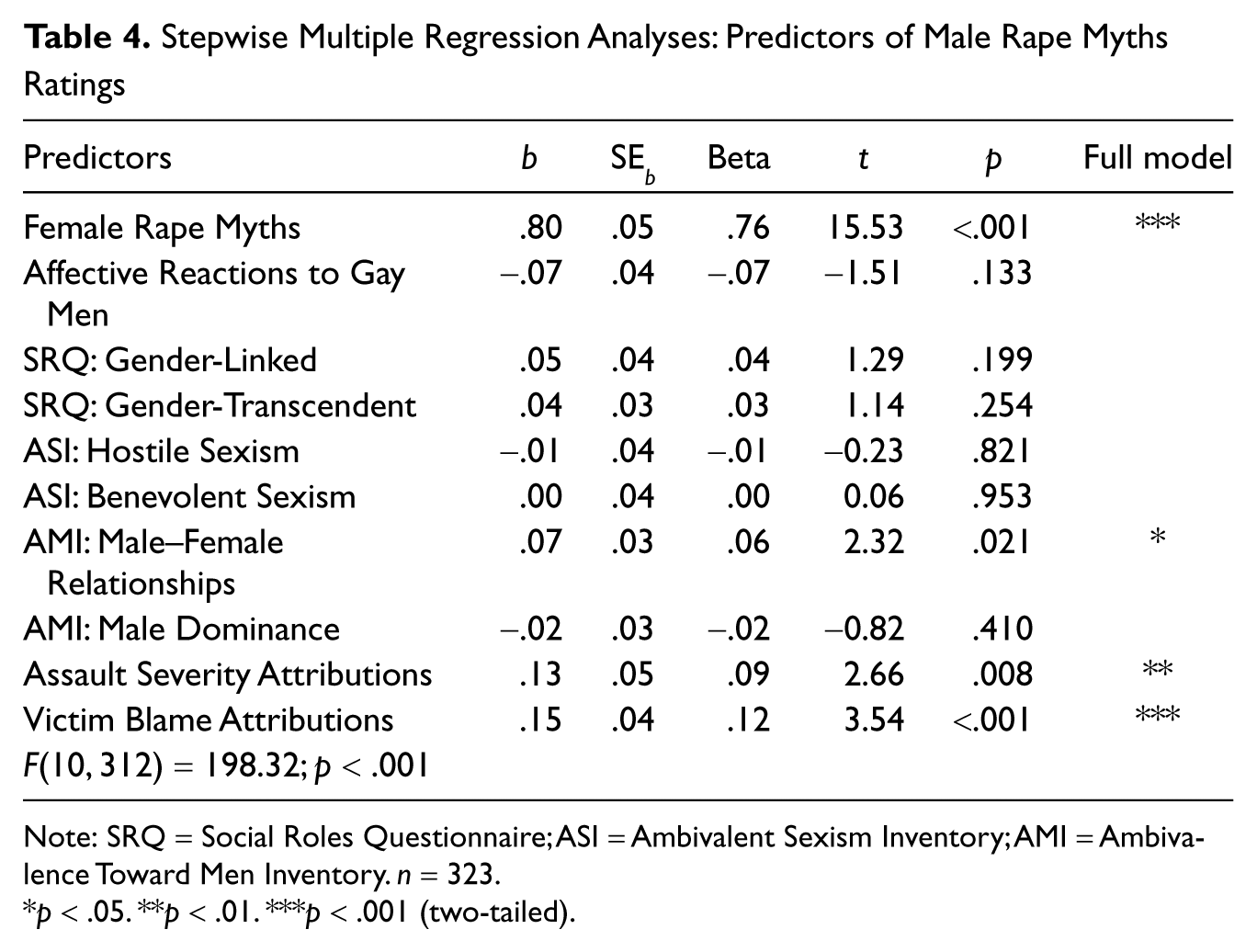
Note: SRQ = Social Roles Questionnaire; ASI = Ambivalent Sexism Inventory; AMI = Ambivalence Toward Men Inventory. n = 323.
p < .05. **p < .01. ***p < .001 (two-tailed).
Discussion
The current findings broadly supported the predictions. Specifically, and in line with previous conceptual work (Chapleau et al., 2008; Davies & McCartney, 2003; Kassing et al., 2005), men endorsed more negativity toward rape myths than did women. They were also more endorsing of female rape myths, more negative toward gay men, displayed more hostile sexism, and were less likely to believe gender should be transcended. Moreover, as predicted, men were more blaming of a hypothetical male rape victim and considered his sexual assault to be less severe than did women. These trends are consistent with previous work (e.g., Davies et al., 2001, 2006, 2008; Davies & McCartney, 2003; Davies & Rogers, 2006) and again, suggest men express more negativity toward male victims of rape. However, men were not exclusively more negative, with men and women equally endorsing of benevolent sexism and in attitudes toward male and female relationships. Furthermore, men held significantly fewer stereotypical views about male dominance than women did. These latter results are interesting as they indicate that it is women, more so than men, who believe that men should hold a dominant role over women. Although it is not the purpose of this study to explore these issues specifically, this is certainly an avenue for further investigation as to why women are particularly endorsing of these specific beliefs, why they are as equally likely as men to believe that women should be cherished and treated in a preferential way, and why they are as likely as men to endorse stereotypical views about male and female relationships.
The present study aimed to explore how male rape myth acceptance related to, and was predicted by, a series of attitudinal measures. As predicted, male rape myth acceptance as measured by Melanson’s (1999) MRMS correlated with the IRMS. This is consistent with Chapleau et al. (2008), who found the IRMS was strongly associated with male rape myth acceptance, as measured by Struckman-Johnson and Struckman-Johnson’s (1992) male rape myths scale. The authors of this study acknowledge that the correlation between the MRMS and the IRMS in this study was so high that there was evidence of multicollinearity, and the implication here is that rape myths about men are so strongly related to those about women that they are basically the same construct. However, the authors chose to retain both scales in the analysis, rather than merging them into a single scale, to retain face validity. Given this issue, however, future researchers should investigate the constructs relating to male and female rape myths further and more specifically.
The present study also supported previous work in that the MRMS related to homophobia (Kassing et al., 2005) and, furthermore, improved on this earlier work by incorporating a specific measure of affective, emotional responses toward gay men—the ARGMS (Davies, 2004b). Some scales purporting to measure homophobia measure more diverse or outdated attitudes that may make results unclear (see Davies, 2004b for a further discussion on the measurement of homophobia), which was not the case in the present study.
Male rape myth acceptance also related moderately positively with hostile sexism and both scales of the SRQ. Interestingly, there was no relationship with benevolent sexism. This is consistent with Glick and Fiske’s (1997) finding that hostile—but not benevolent—sexism related to rape myth acceptance. Thus, current findings can be seen as an extension of Glick and Fiske’s (1997) work on female rape myth acceptance in that hostile—but not benevolent—sexist attitudes also relate to endorsement of myths toward male victims.
Finally, although there was a small but significant positive relationship with the male–female relationship scale of the AMI, a negative relationship was revealed between the MRMS and the AMI’s male dominance scale. This is inconsistent with Chapleau et al.’s (2008) claim that all three subscales were positively related. In the present analysis, AMI subscales evolved from PCA and thus may represent a slightly different construct to those reported by the original authors (Glick & Fiske, 1999) and by Chapleau and colleagues. Likewise, one should also recall that Chapleau et al. used a different male rape myths measure than that used in the present study. Future research is needed to clarify if measurement issues are the source of any trend inconsistencies.
Subsequent multiple regression analysis examined potential predictors of male rape myth acceptance. The final model explained a large amount of variance which gives credibility to the measures used here. As expected, given their sizeable correlation, IRMS was the strongest predictor of MRMS, followed interestingly by the AMI male and female relationships subscale, victim blame, and assault severity. These results support previous evidence of a strong relationship between male rape myths and victim blame toward a hypothetical male rape victim (Davies & McCartney, 2003; Sleath & Bull, 2010). Future education programs could use these findings to reduce the amount of victim blame and male rape myths currently endorsed by the society.
Contrary to expectations, ARGMS ratings did not predict male rape myths in the multiple regression model despite the clear correlational relationship. The authors are unsure why this measure dropped out of the model, given that the correlation was high between the MRMS and ARGMS. Future research should clarify this position.
Methodological Issues
By employing a hypothetical scenario to elicit attributions of victim blame and assault severity, the ecological validity of the current study may be somewhat compromised. That said, the use of vignette methodology is widespread and remains the best approach for this type of work (see Davies & Rogers, 2006; Pollard, 1992). However, use of a student sample does limit the generalizability of current findings, and future research should endeavor to widen participation to nonstudents. The authors also acknowledge that due to problems with PCA several scales (namely, those from the ASI and AMI) were not used in their entirety. That said, all scale that were used here demonstrated very high internal reliability and thus appropriate measures in their own right.
Implications and General Conclusion
This and similar research has implications for professionals working with victims and/or employed to educate the public about rape. Current findings suggest that individuals who adhere to male rape myths are also more likely to endorse myths about female rape, to hold negative views about gay men, to maintain sexist attitudes, and to attribute more blame to male rape victims for their own assault. The implication here is that secondary victimization—which is often severe, long lasting, and detrimental to victim recovery (Williams, 1984)—may take a variety of forms, reflected in the types of negative attitude rape victims often experience and perhaps even come to expect. Service providers and those working to educate the public about rape need be mindful of the possibility that negative attitudes about rape are both wide-reaching and diverse, relating to more general beliefs about gender and sexuality than, say, attributions of blame for one’s own victimization.
Footnotes
Declaration of Conflicting Interests
The author(s) declared no potential conflicts of interest with respect to the research, authorship, and/or publication of this article.
Funding
The author(s) received no financial support for the research, authorship, and/or publication of this article.