



Abstract
The objective of this study was to measure the efficacy of protection orders (POs) in reducing assault and injury-related outcomes using a matched comparison group and tracking outcomes over time. This study was a retrospective review of police, emergency department, family court, and prosecutor administrative records for a cohort of police-involved female IPV victims; all events over a 4-year study period were abstracted. Victims who obtained POs were compared with a propensity-score-based match group without POs over three time periods: Before, During, and After the issuance of a PO. Having a PO in place was associated with significantly more calls to police for nonassaultive incidents and more police charging requests that were of multiple-count and felony-level. Comparing outcomes, PO victims had police incident rates that were more than double the matched group prior to the PO but dropped to the level of the matched group during and after the order. ED visits dropped over time for both groups. This study confirmed the protective effect of POs, which are associated with reduced police incidents and emergency department visits both during and after the order and reduced police incidents compared with a matched comparison group.
Background
Intimate partner violence (IPV) is a problem for millions of women in the United States; approximately 25% suffer physical or sexual assault by an intimate partner during the course of their adult lives (Tjaden & Thoennes, 2000). The nature of IPV ranges from isolated assaults to multifaceted, systematic abuse (Macmillan & Kruttschnitt, 2004), with many women experiencing assaults spanning several years and resulting in acute injury as well as long-term adverse health (Catalano, 2007; Coker, Smith, Bethea, King, & McKeown, 2000). Women engage in numerous strategies to cope with the violence and its aftermath: Turning to family and friends, calling police, seeking medical care, using victim shelter services, and obtaining personal protection orders (Catalano, 2007; Fugate, Landis, Riordan, Naureckas, & Engel, 2005; Holt, Kernic, Wolf, & Rivara, 2003; Sabina & Tindale, 2008).
Protection Orders (POs)
POs are one of the most potentially powerful and flexible legal remedies available to IPV victims; designed to offer the accessibility of civil proceedings with the power of criminal justice enforcement (T. Logan, Shannon, Walker, & Faragher, 2006). POs are federally mandated through the Violence Against Women Act (VAWA) and, although implemented locally, are regulated at the state level and operational across state lines (American Bar Association Commission on Domestic Violence, 2009; DeJong & Burgess-Proctor, 2006). POs are designed to empower victims, who can initiate proceedings and request individualized restrictions within the order (Keilitz, Hannaford, & Efkeman, 1997). Administered through civil court, POs require a lower burden of proof than criminal charges and are often available ex parte (without the perpetrator). As such, POs can be less intimidating than criminal court proceedings. Yet enforced with the arm of the law, POs hold a very real threat over the abuser: Violating a PO is a contempt-of-court crime that may result in arrest and incarceration. In practice, however, victims face significant barriers to accessing and enforcing POs, including complex and time-consuming procedural steps that place the evidentiary onus upon the victim, difficulty serving the order, and police and judiciary that can be unresponsive (Harrell, Smith, & Newmark, 1993; Keilitz et al., 1997; T. Logan, Stevenson, Evans, & Leukefeld, 2004; Moe, 2000).
Measuring PO Effectiveness
Although a notable number of IPV victims (12%-22%; Sptizberg, 2002) use POs and the weight of current evidence points to reduced assaults with POs (Carlson, Harris, & Holden, 1999; Gondolf & Jones, 2001; Gondolf & White, 2001; Holt, 2004; Holt et al., 2003; Holt, Kernic, & Lumley, 2002), the legal-ethical barriers to testing POs through experimental design has limited conclusions about their efficacy (Klein, 2009; T. Logan et al., 2006). Without randomized control studies, it is difficult to disentangle how much of POs’ impact is due to changes in victim behavior, changes in criminal justice response during POs, or the PO itself. One of the primary methodological difficulties for both survey follow-up and records review has been identifying valid non-PO comparison groups (Burgess-Proctor, 2003; Carlson et al., 1999; Harrell & Smith, 1996; T. Logan & Walker, 2009; McFarlane et al., 2004). This is a critical point because petitioners have been shown to be different from other IPV victims, with longer and more severe victimization histories and greater help-seeking behaviors (Duterte et al., 2008; Klein, 2009; Wolf, Holt, Kernic, & Rivara, 2000). Police calls for service, a traditional measure of safety, can be confounded by the intermittent nature of police reporting by victims and police discretion on enforcement and arrest (Buzawa, Hotaling, & Byrne, 2007; Felson & Ackerman, 2001; Holt et al., 2002; Kane, 2000). It is important, then, to take into account how POs may change victim help-seeking from police and police response to that help-seeking. Furthermore, using assault- and injury-related measures drawn from outside the criminal justice system would be important evidence regarding PO effectiveness. Emergency department (ED) visits are just such a measure: IPV victims, and those with POs specifically, use emergency departments substantially more often than the general population (Cerulli, 2010; Dearwater et al., 1998; Kothari & Rhodes, 2006), and injury-related visits, particularly, have been shown to be strongly associated with IPV (Biroscak, Smith, Roznowski, Tucker, & Carlson, 2006).
The current longitudinal study attempts to address these methodological challenges by (a) establishing a comparison group of IPV victims without POs, matched by both risk profile and temporal criminal case involvement, (b) examining the impact of POs on victim–criminal justice interactions, and (c) using ED visits as an objective safety measure outside the criminal justice system in addition to police incident reports. Study research questions were as follows:
Research Question 1: Does victim help-seeking and criminal adjudication differ when POs are in effect, as indicated by police charging requests, victim participation in prosecution, and case disposition?
Research Question 2: Do POs prevent future IPV assault and injury, as measured by victim ED visits and police incidents?
Method
We conducted a retrospective record review of police-involved female IPV victims and compared those with POs with a matched group of police-involved female IPV victims without POs over three time periods: Before, During, and After PO. Data were abstracted from ED, police, family court, and prosecutor administrative records for all events involving the study population over a 4-year study period. The sample and data were drawn from a larger study examining victim participation in prosecution and subsequent safety (Rhodes, Cerulli, Kothari, Dichter, & Marcus, 2011) that was conducted in Kalamazoo County, Michigan.
Study Sample
The study sample was the full population of 993 police-identified female victims of assault by a male intimate partner in the year 2000 occurring in the study county. Charging requests had been submitted by police for this assault, which meant that police had been called, dispatched to the scene, determined that a crime had been committed, and submitted a formal request to the prosecuting attorney’s office for charging authorization. Charging requests encompassed simple and aggravated assault, felonious assault, intent to commit great bodily harm, sexual assault, and homicide. Male intimate partners included current and former partners, spouses, dating partners, and cohabiting partners.
Procedures for Creating the PO and Matched Comparison Subgroups
The PO subgroup was established using the following criteria: (a) The study victim was petitioner in a civil PO executed through the family division of the circuit court at any point during the study period and (b) the respondent named in the petition was the same individual as the defendant in the assault charging request. One hundred thirty-two women (13.3% of the full 993 study sample) met these criteria.
The matched subgroup was developed in several steps: To begin with, individual-level comparisons of the study population were conducted, stratifying by whether the victim had obtained a PO during the study time frame. Chi-square analyses were calculated comparing IPV victims who obtained a PO with those who did not. Characteristics that were statistically different at the p < .05 level were then entered into a logistic regression model. This regression produced a propensity score variable whose values represented each individual’s probability of having a PO during the study period based on the entered model. Participants with missing values for any of the model factors did not receive a propensity score. One hundred and thirty of the 132 victims with POs and 816 of the 861 without POs had propensity score values. Next, 23 victims in the remaining non-PO group who had submitted a PO petition but had not been granted an order were removed from the matching pool to eliminate a possible source of bias, leaving 793 potential match candidates for the 130 PO victims. One candidate was then matched to each of the 130 PO victims according first to propensity score and then to charging request date. Where a PO victim had multiple candidates with the same propensity score, the one with the closest charging request date was selected. The majority was close calendar matches: 110 of the 130 (84.6%) pairs had charging request dates that were less than 30 calendar days apart.
Measures
Independent variables
The primary independent variable, issuance of a civil court protection order (PO), was abstracted from family court records. In this jurisdiction, family court issues POs as the sole provider, independent of any stay-away terms that may be contained within pretrial bond requirements if there is also a pending criminal court case. Individuals can petition for protection from a current or former intimate partner, family member, or household member on the basis of physical, emotional, or sexual abuse. The petitioner must complete a civil court motion detailing the abuse and specifying the protection terms she or he is requesting. A circuit court judge can then either issue the order ex-parte (without a hearing), can request a hearing, or can deny the petition. For our study, we reviewed family court records for all 993 study victims to identify those who had received a PO. For couples where the police-identified women victim was the petitioner and the male defendant was the respondent in the petition, the PO starting and termination dates were abstracted. Interrater reliability, kappa values, for victim role and PO petition date were 0.96 and 1.00, respectively.
Dependent outcome variables
Dependent variables were the police incidents and ED visits occurring throughout the study period. Four count variables were developed: (a) all police incidents involving the study couple, (b) the subset of police incidents that were for assaults, (c) all ED visits by the victim, and (d) the subset of ED visits that were injury related. Police incident report data were obtained from all 12 jurisdictions in the study county. Based on recommendations from the study’s community advisory board and input from IPV survivors who were community-based domestic violence shelter support group participants, the following criteria were set for defining police incidents for inclusion: Assault incidents were all police incidents involving the study couple that were labeled as simple, aggravated or felonious assault, assault with intent to commit great bodily harm or murder, sexual assault, and homicide. Nonassault incidents were all remaining police incidents involving the study couple including property, harassment, robbery, motor vehicle accidents and disturbing the peace, as well as property-related incidents where the study victim was named as the victim and there was no named defendant. ED data were collected from all eight emergency departments in the county, two Level 1 Trauma Centers and six tertiary care EDs. ED visits were counted if they had an International Classification of Diseases 9 (ICD-9) code indicating injury or assault, regardless of the mechanism of injury or the lack of identification of the assailant. Identifiers used to link study participants with police and hospital records were first name(s), last name(s), date of birth, and address.
Each of the four count variables were divided into three PO time periods: Before, During, and After. For the PO group, the Before period spanned study start date (January 1, 1999) through the day before the PO order began, the During period spanned the day the order began through the day it ended, and the After period spanned the day following PO termination through study end date (December 31, 2002). For the matched group, equivalent time periods were identified. First, an equivalent PO-During period was determined. This was accomplished by selecting the same calendar dates as the matched PO victim and then adjusting this date according to the time lapse between the two charging request dates. The Before and After periods for the match group were then defined using the same method as the PO group. For example, if a victim in the PO group had a charging request on February 5 and her PO began on June 5 and ended on December 5, then June 5 through December 5 was defined as her “During” period. If the matched comparison victim had her charging request on February 3, then her During period would be June 3 to December 3. As study participants had differing Before, During, and After period lengths, counts were standardized into annualized rates for comparison, for example,

For the 19 participants (13 from the PO group and 6 from the match group) whose During period extended beyond the study end date, the during period days were calculated as if the period ended on December 31, 2002, and they had no After period so their After rates were missing values.
Covariates
Individual-level characteristics of the victim and the defendant (age, race, address, substance use, prior IPV convictions of perpetrator), couple characteristics (marital status, whether together or separated, children in the home, victim-self-reported prior IPV), and criminal incident characteristics (victim injury, weapon use, victim participation in case prosecution, case disposition) were drawn from police incident reports and prosecutor administrative records. Many of these measures (victim and defendant individual and couple characteristics except for children at home, and case disposition) were contained in a database exported from county prosecutor administrative records for the index event in 2000, the event that defined the study sample. Victim demographic information (age, race, marital status) was further confirmed against medical record information. Discrepancies were resolved by adopting the medical record information, as it was considered to be more accurate with regard to victim information. The narrative police incident report was obtained for each index event and the following case information was abstracted from them: children at home, victim injury, and weapon used. Prosecutor case notes were reviewed and information about victim participation in prosecution was abstracted. Socioeconomic status was imputed from census tract information based on defendants’ address. Interrater reliability, kappa values, for presence of children and victim–prosecutor contact were 0.93 and 0.89, respectively.
Data Analysis
Statistical comparisons were conducted using three levels of analysis: individual, incident, and annualized event rates. Individual-level comparisons used chi-square analyses to examine differences between victims with POs and two groups of those without, all 861 remaining victims in the study sample without POs as well as the 130 matched non-PO victims. Incident-level comparisons were conducted using logistic regression to compare criminal events occurring when a PO was in effect compared with those occurring when PO was not in effect. Regression models were calculated for three sets of criminal events: (a) all police incidents involving the study population, (b) the subset of incidents resulting in criminal charging requests, and (c) the further subset of incidents authorized for prosecution. This analysis produced both unadjusted and adjusted odds ratios for each model factor. Finally, comparisons of PO and non-PO annualized event rates across the three time periods were conducted using mixed ANOVA analysis for each of the two event category types (police and emergency department). For the mixed ANOVA, the within-subjects factors were time period (Before, During, and After) and outcome level (for police, total incidents and assault-specific incidents; for emergency department, total visits and injury-specific visits). The between-subjects factor was whether the victim had a PO or not. Main effects and interaction effects were assessed for statistical significance. Contrasts for each of the effects were also conducted to test whether rates were varied statistically between the Before period compared with the During period and the After period.
The robustness of the propensity-score-matching approach was evaluated by repeating the sampling and matching procedures to develop two additional match groups from the pool of 793 candidates and conducting the same statistical analysis as described above for the resulting event rates. All statistical analyses were conducted using Statistical Package for the Social Sciences (Version 18.0; SPSS, Inc.). Significance levels were two sided and set at the 95% level.
Results
Study Population and Protection Orders
Over the 4-year period, 15.7% of police-identified IPV victims petitioned the court for a PO against the defendant named in the original police report. Half of the PO petitions (49.7%) were submitted the week following an IPV-related police incident. Compared with police incidents not leading to a PO petition, there was a high level of victim–prosecutor contact (88.7% of PO petitioners vs. 68.6% of nonpetitioners, p = .002) and an equally high level of victim support for prosecution, with 90.6% expressly stating they wished for charges to be pressed compared with 75.2% of nonpetitioners (p = .010; not shown).
Of the total 173 petitions, the majority (82.6%) resulted in PO orders. Petitioners who were granted PO orders had only a few differences from those who were denied: Those who received orders were less likely to have documented substance use and more likely to have reported prior IPV (not shown). Otherwise, there were no demographic or couple differences. Typically, orders were in place for 1 year (88.1%), but some were shorter (9.8% were for 6 months) and a few were longer (1.4% were for 2 years and 0.7% was for 5 years). Most POs remained in place for the entire length of the order; only 20.3% were terminated early because of a motion to terminate filed by the petitioner. As noted in the methods, 130 of the 132 victims granted protection orders formed the basis for study comparisons.
Table 1 shows the entire sample of police-identified IPV couples, comparing victims with POs against two samples of victims without POs: (a) the remaining 861 sample victims without a PO and (b) the subset of these (n = 130) who were the propensity-score matched subgroup developed for the outcome comparisons. Those with POs were significantly different from other police-involved victims (n = 861) on several counts. Demographically, they were more likely to be White, married at some point in time to the defendant, and have children with the defendant. They were less likely to have alcohol or drug use noted at the index criminal assault. Women with POs were significantly more likely to report that they had experienced prior IPV and used a domestic violence shelter (8.5% PO shelter use compared with 2.2% non-PO shelter use, p < .001). In contrast to the individual-level differences between victim-petitioners with and without POs, defendant-respondents with and without POs were similar on all sociodemographic characteristics.
Individual and Couple Characteristics of Study Population, Stratified by Protection Order Status
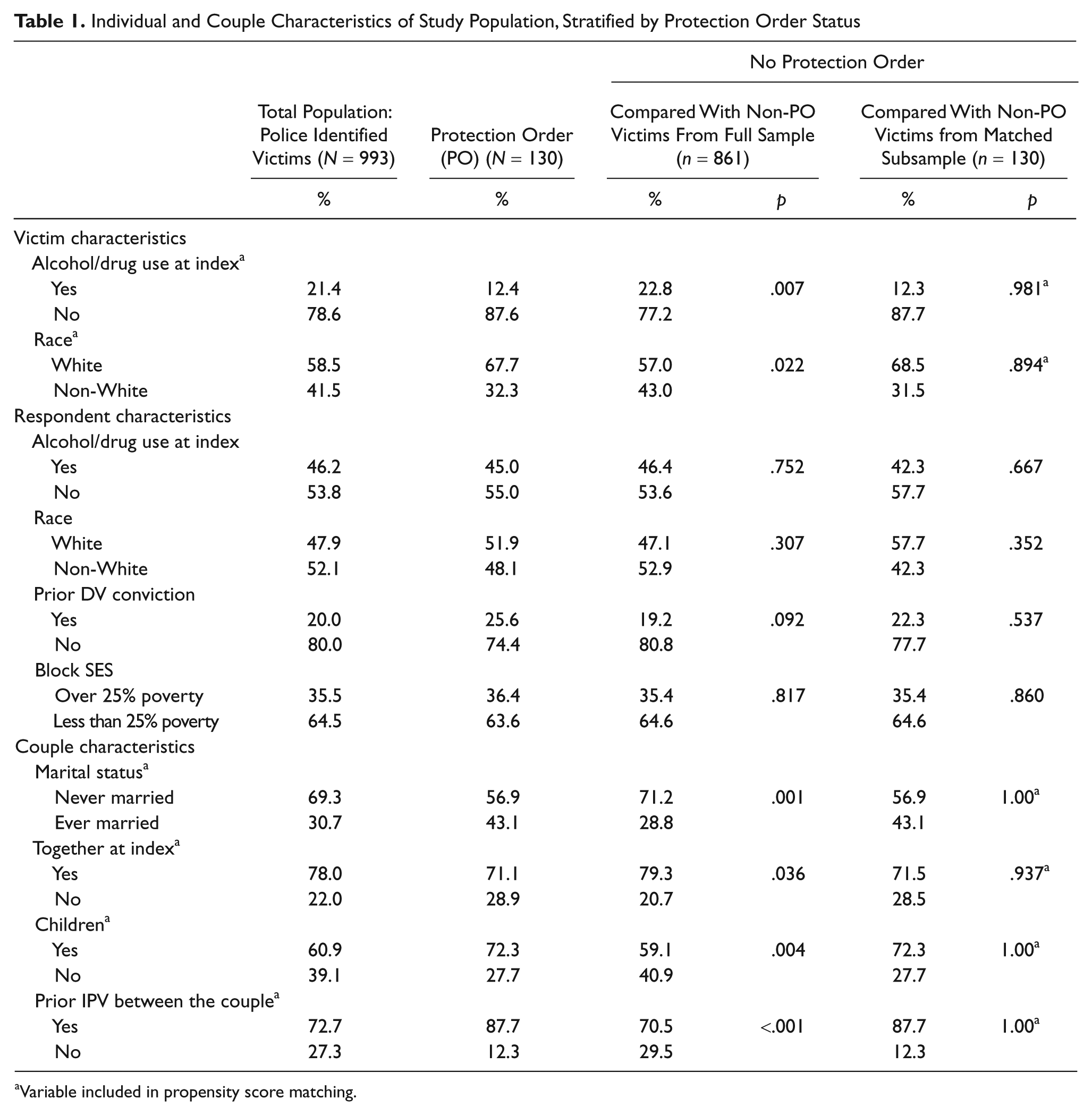
Variable included in propensity score matching.
Comparisons of the PO victims with the non-PO matched subgroup show a high degree of similarity on each of the matched variables: victim substance use, victim race, marital status, relationship status, presence of children, and prior violence. Although not included in the propensity score matching, the two groups are also similar on the remaining characteristics: Defendant substance use, defendant SES, and prior domestic violence conviction.
Victim–Criminal Justice Interactions With and Without Protection Orders
Nearly half (48.5%) of women with PO orders reported violations, ranging from one to four times, for a total of 104 police-reported incidents during a PO. Using the full study population of 993, Table 2 compares characteristics of the 104 events occurring under a PO with the 2,616 events occurring when no PO was in effect. Unlike police-reported events when no PO was in effect, police incidents during POs are more likely to be nonassault than assault incidents. Among nonassaults, incidents categorized as “disorderly conduct/trouble with subject,” were twice as common during POs (11.6% of police incidents during PO vs. 5.9% of incidents when no PO in effect, p < .001, not shown). Furthermore, although only a small portion of total police incidents, those coded as “obstructing or resisting police officer” were more likely during a PO compared with when no PO was in effect (2.8% and 1.0%, respectively, p < .001, not shown).
Association Between Incident Characteristics and PO Status at Time of Event for Three Sets of Criminal Incidents
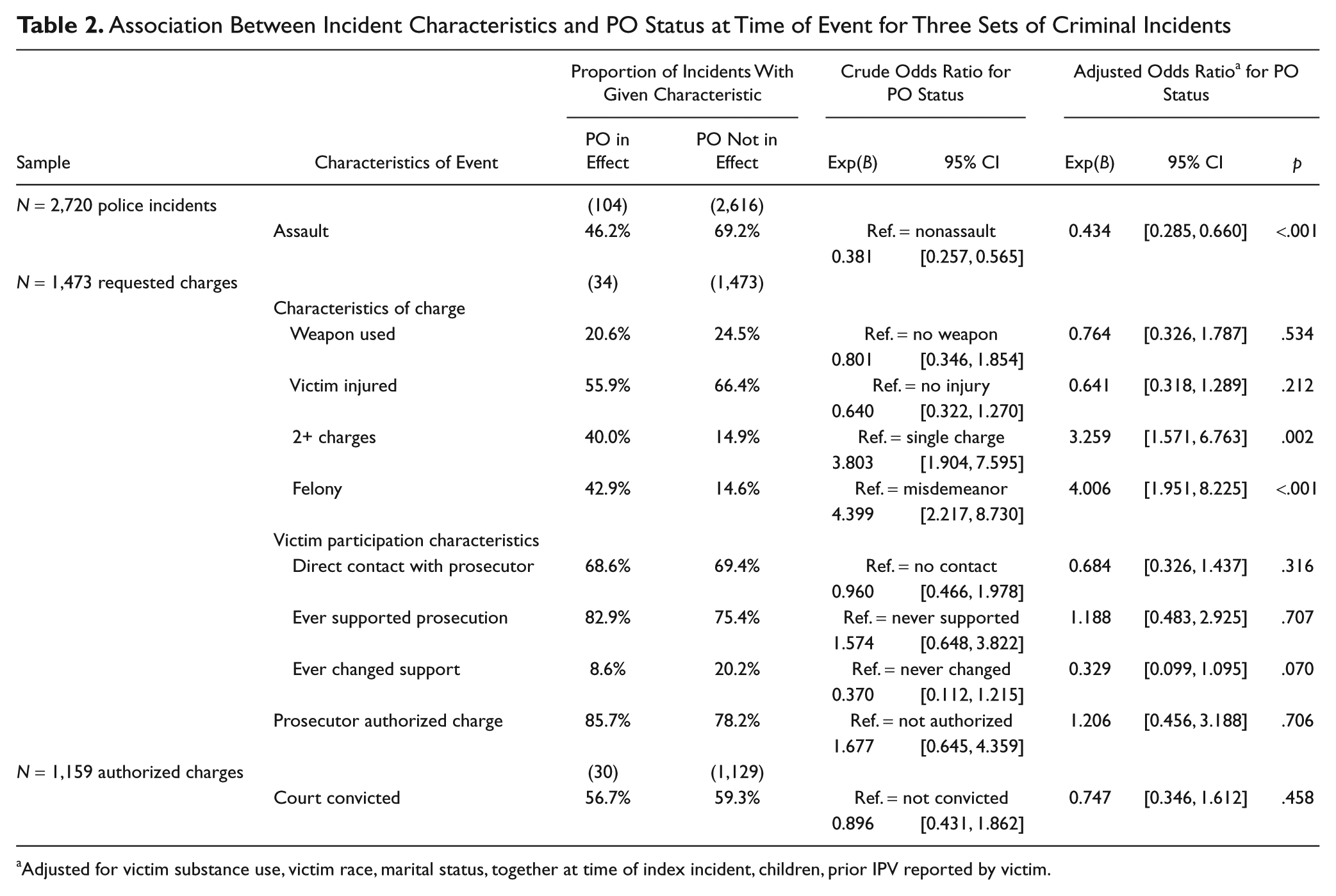
Adjusted for victim substance use, victim race, marital status, together at time of index incident, children, prior IPV reported by victim.
Police filed PO violations with civil court about a quarter of the time (26.4%) when a police incident occurred during a PO period. Police were twice as likely to file violations for assaultive incidents as for nonassaultive incidents (65.5% and 34.5%, p = .014). In several of the charging requests that were filed without an accompanying civil violation, the police report narrative noted that the PO had not yet been served and that they (the police) had served it at the time of the incident.
For the subset of police incidents leading to a requested charge (N = 1,473), Table 2 shows that police were four times more likely to file felony-level charging requests and three times more likely to file multiple-count charging request when a PO was in effect compared with when it was not. Victim participation (contact with the court, expressing support for prosecution) varied little when POs were in effect compared with when they were not in effect. However, PO victims were less likely to reverse support for prosecution for incidents occurring the week prior to a PO and incidents occurring during a PO (p = .049, not shown, and p = .70) than for incidents unrelated to POs. As seen in Table 2, charging authorization rates and conviction rates among those authorized (N = 1,159) remained unchanged, regardless of whether a PO was in place.
Assault and Injury-Related Outcomes for PO Victims Versus the Matched Comparison Group
The results shown in Figure 1 depict statistically significant interaction and main effects for having a protection order and for time period on both police measures (total incidents and the subset of assault incidents). The rate of police incidents decreased over time but decreased even more for those with POs, F(1, 239) = 6.348, p = .012 for Time × Outcome × PO interaction. PO victims had rates that were more than double the matched group prior to the PO, with an annualized total-incident rate of 1.73 and an annualized assault-incident rate of 1.17 for PO victims versus 0.78 total rate and 0.58 assault rate for matched victims. However, afterward, these rates were the same as the matched group: 0.41 total-incident rate and 0.16 assault-incident rate for PO victims in the after period, and 0.31 total-incident rate and 0.11 assault-incident rate for matched victims. Contrast comparisons revealed that Before rates were statistically significantly different from both During rates and After rates for all interaction and main effects.

Event rates by PO status and time period
Results for ED measures show statistical significance for time period, dropping over time for both groups, F(1, 239) = 4.006, p = .046 for time period: Before versus After contrast—1.48 and 1.44 ED-total “before” rates for the PO and match groups, respectively, and 1.16 and 1.15 ED-total “after” rates, respectively. There was no statistically significant main effect for PO. There were five outliers for ED visits; however, results remained the same when these cases were excluded.
The assumption of sphericity was violated for each of the four analyses, thus repeated measures effects reported above are Greenhouse-Geissner adjusted figures. The propensity score match approach was shown to be robust to multiple match groups, with similar results found for the two additional match groups that were developed and fully analyzed.
Discussion
This study, which tracked police and health-related outcomes over time and used a propensity-score-matched comparison group, produced strong evidence confirming the protective effect of civil protection orders for police-involved women victims of partner violence. IPV victims with POs had significantly fewer ED visits and significantly fewer police incidents after a PO than before. By the end of the 4-year study, police incidents among IPV victims who obtained a PO had dropped to the same level as the matched comparison group, with annualized rates approaching zero. This drop is more striking when considering that the match group started at a significantly lower rate and that that lower rate declined as well. Although interpreting the decrease of police incidents as a direct indicator of reduced violence can be problematic (Buzawa et al., 2007; Felson & Ackerman, 2001; Holt et al., 2002; Kane, 2000), IPV victims with POs may represent an exception to this concern. Studies have documented that PO victims have not only longer and more severe victimization but also more frequent help-seeking, including police calls for service (Ptacek, 1999). Within this study, the fact that PO victims had a high rate of police calls prior to obtaining a PO, coupled with the significantly greater police notification of nonassault incidents during the PO points to a greater willingness to call police. Seeing the same decreasing trend in ED visits also lends validity to our interpretation that the decrease in police incidents represents a valid measure of improved victim safety. It may be that, for PO victims, police incidents are a closer reflection of violence than for other victims.
The greater help-seeking by study PO victims is consistent with research that victims seek POs only after other strategies have failed to stem the violence (Ptacek, 1999). Studies have documented that, at the time of the PO petition, victims report severe, escalating violence, as well as ongoing utilization of numerous formal resources including police, emergency medical services, and shelters (Fischer & Rose, 1995; Gillis et al., 2006). Despite having similar levels of prior violence and ED utilization, the lower prior help-seeking (police, shelter, and PO) by the match group may indicate that, unlike PO victims, they have not yet exhausted their help-seeking strategies or resources. The fact that both police incidents and ED visits decrease for the matched comparison group suggests that many of them may not need a PO. Perhaps for this group calling the police provided adequate “legal leverage” to prevent further violence.
POs are often a last resort because they require greater victim action and resolve (Duterte et al., 2008; Fugate et al., 2005; Moe, 2007); from initiating the petition and making their case in court to calling police when order conditions are violated to instigating civil violation proceedings. In addition to perceiving that strong action is warranted, victims who are ready for this effort appear to have crossed some threshold of emotional disengagement and resolve (Keilitz et al., 1997; T. Logan et al., 2006), an emotional threshold that may itself add weight to POs effectiveness . It is of interest that PO victims were more likely to have used shelter services, suggesting that community-based domestic violence shelters may be helping IPV victims to obtain POs. Perhaps it is the combination of escalating violence and aggressive help-seeking that leads a woman to both use shelter and apply for a PO. Nonetheless, the fact that the non-PO comparison group had different police and shelter help-seeking histories despite similar relationship patterns suggests that there may be a sequence of events which precipitate a PO petition and that this sequence contributes in some way to PO’s eventual effectiveness.
In our study, the presence of a PO was linked to changes not only in victims’ behavior but also in police response. While a PO was in effect, study victims were more likely to call police for nonassaultive events due either to a lower help-seeking threshold by victims or to increased harassment by defendants (T. Logan & Walker, 2009; Zoellner et al., 2000). The police, for their part, were significantly more likely to submit charging requests for multiple counts and at felony level during a PO, even when the events themselves were no more likely to involve weapon use or victim injury, typically strong predictors of arrest (T. Logan & Walker, 2009). Given the complexity of the PO violation process and police reluctance to violate a defendant not yet served, perhaps police use these strategies as a way of “upping the ante” within the criminal system. It is important to note that these higher level charges are no more likely to end in an authorized charge or conviction. However, since adjudication is a long process, the higher level charging requests may still be exerting some protective influence.
Finally, the fact that two such similar victim groups also had similar ED utilization patterns provides validation for ED visits as at least a crude measure of partner violence. Studies have shown a dose–response relationship between severity of abuse and health consequences, both in acute injury and chronic disease conditions (Macmillan & Kruttschnitt, 2004). Although IPV victims’ high ED utilization is well documented (Dichter, Marcus, Morabito, & Rhodes, 2011), that these visits rarely result in disclosure to ED staff and even more rarely overlap with a police-known assault (Cerulli, 2010; Dearwater et al., 1998; Kothari & Rhodes, 2006) suggests that the ED may be a venue used by victims not ready to “go public” but who, nevertheless, need help for the health-related sequelae of violence.
There are a number of important limitations to this study. Study data were drawn from administrative records and thus are subject to reporting as well as recording bias. In particular, police incidents are known to undercount IPV events because not all partner assaults lead to a police call for service and not all police calls for service lead to an incident report (K. Rhodes et al., 2011). ED visits for injury, although strongly associated with IPV (Hotaling & Buzawa, 2003), may overcount IPV events, especially because the medical records usually lacked information on the mechanism of injury. Taken together, though, the combination of police-reported IPV incidents and injury-related ED visits present a more complete picture of IPV outcomes than has previously been possible through either police incidents alone or through victim surveys. Another limitation is that the PO group was drawn from a police-identified population rather than a PO population, so they may not fully represent the entire population of IPV victims with POs. Two factors mitigating this limitation are that high police utilization is typical of the PO population and that the study sample shares many characteristics of PO samples in the literature. The variability of PO legislation across states and PO enforcement across communities limits the generalizability of any single site study. However, Michigan’s PO statute (MCL 600.2950 and MCR 3.700) is neither broadly nor narrowly written relative to other states (Biroscak et al., 2006). Furthermore, this study’s reported violation rate of 48.5% is similar to the 40% averaged violation rate found in a review of 32 studies (American Bar Association Commission on Domestic Violence, 2009). Finally, the results obtained from our analysis of administrative health and criminal justice data would be stronger if we had been able to link with community-based IPV service data or conduct follow-up interviews with the victims themselves.
Conclusions
This longitudinal study of police-involved women victims of IPV confirmed the protective effect of POs. We found that civil protection orders were associated with reduced police incidents and emergency department visits over time and reduced police incidents compared with a matched comparison group. More work is needed to understand the pathways by which victims decide to seek civil POs and the ways that POs affect subsequent police–victim interactions.
Footnotes
Author’s note
The contents of this article do not necessarily represent the views of the Department of Veterans Affairs or the United States Government.
Declaration of Conflicting Interests
The author(s) declared no potential conflicts of interest with respect to the research, authorship, and/or publication of this article.
Funding
The author(s) disclosed receipt of the following financial support for the research, authorship, and/or publication of this article: This project was supported by NIJ Award #2006-WG-BX-0007, NIMH K11MH75965 (Cerulli), and NIMH K23MH64572 (Rhodes).