



Abstract
The court system is a central part of the societal response to intimate partner violence (IPV), and is a frequently used source of help for victims. The concept of therapeutic jurisprudence suggests that the court should be evaluated not just for its potential effect on recidivism, but for its impact on the well-being of all those who participate in it, and IPV scholars suggest that empowerment is a key component of any therapeutic intervention for victims. Research in these areas is limited by the lack of a standard method for examining victim experience in the court system. This article describes the development and piloting of a 23-item measure designed to address this gap. The pilot sample included 157 victims of IPV seeking civil protection orders (CPOs). Exploratory factor analysis yielded 5 factors: Negative Impact, Positive Impact, Fear, Validation, and Network Impact. Validation was most strongly correlated with global satisfaction with the court process. Implications and applications for work in therapeutic jurisprudence and empowerment are discussed.
The court system has become a central part of the societal response to the social problem of intimate partner violence (IPV; Cramer, 2004; Romkens, 2006). As such, it has attracted significant attention from researchers. A great deal of this research focuses on the relationship between system outcomes (arrest, prosecution, incarceration, and the attainment of a civil protection order [CPO]), and offender recidivism or victim safety (for reviews see Bell, 2007; Cattaneo & Goodman, 2005). In general, studies tend to report a small main effect of system involvement at best, and suggest significant variability among cases or even within cases across time in terms of response to intervention (Bell, 2007; Cattaneo, Cho, & Botuck, 2011; Williams, 2005; Wooldredge & Thistlethwaite, 2002, 2005). Perhaps partly because there does not appear to be an intervention that has resounding effect on recidivism across cases, a body of work has emerged suggesting that the court system affects more than victims’ safety, and should be evaluated accordingly.
The contention that the court might broadly affect the well-being of those who pass through it is the cornerstone of therapeutic jurisprudence, a movement that advocates for scholarship and practice aimed at maximizing the court’s healing potential (e.g., Hartley, 2003; Rottman & Casey, 1999). Within IPV, a handful of studies support the hypothesis that victim experiences within the court system do indeed have such a broad impact. However, synthesis of this work and evaluation of innovations in the approach of the court are hindered by wide variety in measurement. This study attempts to build on the existing conceptual foundation by introducing a measure that might be applied in future work in this area. Before detailing the measure and the study, here we review the literature on the court’s response to IPV and its impact on victims.
IPV in the Court System: The Contribution of Therapeutic Jurisprudence
Beginning in the 1970’s, there has been a gradual cultural shift in the United States: IPV is now considered a social problem requiring a societal response, rather than a family problem to be handled privately (Cramer, 2004; Goodman & Epstein, 2008; Stark, 2007). The justice system has been a central component of this change. The centrality of the courts to U.S. efforts to address IPV is particularly clear at the macro-level, in that the Violence Against Women Office—an office of the federal government created by the 1994 Violence Against Women Act (VAWA) that distributes federal funds—is housed in the Department of Justice (Cramer, 2004). In addition to changes at the federal level, local policies related to the criminal justice response to IPV have become more aggressive: mandatory arrest and no-drop prosecution policies, where police are required to arrest, and prosecutors move forward with or without the victim’s consent, are widely employed and have resulted in drastically increased case flow (Goodman & Epstein, 2008; Rebovich, 1996).
On the one hand, the considerable resources the justice system devotes to IPV is a stunning example of a successful social movement, and is a tremendous improvement over the state of affairs even 20 years ago (Stark, 2007). After all, a chief aim of early advocates was the criminalization of IPV (Goodman & Epstein, 2008; Hare, 2006). There is also research to suggest that the criminal justice emphasis aligns with what many IPV victims want when they seek help (Hare, 2006; Weisz, 2002). In fact, studies have found that the majority of women who seek formal help for IPV have contact with the criminal justice system at some point (Bell, 2007), and that they are often satisfied with their experience (Belknap & Sullivan, 2003; Cattaneo, 2010).
On the other hand, growing out of the civil rights and broader women’s movements, the battered women’s movement has a long history of ambivalence toward increasing the power of the state (Mirchandani, 2005). Indeed, there is evidence that for some victims, involvement in the criminal justice system compounds the trauma they experienced at the hands of the abuser (Erez & Belknap, 1998; Mills, 1999; Ptacek, 1999), and that it can be out of step with their goals (Herman, 2005; Orth, 2002). Negative Impact may be particularly likely when victims’ involvement in the case against a current or former partner is involuntary, as in cases of mandatory arrest and no-drop prosecution.
The therapeutic jurisprudence framework is useful in considering how this mixed picture should be addressed. It elevates the question of how the practice of law affects those involved in the court, assuming first, that such an impact extends beyond offender deterrence and second, that meeting the healing potential of the court does not need to sacrifice its other aims (Rottman & Casey, 1999). In considering how this framework should inform the court’s efforts to address IPV, literature describes the work of domestic violence courts, which, like other problem-solving courts (e.g., drug courts, mental health courts), aim not just to punish the offender but to address the problem underlying the offense (Mirchandani, 2005; Winick, 2000). The literature also notes that therapeutic jurisprudence can be applied in interactions among court personnel and all involved parties in a more traditional court context, such as when a judge tells a victim that what happened is not her fault (Rottman & Casey, 1999). What is missing in this body of work is an understanding of how such variability in the court response impacts victims (Winick, 2000). In other words, to what extent are such applications of therapeutic jurisprudence in fact therapeutic?
Evidence for the Importance of Victim Experiences in Court
Although we have much to learn about the link between what happens in court and the well-being of IPV victims, the literature on victims’ experiences in court provides evidence for the assumption that their experiences do vary, and that this variance is important to understand. For instance, several studies find that victims who feel in control or empowered, feel that they have been treated well, or report that they received information from police, also report that they would be more likely to contact the system in future incidents (Cattaneo & Goodman, 2010; Fleury-Steiner, Bybee, Sullivan, Belknap, & Melton, 2006). In contrast, victims who feel ignored, unable to share their story, dissatisfied by staff treatment, pressured to file charges, or had their proceedings cancelled at least once report that they would be less likely to use the system again if needed (Buzawa, Hotaling, Klein, & Byrne, 1999; Fleury-Steiner et al., 2006; Zweig, Burt, & Van Ness, 2003). In a study that combined victim report with official data, adding credence to findings based on one data source or the other, Hotaling and Buzawa (2003) examined the relationship between victim experience and reporting of new incidents. In a sample of victims who had been involved in a prosecuted case, they found that those who had not reported new incidents to the criminal justice system a year later were dissatisfied with the handling of the previous cases and more likely to feel they had had no rights or voice in the process, compared with victims who reported or did not experience future incidents. These results suggest that victim experience may inform decisions to recontact the court if needed, impacting the ability of the system to intervene.
A smaller number of studies have linked victims’ experiences to a range of outcomes beyond the explicit aims of the court (Bell, 2007), fitting with the core assumption of therapeutic jurisprudence. For example, the tone judges set during the proceedings can affect victims’ evaluation of the process, and victims’ confidence in batterer compliance is higher when judges provide specific instructions and paperwork is completed efficiently (Bell, Perez, Goodman, & Dutton, 2011). Legal and lay advocacy during the court process has been linked to better quality-of-life, less difficulty in using other community resources, and less IPV after exiting the system (Bell & Goodman, 2001; Sullivan & Bybee, 1999). Finally, empowerment during the court process has been linked longitudinally with better quality-of-life and less depression after court disposition (Cattaneo & Goodman, 2010). In short, the evidence is compelling that victims’ experiences in court are relevant to the aims of the system and to a broad range of outcomes related to victim well-being.
While providing important information, a shortcoming of the literature to date is the use of diverse ad hoc measures. Standardized measures are often used to measure predictors or outcomes before and after the court process, such as abuse or depression, but there are no measures used consistently to gauge victim perceptions of the process itself. Instead, authors of key studies related to victim experience have designed their own questions (Belknap & Sullivan, 2003; Bell, et al., 2011; Buzawa et al., 1999; Cattaneo & Goodman, 2010; Fleury-Steiner et al., 2006; Hotaling & Buzawa, 2003; Sullivan & Bybee, 1999), resulting in a wide variety of approaches to measuring related constructs. These differences make it difficult to synthesize the findings of studies on the same topic. In sum, although we have some evidence that there is variety in experience and that this variance may be related to some important outcomes, as suggested by the therapeutic jurisprudence framework, the field needs more standardization in measurement to answer the questions the framework proposes.
The Empowerment Model as a Guide for Evaluating the Helpseeking Experiences of IPV Victims
Researchers and practitioners in IPV-related fields agree that empowerment is a key element of victim experience that requires attention (Kasturirangan, 2008); in fact, within the framework of therapeutic jurisprudence, empowerment may be the mechanism that leads to therapeutic outcomes for victims (Cattaneo & Goodman, 2010). However, there has been no agreed-upon definition or measurement tool to support empowerment-focused scholarship. Laying the foundation for more rigorous exploration, the first and third authors introduced a definition of empowerment and a model of the process (Cattaneo & Chapman, 2010). This definition of empowerment was the springboard for the current study:
an iterative process in which a person who lacks power sets a personally meaningful goal oriented toward increasing power, takes action toward that goal, and
When a victim of IPV takes action to change the nature of her relationship with an abusive current or former partner, the empowerment process is a framework within which to understand her experience. Here, we focus on the impact component of the empowerment process: what do victims experience when they reach out to the court system as part of their effort to reach their goals? A valid and reliable measure of that experience paves the way to explore the system’s therapeutic and antitherapeutic effects.
Research Questions
The goal of this study was to develop a measure to capture victim experiences in the court system. Implicit in this effort were the following questions:
Are there multiple dimensions of victims’ experience in the court system? If so:
How can they be described?
How are they related to each other?
How are they related to more global measures of victim experience?
Method
Two studies were required to develop the Court Impact Scale. First, we generated potential items through a qualitative study. Second, we piloted the items and conducted an exploratory factor analysis to produce the final scale.
Study 1: Qualitative Interviews
Procedure
Theoretically guided qualitative interviews are a common tool for generating measure items (e.g., Jones, Jenkinson, & Kennedy, 2004; Rat et al., 2007). The items for the Court Impact Scale were generated as part of a larger measure development effort. For the parent study, we designed a semistructured interview protocol based upon Cattaneo and Chapman’s (2010) theoretical model of the empowerment process. The interview included questions related to each component of the empowerment process, including all of the actions that the participants took to obtain a CPO, and the impact of each action.
Eligible participants were female, and had received a CPO (known in some states as a restraining order) against a current or former intimate partner. Although we did not intentionally limit our sample by ethnicity, observation suggested that all participants in our final sample were African American. This reflected the population who sought services in the court where we recruited participants.
The third author recruited participants by attending CPO hearings, identifying eligible individuals, and approaching them after they left the courtroom. She briefly described the study to these individuals, obtained informed consent, and collected contact information and details about ways to reach them safely. A total of 20 adult women agreed to be contacted during this phase of recruitment. The third author made up to 10 attempts to reach each potential participant via telephone one to two weeks after the initial contact. Of the 20, we were unable to contact eight women, and we determined that one other was ineligible for the study. A total of 11 phone interviews were successfully completed. Each interviewee was mailed a US$25 Visa gift card in thanks for her time. All interviews were recorded with the permission of the participant, and transcribed. We discovered that one transcribed interview did not meet eligibility criteria, leaving a final sample of 10 interviews ranging from 30 to 90 min in length.
Data analysis
Interviews were coded by the first and third authors in accordance with the consensual qualitative research (CQR) procedure described by Hill et al. (2005). CQR involves analyzing interviews line-by-line and identifying domains, core ideas, and cross-categories. Domains are general topic areas; core ideas are the smallest units of meaning within each domain; and cross-categories group together core ideas within each domain that have common themes. Interviews were first coded individually and then the authors discussed codes to reach a consensus on each.
Domains for the interviews were predetermined, given that the interview protocol was structured according to Cattaneo and Chapman’s (2010) empowerment model. Coding thus began with identification of core ideas, which were then sorted into domains, one of which was impact. Cross-categories were identified within each domain by examining the lists of core ideas for common themes. Finally, the core ideas and cross-categories were reworded into items that were reviewed by three experts for content and face validity. This process resulted in a 29-item measure of the impact of victims’ involvement in court. Finally, we developed three additional items as global assessments of the court process: “Overall, this process has had a negative effect on my life”; “Overall, this process has had a positive effect on my life”; and “Overall, I am satisfied with what happened at the court.” These items allow for exploration of convergent validity.
Study 2: Pilot study
Procedures
The items developed in Study 1 were included in a larger survey about victim experiences in court (Chapman, Dunn, & Cattaneo, 2011). All items included response options in the form of a 4-point Likert-type scale, from strongly disagree (1) to strongly agree (4). To pilot the measure developed in Study 1, research assistants visited an urban courthouse and viewed civil cases in two domestic violence courtrooms. A participant was deemed eligible if the case involved allegations of abuse against a current or former intimate partner, and was concluded that day. After the petitioner left the courtroom, a research assistant approached and asked her to participate in our survey, which took approximately 20 min to complete either on paper or laptop. Participants were paid US$10 for their time, and approximately 60% of the petitioners we approached agreed to participate. When petitioners refused participation and provided a reason, they most commonly stated that they needed to go elsewhere in the court or speak with a court worker.
Participants
A total of 162 participants completed the measure; however, due to missing data from three participants and responses from two ineligible (non-IPV) participants, 157 surveys are included in all analyses. The majority of petitioners/participants were female (n = 139) and African American. Orders were primarily filed against males (n = 132), and about half of the respondents attended the CPO hearing. Most participants reported a current or ex-boyfriend/girlfriend relationship with the respondent, and/or that the respondent was their child’s parent (81.4%). The remainder of the sample reported that they were married, divorced, or separated from the respondent. Data on relationship status was missing for one participant. Almost all participants received a temporary protection order (TPO) at the beginning of the process (n = 144), and most participants were granted a CPO at the conclusion of their hearing (n = 152).
Results
Exploratory Factor Analysis
We used exploratory factor analysis to reduce the number of variables in the measure developed from the interviews, and to identify latent constructs (factors) underlying these observed variables (cf. Tabachnick & Fidell, 2007), exploring research question 1. Exploratory factor analysis (EFA) is appropriate when, as in the current study, there is no a priori theory being tested but rather a parsimonious description of a complex phenomenon is sought to develop a valid and reliable measure. As a first step, we examined frequencies and descriptive statistics of our 29 items to examine the distributions, identify outliers, and note missing data. This evaluation led us to drop four items with high frequencies of “not applicable” responses, including three that referred to participants’ children, and one that required that the respondent be present for the hearing. This left us with 25 items for our main analyses.
To determine the number of factors to extract, we first conducted a parallel analysis (Fabrigar, Wegener, MacCallum, & Strahan, 1999) using syntax developed by O’Connor (2000). This analysis generates random data sets by scrambling the data from real participants, and identifies the point at which a factor from the actual data set explains no more item variance than one from a random data set. We conducted this analysis once using principal axis factoring (which suggested a 7-factor solution) and once using principal components analysis (which suggested a 4-factor solution), because there is as yet no agreement on which is best to use for this purpose. Scree plots also suggested the best solution was between four and seven factors.
Next we conducted a principal axis factor (PAF) analysis, evaluating the 4, 5, 6, and 7-factor solutions using oblique (promax) rotation. Using a threshold for loading of .4 (see Tabachnick & Fidell, 2007), we found that two items either did not load on any factor, loaded weakly and inconsistently across solutions, and/or had low communalities across solutions. These items, which were subsequently removed, were: “the CPO process was too time-consuming” and “I found it uncomfortable to tell people in court about what happened.”
A 5-factor solution best explained the variance in the remaining 23 items and made the most conceptual sense. As an additional check, we ran an EFA using maximum likelihood estimation to examine the fit using a chi-square test. The 5-factor model exhibited a nonsignificant chi-square (χ2(148) = 164.24; p = .17) indicating a good fit to the data. Loadings of items on factors, communalities, and percent of variance explained in the 5-factor solution are shown in Table 1. 1 We interpreted the five factors (research question 2) as Negative Impact (negative aspects of the court experience), Positive Impact (positive aspects of the court experience), Fear (ways the court experience heightened or triggered fear, or the emotional sequelae of trauma), Validation (ways in which the experience in court felt validating to the victim), and Network Impact (the extent to which the court experience caused problems in the victim’s home and work life). Cumulatively the factors explained 44% of the variance in the items.
Factor Loadings and Extracted Communalities for the Court Impact Scale Items
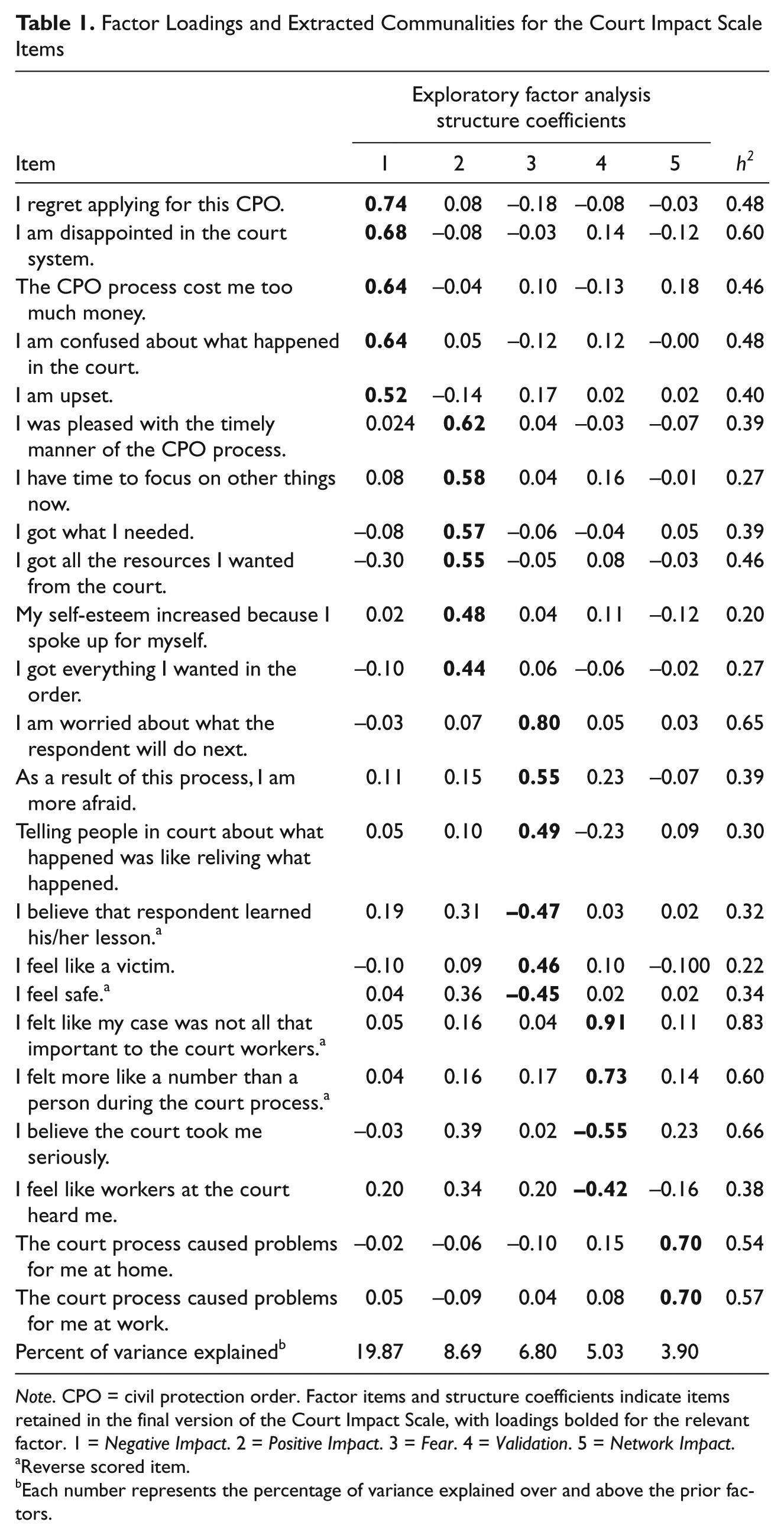
Note. CPO = civil protection order. Factor items and structure coefficients indicate items retained in the final version of the Court Impact Scale, with loadings bolded for the relevant factor. 1 = Negative Impact. 2 = Positive Impact. 3 = Fear. 4 = Validation. 5 = Network Impact.
Reverse scored item.
Each number represents the percentage of variance explained over and above the prior factors.
Factor Descriptives and Intercorrelations
Descriptive statistics and correlations among factors and the three global items are presented in Tables 2 and 3. For ease of comparison, subscale scores were computed by averaging items. Thus the possible scores in each factor range from one to four. Mean scores show that experiences tend to be more positive than negative on all factors but Fear, with the means above (for positive) or below (for negative) the midpoint. The mean score for Fear was at the scale midpoint (2.5). The Fear and Network Impact subscales had the greatest variance. In terms of correlations among factors (research question 3), Positive and Negative Impact were inversely related, but not to an extent that suggests they are opposite ends of the same construct. Positive Impact was positively related to Validation and negatively connected to Network Impact, whereas Negative Impact was negatively related to Validation and positively associated with Network Impact. Validation was also negatively related to Network Impact. Interestingly, Fear was weakly related to Positive Impact and unrelated to the other the other constructs, suggesting that this factor may add additional unique variance to any predictive equation.
Descriptive Statistics and Reliability Estimates for Court Impact Subscales

Intercorrelations among Court Impact Scale Factors and Global Items
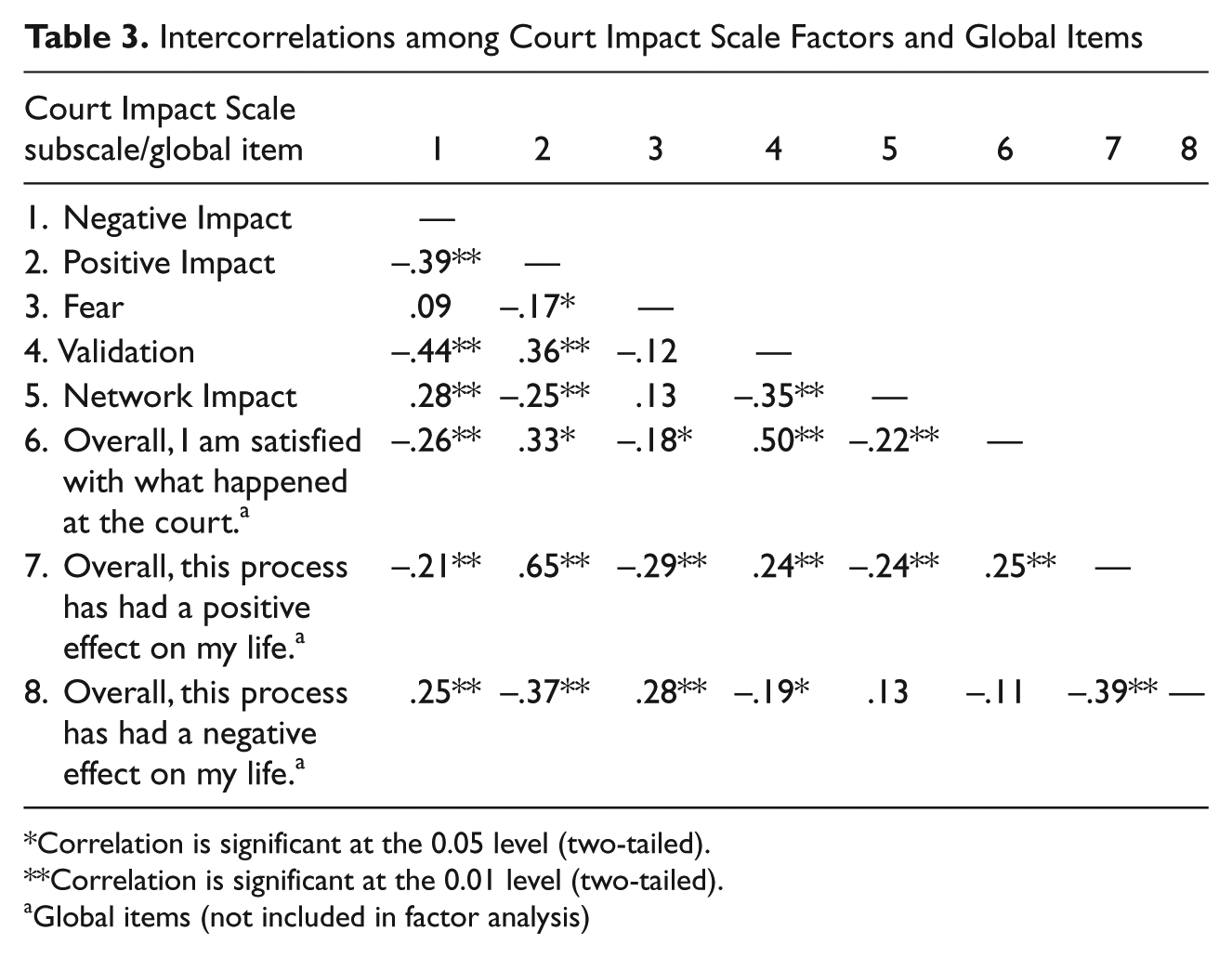
Correlation is significant at the 0.05 level (two-tailed).
Correlation is significant at the 0.01 level (two-tailed).
Global items (not included in factor analysis)
In general, correlations between the factors and the global items were in the expected directions (research question 4) and provide evidence for the validity of factors: both the global positive item and the satisfaction item were positively correlated with Positive Impact and Validation, and were negatively correlated with Fear, Negative Impact, and the Network Impact. The global negative item also correlated as expected—negatively with Positive Impact and positively with Negative Impact and Fear.
The connections among factors and the satisfaction item are worth special attention, because this is the global item that reflects participants’ feelings about the system as opposed to the way the system impacted other parts of their life. In other words, these correlations are an index of how strongly each factor is related to victims’ overall feelings about the court. Validation had by far the strongest correlation with satisfaction (r = .50; p < .01), and Fear had the weakest (r = –.18; p < .05).
Discussion
Summary and Discussion of Results
The development of the Court Impact Scale is a response to the need for a comprehensive, standardized tool to gather information about IPV victims’ experiences at court. Existing research suggests that these experiences are broadly consequential, but disparate measurement strategies have hindered synthesis of the literature or comparison among approaches. This tool thus has the potential to contribute to scholarship in the related areas of therapeutic jurisprudence and empowerment, and to inform evaluation and reform.
In answer to our first research question, our 5-factor solution suggested that participants’ experiences were indeed multidimensional, as opposed to merely satisfying or unsatisfying. Further supporting this conclusion, although all of our factors were significantly related to single, global items in the expected directions, the correlations were not strong enough to suggest that the single item should be used in place of the multi-item scale. For example, the multi-item scale “Negative Impact” was correlated at r = .25 with the global item “overall, this process has had a negative effect on my life,” and at r = –.26 with “overall, I am satisfied with what happened at the court.” The multi-item scale captures nuance in this negative impact, including confusion, disappointment, and the financial cost of going to court, that is likely not captured in the single items.
In answer to our second research question concerning the nature of these dimensions, our results extend prior work on how the court is experienced. In particular, our scales include notions of distributive and procedural justice (Tomkins & Applequist, 2008; Tyler & Lind, 2000). These constructs translate roughly into the fairness of the outcome of the proceeding (distributive), and the fairness of the process leading to the outcome (procedural). In their discussion of procedural justice, Tomkins and Applequist (2008) include the construct of voice in this conceptualization, identifying it as a key component of perceived fairness of the court process. The factors described here capture these theoretical elements, but go beyond them. Specifically, items on the Positive Impact factor relate to distributive justice (“I got what I wanted”), and items related to both fairness of process and voice are included in the Validation factor (“I believe the court took me seriously;” “I believe the court workers heard me”). The Network Impact and Fear factors extend beyond this conceptualization. These two factors are likely more relevant for instances where the court proceeding is quite personal—the person against whom the order is filed may be part of the petitioner’s social network (for example, their child’s father), and for a population in which posttraumatic stress disorder (PTSD) is common (Bargai, Ben-Shakhar, & Shalev, 2007). In sum, the factors identified in this measure include what are known to be important aspects of experience in court but extend them as well.
The relationships among factors (research question 3) provided evidence in favor of construct validity, and highlighted the independence of Fear. Where the other factors were related to each other in predictable ways—for example, the inverse relationship between Negative and Positive Impact—Fear was only weakly correlated with one of the other factors (Positive Impact). The relative independence of fear from other aspects of the experience fits with the consistent research on predictors of IPV victims’ helpseeking. As the severity of violence worsens (and, presumably, fear increases), victims tend to seek help more often and follow through with legal remedies with greater tenacity (e.g., Goodman, Bennett, & Dutton, 1999; Goodman, Dutton, Vankos, & Weinfurt, 2003). It is also likely that victims who seek help from and persist in the court system have developed strategies for coping with their fear in that context. In other words, victims engage and persist in the system despite their fear; our finding that perception of fear is unrelated to other feelings about the system reflects this picture.
In terms of the connections among factors and the indicators of global feelings about the system (research question 4), it is important to note that participants in this study tended to be satisfied with their experience. This is not surprising, given that all participants had followed through with the court process and most had received the CPO that they had requested. Past literature in the criminal context has reported that victims are less satisfied when their batterers are not convicted (Belknap & Sullivan, 2003), suggesting that a more heterogeneous set of outcomes might be related to more variance in victim responses. Future studies could test this possibility by using a sample with a greater variety of court experiences.
Even within the current sample, however, where variability in overall satisfaction with the system was likely constrained, interesting differences among factors emerged. We focus here on the relationships between factors and the satisfaction item, since it is most global. All factors were significantly correlated with satisfaction—for example, those reporting a more negative reaction to the court in the multi-item subscale (Negative Impact) were significantly less satisfied, and those reporting greater levels of fear were significantly less satisfied. However, the strongest predictor of satisfaction by far was the Validation subscale (r = .50), which indicates the extent to which victims felt heard and taken seriously in court. This result fits well with prior literature indicating the importance of procedural justice and voice (Bell, 2007; Cattaneo & Goodman, 2010). The development of a scale that separates this element of experience from other elements lays the groundwork to extend scholarship exploring its impact.
Next Steps in Measure Development
This study is an early step in the development of this measure, and there are several steps necessary to establish the utility and broad applicability of the Court Impact Scale. First, it should be tested in a larger sample to investigate the robustness of the factors identified in this study. Such samples should extend beyond the primarily low-income African American population who participated in the current study. Second, it should be applied outside the civil context, and potentially outside the field of intimate partner violence. It could fairly easily be adapted to fit, for example, the criminal justice context for victims of IPV and then for crime victims in general. We hypothesize that the factor structure will be invariant across court contexts within IPV, given previous findings that victims typically do not distinguish between different aspects of their experience that are often co-occurring (e.g., criminal process versus civil; Bell et al., 2011; Bennett, Goodman, & Dutton, 1999). Finally, the timing of this pilot study meant that we measured proximal impact. The test–retest reliability of the scale should be evaluated in longitudinal work, allowing for the possibility that with additional time for reflection, responses or even factor structure could shift.
Implications for Research and Practice
As data are collected further establishing its reliability and validity, the Court Impact Scale has the potential to advance scholarship related to therapeutic jurisprudence, and to empowerment as a possible mechanism for therapeutic jurisprudence, in several ways. First, if it is true that victims’ experiences are indeed nuanced, the next question is what in court predicts these nuances. Earlier we reviewed work on applications of therapeutic jurisprudence. Are individual-level applications, where judges make comments such as “this was not your fault,” enough to promote experiences of validation in court, for example? Or are more institution-level reforms necessary? Similar questions could be asked of the other scale factors: is a positive outcome in court (such as receiving the order petitioned for) enough for a positive impact, or must cases also be handled efficiently? Second, the Court Impact Scale lays the groundwork to explore which variations in court experiences promote therapeutic outcomes in the long term. Are victims who experience more validation and less fear better off six months after their court involvement ends? Which aspects of their experience are predictive of which distal outcomes?
Third, impact is only one component of the process of empowerment described earlier. Involvement in court may also promote or hinder growth in other components of the process, such as self-efficacy or knowledge. The Court Impact Scale provides a tool to explore which elements of the empowerment process are facilitated by which interactions in court, and then to explore which elements of empowerment are indeed mechanisms for therapeutic outcomes. Finally, advances in scholarship in these areas have the ultimate potential to support evaluation and to guide reforms in court, improving the experience of IPV victims and promoting their well-being.
Limitations
Several limitations frame the results of this pilot study and might be addressed in future research. First, although there is no firm rule of thumb for sample size (see Costello & Osborne, 2005), and for exploratory purposes, “both the theoretical and practical limitations to factor analysis are relaxed in favor of a frank exploration of the data” (Tabacknick & Fidell, 2007, p. 611), our sample was relatively small for this analysis. This limitation is further rationale for recommending a factor analysis with a larger sample. Second, the nature of the sample participating in this study presents limitations. The sample was overwhelmingly African American; it is possible that interactions between the system and this population were impacted by racism, or that their experience might differ from other demographic groups in systematic ways. Future research could explore this possibility. Finally, most participants were not only CPO recipients but had received temporary protection orders while they awaited their CPO hearing. Potentially, the most dissatisfied petitioners—those who received no relief from the court—were not represented in this study. Future efforts to explore the validity of this measure must include a more heterogeneous sample on this front as well.
Conclusion
Despite its limitations, this article presents an important advance in the work to maximize the effectiveness of the court response to IPV. The development of the Court Impact Scale opens the door to explore rigorously a question of scholarly import and practical significance: how are victims affected by various approaches to justice? It is our hope that a standard measure can facilitate the court’s movement toward maximizing its healing potential for victims who seek its support.
Footnotes
Acknowledgements
The authors would like to thank Jeff Stuewig for his assistance with statistical analyses.
Declaration of Conflicting Interests
The author(s) declared no potential conflicts of interest with respect to the research, authorship, and/or publication of this article.
Funding
The author(s) disclosed receipt of the following financial support for the research, authorship, and/or publication of this article: This project was supported by a grant from the American Psychological Foundation.