



Abstract
The substantial increase in the enrollment of women in batterer intervention programs (BIPs) over the past 30 years has greatly outpaced research on women who perpetrate intimate partner violence (IPV). As a result, it is unknown whether existing programs, which were originally designed to treat male perpetrators, are effective at preventing recidivism among women. Recent research shows that men who perpetrate IPV may also aggress against nonintimate partners, children, and animals, and that the reach of their aggressive tendencies has implications for treatment. Conducting similar investigations on women who perpetrate IPV may help to inform treatment delivery in BIPs. This study examined the prevalence of adulthood animal abuse perpetration and its association with psychological and physical IPV perpetration in a sample of women arrested for domestic violence (N = 87). Seventeen percent (n = 15) of the women committed at least one act of animal abuse since the age of 18, in contrast to the 0.28% prevalence rate reported in the general population. The overrepresentation of animal abuse in this sample was consistent with that of men arrested for domestic violence. Furthermore, women who reported committing animal abuse as an adult showed moderately higher rates of psychological aggression and physical assault perpetration against their partners, relative to women who did not report animal abuse. Implications for future research are discussed.
The enrollment of women in court-referred batterer intervention programs (BIPs) has increased substantially since the 1980s; this change is often attributed to the institution of mandatory arrest laws across multiple states (Carney & Buttell, 2004; Dowd, Leisring, & Rosenbaum, 2005; Stuart, Temple, & Moore, 2007). Unfortunately, research on women who perpetrate intimate partner violence (IPV) is greatly lagging behind research on men who perpetrate IPV from which existing BIPs are based. Of further concern is the fact that the efficacy of existing BIPs for male perpetrators is questionable (Babcock, Green, & Robie, 2004; Feder & Wilson, 2005). As a result, interventions that have already demonstrated limited effect for men are being applied to women without knowledge of their effectiveness for women (Carney & Buttell, 2004; Dowd et al., 2005; Swan, Gambone, Caldwell, Sullivan, & Snow, 2008). More research is needed on the issues relevant to women who perpetrate IPV in order to determine the efficacy of BIPs for women.
Research with men who perpetrate IPV demonstrates that their aggressive behavior often extends to nonintimate partners and children (Appel & Holden, 1998; Edleson, 1999; Hamberger, Lohr, Bonge, & Tolin, 1996; Holtzworth-Munroe, Meehan, Herron, Rehman, & Stuart, 2000). Research has also demonstrated an association between IPV perpetrated by men and adulthood animal abuse. In their study of 101 women residing in domestic violence (DV) shelters, Ascione and colleagues found that the women were 11 times more likely to report that their partners had also abused the family pet, relative to a control group of community women who denied experiencing DV. A significant association has also been shown between male partners’ abuse of a pet and their perpetration of severe physical violence against their female partners (Ascione et al., 2007; Simmons & Lehmann, 2007). In addition, male perpetrators of IPV have been known to threaten to harm their female partners’ pets, which has been considered a form of coercion or control and an amplification of existing emotional abuse (Carlisle-Frank, Frank, & Nielsen, 2004; Faver & Strand, 2003; Johnson, 2006; Loring & Bolden-Hines, 2004). Finally, adulthood animal abuse has been found to be overrepresented in samples of men mandated to BIPs as compared to rates found in the general public (Febres et al., 2012; Vaughn et al., 2009). This further suggests that aggression may be a pervasive way for some male perpetrators of IPV to interact with their environment whereas other men may limit their aggression to intimate relationships. Such distinctions have implications for treatments aimed at reducing IPV recidivism (e.g., arguments exist for the targeted application of insight-oriented, cognitive-behavioral, or criminal justice–specific interventions for generally violent men; Boyle, O’Leary, Rosenbaum, & Hassett-Walker, 2008; Holtzworth-Munroe et al., 2000).
Similarly, women who perpetrate IPV have been shown to perpetrate violence against nonintimate partners (Babcock, Miller, & Siard, 2003; Stuart, Moore, Ramsey, & Kahler, 2004). However, to our knowledge, no research exists that examines whether these women also perpetrate violence against animals and whether this may be associated with higher frequency or severity of IPV perpetration, as seen in their male counterparts. Knowing whether women who perpetrate IPV may have more trait-like aggressive tendencies may help to inform the approach BIPs take toward them, as has been suggested in previous studies of male perpetrators of IPV (Boyle et al., 2008; Holtzworth-Munroe et al., 2000). Therefore, the aim of the current study was to examine the prevalence of adulthood animal abuse perpetration and its relationship to IPV perpetration in women court-referred to BIPs. On the basis of previous reports of male perpetrators of IPV (i.e., Ascione et al., 2007), we expected that the endorsement of adulthood animal abuse by female perpetrators of IPV would be greater than that in the general public and that it would be significantly associated with both severe psychological and severe physical IPV perpetration.
Method
Participants
Participants in the current study come from a larger study of women court-referred to BIPs (see Stuart et al., 2006). A subsample consisting of all the women who completed measures of interest to the current study (N = 87) was utilized. Participants reported a mean age of 30.5 years (SD = 10.27), 12.3 years of education (SD = 2.3), and an annual income of US$21,417 (SD = 19,017). Participants were primarily non-Hispanic Caucasian (74.7%), followed by African American (6.9%), Hispanic (8.0%), American Indian/Alaskan Native (2.3%), Asian/Pacific Islander (1.1%), and ”Other” (5.7%). One participant did not report her racial background. At the time of the study, most participants were cohabitating, but not currently married (35.6%), followed by dating (31.0%), married (16.1%), separated (5.7%), divorced (5.7%), or single (5.7%). For those in current relationships, average relationship length was 5.1 years (SD = 9.7), and for those currently cohabitating, average time living with a partner was 3.0 years (SD = 3.3).
Procedure
Participation was voluntary, and questionnaires were completed during the women’s regularly scheduled BIP sessions. Compensation was not provided, and none of the information gathered was shared with the intervention facilitators or anyone within the criminal justice system. After giving informed consent, the women were provided with a questionnaire packet, with each measure asking about a different time period in the past. Participants reported attending a mean of 10.85 (SD = 7.06) batterer intervention sessions at the time of the study. Total number of intervention sessions attended was not significantly correlated with any of the variables of interest in the current study. It was, therefore, concluded that number of sessions attended did not impact our findings.
Measures
Demographics questionnaire
Information about the participant’s age, education, income, ethnicity, marital status, duration of current relationship, and duration of cohabitation with current partner was obtained.
Intimate partner violence
Past year IPV perpetration was assessed with the Revised Conflict Tactics Scale (CTS2; Straus, Hamby, Boney-McCoy, & Sugarman, 1996). The Psychological Aggression and Physical Assault subscales were examined for the current study. Within these subscales, items are classified by severity level (minor or severe). Sample items measuring severe psychological aggression include, “Threatened to hit or throw something at my partner” and “Destroyed something belonging to my partner,” and severe physical assault items include, “I slammed my partner against a wall” and “Punched or hit my partner with something that could hurt.” The number of times a specific form of aggression was used against an intimate partner in the year before entrance into the BIP was rated on a 7-point scale (0 = never, 6 = more than 20 times). The frequency of each behavior was summed to obtain scores, which ranged from 0 to 25 for each item with higher scores indicating more frequent aggression (Straus, Hamby, & Warren, 2003). Adequate reliability and validity have been demonstrated by the authors (Straus et al., 1996). In the present study, internal consistency estimates for psychological aggression and physical assault were .80 and .75, respectively.
Animal abuse
Animal abuse perpetrated since the age of 18 was assessed using the Aggression Toward Animals Scale (ATAS; Gupta & Beach, 2001). The ATAS was adapted from the CTS2 (Straus et al., 1996) to reflect acts of aggression committed against nonhuman animals. Items describe such things as threats made toward an animal (1 item), acts of neglect (1 item), and acts of physical aggression (11 items). Sample items include ”Did you threaten, scare, intimidate, or bully an animal on purpose?,” “Did you hit an animal with an object that could hurt?,” and “Did you kill an animal on purpose (other than for hunting or medical reasons)?” The frequency of 13 such behaviors was rated on a 7-point scale (0 = never, 6 = more than 20 times). Scores ranged from 0 to 25 for each item. The internal consistency for the ATAS was .90 in the present study.
Results
Bivariate correlations, means, and standard deviations for all variables are presented in Table 1. Means and standard deviations were derived from raw scores of all the measures. For the remaining analyses, raw scores of the Psychological Aggression subscale of the CTS2 were used, and natural log transformations of the Physical Assault subscale of the CTS2 and the ATAS were used to correct for positively skewed distributions.
Correlations, Means, and Standard Deviations Among Study Variables

Note: ATAS = Aggression Towards Animals Scale.
p < .01.
Fifteen (17%) of the 87 women reported committing at least one act of animal abuse since the age of 18. On average, these women perpetrated 8.8 acts of animal abuse (SD = 14.3). In terms of specific acts, the item describing threats made toward animals was most frequently endorsed (10 women), followed by the items detailing physically aggressive and neglectful acts (from 7 women to 1 woman). None of the women endorsed the items involving burning or scalding an animal or killing an animal other than for hunting or medical purposes. Psychological aggression and physical assault (overall and severe) showed a significant positive correlation with each other. Adulthood animal abuse was only significantly correlated with severe physical assault perpetration (see Table 1).
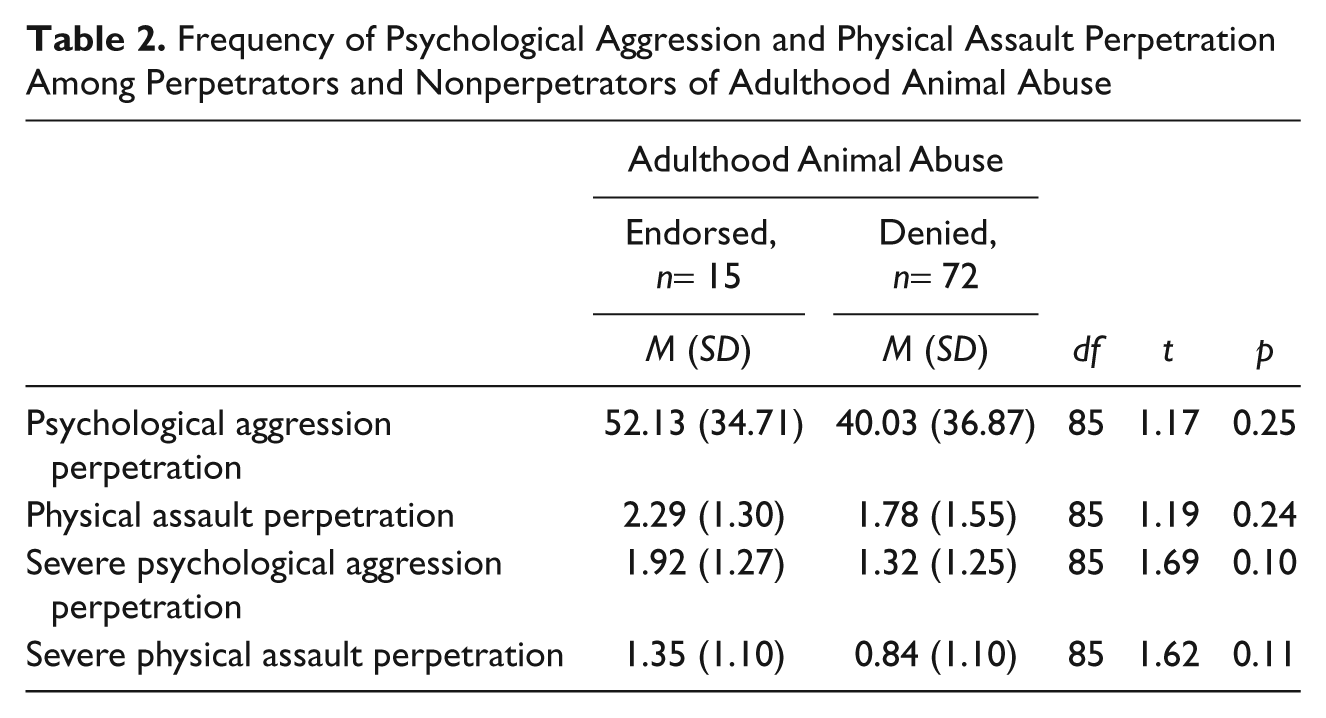
Next, t tests were run examining whether differences exist in the amount of IPV perpetrated between women who abused animals and women who did not (Table 2). There were no statistically significant differences in frequency of IPV perpetration (psychological and physical) between the women who perpetrated animal abuse and the women who did not abuse animals. Due to the relatively small sample, effect sizes (d) for group differences were examined. Effect sizes were in the expected direction, with animal abusers reporting more frequent psychological aggression (d = 0.34) and physical assault (d = 0.36) perpetration in their relationships than women who did not abuse animals. There was also a trend for differences in the frequency of severe IPV perpetration (psychological aggression, p = .10; physical assault, p = .11) between women who abused animals and women who did not. Furthermore, effect sizes were in the expected direction with animal abusers reporting more frequent severe psychological aggression (d = 0.32) and severe physical assault (d = 0.46) against their partners than women who did not abuse animals.
Frequency of Psychological Aggression and Physical Assault Perpetration Among Perpetrators and Nonperpetrators of Adulthood Animal Abuse
Discussion
The aim of the current study was to examine the prevalence of adulthood animal abuse perpetration and its relationship to IPV perpetration in women court-referred to BIPs. This is the first study to assess the prevalence of adulthood animal abuse in this population. In contrast to the 0.28% prevalence rate of animal abuse by women in the general public (Vaughn et al., 2009), adulthood animal abuse was overrepresented (17%) in this sample of women court-referred to BIPs. This is consistent with our hypothesis and existing literature showing an overrepresentation of animal abuse reported by men court-referred to BIPs (Febres et al., 2012) and provides preliminary evidence that aggression may be pervasive for some women who perpetrate IPV. Future research should examine the prevalence of adulthood animal abuse in samples of IPV perpetrators as this may provide additional insight into the nature of their aggressive tendencies and whether aggression may be a pervasive trait for some women.
With regards to specific acts of adulthood animal abuse that were endorsed in this sample, a variety of physically aggressive acts were reported, along with one act of neglect. Also, the item with the highest endorsement described threatening, scaring, intimidating, or bullying an animal. Previous research on male criminals has examined the relationship between specific types of childhood animal abuse committed and specific types of violence perpetrated against humans, and have found, for example, that similar methods of aggression persist across victim types (e.g., Merz-Perez, Heide, & Silverman, 2001). In contrast, in this study, analyses examining the relationship between specific types of adulthood animal abuse committed and specific types of IPV perpetrated were not indicated due to the preliminary nature of the ATAS and the relatively small number of participants reporting adulthood animal abuse in this sample (n = 15). Furthermore, it is foreseeable that a sample size of 15 would not afford the power to detect significant differences at this level of specificity. In the future, researchers should consider examining whether such relationships may exist in samples of female perpetrators of IPV in order to provide a fuller understanding of these individuals' aggression.
In addition, our prediction was partially supported in that animal abusers showed a trend toward moderately higher rates of overall and severe IPV than nonanimal abusers. Although larger samples may be necessary to detect a significant difference between groups on total IPV and severe IPV, our results indicate that adulthood animal abuse may be a marker for the presence of more frequent and/or severe IPV perpetration. Future research should attempt to elucidate whether and why these associations exist.
There are some important limitations to consider when interpreting the results of the current study. First, the size of the sample is relatively small and limited our ability to detect significant differences between groups. Future investigations should include larger samples. Second, full disclosure of sensitive information on such topics as animal abuse and IPV perpetration may be affected by impression management, particularly in a court-mandated sample. Subsequent studies should control for social desirability and obtain collateral information, including partner reports of aggression against humans and animals. Third, the measure of animal abuse (ATAS) does not distinguish between companion and noncompanion animals; it is plausible that there may be differences in individuals who harm companion animals and those who seek out other animals to harm. Furthermore, the measure does not assess when the animal abuse occurs; differences might be found between individuals whose perpetration of animal abuse occurs within a limited time frame versus individuals who continuously perpetrate aggression against animals. Therefore, the development of a measure of adulthood animal abuse that more comprehensively evaluates the construct is needed. Fourth, conclusions about causality among the study variables are precluded by the study's cross-sectional design. Longitudinal research is needed to determine the nature of the relationship between adulthood animal abuse and IPV. Last, the specificity of the population studied and the fact that the majority of the women identified as non-Hispanic Caucasian limits the generalizability of the findings to more diverse populations.
In summary, the current study adds to the emerging research on women arrested for IPV. This sample evidenced a high prevalence of animal abuse perpetrated as adults. Furthermore, those who reported committing animal abuse reported higher rates of psychological and physical IPV than those who denied committing animal abuse. These results suggest that the aggressive tendencies of some women who perpetrate IPV may extend beyond intimate partners and that aggression toward animals may signal more frequent and/or severe IPV perpetration. Continued research on the nature of aggression in the lives of women who perpetrate IPV is greatly needed in order to better inform interventions aimed at reducing aggression.
Footnotes
Author’s Note
The content is solely the responsibility of the authors and does not necessarily represent the official views of the NIAAA or the National Institutes of Health. The authors would like to thank Maya Gupta, PhD and Steven R. H. Beach, PhD, for the use of their unpublished measure of animal abuse.
Declaration of Conflicting Interests
The author(s) declared no potential conflicts of interest with respect to the authorship and/or publication of this article.
Funding
The author(s) disclosed receipt of the following financial support for the research and/or authorship of this article: This work was supported, in part, by grant K24AA019707 from the National Institute on Alcohol Abuse and Alcoholism (NIAAA) awarded to the last author.