



Abstract
In prior research, Ackerman and Field (2011) found that intimate partner violence (IPV) affects the relationship satisfaction of females more than the relationship satisfaction of males. The current research replicated those findings on a different sample of men and women. In addition to confirming past findings, it also found that gendered patterns in IPV differed substantially for current versus former relationships. Subsequent analyses indicated that gendered differences in whether relationships are continued or terminated after IPV apparently explained these patterns. The current analyses illustrate how relationship continuation differences across gender can produce sample selection biases that substantially affect conclusions about whether partner violence is perpetrated equally by men and women. More specifically, the results of this research are consistent with the conclusion that female IPV victims are more likely than are male victims to become dissatisfied with aggressive opposite-sex partnerships and subsequently terminate their aggressive relationships. For this reason, research that relies only upon the analysis of current relationships will underestimate the amount of partner violence committed by men.
For over three decades, and with few exceptions, findings from general surveys have documented an apparent gender symmetric perpetration of intimate partner violence (IPV) among dating, cohabitating, and married couples (Archer, 2000). Because a substantial number of scholars continue to question the symmetry findings, however, a rather contentious debate about gender symmetry continues (e.g., Kimmel, 2002).
Various critiques of gender symmetry all note that survey findings sharply contrast with police, medical, and shelter data, which indicate that IPV victims who seek social services are almost exclusively female. Beyond this concordance, however, critiques take various forms.
Some scholars entirely discount survey findings, often disbelieving the validity of self-reports about violent behavior (O’Leary, 2000). Other scholars accept that behavioral symmetry may exist in some ways, but argue that current widely used self-report instruments do not place aggressive behavior in context and do not focus on gendered differences in injury, fear, and other consequences that clearly are not symmetric (Currie, 1998). A third group of scholars suggests that IPV is not a unitary phenomenon and that survey data may be adequate to measure some forms of IPV but inadequate to measure others (Johnson, 1995). The current study is among the first to consider how the traditional focus on current (vs. prior) relationships affects this ongoing debate. More specifically, this study examines whether assessing IPV only among partners in current relationships will bias gender comparisons because men are more likely than women to stay in relationships in which they are victimized.
A recent study by Ackerman and Field (2011) was foundational for the current research. This prior work examined IPV’s effect on relationship satisfaction, an often ignored consequence of partner violence. Ackerman and Field’s study noted that in a sample of young adults, female participants who reported being slapped, hit, or kicked by their partners reported substantially lower satisfaction than did male participants who reported similar behaviors directed at them by women. Moreover, the lower satisfaction among the females appeared regardless of whether the event occurred within the context of a same- or opposite-sex relationship and after controlling for injury. Among females, IPV victimization was by far the strongest predictor of relationship satisfaction. For males, however, it was among the weakest. Age when starting a relationship, for example, was a stronger determinant of satisfaction than IPV for men.
Relationship Satisfaction and Continuation
Theoretical Foundation
Several IPV studies have provided a theoretical foundation upon which to examine issues of relationship satisfaction and continuation. In a longitudinal study of opposite-sex partnerships, Demaris (2000) found that male aggression increased the risk of divorce among married couples while female aggression had no appreciable effect. His study was framed by rational choice and social exchange theories (Homans, 1950; Thibaut & Kelley, 1959), which suggest that violence extracts various emotional and physical costs. Demaris suggested that these frameworks predict that the effect of IPV on relationship stability/continuation (as measured by marriage dissolution) is mediated by relationship satisfaction. His study supported this prediction.
Social exchange theory also emphasizes the importance of knowing how people attribute cause to the traumatic events they suffer and that individuals can attribute substantially different cost and reward values to the same experience depending upon their comparison level. People with high aspirations can be disappointed by outcomes that others with low aspirations find rewarding (Thibaut & Kelley, 1959). In a community sample of married couples, for example, Katz and colleagues (1995) found IPV to differentially predict divorce consideration among female victims dependent upon their attributional style. Applying these ideas to the current research suggests that men and women can attribute different costs to essentially the same experience (e.g., hitting). For this reason, similar IPV victimization may differentially impact male and female relationship satisfaction and subsequently produce dissimilar motivations in men and women to remain with aggressive partners.
Attributional differences, however, may have objective and subjective foundations. The same act of hitting, for example, can produce a very realistic and objective fear of future and potentially more serious violence in female victims than in males even in cases where the hitting was done with the same force by both male and female perpetrators. More subjectively, however, it is certainly possible that women are socialized to view aggressive acts as more problematic in relationships even when the aggression has objectively equal severity in a variety of ways.
Relationship Dissolution and IPV
Although research has frequently noted that victims of partner violence routinely maintain physically and emotionally harmful relationships to a surprisingly high degree (O’Leary et al., 1989; Rusbult & Martz, 1995), many victims do dissolve their aggressive partnerships. Some victims, however, are more likely to do so than others (Anderson, 2007; Katz et al., 1995).
The processes and effects of what some authors have termed “deselection,” the termination of friendship dyads, have been studied primarily in the interpersonal influence and social networks literatures (Billy & Udry, 1985). The IPV literature contains some discussion of issues related to selection biases in survey participation (e.g., Johnson, 1995; Waltermauer, Ortega, & McNutt, 2003) and deselection/dissolution of violent marriages (e.g., Sanchez & Gager, 2000). Unfortunately, however, there is no known work in the IPV field that addresses how the process of victim deselection from aggressive relationships may bias research based only upon current partnerships. More specifically, scholars of partner violence have given little consideration to how selective relationship dissolution can impact IPV prevalence estimates and whether this deselection differs across gender in ways relevant to the symmetry debate. Regardless of the reasons why victims differentially dissolve aggressive partnerships, if certain types of victims differentially leave aggressive relationships, then research samples based upon current relationships may not adequately generalize to all victims. If differential relationship termination occurs across gender, the selection mechanism may substantially impact analyses of gender symmetry that we obtain from research focused only on current partnerships.
We can see an example of the extent of this problem in the hypothetical case where all women are more negatively affected by opposite-sex partner violence than men in ways that cause all women to immediately terminate violent relationships while all men maintain their equally violent relationships. Under this scenario, data based only upon current relationships will indicate victimization only among males. Here, the extent of female victimization can only be detected by examining former relationships. Although clearly extreme, this illustration depicts that the differential degree to which women and men terminate violent partnerships may misrepresent the picture we obtain about IPV if information is gained from samples that include only current partnerships.
Overview of the Current Study
In sum, findings from prior research suggest the importance of understanding the degree to which IPV affects relationship satisfaction, which subsequently affects relationship termination. It also suggests understanding how this process might impact the results of IPV research based primarily on current relationships.
Toward this end, there were two primary goals of the current research: first, to compare IPV prevalence estimates for the men and women who reported about current relationships to a similar sample who reported about IPV in past dating situations; and second, to analyze models based upon the theoretical reasons why we might expect these differences to be present.
In performing these tasks, this research replicated the prior work of Ackerman and Field (2011) by examining the degree to which IPV differentially impacts male and female perceptions of relationship satisfaction using newly collected data on young dating adults in opposite-sex relationships. These data contained improved measures of IPV, relationship satisfaction, injury, and other important control variables. This research also replicated prior work by determining whether the injury measure in these new data explained gendered differences in the IPV/satisfaction association. Afterward, it extended prior research by examining IPV’s impact on expected relationship continuation. Next, it assessed the degree to which relationship satisfaction mediated that impact and how these associations differed across gender. To accomplish these latter tasks, the analytical models controlled for theoretically relevant variables associated with relationship satisfaction and relationship stability.
This study’s main hypothesis was that the ratio of male-on-female to female-on-male IPV prevalence substantially differs for current versus past romantic relationships. The reason to expect this difference is related to the gendered differences in how IPV affects relationship satisfaction, how satisfaction subsequently affects relationship stability, and how both ultimately affect relationship termination. Very clearly, if IPV does not substantially affect male perceptions of relationship satisfaction and end as many relationships where females have aggressed against males as relationships where males have aggressed against females, then current opposite-sex romantic relationships should contain greater numbers of aggressive female partners then aggressive male partners.
Method
Participants
The main participant group for this study was selected from kinesiology classes at a large South-Central public University (usable n = 170). Because the University required all students in all majors to complete two kinesiology classes before graduating, this procedure and a hypothetical full participation rate among students enrolled in these classes had the potential to produce a random sample of the University’s students who attended classes on recruitment days. Although the inability to recruit from every kinesiology class and the less than perfect participation rate did not produce an actual random sample of University students, the procedure did produce a sample more representative of the University’s students than typical convenience samples, which are often obtained from a more limited selection of students.
After a brief research presentation, students wishing to participate provided their names and email addresses. As a participation incentive, each participant was included in a drawing for one of two one hundred dollar gift cards. Unfortunately, the degree to which the potential for financial reward influenced our sample selection cannot be known, primarily because no data were collected from nonparticipants other than a count of how many there were. We can, however, characterize the families of origin of the students at this university as having approximately the same mean income with approximately the same variation as the state’s average. This level is not dissimilar from other states in the region, but is lower than states in the Northeast. For these reasons, there is no reason to suspect that the offer of financial reward influenced our sample any more or less than it would at other universities.
The main sample was supplemented by several deliberatively chosen student samples from three of the University’s sororities (usable n = 129), from introductory sociology classes (usable n = 86), and from those attending a presentation on dating violence sponsored by the campus women’s center (usable n = 73). The sorority women were recruited as a presumed high-frequency dating group. Because this university had a large and organized woman’s sorority system and a small male fraternity system, the study did not recruit a separate supplemental sample of fraternity men. Fraternity members were, however, included in the general sample by chance selection.
The students enrolled in the introductory sociology classes were filling general educational requirements and represented students from across all majors. The women’s center presentation was attended by students desiring extra credit in a variety of other university classes. For these reasons, students recruited from these two sources were also representative of the overall student population as further evidenced by the fact that the racial/ethnic distribution, class standings, and other demographic differences were similar across samples and to the University’s overall student population (e.g., the overall sample and each subsample was approximately 77% White, 3.8% Black, 12.3% Hispanic/Latino, 2.2% Asian, and 3% Other, which closely matched the University’s student demographics). The supplementary samples were collected for a different analysis, but because the each samples’ demographics and the subsequent results of our models did not substantially differ across the various samples, they were analyzed and presented together to increase statistical power.
Procedure
This research used a computer assisted survey information collection (CASIC) method (Weeks, 1992) that relied upon proprietary programming developed specifically for this and similar projects where restricted access, email contact, and complex skip patterns are necessary. After recruitment, each participant was emailed instructions about completing a 20 minute online survey. The emails contained a web site address with embedded credentials that permitted each participant to complete one survey. If a participant did not complete the survey within a few days, the site sent up to three reminder emails over the next several weeks.
Participants who visited the site after receiving their instructional email acknowledged standard implied consent information and were asked basic demographic questions. If participants were unsure about question intent, they could select a button labeled, “More Info.” They also had the option of leaving written open-ended comments about each question. An examination of these comments and the knowledge that few participants failed to complete the survey after visiting the site provided confidence that the participants understood the intent of the questions and the response categories.
The research team offered participation to 956 students, emailed 833 students who initially agreed to participate, and 586 students subsequently completed surveys (a 70.3% rate of completion after initial agreement to participate). The site diverted married students (n = 18), engaged students (n = 31), and those who had not dated since high school (n = 49) to alternative questions that were used for purposes unrelated to the current research. These groups were excluded from the current analysis. Students who reported about same-sex relationships (n = 7) and those who did not complete a usable survey (n = 30) were also excluded. These exclusions resulted in a final sample size of 458. The final sample size represents 54% usable surveys from the 851 potential participants we attempted to enroll who would have been eligible for inclusion in the models specific to this manuscript (956 minus 18 married, 31 engaged, 49 no dating, and 7 same-sex = 851).
Participants who had dated were given the following instruction, “When answering the rest of our questions, think about the most important romantic relationship or date since your high school graduation, regardless of whether or not the relationship ended on good or bad terms.” The participants were also told, “If you’ve never had a relationship you consider important, think about the date or potential romantic partner you spent the most time with, dated most often, or would like to have dated more.” Participants who desired more information about this question were provided the following additional information,
By “important,” we mean the person with whom you had the most significant relationship or felt the closest emotional connection. This does not have to involve your current relationship and you do not have to feel the same way now.
The next question was, “Are you currently in your most important relationship, or was this in the past?” Students who indicated that they would discuss their current relationship were directed to a set of questions worded in present tense and intended to apply to ongoing dating. Students who indicated they would discuss a past relationship were directed to a similar set of questions worded in past tense.
Both question sets inquired about relationship satisfaction and various IPV events equivalent to those measured by the conflict tactics scale (CTS, Straus, 1979) and similar instruments. The exact question wording was determined after considering student feedback during pretesting. For current relationships, the survey inquired about when the relationship began. For prior relationships, the survey inquired about how long it lasted. These were used to construct a measure of relationship length.
At the end of the IPV questions, the instrument asked whether any other type of event occurred that, “caused physical injury, another type of harm, or was relatively serious in another way?” For participants who endorsed any of the attempted or actual physical aggression measures, we provided the optional ability to describe what occurred. These two features provided a check about the inclusiveness of our IPV items and (in conjunction with the ability of the participants to provide optional comments on each question) the ability to determine the extent to which participants may have provided answers inconsistent with question intent.
For reasons related to another study, the participants were divided randomly across five separate but related survey instruments that presented the IPV items in slightly different ways. For example, one instrument first asked whether or not an event occurred before asking about how often it occurred. A different instrument more closely followed the CTS method of providing event-frequency response categories with never being a possible response. Other manipulations across instruments varied the introductory statement participants were presented prior to the IPV items and varying whether or not each participant was asked about their own aggressive behavior in addition to aggression directed toward them by their partner. Because responses did not substantially differ across survey versions in ways that would affect the current analyses (because the participants were randomly assigned different survey versions), this added complexity does not affect the results of the present research.
Measures
Relationship satisfaction
Relationship satisfaction was a four-item index. Each item inquired about agreement with the following statements: (a) we enjoy doing ordinary day to day things together, (b) I am satisfied with the way we handle our problems and disagreements, (c) my partner listens to me when I need someone to talk to, and (d) in general, how happy are you with the relationship. Participants answering about prior relationships were given nearly identical questions using past tense terminology and were asked to answer in regard to the relationship near the time it ended. The first three items were scored as a 5-point Likert response ranging from strongly agree to strongly disagree and the last item as a 4-point response ranging from very happy to very unhappy. The items were coded so that high satisfaction was given the highest value and summed so that the final index had a possible range of values from 5 to 20.
Partner violence
Partner violence was a six item summative measure roughly equivalent to an abbreviated version of the physical aggression scales of the CTS. Following traditional CTS instructions and the procedures that are most often used in both IPV instruments and measures of general crime and delinquency, we dichotomized each item (event occurred = 1, event did not occur = 0) prior to summing. Because there were few cases of serious violence in our sample, we used a single IPV scale rather than separate minor and serious scales as found in the CTS. The six IPV items were (a) throwing something that could hurt, (b) slapping, (c) pushing/shoving, (d) punching/hitting, (e) threatening to hit or throw something, and (f) using a gun or knife. Although the possible range of values was 0 to 6, no participant endorsed more than 5 items. In addition, no participant described alternative physically violent victimizations in response to our open-ended questions nor with the optional comments. Because the study addressed young adult dating during times when relationships are often of short duration (e.g., the mean duration for both men and women was just over one year), and because our primary purpose was not the precise estimation of yearly prevalence rates, the survey asked about IPV over the entire relationship. Relationship duration was used as a control in relevant models.
Expected relationship continuation
This was a single item based on the question, “Will you still be dating this partner one year from now?” It was a 6-point Likert response with a possible range of values from 1 (definitely not) to 6 (definitely) This item was presented only to participants who were reporting about current relationships.
Relation duration
Relationship duration/length was measured by asking each participant how long ago their relationship started (for current relationships) or how long it lasted (for prior relationships). It was measured in months. Most research suggests that relationship satisfaction tends to decrease shortly after relationship initiation. As time in the relationship increases, satisfaction drops to a low point near the temporal middle of the affiliation but increases as the relationship matures (Spanier & Lewis, 1980). Controlling for relationship duration is particularly important in this research because longer durations necessarily provide an increased opportunity for IPV to occur and for relationship satisfaction to decrease. In other words, both IPV and satisfaction are known correlates of duration.
Injury
Participant injury was a summative measure comprised of four items that inquired about (a) physical pain, (b) bruises, (c) seeing a physician, and (d) needing to see a physician but not going. As mentioned above, one purpose of this research was to replicate prior research by determining whether men’s ability to cause more injury explains why the association between IPV and relationship satisfaction is stronger among women than among men. This scaled measure of injury is superior to that used in Ackerman and colleagues’ prior work because the current measure is based upon four items rather than one and also includes a measure of pain without actual physical injury. As in the IPV measure, the auxiliary open-ended questions and the ability for participants to leave comments about each form of injury provided no other types of physical injury inflicted upon these participants. For this reason, the injury scale had a range of values from 0 (no injury or pain) to 4 (all items endorsed).
Greek member
This was an dichotomous indicator (0 = no, 1 = yes) of whether the participant was a member of a social fraternity or sorority and included participants recruited as part of the sorority sample.
Cohabitation
This was a dichotomous indicator (0 = no, 1 = yes) representing whether the participant was cohabitating or not. We included this measures because cohabitation necessarily increases the opportunity for IPV and may alter the association between IPV and satisfaction in other ways (Kenney & McLanahan, 2006).
Minority
Minority was a variable representing whether the participant self-identified as White or in one of our other racial/ethnic categories. The low percentage of Black/African American students enrolled at the university (n = 18 in the final sample, with some gender/relationship-categories having zero) did not permit a statistical comparison across different ethnic groups in most analyses. For this reason, and because potential differences in satisfaction across race was not a primary research focus, we dichotomized the measure by coding White participants as zero and Non-White participants as one.
Participant age
Age was measured in years. Age is a well-established correlate of aggression and of relationship satisfaction (e.g.,Hirschi & Gottfredson, 1983; Karney & Bradbury, 1995).
Models
The results relevant to this research include descriptions about how IPV differs across gender and across the current versus past status of relationships. First, separate IPV prevalence estimates were computed for prior and current romantic partnerships to compare whether these estimates differed from each other and the ways they differed across gender.
Next, regression analyses were run to explore whether (and why) results about the effect of victimization on relationship satisfaction and on relationship continuation differed across gender. Although the somewhat limited range of the dependent variables may suggest the use of more complex forms of regression, alternative but more complex models produced similar results for the gender comparisons that were of primary interest in the present research. For this reason, and because the primary purpose of the current work does not include a precise estimation of the regression coefficients, this research followed procedures similar to that used in Ackerman and Field’s (2011) prior research. Specifically, the results are presented using ordinary least squares regression. The presentation of results from more complex models would be difficult to interpret and certainly beyond that necessary for the current research given the level of precision inherent in the current data (e.g., a main point of this paper is that we can produce different prevalence/incidence rates and regression coefficients depending on whether current or former relationships are considered).
Because the gender by victimization interaction was statistically significant for the models presented in Tables 3, 4, and 5 (p = .03, p = .04, p = .04) these tables present separate models for males and females. This was done as an alternative to a single model with interaction and main effects terms to aid interpretation.
The first regression analysis for each gender regressed relationship satisfaction on IPV victimization while simultaneously accounting for all controls other than injury. Injury was subsequently added to determine whether the ability of men to cause more injury explained gendered differences in the IPV/satisfaction association. This was done separately for prior and current romantic relationships.
The current analyses extend Ackerman’s prior work by examining models where expected relationship continuation was regressed on IPV for current romantic relationships using appropriate control variables. This was not possible in prior work because the data used in that research did not have a measure of expected or actual relationship continuation/termination. Relationship satisfaction was subsequently added to the base models to determine the degree to which relationship satisfaction mediated the IPV/continuation association. Together, these various models illustrate the presumed causal sequence that leads IPV to affect relationship termination for female and male IPV victims.
Results
Table 1 provides descriptive statistics about the participants and lists males and females separately. The rows provide the mean, standard deviation, and range of values for each of the variables in the regression models with the exception of rows labeled (%). In those cases, columns labeled “mean” represent the percentage of participants classified within the category. There were 107 males and 351 females reporting about opposite-sex relationships. Married and engaged students and those who had not dated since high school were not included in this table nor in subsequent analyses.
Descriptive Statistics

Actual range of values in these data, the scale potentially ranges from 0 to 6.
Actual range of values in these data, the scale potentially ranges from 0 to 4.
The high percentage of female students who were sorority/Greek members (38.2%) reflects the inclusion of our supplementary sorority sample. The percentage of minority participants (20.6% for men and 24.2% for women) is in line with the overall racial/ethnic breakdown of the University as mentioned earlier. The average age (around 20.5 years) is also consistent with university averages.
The percentage of students who reported about current relationships was 41.1% for men and 52.7% for women. Around 10% of each gender reported cohabitating. Relationship duration averaged 15.1 months for men and 16.6 months for women. Of particular interest, reports of relationship satisfaction for current relationships were very close for male and female participants (a mean of 17.5 for men and 17.9 for women). Satisfaction was predictably lower for prior relationships than for current ones, but again, these reports were quite similar across gender (15.2 for men and 14.1 for women).
The 29.9% overall prevalence rate for male victimization and 15.7% prevalence rate for female victimization is not surprising because aggressive behavior in general, and IPV more specifically, is known to be more frequent among young adults than among older individuals (Hirschi & Gottfredson, 1983; Straus, 2004). These rates were in line with those of prior studies measuring young adult samples with CTS scales (e.g., Straus, 2004).
Gendered differences in injury prevalence due to IPV victimization was also consistent with prior research, in that far more females than males are injured during an IPV event (1.9% for men and 6.3% for women). The IPV victimization scale presents an alternative measure to the dichotomous IPV prevalence measure by presenting a summative scale ranging from no reported IPV events to a maximum of five different forms of partner violence that the participant reported being perpetrated against them. The regression models in Tables 3, 4, and 5 use this scaled IPV measure. Consistent with prior research on young adult samples as well as the previously mentioned IPV prevalence measure, males reported more IPV than women (a mean of .5 for males and .3 for females).
Table 2 presents IPV prevalence rates and the means on the IPV scale for the current and prior relationships for the male and female participants. This table clearly indicates that the gender ratio of IPV is substantially different for current and prior relationships. Of the young men who reported about current relationships, 36.4% reported IPV. Of the young women who reported about current relationships, 11.4 reported IPV. The current relationship findings are not inconsistent with prior research that almost always examines current relationships and routinely shows that males report more IPV victimization than women. In sharp contrast, however, when examining prior relationships, a different picture emerged. Here, 25.9% of the females reported victimization compared to 18.1% of the men. Similar findings occurred when examining the victimization scale. The men reported a higher average number of victimizations for current relationships than did women (.57 for men versus .19 for women). For prior relationships, however, the women reported more (.39 for women and .23 for men).
IPV and Demographic Differences for Current and Prior Relationships

Note: Male vs. Female Victimization Prevalence, Current Relationships χ2 = 16.4, p < .01; Male vs. Female Victimization Prevalence, Prior Relationships χ2 = 12.4, p < .01; Male vs. Female Victimization Scale, Current Relationships χ2 = 21.2, p < .01; Male vs. Female Victimization Scale, Prior Relationships χ2 = 11.2, p < .01.
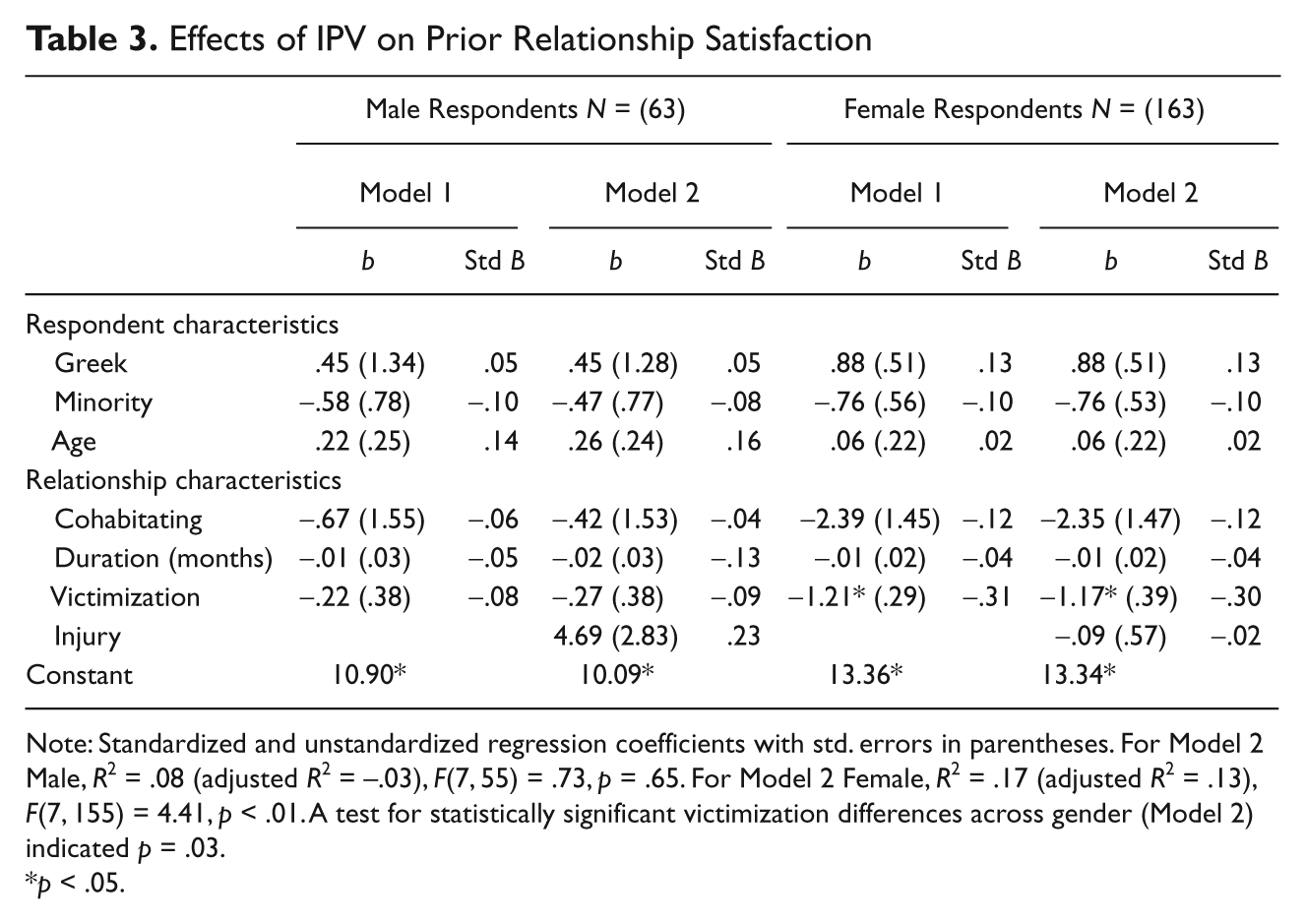
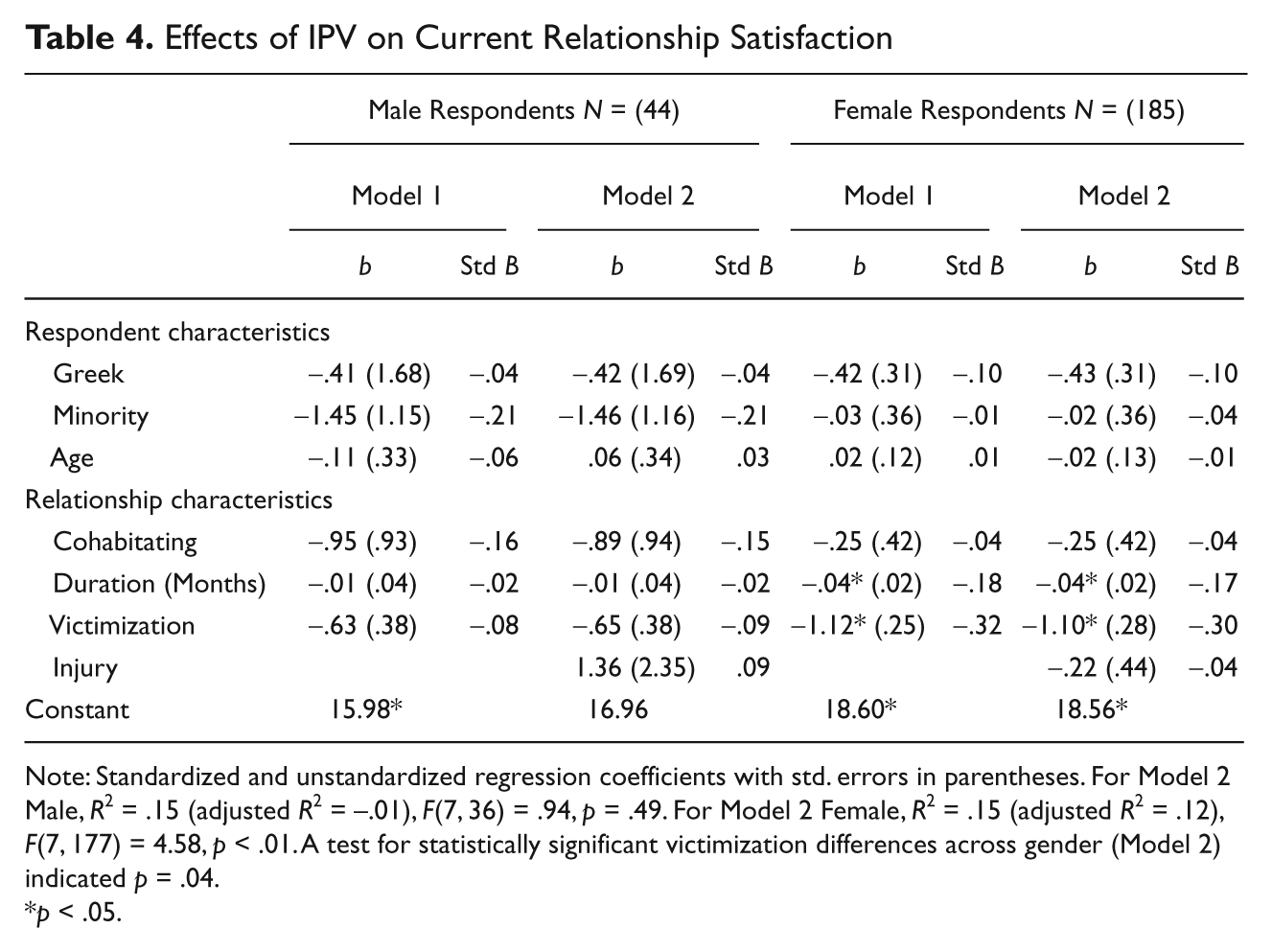
Tables 3 and 4 provide the results of the first sets of regression analyses, which were primarily designed to replicate Ackerman and Field’s prior research using a different sample of young adults. Table 3 presents IPV’s effect on relationship satisfaction for the participants who discussed prior relationships and Table 4 presents these effects for participants who discussed current relationships. As mentioned earlier, the gender by IPV interaction indicated statistically significant gender differences for the effect of IPV on the dependent variable in all models. Rather than presenting more complex models containing the interaction terms, however, these tables present separate male and female models to aid interpretation.
Effects of IPV on Prior Relationship Satisfaction
Note: Standardized and unstandardized regression coefficients with std. errors in parentheses. For Model 2 Male, R2 = .08 (adjusted R2 = –.03), F(7, 55) = .73, p = .65. For Model 2 Female, R2 = .17 (adjusted R2 = .13), F(7, 155) = 4.41, p < .01. A test for statistically significant victimization differences across gender (Model 2) indicated p = .03.
p < .05.
Effects of IPV on Current Relationship Satisfaction
Note: Standardized and unstandardized regression coefficients with std. errors in parentheses. For Model 2 Male, R2 = .15 (adjusted R2 = –.01), F(7, 36) = .94, p = .49. For Model 2 Female, R2 = .15 (adjusted R2 = .12), F(7, 177) = 4.58, p < .01. A test for statistically significant victimization differences across gender (Model 2) indicated p = .04.
p < .05.
Both tables list unstandardized and standardized regression coefficients with the standard errors in parentheses for each variable. Model 1 for each gender in both tables represents the base model that included all variables other than injury. Model 2 added injury to the analyses.
The most important aspects of Tables 3 and 4 are that the findings are quite similar to Ackerman’s prior research. Most substantially, for both the prior relationships in Table 3 and the current relationships in Table 4, male relationship satisfaction was far less affected by IPV victimization than female relationship satisfaction. For prior relationships, a one unit increase in victimization produced a .22 unit decrease (not significant) in satisfaction among the males, but a 1.21 unit decrease (p < .05) among the females. A similar pattern occurred for the current relationships in Table 4. Here, a one unit increase in male victimization produced a .63 unit decrease (not significant) in satisfaction but a 1.12 unit decrease (p < .05) among the females. Like the prior research, the effect of IPV on relationship satisfaction among the young women was two to five times that of the young men. The standardized coefficients also show results similar to the prior research. As in prior findings, IPV victimization was the strongest predictor of satisfaction in both tables for the females. In contrast, victimization was a weak (and non significant) predictor of satisfaction for the males.
Again confirming the prior research, gendered differences in injury did not explain why female satisfaction was much more affected by IPV than male satisfaction. Adding the injury control to the second female model in both tables produced very little decrease in the magnitude of the IPV effect for the females. An important point to note about the injury control for the males is that the male coefficients are based upon a small number of male injuries. For this reason, the positive (but nonsignificant) coefficient for injury is not reliable.
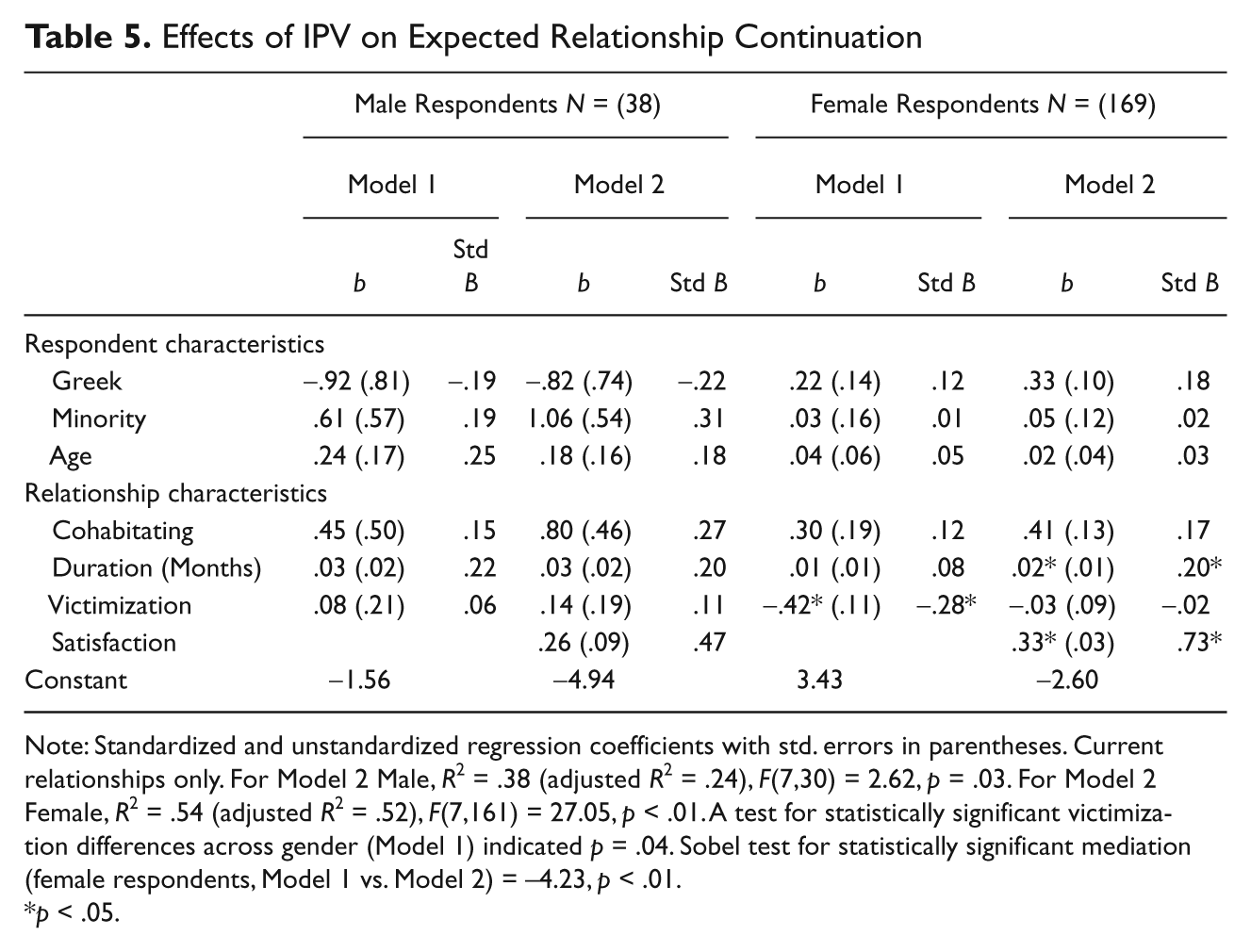
Table 5 provides results that could not be included in Ackerman and Field’s prior study due to data limitations. The models in Table 5 regressed expected relationship continuation on IPV among participants who were reporting about current relationships. The first model for each gender included all control variables other than satisfaction. In a manner parallel to the findings in the prior tables, IPV victimization in these first models had a much stronger effect on expected relationship continuation for women than for men. The standardized coefficient for victimization among women was –.28 (p < .05), which was much higher than the .06 (not significant) indicated for the men. The standardized coefficient for victimization among women was the strongest predictor in the first model. In contrast, IPV victimization for men was the weakest predictor of expected relationship continuation in the first model.
Effects of IPV on Expected Relationship Continuation
Note: Standardized and unstandardized regression coefficients with std. errors in parentheses. Current relationships only. For Model 2 Male, R2 = .38 (adjusted R2 = .24), F(7,30) = 2.62, p = .03. For Model 2 Female, R2 = .54 (adjusted R2 = .52), F(7,161) = 27.05, p < .01. A test for statistically significant victimization differences across gender (Model 1) indicated p = .04. Sobel test for statistically significant mediation (female respondents, Model 1 vs. Model 2) = −4.23, p < .01.
p < .05.
The second model for both the male and female participants in Table 5 added the relationship satisfaction control. Here, we see that satisfaction very substantially mediated the association between IPV victimization and expected relationship continuation among the women. For the women, the unstandardized coefficient for victimization decreased from –.28 (p < .05) in the first model to –.02 (not significant) in the second model.
Discussion
This study illustrates a problem that can occur when IPV research examines only current relationships without considering violence that occurred in prior partnerships. It elaborates upon prior claims that men are not “as bothered” by their female partner’s aggression (Dobash & Dobash, 1979). It also elaborates upon prior work by showing that the attenuated male concern about female aggression not only produces fewer effects on relationship satisfaction among the males, but also produces less substantial effects on expected relationship continuation (and presumably actual relationship termination). The logical implications of these findings are that males are much more likely to maintain romantic relationships with aggressive female partners than are females to maintain similar relationships with aggressive males. For this reason, cross sectional research that addresses IPV only among current couples is likely to provide somewhat misleading information about gender symmetry and potentially about other aspects of IPV. Because victimized females are more likely to terminate relationships than are victimized males, a lower percentage of victimized women will be found in research samples that address IPV only among currently dating couples. The fact that young men do not seem as “bothered” by aggressive women and do not appear to terminate relationships with them implies that there will be more men reporting about aggressive women in this type of research. Evidence supporting those logical implications is well illustrated by comparing victimization prevalence in current and prior relationships.
We can only speculate about the reasons for the apparent gendered differences in aggression tolerance and the accompanying attenuated relationship satisfaction found among female victims in this study. Perhaps males are conforming to norms of stoicism (e.g., Felson & Outlaw, 2007), which discourage admissions of unhappiness. Although possible, if this explanation is accurate, it is difficult to determine how the findings regarding higher rates of male (vs. female) victimization among current relationships and lower rates of male victimization among prior relationships fit this possibility. If the stoic explanation were feasible, it seems likely that victimization rates among males would be relatively equal for current versus past relationships with only the female rates changing between current and past partnerships.
Another possibility is that when men get hit, they may not feel as much pain as women. While this was more plausible in Ackerman and Field’s prior research that was based on a single IPV item and a single item measuring injury, the findings in the current research were based upon a multiple item IPV scale as well as a scale of injury that included, having pain the next day. Although it remains possible that this more accurate measure of pain and injury still fails to capture important elements about aggression seriousness in romantic partnerships, the current study indicates that accounting for injury (and pain) differences does not explain the victimization/satisfaction association in these data and thus does not support a differential pain explanation. Yet another possibility is that males are simply socialized to be more physically aggressive and to tolerate, expect, and perhaps even elicit similar aggression from others. This may make them less fearful of aggression and less likely to terminate relationships due to aggression directed against them. A closely related issue concerns potential differences in the social meaning of intergender violence. For example, a woman who slaps a man for expressing physical affection prematurely may gain his respect and increase her perceived attractiveness. In contrast, a man slapping a woman for expressing similar affection, besides being unlikely in this situation, will certainly not have the same effect.
A final explanation is that there is something else different about men’s aggression toward women that is not captured by the questions and response categories in these (and similar) survey data. In other words, perhaps participants’ endorsements of CTS type items should not be taken at face value. For example, perhaps the meaning and response patterns for these questions may differ in important ways across gender that have yet to be determined.
Regardless of the reasons why IPV does not affect male relationship satisfaction and expected relationship continuation to the degree it affects females, it seems relatively clear that prior characterizations of women as being passive in the face of IPV (e.g., Walker, 1978) may not be as accurate as characterizations that depict female IPV victims as motivated to remove themselves from aggressive and/or unsatisfying relationships when feasible and in their best interests (e.g., Gondolf, Fisher, & McFerron, 1990).
Limitations
Before concluding, it is advantageous to discuss the limitations of the current study. First, these data were collected from a single university. For this reason, the current participant sample cannot produce results that are necessarily representative of this country’s college student population. Similarly, the results may not generalize to young adults who do not attend college nor to older individuals.
Second, these data are not experimental or longitudinal and therefore cannot more definitively show that the associations illustrated in the regression models are causal. It is difficult, however, to reconcile the patterns of results with something other than a causal interpretation.
Third, the present analyses rely upon the participants’ retrospective reports for many items while also asking them to predict the future course of their relationships. This may create reporting biases of unknown degree. Similarly, the participants self-selected to report about a current or about a former relationship, and this selection may have created unknown biases. For this reason, future research should measure current and prior partnerships for each participant.
Fourth, although participation rates were moderately high for survey research, it remains possible that the most aggressive individuals refused participation. More aggressive participants (or males more generally) may also be more motivated by social desirability factors that limit the degree to which they accurately report antinormative behavior. We might expect, however, that if the most aggressive individuals do self-select out of survey participation, as some prior work has suggested, the current results would simply represent conservative estimates of actual gender differences.
Fifth, the survey upon which this work relied had limits upon the number and types of aggressive behavior it measured. Although the auxiliary open-ended questions and comments included in the survey design improved upon past strategies, it may still be more likely for a participant to endorse victimization items when specifically asked, than to volunteer information about additional forms of victimization in open-ended question construction. For this reason, the survey may have missed several important forms of IPV. However, while there have been several discussions about including and excluding certain forms of violence in the prior literature (e.g., Kimmel, 2002), the consensus suggests that the majority of exclusions involve the types of violence committed by men against women (e.g., sexual assaults, which were not measured in this study). Again, this prospect suggests that the current pattern of results provides a conservative estimate of the real gender differences in the effects of IPV on relationship satisfaction and termination and thus on the different ways that IPV is experienced by men and women.
Conclusions
The results presented here strongly suggest that if scholars concentrate their research only upon current relationships, they may produce misleading findings about gender symmetry and potentially about IPV more generally. This will occur because current relationships, at least among young unmarried adults, will likely be affected by a selection bias that will produce a greater number of relationships consisting of aggressive females partnered with males who are far less likely to be “bothered” by that aggression as well as a greater number of males who have not yet aggressed against women. The implications for future research seem clear. Even after a multidecade scholarly debate regarding how to best conceptualize about and measure IPV, there remain many methodological issues to resolve.
Footnotes
Acknowledgements
The author wishes to thank Claire Renzetti, Michael P. Johnson, and Richard B. Felson for helpful editorial commentary on an earlier version of this article. He also thanks the anonymous reviewers for comments and helpful examples used in the discussion.
Declaration of Conflicting Interests
The author(s) declared no potential conflicts of interest with respect to the research, authorship, and/or publication of this article.
Funding
The author(s) received no financial support for the research, authorship, and/or publication of this article.