



Abstract
During the past 50 years, there has been an increase in research and programming initiatives focusing on the issue of heterosexual intimate partner violence (Het-IPV). In comparison, less attention has been paid to same-sex intimate partner violence (SS-IPV). Furthermore, of the existing research, the majority focuses on SS-IPV incidents in the United States which, due to social and legal differences, cannot yield an accurate picture of SS-IPV in Canada. This descriptive study sought to understand the prevalence, characteristics, and types of SS-IPV and Het-IPV within a Canadian context, with an emphasis on understanding the differences and similarities of incidents reported to police services. It explores the influences of heteronormativity and hegemonic masculinity on SS-IPV reporting and recognition. To assess this, data from Statistics Canada’s 2007–2011 Uniform Crime Reporting (UCR) Surveys were utilized. Participation in this survey is mandatory for all police services and, therefore, the sample used contains over 99% of incidents of IPV reported in Canada during the 4-year period (N = 346,565). The results indicate that 4% of incidents of intimate partner violence reported to the UCR involved people engaged in same-sex relationships. It demonstrates that SS-IPV incidents are similar to Het-IPV incidents in reported prevalence, and the findings also show that there are differences in the types of violations reported and several incident characteristics, including levels of victim injury, and the population density of the offense location. These findings can provide a foundation for future research and raise further questions about how SS-IPV is responded to by the criminal justice system after it has been reported to police services.
Keywords
Over the past 50 years, public perceptions of intimate partner violence (IPV) have changed slowly but significantly. There has been an increase in research and programming initiatives focusing on the issue of IPV as a crime and a public concern rather than a private matter (Balsam, 2001). However, this increased attention has predominantly focused on heterosexual IPV (Het-IPV). 1 To date, comparatively less research on same-sex IPV (SS-IPV) 2 exists (Burke et al., 2002; Duke & Davidson, 2009; Gehring & Vaske, 2017; Goldberg & Meyer, 2013; Hoyle, 2007; Messinger, 2014; Murray & Mobley, 2009), and this is particularly true for Canadian research (Furman et al., 2017; Ristock et al., 2017).
The majority of the existing research on abuse within same-sex relationships has focused on determining prevalence (Oringher & Samuelson, 2011; Tesch et al., 2010) and barriers to reporting of IPV incidents (Calton et al., 2016, Guadalupe-Diaz & Jasinski, 2017). However, this growing body of research has yielded inconsistent estimates of the extent of the problem (Gehring & Vaske, 2017) and placed less emphasis on understanding the types of SS-IPV that occur. Researchers have argued that the comparatively slower growth of SS-IPV research is a result of discrimination against same-sex communities and the widespread perception, by service providers, researchers, and same-sex individuals, that IPV occurs only with male abusers and female victims (Guadalupe-Diaz & Jasinski, 2017; Murray & Mobley, 2009). This cyclical issue has resulted in fewer public policies and programming initiatives that address SS-IPV, which in turn has hindered data collection and research (Murray & Mobley, 2009).
Similar to studies of Het-IPV, the majority of research examining SS-IPV incidents focus on samples from the United States. However, Canadian views and legal approaches toward same-sex relationships differ from some of the U.S. counterparts. For example, in Canada, same-sex marriage has been legally acknowledged since 2005. In contrast, the U.S. Supreme Court found that state-level bans were unconstitutional 10 years later in 2015 (Obergefell v. Hodges, 2015; Statistics Canada, 2015; Widiss, 2016). Legally recognizing same-sex marriage may be viewed as a way of reducing or eliminating homophobia within the legal system (Smith, 2005). Greater societal and legal acceptance of same-sex partnerships has the potential to play a role in enhancing the services available to and for victims when seeking help (Fray-Witzer, 1999). The U.S. legalization of same-sex marriage may alter societal and legal acceptance over time; however, currently, it may not always be possible to draw analogies between the U.S. and Canada.
Another limitation faced by many studies of both Het-IPV and SS-IPV is the difficulty in locating representative or large samples (Hester et al., 2010; Messinger, 2014; Turell, 2000). There is no known sampling frame of individuals involved in same-sex relationships or SS-IPV victims, and studies of SS-IPV often rely on the victim or offender to self-identify. As a result, many studies have utilized convenience samples recruited at same-sex events, through partnership with community organizations via on-site recruitment or use of member email lists (e.g., Hassouneh & Glass, 2008; Wathen et al., 2018), geospatially specified advertising on social media (e.g., Delle Donne et al., 2018), administrative data (e.g., Messing et al., 2018), or time-location sampling (e.g., Friedman et al., 2018), to promote representativeness. However, a limitation of several of these approaches to sampling is that the insights yielded by them may focus on individuals who more frequently access same-sex venues, and thus may emphasize the experiences of younger or more “out” same-sex individuals (Messinger, 2014).
Theoretical Framework
Traditional IPV research has used feminist frameworks and social constructs of gender inequality to explain IPV as a crime that is frequently perpetrated by men against women (Dobash & Dobash, 1979; Hoyle, 2007; Johnson & Dawson, 2011; McClennen, 2005; Ristock, 2002). However, as a result of the emphasis on the domination of men over women, these approaches cannot adequately describe abuse between same-sex partners (McClennen, 2005). For example, it is argued that the concept of patriarchy alone cannot explain instances of abuse that occur between women (Hoyle, 2007). Similar to heterosexual relationships, same-sex relationships may also have diverse and dichotomous roles with both a dominant and a submissive partner. As noted by Stark and Hester (2019) aspects of coercive control, a combination of psychological, physical, and/or sexual abuse causing the victim to feel a loss of freedom may also be present in same-sex relationships. This may manifest through “relationship rules” in which one partner assumes a position of power and decides the terms of the relationship while the other partner abides by the rules and undertakes emotional responsibility within the relationship (Donovan & Hester, 2014; Stark and Hester, 2019). In short, heterosexuality is not the only form of intimate partner relationship in which this power imbalance can occur (Little & Terrance, 2010). Therefore, to better explain SS-IPV, feminist frameworks can be combined with additional theoretical approaches, including concepts of hegemonic masculinity, heteronormativity, and heterosexism as factors that may influence the frequency and nature of SS-IPV incidents (Donovan & Hester, 2014; Stark and Hester, 2019).
Hegemony is an understanding or worldview that is so dominant that people will often have difficulty conceiving alternative perspectives (Deutschmann, 2007). Kinsman (1996) applied the concept of hegemony to sexual orientation by linking struggles over sexual relations to conflicts between social classes and coined the term “hegemonic masculinity” (Deutschmann, 2007; Kinsman, 1996). It draws attention to prevailing views that support the dominance of heterosexuality over other sexual orientations and incorporates the concepts of heterosexism and heteronormativity.
Hegemonic masculinity reinforces the legitimacy of patriarchy and the dominant role of men within society (Hearn, 2012). The concept focuses on strength, authority, control, and aggressiveness as ideal masculine attributes frequently associated with heterosexuality and homophobia (Jeffries & Ball, 2008; Kay & Jeffries, 2010). Those in same-sex relationships, particularly males, challenge this viewpoint. As a result, male same-sex masculinity is viewed as subordinate to heterosexual masculinity, and same-sex men are often dehumanized or portrayed as weak and feminine (Kay & Jeffries, 2010). This perspective may be a factor that contributes to violence, including against intimate partners, among same-sex populations. According to Kay and Jeffries (2010), some same-sex men may choose to challenge their subordinate position in society by engaging in IPV. Assaults may be viewed as an act of retaliation or a method of asserting manhood that would otherwise be negated or undermined as a result of the offender’s sexual orientation (Kay & Jeffries, 2010; Kwong-Lai Poon, 2011). Similarly, Milletich et al. (2014) argue that incidents of female SS-IPV may occur because females also experience feelings of inadequacy or lack self-worth as a result of identifying as a sexual minority. Furthermore, they argue that women who are in same-sex relationships, but do not identify themselves as lesbian or bisexual, are more likely to abuse their female partners and relate this to internalized homophobia.
In conjunction with hegemonic masculinity are the ideologies of heteronormativity or heterosexism, societally influenced views of heterosexual relationships as a representation of the norm in the broader culture and as superior to same-sex relationships (Banks, 2003; Van Eeden-Moorefield et al., 2011). Peterman and Dixon (2003) view heterosexism as a “social disease” and note its pervasiveness within contemporary families, media, and social service providers. Similar to the concept of hegemonic masculinity, individuals experiencing SS-IPV relationships may be influenced by heteronormativity and heterosexism. These ideologies dichotomize heterosexual and same-sex relationships as well as males and females and limit understandings of shared experiences across relationships and genders (Hassouneh & Glass, 2008).
Heteronormative and heterosexist ideologies can be related to IPV as such acts are often viewed as crimes that occur within heterosexual relationships. The battered women’s movement of the 1970s drew attention to the problem of IPV but also conceptualized it as a male–female phenomenon (Hassouneh & Glass, 2008; Schechter, 1982). Men are frequently portrayed as the perpetrators and women as the victims and, in fact, the majority of reported cases do adhere to this male–female conceptualization (Burczycka & Conroy, 2018; Kay & Jeffries, 2010).). However, this understanding may create a barrier to the recognition of IPV because, within SS-IPV incidents, females may be offenders and males may be victims, thus defying the dominant male–female conceptualization. As a result of heteronormativity and heterosexism, some SS-IPV victims may not identify the abuse that they are experiencing as IPV and responding police officers may be more likely to confound perpetrators with victims (Kwong-Lai Poon, 2011).
Literature Review
Prevalence of SS-IPV
As noted above, the majority of existing SS-IPV research has compared the prevalence of SS-IPV to IPV that occurs between heterosexual partners (Messinger, 2011). As with Het-IPV, exact rates of SS-IPV are unknown because many incidents are not reported (Owen & Burke, 2004). In addition, limited Canadian SS-IPV data are currently available. Thus, when identifying similarities and differences between SS-IPV and Het-IPV incidents, self-reported prevalence rates of SS-IPV are primarily from the United States (Barrett & St Pierre, 2013; Messinger, 2011).
There is no consensus in the current literature about the prevalence of SS-IPV. The Canadian 2009 General Social Survey (GSS) results indicate that self-identified same-sex or bisexual women (21%) reported experiencing IPV more frequently than heterosexual women (6%) in the last 5 years (Hutchins, 2013). More recently, the 2014 GSS found that 4% of heterosexual Canadians had experienced IPV in the form of physical or sexual abuse in the last 5 years and that those identifying as same-sex or bisexual were twice as likely to report IPV victimization at 8% (Burczycka, 2016). This estimate is slightly lower than Barrett and St. Pierre’s (2013) study of 2004 GSS data which found that 36% of Canadian bisexual and same-sex respondents had experienced at least one incident of IPV. However, their results may differ as they included reports of emotional and financial abuse in their study.
In the United States, Het-IPV literature has indicated prevalence rates ranging from 7% to 33% (McClennen, 2005; Turell, 2000; Walters et al., 2013). In comparison, SS-IPV literature has reported a vast difference in prevalence, with victimization rates ranging from 15% to 75% (Burke et al., 2002; National Coalition of Anti-Violence Programs [NCAVP], 2016; Waldner-Haugrud et al., 1997; Walters et al., 2013). For example, Goldberg and Meyer (2013) found that lifetime and 1-year IPV prevalence rates were higher in both male and female same-sex relationships compared with heterosexual relationships in California.
It has been suggested that these disparities may be the result of barriers to victim reporting of SS-IPV or due to different research techniques, including how researchers define violence, the types of relationships being studied, and whether individuals identifying as bisexual were included in the study (Barrett & St Pierre, 2013; Oringher & Samuelson, 2011). For example, results may not be comparable if one study includes only individuals in committed relationships and another study also includes casual relationships when defining intimate partners. Although SS-IPV victims face many of the same deterrents as heterosexual victims when reporting, underreporting by SS-IPV victims may be further exacerbated because they face additional barriers due to their sexuality. These may include homophobia, potential loss of community ties, and fears about revealing their sexuality if this has not already been disclosed (Calton et al., 2016). Also, because SS-IPV prevalence estimates are typically based on smaller samples, victimization percentages may vary widely (Hassouneh & Glass, 2008). Overall, the majority of research indicates that SS-IPV is as prevalent as Het-IPV, but may be reported less frequently to police services and, therefore, is likely underestimated (Burke et al., 2002; Calton et al., 2016; McClennen, 2005).
Types of SS-IPV
Much of the existing SS-IPV research highlights similarities with Het-IPV. Het-IPV and SS-IPV have both been found to have high rates of recidivism and contain similar patterns of escalation over time (Island & Letellier, 1991; Pattavina et al., 2007). With regard to the types of abuse reported, heterosexual and same-sex perpetrators both use forms of physical violence, intimidation, and emotional abuse to control their victims (Carvalho et al., 2011). However, studies comparing the types of IPV offenses committed by heterosexuals and same-sex abusers are few. Furthermore, similar to studies examining the prevalence of SS-IPV, methodological differences when identifying types of SS-IPV committed have made it difficult to compare findings to Het-IPV (Donovan & Hester, 2014; Nowinski & Bowen, 2012).
To date, most studies that do compare types of IPV reported within heterosexual and same-sex relationships have been conducted in the United States. For example, Waldner-Haugrud et al. (1997) found that incidents reported by male and female same-sex partners had similar levels of violence severity. Later, Turell (2000) surveyed self-identifying heterosexual, male same-sex, female same-sex, bisexual, and transgender individuals (N = 499) about their experiences with IPV throughout their lifetimes. Results showed that both male and female same-sex individuals reported higher rates of physical violence and other coercive behaviors compared with heterosexual victims. Female same-sex victims reported experiencing physical abuse more than male same-sex victims, thus conflicting with the findings of Waldner-Haugrud et al. (1997). Turell (2000) also found that heterosexual individuals reported slightly higher rates of threats as well as financial and emotional abuse. Similar rates of sexual abuse were reported by both groups. In support of Turell’s results, Renzetti (1989) found that female same-sex victims experienced severe physical abuse similar to forms experienced by heterosexual female victims. Also, supporting Turell’s findings, Nowinski and Bowen (2012) found that male SS-IPV victims experienced higher levels of physical IPV than heterosexual males. Recently, the NCAVP (2016) further affirmed these findings and reported that male SS-IPV victims were twice as likely to experience physical violence. These studies overall indicated similarities between the characteristics of SS-IPV and Het-IPV in the United States.
Among the limited Canadian studies, similar findings to those documented above have been reported. Focusing on male SS-IPV reported in Canada, Bartholomew et al. (2008) found that 94% of victims reporting SS-IPV experienced psychological abuse, 41% physical abuse, and 12% sexual abuse during their lifetime (Bartholomew et al., 2008). Similarly, Barrett and St. Pierre (2013) demonstrated that 20% of their sample experienced physical or sexual abuse, and 35% of same-sex and bisexual respondents also reported that they had experienced emotional or financial abuse. When SS-IPV incidents have been reported to police services in Canada, physical assaults, including common, major, and other assaults, were most frequently recorded followed by utterance of threats (Ibrahim, 2019). Thus, Canadian studies report similar findings to those of the U.S. studies. Generally, it has been found that, regardless of gender or sexual orientation, incidents of verbal and emotional abuse within a relationship occur more frequently than physical abuse and that sexual abuse occurs the least often, although these incidents may also be least likely to be disclosed (Burke et al., 2002; Merrill & Wolfe, 2000; Messinger, 2011; NCAVP, 2016; Turell, 2000). In addition, physical and sexual abuse often takes place within the context of coercive control perpetrated by one or both partners and are, therefore, difficult to isolate (Bartholomew et al., 2008; Stark & Hester, 2019).
Research Questions
To contribute to the discussion surrounding SS-IPV prevalence and address the limited information regarding types of SS-IPV experienced within a Canadian context, this analysis will utilize data from Statistics Canada’s 2007–2011 incident-based Uniform Crime Reporting (UCR) Surveys. This study will seek to determine the similarities and differences between SS-IPV and Het-IPV. Specifically, two research questions guide this study:
This research can provide insight into SS-IPV within a Canadian context and an initial foundation for future research. Furthermore, additional information about the characteristics of SS-IPV in Canada may help to reduce the stigma surrounding SS-IPV and, subsequently, empower victims (McClennen, 2005).
Method
Data
The data used in this study were derived from Statistics Canada’s 2007–2011 incident-based UCR Survey. The UCR is a census of all crimes that come to the attention of the police in Canada. Data were collected directly from police service organizations throughout the country, and police responses to this survey were mandatory. Information at the national level was collected with a police response rate above 99% (Statistics Canada, 2013).
This study focused on cases in which the following four criteria were met: (a) the sex of both the victim and the accused was identified as either male or female; (b) the victim and the accused were currently or previously involved in an intimate relationship, including a current or former legal or common-law spouse, dating partner, or other intimate partner; (c) the incident contained elements of physical violence, sexual violence, and/or utterance of threats; and (d) the accused was at least 18 years old (N = 346,565). As the UCR is a census, the number of missing observations was very low for the key variables used in the sample selection for the study (age, sex, and victim–accused relationship). Less than 1% of the cases had missing victim–accused relationship information, and no cases were missing information regarding the sex of the victim or accused. Incidents containing missing values for one or more of the independent variables were generally included in the models to preserve the sample size. All variables with missing values that made up 1% or more of the observations were included and reported as missing, the highest being the variable “victim injury” at 4%.
As an administrative data set, the UCR collects limited information on the personal characteristics of the victim and accused. Unlike its U.S. counterpart, the National Incident-Based Reporting System (NIBRS), which asks police respondents to identify whether or not incidents of IPV occurred in same-sex intimate relationships (see Pattavina et al., 2007), the UCR questionnaire does not contain questions on the sexual behavior or sexual identity of the victim or the accused except in survey modules focused on hate crime. Thus, for the purpose of this study, it was possible to identify violence in same-sex and opposite-sex relationships by recorded information on the sex of the victim 3 and accused in conjunction with the variable that identifies the relationship between the victim and the accused. However, it is important to note that this measure does not capture the sexual and/or gender identity of the victim or accused. For example, a victim may be assaulted by someone of the same-sex, and the police may have recorded the relationship between the victim and accused as dating partners or other intimate partners, but if asked, the individual may report their primary sexual identity as heterosexual or bisexual. To remain consistent with prior literature, we will refer to incidents of IPV committed by same-sex or heterosexual (opposite-sex) partners as measured at the time of the incident. It is acknowledged that comparisons of IPV across spectrums of sexual identities are better suited for studies using self-reported measures.
Measures
Thirteen variables, identified through prior IPV research, were used to assess the prevalence and characteristics of SS-IPV and Het-IPV reported to police services in Canada. These variables were grouped into two categories: (a) victim and accused variables and (b) incident or situational variables (see also Table 1).
Descriptive Statistics (N = 346,565).

Note. For data quality reasons, the sample includes incidents in which the sex of the victim and the accused is known, and the accused and the victim are between the ages of 18 and 90 years.
Victim and accused variables
This group of variables captures characteristics of the individuals involved in the reported incident and includes victim–accused relationship, relationship status, as well as the age of the victim and the accused. The victim–accused relationship was captured in two ways: (a) a binary variable that compared cases involving heterosexual partners and same-sex partners and (b) a four-category variable which included male victim with female accused, female victim with male accused, male victim with male accused, and female victim with female accused. 4
Next, the “relationship status” variable was coded as a categorical variable to compare incidents of IPV that occurred between current partners and estranged partners. Research has indicated that IPV may escalate when partners separate and that this may affect the severity of abuse (Island & Letellier, 1991; Peterman & Dixon, 2003).
The age of the victim and the accused were treated as continuous variables. To meet data quality recommendations for the UCR data, 5 incidents involving a victim or an accused over the age of 90 years were excluded (Dawson & Hotton, 2014; Statistics Canada, 2013).
Incident variables
Incident variables included the violation type, victim injury, use of a weapon, offense location, province or territory, and the population density of the police jurisdictions in which the offense occurred. These variables have been included to better understand the types of IPV reported in Canada and to isolate any differences in heterosexual and same-sex IPV reporting.
The violation type variable focuses on the most serious offense recorded in relation to the incident. It was divided into 15 categories based on the Criminal Code (1985). These categories included the following: murder, manslaughter, other offenses causing death; attempted murder and conspire to commit murder; aggravated sexual assault or sex assault with a weapon; sexual assault (Level 1); other sexual crimes and trafficking in persons; aggravated assault and assault with a weapon; assault (Level 1); firearms offenses; assaults against peace public officer; kidnapping, forcible confinement, or taking hostage; robbery, extortion, and intimidation; criminal harassment; harassing telephone calls; 6 uttering threats to person; and other assaults, including other violations against the person.
Next, the level of injury was categorized as no visible injury, minor physical injury, and major physical injury or death. Incidents in which the level of victim injury was unknown were included in the analysis. Cases were categorized as “minor physical injury” if no professional medical treatment was administered and as “major physical injury” if professional medical treatment was required at the scene or later at a medical facility (Statistics Canada, 2015). This variable was based on the injury observed by officers at the time of the incident and does not capture any follow-up information collected by police services. 7
The “use of a weapon” variable captures whether the incident involved a firearm, a knife, or other piercing instrument, or another type of weapon (e.g., if a motor vehicle is used as a weapon). The accused’s use of weapons may be perceived as an indicator of seriousness within the criminal justice system (Pattavina et al., 2007) and thus is an important characteristic to measure in relation to police-reported IPV.
The “offense location” variable captures whether the incident occurred at a private residence, in a public location, or in which the location was unknown or not reported. Incidents that occurred in an unknown location or not reported (N = 6,060) were included to maintain the sample size and coded similarly to Dawson and Hotton’s (2014) UCR analysis.
The “province or territory” variable was included as previous studies have demonstrated that police responses may differ at the provincial, territorial, or local levels (Dawson & Hotton, 2014). It has also been noted that IPV is reported to police services at disproportionate rates in different provinces and territories, with higher reporting rates in the territories and western provinces (Bressan, 2009).
The final variable concerns the population density and captures whether the incident occurred in an urban or rural location. This variable was included because reported rates and severity of IPV have been shown to differ based on the population density of the incident location (Northcott, 2011; Statistics Canada, 2018b). For example, Blosnich and Bossarte (2009) found that female SS-IPV was more prevalent in urban areas than in rural. In this study, the population density of reporting police jurisdiction was used as a crude proxy measure to classify the location of the reported incident. This variable was coded into six categories based on the population serviced by the reporting police jurisdiction: rural (less than 9,999), small town (10,000–49,999), smaller urban area (50,000–249,999), mid-sized urban area (250,000–999,999), major urban area (1,000,000 and over), and unknown. 8
Method of Analysis
A descriptive analysis of 346,565 cases from the UCR data was conducted to compare the prevalence and characteristics of police-reported incidents of IPV. The analysis highlights the similarities and differences between Het-IPV and SS-IPV incidents reported between 2007 and 2011 in Canada, by the relationship between the victim and accused (see Table 2). It is important to note that the UCR is a census and not a sample of police-reported incidents. Therefore, analyses for the purpose of statistical inference were not necessary as these findings described all IPV-related crime reported in Canada during this period.
Victim–Accused Relationship by Characteristics of the Incident, UCR2 2007–2011 (N = 346,565).
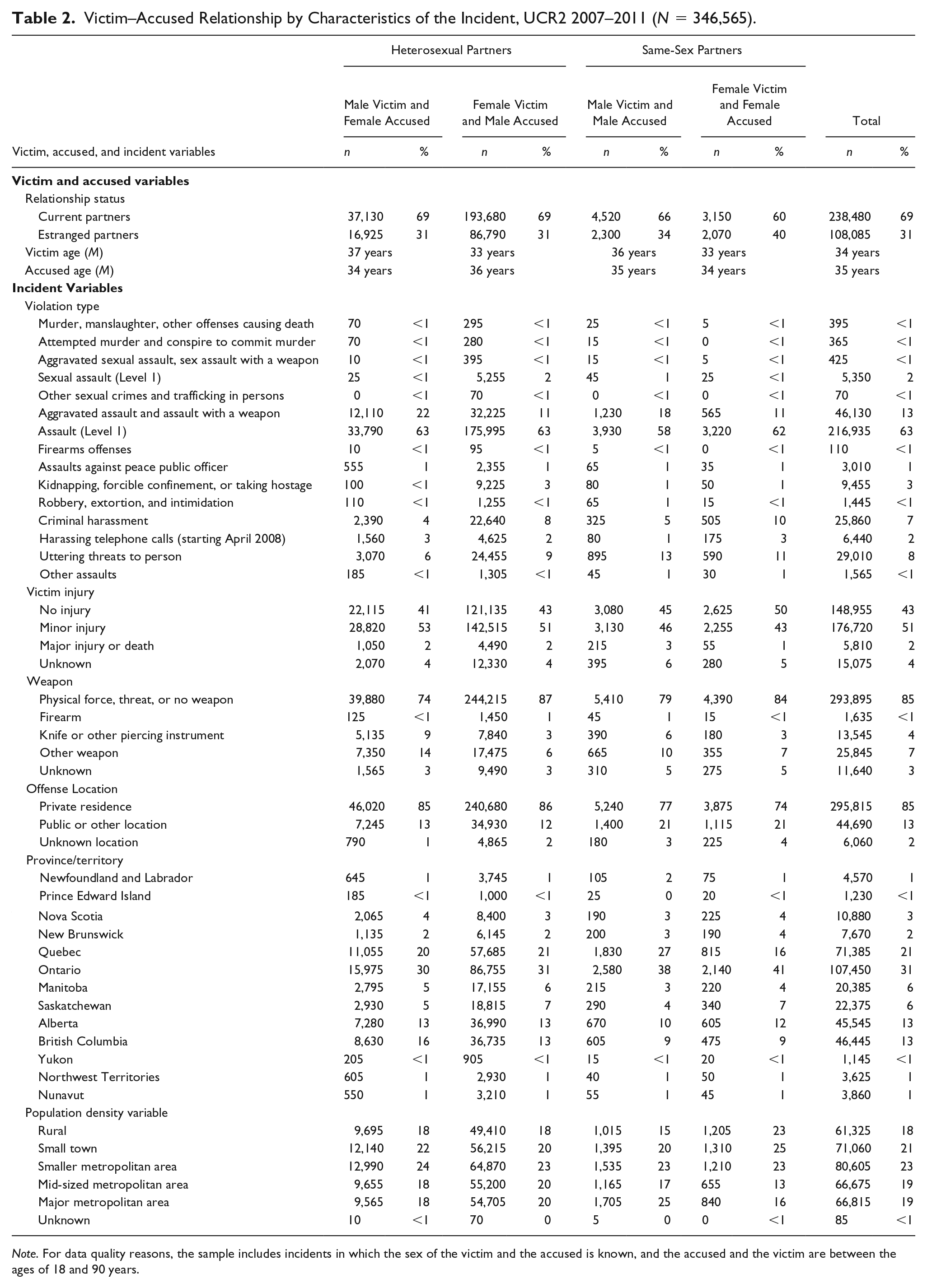
Note. For data quality reasons, the sample includes incidents in which the sex of the victim and the accused is known, and the accused and the victim are between the ages of 18 and 90 years.
Results
Prevalence
The first research question focused on determining how often SS-IPV is reported to police in Canada in comparison to Het-IPV. It was shown that the majority of cases reported involved heterosexual partners (97%) and that SS-IPV was reported in 3% of incidents (see Table 1). These distributions are consistent with prior literature regarding the population of Canadians who identify as same-sex or bisexual (3%); that is, same-sex partners do not appear to be overrepresented among police-reported victims of IPV (Statistics Canada, 2015). When the victim–accused relationship was divided into four categories, as anticipated, most incidents involved Het-IPV with cases involving a female victim and male accused (81%) being reported most frequently followed by incidents between male victims and female accused (16%). SS-IPV was reported less frequently with 2% of cases involving a male victim with a male accused and 2% 9 occurring between a female victim and a female accused.
Characteristics
The second research question sought to compare characteristics and types of police-reported SS-IPV and Het-IPV. Based on the descriptive analysis, similarities were found in relationship statuses and the average ages of the victim and accused (see Table 2). Both Het-IPV and SS-IPV were reported more frequently between current partners than estranged partners. In the sample, approximately two thirds (69%) of the incidents reported to police between 2007 and 2011 were perpetrated by a current partner and one third (31%) by an estranged partner. However, female SS-IPV offenses had a slightly higher rate of occurrence between estranged partners (40%). Regardless of sexual orientation, the average age of victims and accused was in the mid-30s with female victims being slightly younger than male victims. SS-IPV differed from Het-IPV in types of violations, levels of victim injury, weapon use, offense location, province or territory of offense, and population density reported (see Table 2).
Types of violation
Victims in both victim–accused relationships reported experiencing assault (Level 1) most frequently (63%); this was followed by aggravated assault and assault with a weapon (13%); uttering threats to person (8%); criminal harassment (8%); kidnapping, forcible confinement, or taking hostage (3%); harassing telephone calls (2%); and sexual assault (Level 1) (2%). All other types of incidents each made up less than 1% of the reported cases of IPV. The types of violations reported were consistent across all victim–accused relationships with the exception of incidents involving aggravated assault and assault with a weapon, criminal harassment, or uttering of threats.
Weapon use
Regardless of the victim–accused relationship, cases with a male victim (Het-IPV = 22%, SS-IPV = 18%) reported incidents involving aggravated assault and assault with a weapon more frequently than cases with a female victim (Het-IPV = 11%, SS-IPV = 11%). This finding is consistent with previous Het-IPV literature that female accused are more likely to use a weapon in incidents of Het-IPV (Brown, 2004) and male SS-IPV accused are more likely to use a weapon than female (Waldner-Haugrud et al., 1997).
Criminal harassment
Female victims (Het-IPV = 8%, SS-IPV = 11%) reported higher proportions of criminal harassment violations than male victims (Het-IPV = 4%, SS-IPV = 5%). This finding aligns with previous research which has shown that females report experiencing criminal harassment more frequently than males (Turell, 2000).
Utterance of threats
Male and female SS-IPV victims reported higher proportions of threats uttered toward them. Previous studies have noted that threats to the individual are commonly used tactics in SS-IPV offenses and may include aspects unique to same-sex experiences, such as “outing” or threats to expose the victim to HIV (Calton et al., 2016; Knauer, 1999; Pattavina et al., 2007).
Physical injury
In the sample, most incidents involved no physical injury (43%) or minor physical injury (51%) to the victim. Major physical injury or death occurred in 2% of the cases, and in 4% of the cases victim injury was unknown. When compared with SS-IPV, both male (53%) and female (51%) victims of Het-IPV cases have a slightly higher proportion of reported incidents involving minor physical injury than same-sex victims. Male SS-IPV incidents reported a proportion of incidents without physical injury (45%) and with minor physical injury (46%) similar to male and female Het-IPV victims. Female SS-IPV cases were the only victim–accused relationship to report a higher proportion of cases without injury (50%) than with minor physical injury (43%). However, it should be noted that the level of injury in male and female same-sex cases was recorded as unknown in over 5% of cases, more often than in heterosexual cases.
In the majority of reported incidents, physical force or threats were used rather than weapons (85%). When weapons were used, the incident involved a firearm (<1%), a knife or other piercing instrument (4%), or another type of weapon (7%). Three percent of the cases did not have information about whether a weapon was used. Physical force or threats were reported in a larger proportion of incidents involving female victims (Het-IPV = 87%, SS-IPV = 84%) than male victims (Het-IPV = 74%, SS-IPV = 79%). Male victims had higher proportions of reported incidents involving knives or other piercing instruments (Het-IPV = 9%, SS-IPV = 6%) and other weapons (Het-IPV = 14%, SS-IPV = 10%) than female victims regardless of the victim–accused relationship.
Location of incidents
Both Het-IPV and SS-IPV incidents were reported most often in private residences (85%) than in public locations (13%), and in which the location was unknown or not reported (2%). A higher proportion of Het-IPV incidents were reported in private residences than SS-IPV incidents.
The majority of incidents took place in Ontario (31%) and Quebec (21%), which are the two most densely populated provinces (Statistics Canada, 2018a). Similar proportions of IPV reporting occurred in most provinces and territories. However, a larger portion of male SS-IPV incidents took place in Ontario (38%) and Quebec (27%). Female SS-IPV was reported at a higher rate in Ontario (41%) and a lower rate in Quebec (16%). British Columbia had a higher proportion of Het-IPV with 16% male victims and 13% female victims reported than SS-IPV victims.
The final difference occurred in the proximity of IPV to urban and rural areas. While reporting was similar in all population densities, slightly more incidents were reported in smaller urban areas (50,000–249,999; 23%) than small towns (10,000–49,999; 21%), major urban areas (1,000,000 and over; 19%), mid-sized urban areas (250,000–999,999; 19%), rural areas (less than 9,999; 18%), or unknown areas (<1%). This finding is consistent with previous Het-IPV research (Peek-Asa et al., 2011) and presents additional challenges to IPV victims, especially same-sex victims, with limited access to services. Male SS-IPV and both forms of Het-IPV have similar proportions of reporting in all population densities. However, female SS-IPV is reported more frequently in rural areas (23%) and less often in mid-sized and major metropolitan areas (13%). This conflicts with Blosnich and Bossarte’s (2009) findings that female same-sex victimization occurs at higher proportions in urban settings.
Discussion
Through a review of current literature and descriptive analysis, this study has assessed the prevalence of Het-IPV and SS-IPV as well as the similarities and differences in incident characteristics and types reported to Canadian police between 2007 and 2011. Approximately 3% of the IPV sample were involved in same-sex relationships while slightly less than 4% of Canadians identify as same-sex or bisexual (Statistics Canada, 2017), and approximately 1% of couples are in same-sex spousal partnerships (Ibrahim, 2019). However, it is not currently known how many same-sex people in Canada were in an intimate relationship during the 4-year period captured in this study.
Studies have found that IPV is often underreported, and therefore, it is likely that many incidents were not captured in this study (Carvalho et al., 2011; Ibrahim, 2019). Furthermore, previous North American studies have argued that SS-IPV is as prevalent as Het-IPV but may be less likely to be reported to police services (McClennen, 2005; Messinger, 2014). It has also been argued that underreporting of SS-IPV may be exacerbated due to heteronormative understandings of IPV, perceptions of homophobic responses by police, and fears about revealing their sexuality (Banks, 2003; Calton et al., 2016; Duke & Davidson, 2009; Hoyle, 2007; Murray & Mobley, 2009; Oringher & Samuelson, 2011). Therefore, this finding cannot be compared to self-reported SS-IPV victimization but can support the development of measurement tools to better gauge underreporting in Canada and inform understandings of prevalence.
Of the sample assessed, similar relationship statuses and average ages of victims and accused were found for all victim-accused relationships. In same-sex and heterosexual relationships, a higher proportion of IPV was reported between current partners and, on average, the victim and accused were in their mid-30s. Notably, SS-IPV differs from Het-IPV in several characteristics, including reported violation types, the levels of victim injury, weapon use, offense location, and urban and rural proximity, and these are addressed in more detail below.
The descriptive analysis showed that male victims reported higher proportions of aggravated assault or assault with a weapon than female victims. It may be possible that males are less likely to report IPV except for in more aggravated or extreme cases. This could be viewed as a manifestation of hegemonic masculinity and its influences on victim behavior as it reinforces societal beliefs that males should be strong, in control, and have a position of authority (Jeffries & Ball, 2008; Kay & Jeffries, 2010). For same-sex or heterosexual men, reporting victimization by an intimate partner may challenge this form of masculinity, and therefore, victims may be especially reluctant to report. It is possible that this difference in the severity of injury when reporting may also influence police responses to incidents and warrants further investigation.
The results also demonstrated that female victims reported higher proportions of criminal harassment than male victims, regardless of victim–accused relationship. This, too, may be related to hegemonic masculinity and its particular impacts on males’ reporting behaviors. Alternatively, criminal harassment may be a technique used by male or female accused to establish power and control over female victims when societal hegemonic beliefs support the notion that females will, when repeatedly harassed, yield to aggressors, but further research is required to explicate these patterns.
Finally, same-sex victims reported higher proportions of violations involving utterance of threats. As previously noted, same-sex victims may be more vulnerable to threats by their partners. This use of threats has frequently been noted as a reason for underreporting of SS-IPV but it is possible that, when reported, this form of abuse is also more frequently disclosed to police services in North America (Knauer, 1999; Pattavina et al., 2007). Between 2015 and 2018, Australia, Ireland, and the United Kingdom created and implemented “coercive controlling behaviour” as a criminal offense (Stark & Hester, 2019). Based on Frankland and Brown’s (2014) study of coercive control in same-sex relationships, it is possible that this distinction may, over time, provide additional information regarding the experiences of individuals who are exposed to forms of emotional abuse that are not currently captured in the UCR and allow for additional comparisons between Het-IPV and SS-IPV.
Weapons were not used in most reported IPV incidents. However, both heterosexual and same-sex male victims were more likely to have a knife or other piercing instrument or other weapon used against them. Previous studies have shown that in heterosexual relationships females are more likely to use a weapon on their male partner (Brown, 2004; Carney et al., 2007). This has been related to females on average being smaller in size or lesser in strength than male partners and using weapons as methods of compensating for these differences (Brown, 2004). However, this differentiation does not explain why male same-sex victims, who may be less likely to differ in size or strength, are also more likely to have a weapon used on them and will require additional research attention.
Approximately one quarter of female SS-IPV incidents were reported in rural areas, small towns, and smaller metropolitan areas. This conflicts with the fact that there are larger proportions of same-sex individuals who live in communities in urban centers (Statistics Canada, 2017). It also raises questions about how police in less densely populated areas are prepared to respond to incidents of SS-IPV.
As noted at the beginning of this article, this study aims to contribute to the conversation about Canadian SS-IPV by presenting a large nation-wide sample and hopes to provide a foundation for future research. This study highlights several similarities and differences between police-reported Het-IPV and SS-IPV in Canada. However, it is not possible to draw any causal conclusions without further analysis. Much more research and attention from the research community, public, and service providers is needed to understand the issue further and to reduce the problem of SS-IPV.
Limitations
The UCR is an administrative data source originally intended to measure rates of police-reported crime in Canada. To ensure that the data collected is standardized, high-level information was collected from all police jurisdictions (Dawson & Hotton, 2014). This means that information is consistent but also that a limited number of variables are recorded. Furthermore, the UCR data collection is limited by the number of incidents reported and the police identification of victim–accused relationship status.
First, the UCR captures only the incidents of IPV that were reported to police (Statistics Canada, 2013). Therefore, not all incidents of IPV will be reported to the police and recorded in the UCR survey as the literature suggests that IPV and SS-IPV are extremely underreported (Messinger, 2011; Oringher & Samuelson, 2011). Second, the accurate identification of SS-IPV incidents has been found to present a barrier to research (Pattavina et al., 2007). The UCR methods of data collection could also be affected by police perception of gay or lesbian individuals and SS-IPV. It is not always possible for an observer or intervener to identify the victim–accused relationship or sexual orientation. In the case of UCR data collection, a police officer may not be aware that SS-IPV has occurred unless they inquire about the relationship or the participants identify themselves as intimate partners. For example, officers operating in a heteronormative environment may assume that an incident involving same-sex partners has occurred between friends or roommates, and it is possible that the victim–accused relationship may be improperly recorded. Finally, the UCR data set does not provide information about the socioeconomic status or racial identity of the victim or accused. However, studies assessing IPV have found that visible minorities are less likely to report their IPV victimization to police services and that those with lower socioeconomic status may have less access to victims’ assistance services (Duke & Davidson, 2009; Ristock et al., 2017; Sokoloff & Dupont, 2005). Thus, it is possible that socioeconomic status and race may influence IPV reporting in the UCR survey.
Future Research
This study aimed to build on the existing research by comparing police-reported SS-IPV and Het-IPV generally. However, as this area of literature continues to grow, additional attention is needed to better understand legal responses to SS-IPV. The reporting of an offense represents one of the initial stages by which an accused individual is filtered through the criminal justice system. Future research could focus on the responses of police and judges to reported SS-IPV incidents. In Canada, pro-arrest policies exist which require police to intervene or make an arrest when an indecent of IPV is reported (Dawson & Hotton, 2014; Pattavina et al., 2007). Under these policies, officers are encouraged or required to arrest and remove the accused (Iyengar, 2009). Once an accused is arrested, police services may choose whether they are charged or cleared otherwise (Dawson & Hotton, 2014). As a result, police officers can often maintain discretion and act as gatekeepers to the criminal justice system (Dawson & Hotton, 2014). Similarly, judges decide the appropriate punishment for individuals convicted of IPV-related offenses. If the sexual orientation of the accused influences police or judicial responses, it could indicate that systemic inequalities exist and help to inform policy development as well as service provider training (Ford et al., 2013). Additional research on the responses of police and judges could shed light on the experiences of same-sex individuals in the criminal justice system and clarify where policy changes would be the most effective to improve responses to SS-IPV.
Footnotes
Declaration of Conflicting Interests
The author(s) declared no potential conflicts of interest with respect to the research, authorship, and/or publication of this article.
Funding
The author(s) disclosed receipt of the following financial support for the research, authorship, and/or publication of this article: The analysis presented in this paper was conducted at the Guelph Branch Research Data Centre which is part of the Canadian Research Data Centre Network (CRDCN). The services and activities provided by the Guelph Branch Research Data Centre are made possible by the financial or in-kind support of the SSHRC, the CIHR, the CFI, Statistics Canada, and the University of Guelph. The views expressed in this paper do not necessarily represent the CRDCN’s or that of its partners’.
Notes
Author Biographies
 ).
).
).
) at the University of Guelph. Over the past 19 years she has worked both as a researcher for the Canadian Center for Justice Statistics and as an analyst and regional manager with the Research Data Centres Program at Statistics Canada.