



Abstract
Although the prevalence of sexual assault in U.S. prisons is debated, it is known that the consequences for victims can be quite severe. The Prison Rape Elimination Act (PREA) requires prison officials to keep track of incidents of sexual assault, but accurate figures will be generated only to the extent that inmates regularly report these acts. Male rape itself is a highly underreported phenomenon and even less reported in prisons due to inmate cultural norms that frown upon forwarding inmate information to correctional authorities. This article examines whether prison inmates believe that reporting prison rape is equivalent to snitching and analyzes possible explanations for the inmates’ responses. Results indicate that inmates are less likely to view the reporting of prison rape as snitching earlier in their current commitment periods, and White inmates are more likely than Black inmates to think reporting rape is snitching. As this topic is extremely under studied, a number of suggestions for future research are advanced.
Estimates of sexual assault in prisons vary considerably and are hampered by weak study designs and poor response rates. In a critical review of this literature, Gaes and Goldberg (2004) found that reported prevalence rates ranged from 1% to 16%, but with a majority of prevalence estimates falling at 2% or less. Regardless of the extent of prison sexual assault, the impact on individual victims can be devastating. Some of the most common consequences of prison sexual violence are depression, anxiety, rape trauma syndrome, and suicidal ideation (Zweig, Naser, Blackmore, & Schaffer, 2006). Victims of prison rape are 17 times more likely to attempt suicide than other inmates (Robertson, 2003). Physical injury also occurs from prison rape. According to McGuire (2005), “victims may be seriously beaten, suffering concussions, broken bones, lacerations, and other physical injuries—not to mention genital injuries associated with forced sexual penetration” (p. 75). Prison rape also increases the risk of contracting HIV/AIDS (Dumond & Dumond, 2007) and the spread of hepatitis B, hepatitis C, and other sexually transmitted infections (Zweig et al., 2006).
Although sexual assault in prisons is not a new phenomenon, attention to this type of behavior has heightened in recent decades, especially with the passage of the Prison Rape Elimination Act (PREA) in 2003. PREA requires all U.S. correctional facilities to submit annual reports and participate in prison rape studies to receive federal funding. In addition, each correctional facility must demonstrate actions toward the detection, prevention, and reduction of prison rape. Although PREA is grounded in good intentions, an underlying obstacle to full and accurate compliance by prison authorities is the underreporting of sexual assault by inmates. For sexual activity to be officially recorded, the information must come to the attention of correctional authorities. As catching inmates in the act is relatively rare, correctional officials and staff often rely on reports from inmates (Owen & Wells, 2006). In a recent study, Miller (2010) cited several reasons why Texas prison inmates would not report sexual assault. Thirty percent of inmates would not report due to embarrassment, 29% anticipated retaliation, 21% feared harassment by inmates, and 7% did not want to land in protective custody. Prison and jail staff have identified aspects of the prison culture as barriers to reporting sexual assault, such as stronger inmates being entitled to take what they please and inmates being expected to do their own time and not interfere with others (Owen & Wells, 2006).
Understanding norms and behavior in prisons, including the reporting of prison rape, requires some familiarity with prison culture itself. As social organizations of all sorts have codes of conduct, prisoners are similarly exposed to an inmate code of behavior. Beliefs fundamental to this inmate code documented for decades include “do your own time,” “don’t whine,” “don’t break your word,” “be a man,” and “don’t be a sucker” (Hasaballa, 2001; Johnson, 2002; Sykes, 1958; Sykes & Messinger, 1960). Clemmer (1958) first noted that this code of prisoner behavior is not universally accepted by all inmates nor does each inmate who accepts the code adopt it for the same reasons or at the same stage of incarceration. Clemmer thus coined the term prisonization to denote the “taking on in greater or less degree the folkways, mores, customs, and general culture of the penitentiary” (Clemmer, 1958, p. 299).
The proscription against snitching in prisons is perhaps one of the best known aspects of the inmate code. Violating the prohibition against snitching in prison culture has led to serious consequences for snitching culprits. Inmates who inform on others have become objects for retribution among the general population and may be placed in protective custody to prevent retaliation (Seiter, 2005; Useem & Kimball, 1991). In the New Mexico State Prison riot of 1980, snitches were sought out and killed by fellow inmates. Some of these inmate snitches were severely tortured, falling victim to rapes, mutilations, beheadings, and even being set on fire (Useem, 1985). Fear of being labeled a snitch and its consequences should naturally enter the calculation of whether to inform prison authorities about sexual violence as suggested by Miller’s (2010) study. Further, it is reasonable to suggest that the prohibition against snitching may significantly skew official statistics on prison rape and limit efforts to successful target and reduce sexual assaults.
As a result, the present study addresses how male prison inmates respond to the question of whether they feel that reporting prison rape is a form of snitching. Although believing that reporting prison sexual assault is akin to snitching certainly fits with past depictions of the inmate code, the proportion of inmates who accept this belief and their reasons for acceptance have yet to be extensively explored. In the following sections, the limited literature on prison inmate snitching is presented and an overview of issues related to reporting male prison rape is provided. Next, the theoretical perspectives most applicable to this study, deprivation and importation theories, are explained and their relevant literatures briefly reviewed.
Snitching in Prison
Snitching is a focal concept for this project, but, in reality, we know very little concerning how providing information about other inmates to prison authorities and staff is viewed within the modern inmate culture. In the 1960s, Johnson (1961) identified different categories of snitches (or “rats”) such as those who snitch for personal gain and those who violate a nonsnitching code due to ignorance of inmate culture. A couple of decades later, Akerstrom (1989) examined ways in which inmates cope with the label of being a snitch. Some of these coping mechanisms included resisting the designation of being a snitch, challenging the snitch-labelers as hypocrites who do the same thing, and relocating inside a prison to create psychological and physical distance from the label. No study could be located that addresses situations in which inmates feel snitching is appropriate versus inappropriate. Nor could empirical guidance be found to indicate why an inmate would feel that communicating inmate information to authorities is okay in one case but not in another.
In addition, research appears lacking to indicate the extent to which inmates actually observe the code against snitching versus informing correctional authorities about inmate affairs. Jacobs (1977) noted in his classic study of Stateville Penitentiary in Illinois that many inmates were actually informants, and Marquart and Roebuck (1985) documented how building tenders in the old Texas prison system functioned essentially as snitches to prison authorities. Until more work is done to examine the beliefs and attitudes that surround and influence the acceptance or rejection of snitching in prison and the degree of actual observance of these beliefs and attitudes, the problem of inmate underreporting of prison rape is bound to continue undermining efforts to reduce prison sexual violence.
Reporting Male Sexual Assault
Although prison snitching and its consequences are potential factors that prevent inmates from reporting unwanted sexual behavior, it is important to emphasize that male reports of sexual victimization outside of prison are also mired in complicating factors. Figures from the National Crime Victimization Survey indicate that 8% of all rapes involve male victims (Truman, 2011); however, official report from the National Incident-Based Reporting System estimate only 2% of sexual assault victims to be male (Chilton & Jarvis, 1999). This difference suggests that perhaps three-fourths of sexual assaults with male victims go unreported. A number of reasons have been advanced to explain the reluctance of males to report sexual victimization. Some of these reasons include blaming oneself for the assault, concerns about negative family and peer reactions, fears that authorities will not take accusations seriously, and intensified feelings of a loss of masculinity (Bullock & Beckson, 2011; Chapleau, Oswald, & Russell, 2008; Pretorius & Hull, 2005).
Understanding the unique context of sexual behavior in a prison environment is also important when exploring inmate views of informing authorities about rape. Sexual roles specific to inmates have been identified. As early as the 1930s and continuing to the present day, prison scholars have observed that sexually oriented labels were attached to inmates, such as “wolf” to signify sexually aggressive male inmates and “punk” to denote inmates who were forced or conned into engaging in sexual relations that they originally resisted (Clemmer, 1958; Fishman, 1934; Fleisher & Krienert, 2004, 2009; Hensley & Tewksbury, 2002; Hensley, Tewksbury, & Castle, 2003; Johnson, 1971; Kassebaum, 1972; Lockwood, 1994; Sykes, 1958; Tewksbury, 1989) Descriptions of prison sexual interactions in the literature have varied from physically coercive incidents, to mutual exchanges, such as sex exchanged for protection or paying debt, to genuinely consensual, affection-based encounters similar to normal sexual relationships outside of prison. A common thread in the prison literature is that perpetrators and victims of sexual violence are often heterosexual prior to and following imprisonment, but engage in same-sex, sexual activity as a substitute for their preprison and postprison behavior.
The most recent and most extensive study on prison sexual life was by Fleisher and Krienert (2006, 2009). These researchers studied the culture of prison sex in 30 different prisons across various geographical regions within the United States from 2004 to 2005. Fleisher and Krienert concluded that inmates view sexual assault as reprehensible and unjustified but simultaneously blame the victims, not perpetrators, for sexual violence. “Inner homosexuality” was described as the focal concept for understanding the prison sexual culture, as inmates rationalized coercive sexual incidents as situations where the victim’s latent but true sexual identity is finally revealed. Fleisher and Krienert emphasize that the victim’s response to sexual victimization is critical to how he is eventually perceived by the inmate population. For example, prison rape victims can regain some of their reputation by responding violently and successfully against the perpetrator of the attack, but victims are unable to obtain the full respect of the inmate population. Complicating matters for the reporting of prison rape, Fleisher and Krienert observed that any type of support provided for a rape victim is viewed within the inmate society as a sign of weakness and can thereby increase the victimization of those who may wish to intervene on the victim’s behalf.
Theories of Inmate Beliefs and Conduct
The prohibition against snitching among inmates is one aspect of a larger inmate code. This code is theorized to have developed in two different, although not necessarily mutually exclusive ways. First, the importation theory maintains that the prisoner code came to the prison from the outside world. Irwin and Cressey (1962) suggest that inmate culture is just an institutionalized version of the criminal subculture in free society. Criminal groups and street gangs discourage the practice of informing on members and associates to police. Irwin and Cressey would thus argue that inmate norms against snitching in prison are simply the manifestation of criminal norms operating in a unique institutional environment. In prison, correctional managers and officers effectively become the police from the offender perspective, thus withholding information from correctional staff has a similar purpose as withholding information from police outside of prison.
A second explanation for the prisoner code is known as deprivation theory. Sykes (1958) claimed that the inmate code developed as a process of inmate adjustment to deprivations caused by imprisonment, also called pains of imprisonment. Deprivations of confinement listed by Sykes include the deprivation of liberty, goods and services, heterosexual relationships, autonomy, and security. By creating a code of conduct and abiding by that code, Sykes believed prison inmates attempted to alleviate the frustration caused by the deprivations and gain a sense of stability and control over their institutional lives. The proscription against snitching on inmate sexual predators from Sykes’ perspective might arise from the belief that sexual activity among inmates is inevitable due to deprivations such as blocked access to normal sexual relationships and limitations for willing sexual contact which necessitate the forcible fulfillment of sexual urges. These sentiments of inevitability and necessity could then provide justifications for this behavior and thereby diminish any perceived need for reporting it to authorities and make any attempt to report frowned upon.
Deprivation and Importation Studies
The empirical focus on a single belief of the inmate code is a research strategy that departs from the norm in the prison literature. Most studies on inmate culture, especially those that examine the potential influence of deprivation and importation, look at prisonization, or conformity to an inmate code versus accepting staff expectations, as a singular concept measured through a composite scale (Atchley & McCabe, 1968; Gillespie, 2003; Paterline & Petersen, 1999; Schwartz, 1971; Thomas, 1977; Wheeler, 1961). Some of these studies have made direct comparisons between the deprivation and importation models. The deprivation theory has emerged as the stronger explanation but with several importation variables also showing significance (Gillespie, 2003; Paterline & Petersen, 1999; Schwartz, 1971; Thomas, 1977). Although focusing on the broader concept of prisonization, it is important to review this parallel literature as it offers a context for examining attitudes toward reporting prison rape and snitching.
The deprivation-related concepts most commonly studied pertain to the amount of time served and the phase of one’s current incarceration, which are both indicators of one’s exposure to prison. Thomas’ (1977) study of 273 inmates in a medium-security, southeastern prison showed that the longer an inmate was confined on a current commitment, the more prisonization the inmate reported. In contrast, neither Gillespie’s (2003) research in 30 prisons across Kentucky, Tennessee, and Ohio nor Schwartz’s (1971) study of a juvenile prison facility found length of imprisonment to have a sound impact on prisonization. Interestingly, Schwartz observed a negative relationship between length of confinement and conformity to the inmate code which disappeared in multivariate analyses. Alpert (1979) suggested that the relationship between time served and prisonization is dependent on race. Studying inmates as they moved from a reception center in Washington state to various prisons in the state, Alpert found that minority inmates entered the prison system with higher degrees of prisonization than White inmates. Whereas the prisonization of minorities remained stable over a six-month period, prisonization experienced by Whites increased.
Other prisonization research has investigated the possibility of a curvilinear relationship for time in prison. Wheeler (1961) examined inmates at a Washington state reformatory by administering a conformity to staff role expectations index—the opposite of which suggests more conformity to inmate expectations. Inmates were divided into those in an early phase of confinement (served less than 6 months), middle phase (served more than 6 months but still had more than 6 months left), and late phase (less than 6 months to serve). Wheeler identified a U-shaped relationship which suggested inmates conform more to inmate expectations during the middle phase of incarceration and less in the early and late stages. The study further found that recidivist inmates underwent a reprisonization process each time returning to prison, meaning that returning inmates were not immediately prisonized from a previous incarceration. Wellford’s (1967) study of a dormitory-style prison in Washington, DC supported Wheeler’s finding of a U-shaped relationship between one’s stage of incarceration and prisonization; however, Atchley and McCabe (1968) failed to observe Wheeler’s U-shape distribution at a maximum-security, federal reformatory in the Southwest.
Other deprivation-related variables have been examined in conjunction with prisonization concepts. Schwartz (1971) found that inmates who had a larger number of prison commitments were more likely to conform to the inmate code, whereas Gillespie (2003) identified no relationship between an inmate’s prior incarcerations and prisonization. Interestingly, Goodstein and MacKenzie (1984) found prior convictions to be linked to prisonization for Whites, but not Blacks. Additional variables empirically linked to increased prisonization include perceptions of prison overcrowding and situational problems (Gillespie, 2003) and more intense inmate group contacts (Atchley & McCabe, 1968).
Although having a weaker impact on prisonization, importation variables have influenced prisonization. Gillespie (2003) identified greater degrees of prisonization for White and younger inmates, as well as those with gang ties prior to imprisonment. Paterline and Petersen (1999) found that inmates were less prisonized the more months they had been employed prior to incarceration. Likewise, Thomas (1977) cited stable preprison employment as decreasing prisonization. It is not always clear however how these variables relate to imported values and beliefs from outside the prison. Rather, it is assumed by researchers that extra-institutional factors must be connected in some way to importation.
Research Questions
As snitching and its association with reporting rape have been overlooked in empirical-based literature on prisoners, formulating deductively driven hypotheses is difficult and perhaps not yet warranted. Instead, we crafted specific research questions guided by prior research to explore using a secondary data set. Our research questions are designed to gauge specific variables relevant to the deprivation and importation models discussed above.
The first set of variables discussed here relate to the deprivation model and specifically address the question: Does greater exposure to the prison environment lead to a higher likelihood of accepting that reporting prison rape is the same as snitching? The expected outcome is that greater exposure to the prison environment will create an accumulation of deprivations that increase one’s prisonization and chances of accepting the prohibition against snitching about inmate sexual experiences. An alternative position could be advanced arguing that because snitching appears to be universally despised by criminal groups inside or outside of prison (Akerstrom, 1989), the magnitude of one’s exposure to prison is inconsequential. However, male rape is a relatively uncommon phenomenon (Kaufman, Divasto, Jackson, Voorhees, & Christy, 1980; Truman, 2011) and not a part of criminal street culture. Thus, inmates may feel less like reporting rape is the same as snitching when they first arrive, but become more accepting of the notion as they become more integrated into the prison environment and its culture. Three methods are used to analyze the impact of prison exposure on inmate attitudes as to whether reporting prison rape is snitching. These measures include the amount of time spent incarcerated during one’s current commitment, an inmate’s total number of prison commitments, and the age at which an offender was first admitted to prison. The age at which one is first admitted to prison is important as earlier exposures in life to deviant and criminal environments can result in greater acceptance of the norms promoted in those environments (Akers & Sellers, 2003; Shelden, Tracy, & Brown, 2004; Vigil, 1988).
The next set of research questions involve variables associated with the importation theory. First, as prison rape represents an act of violence, are inmates sent to prison for violent crimes more likely to view the reporting of prison rape as snitching? Paterline and Petersen (1999) reported that inmates with more positive attitudes toward violence demonstrated greater allegiance to the inmate code. One explanation for this finding is that the inmate code favors the strong and more physically aggressive inmates who tend to also be more violent. It is also possible that violent offenders are more empathetic of other violent perpetrators (Anderson, 2007). To cast accusations of wrongdoing toward people who act in similar ways as oneself is to essentially deprecate one’s own character. This psychologically troubling self-reflection could make violent offenders less inclined to take offense to another’s violence and consequently more likely to perceive reporting it as being snitching.
The second question relevant to the importation perspective is: Do maturity (as represented by age) and social commitments external to prison (as measured by marriage) influence responses to whether reporting rape is snitching? Literature indicates that criminals become less inclined to engage in deviant acts and habits as they age, and one reason cited for this is that people mature with age (Hoffman, 2010). It is possible that offenders will become more disturbed by the act of rape as they age and thus be less likely to believe reporting it is synonymous with snitching. In addition, the strength of one’s social commitments may serve as a buffer preventing acceptance of prisoner codes as suggested by social bonding and life-course theories (Sampson & Laub, 1993). In other words, strong ties to society’s belief system can potentially prevent the acceptance of an alternative belief system. We use marriage as an indicator of an inmate’s ties to the outside world (Laub, Nagin, & Sampson, 1998) and examine if being married affects attitudes toward prison rape and snitching.
Finally, does sexual orientation play a role in how inmates answer the reporting rape and snitching question? One might assume that homosexual and bisexual inmates in comparison with heterosexual prisoners will show more compassion to the victim of a male rape in prison and be less likely to accept that reporting rape is the same as snitching. This is because homosexual and bisexual men are heightened targets for prison sexual assault (Eigenberg, 1992; Human Rights Watch, 2001), and potential victims of a crime may be more resistant to cover up its identification. However, fear of sexual assault is prominent in prison culture (Fleisher & Krienert, 2009), and the threat of increasing one’s risk of victimization prompting self-protective measures (which include remaining silent) may outweigh any sense of duty to assist fellow victims. In turn, fearful inmates might feel that accepting the reporting of prison rape as snitching is in their self interest.
Method
Data
The data for the this study comes from an existing data source, Ethno-Methodological Study of the Subculture of Prison Inmate Sexuality in the United States, 2004-2005, retrieved from the Inter-university Consortium for Political and Social Research (ICPSR #04556). The original study (Fleisher & Kreinert, 2006) examined inmates in 30 high-security prisons (23 male and 7 female). These institutions represented 10 states in four different regions of the United States. The original researchers obtained the consent of the American Correctional Association (ACA) and Association of State Correctional Administrators (ASCA) at the outset of the project to encourage participation among directors of state prison systems. Higher-security inmates were targeted for several reasons, including their more extensive criminal histories, more years of incarceration, and the greater likelihood of witnessing or partaking in prison sexual activity. Several inmate populations were excluded from selection, including those in medical, substance abuse, mental health, and transit units, administrative and disciplinary segregation, protective custody, and INS detainees.
The goal of the original research project was to gather information about perceptions of prison rape as they exist within the inmate culture. The original researchers met with an advisory panel and various correctional experts and concluded that interviewing alleged rape perpetrators and victims might increase future risks of violence. Interviewed inmates were not asked if they had committed or participated in a rape. Development of the questionnaire went through an extensive process, which included asking former inmates about prison sex. This process helped guide question length, use of terminology, and follow-up procedures. The final interview instrument was composed of 12 sections ordered in such a way as to help build researcher–inmate rapport and reduce interviewee fatigue and boredom. The sections included such categories as demographics, prison history, physical and sexual abuse, mental health history, prison terms, inmate perceptions of social roles, and staff and institutional factors influencing rape.
Researchers were provided with general population rosters at the selected prison sites and inmates were chosen using a systematic, probability sampling technique. Selected inmates were informed about the research project and taken to an interview location during call-out. Approximately two inmates per institution refused to participate (for an estimated total of 46 inmates who refused), all of which reportedly refused to participate due to prison rape being the subject matter. The on-site researchers reviewed an IRB preapproved consent document which stressed that participation was voluntary, that refusing to answer was okay, and that the inmates could terminate the interview at any time without receiving any punishment from prison authorities. The final sample in the original research consisted of 409 male and 155 female inmates. The focus in the current study is solely on the male inmates.
Variables
Dependent variable
One dependent variable is analyzed in the current study. Measurement of this variable consists of responses to a single-item question, “Is reporting a rape considered snitching?” This item was coded dichotomously (1=yes).
Independent variables
A number of independent variables are used in the analyses. The first set of variables includes indicators of one’s exposure to a prison environment and thus is aligned with the deprivation model. The amount of time served in months for one’s current commitment measures the extent of one’s current exposure to imprisonment. Prior literature suggests that this variable could be related to perceptions of reporting rape as snitching in a curvilinear fashion, as inmates acclimate to institutional deprivations with time and develop greater potential to reassess the value of prison norms. The statistical analysis here investigates whether a curvilinear relationship exists by examining the natural log of time served on current commitment and the square term for this variable in separate models. Two other measures of prison exposure are the age at which one was first admitted to an adult prison and the number of prior prison commitments. A second set of variables includes those that would traditionally be associated more with the importation model. Race/ethnicity is measured as a factor with Black, Hispanic, and other race as dummy variables and White as the reference category. Other importation-related variables include age (in years), sexual preference (1=heterosexual), violent current offense (1=violent), and current marital status (1=married).
Sample
Four hundred nine male inmates are part of the current sample. The youngest male surveyed was 19 and the oldest 70 years old, with an average age of 37 (SD = 9.87). One hundred ninety-eight inmates were Black (48.4%), 153 White (37.4%), 39 Hispanic (9.5%), and 19 identified as another race (4.6%). An overwhelming majority, 335 inmates, considered themselves heterosexual in their sexual orientation (81.9%). Most inmates, 342, were not married (83.6%), and about two-thirds had a violent offense as the most serious charge for their current incarceration (65.6%). The average number of months served on one’s current conviction was 75 (SD = 88.08), with a range from 1 to 420 months. The number of previous stints in prison ranged from 0 to 13 (SD = 1.77), with a mean of 1.13, and the age of first admittance to prison averaged 24 years of age (SD = 8.41), with a range of 15 and 69.
Results
Sixty-five percent of the inmates studied responded that reporting prison rape is the same as snitching. Table 1 shows the results of the logistic regression analysis that attempts to explain variation in responses to this question. All independent variables were entered into the regression simultaneously to control for potentially intervening influences. The regression model is statistically significant, with 10% of the variance explained according to the Nagelkerke R2.
Logistic Regression Analysis of Inmate Perceptions of Reporting Prison Rape as Snitching
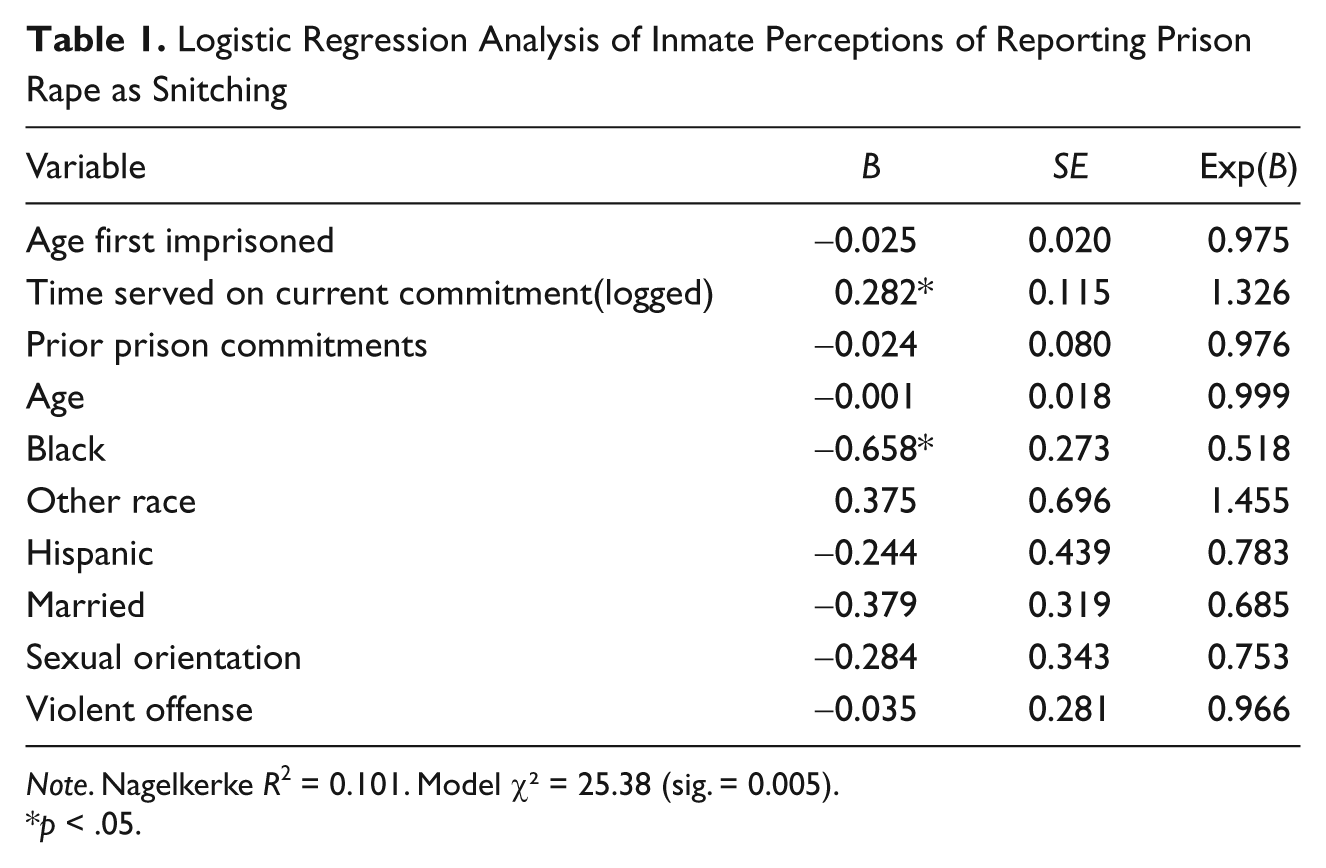
Note. Nagelkerke R2 = 0.101. Model χ2 = 25.38 (sig. = 0.005).
p < .05.
Two variables in the model are statically significant. The measure of length of time served on one’s current commitment representing the deprivation model was positively associated with the dependent variable. The natural log of the number of months served for the current commitment proved to be the best indicator of the effect of time served on whether an inmate felt reporting prison rape was equivalent to snitching. No significant improvement to the model was identified when a parabolic term was introduced to determine whether a tipping point existed. According to the exponentiated regression coefficient, the odds of an inmate considering that reporting rape is synonymous with snitching increases 33% for every one unit increase in the log of months served on one’s current commitment. As the use of the natural log indicates a curvilinear relationship, it can be said that the longer a person is incarcerated for their current crime, the more the person will feel that reporting prison rape and snitching are equivalent. However, the effect of time served will flatten as the incarceration period gets longer. In other words, at some point as an imprisonment period moves along, the exposure to incarceration will no longer or much less affect how an inmate interprets snitching in rape situations. Models were run with multiplicative terms (analysis not shown) to determine whether race and ethnicity interacted with the log of time served, and both relationships were not significant.
Race was statistically significant and is typically regarded as representing the importation theory. Presumably certain aspects of the cultural experience of one’s race are imported as a result of his imprisonment. The direction of the unstandardized regression coefficient indicates that Black inmates are less likely to consider reporting rape as snitching. Specifically, an inmate being Black decreases the odds that reporting rape is viewed as snitching by 48% over White inmates. None of the following variables reached statistical significance: age first imprisoned, prior prison commitments, age, other race, Hispanic ethnicity, marital status, sexual orientation, or violent offense.
Discussion and Suggestions for Future Research
This study provides a stepping stone for additional research and is limited due to its reliance on secondary data. Nonetheless, important implications and directions for research can be garnered from this study. With this in mind, the curvilinear relationship for time served for one’s current commitment and the belief that reporting prison rape is snitching has significant policy implications. The relationship implies a need to address inmate socialization immediately upon inmate arrival, as the likelihood of accepting the reporting of rape as snitching increases the most during the earlier months of incarceration. If not already a component of prison policy, inmates at intake could be informed in detail about procedures to protect confidentiality of information given to staff and administrative officials. Inmates can also be taught in the early stages of their sentence about how underreporting of inmate violence and disruption will only facilitate a climate of disorder that will put everyone at greater risk of victimization.
A challenge likely to emerge over the long term is determining how to effectively sway inmates to rethink their prison norms and values regarding snitching and the reporting of sexual assault. Ultimately this is likely to mean changing the inmate culture itself, as the proscription against snitching is part of that culture. Fleisher and Krienert’s (2009) analysis of the original data may shed some light on how variation in inmate responses to the informing about rape and snitching question could be influenced by inmate culture. First, the original authors found that although inmates view rape in many cases as senseless and irrational, they nonetheless often assign blame to the victim. Perceptions of the degree of victim resistance could correspondingly influence how the inmate population perceives the harm inflicted upon the victims and culpability of the perpetrator. In other words, less harm may be perceived by inmates when the victim does not fight back or is in debt to the perpetrator, thus providing less of a reason to report and risk being labeled as a snitch. Second, Fleisher and Krienert concluded that inmates who overempathize with the plight of prison victims are at risk of being perceived as weak themselves by the prisoner community. Any psychological identification of being weak or fear of being labeled as such due to reporting prison rape could logically affect decisions to report or not.
The key question is whether and how perceptions favorable to justifying a sexual assault as the victim’s responsibility can be changed. Studies have identified that increasing the level of programming in a prison is one of the most effective means of reducing inmate violence (Byrne, Taxman, & Hummer, 2008). One reason for this may be that more programmatic environments buffer against tougher and more rigid pro-violence inmate norms. Although research has focused on reducing violence itself, it has yet to delve into minimizing the cultural aspects that support violence, and particularly sexual violence, as acceptable forms of behavior.
What is interesting is that our indicators of total exposure to prison had no impact on perceptions of reporting rape as snitching. These null findings suggest that multiple prison terms and exposure to confinement at an earlier age do not influence perceptions here. This should be interpreted favorably as prison officials and managers can address inmate perceptions about the perceptual crossover between reporting prison sexual assault and snitching within the current commitment period and not have to battle more embedded attitudes generated from past prison experiences.
Identifying the reporting of prison as equivalent to snitching also may depend on staff culture as well as inmate culture. Liebling (2008) maintains that each prison has a distinctive organizational culture, with staff in each prison having a collective working personality. In a prison where the organizational and staff culture portrays inmate sexual victimization as an unconscionable and intolerable act, inmates may perceive the reporting of prison rape as less of a violation against institutional norms. It is also possible that staff culture may influence inmate culture and thereby diminish the collective inmate identification (or at least the identification by two-thirds of inmates) of reporting sexual assault as equivalent to snitching. Recently, initiatives have been set forth to change correctional culture with the aim of encouraging inmate reporting of rape (National Institute of Corrections, 2007; Zweig et al., 2008), but the impact of these initiatives has not yet been fully evaluated.
The impact of being Black on feeling that reporting rape is snitching is a curious finding. That is, Black inmates were slightly less likely to view the reporting of sexual assault as snitching. Although Gillespie (2003) observed White inmates to be more prisonized than any other race, Alpert (1979) found minority inmates to be more prisonized at the intake stage. As explanations for the current result are elusive, future research should carefully examine how inmates from different races calculate their agreement or disagreement with various beliefs of the inmate culture. It may be that the degree of a racial group’s acceptance of a belief or custom depends on the individual belief or custom being analyzed. It will also be important to examine potential indirect and moderating effects with race and ethnicity in future studies. In some prisons, inmates organize themselves extensively along racial lines within gangs, and gang membership prior to imprisonment was cited in one study as increasing levels of inmate prisonization (Gillespie, 2003). Attitudes toward reporting rape as snitching could be similarly affected by race-specific gang norms and codes.
The majority of the variables used to predict whether an inmate would view reporting rape as snitching did not reach statistical significance in the analysis. Although space does not permit elaboration of each null finding, it is important to review the null findings that relate to the research questions driving the study. First, the absence of a relationship between type of criminal offense and attitudes about reporting rape as snitching goes against our expectations. Violent crime as one’s current commitment offense was used as an indicator of an inmate’s propensity for violence. A better measure for this study would have been violent misconduct reports accumulated during one’s current commitment. However, the code against snitching transcends violent criminals. It applies to property and drug offenders as well, perhaps making the content about which an inmate snitches less relevant than the act of snitching itself. Future studies should also examine whether differences in perceptions of snitching and reporting rape differ between perpetrators and victims of sexual violence in prison.
An inmate’s maturity and social commitments were expected to be significant variables. Limitations in secondary data, however, limited the extent to which these concepts could be measured. The proposition that outside social bonds and commitments may influence inmate perceptions about prison rape and snitching is only partially tested here. The only variable available in the data to measure outside social commitment was marriage. Past research has connected preprison employment, a measure of pro-social involvement, to lower degrees of inmate prisonization (Paterline & Petersen, 1999; Thomas, 1977). An inmate’s ties to religious institutions and the strength of religious beliefs may also factor into their opinions about reporting sexual misconduct to prison officials. Further, age is not an exact measure of maturity. Measures of moral development would be beneficial for testing inmate maturity level in future studies.
The final research question for this study dealt with the attitudes of homosexual and bisexual inmates. Two different outcomes were articulated when presenting this question. On one hand, homosexual and bisexual inmates as heightened targets of sexual exploitation and violence might empathize with other victims and thereby be reluctant to view reporting rape as snitching. On the other hand, as heightened targets of sexual violence, homosexual and bisexual inmates may be more accepting that reporting is snitching, fearing that denial of the snitching code could make them more vulnerable to sexual victimization. The null finding could indicate that both types of feelings are present and cancel each other out. In contrast, it could mean neither explanation has any impact. Without extended research into this area, it is hard to speculate any further.
As noted throughout this section, there is considerable work that lies ahead to better understand and address how the concept of snitching factors into decisions to report prison sexual assaults. One distinction needing to be made is the difference between inmates’ attitudes and beliefs and their actual practices. There is no perfect correlation between perceptions and behaviors. Those who feel that reporting rape is not snitching may still be reluctant to report based on the negative consequences associated with being recognized as a snitch in prison.
This line of research begs for deeper examinations of the situational context involved in shaping perceptions of snitching and prison sexual assault. For example, does the amount of physical force inflicted during sexual assaults have an impact on beliefs that reporting rape is snitching? In other words, might extreme violence in some sexual assaults be so severe that inmates feel that the harm inflicted goes beyond any allegiance to an antisnitching code? How much does the issue of correctional staff believing inmates’ accusations about sexual exploitation factor into the strength of an inmate’s commitment to snitching prohibitions in rape cases? Do inmates feel that the antisnitching code should be observed when a sexual assault involves submission through tricking victims into debts or arousing fears about the need to exchange sex for protection against predatory inmates?
At the heart of many of these questions is the process of rationalizing the reporting of sexual assault as snitching in prison. Examining more deeply how inmates rationalize whether it is appropriate to report information about inmate victimization to authorities would be a very beneficial contribution to this literature. Studies on people’s attitudes have identified that values often clash when someone calculates their approval or disapproval of an act (Alvarez & Brehm, 1995; Feldman, 2003). It would be interesting to see which values and loyalties inmates weigh when judging the appropriateness of reporting prison sexual assault and what values and loyalties are given precedence under various circumstances and why. Only by knowing how values are weighted by inmates can a solid understanding develop of how the prohibition against snitching influences reporting. Whereas research on perceptions of rape in free society has examined various beliefs that underlie people’s opinions (for a review, see Anderson, Cooper, & Okamura, 1997), this type of analysis to the authors’ knowledge has yet to be done with inmates.
Conclusion
This study represents an exploratory attempt to better understand how inmate belief systems can influence a prisoner’s willingness to report sexual assault. Research on prisoner belief systems and customs needs to be updated, and seldom have researchers focused on prisoner attitudes, beliefs, and customs independently. The current study suggests that such an independent focus could be very profitable. In all, a key contribution of the present work is that it clarifies how little we have learned about an instrumental and enduring issue in American corrections. Suggestions for future research have been advanced with the hope that additional research on inmate belief systems and customs, especially as they relate to sexual assault, will be initiated from a variety of regions to fill this gap in the corrections literature.
Footnotes
Declaration of Conflicting Interests
The authors declared no potential conflicts of interest with respect to the research, authorship, and/or publication of this article.
Funding
The authors received no financial support for the research, authorship, and/or publication of this article.