



Abstract
The purpose of this research is to establish and verify the psychometric and structural properties of the self-report Chinese Sexual Assault Symptom Scale (C-SASS) to assess the trauma experienced by Chinese victims of sexual assault. An earlier version of the C-SASS was constructed using a modified list of the same trauma symptoms administered to an American sample and used to develop and validate the Sexual Assault Symptom Scale II (SASS II). The rationale of this study is to revise the earlier version of the C-SASS, using a larger and more representative sample and more robust statistical analysis than in earlier research, to permit a more thorough examination of the instrument and further confirm the dimensions of sexual assault trauma in Chinese victims of rape. In this study, a sample of 418 victims from northern Taiwan was collected to confirm the reliability and validity of the C-SASS. Exploratory factor analysis yielded five common factors: Safety Fears, Self-Blame, Health Fears, Anger and Emotional Lability, and Fears About the Criminal Justice System. Further tests of the validity and composite reliability of the C-SASS were provided by the structural equation modeling (SEM). The results indicated that the C-SASS was a brief, valid, and reliable instrument for assessing sexual assault trauma among Chinese victims in Taiwan. The scale can be used to evaluate victims in sexual assault treatment centers around Taiwan, as well as to capture the characteristics of sexual assault trauma among Chinese victims.
Introduction
While research on sexual assault started much earlier in Western countries, Taiwan has officially only tackled the issue starting in 1996, by passing the Sexual Assault Prevention Act (SAPA). Before that, the problem was largely ignored by the government, the society, and the academic community as a whole; it was taboo to talk about rape in the public. The victims were usually stigmatized as shameful and were blamed for causing the incident. However, after the passing of the SAPA, the official statistics of sexual assault reported to the police in Taiwan continued to increase throughout the 1990s and 2000s. Even more rape incidents were reported to the governmental rape crisis centers, and the numbers of victims have been three times higher than the police records. Along with the law and the establishment of governmental rape crisis centers in each county, the research on sexual assault has been increased in the past decade in Taiwan (Chen & Lin, 2007).
Since there is still no national victimization survey available in Taiwan, its official rape statistics from the National Police Agency showed that sexual assault has increased 6.6 times from 1981 to 2010. There were 477 cases reported to the police in 1981, 766 cases in 1991, then after passing the SAPA, it doubled rising to 1,478 cases in 1997, and continually rising to 3,647 cases in 2010 (National Police Academic of Taiwan, 2010). However, the nonreporting rate of sexual assault in Taiwan according to Huang (1999) has been estimated around 7 to 10 times of those reported cases. We can estimate about 25,529 to 36,470 rape cases actually happening per year in Taiwan with a total population around 20 million people. According to the only research of prevalence rate among college students in Taiwan, Chen (1994) found the prevalence rate of sexual assault for college women to be 4.17% and for college men, 1%. Therefore, sexual assault is a serious social problem in Taiwan and we need a valid measure to assess its traumatic consequences.
With the increase of known rape victims present in a society, it became urgent to understand their trauma and provide needed treatment through assessment. The pioneer studies of sexual assault trauma in the United States measured whether a trauma symptom was present or absent (Burgess & Holmstrom, 1979; McCahill, Meyer, & Fischman, 1979) or by a single item. Since then, the measurement of sexual-assault trauma has been developed via several approaches, including when and how they should be administered, type of trauma dimensions assessed, target of the assessment, and length.
Ruch and Wang (2006) argued that existent scales assessing sexual assault trauma, while greatly improved over time, introduced the Sexual Assault Trauma Symptom Scale (SASS II) to address their limitations. Since victims vary in their trauma levels at given points in time and the trauma level experienced by a victim can change significantly over time, assessment instruments with too few dimensions may fail to assess the victim’s trauma because victims may be traumatized with respect to some dimensions and not others. With respect to scales measuring posttraumatic stress disorder (PTSD), Finkelhor (1988) has argued that PTSD symptoms are absent in many victims of child abuse, although they are traumatized in other respects. Moreover, PTSD is not the sole disorder associated with sexual assault; other mental health problems may include major depression, substance abuse, sexual dysfunction, and other anxiety disorders (Resnick, Kilpatrick, & Lipovsky, 1991). To address this and other issues, Ruch and Wang (2006) developed and validated the 31-item SASS II validated on a large sample of American victims assessed longitudinally. The SASS II has seven factors: Safety Fears (SF), Self-Blame (SB), Depression, Anger and Emotional Lability (AEL), Health Fears (HF), Anger about the Criminal Justice System, and Fears About the Criminal Justice System (CJF; see Ruch & Wang, 2006, for description of psychometric properties of the scale and validation).
However, there was no systematic quantitative measurement of sexual assault trauma experienced by victims in Taiwan until Wang (1999) developed the Chinese Sexual Assault Symptom Scale (C-SASS). This instrument was developed to fill the gap of a lack of an instrument designed specifically to assess trauma in sexual assault victims in Taiwan, especially for use in governmental rape crisis centers. Wang used the same list of 43 items from which the 31-item SASS II was developed and added three questions based on clinical observation of victims in Taiwan: “Worry about the flaws of the body,” “Worry about the damage to the sexual organs,” and “Worry about the breaking of the hymen.” Wang administered this preliminary version of the C-SASS to a sample of 160 Taiwanese female victims.
Wang (1999) found that a factor analysis of this data yielded a 21-item scale similar to the SASS II, but with fewer factors and items. The factors found in Chinese and American samples were Safety Fears, Self-Blame, Health Fears, Anger and Emotional Lability, and Criminal Justice Fears. The two factors found in American victims and not in Chinese victims were Depression and Anger at the Criminal Justice System.
After 10 years of using the preliminary version of C-SASS, we want to revalidate the scale by larger and more representative samples including males and children, mainly from one major rape crisis center in northern Taiwan. The larger sample allows us to carry out a confirmatory factor analysis (CFA) which was not possible before. Therefore, in this study we could perform a more thorough examination of the instrument that goes beyond the preliminary examination conducted when the scale was initially published. The purpose of this research is to examine the psychometric properties of the revised C-SASS designed for assessing trauma in Chinese victims of sexual assault over time.
Method
History of the Scale
As described earlier, a preliminary version of the C-SASS was developed from a previous sample of 160 female victims in Taiwan (Wang, 1999; Wang & Wu, 2001). At that time, only female victims were selected for the research sample for a self-report survey from different areas of Taiwan. The victims answered how much they had been distressed or upset by the trauma symptoms during the last 2 weeks on a 5-point Likert-type scale, ranging from 1 (not at all) to 5 (extremely). Exploratory factor analyses (EFA) resulted in a 21-item scale with five trauma factors: Safety Fears—5 items, Self-Blame—4 items, Health Fears—5 items, Anger and Emotional Lability—5 items, and Criminal Justice Fears—2 items. The results showed that this instrument could be used to assess rape trauma at different time periods for Chinese female rape victims in Taiwan. Since then, the scale has been adopted by the government database system for social workers treating sexual assault victims throughout Taiwan.
Participants
In this study, the rape victims were clients of Taoyuan County Domestic Violence and Sexual Assault Prevention Center in Taiwan admitted from 2006 to 2009. Taoyuan County is the second largest county in northern Taiwan adjacent to Taipei metropolitan area, with more than a two million population. Our research data were obtained from the Taoyuan County Domestic Violence and Sexual Assault Prevention Center; we were given a written authorization from the center to use the social workers’ database via a grant from the Taoyuan County Government. All the private data of clients (e.g., names, addresses) were deleted before releasing the data to us. We were given permission to use the social worker’s database from 2006 to 2009, obtaining 543 victims being evaluated by the C-SASS. The victims completing the C-SASS from 2006 to 2009, respectively, were 83, 156, 136, and 168. After deleting repeated measures due to repeated victimization, incomplete trauma assessments, multiple victims within one household or noncoerced case, there were finally 418 cases used for this analysis.
There were 406 female and 12 male victims in this sample, ranging from 4.77 to 69.31 years in age, with a mean age of 17.91 (SD = 8.14). A total of 293 victims were never married (70.1%), 22 married (5.2%), 20 divorced (4.7%), 4 widowed (1.0%), and 79 others (18.9%). The sample has 340 Taiwanese (82.5%), 51 aboriginal Taiwanese (12.4%), 14 Southeast Asians (3.4%), and 1 Mainland Chinese (0.2%). Their education level was 45 primary school (11.3%), 190 (47.5%) junior high school, 135 senior high school (33.8%), 26 colleges or universities (6.6%), 1 master’s degree or above (0.3%), and 1 illiterate (0.3%). There were 24 people with disabilities (5.8%), and the rest 389 victims (94.2%) were not. The majority of the victims were students (71.7%), service industry workers (12.1%), and unemployed (7.3%). Two types of sexual assault victims were included, the majority were victims of coerced sexual assault (75.8%) and the others were of molestation 1 (24.2%).
Procedure
Since the Center is a governmental agency, by the Taiwan Sexual Assault Prevention Act of 1996, it was mandated to assist all the victims reporting sexual assault to the center and to provide medical, legal, financial, and psychological services with no charge within the county. The sexual assault victims reporting to the center can be referred by the police, hospitals, schools, the hotline, or the victims themselves. Sexual assault is a criminal offense case in Taiwan and it is also mandatory for medical doctors, teachers, social workers, and counselors to report it to the police or to the public sexual assault prevention centers. The victims usually go through the forensic medical examination, police interview, and prosecutor’s investigation process. The prosecutor will decide whether to file charges against the assailant, hold a preliminary hearing and then go to trial. The victims given the assessment were informed by the social workers that the C-SASS was to a means to assess their trauma to assist them further. The social workers were given instructions as to which victims would or would not take the trauma assessment. Excluded were those too young to understand it, developmentally disabled, or who refused to cooperate. Those victims who gave consent would fill out the C-SASS and then the social workers would enter the answers into the database. Out of 1,587 cases reported to the crisis center during 2006-2009, there were 543 victims (34.6%) who completed the trauma scale. The data were confidential to all personnel except the social worker in charge of the case.
Data Analysis
In this study, a two-step analysis procedure was used to validate the C-SASS scale (Anderson & Gerbing, 1988; Diamantopoulos & Siguaw, 2000; Hoyle, 1995; Jöreskog & Sörbom, 1996; Steenkamp & Baumgartner, 1998). The first step was an item analyses and exploratory factor analysis, to explore the factorial structure of the measurement instrument. The second step was a structural equation modeling (SEM) approach to conduct the CFA, which can provide more abundant information and accurate results, through examining the composite reliability and the validity of the C-SASS (Suhr, 2006).
For the two-step data analyses, the total sample of 418 was randomly split into two portions using SPSS 17.0. Sample A consisted of 207 victims and Sample B of 211 victims. Results from the χ2 analysis revealed no significant differences (p < .05) in the demographic variables between the two randomly split samples. First, Sample A was used to conduct the item analysis and exploratory factor analyses. The selection of items from the 21 items in the original C-SASS was based on several criteria, including percentage of missing values, central tendency, comparison of extreme group (the upper 27% and the lower 27% in each subscale), skewness, kurtosis, item–total correlation, corrected item–total correlation, Cronbach’s alpha if item deleted, extraction communalities, factor loading, and so on. Then Sample B was used for the confirmatory factor analyses to conduct competing modeling, to test the proposed relationship between variables and their underlying latent constructs of C-SASS.
Results
We first used item analyses and exploratory factor analyses to select appropriate items and factors. Then, we use reliability, discriminate validity, and CFA to confirm the structure of the scale.
Item Analyses
To determine appropriateness of each item in the 21-item scale, we first examined the relevant criteria and found that all items passed the criteria of percentage of missing values, extreme group comparison (p < .05), central tendency (p > .05), skewness (< |3|), kurtosis (< |10|), item–total correlation (> .40), corrected item–total correlation (> .40), the corrected Cronbach’s alpha larger than the original Cronbach’s alpha, extraction communalities (> .20), and factor loadings (> .40; DeVellis, 2003). However, there were only two minor exceptions. Five items “Feeling easily annoyed or irritated” (Item 4), “Mood swings, being up and down emotionally” (Item 12), “Anger at family or friends” (Item 14), “Blaming yourself” (Item 16), “Worry about the defect of the body” (Item 19), and “Worry about the breaking of the hymen” (Item 21) did not meet the criterion of central tendency, since their means were significantly different from the mean of its subscale. One item “Worry about contracting a disease from the assailant” (Item 1) had a corrected Cronbach’s alpha (.82), which was larger than the original Cronbach’s alpha (.79).
Furthermore, we examined the difference between coerced sexual assault victims and noncoerced statutory rape victims 2 on all items. The results showed that most of the items had the ability to differentiate between the two groups. The means of the coerced sexual assault victims were significantly higher than the means of the noncoerced statutory rape victims on all items except for four items. The four items were “Feeling guilty” (Item 3), “Anger at family or friends” (Item 14), “Fears about testifying in court” (Item 15), and “Blaming yourself” (Item 16). These emotions were similar for statutory sexual assault victims and the coerced sexual assault victims in Taiwan. Since the statutory victims like the coerced sexual assault victims needed to go through the criminal justice system, they were as likely to feel guilty and angry at family who brought this case against their sexual partners. They were also fearful about testifying in court and blaming herself or himself for getting into all this trouble (consider getting into this situation).
Exploratory Factor Analyses
We first checked the sample size appropriate for doing the exploratory factor analyses. The size of Sample A (n = 207) passed the required minimum sample size of 100 (Gorsuch, 1983). Then, we checked the appropriateness of performing factor analyses by the Kaiser–Meyer–Olkin (KMO) and Bartlett’s test. Table 1 showed that the KMO was .90, and the Bartlett’s test reached a significant level (χ2 = 2,023.48, df = 210, p < .001). These findings provide evidence that the results of the factor analysis are reliable (Bartlett, 1954; Kaiser, 1970). To extract the factors in the scale, we applied principal axis factoring extraction analysis and direct oblimin rotation methods once (Ledesma & Valero-Mora, 2007), resulting in the five-factor structure as in Table 1.
Exploratory Factor Analysis.

Note. The factor which the specific items belongs to is indicated in bold. KMO = Kaiser-Meyer-Olkin.
The cumulative explanation of overall variance of the C-SASS scale was 57.45%. The five factors extracted are Safety Fears, Self-Blame, Health Fears, Anger and Emotional Lability, and Fears About the Criminal Justice System. To verify the stability of the five-factor structure, we used another forced two-factor solution on all items and found four items had higher factor loadings on the second rather than the first factor. Therefore, Item 6 (“Angry at the assailant”) of Safety Fears, Item 13 (“Embarrassed about what you had to do to survive the assault”) and 18 (“Feeling you shouldn’t have gotten into the assault situation in the first place”) of Self-Blame, Item 9 (“Feeling hopeless about the future”) of Anger and Emotional Lability, and Item 1 (“Worry about contracting a disease from the assailant”) of Health Fears were less stable inside their factor structures.
Therefore, we selected items based on the above item analyses and the exploratory factor analyses, deciding to delete Item 1 of Health Fears factor and Item 13 of Self-Blame factor from the C-SASS, because the two items did not meet at least two criteria, especially for their low factor loadings and less stability in the factor structure. Thus, the remaining 19-item C-SASS scale was examined through further reliability and validity tests.
Reliability
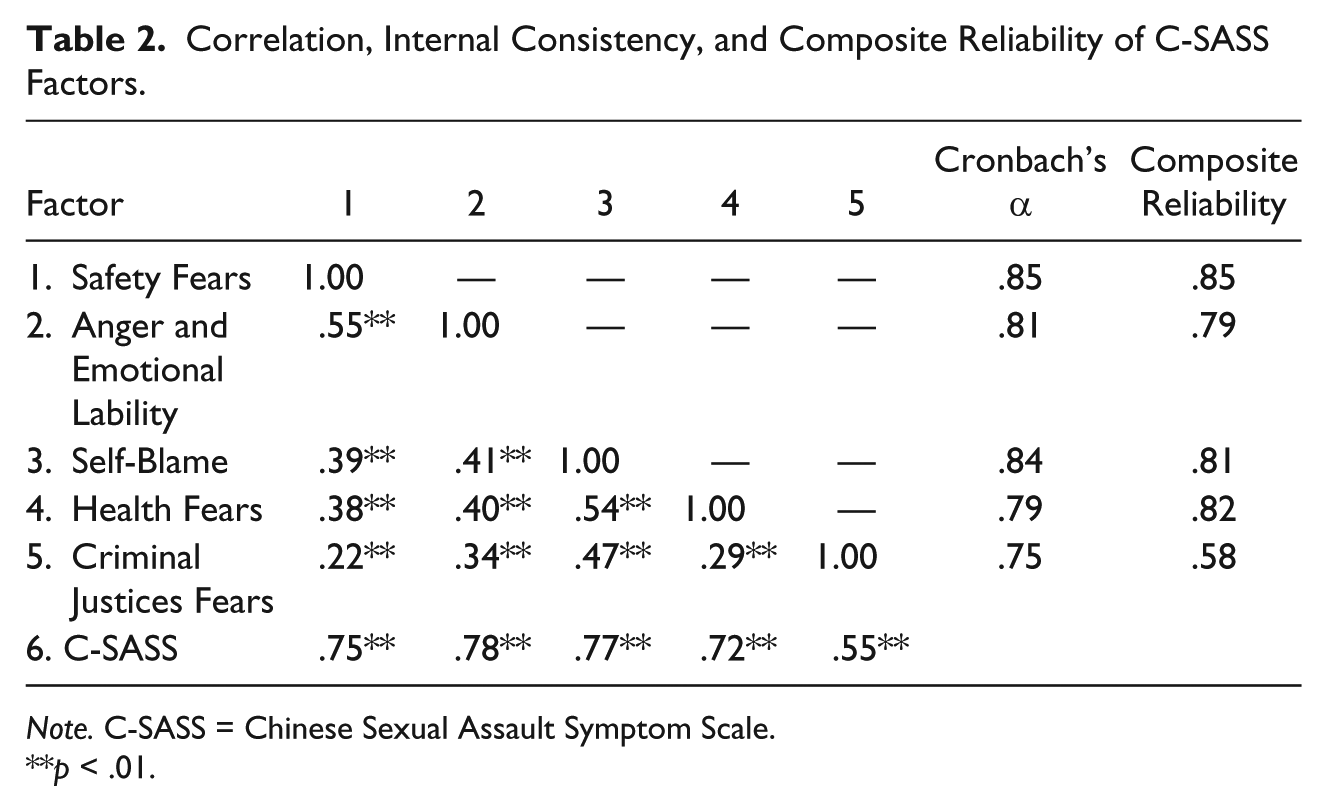
Two ways were used to examine the reliability of a scale. One is internal consistency and the other is the composite reliability. Good internal consistency (Cronbach’s α) shall be greater than 0.7 and a minimum acceptable level at 0.6 (DeVellis, 2003; Nunnally, 1978). The composite reliability was calculated from standardized factor loading coefficient (λ) and error variances (θ; Fornell & Larcker, 1981). Kline (2005) recommends that an acceptable CR level is 0.5 to 0.65 and a good CR is 0.76 to 0.85. Four factors have high internal consistency (Cronbach’s α = .81-.85) and good composite reliability (CR = .79-.85); only the Criminal Justices Fears has median internal consistency (Cronbach’s α = .75) and acceptable composite reliability (see Table 2).
Correlation, Internal Consistency, and Composite Reliability of C-SASS Factors.
Note. C-SASS = Chinese Sexual Assault Symptom Scale.
p < .01.
Discriminant Validity
We also used two approaches to examine the discriminant validity of the scale. One is by model comparison and the other is by the correlation coefficients. We first used nested models for model comparisons to determine discriminant validity of the C-SASS scale (Anderson & Gerbing, 1988; Bogozzi, Youjae, & Lynn, 1991). We compared the correlation coefficients between five factors for the nonparameter constraints model and parameter constraints model (Trochim & Donnelly, 2006). The results showed these two models were not equivalent (Δχ2 > 3.84, p < .05) and indicated the distinct nature of these five latent variables in C-SASS.
By comparing the correlation coefficients among factors, we found that (a) there were five separate factors in the C-SASS, because each factor has a median-correlated relationship with each other (.22 ≤ r ≤ .55; p < .01), and (b) there was a possible second-order latent construct behind the five factors, because each factor was highly correlated with the total C-SASS scores (.55 ≤ r ≤ .78; p < .01; see Table 2).
Confirmatory Factor Analyses
CFA is a special form of factor analysis, which is frequently used as a way to assess the proposed measurement model in a SEM (Brown, 2006). In this step, we used Sample B (n = 211), which passed the minimum required sample size of 200, to perform a CFA for scale cross-validation (Jackson, 2001). Our results showed that the C-SASS fit into the second-order factors model, where RMSEA (.08), IFI (.90), PGFI (.67), PNFI (.71), and PCFI (.77), have passed the required levels. It was also consistent with the results from the discriminant validity. In Figure 1, the C-SASS showed one second-order latent variable and five first-order latent variables. Thus, we have confirmed the structure of the C-SASS to be reliable and valid, and appropriate to assess trauma in Chinese victims of sexual assault.

Second-order factors model with standardized parameters of regression weights, and squared multiple correlations for C-SASS.
Discussion
The purpose of this research is to establish and verify the psychometric and structural properties of the self-report C-SASS to assess the trauma experienced by Chinese victims of sexual assault in Taiwan. We have examined the structure of C-SASS by two steps: (a) item analyses and exploratory factor analyses and (b) CFA. The results confirmed that the C-SASS measures five dimensions of trauma with only 19 items. Sexual-assault victims in Taiwan are fearful not only about their personal safety and the assailant (Safety Fears) but also about their physical health (Health Fears) and involvement with the criminal justice system (Fears About the Criminal Justice System). Additional dimensions of sexual assault trauma are feeling angry, irritable, and emotionally volatile (Anger and Emotional Lability), and guilty and blaming themselves (Self-Blame).
Substantively, rape-related fears experienced by victims of sexual assault are multidimensional. From the factor analyses, some fears are about personal safety and vulnerability, while other fears are about physical health or the criminal justice system. They may be concerned about their physical health, personal safety, or apprehensive about the criminal justice system.
Based on Luo’s (1998) interviews with sexual abuse Chinese survivors in Taiwan, that found Chinese survivors shared a pervasive concern for the loss of their virginity, which often led to a sense of guilt and shame. Thus, the C-SASS has successfully captured the cultural components of Health Fears for Chinese victims by the three items not in the SASS II, “Worry about the damage to the sexual organs,” “Worry about the breaking of the hymen,” and “Worry about the flaws of the body.”
The 19-item C-SASS has been validated for Taiwanese victims, assessing short- and long-term traumas. This is the first rape trauma scale on Taiwanese rape victims to assess their emotional distress and thus better help them. The scale is used throughout the country in various rape crisis centers; therefore it has filled in an extremely important measurement gap and provided an extremely important service to the rape victims.
The C-SASS can assess trauma from within one day to over a year. It can be used for male and female victims, and ages ranging from 5 to 69 years. Our sample also contained incest victims, and victims of strangers and acquaintances. The victims filled out the form or the social worker administered it to her or him. The instrument was used by social workers through interviews or by victims through pencil and paper. Our victims were considered reported cases, because once they contacted the governmental rape crisis centers, the police investigation will be involved eventually, since the penal law requires the mandatory reporting of sexual assault to the police.
These results are based on one assessment of the rape victims, usually at the initial session. This study was successful in recruiting a heterogeneous group of victims who receive services from the governmental rape crisis center. The results indicate that the C-SASS is a relatively brief, valid, and reliable self-report scale that assesses the level of several dimensions of trauma post-assault in Taiwanese victims. This scale can be used by clinicians, sexual assault treatment center counselors, and researchers investigating such topics as trauma change over time and its determinants.
However, the limitations of the present study are that our sample came from only one crisis center out of 23 centers around Taiwan and included only 3% male victims. Therefore, future research should examine the utility of the scale for assessing trauma in different centers and include more male victims and other types of victims (e.g., statutory rape victims). Among the five factors of the C-SASS, the reliability of Criminal Justices Fears was the lowest and could be improved by adding more items. Furthermore, the C-SASS scale can be tested on other areas of Chinese population, such as Mainland China, to see if the dimensions of trauma are similar for victims from different Chinese societies.
Footnotes
Acknowledgements
The authors thank Libby O. Ruch, Professor Emeritus, Sociology, University of Hawaii at Manoa, for comments on earlier versions of the manuscript. The authors also thank the social workers at the Taoyuan County Domestic Violence and Sexual Assault Prevention Center for facilitation of the study.
Declaration of Conflicting Interests
The author(s) declared no potential conflicts of interests with respect to the authorship and/or publication of this article.
Funding
The author(s) disclose receipt of the following financial support for the research and/or authorship of this article: Preparation of this manuscript was supported in part by the Grant from the Taoyuan County Government, a collaborative effort of the Taoyuan County Domestic Violence and Sexual Assault Prevention Center, Taiwan.