




Abstract
Evidence regarding the relationship between married women’s autonomy and risk of marital violence remains mixed. Moreover, studies examining the contribution of specific aspects of women’s autonomy in influencing the risk of marital violence using measures of autonomy that incorporate its dynamic nature are rare. We investigated the relationship between women’s autonomy and their experience of marital violence in rural India using prospective data. We used data on 4,904 rural women drawn from two linked studies: the NFHS-2, conducted during 1998-1999 and a follow-up study for a subgroup of women carried out during 2002-2003. Three dimensions of autonomy were used: financial autonomy, freedom of movement, and household decision-making. Marital violence was measured as experience of physical violence in the year prior to the follow-up survey. Findings indicate the protective effects of financial autonomy and freedom of movement in reducing the risk of marital violence in the overall model. Furthermore, region-wise analysis revealed that in the more gender equitable settings of south India, financial autonomy exerted a protective influence on risk of marital violence. However, in the more gender-stratified settings of north India, none of the dimensions of autonomy were found to have any protective effect on women’s risk of marital violence. Results argue for an increased focus on strategies aimed at improving women’s financial status through livelihood skill-building opportunities, development of a strong savings orientation, and asset-building options.
Introduction
During the past decade, the policy and programmatic attention related to eliminating violence against women in India has increased considerably. Several national policies, laws, and programs such as the National Policy for the Empowerment of Women 2001, the Protection of Women From Domestic Violence Act 2005, and the strategies outlined in the XIth 5-year plan have advocated the importance of eliminating violence against women. Despite these efforts, substantial proportions of women continue to experience violence, especially within marriage. As recently as 2005-2006, more than one in three (35%) of a nationally representative sample of women aged 15 to 49 years reported experiencing violence from their husband at some point during their married life (IIPS and Macro International, 2007).
Women’s autonomy, defined as the capacity to manipulate one’s personal environment through control over material and social resources (Basu, 1992; Dyson & Moore, 1983; Jejeebhoy, 2000), has been examined as a factor associated with the risk of marital violence in different global settings. For example, a study conducted among rural women in India found that women had limited autonomy including personal freedom of movement and decision-making autonomy (Jejeebhoy & Cook, 1997). Another study found that a woman’s control over financial resources played a protective role against marital violence, although this relationship was found to be context-specific such that women’s higher autonomy was protective against risk of marital violence in the southern state of Tamil Nadu but not in the more conservative northern state of Uttar Pradesh (Jejeebhoy, 1998). Similarly, another study conducted in South Africa using the cluster-randomized design showed improvements in women’s empowerment as a result of the intervention, and such improvements were further associated with reduced risk of partner violence (Kim et al., 2007). In contrast, studies from Bangladesh and Brazil found that higher autonomy, as measured by overall household autonomy and financial autonomy, was associated with elevated risks of violence from intimate partners (d’Oliveira et al., 2009; Koenig, Ahmed, Hossain, & Mozumder, 2003), but once again, the study setting seemed to play an important role, with the negative association between autonomy and violence being evident in the more conservative regions of the respective country. A multi-country study in Bolivia, Haiti, and Malawi also showed that women who made decisions regarding their own health care independently were more likely than those who made decisions jointly with their husband to report experiencing violence from their husband (Hindin, Kishor, & Ansara, 2008).
Thus, while the role of autonomy in influencing the risk of marital violence has been explored by studies in the past, evidence on whether a woman’s level of autonomy within her marital household plays a role in protecting her from marital violence remains mixed and inconclusive. Similarly, evidence on the extent to which variations in autonomy over a woman’s lifetime influence risk of marital violence is almost nonexistent, as almost all of the past studies have been conducted using cross-sectional data, although there is evidence that a woman’s autonomy changes over time, for example as women age, become mothers, and assume the role of a mother-in-law (Das Gupta, 1995; Lee-Rife, 2010). Finally, evidence from India regarding the association between woman’s autonomy and risk of marital violence is limited, with only one study having looked at this association. This study, as described hereinbefore, documented the protective influence of financial autonomy on risk of marital violence in the southern region of India (Jejeebhoy, 1998).
To address these gaps in evidence, we used data from a prospective study of married women in four Indian states to examine the relationship between women’s autonomy over time and their experiences of physical violence within marriage in rural settings in India. Furthermore, given the past evidence regarding the context-specific nature of this relationship, we conducted a regional analysis to assess whether the relationship between women’s autonomy and marital violence varied in regions characterized by more and less gender inequities. To our knowledge, this is the first study to prospectively examine this relationship in India.
Method
Study Setting and Design
The study draws on data from rural women in four economically and culturally diverse states of India: Bihar, Jharkhand, Maharashtra, and Tamil Nadu. Tamil Nadu and Maharashtra are among the more economically progressive states in the country, accounting for 7% and 13% of the national Gross Domestic Product, respectively, while Bihar and Jharkhand are among the lesser-developed states, accounting for 2% to 3% each (Ministry of Statistics and Programme Implementation, 2009). There is also considerable evidence of regional differences in the situation of women and gender equality. Inegalitarian relations are much more acute in north India than in west and south India (see, for example, Altekar, 1962; Dyson & Moore, 1983; Karve, 1965). These gender differences are also seen in terms of key indicators of women’s status. For example, Bihar and Jharkhand have lower levels of female literacy (53% and 56%, respectively) as compared with Maharashtra and Tamil Nadu (75% and 74%, respectively; Office of the Registrar General and Census Commissioner, 2011). Similarly, life expectancy at birth is about 2 to 3 years greater for females than males in Maharashtra and Tamil Nadu, whereas it is greater for males than females in Jharkhand and Bihar (Office of the Registrar General, India [RGI], 2008). State-wise differences in the experience of marital violence among women of reproductive ages are narrow, but are nevertheless present. Marital violence was experienced by 35% to 56% of women from Jharkhand and Bihar, compared with 29% to 37% of women in Maharashtra and Tamil Nadu (International Institute for Population Sciences [IIPS] and Macro International, 2007).
We used data from two linked studies: the National Family Health Survey–2, a nationally representative population-based survey conducted in India during 1998-1999 by the International Institute for Population Sciences (IIPS) and ORC Macro (2000), and a follow-up study of women interviewed in NFHS-2 in four states carried out during 2002-2003 by IIPS and Johns Hopkins University (2005). The follow-up study was restricted to married women who were between 15 and 39 years of age and were the usual residents of the household at the time of NFHS-2 survey. High reinterview rates were achieved in all four states, ranging from 76% in Maharashtra to 94% in Tamil Nadu. The reinterviewed sample was similar to the non-reinterviewed sample in terms of most characteristics (International Institute for Population Sciences [IIPS] & Johns Hopkins University, 2005). Six thousand four hundred and thirty-seven women completed the follow-up survey, and of these, 90% were selected for the domestic violence module. To ensure ethical standards, the domestic violence module was administered only to the youngest woman in households with multiple eligible respondents (International Institute for Population Sciences [IIPS] & Johns Hopkins University, 2005). Selecting only one woman for the domestic module even when there are more women eligible for interview enabled the interviewed respondent to keep the information confidential.
We note that in this can make the sample biased toward the younger age group. To ascertain the extent of this bias, we compared the extent of recent violence experienced at the time of the baseline survey by those selected in the follow-up and those not selected in the follow-up sample (i.e., the youngest and the oldest women in households with more than one eligible respondents) and we found no significant differences between the two groups. Furthermore, a large majority of the respondents in the overall follow-up sample belonged to households with single eligible respondent.
Two percent of women were further excluded from the present study due to missing data. Around 12% of women who reported having experienced life-time violence at NFHS-2 did not report such violence in the follow-up study and hence were also excluded from the analysis, yielding a final sample size of 4,904 women.
Measures
Dependent variable
Our violence exposure variable was taken from the follow-up survey, and assessed whether the respondent had experienced physical violence perpetrated by her husband in the 12 months prior to the interview. Questions pertaining to physical violence assessed whether the respondent’s husband had pushed, pulled, or held her down, hit with fist, kicked or dragged her, strangled or burned her, or attacked her with a knife or gun.
Independent variables
The three dimensions of autonomy examined were—women’s financial autonomy, freedom of movement, and decision-making autonomy. A similar set of questions was used to assess the extent of women’s autonomy at baseline and at follow-up. Women’s financial autonomy was measured with a question about whether they were allowed to have money set aside for them to use as they wished (yes/no). Women’s freedom of movement was measured using two items—whether they needed permission to (a) go to the market and (b) visit friends or relatives. Possible responses included: yes, no, and not allowed to go. Women who reported not needing permission to visit either of the two places were coded as having freedom of movement. For household decision-making autonomy, three items were considered. Respondents were asked whether they made decisions on the following: seeking health care for self, the purchase of jewelry, and visiting relatives/friends. Possible responses included made the decision independently, made the decision jointly with her husband, made the decision jointly with others in the family, others in the family made the decision, and finally, husband alone made the decision. Women who reported independent say in decisions related to at least one of the three topics were considered to have decision-making autonomy and others were considered to have no autonomy.
In recognition of the fact that women’s autonomy is a dynamic rather than a static construct, we further refined our indicators of autonomy to account for changes in women’s autonomy that occurred during the inter-survey period. We created a four-category variable for each of the three dimensions of women’s autonomy. For example, in the case of women’s financial autonomy, the indicator variables were (a) woman had no financial autonomy at baseline and at follow-up; (b) woman had financial autonomy at baseline and follow-up; (c) woman had no financial autonomy at baseline, but gained financial autonomy by the time of the follow-up survey; and (d) woman had financial autonomy at baseline, but lost it by the time of the follow-up survey. Equivalent variables were created for freedom of movement and household decision-making autonomy.
Control variables
We controlled for a number of background variables. These included respondent’s present age, educational level (illiterate, some primary or middle school education, middle school complete or higher), wealth status at baseline (defined by using the standard of living index—low, medium, or high), change in wealth status from baseline to follow-up (improved, worsened, or remained the same), and religion (Hindu, Muslim, or other religions) and caste (scheduled caste, scheduled tribe, other backward caste, and general caste). 1 Given the links between childlessness/infertility and experience of violence, we also controlled for whether the woman was childless, that is, whether she had at least one living child before the start of the year preceding the follow-up survey (Unisa, 1999). We also controlled for husband’s characteristics and behaviors that are found to be correlated with women’s risk of experiencing violence (Ackerson, Kawachi, Barbeau, & Subramanian, 2008; Babu & Kar, 2010; Bates, Schuler, Islam, & Islam, 2004; Jejeebhoy, 1998; Jejeebhoy & Cook, 1997; Rao, 1997), including educational level (illiterate, less than middle school, middle school complete, or higher), alcohol use (whether the husband ever consumed alcohol), and reaction to the dowry brought by the wife (dissatisfied, satisfied, or did not care, wife did not bring anything). Finally, to account for the influence of previous experience of partner violence on the relationship between autonomy and recent violence, we also controlled for whether the respondent reported the experience of violence at the time of the baseline survey. In the overall model, we also controlled for the state of residence of the respondent.
Analysis
Multivariable logistic regression analyses were conducted in STATA to accommodate the complex design of the baseline and follow-up surveys including the potential nonindependence of responses within primary sampling units. To account for the socioeconomic and cultural differences among the study states and to capture the contextual influences, we also conducted a regional analysis, with Bihar and Jharkhand constituting the northern region and Maharashtra and Tamil Nadu the southern region. The models included all three dimensions of women’s autonomy along with other covariates.
Results
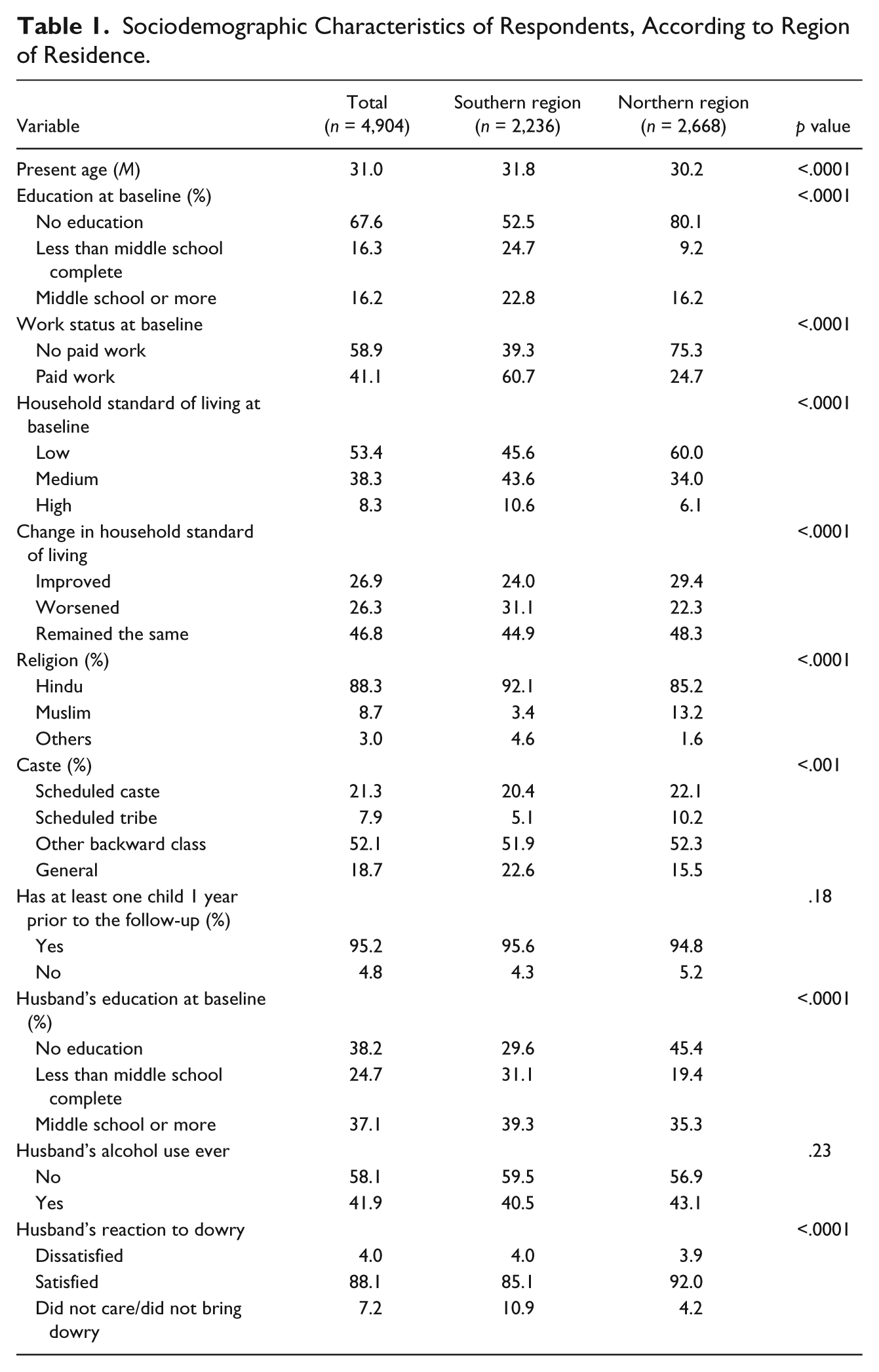
Table 1 presents a sociodemographic profile of married women aged 19 to 43 years, according to their region of residence. Women in the overall sample were, typically, 31 years of age, poorly educated (68% women reported having no education), and from economically disadvantaged families (53% having a low standard of living index). Regional differences were present: A larger proportion of women belonging to the northern region reported no education and came from economically disadvantaged households, compared with their southern counterparts. Two fifths of the women were working (41%) and more women reported being employed in paid jobs in the southern region than in the northern region (61% and 25%, respectively). Five percent of the women interviewed did not have any children 1 year prior to the follow-up. In terms of husband’s characteristics, almost two fifths of husbands in the overall sample did not have any education, and once again, regional differences were apparent, with a larger proportion of husbands in the northern region than in the southern region reporting no education (45% vs. 30%). Two fifths of women reported alcohol use among their husband in the overall sample. Only 4% of women reported that their husband was dissatisfied with the dowry they had brought with them at the time of marriage.
Sociodemographic Characteristics of Respondents, According to Region of Residence.
Experience of physical violence within marriage
Almost one fourth of the women (24%) in the follow-up survey reported experiencing physical violence from their husband in the 12 months preceding the interview, with 22% and 25% of women reporting violence in southern and northern regions, respectively. Of all forms of physical violence, hitting with a fist was most commonly reported; of those reporting experience of violence, 70% reported that their husband had hit them with a fist.
Women’s autonomy and change in autonomy during the inter-survey period
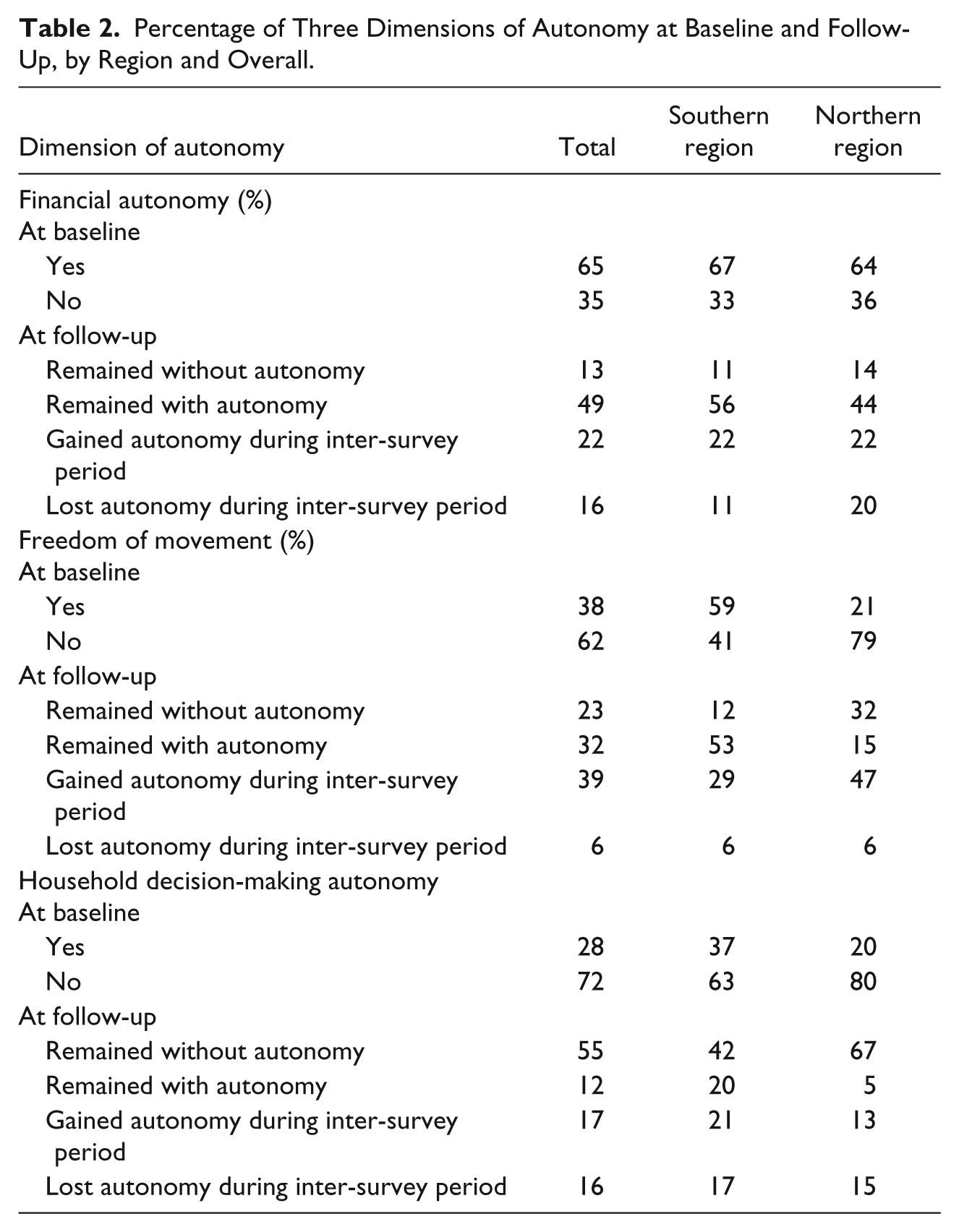
Table 2 summarizes the overall and region-wise distribution of the three key dimensions of women’s autonomy—access to financial resources, freedom of movement, and household decision-making—at baseline and follow-up. Thirty-five percent of women reported not having financial autonomy at the time of the baseline, with little difference between the two regions (33% in the south and 36% in the north). During the inter-survey period, 62% of women retained their baseline financial autonomy status—13% with no autonomy and 49% with autonomy. While 22% of women reported having gained financial autonomy, 16% reported having lost financial autonomy. Patterns remained similar in both regions, although the proportion of women who reported that they lost financial autonomy during the inter-survey period was slightly larger in the northern than southern region (20% vs. 11%). The majority of women (62%) reported no freedom of movement at the baseline, with a considerably larger proportion of women in the northern than southern region reporting so (79% vs. 41%). During the inter-survey period, a substantial proportion of women reported having gained freedom of movement (39%), whereas a negligible minority lost it (6%). Not surprisingly, a larger proportion of women in the northern than southern region reported having gained freedom of movement over time (47% vs. 29%), whereas a similar proportion reported having lost it (6% each). With respect to household decision-making, a large majority of women (72%) did not have household decision-making autonomy at baseline; again, more women in northern than southern region reported lack of decision-making autonomy (80% vs. 63%). Over time, similar proportions of women reported having gained decision-making autonomy (17%) and lost it (16%). A similar pattern was observed in both regions, although a somewhat larger proportion of women in the southern than northern region reported having gained decision-making autonomy over time (21% vs. 13%).
Percentage of Three Dimensions of Autonomy at Baseline and Follow-Up, by Region and Overall.
Relationship between women’s autonomy and physical violence within marriage
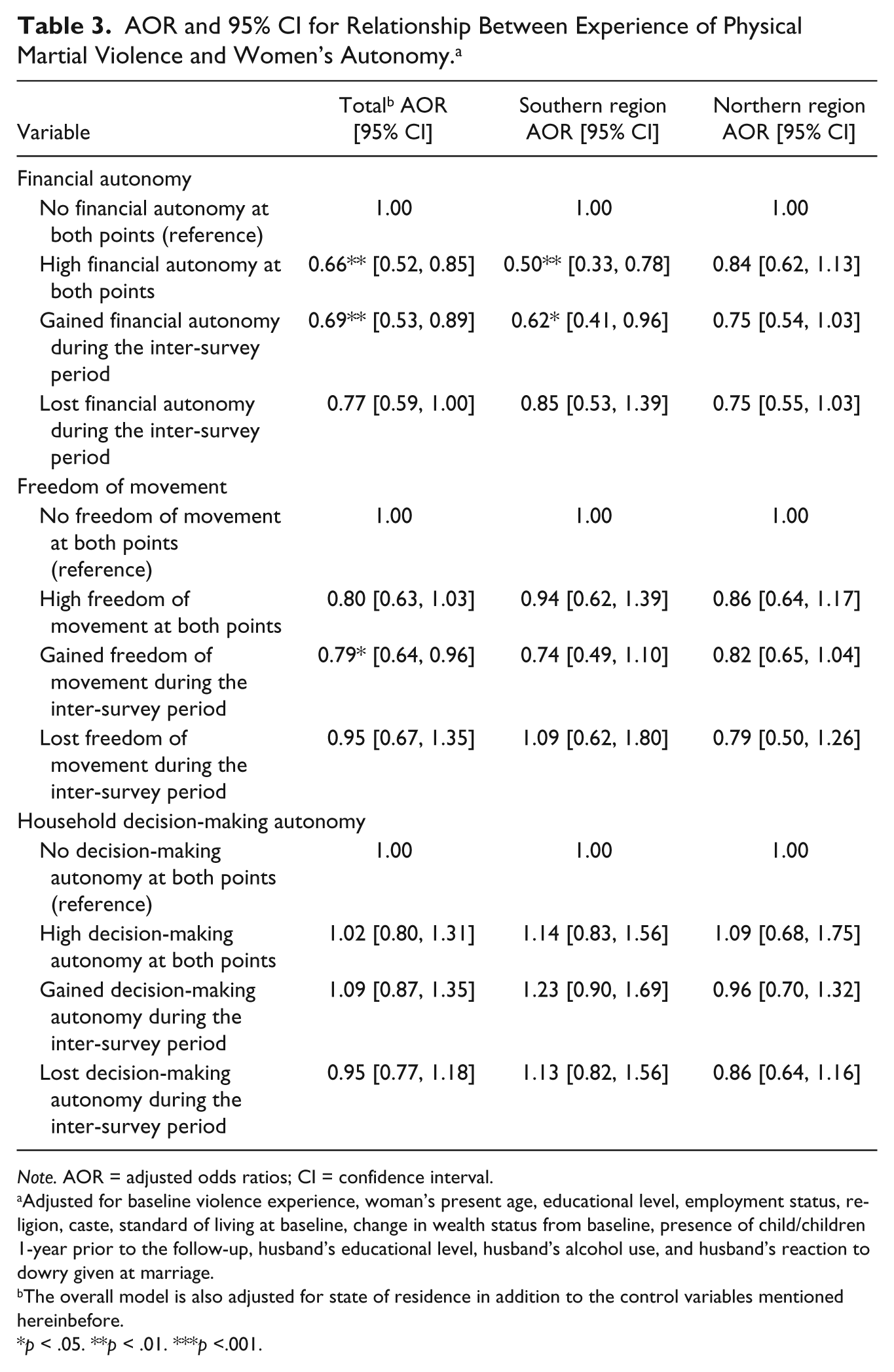
Table 3 shows the results of the multivariable analyses. We find that, in the overall model, financial autonomy is protective against the risk of marital violence after controlling for a range of background variables. Specifically, women who maintained financial autonomy over the study period (OR = 0.66; 95% CI [0.52, 0.85]) and those who reported gains (OR = 0.69; 95% CI [0.53, 0.89]) in financial autonomy were less likely to report recent experiences of marital violence. We also found that, in the overall model, women who reported gains in freedom of movement over time were also less likely to report marital violence. However, we did not find any effect of decision-making autonomy on women’s experiences of marital violence.
AOR and 95% CI for Relationship Between Experience of Physical Martial Violence and Women’s Autonomy. a
Note. AOR = adjusted odds ratios; CI = confidence interval.
Adjusted for baseline violence experience, woman’s present age, educational level, employment status, religion, caste, standard of living at baseline, change in wealth status from baseline, presence of child/children 1-year prior to the follow-up, husband’s educational level, husband’s alcohol use, and husband’s reaction to dowry given at marriage.
The overall model is also adjusted for state of residence in addition to the control variables mentioned hereinbefore.
p < .05. **p < .01. ***p <.001.
The region-specific analysis reveals that the effects of women’s autonomy on their experience of violence varied according to the region of residence. Among women residing in the southern region, we found a strong protective influence of financial autonomy on the risk of experiencing marital violence, even after controlling for the effects of important sociodemographic correlates of violence and other dimensions of autonomy. Results indicate that women who reported financial autonomy at baseline and follow-up were only half as likely as those who did not report financial autonomy to report violence (OR = 0.50; 95% CI [0.33, 0.78]). We also found that women who gained financial autonomy during the inter-survey period had a reduced risk of experiencing marital violence as compared with women with no financial autonomy at both time points (OR = 0.62; 95% CI [0.41, 0.96]). We did not find any statistically significant effects of women’s freedom of movement and household decision-making autonomy on their experience of violence in the south. In contrast, in the northern region, none of the three dimensions of autonomy were found to have any significant effect on the risk of marital violence.
Discussion
Findings confirm that married women in India face constraints to their autonomy with significant proportions reporting limited access to and control over financial resources, restricted freedom of movement and no independent say in household decisions, and a sizable proportion experiencing physical violence within marriage. Moreover, the results of our study indicate that in the overall sample, financial autonomy and freedom of movement are protective against risk of marital violence. Corroborating the findings from an earlier study conducted in India (Jejeebhoy, 1998), findings highlight the context-specific nature of the relationship between autonomy and violence. We found that among women residing in settings where gender relations are less hierarchical and gender stratified (southern region), there is a strong protective relationship between women’s financial autonomy and marital violence. In contrast, these effects are not seen in the northern region, which is characterized by greater gender inequality.
As demonstrated by a cluster-randomized trial in South Africa, increased economic well-being among women can potentially lead to decreases in partner violence through the following mechanisms—increased capacity to challenge the acceptability of partner violence, increased expectation of receiving better treatment from partners, and increased social support through mobilization of new and existing community groups (Kim et al., 2007). It is likely that in the more egalitarian settings of Maharashtra and Tamil Nadu, women having access to and control over resources are able to prevent violence perpetrated by their partner through the mechanisms mentioned above. In contrast, in the more conservative and patriarchal settings of Bihar and Jharkhand, lack of community norms supporting women’s well-being and independence can make it difficult even for more financially autonomous women to demand better treatment from their partner, or find social support that can potentially prevent violence from their partner.
Findings from our study also provide evidence regarding the dynamic nature of women’s autonomy. Past research demonstrates that in South Asia, improvements in women’s autonomy are influenced by age, birth of sons, shifts in role from mother to mother-in-law and changes in household structure (extended to nuclear; Das Gupta, 1995; Lee-Rife, 2010). Results of our study indicate that while a substantial proportion of women experienced an improvement in their autonomy status over time, a considerable number also reported a decline in their autonomy, particularly financial and household decision-making autonomy. A recent study from India corroborates these findings; this study found that financial discretion had declined for almost 50% of the study participants (Lee-Rife, 2010). Since our study was not designed to probe the determinants of changes in autonomy over time, further research is needed to explore the determinants of observed changes, both improvements and declines, in women’s autonomy found in our study.
Findings of this study need to be interpreted in light of certain limitations. First, we acknowledge that although we made considerable efforts to ensure the inclusion of a range of sociodemographic factors as well as changes in these factors over time, it is possible that we failed to account for some important variables that might affect the risk of marital violence. For example, change in family structure (joint family vs. nuclear family) is an important variable that can potentially influence the risk of marital violence as well the level of autonomy enjoyed by women within the household (Koenig et al., 2003; Lee-Rife, 2010). Second, we note that in households with multiple eligible respondents, only the youngest woman was selected for interview in the follow-up study, which can make the sample biased toward the younger age group. However, the possibility of such a bias is low as explained in the Method section.
Despite these limitations, the study underscores the value of examining the influence of a range of status variables on marital violence, moving beyond the focus on women’s education and employment that has dominated the literature to date.
Conclusion and Implications
Our findings highlight yet another imperative for improving women’s autonomy, namely, its protective effect on marital violence. Of particular note are the protective effects of increased financial autonomy. Findings highlight the need for strategies, programs, and policies that aim to improve women’s access to and notably their control over financial resources, including, for example, the provision of livelihood skill-building opportunities, opportunities for savings and access to varied savings products, and asset building options. More focused efforts are needed to enhance married women’s agency, mitigate their social disadvantage, and encourage savings among women. Equally important are efforts to raise awareness among women about their rights and enhance their ability to challenge existing gender norms.
Footnotes
Declaration of Conflicting Interests
The author(s) declared no potential conflicts of interest with respect to the research, authorship, and/or publication of this article.
Funding
The author(s) declared receipt of the following financial support for the research, authorship, and/or publication of this article: This work was funded by Grant 2000486149 from the Johns Hopkins Bloomberg School of Public Health, Johns Hopkins University, Baltimore, given to the Population Council, New Delhi.
Notes
Author Biographies