



Abstract
Sexual victimization is prevalent in the United States and overrepresented among adolescents. Research typically assesses victimization on a continuum of severity and rarely examines patterns of victimization within an individual. Using latent class analysis, the present study investigated whether meaningful classes of sexual victimization could be found based on the tactic used and severity of sexual behavior. Personal characteristics and psycho-behavioral outcomes were explored as they related to victimization classes. Peer sexual coercion experiences were examined among 657 racially diverse high school and college students, and four classes were identified: non-victims (54%), manipulated and forced fondle/intercourse (27%), poly-victimization (9.5%), and forced fondling (9.5%). Sexual victimization classes were significantly characterized in regards to childhood sexual abuse, gender, and age. The poly-victimization class (i.e., verbal coercion, substance facilitated, and physical force resulting in completed intercourse) showed the greatest level of psycho-behavioral consequences with significantly lower self-esteem, higher psychological distress, and more sexual risk taking than all other classes. The manipulated and forced class also showed significantly lower self-esteem than non-victims. Findings provide important implications for understanding patterns of sexual victimization and related consequences to help target interventions more effectively.
Decades of research highlight the pervasive nature of sexual victimization. According to Centers for Disease Control’s (CDC) recent national estimates (Black et al., 2011), approximately 18%, or one in five, adult women and 1.4% of adult men in the United States report having been raped in her or his lifetime (i.e., completed or attempted forced vaginal or anal penetration by physical force, or completed penetration by alcohol or drug facilitation). The prevalence increases to 44.6% of women and 22% of men who report experiencing other forms of sexual violence, such as unwanted sexual contact (i.e., unwanted touch but not penetration; 27% women, 12% men) and sexual coercion (i.e., unwanted penetration after nonphysical pressure; 13% women, 6% men).
In research and practice, sexual coercion experiences are assessed as a continuum of severity and classify the survivor based on the most severe type of tactic used; however, we argue that victims likely experience multiple types of sexual coercion throughout their lifetime. Research understanding patterns of victimization and psycho-behavioral correlates can provide a more nuanced understanding of the problem of sexual violence and inform targeted interventions. The present study utilized latent class analysis (LCA) to explore sexual victimization patterns based on the tactic used (i.e., verbal coercion, substance facilitated, physical force) and sexual outcome (kissing/fondling, attempted sexual intercourse, completed sexual intercourse) among a sample of adolescents, and the relationship between victimization patterns and psycho-behavioral functioning. In this study, we define the following non-consensual sexual experiences as the following: verbal coercion refers to the use of verbal pressure and intimidation; substance facilitated implies intentional use of chemical substances or taking sexual advantage of someone who is chemically impaired; and physical force refers to employing or threatening physical violence.
Sexual Victimization Continuum and Severity
Koss, Gidycz, and Wisniewski (1987) identified four types of unwanted sex including rape (i.e., sexual intercourse due to alcohol/drugs or physical force), attempted rape (i.e., attempted but not completed sexual intercourse by alcohol/drugs or physical force), sexual coercion (i.e., sexual intercourse due to continual arguments, pressure, or abused authority), and sexual contact (i.e., sex play due to arguments, pressure, or abused authority). Studies typically assess sexual victimization experiences on a continuum of severity, which suggest that physical force resulting in intercourse (i.e., completed rape) is the most psychologically traumatic, and that greater incidents of sexual victimization are related to lower levels of psychological and behavioral health (Classen, Palesh, & Aggarwal, 2005; Ullman, Townsend, Filipas, & Starzynski, 2007).
Although forcible rape has been considered the most severe victimization experience, substance facilitated sexual assault and verbal coercion have also been associated with deleterious outcomes. Some studies have found that forcible rape and incapacitated rape show comparable levels of psychological distress (Brown, Testa, & Messman-Moore., 2009). McCauley and colleagues (2009) found among a nationally representative sample of young women that survivors of incapacitated and substance facilitated sexual assault were comparable to other sexual assault survivors on past year major depressive episode and post-traumatic stress disorder (PTSD). Verbal coercion has also related to greater psychological distress as Norwood and Murphy (2011) found among a community sample of women, in which sexual coercion was a unique predictor of PTSD symptoms, whereas forcible rape was not. The relationship of sexual victimization diminished, however, when controlling for psychological abuse. Moreover, some studies report lower self-esteem (Testa & Dermen, 1999; Tyler, Hoyt, & Whitbeck, 1998) and greater psychological distress (Zweig, Barber, & Eccles, 1997) among women who were sexually coerced than those who were raped. Although penetration is presumed to be the most severe sexual act of victimization, some research has found poor psychological sequelae among sexual assault survivors when sexual intercourse did not occur (Resnick, Kilpatrick, Dansky, Saunders, & Best, 1993).
Sexual victimization of men has also been associated with deleterious psychosocial correlates (Larimer, Lydum, Anderson, & Turner, 1999; Walker, Archer, & Davies, 2005). Unlike the growing research on differential correlates of women’s sexual victimization, however, few studies have explored the psychological correlates of men’s victimization by tactic and sexual outcome. One notable exception is Turchick’s (2012) recent study among 302 male college students who were classified by victimization as non-victims, unwanted sexual contact, sexual coercion, and rape. Results indicated that over half of the men reported some form of sexual victimization, and men who were raped showed greater sexual risk taking and substance use behaviors than their non-victimized counterparts.
Limitations in Multivariate Explorations of Sexual Victimization
Despite the negative psychosocial outcomes associated with different forms of sexual victimization, few studies have investigated sexual victimization based on all three types of common perpetrator tactics (i.e., verbal coercion, substance facilitated assault, forcible rape) within one study. One notable exception is Abbey, BeShears, Clinton-Sherrod, and McAuslan (2004) who investigated sexual victimization based on perpetrator tactic among a community sample of women, focusing on experiences of sexual intercourse by verbal coercion, intoxicated sexual assault, and physical force. Using discriminant function analysis, participants were classified by their most severe experience based on a continuum of coercion types, victim perception, and recency of assault. Results showed common and divergent classifications based on the tactic used. Physical force had unique assault characteristics from intoxicated and verbal coercion, whereas physical and intoxicated assault showed greater similarities in perceived seriousness and severity compared to verbal coercion. Despite these differences, all survivors of sexual victimization experienced some negative outcome, with the majority of women experiencing multiple sexually coercive tactics. For example, 94% of forcible rape survivors and 88% of intoxicated sexual assault survivors also experienced verbal coercion. Brown and colleagues (2009) also explored differential consequences related to forcible rape, incapacitated rape, and verbal coercion among a large sample of community and college women. Among both samples, forcible rape victims reported the greatest psychological trauma followed by incapacitated assault victims; verbal coercion victims reported the fewest traumatic symptoms. After controlling for number of items endorsed, experiences meeting legal definitions of rape (i.e., forcible and incapacitated rape) were significantly related to greater traumatization.
These studies offer important advances to the sexual victimization literature by exploring differential correlates of psychological assessments related to the three most commonly reported and investigated sexual victimization tactics: verbal coercion, incapacitated assault, and forcible rape. However, the research lacks in that both studies explored psychosocial correlates by ranking participants a priori based on the most severe tactic experienced and only included unwanted penetration. This measurement approach and analysis does not allow for the investigation of multiple experiences within the individual and patterns of victimization, exploration of sexual behaviors other than penetration, or the psychosocial variables related to these patterns.
Personal and Group Level Variables Related to Sexual Victimization
Research suggests that certain groups with specific identifying variables might be at greater risk for sexual victimization than others. One consistent finding indicates that childhood sexual abuse survivors are more likely to experience later revictimization than their non-abused counterparts (Macy, Nurius, & Norris, 2007; Swartout, Swartout, & White, 2011; Webster, 2001).
Adolescents are also overrepresented in sexual victimization rates, representing 50% of sexual assault survivors (Catalano, 2005). Potential risk factors may include the environmental context related to adolescent development. For example, 53% of high school girls were found to have experienced sexual assault (Young, Grey, & Boyd, 2009), and those with older male partners were significantly more likely to experience unwanted or coerced sex (Marin, Coyle, Gomez, Carvajal, & Kirby, 2000). College environments have unique contexts of sexual coercion including increased expectations for sex and drinking (Abbey, 2002), and rape supportive attitudes among male dominated groups (Forbes, Adams-Curtis, Pakalka, & White, 2006; Humphrey & White, 2000). Rates as high as 69% have been documented for experiences of unwanted sexual contact in college environments (Fisher, Cullen, & Turner, 2000). Despite overrepresentation of sexual coercion in mid to late adolescence, few studies have compared the experiences of sexual coercion across adolescent contexts such as high school and college.
Although women are more likely to report sexual victimization than men, we know considerably less about male sexual victimization in comparison. Research suggests that men are more often coerced through the use of verbal and substance facilitated coercion strategies, more so than physical coercion tactics (Sorenson & Siegel, 1992; Struckman-Johnson & Struckman-Johnson, 1994). A small but nationally representative sample of male sexual assault victims reported that the majority of their experiences did not include substance use or penetration (Light & Monk-Turner, 2009). Exploring the victimization patterns among men is particularly imperative given the dearth of research in this area.
The Present Study
Research consistently documents the harmful effects of sexual victimization on psychological health. However, few studies have explored psychological correlates related to different perpetration tactics and sexual outcomes. Notable exceptions have found unique relations based on the tactic used and suggest that outcomes other than sexual intercourse relate to deleterious sequelae. This complicates the notion of the sexual violence continuum, yet studies typically classify survivors based on the most “severe” type of victimization. Macy (2008) challenges researchers to advance traditional assessments of victimization using binary yes/no measures and encourage multivariate analyses to assess victimization patterns. Understanding the unique patterns of sexual victimization and their influence on psychological adjustment is imperative in sexual violence prevention and counseling. Following Macy’s recommendations for sophisticated analyses in sexual violence research, this study expands on the work of Abbey et al. (2004) and Brown et al. (2009) by using LCA to explore sexual victimization patterns based on the three most commonly classified coercive tactics (i.e., verbal coercion, substance facilitated, physical force), while also including a range of sexual outcomes (i.e., kissing or fondling; attempted vaginal, oral, anal intercourse; completed vaginal, oral, anal intercourse). LCA is a person-centered approach that allows researchers to characterize participants by various indicators, in this case, characteristics of sexual victimization, and explore to these classes. Such analyses methodologically advance one-dimensional dichotomous examinations of sexual coercion, based on presumed severity, by offering multi-dimensional assessments based on various indicators.
The purpose of the present study was to explore sexual victimization patterns through LCA among young men and women and the related psycho-behavioral correlates of these classes. In accordance with expert conceptualizations of adolescent development spanning into one’s early 20s (Arnett, 2000) and the disproportionate rate of sexual coercion among adolescents (Catalano, 2005), this study focused on mid and late adolescents and includes a sample of high school and college students. The following research questions and related hypotheses guided our study: (1) What patterns of sexual victimization emerge based on tactic used and sexual behavior? We hypothesized that the best fitting model would consist of multiple latent classes of sexual coercion based on the type of tactic(s) used and sexual behavior experienced, including at least one class with no victimization and one class with multiple victimization tactics and sexual behavior outcomes. (2) To distinguish classes based on prior abuse and investigate potential gender and developmental differences in victimization patterns, we asked the following: Are classes characterized by childhood sexual abuse, gender, and adolescent development? Based on the extant literature, we hypothesized that the class with multiple forms of victimization would show the greatest likelihood for childhood sexual abuse history, that college students would show greater representation in classes with substance use given increased alcohol and drug use among college populations, and that men would be less represented in classes meeting criteria for forcible rape (i.e., physical force resulting in intercourse). Finally, to explore the potential influence of various victimization patterns on psychological and behavioral outcomes, the following question was asked: (3) How do classes predict psychological and behavioral outcomes? We focus specifically on the psycho-behavioral indicators of self-esteem, psychological distress, and sexual risk taking, given that research consistently demonstrates the correlation of these variables with sexual victimization. Previous findings support evidence of differential relations in self-esteem and psychological distress based on the tactic used by the perpetrator; and exploring the relation to sexual risk taking is important in assessing adolescent risk behaviors and of particular relevance, given the overrepresentation of adolescents in sexually transmitted infections (Centers for Disease Control and Prevention, National Center for HIV/AIDS Prevention, Divisions of HIV/AIDS Prevention, 2011; Weinstock, Berman, & Cates, 2004).
Methods
Participants
A total of 657 participants were included in this study, 373 (57%) young women and 284 (43%) young men. Participant ages ranged from 14 to 26 (women: M = 18.48, SD = 1.36) and were recruited from two high schools (n = 147, 22%) and a large public university (n = 510, 78%) in the Midwest. The sample was racially diverse: 39% White, 27% Black or African American, 18% Asian or Asian American, 10% Latina/o, and 35% multiracial. High school adolescents were recruited through gatekeepers at participating schools including principals, an assistant principal, and teachers from targeted psychology classes. University participants were recruited through psychology and African American studies classes as well as the campus registrar. Approximately half of the participants (n = 337, 51%) qualified for free or reduced lunch (high school students) or need-based financial assistance (university students).
Measures
Demographic variables
To explore potential differences in sexual coercion experiences and health outcomes related to adolescent development, age and participant level in school (i.e., 0 = high school, 1 = college) were included as a proxy for adolescent development. Gender was coded such that 0 = man, 1 = woman.
Sexual victimization
A modified version of the Sexual Coercion Inventory (SCI; Waldner, Vaden-Goad, & Sikka, 1999) was used to assess sexual victimization experiences. The original SCI is a 14-item instrument that measures an array of sexually coercive incidents grounded in the seminal sexual coercion literature with multiple response options to assess a continuum of sexual behaviors ranging from kissing to intercourse. The scale was modified from the original 14-item version by adding three additional items on voluntary and involuntary substance use for facilitated and incapacitated sexual assault and included attempted intercourse as response option outcome for each incident. Example items for the tactic used include (a) verbal coercion (seven items, for example, “My partner threatened to stop seeing me”); (b) substance facilitated (four items, for example, “My partner encouraged me to drink alcohol and then took advantage of me”); and (c) physical force (six items, for example, “My partner threatened to use or did use a weapon”). For the purpose of this study, responses were dummy coded for scores on verbal, substance, and physical coercion (0 = did not occur, 1 = at least one experience with coercion tactic). The sexual behavior outcomes of each victimization incident were assessed using the following classification: 1 = kissing, fondling; 2 = attempted vaginal, oral, or anal intercourse; and 3 = completed vaginal, oral, or anal intercourse. Participants were asked to provide information for the most significant experience, and explicit instructions were included to distinguish from childhood sexual abuse (e.g., refer to sexual experiences with a non-relative peer who is not a family member). Reliability estimates for the total SCI were acceptable, α = .80. The SCI was chosen over other existing sexual victimization measurements for its breadth and detailed specificity. Because little psychometric support for this scale has been published, we tested concurrent validity with the SCI subscales and the total score on the widely used Sexual Experiences Survey (Koss & Oros, 1982). Consistent with the purpose of the study to test multiple forms of victimization without a priori classification, the total score was used as opposed to classifying scores based on the most severe type: r = .46, p < .01 (verbal tactics), r = .36, p < .01 (substance facilitated), and r = .48, p < .01 (physical force).
Childhood sexual abuse
The Sexual Abuse subscale of the Childhood Trauma Questionnaire (CTQ; Bernstein & Fink, 1998) consists of five items rated on a 5-point Likert-type scale ranging from 1 (never true) to 5 (very often true); higher scores represent greater childhood trauma. The scale was modified to provide greater distinction between peer sexual coercion and childhood sexual abuse (e.g., “An adult tried to make me do sexual things or watch sexual things” vs. Someone . . . ). Descriptive instructions were also provided to clarify adults from peers. Construct validity was supported among a sample of racially diverse adolescent psychiatric patients, consistent with therapists’ independent ratings of maltreatment type (Bernstein et al., 2003). Alpha coefficient estimates for the current sample were acceptable (α = .90). Scores were dummy coded, such that 0 = no childhood sexual abuse and 1 = at least one experience with childhood sexual abuse.
Self-esteem
The Rosenberg Self-Esteem Scale (RSES; Rosenberg, 1965) is a 10-item, 4-point Likert-type scale ranging from 1 (strongly disagree) to 4 (strongly agree), higher scores yield higher levels of self-esteem (e.g., “On the whole I am satisfied with myself”), higher scores indicate higher self-esteem. Acceptable internal consistency has been found among ethnically diverse adolescents (Chang, Bendel, Koopman, McGarvey, & Canterbury, 2003). Internal consistency estimates for the current study were α = .88.
Psychological distress
The five-item version of Mental Health Inventory (MHI-5; Berwick et al., 1991; Veit & Ware, 1983) is a 6-point, Likert-type scale that asks participants to indicate how much of the time they felt happy, anxious, or depressed during the past month. MHI-5 measures overall psychological well-being, including symptoms of anxiety (i.e., “ . . . been a very nervous person?”), general positive affect (e.g., “ . . . felt calm and peaceful?”), depression (i.e., “ . . . felt downhearted and blue?”), and behavioral/emotional control (i.e., “. . . felt so down in the dumps that nothing could cheer you up?"). Response options range from 1 (all of the time) to 6 (none of the time); higher indicates greater levels of psychological distress. Reliability estimates of .90 have been found with adolescents (Ostroff, Woolverton, Berry, & Lesko, 1996) and criterion validity has also been established (Manne & Schnoll, 2001; McHorney & Ware, 1995). This scale was chosen for its demonstrated validity with adolescent samples and ability to assess for symptomatology across a number of indicators of psychological distress. In addition, given that psychological distress was not the main focus of the study, a shorter scale was used to reduce participant fatigue. Reliability estimates for the current sample were α = .84.
Risky sexual behavior
The Scale of Sexual Risk Taking (SSRT; Metzler, Noell, & Biglan, 1992) is a 13-item scale and measures the amount of sex with non-monogamous partners, number of sexual partners in the past year, condom use, and sex associated with alcohol or drugs. Response formats include “Yes/No,” Likert-type and numerical indication depending on the item; higher scores indicate greater sexual risk taking. Reliability coefficients have ranged from .75 to .90 among a sample of racially diverse adolescents (Biglan, Noell, Ochs, Smolkowski, & Metzler 1995) and have convergent validity with the Scale of AIDS Risk (Metzler et al., 1992). The alpha reliability estimates for the current sample were acceptable, α = .78.
Procedures
Institutional Review Board Human Subject approval was received prior to data collection. Participants completed the survey in one of three ways including an online electronic format at their own convenience (n = 224, 34%, university only), paper-and-pencil format in a classroom setting (n = 302, 46% university and high school students), or paper-and-pencil format in private (n = 131, 20% university only). All of the high school participants completed a paper-and-pencil survey in a large classroom setting during regular school hours and were provided with opaque sheets of paper to cover their answers for greater anonymity. Investigators remained present during data collection for all high school participants in case questions or concerns arose. Participants under 18 years of age were required to provide active parental consent and youth assent. High school students 18 years of age or older were allowed to participate if they provided written consent and all university participants were required to be 18 years of age or older. Survey participants received remuneration in the amount of $5.00 gift certificate.
Data Analyses
LCA was used to classify participants into optimal grouping categories on the basis of common sexual coercion features (Nylund, Asparouhov, & Muthén, 2007). LCA is a multivariate person-centered analysis that assumes an underlying latent variable, determines an individual’s class membership (Reinke, Herman, Petras, & Ialongo, 2008), and serves as a useful tool in investigating the existence of unobserved heterogeneity among observed variables (Hagenaars & McCutcheon, 2002). Compared to the traditional cluster analysis, LCA is able to include the uncertainty of membership (i.e., error) and assigns membership on the basis of probabilities. Class membership is determined through fit statistics and tests of significance including the likelihood ratio test, the Vuong-Lo-Mendell-Rubin (VLMR; Lo, Mendell, & Rubin, 2001; Vuong, 1989), Akaike information criterion (AIC), and the Bayesian Information Criteria (BIC; Nylund et al., 2007). Data were analyzed using Mplus 6.1 software. Predictors of class membership (i.e., childhood sexual abuse, gender, adolescent development) and psycho-behavioral outcomes (i.e., self-esteem, psychological distress, sexual risk taking) were examined through tests of mean differences.
Results
Research Question 1: Patterns of Sexual Victimization
LCA was conducted to determine the optimal number of classes based on tactic used (i.e., verbal, substance, physical) and sexual behavior (i.e., kissing/fondling, attempted intercourse, completed intercourse) of sexual victimization experiences. LCA fit indices determined a four-class solution as the best fitting model (see Table 1). Figure 1 summarizes the characteristics and prevalence of the four identified latent classes. Approximately half of the sample experienced some form of sexual victimization, with 54% classified as non-victims, consistent with our hypothesis of at least one non-victimized class. Of those who were victimized, the most common classification was the manipulated and forced fondle/intercourse class (27%). This class was characterized as having a high probability of verbal coercion (1.0), moderate physical coercion (0.64), and resulting most often in completed intercourse (.48), followed by kissing or fondling (.34). Equal proportions of the sample were classified in the forced fondling (9.5%) class and the poly-victimization class (9.5%). Forced fondling was characterized by a high probability of experiencing physical tactics (1.0) that overwhelmingly resulted in kissing or fondling (0.67). Consistent with our hypothesis of a class with multiple victimization experiences, the final class, poly-victimization, was characterized by a high probability of experiencing all tactics: verbal coercion (0.75), substance facilitated (1.0), and physical force (0.73) and that overwhelmingly resulted in completed sexual intercourse (0.68).
Model Fit indices for 1 to 5 Class Solutions of Types and Severity of Sexual Coercion Experience.

Note. Bold indicates best fit: The 4-class solution had the lowest adjusted BIC of eligible classes and the Bootstrap LRT indicated the 4-class solution provided a better fit than the 5-class solution. All entropy ratings indicate an acceptable fit. AIC = Akaike information criterion; BIC = Bayesian information criteria; LRP LRT = Lo-Mendell-Rubin Adjusted Likelihood Ratio Test.

Defining characteristics and prevalence of each class.
Research Question 2: Class Characteristics
Latent class regression analyses were used to estimate the predictors for class membership in relation to participants’ childhood sexual abuse history, adolescent development, and gender (see Table 2). Consistent with our hypothesis, participants in the poly-victimization class showed significantly higher rates of childhood sexual abuse compared to all other classes. A small number of participants reported at least once incident of childhood sexual abuse: 20% of women and 10% of men. Manipulated and forced fondling/intercourse reported significantly greater childhood sexual abuse than non-victims. The poly-victimization class also showed significantly greater representation of women compared to all other classes, which were equivalently distributed between men and women. This supports our hypothesis that men would be underrepresented in classes with forced intercourse, yet also contradicts it as the manipulated and forced intercourse class showed equivalent proportions of men and women. Also challenging our hypothesis, there was little distinction of the classes by adolescent development. Educational context did not distinguish any of the classes; however, participants in the poly-victimization class were significantly older than non-victims.
Class Characteristics: Proportion of Childhood Sexual Abuse, Gender, and Adolescent Development.
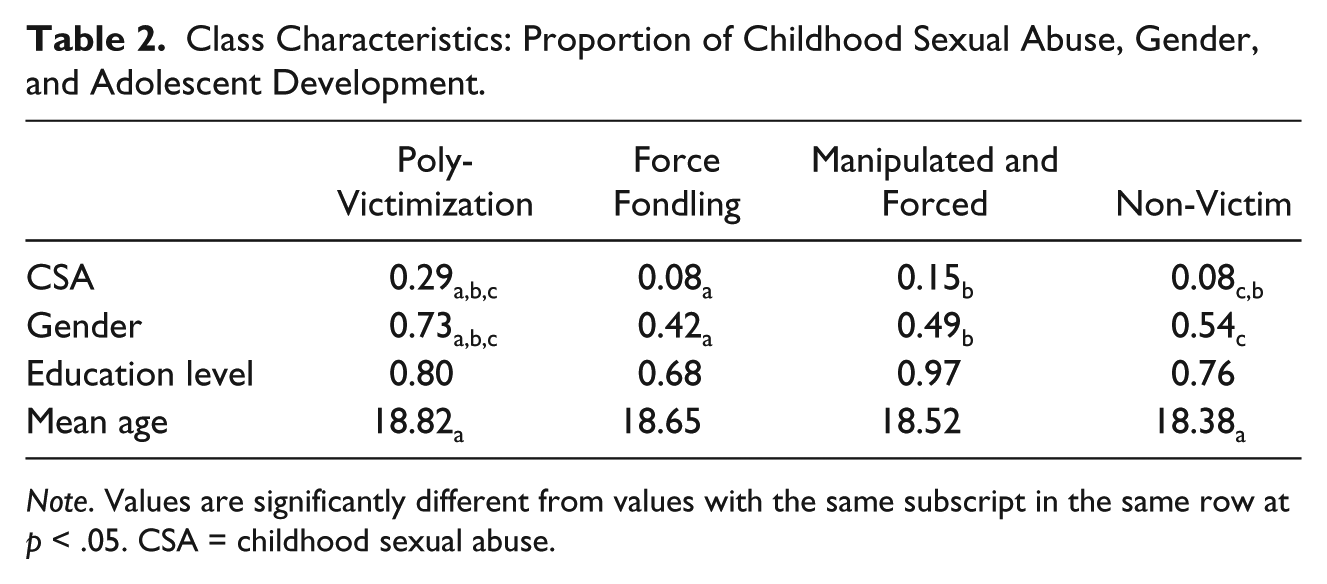
Note. Values are significantly different from values with the same subscript in the same row at p < .05. CSA = childhood sexual abuse.
Research Question 3: Predicting Psycho-behavioral Correlates
Results of the equality tests of means indicated that there were significant differences in psycho-behavioral correlates related to class membership (Table 3). Consistent with our hypothesis, participants in the poly-victimization class showed the greatest level of psychological-behavioral consequences. This class reported significantly lower levels of self-esteem, greater psychological distress, and higher sexual risk taking, than the forced fondling, manipulated and forced fondling/intercourse, and non-victim classes. The manipulated and forced fondling/intercourse class reported significantly lower levels of self-esteem than the non-victims class, χ2(1, 657) = 8.53, p < .01. The forced fondling, χ2(1, 657) = 10.89, p < .01, and manipulated and forced fondling/intercourse χ2(1, 657) = 72.30, p < .001, classes engaged in significantly higher sexual risk taking than the non-victim class.
Tests of Mean Differences on Class Membership and Psycho-behavioral Outcome.

Values are based on parameterization of non-victim class as the reference group.
Values are based on parameterization of poly-victimization class as the reference group; tests of mean differences were not significant between forced fondling and manipulated and forced classes.
p < .05. **p < .01. ***p < .001.
Discussion
Research in sexual violence typically classifies participants based on the most severe assault experienced, without taking into consideration that experiences considered less severe show significant relations to psychological consequences. The aim of this study was to fill a gap in the literature by identifying sexual victimization patterns based on type of tactic used and outcome of sexual behavior, and explore related psycho-behavioral correlates. Through using sophisticated analyses to statistically classify participants based on complex victimization patterns, we identified the presence of four distinct classes of sexual victimization. Approximately half of the sample experienced some form of sexual victimization, with the most frequent pattern emerged being the manipulated and forced intercourse class. This finding suggests that the most common victimization for the young men and women in this sample occurred through a combination of verbal coercion strategies and physically forceful tactics, which resulted in sexual intercourse about half of the time. Participants were equally classified in the forced fondling class and the poly-victimization class; thus, roughly a quarter of the sample experienced kissing and fondling due to physical force, or were victims of multiple tactics to have unwanted sexual intercourse. These findings offer a more complete picture of sexual victimization patterns by acknowledging intersecting tactics and sexual outcomes without prioritizing physical violence and intercourse in sexual violence research. Results challenge the traditional assessment of categorizing victimization based on the most “severe” type, as this study suggests that survivors typically experience more than one tactic with an array of sexual outcomes.
Consistent with our hypothesis, participants in the poly-victimization class demonstrated significantly poorer psychological and behavioral outcomes compared to all other classes, with the non-victimized class demonstrating the least distress. This supports the previous literature, which has found that greater frequency of sexual victimization (Classen et al., 2005) and multiple types of intimate partner violence tactics (Cavanaugh et al., 2012) relate to higher levels of psychological distress. Poly-victims were also most likely to experience childhood sexual abuse and had higher representation of women than men. Classen and colleagues’ review notes that women who experience childhood sexual abuse are two to three times as likely to experience adult sexual assault.
There were fewer psycho-behavioral consequences related to the other victimization classes, forced fondling and manipulated and forced intercourse. One interesting finding that is consistent with the literature was the significantly lower self-esteem rates for manipulated and forced intercourse compared to non-victims. Given the high probability of experiencing verbal coercion tactics within this class, these results partially support previous findings related to verbal coercion and self-esteem (Tyler et al., 1998) and thus may be less likely to ward off unwanted advances, or are easier targets for manipulation. This class did not significantly differ from the forced fondling class, however, and showed higher self-esteem than the poly-victimization class, contrary to the research suggesting that verbal coercion victims have lower self-esteem than forcible rape survivors (Testa & Dermen, 1999). The experience of multiple types of victimization may have a powerful impact on self-worth. A potential mediating effect may partially explain these findings through the role of attributions of blame. Brown and colleagues (2009) found that participants experiencing verbal coercion showed significantly higher levels of self-blame than survivors of incapacitated assault or forcible rape; they also found that a greater number of victimization experiences related to cognitive distortions. This relationship may in turn impact self-esteem. Our interpretation is speculative, however, as we did not explore cognitive distortions; thus, we encourage future research to investigate mediating relationships. All victimization classes reported greater sexual risk taking than the non-victimized class. The relation between unwanted sexual experiences and risky sexual behaviors has been well documented (Biglan et al., 1995; Zweig, Sayer, Crockett, & Vicary, 2002) and recent longitudinal research provides initial evidence that sexual victimization leads to later sexual risk taking (Lang et al., 2011). Future research should expand this literature by investigating longitudinal outcomes as they relate to victimization patterns and characteristics.
Some unexpected yet interesting findings arose as well. There were no gender differences between the forced fondling, manipulated and forced intercourse, and non-victim classes. These results partially support previous research, which found that men more often experience verbal coercion strategies, and are less likely to experience penetration with regard to the forced fondling class (Light & Monk-Turner, 2009). However, the manipulated and forced intercourse class challenges assumptions that men do not experience victimization through physical means or that victimization does not result in completed intercourse, as the probability of sexual intercourse was about 50% for this class. These results offer important additions to the literature on the sexual victimization of men, and suggest similarities between young men’s and women’s victimization histories. Our hypothesis regarding adolescent development was weakly supported, as classes showed no significant difference based on educational level or age with the exception of poly-victimization being significantly older than non-victims. Given the small sample of high school students, results should be interpreted with caution and future research would benefit from continued exploration on developmental differences in sexual victimization.
Limitations
With the strengths of this study, results should be interpreted in the context of this study’s limitations. Although our operationalization of sexual victimization included the tactic used and sexual behavior outcome, we did not assess for the number of incidents within the individual nor types of experiences within an incident. Thus, the relationship between lifetime and incident specific victimization is unknown. Given the focus of this study on sexual victimization and psycho-behavioral outcomes, we did not explore other risk factors related to behavioral and psychological health variables and thus could not control for these in the analyses. Limitations common in retrospective and self-report assessments arise as some participants may not have accurately recalled their experiences or may have withheld disclosing private information. Finally, additional concerns include the cross-sectional design and limited geographic representation, preventing cause-and-effect interpretations and limiting generalizability.
Conclusion
Despite these limitations, this study offers important contributions in understanding patterns of sexual victimization among adolescents and related psycho-behavioral outcomes. The large sample size and statistical sophistication provide advances to the sexual violence literature. Findings reveal four distinct patterns of sexual victimization that relate uniquely to psychological and behavioral health indicators. Our findings offer important advances in the assessment of sexual victimization by exploring classifications based on intersecting experiences, and highlight some of the weaknesses and potential fallacies in classifying survivors based on presumed severity. Relations between victimization, health risk behavior, and self-esteem highlight the importance of unwanted sexual experiences across the spectrum and can better inform prevention efforts by acknowledging aspects such as subtle manipulation tactics and unwanted kissing or fondling in interventions. Assessing for patterns of sexual victimization experiences allows clinicians to form a more complete understanding of adolescent victimization while also raising awareness of potential psychological and behavioral corollaries.
Footnotes
Acknowledgements
Special thanks to Helen A. Neville for continued support with the larger sexual coercion project, Keith C. Herman, Wendy M. Reinke, and Kenneth T. Wang for their statistical consultation, and Mary J. Heppner and Dorothy L. Espelage for feedback on manuscript drafts.
Declaration of Conflicting Interests
The author(s) declared no potential conflicts of interest with respect to the research, authorship, and/or publication of this article.
Funding
The author(s) received no financial support for the research, authorship, and/or publication of this article.