



Abstract
Secondary exposure to community violence, defined as witnessing or hearing violence in the community, has the potential to profoundly impact long-term development, health, happiness, and security. While research has explored pathways to community violence exposure at the individual, family, and neighborhood levels, prior work has largely neglected situational factors conducive to secondary violence exposure. The present study evaluates “unstructured socializing with peers in the absence of authority figures” as a situational process that has implications for secondary exposure to violence. Results indicate that a measure of unstructured socializing was significantly associated with exposure to violence, net of an array of theoretically relevant covariates of violence exposure. Moreover, the relationships between exposure to violence and three of the most well-established correlates of violence exposure in the literature—age, male, and prior violence—were mediated to varying degrees by unstructured socializing. The results suggest a more nuanced approach to the study of secondary violence exposure that expands the focus of attention beyond individual and neighborhood background factors to include situational opportunities presented by patterns of everyday activities.
Being exposed to violence in childhood and adolescence has the potential to profoundly impact long-term development, health, happiness, and security. Exposure to violence exists in many forms, including sexual abuse, physical abuse, intimate partner violence, and community violence. While juvenile violent victimization has received significant attention in the theoretical and empirical literature (Lauritsen, Laub, & Sampson, 1992; Piquero & Hickman, 2003; Schreck, Stewart, & Fisher, 2006; Schreck, Wright, & Miller, 2002; Stewart, Elifson, & Sterk, 2004), secondary exposure to community violence, defined as witnessing or hearing violence in the community (see Buka, Stichick, Birdthistle, & Earls, 2001; Gardner & Brooks-Gunn, 2009; Gibson, Morris, & Beaver, 2009), is also of particular concern to the public health community. One out of every five U.S. youths witnesses violence in his or her community in any given year (Finkelhor, Turner, Ormrod, & Hamby, 2009a, 2009b), and research has consistently documented the negative mental health and behavioral consequences for youths exposed to community violence (see Boxer et al., 2008; Buka et al., 2001; Fowler, Tompsett, Braciszewski, Jacques-Tiura, & Baltes, 2009; Lewis et al., 2012; Lynch, 2003; Margolin & Gordis, 2000; McCart et al., 2007).
The prevalence and consequences of exposure to neighborhood violence prompted the formation of a national task force on children exposed to violence in 2011. As part of the Department of Justice’s (DOJ) Defending Childhood initiative, the task force held four national hearings from 2011 to 2012 to examine the scope and nature of childhood exposure to violence, and to identify strategies to address the problem. The findings of the task force, published in December 2012, indicated that an increased understanding of the complex pathways to violence exposure is critical (Listenbee et al., 2012).
The pathways to community violence exposure that are most well established in the literature are those at the individual level. Research has documented demographic characteristics, parenting variables, behavioral problems, and personality characteristics that increase the risk for experiencing secondary violence (for an overview, see Buka et al., 2001). Research has also begun to examine neighborhood influences on exposure to violence, after taking into account individual risk factors (Gardner & Brooks-Gunn, 2009; Gibson et al., 2009; Zimmerman & Messner, 2013). However, prior work has largely neglected situational factors conducive to secondary violence exposure. We maintain that a full understanding of the etiology of secondary exposure to violence necessitates a situational component.
We propose a situational approach to the study of secondary violence exposure, an approach that expands the focus of attention beyond individual and neighborhood background factors to include opportunities presented by patterns of everyday activities. Drawing upon prior research that has concentrated on criminal and delinquent offending (Maimon & Browning, 2010; Osgood & Anderson, 2004; Osgood, Wilson, O’Mally, Bachman, & Johnston, 1996), we argue that “unstructured socializing with peers in the absence of authority figures” represents a situational process that has implications for secondary exposure to violence. Specifically, secondary violence exposure should be particularly prevalent when individuals (a) spend more time with their friends, a known risk factor for delinquent conduct (see Felson, 2003; Reiss, 1986; Warr, 2002), (b) spend this time in unstructured activities that increase the opportunity time (see Gottfredson, 1981) for secondary violence exposure, and (c) spend more time with friends in unsupervised activities outside of the home, school, or purview of other adults (see Anderson, 2013), whose responsibility it is to exert social control in response to deviant behavior. Based on this reasoning, we anticipate that indicators of unstructured socializing will yield associations with violence exposure net of the relationships with individual and contextual measures. Moreover, we hypothesize that indicators of unstructured socializing will mediate some of the relationships between individual characteristics, contextual conditions, and secondary exposure to violence.
Secondary Exposure to Community Violence: Extent and Repercussions
Rates of secondary exposure to community violence vary widely across race, sex, socioeconomic status, and geographic location. For example, studies have found that only 1% of middle to upper class White youths witness murder (Gladstein, Rusonis, & Heald, 1992), whereas more than 40% of low-income Black youths witness a killing (Fitzpatrick & Boldizar, 1993). In addition, well more than half of urban children and adolescents report exposure to violence in their neighborhoods (McCart et al., 2007; Stein, Jaycox, Kataoka, Rhodes, & Vestal, 2003), elevated rates compared with nationally representative samples (Finkelhor et al., 2009a, 2009b; Zinzow et al., 2009.
We also note that there is potential measurement error associated with rates of secondary violence reported in the literature. For example, estimates depend on whether reports of youth violence exposure come from parents or from youths (see Kuo, Mohler, Raudenbush, & Earls, 2000), with parents commonly reporting less exposure to community violence among youths than youths themselves (Ceballo, Dahl, Aretakis, & Ramirez, 2001; Hill & Jones, 1997; Kliewer, Lepore, Oskin, & Johnson, 1998; Lewis et al., 2012; Lynch & Cicchetti, 2002; Richters & Martinez, 1993). In addition, estimates depend on the method for aggregating single indicators of secondary violence exposure into scales. Most studies have constructed summative scales, thereby weighting events equally despite known variation in item severity (e.g., seeing someone hit versus seeing someone shot; see Buka et al., 2001). But, some recent work has used more sophisticated item response models that take into account variation in item severity across item responses (e.g., Kuo et al., 2000; Zimmerman & Messner, 2013).
Despite these differences, most studies have used an adaptation of the same survey instrument—the Survey of Exposure to Community Violence—to assess the extent of youth violence exposure (see Richters & Martinez, 1993). These studies have demonstrated that secondary exposure to community violence is a particularly consequential aspect of youths’ reality, in particular, because youths are 2 to 4 times more likely to witness community violence than to be personally victimized (Kennedy, 2008; Richters & Martinez, 1993). Furthermore, in national samples, approximately 20% of all U.S. youth report witnessing violence in their communities annually (Finkelhor et al., 2009a, 2009b), and almost 40% of U.S. youth report witnessing violence in their lifetimes (Zinzow et al., 2009). Indirect exposure to violence is thus a frequent and often commonplace occurrence among U.S. youths (Bell & Jenkins, 1993; Buka et al., 2001; Gardner & Brooks-Gunn, 2009; Gibson et al., 2009; Kennedy, 2008; McCart et al., 2007; O’Keefe, 1997; Osofsky, 1995; Schwab-Stone, Koposov, Vermeiren, & Ruchkin, 2012; Zinzow et al., 2009).
These prevalence estimates are particularly vexing given the extensive list of immediate and long-term problems associated with secondary violence exposure (see Boxer et al., 2008; Buka et al., 2001; Fowler et al., 2009; Lewis et al., 2012; Lynch, 2003; Margolin & Gordis, 2000; McCart et al., 2007). Adverse emotional problems include anxiety, depression, and posttraumatic stress disorder (Fitzpatrick, Piko, Wright, & LaGory, 2005; Lynch & Cicchetti, 2002; Rosario, Salizinger, Feldman, & Ng-Mak, 2008; Terr, 1990; Wilson & Rosenthal, 2003). Elevated heart rate, altered cortisol production, and delayed pubertal development are among the medical ailments associated with exposure to secondary violence (see Buka et al., 2001; Eunice Kennedy Shriver National Institute of Child Health and Human Development, 2002). Social repercussions include disassociation from meaningful and secure relationships (Osofsky, 1995). And, secondary violence exposure increases the risk of school failure, substance use, and aggressive interpersonal behavior (Bingenheimer, Brennan, & Earls, 2005; Buka et al., 2001; Dodge, Bates, & Petit, 1990; Margolin & Gordis, 2000; Ozer, Richards, & Kliewer, 2004; Selner-O’Hagan, Kindlon, Buka, Raudenbush, & Earls, 1998). Understanding the etiology of exposure to community violence therefore warrants the attention of public safety and mental health professionals.
Correlates of Secondary Exposure to Violence: What We Know
Research on the correlates of secondary exposure to community violence has been conducted primarily at the individual level. The strongest documented covariates of violence are demographic characteristics (for an overview, see Buka et al., 2001). Exposure to violence is disproportionately concentrated among racial and ethnic minorities, particularly African Americans and Hispanics (see Fitzpatrick & Boldizar, 1993; Gladstein et al., 1992; Martin, Gordon, & Kupersmidt, 1995); age accounts for approximately 25% of the variation in lifetime exposure to community violence (see Selner-O’Hagan et al., 1998), with violence exposure increasing from childhood through young adulthood (e.g., Bell & Jenkins, 1993; Gardner & Brooks-Gunn, 2009; Gibson et al., 2009; Richters & Martinez, 1993); and male youths disproportionately report being exposed to violence (see Kennedy, 2008; Kuo et al., 2000). Individual difference factors such as low self-control (Gibson et al., 2009), delinquency (Gardner & Brooks-Gunn, 2009), and violent peer associations (Zimmerman & Messner, 2013) also appear to increase the risk of secondary violence exposure. Furthermore, structural family characteristics, such as residential instability, low socioeconomic status, and non-intact family structure, are associated with exposure to violence (see Fitzpatrick & Boldizar, 1993; Martin et al., 1995; Richters & Martinez, 1993; Schubiner, Scott, & Tzelepis, 1993). However, parent–child relations appear to be largely unassociated with exposure to violence (Gorman-Smith & Tolan, 1998; Miller, Wasserman, Neugebauer, Gorman-Smith, & Kamboukos, 1999; see also Buka et al., 2001). We note, however, that high levels of family support may mitigate the detrimental consequences of exposure to violence (Gorman-Smith, Henry, & Tolan, 2004; Hammack, Richards, Luo, Edlynn, & Roy, 2004; T. N. Sullivan, Kung, & Farrell, 2004).
Research has also begun to examine neighborhood influences on secondary exposure to violence, after taking into account individual risk factors. Studies using hierarchical models have demonstrated that higher levels of concentrated disadvantage and a lack of community youth services contribute to secondary violence exposure, net of individual characteristics (Gardner & Brooks-Gunn, 2009; Gibson et al., 2009; Zimmerman & Messner, 2013).
However, situational factors conducive to secondary violence exposure are unaccounted for in the literature. We maintain that a full understanding of the etiology of secondary exposure to violence necessitates a situational component. Below, we propose a situational approach to the study of violence exposure, an approach that expands the focus of attention beyond individual and neighborhood background factors to include opportunities presented by patterns of everyday activities.
A Situational Approach to Understanding Secondary Violence Exposure
The friendship group is a key developmental context during adolescence (Bagwell & Schmidt, 2011; Hansell, 1981). Play-based friendships in childhood transition to more complex relationships, based on intimacy, self-disclosure, closeness, trust, and social/emotional support, in adolescence (Berndt, 1986; Corsaro & Eder, 1990; Hartup, 1993; Newcomb & Bagwell, 1995; H. S. Sullivan, 1953). Maintaining these relationships requires significant time investment. In fact, across age, gender, and race/ethnicity (see Bagwell & Schmidt, 2011; Cairns & Cairns, 1995; Rubin, Bukowski, & Laursen, 2009), “peers are by far the greatest presence in an adolescent’s life” (Csikszentmihalyi & Larson, 1984, p. 71).
A natural consequence of increased time spent with friends is a corresponding decrease in time spent with parents (Larson, Richards, Moneta, Holmbeck, & Duckett, 1996; Richards, Crowe, Larson, & Swarr, 1998). This shift in time allocation is highly correlated with time spent with peers in after-school programs, volunteer work, and other structured activities out of the home (Anderson, 2013). However, as adolescents seek autonomy from parents and other authority figures (Steinberg, 1990), they also spend more time with friends in unsupervised activities such as pickup games (Gold, 1970) and hanging out (Agnew & Peterson, 1989). Moreover, these activities often occur without adult supervision in the community, which becomes an organizing and situational context for the development and maintenance of adolescent friendships (see Dishion, Andrews, & Crosby, 1995; Giordano, 2003).
Drawing upon prior research that has concentrated on criminal and delinquent offending (Maimon & Browning, 2010; Osgood & Anderson, 2004; Osgood et al., 1996), we hypothesize that “unstructured socializing with peers in the absence of authority figures” represents a situational process that has implications for secondary exposure to violence. Specifically, research has found that delinquent behavior increases as time spent with peers increases, regardless of the behavior of the peers (Regnerus, 2002). If delinquency is indeed an inherently social activity involving associates (see Felson, 2003; Reiss, 1986; Warr, 2002), then individuals who spend more time with friends should witness violence more frequently. In addition, spending time with peers in unstructured activities, as compared with structured activities, should increase the opportunity time (see Gottfredson, 1981) available for violence exposure. Finally, inadequate monitoring reduces the potential for social control responses that could prevent exposure to violence (e.g., Cohen & Felson, 1979). Unstructured activities with friends are thus likely to be particularly conducive to secondary violence exposure.
While time spent with peers, time spent in unstructured activities, and unsupervised socializing may matter independently, it is their combination in which we are interested. This comports with recent work by Weerman, Bernasco, Bruinsma, and Pauwels (2013), who found that time spent with peers is relevant only in conjunction with socializing (e.g., hanging out), being in public (i.e., engaging in unstructured activity), and being unsupervised. Ultimately, we argue that unstructured socializing with peers in the absence of authority figures represents a routine activity in the pattern of an adolescent’s everyday life (Cohen & Felson, 1979; Hindelang, Gottfredson, & Garofalo, 1978), and that this normative adolescent process (Bagwell & Schmidt, 2011; Hansell, 1981) increases the likelihood of being exposed to secondary violence. We therefore hypothesize that unstructured socializing will be associated with secondary violence exposure, net of the relationships with individual and contextual measures. We also hypothesize that indicators of unstructured socializing will mediate some of the relationships between individual characteristics, contextual conditions, and exposure to violence. This theoretical framework is predicated on the premise that some of the known correlates of exposure to violence will be strongly associated with unstructured socializing, and that their relationships with secondary exposure to violence will therefore operate indirectly through unstructured socializing.
Method 1
Participants
The analysis uses data from the Project on Human Development in Chicago Neighborhoods (PHDCN), a study designed to understand how a range of individual, family, and contextual factors contribute to youth development. The PHDCN consists of several components, two of which are used in this study: a Community Survey and a Longitudinal Cohort Study. The Community Survey was constructed as a probability sample of 8,782 Chicago residents within 343 researcher-defined neighborhood clusters. These neighborhood clusters, designed to approximate local neighborhoods, averaged 8,000 people and represented all of Chicago’s 865 census tracts with respect to spatial contiguity, according to ecological boundaries, and internal homogeneity, with respect to race/ethnicity and socioeconomic status. A multi-stage sampling design was used to select city blocks within neighborhood clusters, households within city blocks, and 1 adult (18 or above) per household. This design yielded approximately 25 cases per neighborhood cluster, which allows for the estimation of neighborhood characteristics based on aggregate individual-level data (see Sampson, Raudenbush, & Earls, 1997).
The Longitudinal Cohort Study was constructed as a stratified probability sample of participants in seven cohorts defined by age at baseline (0, 3, 6, 9, 12, 15, and 18). Eligible respondents in each cohort were identified using a multi-stage sampling design, which selected a simple random sample of households within 80 of the 343 neighborhood clusters. Up to three waves of data were collected during interviews with respondents and their primary caregivers from 1994 and 2002; the average time between interviews was 2.5 years. Our sample consists of all 2,344 subjects from the 9-, 12-, and 15-year-old cohorts who were interviewed at Wave 1, representing 80 neighborhood clusters across Chicago.
We take advantage of the longitudinal nature of the PHDCN and model exposure to violence at Wave 3 with unstructured socializing at Wave 2 and endogenous variables at Wave 1. As with most longitudinal surveys, data were missing due to non-response (14.4% of our sample), and there was attrition between Wave 1 and Wave 3 of the study (19.5% of our sample). To address potential bias produced by missing data due to non-response and attrition, we used multiple imputation techniques to produce 10 data sets using a missingness equation that included the dependent variable, the independent variables, and theoretically and empirically relevant auxiliary variables. Results were combined across the 10 imputed data sets (Allison, 2002; Raudenbush & Bryk, 2002; Royston, 2005). We examined the robustness of our findings to estimation strategy by re-estimating all models using a listwise deletion approach and found no substantive changes from those presented in the “Results” section.
Dependent Variables
Secondary exposure to community violence
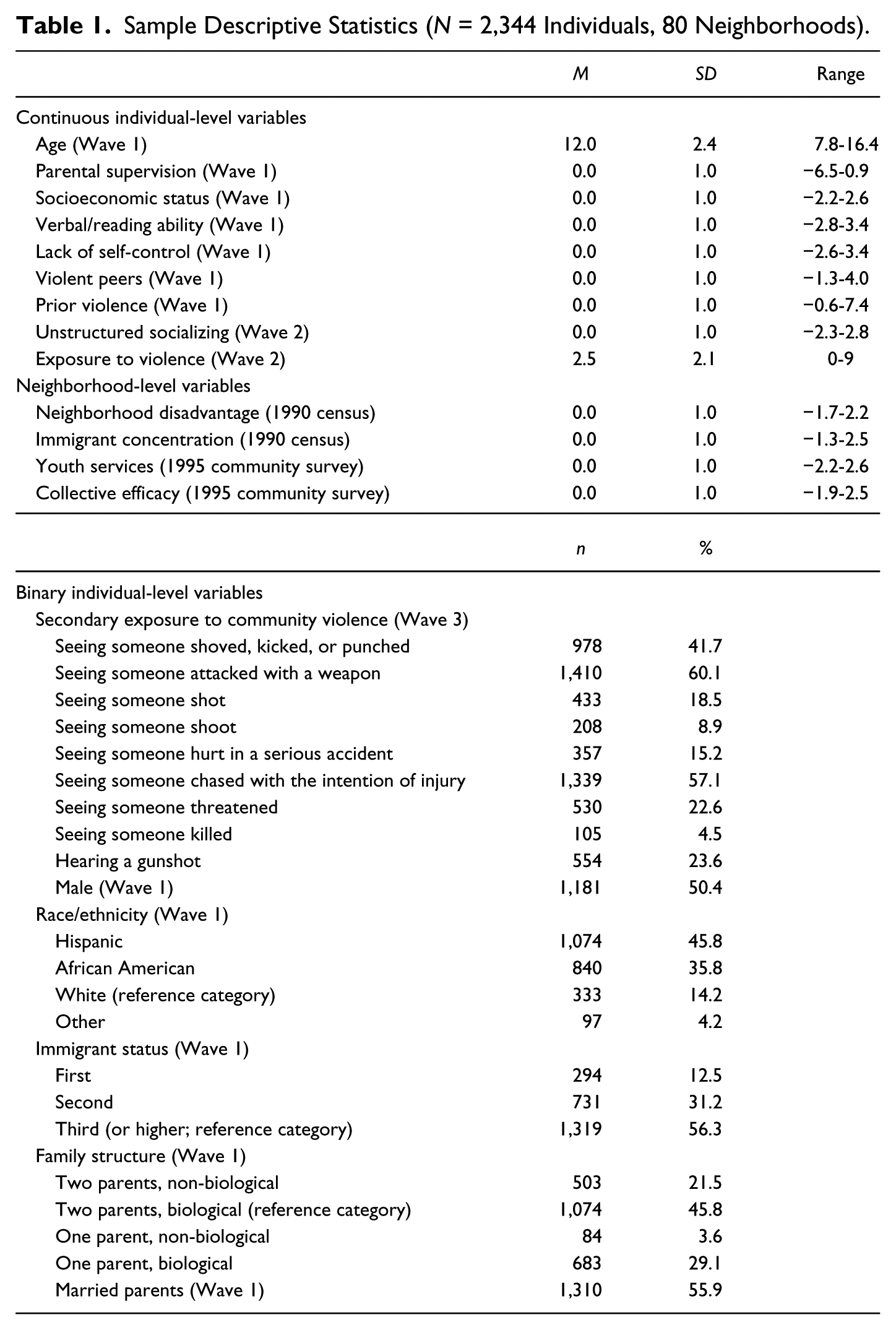
The dependent variable was constructed using items from the PHDCN’s My Exposure to Violence questionnaire (Gardner & Brooks-Gunn, 2009; Gibson et al., 2009; Kindlon, Wright, Raudenbush, & Earls, 1996; Kuo et al., 2000; Selner-O’Hagan et al., 1998). This questionnaire was adapted from the Survey of Children’s Exposure to Community Violence, the most widely used measure of exposure to community violence (Richters & Martinez, 1993). Respondents reported whether they had witnessed a series of violent events in the community (1 = yes, 0 = no) in the 12 months prior to the Wave 3 interview: (a) seeing someone shoved, kicked, or punched; (b) seeing someone attacked with a weapon; (c) seeing someone shot at; (d) seeing someone shot; (e) seeing someone hurt in a serious accident; (f) seeing someone chased with the intention of injury; (g) seeing someone threatened; (h) seeing someone killed; and (i) hearing a gunshot. This scale comports with those used in prior research (e.g., Howard, Cross, Li, & Huang, 1999; Johnston, Steele, Herrera, & Phipps, 2003; Kuo et al., 2000) and has shown adequate validity and reliability in related studies (see Mohler, Kuo, Kindlon, Buka, & Earls, 1999). In our study, the reliability for each of the subject participants was .74. The dichotomous items were incorporated into a scale of exposure to violence as described in the “Analysis Strategy” section. Respondents on average were exposed to 2.5 of the 9 violent events (median = 2.0, standard deviation = 2.1, range = 0-9).
Unstructured socializing
Following Osgood et al. (1996), we constructed a measure of “unstructured socializing with peers in the absence of responsible authority figures” (p. 642; see also Maimon & Browning, 2010, p. 452). At Wave 2 of data collection, adolescents responded to the following five questions: “How often do you ride around in a car/motorcycle for fun?” “How often do you hang out with friends?” “How often do you go to parties?” “How many days a week do you go out after school/at night?” and “How often do you go out with a date?” Responses to the items ranged from 1 (never) to 6 (almost every day). The items were summed and the resulting scale was standardized to form an index on which higher values represent more unstructured socializing. This scale was developed and assessed for validity and reliability by Osgood et al. and has shown adequate validity and reliability in subsequent research using the PHDCN (Maimon & Browning, 2010). In our study, the reliability of the items was .61.
Model Covariates
Previous research on unstructured socializing (Maimon & Browning, 2010; Osgood & Anderson, 2004; Osgood et al., 1996) and exposure to community violence (see Buka et al., 2001; Gardner & Brooks-Gunn, 2009; Gibson et al., 2009; Kuo et al., 2000) guided the inclusion of individual- and neighborhood-level covariates in this study. Specifically, only theoretically relevant variables that have been shown to correlate empirically with unstructured socializing or exposure to violence are considered in this study. The inclusion of these variables can be used to examine mediating processes and protect against model misspecification and confounding.
Demographic covariates
Demographic variables include age, sex (male = 1), race/ethnicity (Hispanic, African American, Caucasian, and “Other”), and immigrant status (first generation, second generation, and third generation or higher).
Individual difference covariates
Behavioral and cognitive factors assessed at Wave 1 include verbal/reading ability, lack of self-control, violent peer exposure, and previous violent offending. Verbal/reading ability was constructed as the standardized sum of youths’ scores on the widely used Wechsler Intelligence Scale for Children (WISC) vocabulary test (Wechsler, 1979) and the Wide Range Achievement Test (WRAT) for reading (Wilkinson, 1993). This is a well-established tool to measure reading/verbal ability that has been used in previous research with the PHDCN (see Sampson, Morenoff, & Raudenbush, 2005). Lack of self-control was constructed as the standardized sum of parents’ responses to 17 items in the Achenbach Child Behavior Checklist. These items, scored on a scale from 1 (uncharacteristic) to 5 (characteristic), represent a respondent’s lack of inhibitory control (five items; for example, has trouble controlling impulses), present orientation (four items; for example, does not like to make detailed plans before doing something), sensation seeking (four items; for example, seeks new and exciting experiences and sensations), and lack of persistence (four items; for example, tends to give up easily). This scale had a reliability of .74 and was derived based on published research (see Achenbach, 1991; Buss & Plomin, 1975). For the violent peer exposure measure, respondents were asked how many of their friends (from 1 = none to 3 = all) engaged in each of four violent behaviors in the year preceding the baseline interview: getting into a fist fight, hitting someone with the intent of injury, attacking someone with a weapon, and robbing someone with a weapon. Based on prior research (Zimmerman & Messner, 2013), these items were summed to form a scale with a reliability of .67. Previous violent offending was measured as the count of eight violent crimes respondents engaged in during the year preceding the initial interview. Behaviors ranged from “throwing rocks at people” to “attacking someone with a weapon.” This scale is well established in the literature (see Raudenbush, Johnson, & Sampson, 2003) and has a reliability of .70.
We also control for lagged secondary violence exposure. Respondents reported whether they had witnessed the same nine violent events comprising the dependent variable in the 12 months prior to the Wave 2 interview. These items were summed to form a count variable ranging from zero to nine. Similar to the dependent variable, this scale has a reliability of .74.
Family-level covariates
Standard family background factors assessed at the Wave 1 interview include parents’ marital status (1 = married), family structure, and socioeconomic status. Family structure was created with the following classification scheme: (a) two parents, both biological; (b) two parents, one/both non-biological; (c) one parent, biological; and (d) one parent, non-biological. Following established procedures (see Sampson et al., 2005), socioeconomic status was constructed from a principal components factor analysis of parental income, parental education, and parental occupation. We also measured parental supervision at the baseline interview using 13 binary (1 = yes; 0 = no) items capturing parental control (e.g., parent sets curfews), parental supervision (e.g., subject is not allowed to wander in public places without adult supervision for more than 3 hr), and parental monitoring (e.g., parent knows child’s friends). These items were adapted from the Home Observation for Measurement of the Environment (HOME) Inventory, which was designed to capture parent–child relations in the home environment (Caldwell & Bradley, 1984; Leventhal et al., 2004). These items were summed and the resulting scale was standardized to form an index with a reliability of .88.
Structural neighborhood covariates
Two neighborhood structural characteristics were constructed from the 1990 decennial census: concentrated disadvantage and ethnic heterogeneity. Concentrated disadvantage is comprised of the percent of families below the poverty line, percent of households receiving public assistance, percent of non-intact families with children, percent of population unemployed, median household income in 1989, and percent of Black population. These variables were combined using a weighted factor regression score (all loadings ≥ 0.83 using principal components analysis with oblique rotation), such that high values of the factor score reflect high levels of concentrated disadvantage. Immigrant concentration, constructed by the sum of z scores for percent Latino and percent foreign-born (r = .91), captures neighborhood heterogeneity. These are well-established scales agreed upon by experts in the field and were constructed following established procedures previously used with this data set (Morenoff & Sampson, 1997; Raudenbush & Sampson, 1999; Sampson et al., 1997; Wikström & Loeber, 2000).
Neighborhood social processes
Two variables capturing social processes occurring in the neighborhoods of subject participants were constructed from the 1995 Community Survey: collective efficacy and youth services. Collective efficacy was constructed by combining social cohesion/trust with shared expectations for social control (Sampson et al., 1997). Social cohesion/trust was measured as the sum of five items asking neighborhood residents how strongly they agreed that “this is a close-knit neighborhood,” “people are willing to help their neighbors,” “people in the neighborhood can be trusted,” “people don’t get along,” and “people in the neighborhood do not share the same values” (last two items reverse-coded). The reliability of these items was .78. Shared expectations for social control was measured by asking residents how likely neighbors would be to “do something about kids skipping school,” “do something about kids defacing a building,” “scold a child for not showing respect,” “break up a fight in front of their house,” and “organize to keep a local fire station.” The reliability of these items was .78. These scales were strongly related across neighborhood clusters (r = .80). Responses of respondents answering all 10 questions were averaged. For respondents who answered at least one but not all of the questions, a linear item response model was used to account for the number and difficulty of the answered items. The “ecometric” or aggregate-level reliability of collective efficacy (the conceptual equivalent of Cronbach’s α) was .85, meaning that the analysis can reliably tap the variance in collective efficacy at the neighborhood level. This is a validated tool that has been used extensively in prior research (see Raudenbush & Sampson, 1999; Sampson et al., 1997).
A measure of youth services reflects the presence of services in the neighborhood (i.e., youth centers, recreational programs, after-school programs, mentoring and counseling services, mental health services, and crisis intervention services) aimed at keeping youths off the streets and providing youths with the resources to avoid neighborhood conflict. Luther and Goldstein (2004) discussed the importance of such services in protecting youths from violence exposure, and this scale has been validated in prior research using the PHDCN (Gardner & Brooks-Gunn, 2009; Gibson et al., 2009). This scale has a reliability of .86. 2
See Table 1 for study statistics. More detailed descriptions of study measures can be found in Gibson et al. (2009) and Zimmerman and Messner (2013).
Sample Descriptive Statistics (N = 2,344 Individuals, 80 Neighborhoods).
Analysis Strategy
Our analysis proceeds in two stages. First, we consider the individual, family, and contextual correlates of unstructured socializing. For this stage of analysis, we estimate a two-level regression model (a hierarchical linear model [HLM]), which generates efficient slope estimates and unbiased standard errors when level-one units (i.e., persons) nested within level-two groups (i.e., neighborhoods) share similar traits (i.e., are clustered; Raudenbush & Bryk, 2002). 3
Second, we examine the relationship between unstructured socializing and secondary exposure to community violence, and whether known covariates of secondary exposure to violence operate indirectly through unstructured socializing. For this stage of analysis, we estimate a hierarchical item response model with logit form (using generalized estimating equations Hierarchical Generalized Linear Model [HGLM]) to predict the odds of witnessing each act of violence in the community. This method simultaneously utilizes the benefits of item response and HLMs, applying item response theory to the dependent variable in a random-effects setting. This approach takes into account the varying frequency and seriousness of the exposure to violence items, and estimates the relationships between violence exposure and individual, family, and neighborhood characteristics (see Raudenbush & Bryk, 2002).
This model has three levels nesting items within persons within neighborhoods. The Level 1 model represents the item response measurement model and nests the dichotomous exposure to violence item responses within persons. In the Level 2 model, representing the person-level model, all individual and family characteristics are included as covariates of exposure to violence within neighborhoods. The Level 3 model, or neighborhood-level model, examines the relationship between individual variation in exposure to violence and the neighborhood-level variables (see Raudenbush et al., 2003). All models are estimated in the HLM program.
Results
The Correlates of Unstructured Socializing
Table 2 presents standardized coefficient estimates and confidence intervals from the two-level regression model discussed in the “Analysis Strategy” section. Model 1 in this table investigates the neighborhood-level covariates of unstructured socializing with peers. Examination of this model indicates that collective efficacy is positively and significantly associated with unstructured socializing (β = .06, p < .05).
Multilevel Regression Model Regressing Unstructured Socializing at Wave 2 on Neighborhood and Individual Measures at Wave 1 (N = 2,344 Individuals, 80 Neighborhoods).

Note. β = standardized regression coefficient; CI = confidence interval.
White = reference category.
Third generation or higher = reference category.
Two parents, both biological = reference category; Models 2 and 3 also control for “Other race” (ns at p = .05); significant findings are in bold.
p < .10. *p < .05. **p < .01. ***p < .001 (two-tailed tests).
Model 2 incorporates the demographic, family-level, and individual difference characteristics. The results indicate that male (β = .12, p < .001) and age (β = .35, p < .001) are positively and significantly associated with unstructured socializing. In addition, exposure to violence increases as exposure to violent peers (β = .06, p < .01) increases. Note that controlling for these individual variables diminishes the coefficient of collective efficacy to non-significance. Overall, these findings comport with prior research on the correlates of unstructured socializing with peers (see Maimon & Browning, 2010; Osgood & Anderson, 2004; Osgood et al., 1996). We note, however, a difference between our study and the Maimon and Browning (2010) study also using the PHDCN. Maimon and Browning detected a significant relationship between collective efficacy and unstructured socializing, whereas this relationship was not significant in Model 2 in Table 2. We attribute this disparity to sample and methodological differences. Specifically, we use data from the 9-, 12-, and 15-year-old cohorts, whereas Maimon and Browning used data only from the 9- and 12-year-old cohorts; and, we use a multiple imputation approach, whereas they used a listwise deletion approach.
To control for heterogeneity in the propensity toward violence preceding the measurement of the covariates, we include a measure of prior violent behavior in Model 3. The results indicate that prior violence is positively and significantly associated with unstructured socializing (β = .12, p < .001). The inclusion of prior violence does not result in marked changes in the coefficient estimates for male and age, but it attenuates the significant coefficient for exposure to violent peers, which becomes non-significant. This finding represents another departure from the Maimon and Browning (2010) study, which detected a significant relationship between deviant peers and unstructured socializing. However, we note that prior violence accounts for the discrepancy with respect to deviant peers.
Linking Unstructured Socializing to Secondary Exposure to Community Violence
Table 3 presents odds ratios (ORs; that is, exponentiated log-odds regression coefficients) and confidence intervals from the hierarchical item response model described above. To make the results interpretable for an average person in the sample, the independent variables (not previously standardized) were grand-mean centered (see Raudenbush & Bryk, 2002).
Multilevel Item Response Model Regressing Secondary Exposure to Violence at Wave 3 on Unstructured Socializing at Wave 2 and Individual and Neighborhood Covariates at Wave 1 (N = 2,344 Persons, 80 Neighborhoods).

Note. OR = odds ratio; CI = confidence interval.
White = reference category.
Third generation or higher = reference category.
Two parents, both biological = reference category; all models also control for “Other race;” significant findings are in bold.
p < .10. *p < .05. **p < .01. ***p < .001 (two-tailed tests).
Model 1 in Table 3 includes many of the known correlates of secondary exposure to community violence (see Buka et al., 2001), providing a baseline comparison with prior research. Regarding the contextual correlates of exposure to violence, the results indicate that the odds of being exposed to violence increase in neighborhoods with higher levels of concentrated disadvantage (OR = 1.16, p < .01) and lower levels of youth services (OR = 0.93, p < .05). These are the neighborhood factors most consistently associated with exposure to violence in prior research (see Gardner & Brooks-Gunn, 2009; Gibson et al., 2009; Zimmerman & Messner, 2013).
Pertaining to the demographic variables, Model 1 shows that the odds of exposure to violence are higher for males (OR = 1.28, p < .01) and for older adolescents (OR = 1.04, p < .01), as compared with females and younger adolescents. In addition, the odds of exposure to violence are significantly higher for Hispanic (OR = 1.84, p < .001) and African American (OR = 1.91, p < .001) youths than for White youths, and for third generation (or higher) immigrants, as compared with first (OR = 0.65, p < .01) and second (OR = 0.75, p < .01) generation immigrants. The results also indicate that youths with married parents (OR = 0.75, p < .01) and those living in households with higher levels of socioeconomic status (OR = 0.90, p < .05) are less likely to be exposed to violence. These findings are generally consistent with research on the demographic and familial correlates of exposure to violence (Buka et al., 2001; Fitzpatrick & Boldizar, 1993; Gladstein et al., 1992; Gorman-Smith & Tolan, 1998; Miller et al., 1999; Richters & Martinez, 1993; Schubiner et al., 1993; Selner-O’Hagan et al., 1998; Singer, Anglin, Song, & Lunghofer, 1995).
Model 1 further indicates that the odds of exposure to violence are higher for adolescents who lack self-control (OR = 1.07, p < .05) and who are exposed to violent peers (OR = 1.11, p < .01). Finally, the odds of violence exposure increase as prior violent offending increases (OR = 1.29, p < .001). Overall, the findings comport with previous research (e.g., Gardner & Brooks-Gunn, 2009; Gibson et al., 2009; Pratt & Cullen, 2000; Sampson et al., 1997; Warr, 2002; Zimmerman & Messner, 2013).
We add our measure of unstructured socializing with peers to Model 2. The OR for “Unstructured Socializing” is 1.44 (p < .001), indicating that a one standard deviation increase in unstructured socializing is associated with a 44% (1.44 − 1) increase in the odds of secondary exposure to community violence. Next, we examine whether the relationships between the endogenous variables and exposure to violence operate indirectly through unstructured socializing. Specifically, we are interested in male, age, and prior violence, the three variables significantly associated with unstructured socializing (see Model 3 in Table 2).
Four criteria are commonly applied in the assessment of mediation (Baron & Kenny, 1986; Frazier, Tix, & Barron, 2004; James & Brett, 1984; Judd & Kenny, 1981). First, the independent variables must be significantly associated with the outcome. As discussed above, sex, age, and prior violence were significantly associated with exposure to violence (see Model 1 in Table 3). Second, the independent variables must be significantly associated with the mediator. As discussed earlier, sex, age, and prior violence were significantly associated with unstructured socializing (see Model 3 in Table 2). Third, the mediator must be significantly associated with the outcome. As discussed above, unstructured socializing was positively and significantly associated with exposure to violence (see Model 2 in Table 3). Finally, to establish complete mediation, or indirect-only mediation, the associations between the independent and dependent variables must not differ significantly from zero when controlling for the mediator. If the first three conditions are met, but the associations between the independent and dependent variables are non-zero when controlling for the mediator, partial mediation or complementary mediation is indicated (see MacKinnon, Fairchild, & Fritz, 2007; Preacher & Hayes, 2004, 2008; Zhao, Lynch, & Chen, 2010).
Figure 1 shows the ORs between exposure to violence and male, age, and prior violence, split by whether unstructured socializing is accounted for. The figure indicates that the OR for “Male” is reduced by 36% from 1.28 (in Model 1 of Table 3) to 1.18 (in Model 2 of Table 3; note that the maximum possible reduction, or 100%, would be from 1.28 to 1.00); the OR for age is reduced by 100% from 1.04 to 1.00 when unstructured socializing is accounted for; and the OR for prior violence is reduced by 17% from 1.29 to 1.24. However, only the association between age and exposure to violence is rendered non-significant. Moreover, statistical comparisons of the regression coefficients for age, male, and prior violence between models (see Clogg, Petkova, & Haritou, 1995; Paternoster, Brame, Mazerole, & Piquero, 1998) indicate that only the coefficient for age is significantly reduced when unstructured socializing is included as a covariate of exposure to violence (p < .01).

Attenuation in odds ratios for male, age, and prior violence before and after unstructured socializing is accounted for, indicating that associations between exposure to violence and age, male, and prior violence operate, at least partly, through unstructured socializing.
In addition to assessing attenuation, we conducted formal tests of mediation using conservative Sobel tests (MacKinnon, Lockwood, Hoffman, West, & Sheets, 2002; Sobel, 1982) as well as more recently advocated bootstrapping techniques with bias-corrected standard errors (Fritz, Taylor, & MacKinnon, 2012; Hayes & Scharkow, 2013; Preacher & Hayes, 2008). Results from both tests indicated that the associations between exposure to violence and male, age, and prior violence were significantly mediated by unstructured socializing (all ps < .001). Taken together, the results indicate that the relationship between age and exposure to violence is completely mediated by unstructured socializing (i.e., indirect-only mediation). However, the relationship between sex and exposure to violence and the relationship between prior violence and exposure to violence are partially mediated by unstructured socializing (i.e., complementary mediation).
Note that, as expected, the coefficients of the covariates that were not significantly associated with unstructured socializing in Table 2 are largely unaffected by the inclusion of unstructured socializing in the model. The coefficients for concentrated disadvantage and youth services remain significant, as do the coefficients for immigrant status, parents’ marital status, household socioeconomic status, lack of self-control, and exposure to violent peers.
In Model 3, we take advantage of the longitudinal nature of the PHDCN and control for an individual’s previous experiences with community violence. As expected, violence exposure at Wave 2 is significantly associated with violence exposure at Wave 3 (OR = 1.24, p < .001). In addition, controlling for prior violence exposure reduces the coefficients for many of the covariates in the model. However, the association between unstructured socializing and exposure to violence remains significant (OR = 1.29, p < .001).
Summary and Discussion
This article proposed that a full understanding of the etiology of secondary exposure to violence, a particularly consequential and often common aspect of youths’ lives, necessitates a situational component. Specifically, drawing upon prior research that has concentrated on criminal and delinquent offending (Maimon & Browning, 2010; Osgood & Anderson, 2004; Osgood et al., 1996), we argued that “unstructured socializing with peers in the absence of authority figures” represents a situational process that has implications for violence exposure. We posited that secondary violence exposure should be particularly prevalent when individuals spend more time with their friends, a known risk factor for delinquency; when individuals spend their time with friends in unstructured activities that increase the opportunity time for secondary violence exposure; and when individuals spend more time with friends in unsupervised activities outside of the purview of adults whose responsibility it is to exert social control in response to deviant behavior. Based on this reasoning, we anticipated that unstructured socializing would be positively associated with secondary violence exposure, net of the relationships with individual and contextual measures. We also hypothesized that unstructured socializing would mediate some of the relationships between secondary exposure to violence and the known correlates of violence exposure.
The results provided strong support for our main assertions. An indicator of unstructured socializing was significantly associated with exposure to violence, net of an array of theoretically relevant covariates of violence exposure. Moreover, the relationships between exposure to violence and three of the most well-established correlates of violence exposure in the literature—age, male, and prior violence—were significantly mediated by unstructured socializing. The results indicated that relationship between age and exposure to violence was completely mediated by unstructured socializing. In addition, the relationship between sex and exposure to violence, and the relationship between prior violence and exposure to violence were partially mediated by unstructured socializing (i.e., complementary mediation). We were interested primarily in male, age, and prior violence because our analyses indicated that these variables were significantly associated with unstructured socializing.
We note, however, that many of the known correlates of exposure to violence were unaffected when we accounted for unstructured socializing. Specifically, the coefficients for concentrated disadvantage and youth services remained significant after the inclusion of unstructured socializing, as did the coefficients for immigrant status, parents’ marital status, household socioeconomic status, lack of self-control, and exposure to violent peers. Yet, it is possible that our measure of unstructured socializing was narrow, and mediating effects not captured by unstructured socializing, as measured, were therefore absorbed in the direct effects of the independent variables. We suggest, like others (e.g., Maimon & Browning, 2010; Osgood et al., 1996), that future research refine and broaden measures of unstructured socializing to better reflect the routine activities and types of guardianship that are relevant for all youths.
While these possibilities represent fruitful areas for future research, we should first focus on practical issues related to the implications of unstructured socializing for exposure to violence. For example, our results indicated that the relationships between violence exposure and sex, age, and prior offending operated, at least in part, through unstructured socializing. Most notably, accounting for the relationship between exposure to violence and unstructured socializing completely mediated the relationship between age and exposure to violence. Given that the PHDCN did not go beyond the official boundaries of the city of Chicago into a wider region (Sampson et al., 1997), care must be taken in generalizing these results. Nonetheless, these results indicate the need for caution when considering the causal significance of demographic characteristics in explaining violence exposure (see Kaufman & Cooper, 2001; Sampson et al., 2005). Demographic characteristics may, in part, be significantly correlated with secondary violence exposure because they are disproportionately distributed across theoretically relevant factors that are, in turn, related to exposure to community violence.
Our findings also contribute to a growing body of research finding support for the relationship between unstructured socializing with peers and risky behavior among youths. Recent research has found positive associations between unstructured socializing and general delinquency, substance use, and dangerous driving (see Haynie & Osgood, 2005; Osgood & Anderson, 2004; Osgood et al., 1996). But, this is the first study, to our knowledge, that has examined the relationship between unstructured socializing with peers and exposure to violence.
We conclude by highlighting the research implications of incorporating situational mechanisms into the study of exposure to violence. Such an approach expands the focus of attention beyond individual and neighborhood background factors to include opportunities presented by patterns of everyday activities. Understanding how everyday activities encourage or protect youths from risky situations can aid in prevention efforts aimed at limiting youth exposure to violence. Ultimately, the etiology of secondary exposure to community violence and its prevention necessitate a comprehensive analysis of variation in individual, community, and situational processes.
Footnotes
Declaration of Conflicting Interests
The author(s) declared no potential conflicts of interest with respect to the research, authorship, and/or publication of this article.
Funding
The author(s) received no financial support for the research, authorship, and/or publication of this article.