



Abstract
Victimization research suggests that individuals who either witness or are direct victims of violence are substantially more likely to experience long-term negative outcomes. Although recent studies identifying factors associated with prison victimization are emerging, the risk factors predicting inmate’s experience of multiple types of victimization, called poly-victimization, remain unknown. Utilizing a lifestyles model that incorporates the importation/deprivation framework, the current study examines whether certain features of the prison environment or individual characteristics predict who is most likely to experience victimization. Data from more than 1,600 recently released inmates confirm that the environmental and individual-level factors are related to poly-victimization in prison. The findings from the study have implications for policy and practice.
Introduction
Research suggests that the U.S. correctional population is becoming increasingly diverse and violent, which has widespread societal implications (Berg & Delisi, 2006). While the interest in prison violence is not new, the focus has recently shifted to examining the prevalence, correlates, and outcomes of prison victimization. The attention directed toward prison victimization appears to have emanated from two sources. First, the passage of policies such as the Prison Rape Elimination Act (PREA) has led to a number of studies examining the issue and policies in prison designed to detect, intervene, and ultimately prevent sexual assault. Second, there is a growing body of work calling into question the utility of hostile prison environments (Nagin, Cullen, & Jonson, 2009; Villettaz, Killias, & Zoder, 2006) in deterring criminal behavior. Moreover, studies suggest that harsh prison conditions, which include exposure to victimization, can have a criminogenic effect on some inmates (see Chen & Shapiro, 2007; Listwan, Colvin, Hanley, & Flannery, 2010; Listwan, Sullivan, Agnew, Cullen, & Colvin, 2013; Windzio, 2006).
The concern surrounding victimization in prison is well placed. In general, victimization research suggests that individuals who either witness or are direct victims of violence are substantially more likely to experience long-term negative outcomes such as anxiety, depression, post-traumatic stress disorder (PTSD), and health-related concerns (Briere & Jordan, 2004; Campbell, 2002; Flannery, Singer, Van Dulmen, Kretschmar, & Belliston, 2007; Flannery, Singer, & Wester, 2001; Gavranidou & Rosner, 2003; Koss, Bailey, Yuan, Herrara, & Lichter, 2003; Lang et al., 2003; Nicolaidis, Curry, McFarland, & Gerrity, 2004; Nishith, Resick, & Mueser, 2001). Studies confirm that prison victimization can have similar negative psychological outcomes that inmates carry with them back into the community (Boxer, Middlemass, & Delorenzo, 2009; Hochstetler, Murphy, & Simons, 2004; Listwan, Colvin, et al., 2010; Wooldredge, 1999). As a result, it becomes increasingly important to identify factors associated with victimization to reduce its occurrence and impact.
Although studies identifying the correlates of prison victimization are emerging (see Warren, Jackson, Booker Loper, & Burnette, 2010; Wooldredge & Steiner, 2013), the risk factors predicting inmate’s experience of multiple types of victimization, called poly-victimization, remain unknown. This omission is surprising given that the poly-victimization research generally suggests that a sizable proportion of victims often experience multiple forms of victimization that can result in a form of complex trauma with lasting consequences (Finkelhor, Ormrod, & Turner, 2007). It is likely that poly-victimization may carry similar consequences for inmates, and thus is an area that warrants investigation.
The current study seeks to identify the factors that predict poly-victimization exposure in prison. This study extends the previous literature by utilizing a lifestyles model that incorporates the importation/deprivation framework. In particular, the study examines whether certain features of the prison environment, the individual’s characteristics, or other lifestyle factors predict who is most likely to experience victimization. The policy implications are noteworthy given those who experience multiple types of victimizations in prison would be expected to experience worse outcomes both in the prison and the community.
Literature Review
In recent years, victimization in prison has garnered national attention. The recent interest in prison victimization emanated primarily from the passage of PREA, which was signed into law by President Bush in September 2003. The bill calls for the development of standards surrounding the definition of sexual victimization and organizational responses to its prevention and detection. At the time the PREA legislation was enacted, the reported prevalence rates of sexual victimization in prison varied dramatically. For example, Struckman-Johnson and Struckman-Johnson (2000) found that 22% of inmates in male institutions were forced into some form of sexual activity. The study also found that once violated, victimized inmates experienced an average of nine incidents of forced sexual acts. Lockwood (1980) reported slightly higher rates of sexual assaults (28%), whereas others (Tewksbury, 1989; Wooden & Parker, 1982) found between 14% and 19% of the incarcerated prison population were targets of sexual aggression.
Other research, however, suggests that prior studies may have overestimated the occurrence of prison rape with others arguing that most of sex acts in prison are consensual (Fleisher & Krienert, 2006). For example, Gaes and Goldberg (2004) conducted a meta-analysis of the sexual assault literature and found a 1.9% prevalence rate. Nacci and Kane (1983) found less than 1% of their sample of federal inmates were sexually assaulted. Finally, the current statistics emanating from the National Inmate Survey adds to the debate. While they found variations by State, the national estimate of inmate on inmate sexual assault “among former state prisoners, 5.4% (or an estimated 27,300 prisoners nationwide at midyear 2008) reported an incident that involved another inmate and 5.3% (27,100) reported an incident that involved facility staff. Some inmates (1.1%) reported sexual victimization by both another inmate and facility staff” (Beck & Harrison, 2010, p. 8). The overall rate of victimization including both inmates and staff was 9.1%; however, some sites reported prevalence rates as high as 20%. It should be noted that the studies also use varying time frames when measuring prevalence (e.g., lifetime, 12 months, 39 months, etc.).
Notwithstanding the debate surrounding the prevalence of sexual assault in prison, it is important to recognize that sexual assault is only one facet of violence exposure in prison. For example, Chen and Shapiro (2007) reported that 16% of federal minimum-security inmates and 22% of federal maximum-security inmates have been seriously injured while incarcerated. In their sample of a state prison population, Blitz, Wolff, and Shi (2008) found that 35% of male inmates and 24% of female inmates reported being physically victimized in prison. Mumola (2005) reported that in 2002 there were nearly 3,000 deaths in prison, 48 of them classified as homicide. Although often not discussed, victimization in prison likely includes other forms such as emotional or verbal assault that are more difficult to measure but are likely quite prevalent.
Risk Factors for Victimization in Prison
Examining why victimization in prison occurs requires an understanding of prison culture. A long line of research suggests that the prison environment is a complex organization shaped not only by the depriving nature of prison itself but also by the inmates and their relationships with one another and staff (Clemmer, 1940; Sykes, 1958). The two dominant models, importation and deprivation, often direct the framework utilized by researchers to study prison culture and victimization. The deprivation model suggests that the inmate’s environment, which is often depriving in a number of ways (e.g., lack of autonomy, danger, crowding, etc.), influences how well inmates adapt to prison life. Proponents of the importation model argue that the characteristics that inmates bring into the prison environment (e.g., attitudes, prior violence) also have a meaningful impact. However, as suggested by Berg and Delisi (2006), “from a broader sociological perspective, the deprivation and importation models of inmate behavior may be losing their viability given the increasing fluidity between prison and community life, particularly among segments of racial and ethnic minority populations” (p. 633). Another relevant perspective is the lifestyles model identified by Hindelang, Gottfredson, and Garofalo (1978) and used by many researchers to examine victimization risk in the community.
The lifestyles model ties risk of victimization to engagement in risky lifestyles. Individuals who have a risky lifestyle are more likely to be victimized than those whose lifestyle is characterized by less risk. For example, risk may be measured by how much time a person spends away from home and family, particularly at night. The notion of a risky lifestyle has been used along with routine activities theory more broadly in research (see Meier & Miethe, 1993) and more recently to the prison organization (Wooldredge & Steiner, 2013). As such, risky lifestyles are commonly viewed as those that bring persons (suitable targets) in contact with motivated offenders or crime without capable guardians. Combining these perspectives, there are three sets of variables that are important in predicting victimization: environmental or deprivation risk factors, relevant characteristics or vulnerabilities, and protective or lifestyle choices that act as guardianship from victimization.
Environmental risk factors/deprivation
To some degree, all inmates are subjected to a depriving environment when they enter prison. They lose many of their freedoms as they become subject to the correctional facility’s rules and the staff who enforce them. The coercive environment common in many prisons can often result in a loss of control among the inmates. As a result, prisoners lose many of the liberties they grow accustomed to in their everyday lives. Those losses affect some more than others and can range from a loss of material goods, heterosexual relationships, and access to family (Sykes, 1958; see also Haney, Banks, & Zimbardo, 1973; Toch, 1977).
The creation or development of a depriving or hostile prison environment could also potentially increase the risk of victimization. The increased risk comes through experiencing victimization through the environment itself. For example, living in what is perceived as a threatening environment, in which fear and intimidation become prevailing aspects of life, makes inmates feel powerless to change their circumstances. Inmates who feel powerless may present themselves in ways that create risk for victimization. In fact, previous studies have consistently shown that low levels of perceived personal control or autonomy are related to both prison misconduct and psychological outcomes such as feelings of helplessness, depression, and anxiety (Goodstein, MacKenzie, & Shotland, 1984; Ruback, Carr, & Hopper, 1986; Wright, 1991, 1993). Related, Perez, Gover, Tennyson, and Santos (2010) found that inmates who had higher perceptions of safety were less likely to be victimized.
The negative effect on perceived control can lead to violence, as well. Colvin (1992) found that prison violence increased when the administration began using a coercive means of control rather than a remunerative approach based on incentive control. Moreover, he argued that the inconsistent application of rule enforcement and lack of support from correctional officers can lead inmates to view their “keepers” as illegitimate. This perception of the administration’s authority as corrupt can cause disruption of the prison social order and lead to a host of negative emotions and ultimately violence (Colvin, 1992, 2007). More recently, Wooldredge and Steiner (2013 found that victimization odds were higher among those who perceived correctional officers as unfair.
Vulnerability/importation
From an importation standpoint, researchers argue that the characteristics of the inmates themselves can drastically shape the prison environment (see Irwin & Cressey, 1962, for elaboration). In terms of prior prison, researchers argue that inmates who are serving their first time in prison may be more vulnerable to violence (Dumond, 2003; Fagan, Wennerstrom, & Miller, 1996). Studies have found that “vulnerable” populations tend to be victimized more often in prison (Dumond, 2003; Fagan et al., 1996); such vulnerabilities include the inmate’s mental and physical characteristics. Specifically, those inmates who are small in stature or are viewed as weak or effeminate are more often targets. Those inmates not affiliated with prison gangs were more likely to be victims. Finally, inmates who are mentally ill tend to be victimized at a higher rate. In fact, Austin, Fabelo, Gunter, and McGinnis (2006) found that the mentally ill were overrepresented in their study of officially reported incidents of sexual assault in Texas’ prisons. It has been hypothesized that others may more easily manipulate mentally ill inmates.
Characteristics such as age and race may affect risk of victimization. Age is a robust predictor of delinquency and has consistently been found to be related to prison misconduct and the risk of victimization (Camp, Gaes, Langan, & Saylor, 2003; Cunningham & Sorensen, 2006; Hensley, Tewksbury, & Castle, 2003; McCorkle, 1993; Steiner & Wooldredge, 2008; Wolff, Shi, Blitz, & Siegel, 2007; Wooldredge, 1994, 1998; Wooldredge & Steiner, 2013). Younger inmates tend to have fewer conventional bonds (Wooldredge, Griffin, & Pratt, 2001) and personality profiles that include higher levels of extraversion and impulsivity (Eysenck & Frith, 1977). Moreover, as noted by MacKenzie (1987), younger inmates may be more aggressive as the result of increased stress or fear. Thus, inmates who are victimized may be those who have victimized before or have some vulnerability that put them at risk of victimization.
Although less consistent in the literature, race has also been found to be related to victimization in prison. Some argue that the influence of race has changed over time (see Irwin, 1980, for discussion of the increase in incarceration rates of minorities); however, research does support the notion that misconduct in prison is more often inter-racial than intra-racial. The traditional view asserts that White inmates tend to be the victims and minority inmates the aggressor; however, the research in this area is mixed (Hensley, Koscheski, & Tewksbury, 2003; Hensley, Tewksbury, et al., 2003; Wolff, Shi, et al., 2007). The relationship is further compounded by research that suggests that Black inmates may be less likely to report victimization and less likely to indicate that race was a motivating factor for the incident (Wolff, Blitz, & Shi, 2007).
Protective/lifestyle factors
Researchers have also identified protective factors for violence and victimization in prison. For example, research finds that the existence of supportive relationships (Colvin, 2007), participation in paid job assignments (Perez et al., 2010), or participating in educational programming (Wooldredge, 1994) can have a positive impact. Although the literature on participating in religious programs is less clear (Clear, Hardyman, Stout, Lucken, & Dammer, 2000; Johnson, Larson, & Pitts, 1997), Thomas and Zaitzow (2006) argue that religious activities may be a proxy measure of an inmate’s adherence to conventional culture. Participation in programming or services in the institution can act as a protective factor simply by keeping inmates involved and in clear view of staff.
Research on victimization more generally has shown that persons who experience more than one type of victimization, known as poly-victims, are at greater risk of experiencing negative outcomes than those who experience only one type of victimization (Finkelhor et al., 2007; Finkelhor, Ormrod, & Turner, 2009; Ford, Elhai, Connor, & Frueh, 2010; Snyder, Fisher, Scherer, & Daigle, 2012) or multiple incidents of the same type of victimization (Turner, Finkelhor, & Ormrod, 2010). In fact, in one study of poly-victimization, it was found that including “poly-victimization in the analyses either eliminated or greatly reduced the predictive power of individual types of victimization” on trauma symptoms (Finkelhor et al., 2007, p. 18). Such a focus on poly-victimization within prison has not, to our knowledge, been conducted.
The current study examines the issue of poly-victimization in prison. Examining poly-victimization allows for the consideration of whether the factors predicting multiple forms of victimization differ from single exposure victimization. Specifically, we assess whether poly-victimization is dependent on three sets of variables: environmental, individual, and lifestyle. The first set of variables tap into whether inmates perceive their environment as coercive. In particular, whether inmates perceive that correctional officers mistreat other inmates and whether they feel the prison environment is dangerous. The second set, individual factors, includes variables that have been well-established predictors of victimization and violence including age, race, martial status, prior record of violence, physical stature, mental health status, and exposure to protective custody. Finally, the last set of variables referred to as the lifestyle variables include whether inmates attended religious services, whether inmates received treatment services, and whether they perceived that they had supports available to them.
Moreover, the study also expands the previous literature by using a broad definition of victimization and includes any witnessed or directly experienced actions between inmates. This included thefts, physical assault, and emotional or verbal abuse (including threats and derogation) as well as sexual assault. These events are measured using a variety score, a higher number than 1 is indicative of poly-victimization. Although previous research has investigated what may predict different types of victimizations in separate models (e.g., assault victimization, theft victimization; see Wolff, Shi, & Siegel, 2009; J. D. Wooldredge, 1998), we are unaware of any study that has examined what predicts the experience of poly-victimization among a sample of prison inmates.
Method
Sample
Data for the current study were collected as part of a federally funded cross-sectional examination of inmates returning to the community (Listwan, Hanley, & Colvin 2010). The population for the current study included individuals recently released (from the Ohio Department of Rehabilitation and Corrections and placed in halfway house locations across the state. Participants were recruited for the study through a four stage sampling approach; see Listwan, Hanley, et al., 2010, for further discussion). The study was not designed as a prevalence study of victimization, rather to examine the impact of victimization on re-entry outcomes. The sample for this study focused solely on male adult inmates and excluded both juveniles and female offenders.
Only those recently released from prison were eligible to participate in the study. The researchers obtained contact information on 2,341 individuals residing in halfway houses between August 2006 and August 2007. Within the pool of 2,341 eligible men, the researchers were able to make face-to-face contact with 1,738. Of those, 1,642 agreed to participate. The remaining were either unavailable (n = 143), were terminated prior to being contacted (n = 463), or refused to participate (n = 93). The overall response rate was 70.1%. If we calculate the rate to include only those who were introduced to the study (n = 1,738), the response rate was 94.5%. Twenty-nine people were mistakenly interviewed twice and were excluded from the final sample.
Typically, halfway houses serve approximately 10% of the prison population in any given year. The inmates who are sent to halfway houses fall into two groups: transitional control (TC) and post-release control (PRC) inmates. Transitional control inmates are sent to halfway house locations to complete up to the last 180 days of their prison term. In Ohio, every prison sentence for a crime occurring after July 1, 1996, must include the requirement that the offender be subjected to a period of post-release control. This PRC supervision may or may not include halfway house participation. The study was limited to those who were sent to the halfway house immediately from prison. As such, parole violators were excluded from the study given they were not entering the halfway house directly from prison.
The use of the halfway house instead of prison was advantageous for several reasons, particularly concerning disclosure. The design allowed the research team to conduct interviews with the participants at the initial contact, significantly increasing the number of face-to-face interviews conducted during the study period. We hypothesized that face-to-face interviews would increase the likelihood of victimization disclosure, as well as provide the ability to conduct more in-depth probing questions. Probing can alleviate problems with recall (interviewers may prompt participants to consider details such as birthdays or holidays when remembering victimization details), or if the participants experience difficulty understanding the questions, interviewers can clarify and assist with the comprehension. Using this data collection method allowed the researchers to assist those who may have difficulty completing a pencil and paper survey. 1
Although the participants in the study represent a small portion of the overall prison population, Table 1 indicates that with the exception of a prior record and marital status, the demographic characteristics of the final sample were similar to those of prisoners across the state. 2 In our study, the majority of the sample was non-White (53%), single (84%), had graduated from high school (51%), and had a prior felony conviction (98%). The average age of the sample was 35 years.
Comparisons Between Current Sample and Prison Population.

Participants were contacted soon after their release from prison (mean time from release to interview = 52.7 days; SD = 49.3). Interviewers met individually with the men to explain the study and its purpose. On average, interviews lasted 60 to 90 min. Individuals who agreed to volunteer for the study were compensated for their time with a gift card worth $15 to a local retail chain.
Measures
Independent variables
Environmental factors
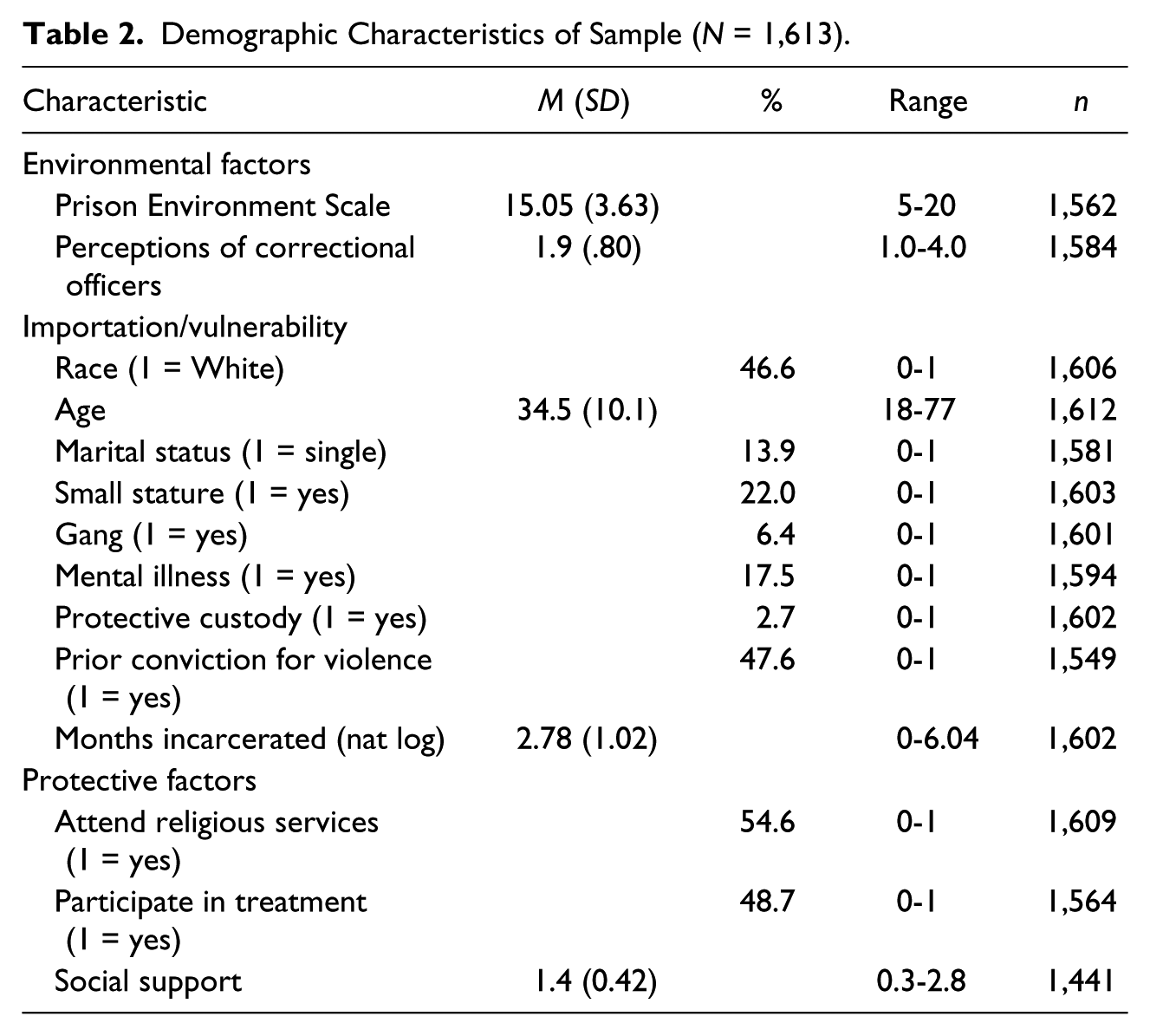
Prison environment is a five-item additive scale created to measure the participant’s perception of the prison environment during their last period of incarceration (α = .77). Respondents were asked to respond to a scale (1 = never; 2 = rarely, 3 = sometimes, 4 = often) about how often other inmates felt afraid of being assaulted, became someone else’s property, were threatened, or were beaten up. Respondents were also asked about the frequency of gang fights in prison. The items described here loaded on a single factor at reasonable levels (.59-.74). The former inmates had a mean score of 15.05 on the prison environment scale (see Table 2). Perceptions of correctional officers is a three-item averaged scale measuring the perceived mistreatment of inmates by correctional officers (α = .83). 3 Participants were asked to respond to a scale (1 = often, 2 = sometimes, 3 = rarely, 4 = never) regarding the frequency with which correctional officers make fun of inmates, belittle or talk down to inmates, and pit inmates against one another. Higher values indicate less perceived mistreatment of inmates by correctional officers, with the former inmates having a mean score of 1.9 on the perceptions of correctional officers scale (see Table 2). Factor loadings were above .60 for the three items.
Demographic Characteristics of Sample (N = 1,613).
Importation/vulnerability
Race was dichotomized into White and non-White categories (1 = White, 0 = non-White). Age was measured on a continuous scale and represents the respondent’s reported age at the time of the interview. Marital status was measured as a dichotomous variable in which “married” is coded as 1 and “not married” (single, widowed, divorced, etc.) is coded as 0. In terms of prior prison experiences, researchers argue that inmates who are serving their first time in prison may be more vulnerable to violence (Dumond, 2003; Fagan et al., 1996). Small stature was coded 1 for those who were below average and 0 for those who were above average height and weight. 4 Slightly less than one fourth of the sample (22%) is small in stature. Participants were asked to report whether they belonged to a gang in prison (1 = yes, 0 = no) and whether they had been diagnosed with a mental illness in prison (1 = yes, 0 = no). As shown in Table 2, only 6% of the sample reported being a member of a gang while in prison, whereas a greater percentage, 18%, indicated that they had been diagnosed with a mental illness during their incarceration. Protective custody measures whether the participant had been placed in protective custody at any time during his or her most recent stay in prison. Protective custody in this regard is seen as a proxy for vulnerability within prison. As indicated in Table 2, only 3% of the sample had been placed in protective custody. Prior violent record measures whether the respondent had a prior record involving violence before his or her last period of incarceration (1 = yes; 0 = no). Although data on prison security level were not available for the participants, a prior violent record would be considered when deciding placement. As shown in Table 2, almost half, 48%, of the sample had a previous conviction for a violent offense. It is theorized that their prior violence record could influence their placement in prison. Months in prison measured the number of months respondents had been incarcerated during their previous period of incarceration. On average, respondents had spent 29 months in prison during their last stay in prison. Because this variable was skewed to the right, the natural log was taken of the variable to create the final measure used in analyses.
Protective factors
Attend religious services ascertained whether the respondent participated in religious services while in prison. Respondents who attended religious services were assigned a 1, and those who did not were assigned a value of 0. Participate in treatment measured whether the respondent participated in any treatment programs while in prison. Respondents who participated in treatment were assigned a 1; those not participating were assigned a 0 on this variable. As can been seen in Table 2, more than half of the sample (55%) participated in religious services (e.g., attended religious services such a church, prayer groups, bible study, etc.), and 49% indicated that they participated in some type of treatment program while in prison. The Social Support Questionnaire (SSQ6) was used to measure the individual’s perceptions of available support. The short form contains 6 two-part questions versus the 27 questions included in the original longer form of the SSQ. The first part of each question measured the number of available supports, and the second part measured the respondent’s satisfaction with these individuals (Sarason, Sarason, Shearin, & Pierce, 1987). For the current study, we sum the totals of each item (measured as counts of number of people, 0 to highest) to create a social support scale. Higher scores indicate more people who can be relied on and thus greater social support. The Cronbach’s alpha coefficient is .89 for the current sample. The former inmates had a mean score of 1.4 on the social support scale.
Dependent variable
Poly-victimization
Individuals were asked to recall whether they had experienced victimization during their last 12 months in prison. Victimization experiences were measured as (a) whether they had witnessed an event or (b) whether they had been directly victimized (termed “completed or direct”). The types of victimization included property loss (thefts), physical assaults (fighting), emotional abuse (verbal harassment), and sexual assaults. For each type, the variables were coded 0 if a person had not experienced it and 1 if they had experienced that type of victimization. To create a measure of poly-victimization, a measure of the number of different types of victimization experienced was created by summing the eight victimization items together, to create a final measure that ranges in value from 0, which indicates that a person did not experience any type of victimization, to 8, which indicates that he or she experienced eight (or all) of the different types of victimizations measured.
Analytical Procedures
The analysis proceeded in two stages. In the first stage, we examined the extent to which former inmates were poly-victims. In doing so, we identified the number of different types of victimizations former inmates experienced and also the specific types of victimizations that occurred. In the second stage, multivariate ordinary least squares (OLSs) regression models were conducted to examine the relationship between environmental factors, importation/vulnerability factors, and protective factors on poly-victimization. 5 In doing so, robust standard errors were used that account for the fact that former inmates were clustered by prison. Without accounting for this clustering, standard errors are deflated and there is a greater chance of rejecting your null hypothesis when you should not (Wooldridge, 2009). In addition, to examine whether there were issues of collinearity between the independent variables in the model, variance inflation factors (VIFs) were calculated for each regression coefficient. None of the VIFs exceeded 2, which indicate that collinearity was not a problem (Wooldridge, 2009).
Results
In the first stage of the analysis, we examined the extent to which former inmates experienced different types of victimization while they were incarcerated. As displayed in Table 3, nearly everyone, 98%, reported that they had experienced at least one of the eight types of victimizations. Most commonly, the former inmates indicated that they had experienced three or four types of victimizations with about one quarter of the sample reportedly victimized in three (n = 424) or four (n = 419) different ways. Notably, a greater percentage of the sample experienced seven forms of victimization (3%) than no victimization (2%). Witnessing victimization was more common than direct victimization experiences for former inmates. For example, as shown in Table 4, 92% of former inmates indicated that they had witnessed a fight while incarcerated compared with only 29% who said they had been in a physical fight. Similarly, 82% said they had witnessed theft and 22% said they had experienced a theft. Clear differences between direct and witnessing sexual assault were also found—23% of former inmates indicated they had witnessed sexual assault, but less than 1% said they had directly experienced this form of abuse. Finally, we examined whether the subjects experienced any form of witnessed or direct victimization. Nearly the entire sample had witnessed victimization (98%) with approximately 6 in 10 directly experiencing victimization (see Table 4).
Number of Different Types of Victimizations Experienced.

Extent of Different Victimizations Experienced by Total Sample.

In the second stage of the analysis, multivariate OLS regression was performed to examine the factors predicting poly-victimization. The results of this analysis are presented in Table 5. 6 Two environmental factors significantly predicted poly-victimization risk. Both the perception of prison environment and perception of correctional officers were significant. For every one-unit increase in the perception of prison as a hostile environment, the number of types of victimizations experienced increased by .12. Perceptions of correctional officers were related to an increase in the different types of victimizations experienced—a one-unit increase was associated with a .27 increase in the different types of victimizations experienced.
Multivariate OLS Regression Models Predicting Number of Different Types of Victimization Experienced (n = 1,288).

Note. OLS = ordinary least squares.
p < .05. **p < .01. ***p < .001.
p = .060.
Four importation factors related to vulnerability were significantly related to poly-victimization risk. Being White and older was associated with experiencing fewer types of victimizations. Having been diagnosed with a mental illness was related to a greater number of different types of victimizations. Two protective factors were significant predictors of poly-victimization. Although social support was marginally related to the different types of victimizations in the expected direction, attending religious services was positively associated with the different types of victimizations experienced. Those attending religious services experienced .19 more different victimization types than those not attending religious services. Social support, however, was protective. A one-unit increase in the social support scale resulted in a .17 decrease in the number of different types of victimization experienced.
Discussion
Our measure of victimization included both witnessing and directly experiencing four types of victimization—theft, fighting, verbal abuse, and sexual assault—all, with the exception of sexual assault, were reported at fairly high rates. The rate of poly-victimization found in our study suggests that this exposure to violence has the potential to be an organizing principle in incarcerated men’s lives. Particularly instructive is that the inmates’ perceptions of their environment were significantly related to victimization in the expected direction. Those who felt that the prison environment and the correctional staff were hostile were more likely to report experiencing multiple forms of victimization. Although it is unclear whether the experience of multiple types of victimization in prison influenced the inmate’s view of hostility, we would hypothesize that threatening prison environments encourage aggression or victimization in prison.
Importation factors were found to be significant—race, age, and mental illness. Research suggests that inmates import certain characteristics into the prison environment that shape their experiences as well as the experiences of those around them. Although research suggests that White inmates are more likely to report victimization in prison (Lahm, 2009; Toch, 1977), our findings suggest that minority group members were more likely to report experiencing poly-victimization in prison. Younger inmates and those with mental illnesses were also more likely to experience multiple forms of victimization in the prisons under study. Younger inmates tend to be at greater risk of victimization due to their tendency to engage in high risk behaviors. Individuals with mental illness on the other hand are seen as vulnerable targets for victimization. These patterns, while consistently found in the literature on the single occurrence of victimization, clearly hold true here for poly-victimization.
Finally, one lifestyle or protective factors, attending religious services, was related to the number of different of types of victimization experienced. The findings regarding religious services were not in the expected direction; however, it could be that those who experienced multiple types of victimization were more likely to seek out religious services after the victimization episode. Another explanation could be that poly-victims were more exposed to motivated offenders via participating in religious services in that doing so brought them into contact with other inmates. The current data do not allow for explorations of the mechanisms underlying the relationship between religious service attendance and poly-victimization.
The findings from this study have implications for policy and practice. Existing research suggests that exposure to victimization (whether exposure occurs through direct experience or witnessing) in prison has deleterious effects on mental health outcomes (Boxer et al., 2009; Hochstetler et al., 2004; Listwan, Colvin, et al., 2010). We would expect that poly-victimization would have potentially greater impacts. Research by Finkelhor and colleagues (2009) found in their sample of children and youth that those who experience multiple forms of victimization experience significantly more distress. This proposition is in line with research that implies that although brief traumas may have only limited effects on the individual, repeated trauma may lead to significant mental health and behavior problems (Davies & Flannery, 1998; Terr, 1991) as well as long-term health consequences from exposure to constant stress (Flannery, 2006; Kotulak, 1997). Although mental health is beyond the scope of the current study, the impact illustrates the importance of identifying the factors predictive of poly-victimization to reduce or prevent its occurrence.
By examining patterns of victimization, administrators may be able to develop strategies toward identifying those at risk for poly-victimization even if an inmate has not come forward, thereby facilitating early, needed interventions. Intervention is especially important given the negative consequences of poly-victimization. This is not to downplay the potential seriousness of experiencing any one type of victimization in prison, but our study does indicate that some inmates are at risk of experiencing a variety of victimizing behaviors. These inmates are particularly in need of services, and correctional personnel should be aware that intervening for one type of victimization may not be sufficient in reducing an inmate’s overall risk. Early detection and intervention could significantly reduce the negative impact of victimization on inmates. Although some may argue that many of these inmates may have been previously involved in violent incidents in their communities, the impact of victimization in prison is particularly important. At the same time, these inmate-focused strategies should be supplemented by staff-focused initiatives. Staff-focused policies may include enhanced training, informed hiring practices, maintaining certain staff-to-inmate ratios, or hiring a more culturally diverse workforce.
In addition, this study provides support for expanding the types of services provided to incarcerated individuals, in the institution and after release. It is important that practitioners identify and comprehend the impact that poly-victimization can have on inmates’ lives and re-entry, short-and long-term. Acknowledging the reality that direct and indirect victimization may manifest in many ways has implications for screening, treatment, and supervision.
Although the findings from this study are noteworthy, there are several limitations. First, the sample includes inmates residing in halfway houses post-incarceration in one state. Although we noted that utilizing this population had several advantages, the generalizability of our findings is limited. Second, the determination of victimization status was based on self-reports through semi-structured interviews with the client. We did not collect official records on victimization incidents in prison such as official hospital or nurse records to confirm or deny the respondent’s assertions of harm or refute the respondent’s assertion that he or she was not victimized.
Related, the higher rate of witnessed victimization is likely due to several factors. First, as with all victimization research, there are concerns about underreporting. It has been argued that women have an easier time identifying themselves as victims, whereas men who are victims may have additional hurdles to overcome in reporting victimization. For example, research suggests that men may not identify with the victim identity as it conflicts with competing hegemonic roles (e.g., power, privilege; A. Johnson, 2001). If this is the case, men victimized in prison may need programs tailored to male victims not only to provide typical victim-aid resources (e.g., tangible, informational, and emotional support), but also to address acceptable masculinity concepts. Second, prisons are often organized to promote victimization. It is more likely that inmates are witnessing victimization on a frequent basis. It should be noted, however, that in the current sample, direct victimization on multiple occasions was not a rare occurrence.
Finally, the cross-sectional nature of the study does not allow for the examination of temporal ordering of the victimization experience and the perception of prison staff and/or the lifestyle factors. We would argue that the prison environmental variables might be fairly static, although variability in coercion certainly can exist. Although this limitation exists, the finding that the inmate’s victimization experience is related to negative perception of staff is informative. Previous research suggests that inmates who feel high levels of mistrust and coercion of staff can have a more difficult time adjusting to prison. Moreover, studies suggest that it can affect their psychological health, recidivism, disciplinary infractions, and (in some cases, as found in Colvin’s research) prison riots. The finding that inmates who experience multiple forms of victimization are more likely to view the prison environment and staff in a negative way highlights a need to intervene in a more meaningful way with victims.
Despite these few limitations, our work presents the first examination of the extent to which inmates experience poly-victimization and the risk factors for experiencing this type of victimization in prison. Our findings should pave the way for future research into this understudied area as well as arm correctional personnel with criteria that they can use to help identify inmates who may be at risk or who may have already experienced poly-victimization. Knowing who is at risk is the first step in reducing poly-victimization among prison inmates.
Footnotes
Declaration of Conflicting Interests
The author(s) declared no potential conflicts of interest with respect to the research, authorship, and/or publication of this article.
Funding
The author(s) disclosed receipt of the following financial support for the research, authorship, and/or publication of this article: The research was supported by the National Institute of Justice, U.S. Department of Justice grant 2005–RP–BX–0002.