




Abstract
Adult inmates who experienced the incarceration of a parent, known as “second-generation prisoners,” experience unique challenges and are at heightened risk for experiencing other adversities throughout the life span. Our study investigated one specific, and previously unexplored, type of adversity—domestic violence—within a sample of 293 incarcerated adults. We examined the relation between generation status (first- or second-generation prisoners), childhood exposure to domestic violence, and participation in adult relationship violence prior to incarceration. Results indicate that prisoners who had been exposed to domestic violence in childhood were more likely to engage in intimate partner violence resulting in inflicted and received injury. Relative to first-generation prisoners, second-generation prisoners reported more childhood domestic violence exposure and were more likely to have been injured by a relationship partner. However, this relation between second-generation status and injury victimization was mediated by domestic violence exposure. These results support an intergenerational pattern of domestic violence and suggest that second-generation prisoners are a unique population worthy of future investigation and mental health intervention.
Keywords
The number of incarcerated individuals in the United States has significantly increased over the past several decades. Concurrently, the number of children with one or more parents in state or federal prison rose by 80% between 1991 and 2007 (Glaze & Maruschak, 2008; West & Sabol, 2008). Although there has been considerable study regarding the impact of parental incarceration on youth (Murray, Farrington, & Sekol, 2012), little is known about the experiences of those children of prisoners who themselves go on to be incarcerated as adults, or “second-generation prisoners” (Novero, Loper, & Warren, 2011). The likely problematic family history of these adults may confer special strains or risks within the group. The purpose of this study was to investigate one well-researched risk factor for children in troubled families, childhood exposure to domestic violence, within an offender sample. In the current study, we contrast the experiences of first- and second-generation prisoners relative to such childhood exposure and the subsequent experience and use of violence in their adult intimate relationships.
The Impact of Parental Incarceration
As the number of incarcerated parents has increased over the past several decades, recent attention has focused on the effects of parental incarceration on childhood development and outcomes (Makariev & Shaver, 2010). Children of incarcerated parents are at higher risk of academic problems, mental health issues, substance use, antisocial behavior (Murray & Farrington, 2008a, 2008b; Murray et al., 2012), and serious delinquency (Farrington, Jolliffe, Loeber, Stouthamer-Loeber, & Kalb, 2001; Kjellstrand & Eddy, 2011), as well as adult arrest and incarceration (Farrington, Coid, & Murray, 2009; Murray & Farrington, 2005; Murray, Janson, & Farrington, 2007). In addition to parental absence due to incarceration, children of incarcerated parents often experience other parental-related risk factors during childhood that put them at heightened risk for overall maladjustment, including family conflict, low maternal education, parental mental illness, and parental drug use (Aaron & Dallaire, 2010; Dallaire, 2007; Sameroff, Bartko, Baldwin, Baldwin, & Seifer, 1998). They are also more likely to identify as a member of an ethnic minority group compared with children who do not experience parental incarceration (Glaze & Maruschak, 2008). In addition, these children may be subjected to a unique set of incarceration-related risk factors that may increase their vulnerability toward criminality, such as the incarceration of multiple family members and residential instability as a result of parental incarceration (Dallaire, 2007).
Second-generation prisoners, compared with first-generation prisoners, report higher rates of conduct disorder behaviors and juvenile offending (Will, Whalen, & Loper, 2014) and experience significantly more adverse childhood experiences (ACE) leading up to their legal involvement (Dannerbeck, 2005; Novero et al., 2011). Accumulated risk theory (Sameroff et al., 1998) predicts that the greater the number of risks, the worse the outcomes. In a study of contextual and incarceration-related risk factors experienced by incarcerated mothers and fathers, Dallaire (2007) found that the percentage of prisoners’ adult children who were incarcerated increased as the number of family risk variables similarly increased. Although several of these studies (Dallaire, 2007; Dannerbeck, 2005) have identified childhood abuse as a contextual risk factor, exposure to parental violence has been largely unexplored in parental incarceration research.
The Impact of Childhood Exposure to Domestic Violence
According to Evans, Davies, and DeLillo (2008), “exposure to domestic violence occurs when children see, hear, are directly involved in (i.e., attempt to intervene), or experience the aftermath of physical or sexual assaults that occur between their caregivers” (p. 132). It is estimated a minimum of 15 million children are exposed to domestic violence in dual-parent households alone (McDonald, Jouriles, Ramisetty-Mikler, Caetano, & Green, 2006). The rates of early domestic violence exposure are likely to be high for individuals who become incarcerated. For example, in one study of childhood experiences of incarcerated American Indian/Alaska Native women, De Ravello, Abeita, and Brown (2008) found that 72% reported witnessing violence against their mother/stepmother when they were children and up to 83.8% reported adulthood involvement in violent relationships. Similarly, Greene, Haney, and Hurtado (2000) found that the percentage of incarcerated women who report witnessing family violence during their childhood (60%) was very similar to the percentage who report that their children had been exposed to violence in the home (70%).
Exposure to domestic violence is a unique adverse experience that is similar to parental incarceration in that the child is not a direct victim (as in abuse or neglect situations). Research conducted with prisoners (Gover, Mackenzie, & Armstrong, 2000; Martin, Cotton, Browne, Kurz, & Robertson, 1995) and community samples (Spaccarelli, Sandler, & Roosa, 1994) alike find that childhood exposure to domestic violence adversely affects children throughout their lives. Children who have been exposed to domestic violence are at increased risk for internalizing and externalizing behaviors (Evans et al., 2008; Yates, Dodds, Sroufe, & Egeland, 2003), anxiety and depressive symptoms (Adams, 2006; Gover et al., 2000; Martin et al., 1995; Murrell, Christoff, & Henning, 2007; Spaccarelli et al., 1994), trauma (Evans et al., 2008), and childhood aggressive and delinquent behaviors (Fantuzzo & Lindquist, 1989), which can extend into adulthood (Murrell et al., 2007). With the exception of Yates et al. (2003), many studies have not statistically controlled for other traumatic experiences, such as being a victim of abuse, in measuring outcomes related to domestic violence exposure.
Intergenerational Transmission of Partner Violence
Exposure to violence between parents increases the likelihood that the child will use similar behaviors in his or her own adult intimate relationships (Ehrensaft et al., 2003; Kalmuss, 1984; Murrell et al., 2007). The theoretical underpinnings of intergenerational violence transmission are rooted in social learning theory (Bandura, 1977; Dannerbeck, 2005; Murrell et al., 2007), which posits that when a parent models violent behavior, the child learns and adopts similar conflict-resolution strategies (Kalmuss, 1984). This theory has been supported by several general population studies of intergenerational violence (Ehrensaft et al., 2003; Kalmuss, 1984), as well as within prisoner-specific samples (Hill & Nathan, 2008). In particular, Kalmuss’s (1984) research suggests that intimate partner violence is adopted as a role-specific strategy, in that intergenerational violence transmission is more likely to occur when a child has witnessed parental violence, as opposed to when a child is a victim of parental physical abuse in a home. Murrell and colleagues’ (2007) study of 1,099 men convicted of battery revealed that men with higher exposure to violence in childhood were more likely to engage in both intimate and non-intimate partner violence as adults. These findings are an important foundation for the current study’s investigation into the transmission of domestic violence among incarcerated individuals.
The Current Study
Our study seeks to better understand the unique experiences of second-generation prisoners by comparing their adversities and violence patterns to those of first-generation prisoners, including their subsequent experiences of violence in their adult intimate relationships. To this aim, we developed the following hypotheses:
These hypotheses are consistent with previous findings attesting to this relationship (Ehrensaft et al., 2003; Murrell et al., 2007) but add confirmation that the relation holds within the more restricted range of individuals in prison.
Although no study to date has directly investigated this hypothesis, children of incarcerated parents have been found to be at heightened risk of engaging in antisocial behaviors on a broader scale (Murray & Farrington, 2008b; Murray et al., 2012).
Numerous studies have identified potential covariates of relevance to the present study, including gender, age, and type of offense. A series of preliminary analyses evaluate the impact of these constructs.
Method
Participants and Procedure
The current study uses archival data from a larger study of prison behavior (Warren & Jackson, 2013). Data were originally collected from 10 prisons in two states, one in the south and one in the midwest United States. Each institution invited between 50 and 200 randomly selected prisoners to complete the survey. A total of 471 prisoners agreed to participate, reflecting a 37% response rate that is consistent with other similar prison studies (Struckman-Johnson & Struckman-Johnson, 2000, 2002; Wolff, Blitz, Shi, Bachman, & Siegel, 2006). Female prisoners were purposefully oversampled in the original study to support gender comparisons. As a result, the total sample was comprised of 288 males and 181 females. Comparisons revealed that general population inmates were more likely to be serving shorter sentences but were otherwise similar (e.g., with respect to age, race, gang affiliation, and severity of offense) to study participants. Due to time limitations, the primary measure used in this study (Revised Conflict Tactic Scale) was not administered to 144 of these inmates and thus they were excluded from the sample. Of the remaining inmates, a total of 293 participants (161 men and 132 women) provided valid data on the variables of interest and were included in the current analyses. Comparison of sample participants with excluded (i.e., cases excluded due to missing data) indicated no differences in terms of education level, age, minority status, or marital status. Sample participants were more likely to be female, whereas excluded inmates were more likely to report that their most current offense was violent (as opposed to non-violent).
Measures
Generation status
A demographic questionnaire included two items in which prisoners responded “yes” or “no” as to whether (a) their mother or (b) their father had ever been sent to jail or prison during the prisoner’s childhood. Those who endorsed the incarceration of either parent were classified as “second-generation” prisoners, whereas those who did not endorse either parental incarceration item were classified as “first-generation” prisoners. Individuals who reported not knowing the incarceration status of one parent (e.g., growing up without knowing the parent) and responded “no” on the other parent item were classified as “first-generation” prisoners.
ACE Study Questionnaire: Expanded
Exposure to childhood domestic violence was assessed by a modified 10-item ACE Questionnaire (Felitti et al., 1998). The ACE is a self-report instrument designed to measure the history of negative events experienced in childhood. Our measure of childhood exposure to parental-figure domestic violence consisted of 10 yes/no items: four items from the original ACE assessing domestic violence perpetrated by a paternal figure (father, stepfather, or mother’s boyfriend) against one’s mother or stepmother, four expanded items assessing similar forms of domestic violence perpetrated by one’s maternal figure against one’s father or stepfather, and two expanded items capturing threats of violence between parent figures. These 10 items demonstrated good reliability (full scale Cronbach’s α = .91). Inspection of the distribution for the scale, however, revealed a skewed pattern with nearly half (48.5%) of the sample having a “0” total for the 10-item scale. We therefore elected to transform the continuous score into a dichotomous variable (see Farrington & Loeber, 2000, for further rationale on dichotomization of skewed distributions). The Exposure group consisted of prisoners who endorsed a “yes” response to one or more of the 10 domestic violence items, whereas those who had not endorsed “yes” to any of these items were classified as No Exposure.
The ACE also generates a separate indicator for physical abuse by which the individual indicates whether any of 2 exemplars occurred as committed by a parent (e.g., “push, grab, shove, or slap you”).
Revised Conflict Tactic Scale (CTS2): Injury
CTS2 (Straus, Hamby, Boney-McCoy, & Sugarman, 1996) is a self-report instrument containing five scales, including the presently used Injury scale. Given the retrospective nature of the study, violent acts that result in injury are plausibly more easily remembered than those without injury. Therefore, as a measure of violence perpetration and victimization in adult relationships, we used the 12-item Injury scale (3 item pairs reflecting minor injury and 3 item pairs reflecting severe injury). Prisoners reported how many times they had been the victim of violence by an intimate partner resulting in their injury (e.g., “I had a sprain, bruise, or small cut because of a fight with my partner”) and how many times they had used violence against a partner that resulted in their partner’s injury (e.g., “My partner had a sprain, bruise, or small cut because of a fight with me”) within the year prior to their incarceration. All items are rated on a Likert-type scale, ranging from 0 (this has never happened) to 6 (more than 20 times in the past year), with the additional option to choose 7 (not in the past year, but it did happen before). Items within the Injury Perpetration and Victimization scales demonstrated good internal reliability (Cronbach’s α = .84 and .86, respectively). Straus (2001) provides multiple methods for scoring the CTS2. We elected to use the “Ever Prevalence” method, wherein any lifetime occurrence represents manifestation of the event (Straus, 2001), to create two versions of the Injury scales. First, two dichotomous (yes/no) variables were created: (a) lifetime perpetration of violence against an intimate partner resulting in their injury (perpetrated injury) and (b) lifetime victimization by an intimate partner resulting in an injury (victim injury). Second, two categorical variables were created to reflect the severity and dangerousness of the injury acts: (a) no injury, (b) minor only (only items on the minor injury subscale were endorsed), and (c) severe (one or more severe acts of injury were endorsed), allowing for a broader understanding of domestic violence (Straus, 2001).
Results
Sample Description and Descriptive Statistics
Demographic characteristics of this sample are presented in Table 1. Of the 293 participants, 45.1% (n = 132) reported that one or both of their parents had been incarcerated during their childhood (second-generation prisoners), whereas 54.9% (n = 161) had not experienced the incarceration of a parent (first-generation prisoners). Of the total sample, 51.5% (n = 151) reported that they had been exposed to one or more acts of domestic violence committed by a parental figure during their childhood, whereas 48.5% (n = 142) had not.
Characteristics of First- and Second-Generation Prisoners.
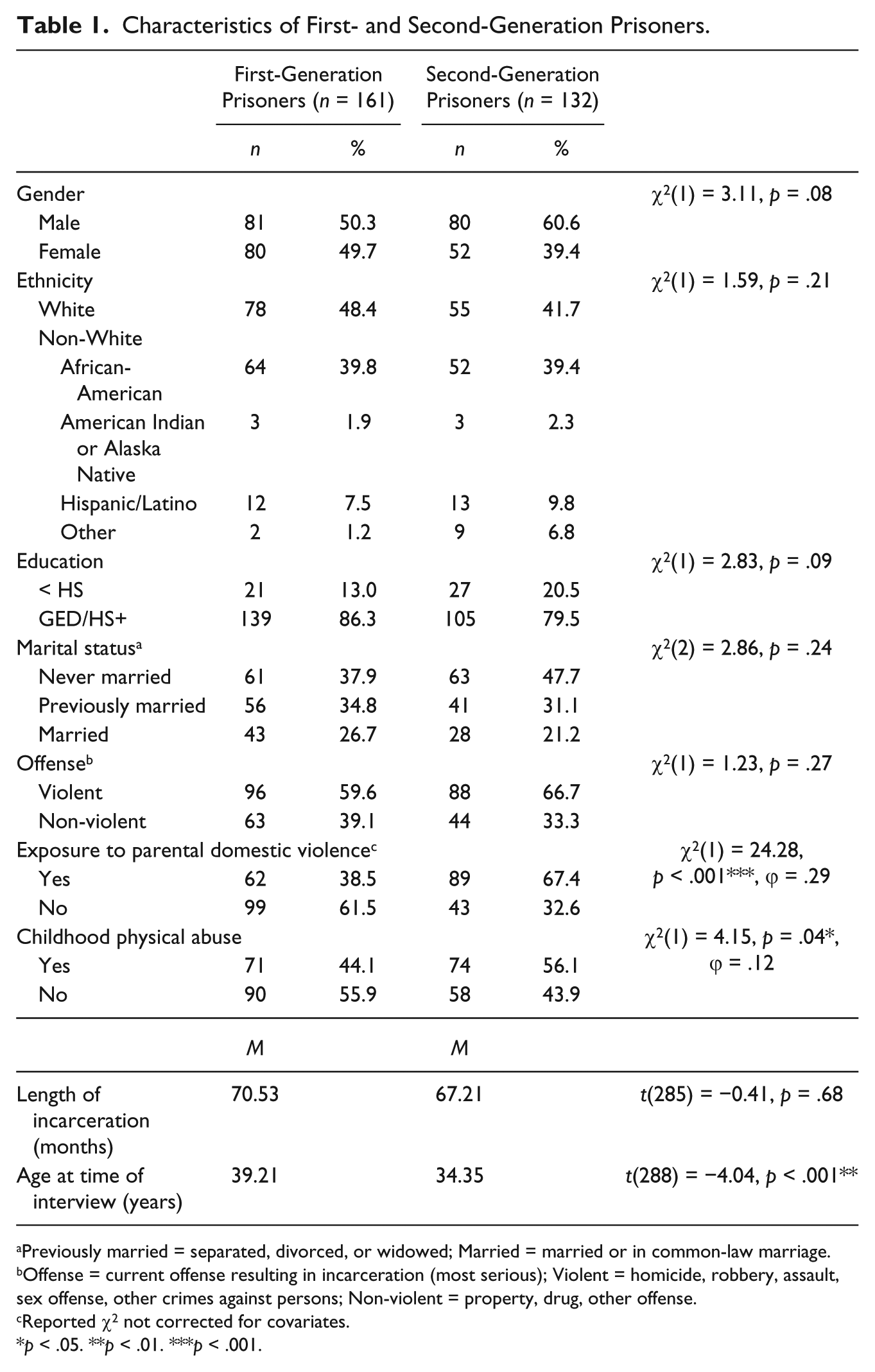
Previously married = separated, divorced, or widowed; Married = married or in common-law marriage.
Offense = current offense resulting in incarceration (most serious); Violent = homicide, robbery, assault, sex offense, other crimes against persons; Non-violent = property, drug, other offense.
Reported χ2 not corrected for covariates.
p < .05. **p < .01. ***p < .001.
We tested a number of variables for possible covariates (see Table 1). No demographic differences were found between the first- and second-generation groups except for age at the time of the interview; second-generation prisoners (M = 34.35 years) were significantly younger than first-generation prisoners (M = 39.21 years), t(288) = −4.04, p < .001. We found that a significantly higher proportion of women (43%) than men (27%) reported victim injury, χ2(1) = 8.76, p = .003, ϕ = .173. However, no statistically significant difference was found between men’s (26%) and women’s (36%) perpetration of injury, χ2(1) = 3.11, p = .08. Consequently, we controlled for both gender and age at time of interview in all analyses. Potential covariates were also examined in relation to our other primary variables of interest, with predominantly non-significant results. Specifically, there were no apparent relations between our primary variables and gender, race, education, marital status, type of most recent offense, length of incarceration, and age at time of interview. Consistent with previous research (Herrenkohl, Sousa, Tajima, Herrenkohl, & Moylan, 2008), exposure to domestic violence was found to be highly related to childhood physical abuse, χ2(1) = 53.46, p < .001, ϕ = .43. Seventy percent of those who endorsed exposure to domestic violence also reported childhood abuse, whereas 70% of those who had not been exposed to domestic violence similarly did not experience abuse, suggesting strong overlap between these variables.
Hypothesis 1
Binary logistic regression was used to investigate the relation between exposure to domestic violence and CTS2 Injury scales (perpetration and victimization). As predicted, individuals in the Exposure group (36.4%) were more likely than those in the No Exposure group (23.9%) to report perpetrating injury, χ2(1) = 4.80, p = .03, Nagelkerke R2 = .066, b = .577, Wald = 4.72, odds ratio [OR] = 1.78. Post hoc analyses using multinomial logistic regression were conducted to determine whether severity of perpetrating injury (none, minor only, severe) was differentially related to exposure to domestic violence. The trinomial variable was dummy coded with “no violence” as the reference category. The overall multinomial model was significant, χ2(6) = 15.12, p = .019, Cox & Snell R2 = .05, Nagelkerke R2 = .06. Exposure to domestic violence was not a significant predictor of perpetrating minor injury (b = .43), Wald χ2(1) = 1.54, p = .21, although it did significantly predict perpetrating severe injury (b = .71), Wald χ2(1) = 4.29, p = .04, providing partial support for our hypothesis.
Also consistent with our hypothesis, prisoners in the Exposure group (41.1%) were significantly more likely to report victim injury than those in the No Exposure group (26.8%), χ2(1) = 6.56, p = .01, Nagelkerke R2 = .08, b = .66, Wald = 6.43, OR = 1.93. Post hoc analyses were conducted to determine whether severity of victim injury (none, minor only, severe) was differentially related to exposure to domestic violence. The overall model was statistically significant, χ2(6) = 26.2, p < .001, Cox & Snell R2 = .09, Nagelkerke R2 = .11. Exposure to domestic violence did not predict minor levels of victim injury (b = .62), Wald χ2(1) = 3.07, p = .08, although it did contribute to severe victim injury, with a corresponding predictive risk ratio of 2.0 for those who had been exposed to domestic violence (b = .69), Wald χ2(1) = 4.62, p = .032.
Given the strong overlap between exposure to domestic violence and childhood physical abuse, each of these models was re-analyzed with inclusion of physical abuse as a covariate. However, as expected, the direct relationship between each of these variables and the injury scales were reduced below significance, as was the full model. Thus, inclusion of both physical abuse and domestic violence exposure essentially eliminated the impact of both variables. For this reason, and in consideration of the conceptual focus of this study on violence exposure rather than physical victimization, childhood physical abuse was excluded from our remaining analyses.
Hypothesis 2
Binary logistic regressions evaluated the relation between generation status and reported exposure to domestic violence during childhood. After controlling for gender and age at the time of interview, second-generation compared with first-generation prisoners were significantly more likely to report exposure to domestic violence, confirming our hypothesis, χ2(1) = 20.42, p < .001, Nagelkerke R2 = .11, Wald = 19.62, OR = 3.09 (Table 2).
Logistic Regression: Exposure to Domestic Violence Among First- and Second-Generation Prisoners.
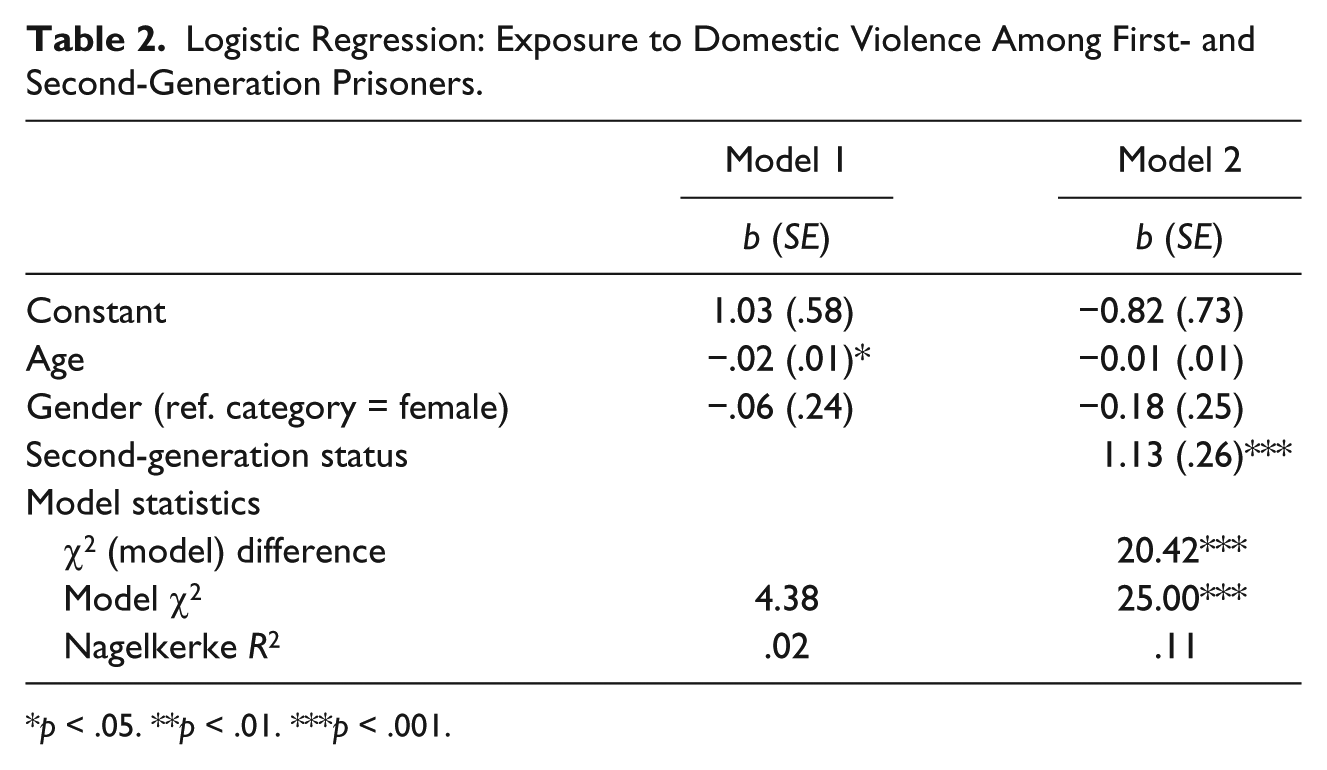
p < .05. **p < .01. ***p < .001.
Hypothesis 3
Binary logistic regression evaluated the relation between generation status and the two CTS2 Injury outcome variables, after controlling for the gender and age at the time of interview. Support for our predictions were mixed (Table 3). Contrary to our hypothesis, second-generation prisoners were not more likely than first-generation prisoners to perpetrate injury. However, the overall binary model was significant, χ2(3) = 13.33, p = .006, Nagelkerke R2 = .059. Gender emerged as a predictor; females were more likely than males to perpetrate injury, after statistical control of other model variables. In contrast, second-generation prisoners were significantly more likely than first-generation prisoners to report victim injury, χ2(1) = 4.67, p = .03, Nagelkerke R2 = .07, b = .57, Wald = 4.62, with statistical control for the contribution of being female.
Logistic Regression: Injury Among First- and Second-Generation Prisoners.
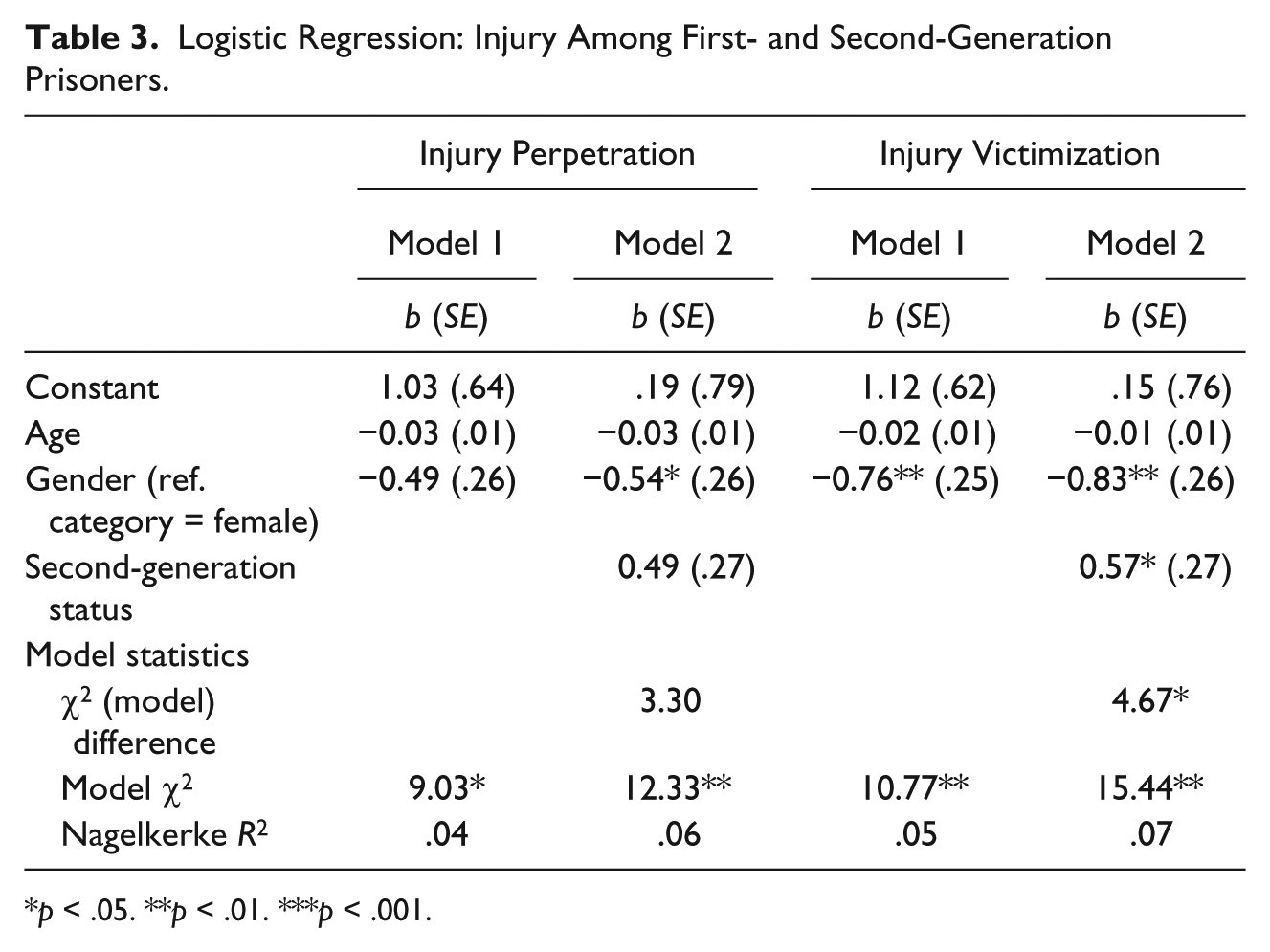
p < .05. **p < .01. ***p < .001.
Hypothesis 4
Logistic regression analysis was used to test whether generation status continued to relate to victim injury with the inclusion of domestic violence exposure as a predictor (controlling for gender and age at the time of interview). Given that generation status did not contribute significantly to perpetrating injury, the mediation analysis was conducted only with victim injury (Table 4). With inclusion of the domestic violence exposure predictor, generation status (b = .43) was no longer a significant predictor of victim injury. Exposure to domestic violence (b = .55, OR = 1.74) absorbed variation associated with generation status that was observed in previous analyses, suggesting that generation status and victim injury is mediated by exposure to domestic violence.
Logistic Regression: Victim Injury as Mediated by Domestic Violence Exposure.
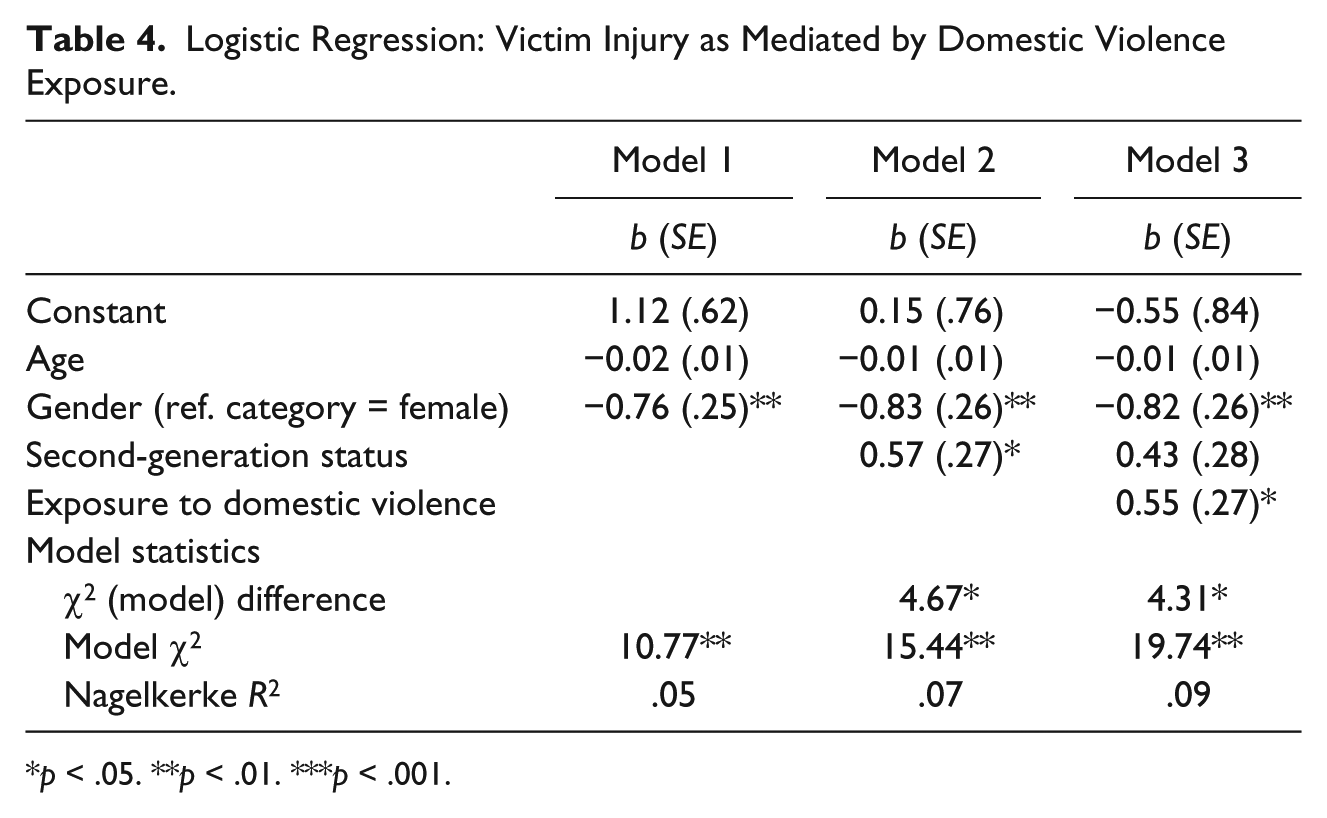
p < .05. **p < .01. ***p < .001.
Discussion
The results of this study reveal new evidence that distinguishes those who follow in their parents’ footsteps to prison—those we call second-generation prisoners—from other incarcerated individuals. Our results indicate that many offenders enter prison with a history of trauma experienced as children, and this trauma is even more likely if the prisoner has a parent who has been incarcerated. Furthermore, this early trauma in the form of exposure to domestic violence may negatively affect adult intimate relationships. Within our study population, exposure to domestic violence predicted severe (as opposed to minor) perpetration of injury and being the victim of an injury by a partner. Being a second-generation prisoner was related to being injured by a partner. The relation between generation status and reported injury by a partner was mediated by the higher levels of exposure to domestic violence evident within the second-generation cohort.
Consistent with previous research (Hill & Nathan, 2008; Kalmuss, 1984), exposure to childhood domestic violence was predictive of a prisoner’s inflicting on and receiving injury from an intimate partner. In comparison with Kalmuss’s (1984) intergenerational study of severe marital aggression, our findings are unique in that we revealed distinctions between minor and severe violence. Domestic violence exposure made a particularly salient contribution to predicting severely violent acts, but not minor acts: Prisoners exposed to parental violence were significantly more likely to cause and to be the recipient of severe injury than those who were not exposed to domestic violence. According to social learning theory (Bandura, 1977; Dannerbeck, 2005; Murrell et al., 2007), witnessing parental violence puts children at increased risk of repeating this pattern in their adult relationships, as was observed in our study. It may be that domestic violence exposure is just one of a multitude of risk factors experienced by these children. Accumulated risk theory (Sameroff et al., 1998) would suggest that the presence of multiple risk factors is associated with worse outcomes, in this case, severe injury perpetration and victimization. However, when we included two strongly correlated risk factors (childhood physical abuse and exposure to domestic violence) in the same model, neither experience was predictive of intimate partner violence above and beyond the other, hence reducing support for the accumulated risk hypothesis.
The high degree of overlap between physical abuse and domestic violence exposure has been frequently documented in past studies, particularly in incarcerated populations (Greene et al., 2000; Herrenkohl et al., 2008). Relatively few prisoners in our study were exposed to domestic violence without also experiencing physical abuse, and those who did not experience domestic violence were also unlikely to experience abuse. However, the aim of the present study was to investigate domestic violence through the lens of social learning theory, rather than accumulated risk theory, and consequently we elected to focus analyses solely on domestic violence exposure. The increased risk of intimate partner violence among victims of childhood abuse has been well established (Malinosky-Rummell & Hansen, 1993), whereas lesser attention has been paid to domestic violence exposure as a precursor to partner violence. We sought to investigate the effects of modeled physical violence rather than direct physical violence on relationship outcomes of physical victimization and perpetration in the form of injury. In addition, the reduced variance afforded by our sample due to this high degree of overlap limited our ability to parse out the implications of these adversities independently. Our measure of physical abuse was also a single dichotomous indicator by which inmates endorsed any one of a number of possible acts of physical abuse. Future studies that enable more detailed measurement of the two constructs will be useful in untangling these experiences.
The results of this study clearly signal that investigation into domestic violence should not just assess prevalence, but also severity, of violent acts. As suggested by previous researchers (Lucente, Fals-Stewart, Richards, & Goscha, 2001; Straus, 2001), dividing the CTS2 Injury scales into minor and severe violence provided a clearer picture of the degree of conflict in relationships. It is plausible that the minor injury scales represent less consequential acts of violence; among the myriad of other contextual risk factors that prisoners have experienced, the likelihood of perpetrating or receiving these minor injuries may not be particularly swayed by turbulent parental relationships. Where domestic violence exposure may have primary predictive value is when the violence is serious enough to result in a severe injury. Minor injuries may be more prevalent, but severe injuries may be more indicative of higher levels of violence in the relationships. In addition, it is necessary to distinguish severity of physical injury from emotional injury. Although our results spotlight differential severity patterns related to physical injury, the degree to which an individual experiences emotional trauma resulting from intimate partner violence may not be synonymous with the degree of physical harm that is inflicted or received.
Incarcerated individuals, regardless of generation status, often report a history of exposure to domestic violence and other childhood adversities (Dannerbeck, 2005; De Ravello et al., 2008; Greene et al., 2000). In our study, 51.5% of prisoners reported previous childhood exposure to domestic violence. These rates are quite high in comparison with non-clinical samples (12.5%, Felitti et al., 1998), underscoring the complex preexisting traumas and adversities in the lives of many individuals entering the U.S. prison system. However, second-generation prisoners are at notably higher risk of experiencing these co-occurring childhood adversities (Dallaire, 2007; Dannerbeck, 2005; Novero et al., 2011). To our knowledge, this is the first study to compare first- and second-generation prisoners with regard to their exposure to domestic violence committed by one or more parent figures. As predicted, second-generation prisoners were more likely to report childhood exposure to domestic violence than first-generation prisoners.
Because second-generation prisoners have higher rates of childhood adversity, possibly including exposure to domestic violence (Dannerbeck, 2005; Novero et al., 2011), and given that childhood exposure to domestic violence is related to intimate partner violence (Ehrensaft et al., 2003; Kalmuss, 1984; Murrell et al., 2007), we predicted that second-generation prisoners would be more likely to injure their intimate partner and be more likely to be injured by their intimate partner. We found partial support for our hypothesis. Generation status predicted a prisoner’s likelihood of being injured by an intimate partner, but not on the prisoner having injured an intimate partner. One possible explanation for this finding is that prisoners who are children of incarcerated parents view their experiences through a lens that emphasizes their own victimization to a greater degree than do other prisoners. Future research will need to identify the mechanisms responsible for this intriguing finding. Surprisingly, when investigating Hypothesis 3, we found a significant gender effect; females were more likely than males to report injury perpetration, even after controlling for age and generation status. This finding is notable in light of the fact that most studies have found that men and women initiate intimate partner violence at approximately equal rates (Straus, 2009). However, there is some evidence that women perpetrate partner assault more than their male partners (Archer, 2002), lending support to our findings. In addition, the prevalence rate of female self-reported injury in our study (35.6%) is slightly lower or comparable with that of other studies with incarcerated populations. In a similar survey of female prisoners by Jones, Ji, Beck, and Beck (2002), 45% of incarcerated women reported perpetrating injury as measured by the CTS2.
Although we found that generation status was related to being injured by an intimate partner, we sought to determine whether this association was mediated by the effect of childhood exposure to domestic violence. Indeed, parental incarceration did not contribute to being injured by a partner directly, but rather was related to exposure to domestic violence, which in turn afforded a significant prediction of injury victimization in adulthood. Second-generation inmates clearly experience a differential trajectory of family violence than their first-generation counterparts. Consistent with social modeling theory, the inmates’ childhood experiences of parental violence contribute principally to the likelihood of joining the intergenerational violence pattern.
Implications for Practice
Individuals who follow along their parents’ footsteps into the criminal justice system are more likely than first-generation offenders to enter prison carrying the memory of complex trauma in the form of exposure to multiple adversities. The results of this study underscore the need for early intervention with children exposed to adversities such as domestic violence, particularly for children whose parents are incarcerated. Children’s exposure to domestic violence may affect their perception and understanding of normal and healthy relationships and may ultimately facilitate the repetition of these relationship dynamics in their own intimate partnerships in adulthood. The substantial degree of overlap among those offenders who were exposed to parental domestic violence and those who were victims of abuse reveals multiple risk factors that may have affected their understanding of appropriate conflict-resolution strategies and broader relationship dynamics.
This relationship has important implications for intervention with prisoners. Throughout the corrections process, from prison intake to risk assessments, representatives of the corrections system benefit from gathering a comprehensive background of the prisoner, including a history of exposure to domestic violence. For prison personnel, learning that a prisoner has been exposed to domestic violence can serve as a red flag for additional evaluation of the prisoner’s history with regard to other adverse experiences in the home (e.g., abuse, parental incarceration). Although we cannot assert a causal relation between childhood exposure to domestic violence and intimate partner violence, the presence of this childhood adversity in particular (as measured in this study) also serves as an indicator for additional inquiry into the prisoner’s history of intimate relationships. Although this study inquired about intimate relationships prior to prison, prisoners also have intimate relationships while incarcerated, some of which are violent (Warren & Jackson, 2013). Thus, prisoners may benefit from additional services related to education on healthy relationships.
Limitations and Directions for Future Research
Although our findings add to an understanding of the complexities of the lives of second-generation prisoners, several limitations should be considered. First, the generalizability of our results to the greater U.S. prison population may be limited by the low response rate (37%), the higher proportion of females in the sample, and that significantly more non-respondents than respondents reported their most recent offense to be violent. However, this rate is similar to comparable studies of prison behavior (Struckman-Johnson & Struckman-Johnson, 2000, 2002; Wolff et al., 2006). Second, our study used self-report data, and prisoners’ recollections of childhood experiences may be limited by the developmental period at which events occurred and the significant length of time that passed between childhood and time of data collection. Whereas self-report data are a beneficial means of collecting information in the context of domestic violence research, it cannot be corroborated. Future studies would benefit from incorporating multiple sources, including court documentation and family interviews, to gain comprehensive insight into the experiences of second-generation prisoners. In addition, the use of dichotomous variables for both the parental incarceration and the domestic violence exposure may have restricted variation, potentially diminishing power.
We did not ask prisoners to report the age or time period at which the parental incarceration and parental domestic violence occurred. As a result, the temporal relationship of these two experiences is unknown. Future research into the timeline of adversities experienced by offenders will improve our understanding of the directionality (or co-occurrence) of family domestic violence and parental incarceration. Other home environment variables (e.g., whether the incarcerated parent was previously living in the home and the degree of parent–child closeness) and environmental characteristics (e.g., exposure to neighborhood violence and media violence) are worthy of future investigation, as these variables may differentially impact adjustment and offending outcomes relative to prisoner generation status. Disentangling the impact of domestic violence exposure from abuse and other forms of victimization is particularly needed. Moreover, our study did not investigate other acts of domestic violence not resulting in an injury. Future studies should be undertaken to determine the extent to which domestic violence exposure contributes to the broader category of relationship violence, not just those resulting in harm that is physically visible or necessitates medical attention.
Conclusion
The trauma that prisoners experience as children in the form of exposure to domestic violence has implications for the quality of their intimate relationships in adulthood, and particularly affects severe forms of injury, whether as a victim or offender. Furthermore, this trauma is more likely to be experienced when the prisoner had a parent who has been incarcerated. Although second-generation status is important in differentiating rates of exposure to domestic violence and in predicting adult relationship injury victimization, second-generation status does not directly affect injury victimization. Rather, it is second-generation prisoners’ exposure to domestic violence that accounts for the association between second-generation status and injury victimization, providing compelling evidence for the importance of early intervention.
Footnotes
Declaration of Conflicting Interests
The author(s) declared no potential conflicts of interest with respect to the research, authorship, and/or publication of this article.
Funding
The author(s) disclosed receipt of the following financial support for the research, authorship, and/or publication of this article: This research was funded in part by the National Institute of Justice, Office of Justice Programs, U.S. Department of Justice (2004-RP-BX-0004; Risk Markers for Sexual Violence and Victimization).