




Abstract
There are limited empirical investigations that directly compare men and women’s motivations, or reasons, for perpetrating physical dating violence (DV). In an attempt to further understand whether men and women have similar or different motives for physical DV, the purpose of the current study was to conduct a gender comparison of motives in a sample of male (n = 163) and female (n = 319) college students. Motivations for physical DV were classified according to seven broad categories proposed by Langhinrichsen-Rohling and colleagues: (a) power/control, (b) self-defense, (c) expression of negative emotion (e.g., anger), (d) communication difficulties, (e) retaliation, (f) jealousy, and (g) other (e.g., because it was sexually arousing, the influence of alcohol, the influence of drugs). The prevalence of physical violence perpetration in the overall sample was 29.4%. Results indicated that communication difficulties and self-defense were among the most frequently endorsed motive categories for both male and female perpetrated DV. In addition, results demonstrated gender similarity in all of the examined motive categories. Research and clinical implications are discussed.
Dating violence (DV), or acts of physical assault, psychological aggression, and sexual coercion, is an alarming and prevalent problem that occurs for many young adults in intimate relationships (Shorey, Brasfield, Febres, & Stuart, 2011). Because DV encompasses physical, psychological, and sexual acts of aggression, for the purposes of the current study and for clarity, when the term dating violence is used in this study, it refers only to the physical form of such aggression. It is estimated that physical assault occurs in 20% to 37% of college student dating relationships (e.g., Shorey, Cornelius, & Bell, 2008a). According to the Centers for Disease Control, physical violence
is the intentional use of physical force with the potential for causing death, disability, injury, or harm. Physical violence includes, but is not limited to, scratching; pushing; shoving throwing; use of a weapon; biting; choking; slapping; and use of restraints or one’s body size, or strength against another person. (Saltzman, Fanslow, McMahon, & Shelley, 2002, p. 11)
In general, men tend to be more physically aggressive than women (Archer, 2004). However, in dating relationships, physical violence is generally equivalent across genders, with more than 200 studies demonstrating that men and women perpetrate physical violence at comparable rates (Straus, 2010). For example, Carney and Barner (2012) reviewed the existing literature on controlling coercive violence and reported that the prevalence of power and control behaviors is comparable across gender. Furthermore, existing research suggests that the frequency of violence against intimate partners is highest during early adulthood (O’Leary, 1999). Given the high prevalence of violence among young dating couples, there has been a growing impetus within the field to elucidate the unique risk factors, predictors, correlates, and consequences associated with DV (Chan, Straus, Brownridge, Tiwari, & Leung, 2008; Shorey et al., 2008a). Of particular importance is an understanding of the proximal motivations for DV perpetration and whether these motivations differ for men and women (Langhinrichsen-Rohling, McCullars, & Misra, 2012). Unfortunately, there have been few direct gender comparisons of self-reported motivations for physical DV (Langhinrichsen-Rohling et al., 2012). This is significant, as examining whether the proximal motivations for DV differ between men and women may highlight potential points for intervention to reduce DV.
Early examinations of the motivations of violence against partners focused on male perpetrated violence and were largely based on feminist theories that hypothesized that power/control was the main motivating factor for male perpetrated violence (Leisring, 2013). Moreover, it was theorized that self-defense was the main motivating factor for female perpetrated violence (Leisring, 2013; Shorey et al., 2008a). For example, in his seminal study on the motivations for DV in a college sample, Makepeace (1986) found that intimidation was the most common self-reported reason for male perpetrated physical aggression and self-defense was the most frequently endorsed motive for female perpetrated aggression. However, overall research has not consistently supported feminist theories and, in many cases, has found results opposite of what you would expect based on feminist theory. Subsequent studies using undergraduate and graduate student samples, batterer samples, and discordant marital couple samples both supported and challenged feminist assumptions about violence motivations, finding that the primary reasons for male perpetrated intimate partner violence (IPV) were partner behavior, anger, power/control, and self-defense (Bonem, Stanley-Kime, & Corbin, 2008; Cascardi, Vivian, & Meyer, 1991; Hamberger, Lohr, & Bonge, 1994; Harned, 2001).
Since the seminal study by Makepeace (1986), there has been a proliferation of research that has further challenged the feminist assumption that men perpetrate violence to maintain power/control and women perpetrate violence out of self-defense (Harned, 2001; Hettrich & O’Leary, 2007; Leisring, 2013; Olson & Lloyd, 2005; Shorey, Meltzer, & Cornelius, 2010; Stuart, Moore, Hellmuth, Ramsey, & Kahler, 2006). For example, Leisring (2013) examined the self-reported reasons for physical aggression perpetration among a sample of college women and found that anger, retaliation, jealousy, and stress were among the most commonly endorsed reasons for perpetrating physical aggression. Additional studies have found that psychological factors (e.g., personality traits, anger, depression, emotional distress; Olson & Lloyd, 2005), communication difficulties (Hettrich & O’Leary, 2007; Olson & Lloyd, 2005), retaliation (Stuart, Moore, Gordon, Ramsey, & Kahler, 2006), emotional regulation (Hettrich & O’Leary, 2007; Stuart, Moore, Hellmuth, et al., 2006), and alcohol use (Olson & Lloyd, 2005) are all commonly endorsed reasons for female perpetrated violence.
A few studies have compared men and women’s motives for DV in an attempt to clarify whether men and women differ in their self-reported motives for aggression. However, the findings have been equivocal, with some studies supporting gender differences and others supporting gender similarity (Follingstad, Wright, Lloyd, & Sebastian, 1991; Graham-Kevan & Archer, 2005; Langhinrichsen-Rohling et al., 2012; Shorey et al., 2010). For example, Harned (2001) compared men and women’s motives for DV and found that women were more likely to perpetrate physical aggression because of anger/jealousy than men. Similarly, in a sample of men and women court-ordered to batterer intervention programs (BIPs), Ross (2011) found that women were more likely to report being violent in response to infidelity than men. Results further indicated that men were more likely to report retaliation and women self-defense as primary motivators for partner aggression. In an additional BIP sample, Elmquist and colleagues (2014) found that women were significantly more likely than men to report retaliation and expression of negative emotions as primary motives for IPV perpetration.
On the contrary, some of the extant literature has provided support for gender similarities in motives for DV (Elmquist et al., 2014; Perry & Fromuth, 2005; Shorey et al., 2010). Perry and Fromuth (2005) examined DV in a college sample of 50 heterosexual couples and found gender similarities for the motives of anger, retaliation, jealousy and/or control, and self-defense. Elmquist and colleagues (2014) demonstrated that, with the exception of retaliation and expression of negative emotions (i.e., anger), gender symmetry exists for a majority of the motive categories (e.g., jealousy, power/control, and self-defense). Shorey and colleagues (2010) compared the motives for physical DV in a sample of undergraduates and found evidence suggesting gender similarity in most of the assessed motives for physical violence. Notably, women were not more likely to report self-defense as a primary motive relative to men. The empirical investigation by Shorey and colleagues was one of the first to provide a comprehensive assessment of motives that enabled respondents to endorse multiple motives, thereby providing a potentially more accurate account of the motives for DV. However, a notable limitation of this investigation is that it relied on a small sample of men (n = 43).
In sum, the existing literature has indicated that both men and women endorse a variety of reasons for perpetrating physical aggression in dating relationships, yet research is mixed as to whether men and women differ in their self-reported motives for DV perpetration (Langhinrichsen-Rohling et al., 2012). In addition, there are a number of limitations in the preexisting literature examining men and women’s motives for DV. For instance, the extant literature is limited by small sample sizes (e.g., see Shorey et al., 2010) and assessment of only a limited number of potential motives for violence (Follingstad et al., 1991; Harned, 2001; Makepeace, 1986). To enhance gender comparisons in DV motivations, clearer operational definitions and frameworks of motivations are needed (Langhinrichsen-Rohling et al., 2012). Toward this end, Langhinrichsen-Rohling and colleagues (2012) proposed seven categories of motives that can be utilized to directly compare motives across genders. The seven categories are (a) power/control, (b) self-defense, (c) expression of negative emotion (i.e., anger), (d) communication difficulties, (e) retaliation, (f) jealousy, and (g) other (e.g., because it was sexually arousing, the influence of alcohol, the influence of drugs). Although a few studies have compared men and women’s reasons for DV (Shorey et al., 2010), to our knowledge, there has been only one study that has applied Langhinrichsen-Rohling and colleagues’ (2012) motive categories to make direct gender comparisons (Elmquist et al., 2014). Moreover, Elmquist and colleagues (2014) utilized samples of men and women arrested for domestic violence, which previous research has found to have significantly elevated rates of violence perpetration relative to college students (e.g., Stuart, Moore, Hellmuth, et al., 2006). Therefore, to advance our understanding of potential gender differences in motivations for DV, additional research is needed that examines the motivational category framework of Langhinrichsen-Rohling and colleagues (2012).
Purpose of the Present Study
The present study sought to extend and replicate the existing literature regarding gender differences and/or similarities in motivations for physical DV by utilizing Langhinrichsen-Rohling and colleagues’ seven motive categories to directly compare male and female undergraduates’ self-reported motives for DV using a larger sample size and more comprehensive assessment of motives. Given that there is no dominant theory of gender comparisons and DV, hypotheses for the current examination were based on extant research. Based on the previous research, we hypothesized that both male and female undergraduates would endorse multiple and varied reasons for perpetrating DV. However, the discrepancies between the current college sample and past BIP samples (e.g., Elmquist et al., 2014) in conjunction with the fact that no studies, to our knowledge, have used the seven motive categories in an undergraduate sample precluded making a priori hypotheses regarding gender differences and/or similarities in the seven broad motive categories. To our knowledge, this is one of the first studies that provides a more careful and comprehensive assessment of gender differences in the motivations for physical DV based on the large literature review of Langhinrichsen-Rohling and colleagues (2012). Specifically, categorizing motives for physical violence into broad categories enables a more parsimonious and comprehensive gender comparison, which ultimately provides an opportunity to examine whether results are consistent with feminist theory. Finally, this study may inform intervention and prevention efforts, such that clinicians could target the motive categories that most frequently precede violence.
Method
Participants
Male (n = 163) and female (n = 319) undergraduate students from a large, public southeastern university participated in the current study. Of these participants, 76.6% were freshmen, 13.7% sophomores, 6.6% juniors, 2.9% seniors, and less than 1% were post-baccalaureate. The mean age of the participants was 18.81 years (SD = 1.96). The mean age based on academic level was 18.26 (SD = 0.918) for freshmen, 20.23 (SD = 3.72) for sophomores, 20.66 (SD = 1.29) for juniors, and 22.14 (SD = 1.75) for seniors. The ethnic composition was 81.4% (n = 390) White, 8.4% (n = 40) Black/African American, 3.5% (n = 17) Asian American, 3.1% (n = 15) more than one race, 1.9% (n = 9) Indian/Native American, 1.3% (n = 6) Hispanic/Latino, and less than 1% (n = 2) “Other.” In terms of race/ethnicity, the sample in the present study was reflective of the overall undergraduate psychology and nonpsychology student population of the university where the study was conducted. The sexual orientation of the sample was 95.8% (n = 461) heterosexual, 2.5% (n = 12) homosexual, 1.5% (n = 7) bisexual, and less than 1% (n = 1) “Other.” At the time of the study, the mean number of months that participants reported dating their partners was 14.82 (SD = 14.45).
Procedure
The University of Tennessee Institutional Review Board (IRB) approved all study procedures. Participants were recruited from undergraduate psychology courses. Eligible students completed informed consent online through a secure, online survey system. After informed consent was obtained, participants completed all study questionnaires on the online survey system. Participation was voluntary, and all participants received partial course credit for their completion of the study questionnaires. The eligibility requirements for the present study included (a) being 18 years of age or older and (b) being in a current dating relationship of 1 month or longer.
Measures
Demographic questionnaire
A demographic questionnaire was used to gather information on participants’ age, gender, ethnicity, sexual orientation, and duration of their relationship.
Dating violence
The Revised Conflict Tactics Scales (CTS2; Straus, Hamby, Boney-McCoy, & Sugarman, 1996; Straus, Hamby, & Warren, 2003) assessed DV perpetration and victimization within the past year. The CTS2 contains subscales that assess physical aggression, psychological aggression, sexual coercion, injury, and negotiation. Participants were provided with 78 acts and asked to rate the frequency with which each of these acts occurred on a 7-point scale (1 = this never happened; 7 = more than 20 times). The CTS2 also has separate scores to account for severe and minor-to-moderate physical violence. The CTS2 has demonstrated adequate internal consistency with estimates ranging from .79 to .95 (Straus et al., 1996). For the purposes of the present study, only the physical aggression subscale was utilized in analyses. In the present sample, the Physical Aggression subscale (perpetration, α = .74; victimization, α = .76) demonstrated adequate reliability.
Motives for dating violence
Participants’ motives for perpetrating physical DV were assessed with the Reasons for Violence Scale (RVS; Stuart, Moore, Hellmuth, et al., 2006). The scale contains 29 different motives (see Table 1) and asks participants to rate the percentage of physically violent episodes in which each motive was the reason they engaged in physical aggression against their dating partners. Scores range from 0% to 100% with higher scores indicating that a motive was involved in more violent episodes. To account for the varied causes of DV, the RVS enables respondents to endorse multiple motives for their violence. For example, a participant could select “to get your partner’s attention” for 60% of their physical violence and “to show anger” for 60%, thus the items will not equal 100%. In the present study, the RVS showed good internal consistency (α = .98). We categorized all RVS items into each of the seven motive categories proposed by Langhinrichsen-Rohling and colleagues (2012). The classification of the motive items is displayed in Table 1. To determine the frequency of each motive category, individual motives for each category were summed and then divided by the number of items in that category.
Summary Statistics for Men and Women.
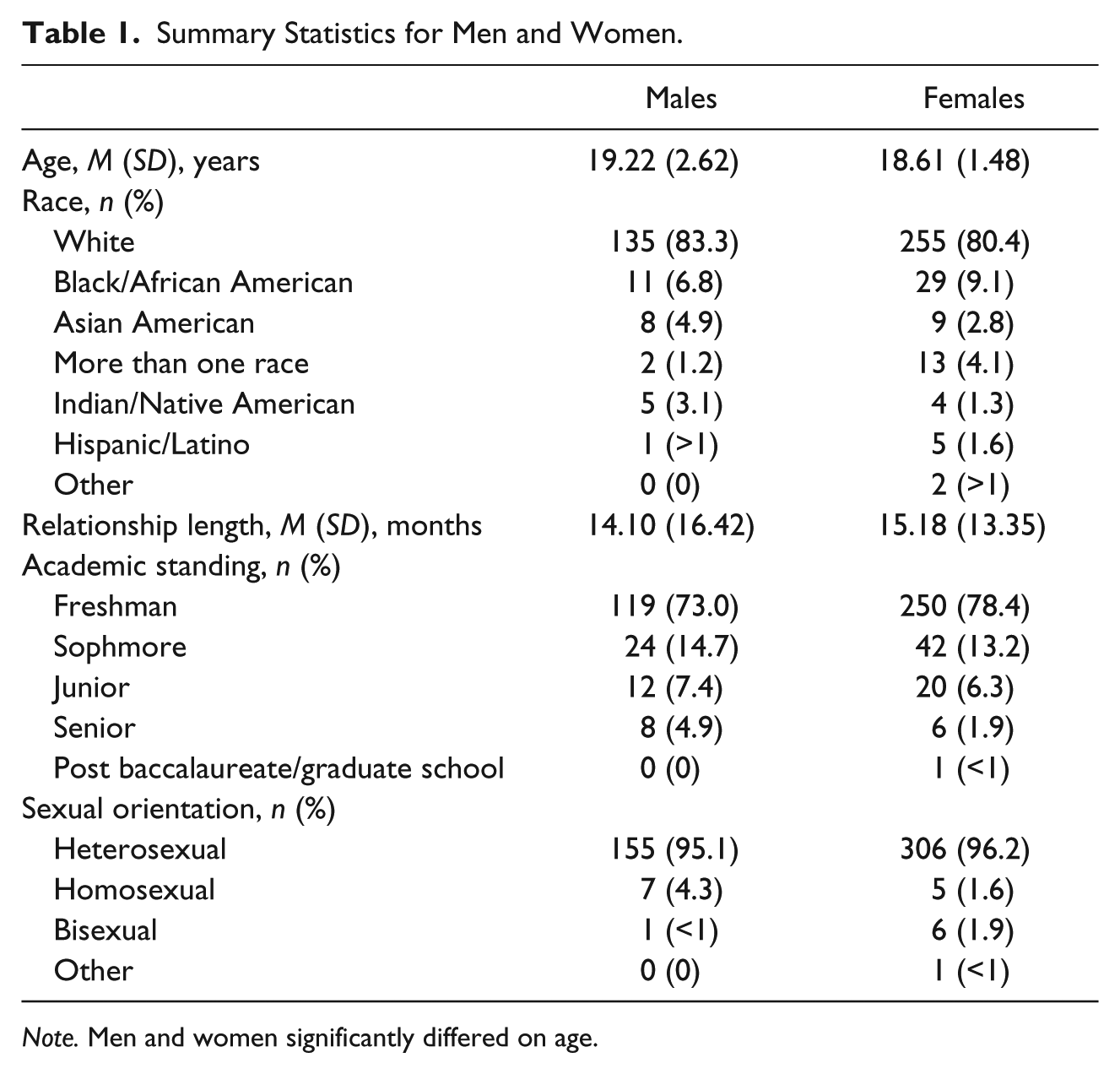
Note. Men and women significantly differed on age.
Results
Raw scores were utilized to calculate the means and standard deviations for DV variables (e.g., physical aggression perpetration and victimization). The overall prevalence of physical violence in the present sample was 29.4%. Chi-square analysis indicated that men (15.4%) and women (19.1%) did not differ significantly on the prevalence of physical violence. Among those who reported perpetrating at least one act of physical violence, analyses indicated that in the year prior to the study, male participants perpetrated a mean of 7.53 (SD = 9.87) acts of physical aggression and were the victims of 7.13 (SD = 7.37) acts of physical aggression. Female participants reported perpetrating a mean of 8.88 (SD = 13.5) acts of physical aggression, and were the victims of 7.81 (SD = 14.8) acts of physical aggression in the year prior to the study. Log transformations were utilized to correct for skewed distributions of all DV variables. The t tests indicated that men and women did not differ significantly on self-reported physical violence victimization and perpetration.
To determine whether there were gender differences on the demographic variables, independent samples t tests were conducted for continuous variables (e.g., age) and chi-square analyses were conducted on dichotomous variables (e.g., race/ethnicity). Findings are presented in Table 1. Analyses indicated that men and women significantly differed on age, t(476) = 2.74, p < .05, such that men were older than women. Men and women did not significantly differ on any other demographic variables.
Findings from the RVS are presented in Table 2. Motives for violence were only examined among those participants who reported at least one act of physical aggression perpetration. The most commonly endorsed motives for perpetrating DV among men were because “it was sexually arousing” (27.06%; SD = 28.67; n = 17), “to prove that you love your partner” (25.88%; SD = 37.43; n = 17), “self-defense” (22.35%; SD = 33.45; n = 17), and “to show feelings that you couldn’t explain in words” (22.35%; SD = 30.73; n = 17). According to the seven broad motive categories proposed by Langhinrichsen-Rohling et al. (2012), the most frequently endorsed motive categories for men were self-defense (22.35%; SD = 33.45; n = 17), communication difficulties (16.08%; SD = 24.43; n = 17), and expression of negative emotions (12.10%; SD = 22.56; n = 17). The most commonly endorsed reasons for perpetrating DV among women were because “it was sexually arousing” (22.35%; SD = 31.21; n = 51), “to show anger” (21.57%; SD = 24.85; n = 51), and “to get your partner’s attention” (19.4%; SD = 26.64; n = 51). The motive categories most frequently reported by women were communication difficulties (16.01%; SD = 23.73; n = 51), self-defense (14.51%; SD = 25.08; n = 51), and jealousy (14.31%; SD = 26.25; n = 51).
Reasons for Dating Violence Perpetration Among College Males and Females.
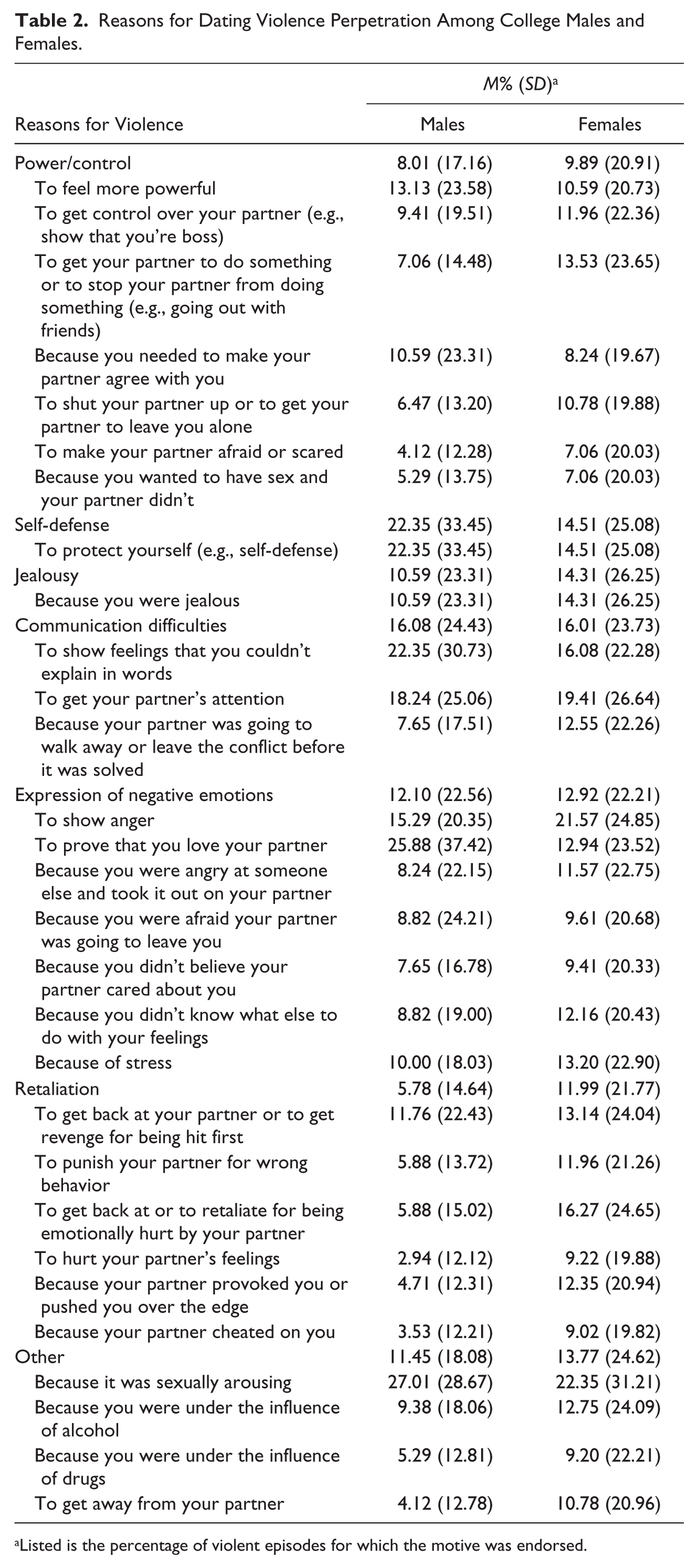
Listed is the percentage of violent episodes for which the motive was endorsed.
To determine whether males and females’ motives for DV were different or similar, seven independent samples t tests were conducted on each motive category. Results indicated that there were no significant gender differences on any of the seven motive categories. The t tests were also used to examine whether motives differed depending on the severity of violence (i.e., minor versus severe), with results demonstrating no significant differences based on violence severity. In addition, t tests were utilized to examine whether within each gender there were differences in endorsement of motive categories for those who engaged in severe physical violence compared with minor to moderate physical violence. Results indicated that there were no significant gender differences on any of the seven motive categories depending on the severity of violence. Analyses of covariance were also conducted to determine whether men and women differed on motives controlling for age. Analyses demonstrated that men and women did not differ on motive categories with age included as a covariate, and age was also not significantly correlated with any motive categories endorsed.
Discussion
The present study sought to further elucidate whether the reasons underlying men and women’s perpetration of physical aggression in dating relationships are similar or different. In an effort to extend and to help clarify inconsistencies in the existing literature regarding motives for DV, the seven broad motive categories proposed by Langhinrichsen-Rohling et al. (2012) were utilized to enable a more direct gender comparison. To our knowledge, this is the first study to directly compare college males’ and females’ reasons for DV using the seven motive categories while also using a larger sample size and a more thorough assessment of motives for physical DV.
Results indicated numerous similarities across genders in self-reported reasons for DV perpetration. First, results from males’ and females’ self-reported motives for DV, including severe DV, indicated gender similarity in all seven broad motive categories. Moreover, although men and women significantly differed on age (i.e., men were older than women), when age was included as a covariate, analyses indicated that men and women did not differ on motive categories. Moreover, the present study found that communication difficulties and self-defense were two of the most frequently endorsed motive categories for both genders. This is consistent with results in a study by Elmquist and colleagues (2014) who found communication difficulties to be a commonly endorsed motive for partner violence among a sample of male and female BIP participants. Therefore, when direct gender comparisons are utilized, men and women often report similar motives for perpetrating DV. The finding from the present study that communication difficulties is a common motivator for physical aggression among college students is in line with previous research that has found poor communication skills to be associated with an increased risk of perpetrating DV (Cornelius, Shorey, & Beebe, 2010; Follingstad, Bradley, Laughlin, & Burke, 1999).
In addition, the finding that males and females did not differ significantly in their endorsement of self-defense as a reason for DV is similar to existing research that has yielded results inconsistent with feminist assumptions regarding violence against partners, namely, that male perpetrators of DV are primarily motivated by power/control and female perpetrators by self-defense. It appears that, at least according to college student participants’ self-reports, both males and females report using self-defense to protect themselves from physical aggression to approximately the same extent. In sum, the results from the present study, in combination with past research (e.g., Shorey et al., 2010), provide support for gender symmetry in many of the motives of DV, and provide results that are inconsistent with feminist theories. Moreover, this examination represents a more careful assessment of different motives for physical DV than previous studies.
Second, as hypothesized, both male and female undergraduates endorsed multiple, different motives, thus underscoring the significant heterogeneity that exists among perpetrators of DV. The variability in self-reported motives that emerged from the current sample is consistent with previous research (e.g., Shorey et al., 2010; Stuart, Moore, Hellmuth, et al., 2006), and highlights the importance of considering this heterogeneity when examining the correlates, predictors, and causes of DV. Specifically, motivations may differ as a function of the context in which the physically aggressive acts occur, although this remains an empirical question for future research to investigate.
In addition, our findings demonstrated that male and female college students endorsed similar individual motives and motive categories. Specifically, the most frequently endorsed individual motives across genders were “because it was sexually arousing.” The elevated frequency of the sexual arousal motive is consistent with previous research finding that sexual arousal was a common motive for DV (Harned, 2001; Shorey et al., 2010). The findings from the present study in conjunction with previous research indicate that college might provide a context in which physical aggression results from a desire to explore sexuality and sexual experiences and achieve heightened sexual arousal (Patrick, Maggs, & Abar, 2007; Shorey et al., 2010). Furthermore, the present study’s replication of previous findings indicate that sexual arousal may be an important motivation that should be targeted in prevention and intervention programs for DV (Shorey et al., 2010).
Limitations and Future Directions
There are a number of limitations that need to be considered when interpreting the findings from this study. First, the sample in the present study largely comprised female undergraduates. However, numerous studies on DV have consistently utilized significantly fewer male participants (e.g., Bell & Naugle, 2007; Perry & Fromuth, 2005; Prospero & Vohra-Gupta, 2008; Shorey et al., 2010). Thus, this investigation contributes to the existing literature by utilizing a larger male sample relative to previous research. Nonetheless, future research utilizing a larger, more balanced gender distribution is needed to further examine the differences and/or similarities in men’s and women’s motives for DV. This would increase statistical power. Moreover, the sample in the present study consisted of primarily White, heterosexual undergraduates, thus limiting the generalizability to more diverse populations. Research that examines motives for DV in a more diverse sample is needed. Third, the present study was cross-sectional, thus precluding a determination of causality among study variables. Future research utilizing prospective assessments of the motives for physical aggression should be conducted. Fourth, assessments of DV and the motives for DV were based on self-reports from one member of the relationship dyad. Research using both members of the relationship dyad and both qualitative and quantitative assessments of the motives of DV is needed. Finally, the present study focused only on physical aggression. Given that psychological aggression occurs in 70% to 90% of dating relationships (Shorey et al., 2008a), future research should examine potential gender differences in motives for psychological aggression in dating relationships.
Implications
The results from the current study have potentially important clinical and treatment implications. Specifically, the motives for DV as reported by both male and female college students should be addressed in violence prevention and intervention programs. For instance, sexual arousal was a motive in 22% of women’s and 27% of men’s violent episodes. This finding in combination with previous research (Harned, 2001; Shorey et al., 2010) indicates that college students may be engaging in risky sexual behaviors that are indicative of DV. Furthermore, research has supported that college is an important development period in which significant changes in sexual behavior occur (Patrick et al., 2007). Thus, prevention programs that increase and promote sexual health could ultimately help decrease the link between sexual arousal and DV (Schulenberg & Maggs, 2002; Turrisi, Jaccard, Taki, Dunnam, & Grimes, 2001).
In addition, results from the RVS suggest that strategies aimed at increasing effective, nonviolent communication and conflict resolution could help reduce DV resulting from ineffective communication and problems with emotional expression. Researchers have suggested the utility and benefit of including strategies that enhance adaptive skills (e.g., problem-solving skills, nonviolent conflict resolution, adaptive communication) in reducing the likelihood of subsequent DV (O’Leary, Woodin, & Fritz, 2006; Shorey, Cornelius, & Bell, 2008b; Shorey et al., 2012). For example, Shorey and colleagues (2012) reviewed the literature on DV prevention programs and suggested that mindfulness-based and dialectical-behavioral interventions could be useful in reducing partner aggression among college students.
Conclusion
In summary, the findings from the present study contribute to the literature on the motives for DV. This is the first study, to our knowledge, that utilized Langhinrichsen-Rohling and colleagues’ (2012) seven broad categories of motives to conduct a direct gender comparison of males’ and females’ motives for DV in a sample of college students. Results demonstrated gender symmetry in all motive categories. Future research is needed to further understand the differences and/or similarities in men’s and women’s motives for DV in different contexts and samples.
Footnotes
Authors’ Note
The content is solely the responsibility of the authors and does not necessarily represent the official views of the National Institute on Alcohol Abuse and Alcoholism (NIAAA) or the National Institutes of Health.
Declaration of Conflicting Interests
The author(s) declared no potential conflicts of interest with respect to the research, authorship, and/or publication of this article.
Funding
The author(s) disclosed receipt of the following financial support for the research, authorship, and/or publication of this article: This work was supported, in part, by Grant K24AA019707 from the National Institute on Alcohol Abuse and Alcoholism (NIAAA) awarded to the last author.