



Abstract
Secondary traumatic stress (STS) is an issue of significant concern among providers who work with survivors of sexual assault. Although STS has been studied in relation to individual-level characteristics of a variety of types of trauma responders, less research has focused specifically on rape crisis centers as environments that might convey risk or protection from STS, and no research to knowledge has modeled setting-level variation in correlates of STS. The current study uses a sample of 164 staff members representing 40 rape crisis centers across a single Midwestern state to investigate the staff member-and agency-level correlates of STS. Results suggest that correlates exist at both levels of analysis. Younger age and greater severity of sexual assault history were statistically significant individual-level predictors of increased STS. Greater frequency of supervision was more strongly related to secondary stress for non-advocates than for advocates. At the setting level, lower levels of supervision and higher client loads agency-wide accounted for unique variance in staff members’ STS. These findings suggest that characteristics of both providers and their settings are important to consider when understanding their STS.
Secondary traumatic stress (STS; that is, symptoms of posttraumatic stress stemming from working or associating with traumatized populations; Figley, 1995) among providers working with survivors of sexual assault is a problem of great importance for agencies attempting to support and retain staff members (see Chouliara, Hutchison, & Karatzias, 2009, for a review). As rape crisis work may afford particular vulnerability for STS, the current study aims to examine potential correlates of STS for rape crisis workers at the individual and setting level.
STS has largely been studied in relation to characteristics of trauma responders. In terms of demographics, younger age has been consistently associated with higher STS in a variety of populations, including sexual assault/domestic violence agency staff (Baird & Jenkins, 2003), sexual assault counselors (Ghahramanlou & Brodbeck, 2000), and sexual assault nurse examiners (Townsend & Campbell, 2009). Fewer studies have examined other demographic characteristics (e.g., race). Also, providers’ personal trauma history has emerged as a relatively consistent predictor of STS (e.g., among social workers working with clients who have experienced sexual assault or domestic violence, Choi, 2011; in sexual assault trauma counselors, Ghahramanlou & Brodbeck, 2000). Finally, different roles may afford different risk for STS: advocates provide direct service in high-stress and crisis situations (e.g., in the hospital during the evidence collection process), whereas other rape crisis staff members may have roles including community education or counseling.
Research has increasingly focused on characteristics of settings that might account for STS in occupants of those settings (e.g., quality of supervision, access to information and resources, and setting culture, Choi, 2011; setting goals, facilities, and cross-program relationships; Townsend & Campbell, 2009). Although significant relationships have emerged, these agency-level variables have exclusively been measured or analyzed as individual-level variables, which raises conceptual and analytic concerns. In addition, variables that have been thus far been studied at the individual level (i.e., client load and degree of support/supervision) might also operate at the setting level. Seeing more clients and working more hours have been positively related to levels of vicarious trauma among sexual assault nurse examiners (Townsend & Campbell, 2009), but a study of advocates found a negative relationship (Baird & Jenkins, 2003). Receiving higher quality supervision has also been associated with lower STS in domestic violence advocates (Slatterly & Goodman, 2009). It may be important to explore how the client load and availability of supervision relates to STS at the setting level in understanding how agencies can mitigate this outcome. In addition, as supervision needs may be different across types of staff members, it may be important to examine for whom the relationship between supervision and STS exists (i.e., role and supervision may interact).
In the current study, we aimed to understand the correlates of STS among rape crisis center staff members at the individual and agency level using multilevel modeling strategies to account for non-independence of nested data. We tested the hypothesis that variation in individual-level STS could be accounted for by both individual- and setting-level predictors.
Method
After receiving approval from our university’s Institutional Review Board, we worked collaboratively with the director of a state sexual assault coalition to recruit participants. The coalition director sent an email to executive directors of member agencies, and with their permission, the coalition director then emailed staff members directly. The recruitment email included a web link to the consent form and the online survey. As a token of appreciation, participants were entered into a lottery for US$50.00. Ultimately, 164 respondents from 40 rape crisis centers across a single Midwestern state volunteered to participate (1-29 respondents per agency; M = 4.1). These centers served a range of geographic areas (39.4% of participants reported serving rural areas, 34.8% reported serving urban areas).
Measures
The survey assessed a range of constructs related to staff members’ work experiences.
Demographics
We asked participants about their gender, race, educational level, and professional role(s) (i.e., administrator, advocate, educator, counselor, volunteer, or other).
Supervision
Participants indicated the frequency in which they were exposed to five types of supervision in their agency using a Likert-type scale format ( 0 = not at all, 1 = daily, 2 = weekly, 3 = monthly, 4 = quarterly, 5 = once/year), which was recoded so that higher numbers represent more supervision. The scale included items regarding formal supervision (e.g., “I receive one-on-one supervision with a supervisor.”) and informal supervision (e.g., “I receive informal peer supervision without a supervisor present.”). We computed the mean score on the five items for each participant and then centered each score by subtracting the sample (grand) mean from participants’ mean scores. We then computed each agency-level mean.
Client load
Client load was assessed with a single, open-ended item: “What is the average number of clients you see for one-on-one intervention in a given week?” We centered each score by subtracting the sample mean and also computed agency-level means.
STS
To assess STS related to rape crisis work, we used a 17-item modified version of the Posttraumatic Checklist–Civilian Version (PCL-C; Weathers, Litz, Herman, Huska, & Keane, 1993), which corresponds to the Diagnostic and Statistical Manual of Mental Disorders (4th ed.; DSM-IV; American Psychiatric Association, 1994) criteria for posttraumatic stress disorder . The instructions read, “think specifically about your work in the field of sexual assault prevention and intervention and the rape victim/survivor cases with which you have assisted” when responding. For example, the PCL-C measure asked participants whether they experienced “Repeated, disturbing memories, thoughts, or images of cases from the past?” in the past month. Due to a clerical error, an incorrect response scale was used: participants responded on a 6-point Likert-type scale: 0 = not at all, 1 = once/year, 2 = quarterly, 3 = monthly, 4 = weekly, 5 = daily. The high correlation of participants’ scores with scores on a measure of depression (r = .69), as well as the distribution of scores across response options (with most participants responding 0 or 1, as expected) strengthen our confidence in the validity of this scale. Responses were summed to create a scale score. In the current sample, Cronbach’s alpha for the scale was .90.
Sexual assault history
Participants’ sexual assault history was assessed using the Sexual Experiences Survey (30 items; Koss, Bachar, & The SES Collaborative, 2004). The measure assesses the number of behaviorally defined instances of sexual coercion and assault since age 14. We created an ordinal variable representing the most severe type of sexual assault experienced, in which non-victims were coded as 0, people who had experienced sexual coercion were coded as 1, and people who had experienced rape were coded as 2.
Analyses
As the data included staff members (individual-level; Level 1) nested in agencies (setting-level; Level 2), we used multilevel modeling in SAS 9.4 to account for dependency in the data and separate variance at the level of the individual and the setting. Because we had complete data on the focal variables from 90 staff members representing 35 rape crisis centers, we used missing data imputation procedures for multilevel data. We present model effects from the imputed data sets and report descriptive and fit statistics from the unimputed data set including missing data (N = 164). Using the unimputed data, we determined that 12% of the variance in STS was at Level 2, intraclass correlation (ICC) = 0.12, suggesting significant between-group variance. We then tested a random slopes model including a within-level interaction term. Our goal was to explore the unique contributions of individual-and setting-level variables to STS.
Results
See Table 1 for descriptive statistics and correlations and Table 2 for model results. The staff member-level model results suggested that a number of variables were statistically significantly associated with STS. In terms of demographics, neither race (B = -0.17, ns) nor role (advocate vs. some other role; B = 0.86, ns) was statistically significantly associated with STS. However, age was inversely related to STS (B = −0.29, p < .01). The main effect for supervision at the individual level was not significant (B = −1.88, ns), but receiving more supervision relative to the other study participants was more strongly associated with lower STS for non-advocates (i.e., those in an educator, administrative, counselor, volunteer, or other role who did not also endorse an advocacy role) than for advocates (B = 3.92, p < .05). In bivariate analyses using non-imputed data, advocates did not differ from non-advocates on their mean supervision frequency, t(152) = 0.70, ns, or their level of STS, t(147) = 0.44, ns. Client load relative to the rest of the sample did not predict STS (B = −0.06, ns). Finally, sexual assault history was associated with statistically significantly higher levels of STS (B = 1.95, p < .01). In the agency-level model results, staff members in agencies with lower agency mean levels of supervision evidenced statistically significantly higher STS (B = −5.95, p < .01), and staff members in agencies with higher agency mean client loads evidenced statistically significantly higher STS (B = 0.60, p < .05).
Descriptive Statistics and Correlations.
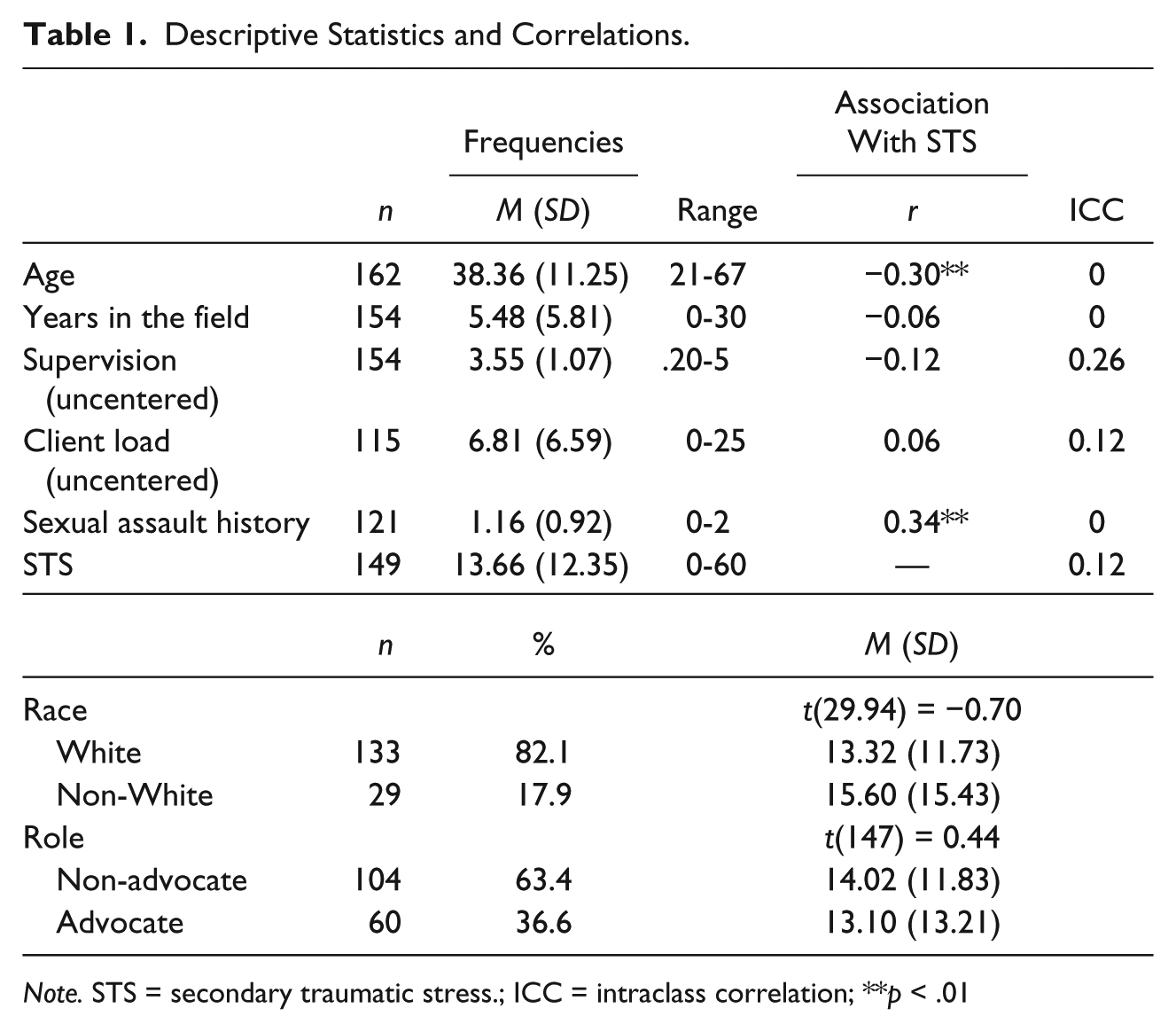
Note. STS = secondary traumatic stress.; ICC = intraclass correlation; **p < .01
Model Results.

Note. AIC = Akaike information criterion.
Referent group for planned contrasts.
p < .05. **p < .01.
Discussion
Addressing STS in rape crisis center staff is essential for the effective provision of services to survivors of sexual assault, and increasing attention is being paid to the ways that agencies can play a role in minimizing its impact. This study extends past findings regarding the correlates of STS to suggest that characteristics of both staff members and their agencies are associated with STS.
Several individual-level variables were related to STS. Consistent with theory and past research, younger staff members experienced more STS than older staff members, and staff members with a history of sexual assault evidenced more STS than staff members without such a history. There were no racial differences in levels of STS. Although there was no main effect for client load or supervision frequency, the relationship between supervision and STS was stronger for non-advocates than it was for advocates. These findings suggest that some, but not all, individual-level variables are associated with STS.
Setting-level variables were also associated with STS. The current study suggests that staff members who worked in settings with less supervision and larger client loads, on average, tended to have higher levels of STS. As these relationships were not significant at the individual level, these findings suggest that agency-level characteristics are associated with STS above and beyond the same variables at the individual level.
Strengths and Limitations
The central strength of this study was our multilevel approach. Our collection of data from many settings and our use of multilevel modeling allowed us to look at both individual and contextual contributors to variance in STS, which helped us to clarify the multilevel nature of the phenomenon. In doing so, we were able to avoid assuming properties of settings from properties of people in those settings. However, this study also had limitations. First, we are unable to assert causality due to the cross-sectional nature of our design. Future research could attempt to establish the causal direction of the relationships we identified with a longitudinal design. Second, we had missing data on some key variables. The consistency of our findings between our raw and imputed data sets strengthens our confidence in our findings. Third, although there was a clerical error in our measure of STS, its association with depression and the consistency of our overall pattern of results with past research strengthen our confidence that it is a valid measure in spite of the error.
Implications and Future Directions
These findings suggest that rape crisis centers may be able to take steps to mitigate STS in their staff members. First, with regard to characteristics of staff members, they should be particularly conscious of the effects of trauma work on their young staff members and those with a trauma history and build in opportunities for these staff members to get support. Future research could attempt to explore whether coping with traumatic stress might serve as a motivator to enter into rape crisis work and the role that this work plays in exacerbating and possible mitigating symptoms over time. Second, offering greater supervision to all staff members or being conscious of the meta-communication of high agency-wide client loads might protect against STS. However, it is important to note that causal inferences cannot be drawn about these relationships: It is possible that high levels of STS in staff members interfere with their ability to provide or attend regular supervision or lead them to take on more clients than they can handle. Finally, centers should consider ways in which advocates’ roles might require different or more intensive supervision than for other staff members. Although the current study cannot speak to this possibility, this could be an avenue of investigation for future research.
Footnotes
Acknowledgements
The authors would like to thank the state sexual assault coalition director who assisted with recruitment as well as the rape crisis center staff members who participated in this study.
Declaration of Conflicting Interests
The author(s) declared no potential conflicts of interest with respect to the research, authorship, and/or publication of this article.
Funding
The author(s) received no financial support for the research, authorship, and/or publication of this article.