



Abstract
This study aims to examine the psychopathological profile of non-homicidal sexual offenders (NHSOs) and homicidal sexual offenders (HSOs). Using an incarcerated sample of 96 NHSOs and 74 HSOs in a federal penitentiary in Canada, these offenders are compared in terms of their offending process, maladaptive personality traits, and paraphilic behaviors. A number of cross-tabular and sequential logistic regression analyses are performed. Relative to their counterpart, findings indicate that a higher percentage of HSOs select a victim of choice, report deviant sexual fantasies, mutilate their victim, and admit to their offense upon apprehension, whereas a higher percentage of NHSOs select victims with distinctive characteristics. In addition, a higher percentage of HSOs manifest paranoid, schizotypal, borderline, histrionic, narcissistic, obsessive-compulsive, and impulsive personality traits, and overall odd and eccentric personality traits compared with NHSOs. Similarly, a higher percentage of HSOs engage in exhibitionism, fetishism, frotteurism, homosexual pedophilia, sexual masochism, and partialism compared with NHSO. These findings are discussed with their implications for offender profiling.
Keywords
Introduction
Individuals with psychiatric disorders are significantly overrepresented among violent offenders (Laajasalo, Ylipekka, & Hakkanen-Nyholm, 2013), especially those who perpetrate violent sexual offenses (e.g., aggravated sexual assault and sexual murder; Chan & Heide, 2009). Personality disorders (PDs) and paraphilias, specifically, are highly prevalent among violent sexual offenders (e.g., Briken, Hill, Habermann, Kafka, & Berner, 2010; Chan, Beauregard, & Myers, 2015; Khachatryan, Heide, Hummel, & Chan, 2016; Koch, Berner, Hill, & Briken, 2011; Myers, 2002; Myers, Chan, & Mariano, 2016; Myers, Chan, Vo, & Lazarou, 2009). Although different studies have examined PDs and paraphilias among sexual offenders, research focusing on those who perpetrate violent sexual offenses is arguably not well-documented.
Within the last decade, only a handful of studies have attempted to empirically explore the prevalence and dynamics of personality and/or paraphilia disorders among violent sexual offenders who killed and those who did not kill, independently (e.g., Beauregard, Deslauriers-Varin, & St-Yves, 2010; Briken, Habermann, Kafka, Berner, & Hill, 2006; Briken et al., 2010; Hill, Habermann, Berner, & Briken, 2007; Rigonatti, de Padua Serafim, de Freitas Caires, Guerra Vieira Filho, & Arboleda-Florez, 2006). To our knowledge, only two studies have looked specifically at differences and similarities between homicidal sexual offenders (HSOs) and non-homicidal sexual offenders (NHSOs; Koch et al., 2011; Proulx & Sauvêtre, 2007). Clearly, more comparative analyses are needed to better understand the processes and mechanisms leading some sexual offenders to kill their victims.
Importantly, influences of different maladaptive personality traits and paraphilic behaviors on the sexual offenders’ decision making during their offending process have largely been neglected by researchers. Notably, burgeoning evidence demonstrate that personality traits are relatively consistent with thinking patterns, feelings, and subsequent behaving manifested by individuals, especially in relation to antisocial behavior (Jones, Miller, & Lynam, 2011; Miller & Lynam, 2001). Similarly, the effects of paraphilic behaviors on the sexual offenders’ decision making during their offenses are well acknowledged (Beauregard & Leclerc, 2007; Beauregard, Proulx, Rossmo, Leclerc, & Allaire, 2007; Chan & Heide, 2009). Paraphilias are found to have a strong correlation with deviant sexual fantasy (Chan & Heide, 2009), and most paraphilias are associated with offenses that are sexual in nature (Hickey, 2012). For instance, sex offenders who enjoy sexually sadistic fantasies to obtain sexual gratification are likely to proceed with the actual sadistic acts on their victim when the fantasies are no longer arousing and/or satisfying. Research on deviant sexual fantasies shows that its principal role is to influence, induce, or motivate violent and/or deviant sexual conducts (Beauregard, Lussier, & Proulx, 2004; Beech, Fisher, & Ward, 2005; Hickey, 2012; Prentky et al., 1989) and subsequent decisions made during the offending process (e.g., Beauregard, Lussier, & Proulx, 2005; Chan & Beauregard, 2016; Chan & Frei, 2013; Chan, Frei, & Myers, 2013; Chan & Heide, 2008; Chan, Heide, & Myers, 2013; Chan, Myers, & Heide, 2010; Maniglio, 2010; Meloy, 2000; Myers & Chan, 2012; Myers, Husted, Safarik, & O’Toole, 2006; Schlesinger, Kassen, Mesa, & Pinizzotto, 2010; A. Stein, 2004). Chan, Heide, and Beauregard (2011) have recently developed a theoretical model to explain how a person becomes motivated to sexually kill, decide to sexually kill, and act on that desire, intention, and opportunity. In this model, deviant sex fantasy plays a major role in influencing the individual to actualize his fantasy in real life (Chan et al., 2011).
Given the important influence of maladaptive personality traits and paraphilic behaviors on subsequent behavioral manifestations during the offending process, such relationships are important to explore. Moreover, such information may prove useful to police officers responsible for sexual crime investigations. For example, sexual offenders with certain types of personality or who engage in certain paraphilic behaviors may carry out their offense in a certain way (e.g., to use physical restraint against the victim, to mutilate the victim, and to be forensically aware) that is likely to reflect their own personality and other psychological preferences. Therefore, in conjunction with the availability of crime scene evidence, being able to understand the effects of maladaptive personality traits and paraphilic behaviors on different sex offending stages may help the police to prioritize their list of suspects. Therefore, this research effort is undertaken with two primary purposes: (a) to examine the differences between NHSOs and HSOs in their offending process, traits of PDs, and paraphilic behaviors and (b) to distinguish the effects of maladaptive personality traits and paraphilic behaviors in homicidal and non-homicidal sexual offending.
Literature Review
PDs and Paraphilias Among NHSOs and HSOs
Prevalence of PDs
Numerous studies have documented a relationship between PDs and paraphilias and sexual offending (e.g., Ahmmeyer, Kleinsasser, Stoner, & Retzlaff, 2003; Bogaerts, Daalder, Vanheule, Desmet, & Leeuw, 2008; Leue, Borchard, & Hoyer, 2004; Smallbone & Wortley, 2004). Specifically, the prevalence of PDs in the criminal offender population has been estimated to be between one third and two third of the forensic population (Berger, Berner, Bolterauer, Guitierrez, & Berger, 1999; Berner, Berger, Guitierrez, Jordan, & Berger, 1992). Studies show that schizotypal, antisocial, borderline, and narcissistic PDs are frequently identified among sexual offenders, contributing to the disinhibition of their behavior (Leue et al., 2004; Rigonatti et al., 2006). Other PDs such as avoidant, dependent, obsessive-compulsive, and passive-aggressive PDs have also been found in sexual offender population (Cohen & Galynker, 2002; McElroy et al., 1999). However, a recent study found that there is no clear evidence that sexual offenders present typical and dominant PDs (Bogaerts, Declercq, Vanheule, & Palmans, 2005).
Among those who perpetrate the most violent type of sexual offenses (i.e., sexual murderers), prevalence rates of PD diagnoses are relatively high. According to Chan and Heide (2009), antisocial PD is the most commonly diagnosed in sexual murderers, estimates varying from 27% to 81% (Chan et al., 2015; Firestone, Bradford, Greenberg, & Larose, 1998; Firestone, Bradford, Greenberg, Larose, & Curry, 1998; Folino, 2000; Hill et al., 2007; Langevin, 2003; Stone, 2001). Moreover, other personality disturbance traits of narcissistic, borderline, schizoid, and schizotypal PDs were also diagnosed in sexual murderers (Chan & Heide, 2009; Chan et al., 2015; Hill, Habermann, Berner, & Briken, 2006; Myers & Blashfield, 1997; Stone, 2001).
Prevalence of paraphilias
Paraphilias are also prominent in the sexual offender population. In general, paraphilias are psychiatric disorders of unconventional or abnormal sexual behavior (Rosler & Witztum, 2000). Although the prevalence estimates of participating in some form of paraphilic behavior lies between 5% and 30% in the general population (Agnew, 2001; Dunsieth et al., 2004), not all sexual offenders are diagnosed with a paraphilia (Bogaerts et al., 2008). For those who are paraphiliacs, multiple paraphilias are reported (Abel, Becker, Cunningham-Rathner, Mittelman, & Roleau, 1988). Prevalence rates of paraphilias among sexual offenders varied from 58% to 98% (Jackson & Richards, 2007; McElroy et al., 1999), with pedophilia and sexual sadism being the two most prevalent paraphilias identified in the sex offender population (Berner, Berger, & Hill, 2003; Chan & Heide, 2009; Jackson & Richards, 2007; McElroy et al., 1999; Myers et al., 2009).
Paraphilias have been associated with the killing of the victim in sexual assaults. Sexual sadism is the most frequently reported paraphilia in sexual murderers (Chan & Heide, 2009; Healey, Lussier, & Beauregard, 2013), with prevalence rates varying from 37% to as high as 89% (Briken et al., 2010; Firestone, Bradford, Greenberg, & Larose, 1998; Firestone, Bradford, Greenberg, Larose, & Curry, 1998; Hill et al., 2007; Langevin, 2003; Myers et al., 2009; Stone, 2001). Langevin (2003) argued that a large majority of HSOs engage in multiple paraphilic behaviors (e.g., fetishism, tranvestism, exhibitionism, and voyeurism). A number of paraphilias are commonly associated with sexual murder, such as mutilations of body parts and necrophilia (Beauregard & Martineau, 2013; Chan & Heide, 2009; Chan et al., 2015; M. L. Stein, Schlesinger, & Pinizzotto, 2010).
Differences Between NHSOs and HSOs: What We Know
Although only a few comparative studies have been conducted to date, reasonable evidence exists supporting the fact that HSOs present, to some extent, a different psychopathological profile compared with NHSOs. This is particularly true in their manifestation of personality disturbance traits and paraphilic behaviors. Almost all studies report that the prevalence rate of PDs is greater in HSOs as compared with the NHSOs. The diagnostic rates of at least one PD among HSOs vary from 52% to 83%, whereas they only range from 4% to 58% for NHSOs (Firestone, Bradford, Greenberg, & Larose, 1998; Firestone, Bradford, Greenberg, Larose, & Curry, 1998; Koch et al., 2011; Langevin, Ben-Aron, Wright, Marchese, & Handy, 1988). Of all the PDs, antisocial is the most prevalent among both HSOs and NHSOs, while being diagnosed significantly more often in HSOs (from 24% to 51%) than in NHSOs (from 0% to 41%; Firestone, Bradford, Greenberg, & Larose, 1998; Firestone, Bradford, Greenberg, Larose, & Curry, 1998; Koch et al., 2011; Langevin, 2003; Oliver, Beech, Fisher, & Beckett, 2007).
Paraphilias are also more prevalent among HSOs than NHSOs. For HSOs, the diagnostic rates of at least one paraphilia vary from 52% to 82%, whereas the rates for NHSOs only ranged from 24% to 43% (Firestone, Bradford, Greenberg, & Larose, 1998; Firestone, Bradford, Greenberg, Larose, & Curry, 1998; Koch et al., 2011). The most common paraphilia diagnosed among HSOs is sexual sadism, followed by pedophilia (Briken et al., 2006; Firestone, Bradford, Greenberg, & Larose, 1998; Firestone, Bradford, Greenberg, Larose, & Curry, 1998; Koch et al., 2011; Langevin et al., 1988).
The current study examines the differences in maladaptive personality traits and paraphilic behaviors in a sample of HSOs and NHSOs. In this study, the terms HSOs and NHSOs are referred to the types of offense committed, in which whether the sex offenders killed or did not kill their victim. Consistent with previous findings, HSOs are expected to present a higher prevalence rate in maladaptive personality traits and paraphilic behaviors than the NHSOs. In addition, this study aims to examine the effects of maladaptive personality traits and paraphilic behaviors on the decision making of sexual offenders during the offending process. Based on the knowledge produced by previous studies, four different research hypotheses are derived:
Method
Sample and Procedure
The data used in this study were collected from a sample of male sexual offenders who were incarcerated in a Correctional Service of Canada institution (for a minimum sentence of 2 years) in the province of Quebec between 1998 and 2005. From the total sample of 624 sex offenders, the current study only included the 170 violent sexual offenders who physically injured and/or killed their victim. Sexual offenders were categorized into two groups based on the outcome of their offense: (a) NHSOs (i.e., convicted of an aggravated sexual assault with a weapon and/or with injuries to the victim) and (b) HSOs (i.e., convicted of a murder that was sexually motivated). Each offender was individually interviewed in a private office without the presence of correctional staff and other inmates. The offenders were assured that their responses would remain confidential and would not be used in any way against them by the Correctional Service of Canada. No monetary reward or other benefits (e.g., sentence reduction) were given, and their participation in this study was completely voluntary.
Information obtained through interview was then codified using the Computerized Questionnaire for Sexual Aggressors (CQSA; Proulx, St-Yves, & McKibben, 1994), which was compiled by a criminologist and a psychologist following a semi-structured interview. All interviewers, psychologists, and criminologists who actively participated in the data collection were all blind to the purpose of the study. The questionnaire included variables related to pre-crime, crime, and post-crime phases, and psychological characteristics of the offenders. In addition to information collected during semi-structured interviews, police records, victim statements (where applicable), and institutional case files were also reviewed to determine details about the offenders’ criminal activities. In cases of discrepancies between self-reported interview data and official data, the latter were used. Inter-rater reliability was measured by using 16 interviewers codified jointly by two raters with consultation of the official documentation. Ratings were conducted independently following these interviews, which were completed by one interviewer in the presence of the other. The mean kappa was 0.87, which was regarded as a strong inter-rater reliability.
Variables
Diagnoses of PDs and paraphilias were established through a professional psychological assessment according to Diagnostic and Statistical Manual of Mental Disorders (4th ed.; DSM-IV; American Psychiatric Association, 1994) criteria. A number of offense (i.e., pre-crime, crime, and post-crime) factors were also examined.
Maladaptive personality traits
Maladaptive personality traits (i.e., with at least two identifying criteria for each diagnosis), rather than a full-blown diagnosis, are considered in this study. A dichotomous outcome (0 = absence, 1 = presence of some features) for each maladaptive personality type was categorized. 1 Maladaptive personality traits tested are as follows: paranoid, schizoid, and schizotypal (odd or eccentric); antisocial, borderline, histrionic, and narcissistic (dramatic, emotional, or erratic); avoidant, dependent, and obsessive-compulsive (anxious or fearful); and passive-aggressive and impulsive (PDs not otherwise specified). In addition, two personality clusters are identified upon a two-step cluster analysis on seven selected personality variables (for details, see Beauregard et al., 2010): Cluster 1—Extroverted personality—corresponds to a personality profile characterized by antisocial, borderline, narcissistic, and impulsive PDs, and Cluster 2—Introverted personality—corresponds to a personality profile characterized by avoidant, dependent, and passive-aggressive PDs.
Paraphilias
With regards to the offenders’ paraphilia diagnoses, a similar identifying criteria is used to identify their manifestation of paraphilic behaviors (0 = absence, 1 = presence of some features). Paraphilias 2 examined in this study are exhibitionism, fetishism, frotteurism, heterosexual and homosexual pedophilias, sexual masochism and sadism, voyeurism, and partialism.
Offending behaviors
Eleven dichotomous variables (0 = no, 1 = yes) are identified for pre-crime (victim selection), and crime and post-crime (victim perpetration) phases. The victim selection variables are as follows: (a) premeditation of the offense, (b) selection of victim of choice who meets the offender’s needs (e.g., the offender selected a victim who meets his psychological, sexual, and/or social needs for sexual intimacy to satisfy his deviant sexual fantasy), (c) selection of victim with distinctive physical and/or personality characteristics 3 (e.g., the victim’s hair length, height, or dressing for physical characteristics; and the victim appeared to be vulnerable, scared, friendly, or good-mannered for personality characteristics), (d) offender is a non-stranger to the victim, (e) presence of deviant sexual fantasies 48 hr prior to the offense, and (f) use of a coercive approach with the victim. Variables identified for the victim perpetration phase are as follows: the offender (a) used a weapon during the offense, (b) used physical restraint against the victim during the offense (e.g., gagging, binding), (c) was likely to be arrested during the offense, (d) admitted to the damages caused to the victim upon apprehension, and (e) mutilated the victim during the offense.
Overall, nearly 57% of the sample is incarcerated for a sexual assault with physical injuries whereas the remaining offenders killed their victim (refer to Table 1). The mean age of the sexual offenders is 33.76 years (SD = 9.97; range between 18 and 59), and there is no significant difference between the HSOs and the NHSOs (M = 34.08, SD = 9.21 for NHSOs and M = 33.32, SD = 10.95 for HSOs). A large majority of the offenders are Caucasians (87%) who were single at the time of offense (62%).
Variables of Non-Homicidal and Homicidal Sexual Offenders.

As to victim demographics, most of them are females (87%) and Caucasian (93%). The victims are younger than the offenders (M = 26.56, SD = 14.17), with about 68% of them being adults. Similar to the offenders’ age, no significant age difference is found in cases of NHSOs (M = 25.31, SD = 12.43) and of HSOs (M = 28.18, SD = 16.08).
Analytical Strategy
Cross-tabular analyses are performed using SPSS 20.0 to compare the victim selection and perpetration phases, traits of PDs, and paraphilic behaviors of HSOs and NHSOs. Measure of association (phi coefficient) is used to investigate the strength of the relationships and, more importantly, to look for meaningful patterns. In accordance to Cohen’s standards for cross-tabular effect size interpretation, the effect size of 0.16 and below is considered weak, between 0.17 and 0.28 as moderate, and 0.29 and above is regarded as strong (Gravetter & Wallnau, 2008).
Subsequently, using SPSS 20.0, a sequential logistic regression approach is used to examine the differential effects of traits of PDs and paraphilic behaviors on the offending behaviors for different crime phases, while controlling for the outcome of the sexual assault (i.e., the survival or death of the victim; 0 = the victim survived, 1 = the victim is dead). It should be noted that when conducting multiple statistical tests in a model, the significance of findings by chance is possible. Odds ratios (ORs) in the logistic models are used to explain the probabilities for an event to occur. In this study, adjusted ORs are computed (exp(B) − 1 × 100 = adjusted ORs) to report the percentage change in odds for statistically significant effects. Percentages are used to explicate the ORs (OR − 1 × 100%).
Results
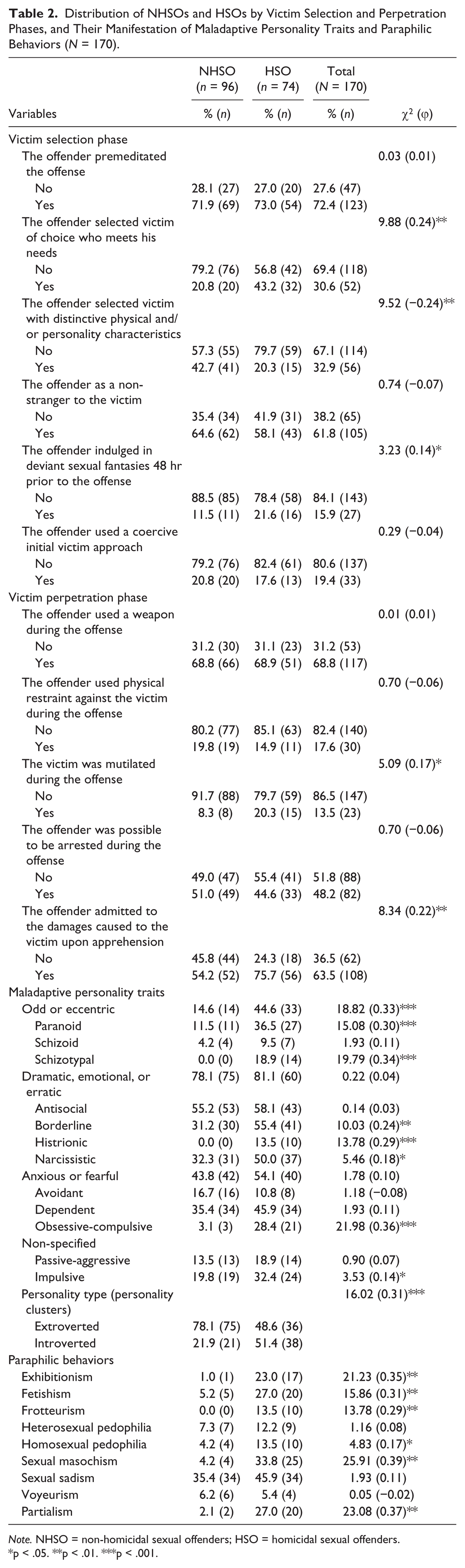
As shown in Table 2, three victim selection (pre-crime) phase variables present significant differences between NHSOs and HSOs. A higher percentage of HSOs (43%) select victims of their choice compared with the NHSOs (21%; χ2 = 9.88, p < .01). The effect size of this relationship is moderate (ϕ = 0.24). However, a significantly higher percentage of NHSOs (43%) hunt for victims with distinctive physical and/or personality characteristics than HSOs (20%; χ2 = 9.52, p < .01). The strength of this relationship is also moderate (ϕ = 0.24). Interestingly, a significantly higher percentage of HSOs (22%) compared with NHSOs (12%) report deviant sexual fantasies 48 hr prior to their actual offense (χ2 = 3.23, p < .05). However, the strength of this relationship is only approaching the moderate level (ϕ = 0.14).
Distribution of NHSOs and HSOs by Victim Selection and Perpetration Phases, and Their Manifestation of Maladaptive Personality Traits and Paraphilic Behaviors (N = 170).
Note. NHSO = non-homicidal sexual offenders; HSO = homicidal sexual offenders.
p < .05. **p < .01. ***p < .001.
Table 2 reveals that only two victim perpetration (crime and post-crime) phase variables significantly distinguish NHSOs and HSOs. Findings show that HSOs (20%) are more likely to mutilate the victim compared with NHSOs (8%; χ2 = 5.09, p < .05), and remarkably, HSOs are also more likely to admit to the damages they have caused to their victim (76%) compared with the NHSOs (54%; χ2 = 8.34, p < .01). The strength of both of these relationships is moderate (respectively, ϕ = 0.17 and ϕ = 0.22).
Significant differences in the manifestation of maladaptive personality traits are observed between NHSOs and HSOs, as indicated in Table 2. HSOs present a significantly higher percentage than NHSOs of paranoid (37% vs. 12%; χ2 = 15.08, p < .001) and schizotypal (19% vs. 0%; χ2 = 19.79, p < .001) personality traits. Overall, 45% of HSOs, compared with only 15% of NHSOs, present odd or eccentric personality traits (χ2 = 18.82, p < .001). It is important to note that the effect size of these relationships is considerably strong (ϕ = 0.30, 0.34, and 0.33, respectively). Similarly, a significantly higher percentage of HSOs compared with NHSOs present dramatic, emotional, or erratic PD traits. Moreover, HSOs present a significantly higher percentage than NHSOs of borderline (55% vs. 31%; χ2 = 10.03, p < .01), histrionic (14% vs. 0%; χ2 = 13.78, p < .001), and narcissistic (50% vs. 32%; χ2 = 13.78, p < .001) personality traits. The strength of these relationships is moderate to strong (ϕ = 0.24, 0.29, and 0.18, respectively).
With regards to anxious or fearful PD traits, only one significant difference—but with a strong effect size (ϕ = 0.36)—between the two offender groups is observed (χ2 = 21.98, p < .001), HSOs (28%) being more likely than NHSOs (3%) to present obsessive-compulsive personality traits. Likewise, a significantly higher percentage of HSOs (32%) present impulsive personality traits compared with NHSOs (20%; χ2 = 3.53, p < .05). However, the effect size is rather weak (ϕ = 0.14). Using a compound measure of personality, findings show that NHSOs are more likely to be extroverted (78%) whereas HSOs are slightly more likely to be introverted (51%). This difference is significant (χ2 = 16.02, p < .001), and the strength is strong (ϕ = 0.31).
As shown in Table 2, significant differences between NHSOs and HSOs are found for many types of paraphilic behaviors. In general, HSOs manifest more paraphilic behaviors than the NHSOs. This is particularly true for exhibitionism (23% vs. 1%; χ2 = 21.23, p < .001), fetishism (27% vs. 5%; χ2 = 15.86, p < .001), frotteurism (14% vs. 0%; χ2 = 13.78, p < .001), homosexual pedophilia (14% vs. 4%; χ2 = 4.83, p < .05), sexual masochism (34% vs. 4%; χ2 = 25.91, p < .001), and partialism (27% vs. 2%; χ2 = 23.08, p < .001). With the exception of homosexual pedophilia (ϕ = 0.17), the strength of the other significant relationships is rather strong (ϕ = 0.29 to 0.39).
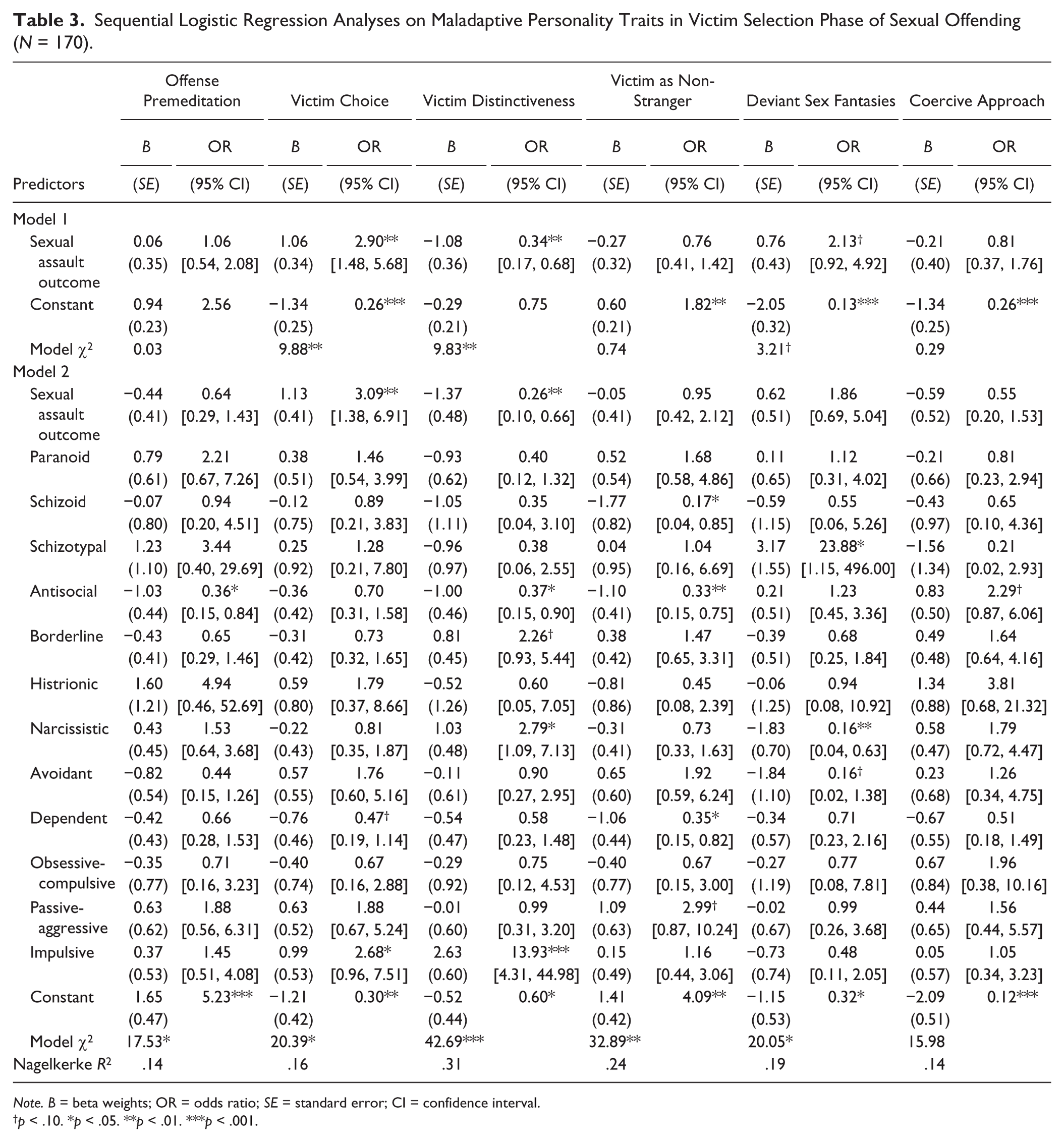
Table 3 presents the significant regression findings of the different maladaptive personality traits on four victim selection phase variables, while controlling for the offense outcome (i.e., victim injured vs. victim killed): offense premeditation (χ2 = 17.53, p < .05), choice of victim (χ2 = 20.39, p < .05), victim selection with distinctive physical and/or personality characteristics (χ2 = 42.69, p < .001), selection of non-stranger victim (χ2 = 32.89, p < .01), and the offender’s deviant sexual fantasies (χ2 = 20.05, p < .05). The sexual assault outcome was only found to have a significant effect on choice of victim (χ2 = 9.88, p < .01) and victim selection with distinctive characteristics (χ2 = 9.83, p < .01). While controlling for the effect of the sexual assault outcome in Model 2, a number of significant effects of maladaptive personality traits on the sex offender’s victim selection phase emerge. The odds of searching victims with distinctive characteristics increase by 1,293% and 179%, when the offenders present impulsive and narcissistic personality traits. However, such odds decrease by 63% for those who present antisocial personality traits. In addition, the odds of hunting for victims of choice increase by 168% when the sex offenders present impulsive personality traits. For the offenders who present schizoid, antisocial, and dependent personality traits, the odds of selecting non-stranger victims decrease by 83%, 67%, and 65%, respectively. Remarkably, a one-unit increase in having schizotypal personality traits increases by 2,288% the odds of the offenders reporting deviant sexual fantasies 48 hr prior to the offense. However, such odds decrease by 84% for those who present narcissistic personality traits. Finally, every one-unit increase in presenting antisocial personality traits results in the offenders’ premeditation to decrease by 64%. Interestingly, the sexual assault outcome remains significant for victim choice and victim distinctiveness, suggesting that HSOs are more likely to select a victim but not with specific characteristics.
Sequential Logistic Regression Analyses on Maladaptive Personality Traits in Victim Selection Phase of Sexual Offending (N = 170).
Note. B = beta weights; OR = odds ratio; SE = standard error; CI = confidence interval.
p < .10. *p < .05. **p < .01. ***p < .001.
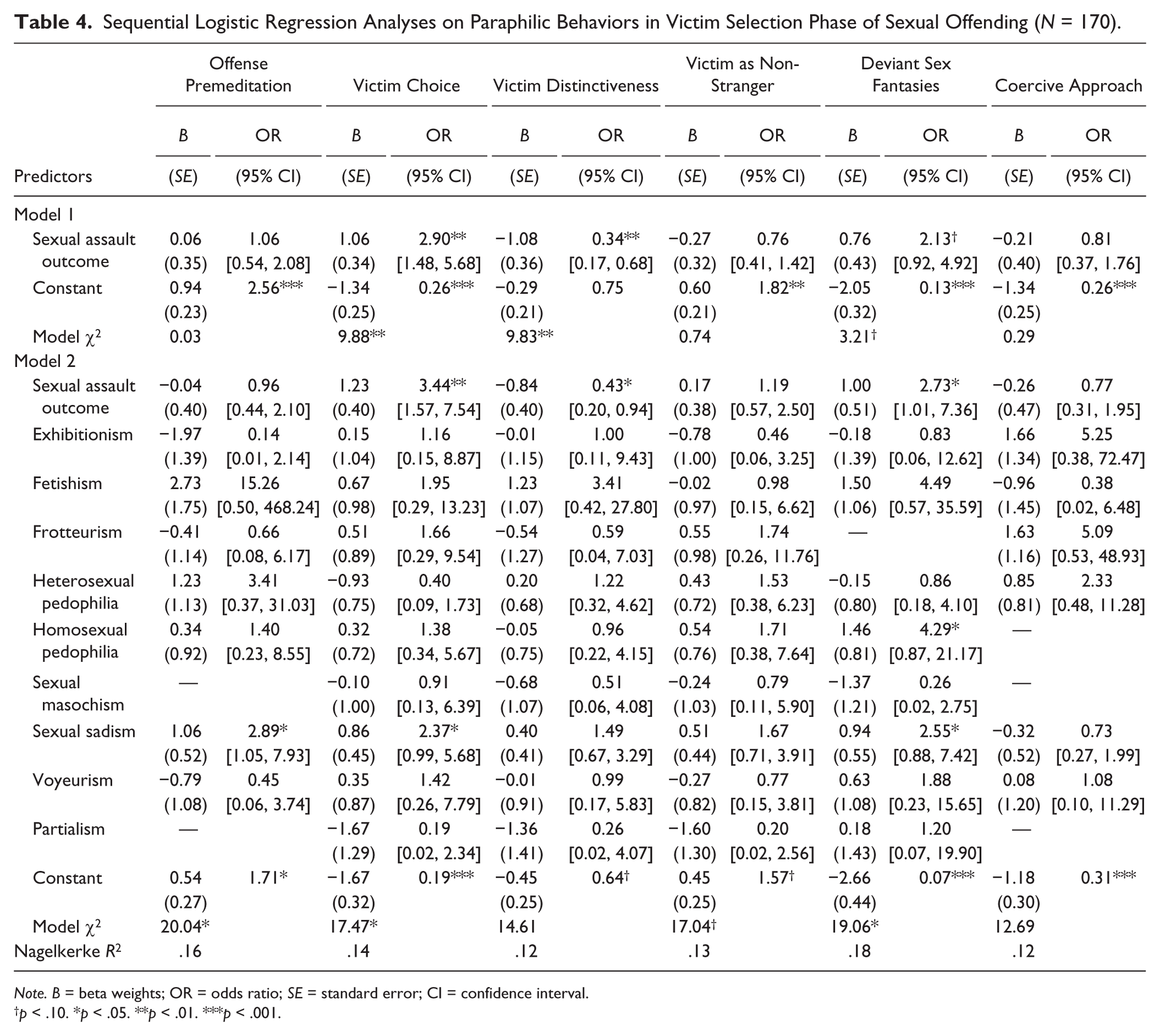
As shown in Table 4, paraphilic behaviors only have significant effects on the offense premeditation (χ2 = 20.04, p < .05), choice of victim (χ2 = 17.47, p < .05), and the offender’s deviant sexual fantasies (χ2 = 19.06, p < .05), after controlling for the sexual assault outcome. When the offenders engage in sexual sadistic behaviors, the odds that the offenders premeditate the offense, engage in deviant sexual fantasies 48 hr prior to the offense, and hunt for victim of choice increase by 189%, 155%, and 137%, respectively. In addition, with every one-unit increase in engaging in homosexual pedophilic behaviors, the odds of reporting deviant sexual fantasies 48 hr prior to the offense increase by 329%. Similar to the findings with PDs, the sexual assault outcome presents a significant impact on victim selection and victim distinctiveness. However, an additional significant relationship is observed with the presence of deviant sexual fantasies, suggesting that HSOs are more likely to report deviant sexual fantasies compared with NHSOs. More importantly, this relationship remains significant when adding the different paraphilic behaviors.
Sequential Logistic Regression Analyses on Paraphilic Behaviors in Victim Selection Phase of Sexual Offending (N = 170).
Note. B = beta weights; OR = odds ratio; SE = standard error; CI = confidence interval.
p < .10. *p < .05. **p < .01. ***p < .001.
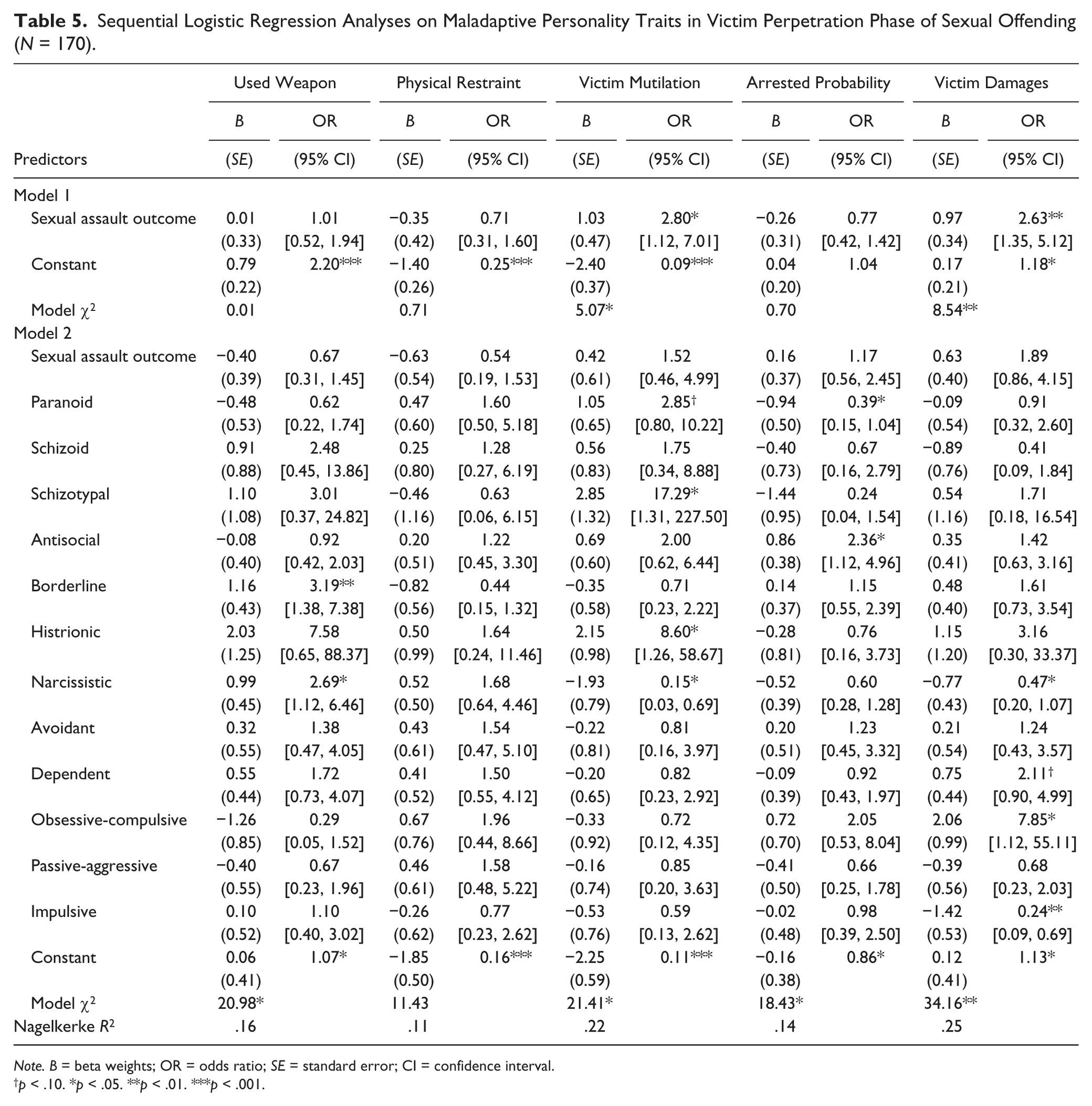
As to the effects of maladaptive personality traits on variables of victim perpetration phase, Table 5 shows four significant models: “…(χ2 = 20.98, p < .05 for weapon being used; χ2 = 21.41, p < .05 for victim mutilation; χ2 = 18.43, p < .05 for likely to be arrested; and χ2 = 34.16, p < .01 for admission to victim damages)” by removing “χ2 = 54.12.The sexual assault outcome presents a significant effect only on victim mutilation (χ2 = 5.07, p < .05) and admission to victim damages (χ2 = 8.54, p < .01), suggesting that HSOs are more likely to inflict mutilations to their victims and to admit to the damages caused to their victims upon apprehension compared with the NHSOs. However, it is interesting to note that these two significant relationships do not remain significant when including the different PDs. While controlling for the effect of the sexual assault outcome, several significant effects of maladaptive personality traits on the sex offender’s victim perpetration phase are found. The odds of the offenders admitting to the damages caused to the victims increase by 685%, with the presence of obsessive-compulsive personality traits. However, such odds decrease by 76% and 53% for those who present impulsive and narcissistic personality traits, respectively. The odds of the victim being mutilated during the offense increase by 1,629% and 760% when the offenders present traits of schizotypal and histrionic PDs, respectively; while such odds reduce by 85% for narcissistic offenders. In addition, a one-unit increase in the presence of borderline and narcissistic personality traits causes the odds of the offenders using a weapon to increase by 219% and 169%, respectively. Finally, the odds of being arrested during the offense increase by 136% when the offenders present antisocial personality traits. In contrast, these odds decrease by 61% for those who present paranoid personality traits.
Sequential Logistic Regression Analyses on Maladaptive Personality Traits in Victim Perpetration Phase of Sexual Offending (N = 170).
Note. B = beta weights; OR = odds ratio; SE = standard error; CI = confidence interval.
p < .10. *p < .05. **p < .01. ***p < .001.
Significant effects of paraphilic behaviors, after controlling for the sexual assault outcome, can be observed in Table 6 for two perpetration phase variables (χ2 = 15.12, p < .05 for physical restraint used and χ2 = 22.28, p < .05 for victim mutilation). It is noteworthy that for the offenders who present sexual sadistic behaviors, the odds of using physical restraint against their victim and to mutilate their victim increase by 184% and 489%, respectively.
Sequential Logistic Regression Analyses on Paraphilic Behaviors in Victim Perpetration Phase of Sexual Offending (N = 170).
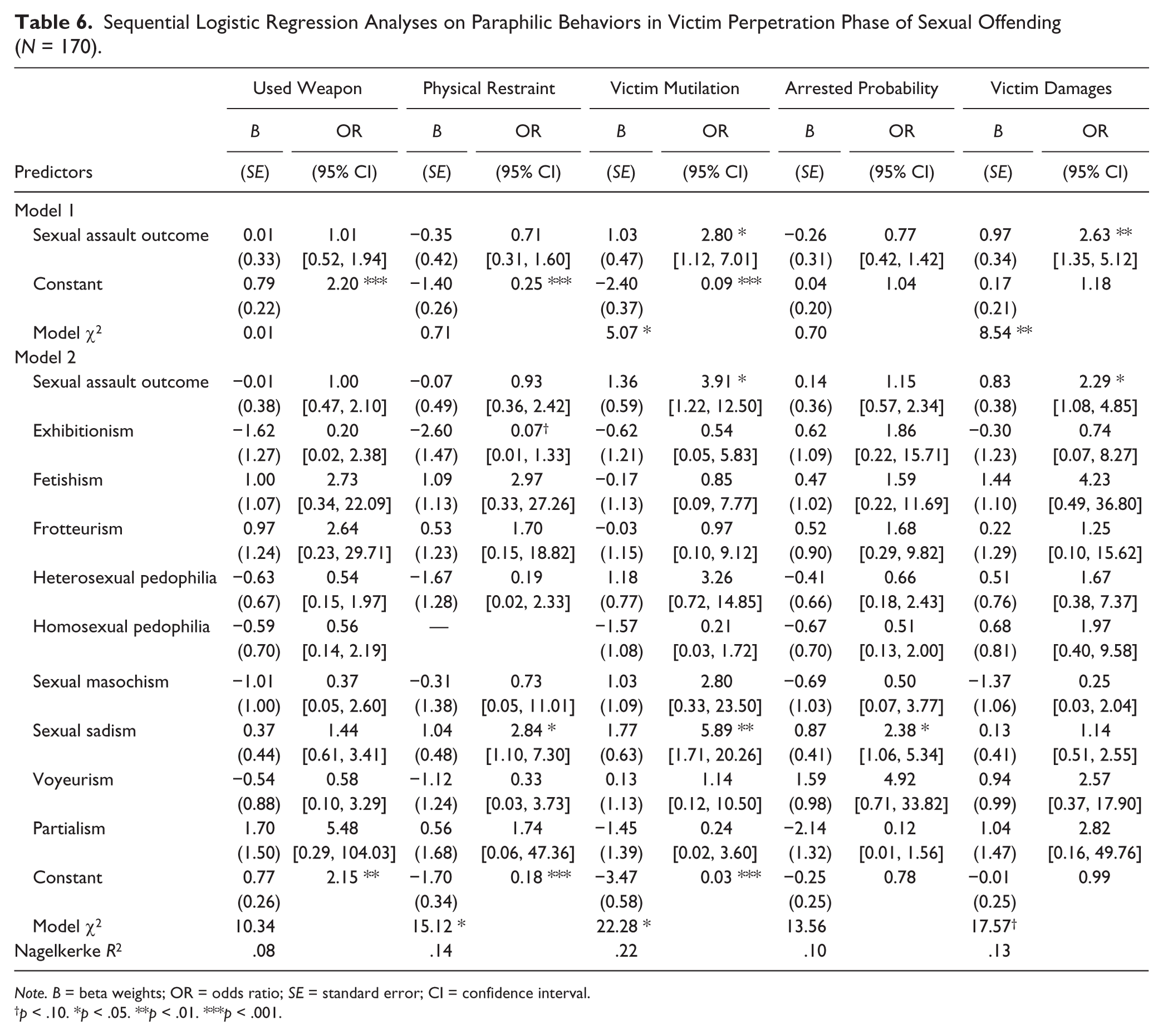
Note. B = beta weights; OR = odds ratio; SE = standard error; CI = confidence interval.
p < .10. *p < .05. **p < .01. ***p < .001.
Discussion
In this study, sexual offenders who killed their victim—HSOs—showed a number of psychopathological and offending features that distinguish them from sexual offenders who physically injured but did not murder their victim (i.e., NHSOs). With respect to the offending process, HSOs were more likely than NHSOs to report deviant sexual fantasies prior to their actual offense; to select victims who meet their psychological, sexual, and/or social needs (i.e., victim demographics such as age and race); and to mutilate their victim during the offense. These very specific characteristics could be explained by their deviant and sadistic sexual preferences. Several studies have found that HSOs frequently report sadistic fantasies to obtain psychological gratification that is sexually motivated (Chan & Heide, 2009). However, when the mere indulgence in sadistic fantasies is insufficient to produce expected sexual euphoria, this appears to lead to the actualization of their fantasies in the real world. This can be translated by the selection of a “suitable” target and the torturing of a victim to achieve sexual gratification. This explanation is partly supported by the theoretical model of sexual homicide offending suggested by Chan and colleagues (2011).
Findings of this study also shed light on the pathological profile of HSOs, relative to the NHSOs. The prevalence rate of maladaptive personality traits is found to be greater in HSOs than NHSOs. Consistent with previous findings, HSOs are more likely to be suspicious and mistrust others with a grandiose sense of self-worth (Koch et al., 2011; Myers & Blashfield, 1997), socially and emotionally isolated or unstable in their relationships (Milsom, Beech, & Webster, 2003; Purcell & Arrigo, 2006; Ressler, Burgess, & Douglas, 1988), and impulsive with a perfectionistic sense (Chan & Heide, 2009; Firestone, Bradford, Greenberg, & Larose, 1998). These personality traits may partly increase the likelihood for the offenders to eventually kill their victim without experiencing any guilt feelings (Koch et al., 2011), perhaps in accordance to their deviant sexual fantasies. It is noteworthy that NHSOs were more likely to be extroverted in this sample. Consistent with previous findings, HSOs present more paraphilic behaviors than the NHSOs. Relative to NHSOs, HSOs in this study engaged in more behaviors of sexual masochism, partialism, exhibitionism, fetishism, frotteurism, and homosexual pedophilia. Again, the higher involvement in paraphilic behaviors could indicate the strong influence of deviant sexual fantasy as strong correlations are found among paraphilias, fantasies, and sexual homicide (Arrigo & Purcell, 2001; Chan et al., 2015; Purcell & Arrigo, 2006). Undeniably, aside from the offender’s psychopathological profile, other potential factors such as situational or external interference with the assault may also influence the lethality outcome of the sexual assault.
Implications for Offender Profiling
Some findings on the effects of maladaptive personality traits and paraphilic behaviors on the offending process may present some implications for the criminal investigation. Although these findings may prove useful for law enforcement in their investigative efforts and the prioritization of suspects, however, these implications need to be interpreted cautiously. The indicators used in this study were maladaptive personality traits and paraphilic behaviors, they were not full-blown diagnoses. These implications may only prove practical if the case evidence reasonably supports that the sexual offense in question is committed by a non-serial offender. Five possible implications are suggested:
If the crime scene reflects some forms of offense premeditation (i.e., organized crime scene with limited or no forensic evidence, and methods used to evade detection), the likelihood of the sexual offender to present features of sexual sadism is increased (1 in 1.53 chances 4 ). The offender is less likely to be someone who presents antisocial personality traits.
If there are multiple sexual victims and the victims are found to share some similar physical and/or personality characteristics, the likelihood of the sexual offender to present features of impulsive (1 in 1.08 chances) or narcissistic (1 in 1.56 chances) personality traits is increased. The offender is less likely to be someone who presents antisocial personality traits.
If a weapon is known to be used in the sexual offense, the likelihood of the offender to be someone who presents features of borderline (1 in 1.46 chances) or narcissistic (1 in 1.59 chances) personality traits is increased.
If a physical restraint is known to be used against the victim during the sexual offense, the likelihood of the offender to present features of sexual sadism is increased (1 in 1.54 chances).
If the victim is found to be mutilated during the offense, the likelihood of the sexual offender to present features of schizotypal (1 in 1.06 chances) or histrionic (1 in 1.13 chances) personality traits, or sexual sadism (1 in 1.20 chances) is increased. The offender is less likely to be a narcissist.
Limitations of Data and Suggestions for Future Research
Issue of generalizability
This study is not without its limitations. First, the small number of incarcerated Canadian sexual offenders sampled in this study has weakened the generalizability of the findings. It is unclear about the representative of these findings to incarcerated sexual offenders in other countries, to those who have been arrested but eventually acquitted from their criminal charge, or even to those who have successfully avoided detection.
Methodological limitations
In addition, the lack of a control group (e.g., non-sexual homicide offenders), the offender stratification by offense type (e.g., child molesters and rapists), and violence risk level (e.g., low, medium, and high) may hindered the generalizability of the current findings. Second, these analyses only used maladaptive personality traits and paraphilic behaviors, and not full-blown diagnosis of PDs and paraphilias. It is reasonable to believe that they may have differences in the intensity of these psychopathological profiles, which could influence their effects on the behavioral manifestation (i.e., relative to maladaptive personality traits, a full-blown PD diagnosis may result in more marked maladaptive traits that could lead to a more intensified maladaptive behavior). Third, the absence of the analysis of comorbidity of these disorders may prevent a more comprehensive finding. Finally, other potential contributing factors (e.g., situational or external influences) that may influence the lethality outcome of the sexual assault should not be neglected.
Future research directions
In view of the study methodological limitations, future research should attempt to consider these issues in its research design. First, future studies should consider using a more representative sample with in-depth offender psychopathological profiles and the use of a control group to enhance the robustness of findings. Next, the use of full-blown PD diagnoses is desirable. In addition, the issues and effects of comorbidity of disorders should also be investigated in future research. Finally, more theoretical and empirical supported situational or external factors should be incorporated in the testing model to generate a more holistic view of the victim selection and perpetration phase of sexual offending. By improving the methodological design, law enforcement agents could be provided with a better guidance in strategizing their investigative efforts. Nevertheless, the present study has set a solid ground for future research on the topic.
Footnotes
Declaration of Conflicting Interests
The author(s) declared no potential conflicts of interest with respect to the research, authorship, and/or publication of this article.
Funding
The author(s) received no financial support for the research, authorship, and/or publication of this article.