



Abstract
Although sexual homicide offenders (SHOs) evince personality disorders, few prior studies have examined all personality disorders or utilized control groups of offenders. Drawing on data from 616 adult male sex offenders including 85 who were SHOs, the current study examined the personality profile of the SHOs, by comparing them with a group of violent nonhomicidal sex offenders (VNHSOs) and a group of nonhomicidal sex offenders (NHSOs) on clinical diagnostics of personality disorders and various crime characteristics. The personality profile of SHOs is comprised primarily of Schizoid and Borderline Personality Disorders, and these offenders were significantly likely to select a victim, use a weapon, and use drugs and alcohol before their offenses, but less likely to force their victim to engage in sexual acts or humiliate them. The comorbidity of Schizoid, Borderline, and Antisocial Personality Disorder features presents unique personality dysfunction that facilitates the lethal sexual violence of SHOs relative to their nonhomicidal sexual offender peers.
Introduction
Although not specified in the various theoretical models of sexual homicide (see Healey & Beauregard, 2015, for a review), the disorders associated with personality represent a contributing factor explaining this form of crime. These models implicitly suggest that to commit such a crime, offenders have to present some form of psychopathology ranging from various personality disorders (e.g., Antisocial, Borderline), to psychopathy to severe psychosis (Malmquist, 2006). However, the psychopathological portrait of the sexual homicide offender (SHO) suffers from several flaws, probably the most important being the lack of empirical investigation. As suggested by Sauvetre and Proulx (2007), several authors have proposed a personality profile for the SHO based on potentially fallacious reasoning: SHOs have no empathy for their victims like psychopaths; therefore, SHOs are psychopaths. 1 Another flaw associated with the role of personality in sexual homicide is the quasi absence of studies including control groups. As many of the studies relied on newspapers and true crime books (e.g., Geberth & Turco, 1997; Stone, 1994) or included small clinical samples of SHOs, it was not possible to compare the personality profile of these offenders with a group of nonhomicidal sex offenders (NHSOs).
One exception to this is a study by Healey and Beauregard (2017) looking at the impact of impulsivity and sexual homicide. Drawing on work by DeLisi and Wright (2014) who have suggested that low self-control—as characterized by Gottfredson and Hirschi (1990) as being self-centered, impulsive, poorly tempered, action oriented, preferring simple tasks, and unable to delay gratification—could partly explain sexual homicide. Following this suggestion, Healey and Beauregard (2017) tested one specific component of the concept of low self-control, namely, impulsivity, and how it relates to sexual homicide. What they found is that this impulse disorder was significantly associated with sexual homicide, even after taking into account crime characteristics. 2 The authors concluded that despite the importance of looking at the actions taken by sex offenders during the crime, SHOs present personality characteristics that differ from other types of NHSOs. Largely based on this latter study, the aim of the current study is to empirically investigate the role of personality disorders in sexual homicide by comparing a group of SHOs with a group of violent NHSOs (VNHSOs) as well as a group of NHSOs.
The Psychopath Hypothesis
Given the constellation of personality features characterized by deficits in guilt, shame, remorse, and empathy and pervasive, multifaceted self-regulation problems, psychopathy has emerged as a theoretical framework with which to understand sexual homicide (Declercq, Willemsen, Audenaert, & Verhaeghe, 2012; Häkkänen-Nyholm, Repo-Tiihonen, Lindberg, Salenius, & Weizmann-Henelius, 2009; Myers, Gooch, & Meloy, 2005; Woodworth & Porter, 2002). Unfortunately, the relationship between psychopathy and sexual homicide has been empirically investigated in relatively few studies. For instance, Porter, Woodworth, Earle, Drugge, and Boer (2003) compared the characteristics of sexual homicide committed by psychopathic and nonpsychopathic offenders. First, they found that almost 85% of the SHOs scored in the moderate-high range on the Psychopathy Checklist–Revised (PCL-R; Hare, 1991). In addition, using a PCL-R cutoff of 30, they showed that sexual homicides committed by psychopathic offenders were more likely to present both gratuitous and sadistic violence compared with nonpsychopathic offenders. According to Porter et al. (2003), it is possible that the absence of empathy combined with a thrill-seeking propensity could lead the psychopath to try to increase their pleasure as well as the damage inflicted during the sexual homicide.
Additional studies had provided some evidence of the relationship between psychopathy and sexual homicide. Comparing SHOs to a group of incest offenders, Firestone, Bradford, Greenberg, and Larose (1998) found that SHOs presented significantly higher PCL-R scores—both on Factor 1 and 2—than the group of incest offenders. Actually, the scores obtained on the PCL-R as well as their respective percentiles show that, compared with other pathological and criminal populations (e.g., prison inmates, forensic patients), SHOs show relatively greater personality disturbance than criminal behavior. Interestingly though is the fact that the study also showed that SHOs were more likely to be diagnosed with any personality disorder (as well as three or more personality disorders), and with antisocial personality disorder in particular, compared with the group of incest offenders.
Although the study by Langevin, Ben-Aron, Wright, Marchese, and Handy (1988) seems to corroborate this link between psychopathy and sexual homicide (as also emphasized by Porter et al., 2003), closer attention to the findings suggests otherwise. For instance, seven out of 13 SHOs scored higher than 70 on the Minnesota Multiphasic Personality Inventory (MMPI) scale of psychopathy. However, it should be noted that despite its name, the psychopathy scale of the MMPI is poorly correlated with Hare’s (1985) psychopathy scale, focusing more on impulsivity and social maladaptation (see Sauvetre & Proulx, 2007). Moreover, scores on the Millon Clinical Multiaxial Inventory (MCMI) showed that for six SHOs, they did not present a clinically significant score on the antisocial and narcissistic scales. Overall, these findings suggest that although psychopathy seems more important in SHOs, some of these offenders also present with different personality disorders that could explain, in part, the perpetration of sexual homicide.
The Heterogeneity of Personality Profiles Hypothesis
Without denying the effect of psychopathy on sexual homicide, other authors have suggested that due to the heterogeneity of SHOs, it was possible that different personality disorders could be linked to the commission of a sexual homicide. For instance, Meloy (2000) reported that two thirds of the SHOs of his sample scored in the primary or severe range on the PCL-R, similar to what was observed by Porter et al. (2003) as well as Firestone et al. (1998). However, he also noticed that the the character pathology of SHOs is more dysfunctional than other psychopathic individuals, presenting with higher levels of obsession, as well as moderate level of formal thought disorder, expected for a Borderline personality (see Gacono & Meloy, 1994; Meloy, Acklin, Gacono, Murray, & Peterson, 1997) compared with nonsexually offending psychopaths (Meloy, Gacono, & Kenney, 1994). Schlesinger (2004) came to a similar conclusion, suggesting that compulsive SHOs were psychopaths, whereas catathymic SHOs were more likely to present Borderline and Schizoid personality disorders.
Although his study included serial killers, Stone (1994, 2001) analyzed biographies of serial murderers and found that 91% of his offenders were diagnosed as psychopath (as well as 81% as Antisocial and 60% as Narcissistic), nearly half of the sample met the criteria of a schizoid personality disorder. This is very similar to Myers and Blashfield’s (1997) study on adolescent SHOs, who found that a little more than a third of their sample was diagnosed with Schizoid and Schizotypal personality disorders, as assessed by the Schedule for Nonadaptive and Adaptive Personality (SNAP). However, contrary to Stone (2001), Antisocial and Borderline personality disorders were rare in these SHOs (moreover, only 2 out of 15 offenders had a PCL-R score above 30; Myers, 2002). According to Myers and Monaco (2000), the combination of Schizoid and Schizotypal disorders is consistent with their crime, exhibiting
disturbed interpersonal functioning, idiosyncratic thinking, and perhaps a greater reliance on fantasy for fulfilment due to impairment in their capacity for relationships with others. Their emotional detachment may well have been an important ingredient in the cascade of factors leading to their crimes. (p. 700)
Conversely, Hill, Habermann, Berner, and Briken (2006) examined the psychiatric reports of 166 men who had committed a sexual homicide and compared those with sexual sadism (n = 61) to those without (n = 105). They found that offenders with sexual sadism were more often diagnosed with personality disorders than the group without sexual sadism. Moreover, SHOs with sexual sadism were also more likely to present higher rates of Antisocial, Narcissistic, Borderline, Schizoid, and Schizotypal personality disorders. Also using a comparative approach, Sauvetre and Proulx (2007) compared a group of SHOs to a group of NHSOs on their personality features. What they found was that using the Diagnostic and Statistical Manual of Mental Disorders (4th ed.; DSM-IV; American Psychiatric Association, 1994) criteria, the most commonly diagnosed personality disorders among SHOs were Antisocial, Borderline, and Narcissistic disorder consistent with some of the research presented previously (e.g., Gacono & Meloy, 1994; Langevin et al., 1988).
However, Sauvetre and Proulx (2007) cautioned that these prevalence estimates were generally low compared with previous studies (35% and lower). The authors also showed that when comparing the clinical diagnoses of SHOs with NHSOs, both groups were generally similar in terms of personality disorders, except for narcissism that was significantly more prevalent in SHOs. They suggested that these results demonstrate that personality profiles are not linked to the severity of the sexual crime (i.e., sexual assault vs. homicide). Interestingly, they also looked at the scores obtained on the MCMI and contrary to the clinical diagnoses that were observed the scores obtained with the psychometric instrument indicated a predominance of Avoidant, Dependent, and Schizoid personality disorders among SHOs. According to Sauvetre and Proulx (2007), such discrepancy between clinical diagnoses and the psychometric results could be
a reflection of the fact that psychometric instruments evaluate the sexual murderer, while clinicians evaluate the crime itself. In fact, during forensic clinical assessment, the emphasis is on understanding the personality traits that may have contributed to the commission of the sexual murder. This leads to overemphasis of antisocial and narcissistic features of the sexual murderer, and underemphasis of avoidant, dependent and schizoid features. (p. 65)
Current Focus
Previous studies have suggested that considering the nature of the crime of the SHO, they had to present psychopathic personality. Although several studies found a high prevalence of psychopathic personality in SHOs, other studies have also found that these offenders were characterized by other personality disorders as well (e.g., Borderline, Schizoid). However, to establish a link between the personality and sexual homicide, it is crucial to include a control group in the analyses. To our knowledge, except for one study (Sauvetre & Proulx, 2007), no studies have included such control group. Moreover, to test the relationship between personality and sexual homicide, it is important to control for other factors as well that we know are capable to distinguish between SHOs and NHSOs, once again, something that has not been done thus far. Therefore, the aim of the current study is to examine the personality profile of the SHOs, by comparing them with a group of VNHSOs and a group of NHSOs on clinical diagnostics of personality disorders. Moreover, the study takes into account various crime characteristics that have been found in previous studies to distinguish those sex offenders who kill from sex offenders who do not kill, namely, some precrime factors (i.e., alcohol, drug, and pornography prior to the crime) as well as factors related specifically to the criminal event (i.e., victim selection, weapon used, intrusive sexual acts, victim forced to commit sexual acts, and humiliation of the victim).
Method
Participants
The data used for this study come from a prospective study on the recidivism of sex offenders that took place between April 1994 and June 2000 in a Federal penitentiary in Canada. All adult males convicted of a sexual crime who received a prison sentence of at least 2 years during that period were recruited for a survey. The participation rate was high as 93% of the recruited participants (n = 624) agreed to collaborate with the research team during the data collection. All participants signed a consent form indicating that the information gathered would be used for research purposes only. At the time of the survey, the majority of participants were incarcerated in a maximum security institution run by the Correctional Service of Canada. Eight participants were dropped from the current study because of too many missing values. Participants included in this study (n = 616) were mostly Caucasian (87.7%). On average, they were 39 years old (SD = 12.0) and serving a prison sentence of 4.2 years (SD = 3.6). Sexual crimes were committed on children (younger than 12 years old; 39.5%), adolescents (between 12 and 17 years old; 24.5%), and adults (18 years or older; 36%), and the majority of the victims were female (81.2%).
Measures
The dependent variable of the study is the type of sex offender and it is divided into three categories: 0 = nonhomicidal sex offender (NHSO), 1 = VNHSO, and 2 = SHO. An offender is considered to be an SHO (N = 85) if the victim died due to the attack or because of the injuries suffered during the attack. These offenders committed a homicide where there was forensic evidence of a sexual element to the killing, the offender later admitted to the sexual element of the crime, or there was a suspected sexual motive to the crime. Suspicion of a sexual motive was determined by investigators and had to meet at least one element of Ressler, Burgess, and Douglas’s (1988) definition of sexual homicide: (a) victim’s attire or lack of attire, (b) exposure of the sexual parts of the victims body, (c) sexual positioning of the body, (d) insertion of foreign objects into the victim’s cavities, (e) evidence of sexual intercourse (oral, anal, and/or vaginal), and (f) evidence of substitute sexual activity, interest, or sadistic fantasy. The SHOs killed a majority of adult victims (69.4%) and some adolescent (17.6%) and child victims (12.9%).
The group of VNHSOs (n = 144) only includes offenders who inflicted physical injuries that went beyond forced sex (e.g., beating of the victim, or any other physical injury beyond defensive wounds experienced by the victim). In this case, the injuries inflicted on the victim are serious enough to have led to the hospitalization of the victim. These offenders also attacked a majority of adult victims (64.6%) and similar to the SHOs, they also attacked some adolescent (14.6%) and child (20.8%) victims. Finally, the group of NHSOs (n = 387) includes sex offenders who did not use physical violence during the crime. Contrary to the two other groups, they attacked a little over half of child victims (51.9%), while also assaulting adolescent (30.0%) and adult victims (18.1%).
As for the independent variables, they are separated into two groups (see Table 1). The first group of interest concerns the personality disorders. Personality disorders are divided into three clusters. Cluster A—the odd, eccentric cluster—includes the following personality disorder: Paranoid, Schizoid, and Schizotypal. Cluster B—dramatic—includes the following personality disorders: Borderline, Narcissistic, Histrionic, and Antisocial. Finally, Cluster C—anxious—includes the following personality disorders: Avoidant, Dependent, and Obsessive-Compulsive. All personality disorders were obtained from the psychologist in charge of the assessment of the offender using the DSM-IV. All inmates admitted to the correctional institution were referred to a psychologist if they met at least one the criteria (i.e., persistent violence, gratuitous violence, and sexual violence). Before meeting with the psychologist, all sex offenders were administered the Minnesota Multiphasic Personality Inventory-II (MMPI-II). Results to this psychometric test were made available to the psychologist before meeting with the offender. Through a structured clinical interview, the psychologist would reach his diagnostic using mainly the diagnostic criteria of the DSM-IV as well as the results to the MMPI-II and official information included in the correctional file (e.g., police report, court transcripts, criminal history, presentencing report, previous psychological assessment). Moreover, the psychologist had to administer the PCL-R. However, this information was only mentioned in the psychological assessment when the offender presented traits or a diagnostic of psychopathy. Unfortunately, the score to the PCL-R was not made available to the research team.
Descriptive Statistics and Chi-Square Analyses Between Personality Disorders and Type of Offenders.
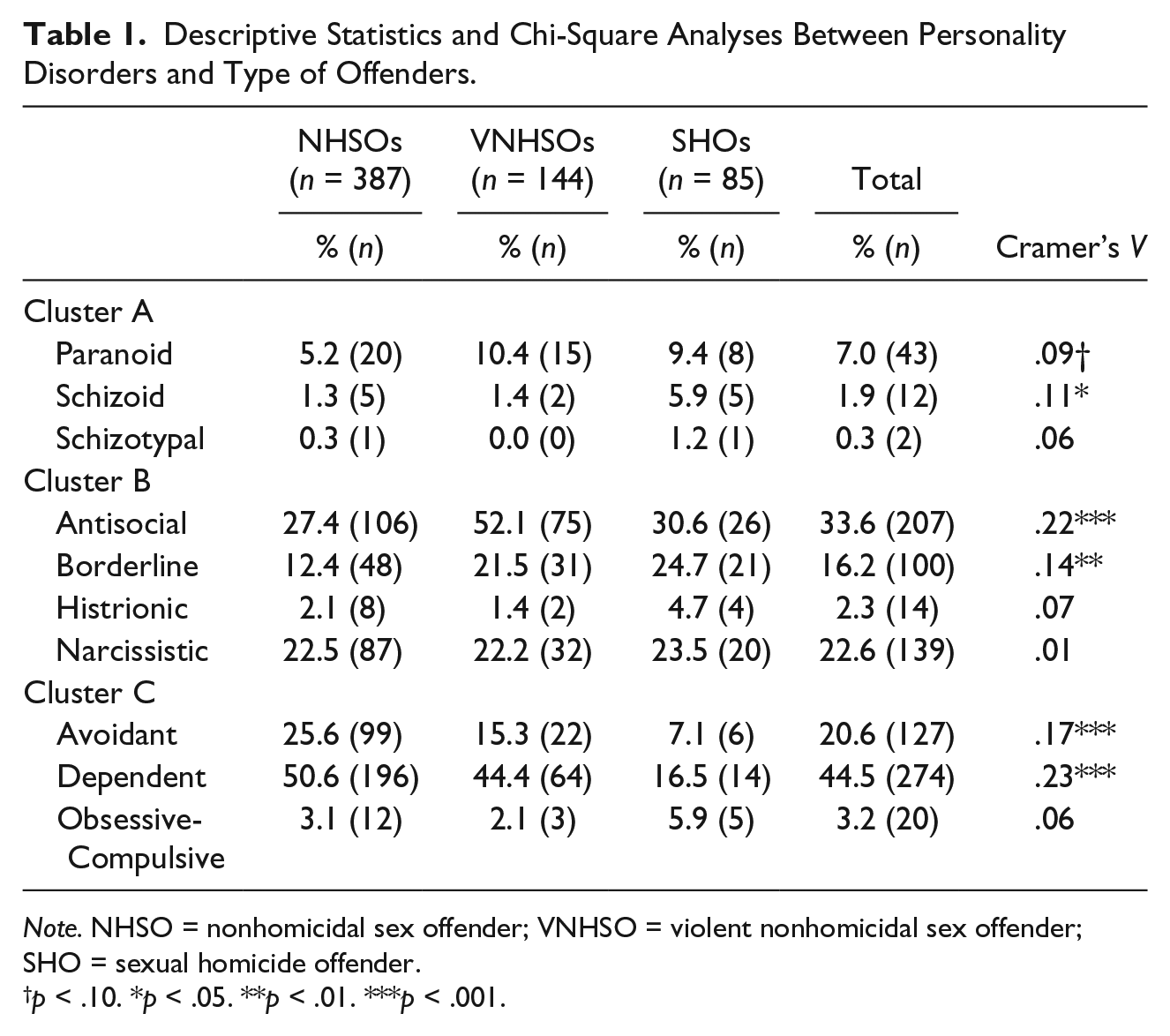
Note. NHSO = nonhomicidal sex offender; VNHSO = violent nonhomicidal sex offender; SHO = sexual homicide offender.
p < .10. *p < .05. **p < .01. ***p < .001.
To assess the real contribution of personality to sexual homicide, crime characteristic variables were also included in the current study (see Table 2): (a) alcohol prior to crime, (b) drug prior to crime, (c) porn prior to crime, (d) victim selection, (e) weapon used, (f) intrusive sexual acts, (g) victim forced to commit sexual acts, and (h) humiliation of victim. These variables were specifically selected for their ability to distinguish between SHOs and NHSOs in previous studies (see Beauregard & Martineau, 2016; Chan & Heide, 2016; Healey & Beauregard, 2015, 2017; Mieczkowski & Beauregard, 2010; Proulx, Beauregard, Cusson, & Nicole, 2007; Stefanska, Carter, Higgs, Bishopp, & Beech, 2015; Stefanska, Higgs, Carter, & Beech, 2017).
Descriptive Statistics and Chi-Square Analyses Between Crime Characteristics and Type of Offenders.

Note. NHSO = nonhomicidal sex offender; VNHSO = violent nonhomicidal sex offender; SHO = sexual homicide offender.
p < .10. *p < .05. **p < .01. ***p < .001.
Procedures
Data were mainly collected during a semistructured interview with each participant using a computerized questionnaire that included information on different aspects of the offender’s life and criminal activity such as correctional information; precrime, crime, and postcrime factors; attitudes regarding the offense; apprehension; victimology; developmental factors; and psychiatric diagnoses. However, considering the nature of the study and the possibility of offenders’ various biases and desire to exaggerate or minimize certain aspects of the crime, data triangulation was performed whenever possible using the entire correctional file. Interrater agreement was measured on the basis of 16 interviews (and consultation of official documentation) conducted jointly by two raters. Ratings were done independently following these interviews, which were conducted by one interviewer in the presence of the other. The mean Cohen’s Kappa was .87, which represents very strong agreement.
Statistical Analyses
The analytical strategy used in the current study follows two different stages. First, chi-square analyses are conducted between each of the independent variables (i.e., personality disorders and crime characteristics) and our grouping variable of the type of sex offenders. Second, to identify the personality disorders and crime characteristics differences between the three groups of sex offenders at the multivariate level, logistic regression models are estimated. Each possible combination among the three groups of sex offenders (i.e., NHSOs vs. VNHSOs, NHSOs vs. SHOs, and VNHSOs vs. SHOs) serves as a dependent variable, and only the significant personality disorders and crime characteristics at the bivariate level are used as independent variables in these analyses. These models identify which of the personality disorders and crime characteristics measures may be used to establish associations with specific types of sexual offending.
Results
Table 1 presents the results of the chi-square analyses between the personality disorders and the three groups of sex offenders. As can be observed, the three groups of sex offenders present a different personality profile. The SHOs are more likely to present a personality profile characterized by Schizoid and Borderline personality disorders compared with the VNHSOs and the NHSOs. However, the VNHSOs are more likely to present a personality profile characterized by Antisocial and Paranoid (p < .10) personality disorders compared with the SHOs and the NHSOs. Finally, the NHSOs are more likely to present a personality profile characterized by Avoidant and Dependent personality disorders compared with the other two groups. Despite these significant differences, it is noteworthy that the effect sizes reported are relatively small.
Table 2 presents the results of the chi-square analyses between the crime characteristics and the three groups of sex offenders. SHOs are more likely to use drugs and alcohol prior to the crime, as well as select their victim and use a weapon to commit the crime, compared with the other two groups of sex offenders. On the contrary, the VNHSOs are more likely to commit intrusive sexual acts and humiliate the victims compared with the SHOs and the NHSOs. Finally, the NHSOs are more likely to use pornography prior to the crime and force the victim to perform sexual acts compared with the other two groups of sex offenders. Contrary to the personality disorder variables, several significant differences presented effect sizes of medium (i.e., alcohol and victim forced to commit sexual acts) or large magnitude (i.e., humiliation and weapon used).
Table 3 presents the findings of the logistic regression models indicating the different types of sex offending. When comparing the NHSOs to the VNHSOs, the first logistic regression model shows that none of the personality disorders significantly distinguish the two types of sex offenders while taking into account the crime characteristics. However, the results show that alcohol prior to crime (odds ratio [OR] = 1.72, p = .035), the use of a weapon (OR = 3.57, p < .001), intrusive sexual acts (OR = 2.25, p = .007), and humiliation of the victim (OR = 6.70, p < .001) present higher odds to characterize the sexual crimes committed by VNHSOs, whereas forcing the victim to perform sexual acts on the offender (OR = 0.51, p < .010) was less likely.
Logistic Regression Models for All Different Types of Sex Offenders From Personality Disorders and Crime Characteristics.

Note. NHSO = nonhomicidal sex offender; VNHSO = violent nonhomicidal sex offender; OR = odds ratio; CI = confidence interval; SHO = sexual homicide offender.
p < .10. *p < .05. **p < .01. ***p < .001.
When comparing the VNHSOs to the SHOs, the second logistic regression model shows that, contrary to the first model, several personality disorders distinguish the two types of sex offenders, even when taking into account the crime characteristics. The results show that a Schizoid personality disorder (OR = 91.71, p = .001) presents higher odds to be diagnosed in SHOs. However, such finding should be interpreted with caution considering the extremely large confidence interval. This could be due to the very low number of cases having been diagnosed with such personality disorder. The results also show that Antisocial (OR = 1/0.19, p < .001), Avoidant (OR = 1/0.22, p = .042), and Dependent (OR = 1/0.19, p = .001) personality disorders present 5.26, 4.55, and 5.26 higher odds, respectively, to be diagnosed in VNHSOs. In addition, the results show that drugs prior to crime (OR = 2.39, p = .049), victim selection (OR = 3.24, p = .009), and using a weapon (OR = 2.85, p = .012) present higher odds to characterize the sexual crimes committed by SHOs, whereas intrusive sexual acts (OR = 0.22, p = .001), forcing the victim to perform sexual acts (OR = 0.18, p = .001), and humiliation (OR = 0.21, p = .001) are less likely.
Finally, when comparing the NHSOs to the SHOs, the third logistic regression model shows that only a few personality disorders distinguish the two types of sex offenders, while taking into account the crime characteristics. The results show that Schizoid personality disorder (OR = 16.62, p = .017) presents higher odds to be diagnosed in SHOs. However, the results also show that Dependent (OR = 1/0.30, p < .012) and Antisocial (OR = 1/0.44, p < .10) present 3.33 and 2.27 higher odds, respectively, to be diagnosed in NHSOs. As to the crime characteristics, the results show that alcohol (OR = 5.70, p < .001) and drugs (OR = 3.60, p = .003) prior to the crime, victim selection (OR = 3.28, p = .006), and weapon used (OR = 26.52, p < .001) present higher odds to be found in the crimes committed by SHOs, whereas forcing the victim to perform sexual acts (OR = 0.05, p < .001) and intrusive sexual acts (OR = 0.52, p < .10) are less likely.
Discussion
The presence of significant personality disorder among SHOs is commonly inferred (e.g., Vaughn, DeLisi, Beaver, & Howard, 2009), but few prior studies have included the full array of DSM-IV personality disorders, included crime characteristics as covariates, and utilized control groups of other serious sexual offenders. Drawing on a large sample of convicted male sexual offenders selected from Canada, the current study examined the personality profile of the SHOs by comparing them with a group of VNHSOs and a group of NHSOs. Moreover, we took into account various crime characteristics that have been found in previous studies to distinguish sex offenders who kill from sex offenders who do not kill. Several important findings warrant discussion.
First, there is compelling evidence that personality disorders are endemic to sexual offenders generally and SHOs specifically. With the exception of Schizotypal Personality Disorder, all types of personality disorder had relatively high prevalence and Cluster B personality disorders had the highest prevalence. 3 These findings are consistent with studies of general homicide offenders (Boduszek, Debowska, & Willmott, 2017; Eronen, Hakola, & Tiihonen, 1996; Fazel & Grann, 2004), juvenile SHOs (Myers & Monaco, 2000), serial homicide offenders (Culhane, Hildebrand, Mullings, & Klemm, 2016), other SHOs (Koch, Berner, Hill, & Briken, 2011), and institutionalized sexual offenders (Chen, Chen, & Hung, 2016). Interestingly, the prevalence and distribution of personality disorders (highest among Cluster B and relatively lower among Cluster A disorders) of the current Canadian data are almost directly commensurate to the sex offender data from Taiwan (Chen et al., 2016). Taken together, the current prevalence estimates of personality disorders coupled with those from allied research attest to the prominence of personality and its dysfunction to the most violent and serious forms of criminal offending. 4
Second, the study of homicide offenders presents a fascinating dialectic between offenders whose psychopathology is primarily rooted in antisocial traits where there is a drive to externalize violence and offenders whose psychopathology is primarily rooted in asocial traits where violence reflects a dislike or revulsion for others (DeLisi, 2015; Meloy, 2000). The current findings on SHOs highlight this dialectic. Compared with NHSOs and VNHSOs, SHOs had personality features characterized by schizoid personality disorder and borderline personality disorder, were more likely to use drugs and alcohol before their murder, use a weapon, and select the victim, and their sexual behavior during the murder was less intrusive sexually, less likely to force the victim to engage in sexual acts, and less likely to involve humiliation of the victim. The salience of schizoid personality disorder is particularly important. Like all personality disorders, there is heterogeneity within each diagnosis. Some persons with schizoid personality disorder abstain from sexual behavior which is entirely consistent with the isolation and solitary nature of their behavior in other domains. They are effectively asexual. Others engage in masturbation and have an extensive fantasy life, and perhaps flirt with the notion of sexual activity with another person. Our data likely reflect this schizoid conflict in the SHOs. On one hand, these offenders are instrumental in terms of victim selection and the use of a weapon to facilitate their violent acts. On the other hand, they use alcohol and drugs likely as a disinhibition mechanism before perpetrating their sexual homicide and are much less likely to force the victim to perform various sexual acts or humiliate them. In other words, although 100% of SHOs kill their victim, only 20% humiliate their victim and just 12.9% force the victim to perform sexual acts. It is as if the SHOs find these behaviors distasteful perhaps because they involve sexual interaction, emotional interaction, or elements of both. Such finding was also observed in the study by Mieczkowski and Beauregard (2010). Looking at the conjunctive analysis of the contextual characteristics involved in sexual crimes, the authors found that the most lethal combination was when the offender used a weapon, the crime lasted more than 30 min, but no sexual acts were committed on the victim and the offender did not force the victim to perform sexual acts on him. To explain such unusual findings, Mieczkowski and Beauregard (2010) suggested that an inchoate sexual assault linked to a weapon in hand may be the worst possible combination of factors in the criminal situation leading to a fatal outcome.
Third, the Borderline personality features in the SHO profile are revealed in the impulsive features (e.g., perpetrating the act after drug and alcohol intoxication), the uncontrollable and visceral emotions involved in the acts of sexual abuse and murder, and the distorted identity and self-image of an offender who preselects a victim to ultimately kill. Borderline personality disorder also potentially structures the fantasy life of the SHO, one that involves the aforementioned distortions in self-image and self-identity, poorly regulated emotions especially anger and hostility, and dysphoria. Our typification is consistent with prior research on SHOs that also included control groups (Gacono, Meloy, & Bridges, 2000). The consumption of alcohol and drugs preceding the sexual homicide likely reflects an attempt by the offender to manage these emotions in the context of premeditating a sexual homicide.
Although it was not a significant covariate in the multivariate models, it is also important to note that nearly 31% of SHOs also presented with Antisocial Personality Disorder; thus, in addition to the contributions of Schizoid and Borderline Personality Disorders, nearly one third of SHOs also evince a lifelong pattern of violations of the rights of others and the rules of society. The comorbidity of Antisocial and Borderline Personality Disorders is important given that both personality disorders have been shown to be significantly associated with aggression that is driven by high levels of anger and hostility (Kolla, Meyer, Bagby, & Brijmohan, 2017). For the SHOs in the current data, the preselected victim likely represents an object of hostility for the offender to sexually defile and ultimately destroy. It is revealing that the prevalence of pornography consumption among SHOs is rather low at 5.9%, suggesting that sexual arousal is not the driving motivation for their behaviors.
Fourth, the SHO personality profile offers insight into the personality features that undergird homicidal ideation. Recent research on federal offenders in the United States (DeLisi et al., 2016) revealed that about 12% of offenders in an entire jurisdiction experienced homicidal ideation, and these offenders had criminal careers that were significantly more extensive, comprised of more violent crimes including murder, attempted murder, kidnapping, and aggravated assaults, and had more pernicious psychopathology. While these offenders were more likely to have Antisocial Personality Disorder, that study did not focus on other personality disorders. In the current data, the combination of features that result from Schizoid and Borderline Personality Disorders—consuming, poorly managed anger and hostility, the tension between wanting to shun any emotional and sexual connections to others while nevertheless experiencing sexual fantasies of particular victims, and the usage of drugs, alcohol, and weapons—are what separate sexual offenders who murder from those who do not. In this way, homicidal ideation, and ultimately, homicidal perpetration, could be related to the manifestations of the personality disorder comorbidity seen here.
Conclusion
Although our study did not test specifically for the presence or not of psychopathy, our findings seem to suggest that SHOs included in the current sample do not meet the typical description of the psychopath offender. Only a third of the SHOs presents an Antisocial Personality Disorder. However, what seems to be linked to the lethal violence in sexual crime is the comorbidity between certain personality disorders (e.g., Schizoid and Borderline). Therefore, to assume that most SHOs are psychopaths due to the nature of their crime is wrong. This is why it is important to investigate other personality disorders as well to get the full picture of their personality makeup.
What comes out also of this study is the fact that personality disorders can distinguish between sex offenders—more specifically between those who kill and those who do not. This is interesting as most theoretical models on sexual homicide have not incorporated this important feature. This is probably due to the preconceived idea that most of these offenders were simply psychopath.
The current findings present some interesting implications—both at the theoretical and clinical levels. First, as mentioned previously, the fact that personality disorders constitute an important distinguishing feature among sex offenders suggest that this should be incorporated in any theoretical models of sexual homicide. As was demonstrated in the current study, personality disorders can distinguish sex offenders who will end up killing their victims from those who will not, while taking into account the crime features that normally distinguish these two groups. As we suggested, it is possible that the choice of behavior during the crime is partly influenced by the personality of these offenders. Second, we believe the findings on the personality of SHOs could be useful in clinical settings, more specifically in the risk assessment context. Obviously, risk assessment of sex offenders is largely based on previous convictions and the presence of certain acts. However, considering the personality of these offenders could add another layer to risk assessment and identify those sex offenders who are more at risk of committing a new sexual offense, more precisely one that ends with the death of the victim.
Despite these interesting findings, this study is not without its limitations. The first one that needs to be mentioned is the use of the psychologists’ diagnostics. Even if the psychologists involved in the assessment of these offenders all used the DSM-IV criteria, it is possible that variations in the diagnostics occurred. Moreover, as these diagnostics were provided in an assessment context—not specifically for the purpose of the study—it was not possible to conduct interrater reliability analysis. A second limitation has to do with the number of SHOs included in the sample. Considering the nature of this population, the number of offenders is very appropriate but a larger number could have probably produced more significant findings. A third limitation is the absence of a direct measure of psychopathy. Even if our findings suggest that most of these offenders are not psychopath, 5 the inclusion of the PCL-R could have been interesting nonetheless. Fourth, it is noteworthy that the sample used was in majority White and has been collected from a province where the majority of people are French speaking. Although this brings some diversity to the study of sexual homicide, it is not possible to know whether this sample and the findings obtained can be generalized to all sexual murderers. A study comparing sexual murderers from different countries and different cultures will be needed. Also, it is important to keep in mind that this study is cross-sectional and that causality between sexual homicide and personality disorders cannot be established. Finally, despite our use of data triangulation with official reports to limit various biases from offenders, it is possible that some offenders may have exaggerated or minimized the presence of certain behaviors, especially in the case where the victim could not provide a statement (i.e., sexual homicide).
Future studies should continue to investigate the role of personality in sexual homicide. For instance, psychometric instruments looking at other personality features should be used, while still controlling for factors that we know can distinguish between sex offenders who kill and those who do not kill their victim. As mentioned previously, future studies need to include specific measures of psychopathy (e.g., PCL-R) as well as psychometric tests that measure different components of personality (e.g., Personality Assessment Inventory). Future studies should also consider the inclusion of additional control groups, such as perpetrators of nonviolent nonsexual crimes or violent nonsexual crimes. This would help identify whether these personality differences are specific to sex offenders or can be observed in criminals in general. Moreover, as personality seems to be important in the choice of behavior, future studies need to consider possible interactions between certain personality features and specific actions taken before, during, and after the crime. For instance, can we identify interactions between personality and precrime behaviors (e.g., use of alcohol, drugs, or pornography) and are these interactions influencing the outcome in sexual crime? Similarly, is it possible to establish relationships between the personality of offenders and their postcrime behaviors, to anticipate their most likely reaction after the crime has been committed? Answering these questions would contribute to expand our knowledge on the role of personality not only for SHOs, but for sex offenders in general. The identification of personality disorders or the psychopathology associated with sexual homicide remains an important research avenue. However, it will also be important to understand on the various mechanisms associated to this psychopathology that could be related to the commission of this type of crime. This is something that existing theoretical models of sexual homicide have failed to do.
Footnotes
Declaration of Conflicting Interests
The author(s) declared no potential conflicts of interest with respect to the research, authorship, and/or publication of this article.
Funding
The author(s) received no financial support for the research, authorship, and/or publication of this article.