



Abstract
Sexual aggression as committed by women has been the target of little empirical research and is still regarded as a myth by many people. The aim of this study was to evaluate the psychosexual profile of young and educated women reporting sexual aggression against men. This is a cross-sectional study; a total of 260 female college students answered to an online survey. Among them, 93 (35.8%) reported having committed some form of sexual aggression against men: 46.2% of sexually aggressive women fell into the category of sexual coercion, 34.1% fell into the category of sexual abuse, and 19.8% reported having used physical force. Findings revealed that sexually aggressive women reported significantly higher levels of sociosexuality, sexual fantasies of dominance and submission, sexual compulsivity, sexual excitation, and sexual inhibition due to the threat of sexual performance failure. Data are expected to affect prevention strategies for a relevant yet understudied social concern.
The phenomenon of sexual aggression is often regarded as being perpetrated exclusively by men. Society holds the myth that males cannot be the target of sexual assault (Struckman-Johnson & Struckman-Johnson, 1992). Even forensics have until recently defined the concept of sexual assault as being limited to male offenders (Krahé, Waizenhofer, & Moller, 2003). According to Russell and Oswald (2001), research focusing on sexual aggression as committed by females is very limited even though there is clear evidence showing men as recipients of sexual aggression perpetrated by women (Struckman-Johnson, 1988). Consequently, there is a strong need for models conceptualizing women’s aggressive strategies and motives to engage in sexually aggressive behaviors (Anderson & Sorensen, 1999).
Sexual aggression against men is believed to be particularly high among college students. In a review conducted by Struckman-Johnson (1991), the author found that 12% to 16% of male college students were pressured or forced to have sex with women. Hannon, Kuntz, Van Laar, Williams, and Hall (1996) reported that 38.5% of male students suffered some form of sexual aggression. Further, 26% of women stated having sexually coerced men (Struckman-Johnson, Struckman-Johnson, & Anderson, 2003). On the other hand, in a study conducted with Greek college students, only 5% of women stated having sexually coerced men (Larimer, Lydum, Anderson, & Turner, 1999). Data discrepancy suggests that findings on the prevalence of female sexual aggression as committed by college women may be biased by the different measures and procedures used to assess this phenomenon. 1 Psychological manipulation seems to be the most frequently used strategy by women—regardless of the academic status—to coerce men into sex, followed by a combination of psychological and physical force, and the use of physical force alone (Struckman-Johnson, 1988). Verbal tactics, such as insulting or blackmailing, are also commonly used by female college students (e.g., O’Sullivan, Byers, & Finkelman, 1998). Studies on the consequences of female sexual coercion against men have further revealed that sexually aggressive behavior may result in emotional disturbance for some men. For example, in a study conducted by Larimer and colleagues (1999), the authors found that male college students reporting unwanted sexual contact presented significantly more depressive symptoms in relation to the control peers. Another study focusing on the reactions of college students reporting sexual victimization showed that 20% of male victims reduced their social activities after the incident and 19% reported impairment in academic functioning (O’Sullivan et al., 1998). Also, 32% of men experiencing coercive touch or intercourse appraised the incident as having a strong negative impact (Struckman-Johnson & Struckman-Johnson, 1994).
Despite evidence confirming the phenomenon of sexual aggression committed by women as well as its negative impact on some men, little research has focused on the predictors of female sexual offending behavior (Anderson & Newton, 2004). One of the few studies conducted on this topic showed that past sexual abuse and the endorsement of adversarial beliefs about sexual relationships were related to women’s aggression toward men (Anderson, 1996). Similarly, Christopher, Owens, and Stecker (1993) reported that sexually aggressive females are likely to experience conflictual relationships and hold the belief that male/female interaction is inherently adversarial. In a cross-cultural study aimed at assessing the predictors of male and female sexual aggression, Hines (2007) found that college women with greater socioeconomic status presented higher levels of sexual aggression against men; further, greater hostility toward men was also a predictor of forced sex. Sexual compulsivity (Schatzel-Murphy, Harris, Knight, & Milburn, 2009), ambiguous communication of sexual intentions, high levels of sexual activity, or peer pressure toward sex (Krahé et al., 2003) were also related to female sexual coercion. In the same line of research, Russell and Oswald (2001) found that sexually coercive women presented higher tolerance of sexual harassment, femininity (i.e., characteristics socially regarded as representative of the ideal woman), as well as a ludic/manipulative approach toward relationships. In addition, 81% of these women further reported having been sexually victimized. The limited evidence on the features characterizing sexually aggressive women prevents the development of conceptual models on female sexual aggression as well as preventive/therapeutic strategies aimed at dealing with this social concern. Against this background, the aim of this study was to characterize a sample of sexually aggressive females (college students) according to relevant psychosexual variables (sexual-esteem, sociosexuality, sexual fantasies, sexual compulsivity, and the predisposition to sexual excitation/inhibition). Whereas some of these psychosexual dimensions were found in samples of male students reporting sexual aggression against women, it remains to be seen whether such markers also characterize female aggressors. For example, some psychophysiological underpinnings were shown to characterize non-forensic samples of male sexual aggressors (i.e., male college students). These students were found to present increased genital responses (as measured by penile plethysmography) to stimuli displaying sexual coercion against women (Lohr, Adams, & Davis, 1997). Furthermore, erectile response was also correlated with sexual fantasies of dominance and submission in a sample of male college students (Plaud & Bigwood, 1997). In addition, sociosexuality (i.e., the positive appraisal of sexual activity with a variety of partners and outside a committed relationship) was found to characterize a sample of male college students reporting sexual aggression against women (Yost & Zurbriggen, 2006). Findings on female aggressors are thus expected to contribute to the development of this promising field of research; furthermore, it should be kept in mind the negative impact of female sexual aggression reported by some men. Data may affect social policies as well as preventive and educative strategies aimed at reducing sexual aggression perpetrated by community women. Based on what is known about male offenders and considering some of the studies conducted with females, sexually aggressive women were expected to present more sexual-esteem, an unrestricted sociosexual orientation (the positively endorsement of casual sex—see above), more sexual fantasies of sexual dominance, higher levels of sexual compulsivity, and more predisposition to sexual excitation than non-sexually aggressive peers.
Method
Participants and Procedures
Five hundred sixty-two female college students responded to a web survey advertised as a study on female sexuality. As this topic is prone to social desirability, the study was not advertised as a study on female sexual aggression. Among them, 302 dropped out of the study possibly due to its length (approximately 30 min) and content of the items which strongly focused on intimate aspects of one’s sexuality. The remaining participants (n = 260) finished the assessment protocol. Participants received an alert when items were left unanswered and were unable to jump to the following questionnaires; although we acknowledge that this may have resulted in a sample bias, this was made to increase the chances of capturing participants really engaged in the study. Only women reporting heterosexual orientation were included in the study (this criterion was mandatory to proceed with the study). Participants gave written informed consent before completing the online questionnaires; the study was approved by the ethics committee of the Faculty of Psychology and Educational Sciences at University of Porto, Portugal.
Measures
The Sexual-Esteem subscale (from the Sexuality Scale)
The Sexual-Esteem subscale (from the Sexuality Scale; Snell & Papini, 1989) is a 10-item self-response measure that assesses the tendency to positively evaluate one’s capacity to relate sexually to others (e.g., “I am a good sexual partner,” “I do not feel very confident in sexual encounters”). The original version presented good psychometrics proprieties: internal consistency α = .91, and test–retest reliability r = .69 (Snell, Fisher, & Schuh, 1992). In relation to the current study, the internal consistency was α = .92.
Sociosexual Orientation Inventory (SOI)
The SOI (Simpson & Gangestad, 1991) is a 7-item self-report inventory assessing the tendency to an unrestricted sociosexual orientation (i.e., the endorsement of casual sex; for example, “How many different partners do you foresee yourself having sex with during the next 5 years?” “Sex without love is OK”). The original version revealed good psychometrics proprieties: internal consistency α = .83 and test–retest reliability r = .94; in the present study, the internal consistency was α = .81.
Sexual Cognitions Checklist (SCC)
The SCC (Renaud & Byers, 2011) is a 56-item self-report questionnaire measuring the frequency of sexual fantasies as being appraised as positive (i.e., pleasant), as well as negative (i.e., unacceptable). The SCC has two non-overlapping subscales: Sexual Dominance (e.g., “Forcing someone to do something sexually”) and Sexual Submission (e.g., “Being pressured into engaging in sex”). The original version presented acceptable internal consistency values (data on women): Sexual Dominance as positive α = .71/as negative α = .66, sexual submission as positive α = .80/as negative α = .82. The present study presented good internal consistency values: sexual dominance as positive α = .72/as negative α = .88, sexual submission as positive α = .80/as negative α = .91.
Sexual Compulsivity Scale (SCS)
The SCS (Kalichman et al., 1994) is a 10-item self-response questionnaire measuring sexual compulsivity markers such as sexual preoccupations/sexually intrusive thoughts (e.g., “My sexual thoughts and behaviors are causing problems in my life,” “I feel that sexual thoughts and feelings are stronger than I am”). Internal consistency ranged from α = .59 to α = .92 across different samples; the temporal stability coefficient was r = .95 (Hook, Hook, Davis, Everett, & Penberthy, 2010). In the present study, the internal consistency was α = .79.
Sexual Inhibition/Excitation Scales (SIS/SES)
The female version of the SIS/SES (Carpenter, Janssen, Graham, Vorst, & Wicherts, 2008) consists of 45 self-report items. These items assess sexual excitation proneness (SES; for example, “When I look at erotic pictures, I easily become sexually aroused”), sexual inhibition proneness due to the threat of sexual performance failure (SIS1; for example, “If I feel that I’m expected to respond sexually, I have difficulty getting sexually aroused”), and sexual inhibition proneness due to the threat of performance consequences (SIS2; for example, “If there is a risk of unwanted pregnancy, I am unlikely to get sexually aroused”). Internal consistencies for the original version were as follows: SES α = .87, SIS1 α = .76, and SIS2 α = .70. Test–retest reliability ranges from .70 (SES), .68 (SIS1) to .41 (SIS2). In relation to the present study, the internal consistencies were as follows: SES α = .88, SIS1 α = .74, and SIS2 α = .75.
Sexually Aggressive Behavior Scale (SABS)
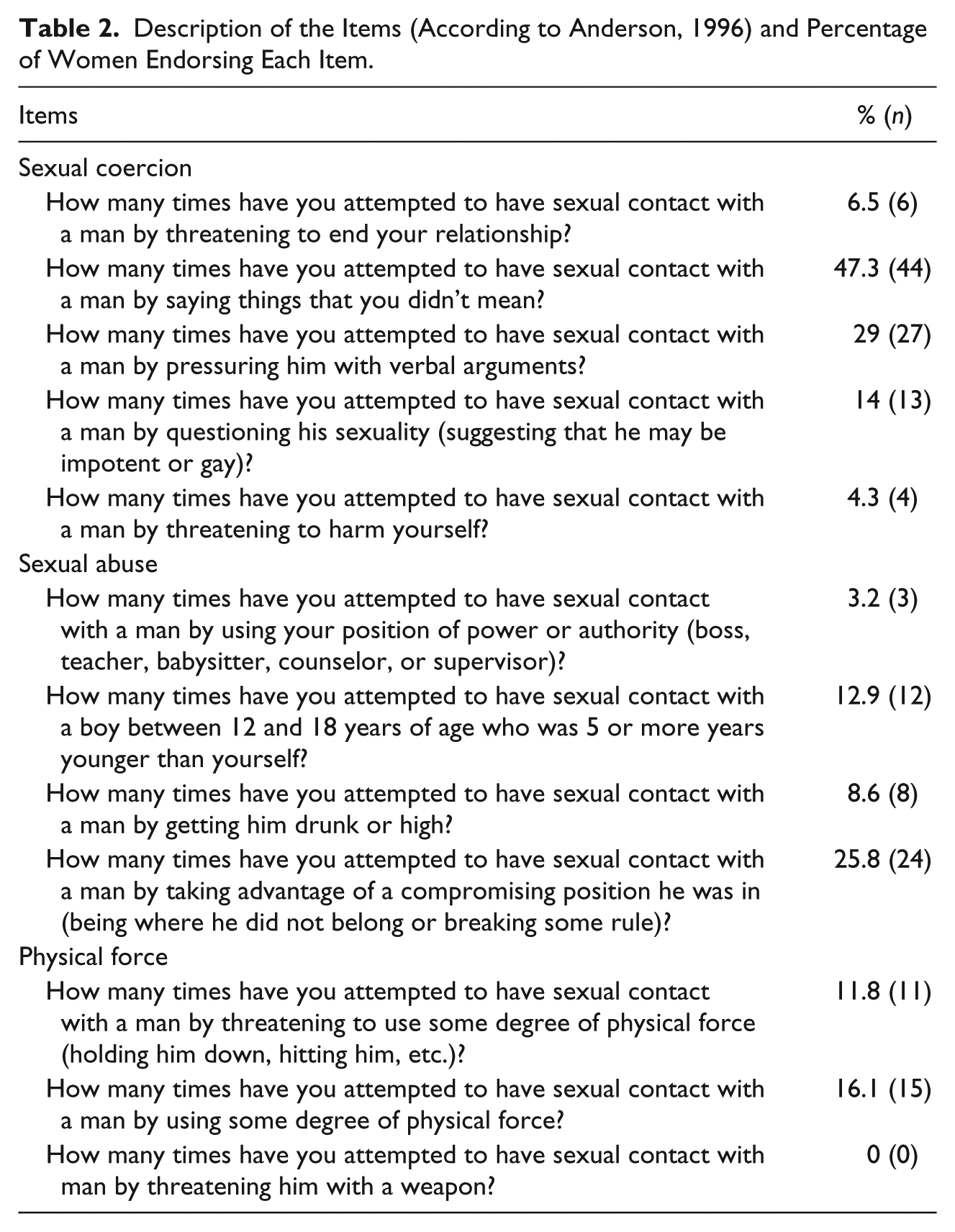
The SABS (Anderson, 1996) is a 26-item self-response scale measuring how many times (lifelong frequency) women have initiated sexual contact using a variety of strategies (internal consistency α = .75). Three subscales were considered for the present study: sexual coercion assessing behaviors that are meant to pressure a man verbally or psychologically to have sex (e.g., “How many times have you attempted to have sexual contact with a man by pressuring him with verbal arguments?”), sexual abuse assessing the use of some sort of authority (for example, based on an age difference) to have sex (e.g., “How many times have you attempted to have sexual contact with a man by using your position of power or authority [boss, teacher, babysitter, counselor, or supervisor]?”), and physical force assessing the use or threat of physical force to have sex (e.g., “How many times have you attempted to have sexual contact with a man by using some degree of physical force?”) (see Table 2 for a description of the items). Overall sexual aggression is calculated by summing the scores on these three subscales. Scores are then dichotomized (0 = behavior has never occurred, 1 = behavior has occurred at least once).The internal consistencies for the present study were as follows: overall aggression α = .70, sexual coercion α = .71, sexual abuse α = .75, physical force α = .64.
Socially Desirable Response Set Measure (SDRS-5)
This measure assesses participant’s tendency to give socially desirable responses (Hays, Hayashy, & Stewart, 1989). The scale contains five self-response items (e.g., “I am always courteous even to people who are disagreeable”).The internal consistency for the original version was α = .68, and for present study was α = .71. Scores from this measure were introduced as covariate to control for the effect of social desirability on the findings.
Results
Descriptive Data
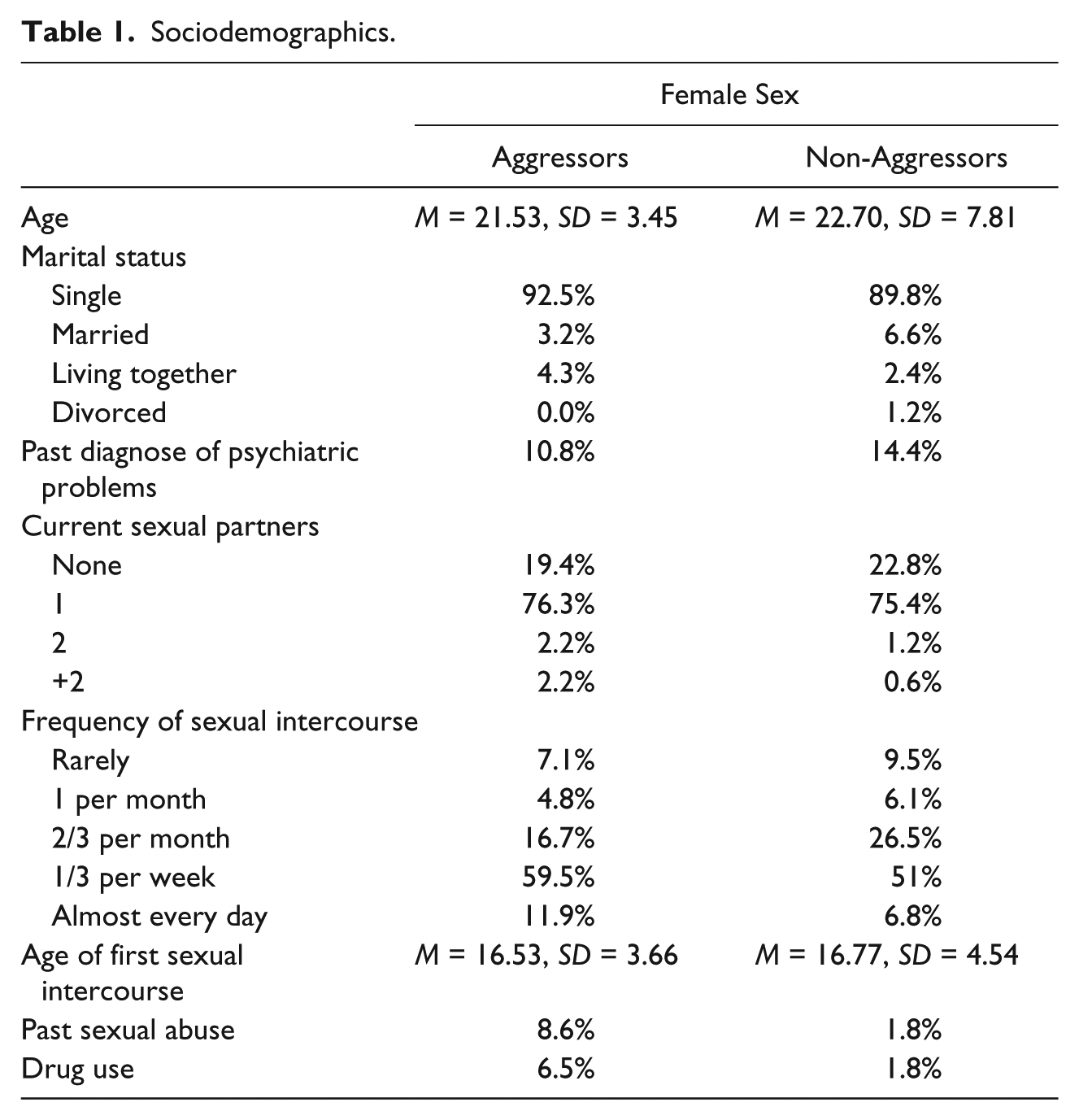
Descriptive data revealed that 167 (64.2%) women reported no history of sexually aggressive behavior whereas 93 (35.8%) reported some form of sexual aggression against men. More precisely, 46.2% of the sexually aggressive women fell into the category of sexual coercion (e.g., initiating sex with a man by threatening to end a relationship, verbal pressure), 34.1% fell into the category of sexual abuse (e.g., sex with a minor by an adult at least 5 years older than the minor, by using a position of power/authority), and 19.8% reported having used physical force (e.g., initiating sex by using physical force or a weapon) (data obtained from the SABS; see “Measures” section). Groups did not present significant differences on the following sociodemographic variables: age (t = 1.369, df = 258, p = .172), marital status (χ2 = 3.118, df = 3, p = .374), past diagnose of psychiatric problems (χ2 = .688, df = 1, p = .407), current sexual partners (χ2 = 1.996, df = 3, p = .588), frequency of sexual activity (χ2 = 5.114, df = 4, p = .276), age of first sexual intercourse (t = .424, df = 253, p = .672). Statistical differences were found on past history of sexual abuse, (χ2 = 6.829, df = 1, p = .009) and drugs consumption (χ2 = 3.874, df = 1, p = .049) (see Table 1). The percentage of sexually aggressive women endorsing each item (as measured by the SABS) is presented in Table 2.
Sociodemographics.
Description of the Items (According to Anderson, 1996) and Percentage of Women Endorsing Each Item.
Differences Between Sexually Aggressive and Non-Aggressive Women
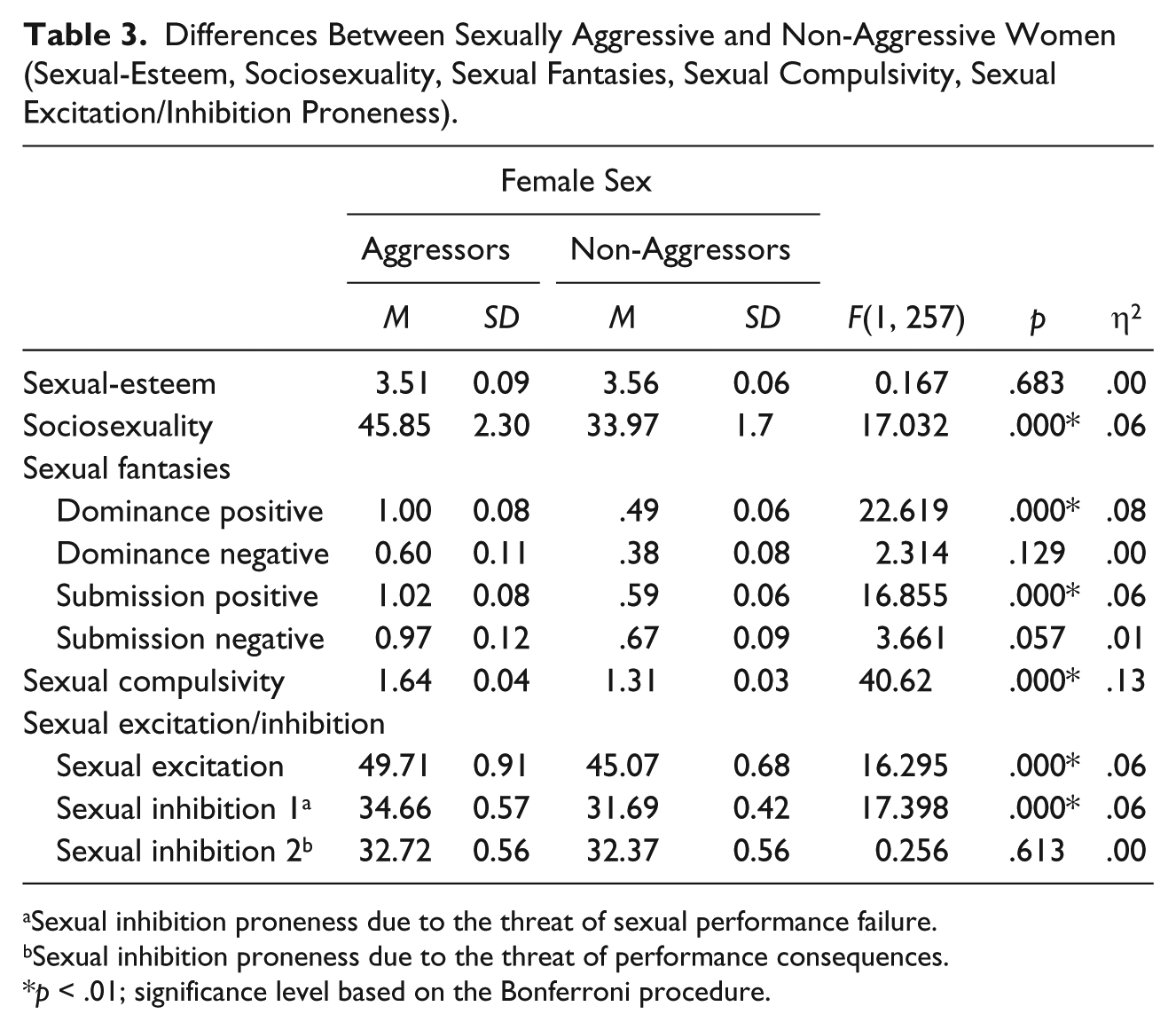
Univariate analyses of covariance (ANCOVAs) and multivariate analyses of covariance (MANCOVAs) were conducted to evaluate the effect of the group condition (Sexually aggressive × Control group) on the measured variables. Social desirability was introduced as covariate (Pearson product-moment correlations between social desirability and sexual aggression revealed the following associations: sexual coercion r = −.18, p < .01; sexual abuse r = .01, p = .86; physical force r = −.05, p = .34). Findings revealed a main effect for the group condition in all variables except sexual-esteem. Results were as follows.
Sexual-esteem
After controlling for social desirability, F(1, 257) = 4.799, p = .029, partial η2 = .018, no main effect was found, F(1, 257) = .167, p = .683, partial η2 = .001.
Sociosexuality
After controlling for social desirability, F(1, 245) = .285, p = .594, partial η2 = .001, a main effect of the group condition was found, F(1,245) = 17.032, p = .000, partial η2 = .065; univariate tests showed that sexually aggressive females presented significantly higher levels of sociosexuality than the control peers (see Table 3).
Differences Between Sexually Aggressive and Non-Aggressive Women (Sexual-Esteem, Sociosexuality, Sexual Fantasies, Sexual Compulsivity, Sexual Excitation/Inhibition Proneness).
Sexual inhibition proneness due to the threat of sexual performance failure.
Sexual inhibition proneness due to the threat of performance consequences.
p < .01; significance level based on the Bonferroni procedure.
Sexual fantasies
After controlling for social desirability, Wilks’s Λ = .983, F(4, 254) = 1.103, p = .356, partial η2 = .017, a main effect of the group condition was found, Wilks’s Λ = .913, F(4, 254) = 6.040, p = .000, partial η2 = .087. After Bonferroni correction (p = .01), univariate tests showed that women from the sexually aggressive group presented significantly more fantasies of sexual dominance as positive and sexual submission as positive (see Table 3).
Sexual compulsivity
After controlling for social desirability, F(1, 257) = .033, p = .856, partial η2 = .000, a main effect of the group condition was found, F(1, 257) = 40.629, p = .000, partial η2 = .137; univariate tests showed that sexually aggressive females presented significantly higher levels of sexual compulsivity (see Table 3).
Sexual excitation/inhibition proneness
After controlling for social desirability, Wilks’s Λ = .999, F(3, 255) = .119, p = .949, partial η2 = .001, a main effect of the group condition was found, Wilks’s Λ = .906, F(3, 255) = 8.804, p = .000, partial η2 = .094. After Bonferroni correction (p = .01), univariate tests showed that sexually aggressive women presented significantly more sexual excitation and sexual inhibition due to the threat of sexual performance failure (see Table 3).
Differences Between Categories of Sexual Aggression
Further analyses were conducted to compare the psychosexual characteristics of women according to the type of sexual aggressive behavior they have committed. In this section, participants reporting sexual aggression were located into the following categories: sexual coercion, sexual abuse, and physical force. Whenever a woman fell into more than one category, she was located in the category representing a higher level of forced sex. For this purpose, it was considered that physical force represented the highest level (n = 18), followed by sexual abuse (n = 31), and sexual coercion (n = 42). ANCOVAs and MANCOVAs were performed to evaluate the effect of the category condition on the measured variables (the same mentioned above). Findings revealed no differences between the categories except for sexual-esteem. After controlling for social desirability, F(1,87) = 2.461, p = .120, partial η2 = .028, a main effect of the category condition was found, F(1,87) = 4.221, p = .018, partial η2 = .088. Women from the sexual abuse category presented significantly more sexual-esteem than women from the sexual coercion category (see Table 4).
Differences Between Categories of Sexual Aggression (Sexual-Esteem, Sociosexuality, Sexual Fantasies, Sexual Compulsivity, Sexual Excitation/Inhibition Proneness).
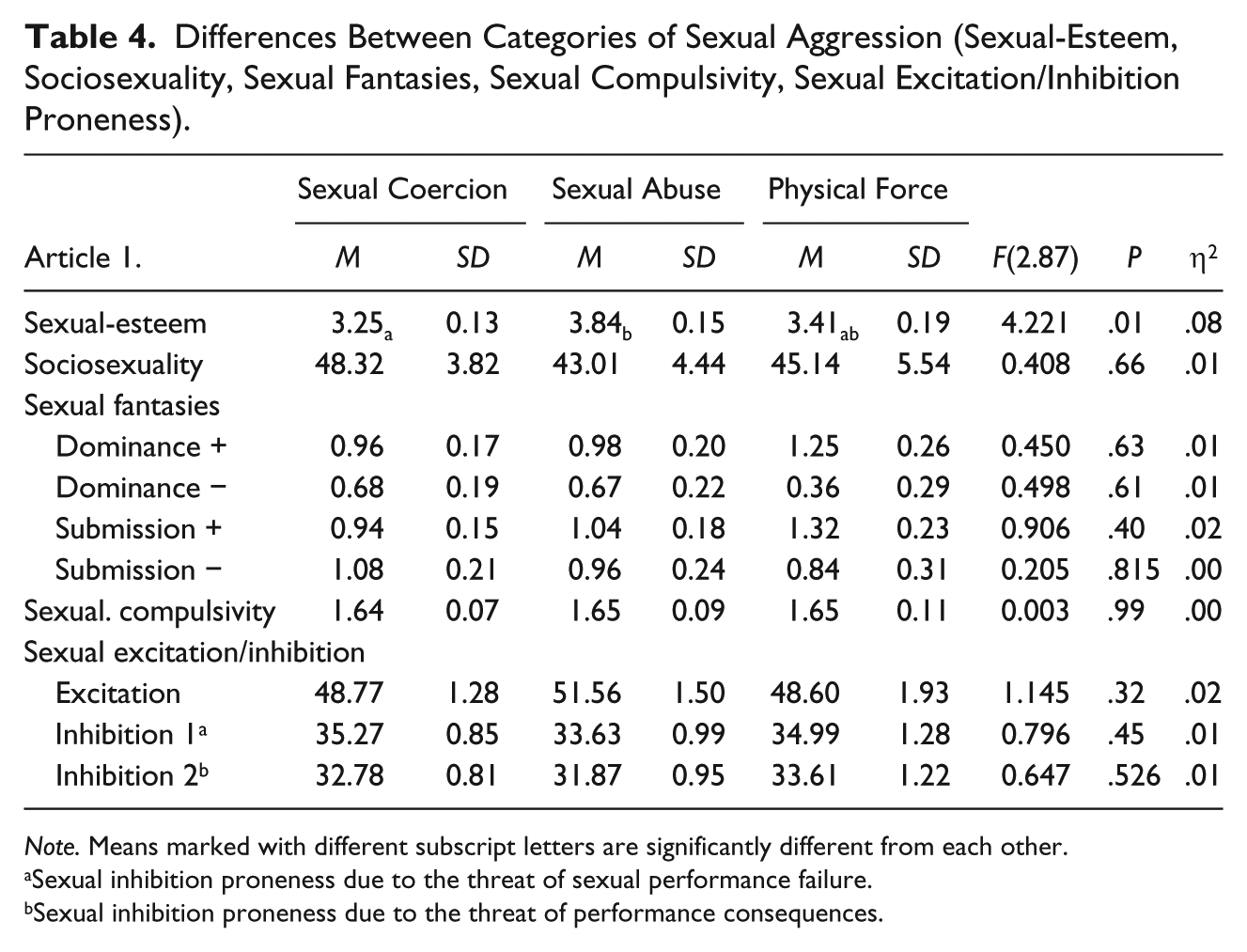
Note. Means marked with different subscript letters are significantly different from each other.
Sexual inhibition proneness due to the threat of sexual performance failure.
Sexual inhibition proneness due to the threat of performance consequences.
Discussion
In the face of the scarce evidence on female sexual aggression, the aim of the present study was to evaluate the psychosexual characteristics of women reporting sexual aggression against men. Findings revealed that 35.8% of females reported some form of sexual aggression. Among these, 46.2% fell into the category of sexual coercion, 34.1% fell into the category of sexual abuse, and 19.8% were assigned to the category of physical force. Although data on the prevalence of female sexual aggression are not new, these rates suggest that the phenomenon of sexual aggression as committed by female college students is somehow common. Although, it must be acknowledged that prevalence rates strongly depend on the measures used to assess sexually abusive behavior and strategies; item’s content may influence these numbers dramatically. 2 Whereas studies using other measures—rather than the measure used in the present study—revealed lower rates (see “Introduction” section), a study conducted in the 1990s using the SABS show that 25.7% to 28.5% of women fell into the sexual coercion category, 7.3% to 21.1% fell into the sexual abuse category, and 1.6% to 7.1% fell into the physical force category (Anderson, 1998). Although sexual behaviors have been conceptualized under similar headings (e.g., female sexual aggression), not all refer to the same behavioral repertoire. Furthermore, data on prevalence rates suggest that women may appraise some of this behavior as normative or even encouraged by some icons of modern society in Western culture. 3 Some of these cultural influences have been related to health risk behaviors in young women (e.g., Bonomi et al., 2014). In addition, this was a study conducted in a European country (most of the studies on this topic have been conducted in United States), thus showing that this phenomenon may have a cross-cultural nature, particularly within Western countries. In line with previous research (e.g., O’Sullivan et al., 1998), the current findings have also shown that the most frequently used strategy to coerce a man into sex is verbal manipulation. As a hands-off strategy, verbal manipulation may mask sexually aggressive behavior as socially acceptable behavior, explaining why this conduct is not, most of the time, regarded as criminal by aggressors, victims, and society at large. In addition, results revealed that sexually aggressive females reported significantly more past sexual abuse (i.e., were more frequently victims of some form of sexual coercion in the past). Previous research has consistently reported similar findings (e.g., Krahé et al., 2003; Russell & Oswald, 2001) which points to a possible victim-to-perpetrator cycle that has been often found in male sex offenders (e.g., Lee, Jackson, Pattison, & Ward, 2002).
Data on sociosexuality showed that sexually aggressive females endorsed significantly higher levels of unrestricted sociosexual orientation (i.e., the endorsement of casual sex) in relation to the control peers. The same profile was found in male college students reporting sexual aggression against women (Yost & Zurbriggen, 2006). Furthermore, aggressive women reported having had significantly more sexual fantasies of sexual dominance and sexual submission; such fantasies were regarded as positive (i.e., sexual fantasies that are purposely used to enhance sexual arousal and gratification). Although sexual fantasies (particularly those containing themes of violence) are expected to play a role in the motivation for sexual crimes (e.g., Abel & Blanchard, 1974), it is also known that a large majority of people experience such fantasies without putting them into practice. For this reason, the topic of deviant sexual fantasies as a direct predictor of sexual violence remains a very controversial issue (Leitenberg & Henning, 1995). Notwithstanding, the current findings on sexual fantasies are in line with those found in previous studies targeting male students. For example, in a study conducted by Plaud and Bigwood (1997), the authors found a relationship between physiological sexual arousal (erection as measured by penile plethysmography) to stimuli displaying sexual coercion against women and sexual fantasies of dominance (to hurt someone) and submission (being hurt). Findings on the proneness for sexual excitation/inhibition (as measured by the SIS/SES rather than by psychophysiological methods) were also similar to those found among samples of male students reporting sexual aggression. Such as in the present study, sexual inhibition due to the threat of sexual performance failure was found to predict sexual aggression as committed by males (Carvalho, Quinta-Gomes, & Nobre, 2013; Peterson, Janssen, & Heiman, 2010). The current data partially departs from what is known about males as women from this study also presented increased sexual excitation. Although more research is certainly needed, this pattern (sexual excitation accompanied by the loss of sexual arousal as a response to the fear of failing sexual performance) may reveal that sexually aggressive women may use sexual coercion as a mean to cope with the fear of sexual failure (non-consented sex is expected to involve less sexual demand and anxiety), while acting on their sexual urges.
Women committing sexual aggression further presented significantly more sexual compulsivity (i.e., recurrent and intense out of control sexual fantasies, thoughts, and urges that significantly interfere and cause damage in one’s life; Coleman, 1991). This dimension presented the highest effect size. A similar finding has been previously described (Schatzel-Murphy et al., 2009) suggesting that sexual compulsion may be a key factor in female sexual aggression. In all, data suggested that the psychosexual profile of female students reporting sexual aggression overlaps with some features that were already recognized as characterizing male offenders. As Anderson (1998) noted in the 1990s, college women were behaving differently from the expected gender role stereotypes, displaying a more male centered sexual behavior. Whether such behavior has its roots on cultural bases rather than on more personal/dispositional mechanisms is something that remains to be seen.
Findings on the differences between categories of sexual aggression revealed that women from the sexual abuse category presented significantly more sexual-esteem than women from the sexual coercion category. In the absence of a solid theoretical background, we can only speculate that high sexual-esteem (more confidence in sexual contexts) may prone aggressive women to use authority, replacing verbal manipulation by the use of their status to act out sexually.
The present study presents some limitations that must be recognized. First, findings must be regarded has having a preliminary nature; future research is warranted to clarify the processes underpinning the phenomenon of female sexual aggression. Second, this was a correlational study; no cause–effect mechanism can be inferred from the current data. It must be also acknowledged that the present findings relate to a particular population living in a specific social context. No generalizations should be made to other samples (e.g., forensic samples of female sexual offenders). Also, because more than 50% of potential participants dropped out the study, data on the prevalence rates are possibly not representative of the general population of heterosexual college women. It must be further recognized that although we have used a self-report measure described as assessing sexually aggressive behavior committed by women toward men, some of the items do not clearly separate consensual from non-consensual sexual activities involving some form of coercion. In fact, none of the questions asked about completed sexual intercourse; all pertained to attempted intercourse. It might be possible that some of the reported behaviors have been performed within the context of a consensual sexual interaction where some degree of force was used. In addition, there are no data on whether men appraised this behavior as aggressive/non-consensual or aggressive/consensual. Furthermore, women were not directly asked if they considered having committed sexual offenses. For this reason, future studies should acknowledge this gap and more comprehensive measures on sexual aggression should be used. Finally, there is a chance that levels of sexual-esteem were confounded by levels of (general) self-esteem.
Overall, the present study showed that some women attempt sexual intercourse by means of aggressive strategies. Further, psychosexual dimensions (some of them recognized as characterizing male sexual aggressors) seem to be related to how these women pursue sexual interaction with men. Findings are thus expected to add to the literature on women’s heterosexual relationships.
Footnotes
Declaration of Conflicting Interests
The author(s) declared no potential conflicts of interest with respect to the research, authorship, and/or publication of this article.
Funding
The author(s) received no financial support for the research, authorship, and/or publication of this article.