



Abstract
The present study examined negative life events (NLEs) and sexual assault victimization as predictors of positive and negative psychological functioning in a sample of 151 female college students. Results obtained from conducting regression analyses indicated several notable patterns. NLEs, compared with sexual assault victimization, were a stronger negative predictor of positive functioning based on indices related to subjective well-being (e.g., life satisfaction, positive affect). Alternatively, sexual assault victimization, compared with NLEs, was a stronger positive predictor of negative functioning based on indices related to posttraumatic stress disorder symptoms (e.g., anxiety) and related conditions (e.g., alcohol use). Furthermore, both NLEs and sexual assault victimization were found to be positive predictors of negative functioning based on indices related to suicide risk (e.g., depressive symptoms, suicidal behaviors). Overall, our findings indicate that both NLEs and sexual assault victimization represent important and distinct predictors of psychological functioning in female college students.
Keywords
Negative life events (NLE), defined by experience/exposure to a wide variety of unfortunate occurrences (e.g., failed exam, financial problems, death of a loved one) over time, has been one of the most frequently examined concomitants of psychological functioning over the past half century (Harkness & Monroe, 2016; Holmes & Rahe, 1967). Indeed, many psychological theories of human adjustment have often been predicated on highlighting the central role of NLE in generating stressful experiences in adults (e.g., Abramson, Seligman, & Teasdale, 1978; Hammen, 2016; Taylor, 1991; Vinkers et al., 2014), including in college student populations (e.g., Chang, Sanna, Hirsch, & Jeglic, 2010; Dunkel-Schetter & Lobel, 1990; Dyson & Renk, 2006). Noteworthy, in a sample of 3,640 college students, Smyth, Hockemeyer, Heron, Wonderlich, and Pennebaker (2008) found that 84.5% of the students reported experiencing some type of NLE, with the two most common types involving death of a loved one (62.7%) and adverse academic events (39.6%).
In turn, experience of NLE in adult populations, including in college student populations, has consistently been linked to a wide range of psychological indices of functioning (e.g., depression, anxiety, suicidal behaviors, and alcohol use; Chang et al., 2010; Dyson & Renk, 2006; Joiner, Katz, & Lew, 1999; Rowe, Walker, Britton, & Hirsch, 2013). For example, in a large sample of college students, Chang and Sanna (2003) found that NLE was a significant positive predictor of depressive symptoms and a significant negative predictor of life satisfaction. Similarly, in a study involving a large sample of Black and White female college students, Broman (2005) found that NLE was positively associated with alcohol-use-related problems (e.g., neglected responsibilities, could not stop drinking). Taken together, past studies examining NLE in college students have found it to be a prevalent problem and an important correlate or predictor of psychological functioning. However, what is not clear from past findings is whether other types of events may be as important, if not more important, in predicting psychological functioning in college students. Thus, in the present study, we focus on one specific type of event, namely, sexual assault victimization (SAV).
Sexual assault can be broadly defined as any sexual act that takes place without the victim’s consent (e.g., unwanted sexual touching, forcible penetration; Polusny & Arbisi, 2006). Importantly, sexual assault victimization is unlike NLE commonly experienced by college students. First, sexual assault victimization involves a situation in which an individual commits a sexual assault against another that is usually a criminal/illegal act (DeMatteo, Galloway, Arnold, & Patel, 2015). This is different from simply experiencing, or being exposed to, general NLE (e.g., failing an exam, missing a paper deadline) that typically does not involve the violent actions of others. Second, although exposure to general NLE is believed to be stressful, exposure to sexual assault victimization is believed to be sufficiently traumatizing for some to involve a wide range of negative psychological outcomes (Fedina, Holmes, & Backes, 2018; Karjane, Fisher, & Cullen, 2005; Klump, 2006; Turchik & Hassija, 2014). And last, whereas the experience of general NLE is equally likely to occur to male and female college students, sexual assault victimization is more likely to occur to female college students, than to male students (e.g., Carey, Durney, Shepardson, & Carey, 2015; Gross, Winslett, Roberts, & Gohm, 2006; Koss, Gidycz, & Wisniewski, 1987; Palmer, McMahon, Rounsaville, & Ball, 2010; Turchik & Hassija, 2014). For example, Krebs, Lindquist, Warner, Fisher, and Martin (2009) found that an alarming 20% of female college students in their sample experienced some type of sexual assault (e.g., drug-facilitated sexual assault, physically forced sexual assault) since entering college. Findings from other studies have indicated even higher prevalence rates when sexual assault attempts and completions were examined. For example, Carey et al. (2015) found that as much as 26% of female college students in their study reported being the victim of incapacitated rape (e.g., due to excessive drinking, being unwittingly drug induced by the perpetrator; Krebs et al., 2009). And, given the stigma often associated with reporting rape, the prevalence rate is likely to be much higher than those typically found in self-report studies (Fedina et al., 2018).
As noted above, given the traumatizing elements associated with sexual assault victimization (Fedina et al., 2018; Klump, 2006; Walsh et al., 2012; Zinzow et al., 2011), it is not surprising that victimization in female college students has often been found to be associated with poor psychological functioning (e.g., depression, suicidal behaviors; Chang & Hirsch, 2015; Eshelman & Levendosky, 2012). For example, in a study of female college students, Turchik and Hassija (2014) found that sexual assault victimization was positively associated with both problematic drinking and drug use. Similarly, Chang et al. (2017) found that sexual assault victimization was a significant positive predictor of both depressive symptoms and anxiety in a sample of female college students. Taken together, it is apparent that both NLE and sexual assault victimization are reliably associated with psychological functioning in female college students. However, as noted earlier, it is unclear whether experience of one is more harmful to female college students than experience of the other. Clarifying this question could have important implications for research and for developing targeted strategies to help female college students maintain optimal psychological functioning despite experiences of adversity. For example, if NLE, but not sexual assault victimization, was found to be a significant unique predictor of psychological functioning in female college students, then it would point to a need for researchers examining the effects of sexual assault victimization to strongly consider the concomitant effects of NLE in their study. Alternatively, and more important, if sexual assault victimization, but not NLE, was found to be a significant unique predictor of psychological functioning in female college students, then it would point to a critical need to allocate greater resources to the prevention and treatment of victimization on college campuses (Sabina & Ho, 2014).
Purpose of the Present Study
Given these concerns, the main purpose of the present study was to determine the extent to which NLE and sexual assault victimization represent important and unique predictors of diverse indices of both positive and negative psychological functioning (e.g., life satisfaction, depressive symptoms, and alcohol use) in female college students.
In general, consistent with past research (e.g., Broman, 2005; Chang & Hirsch, 2015; Chang et al., 2017; Turchik & Hassija, 2014), we expected both NLE and sexual assault victimization to emerge as significant and unique predictors of psychological functioning in female college students. However, given the traumatic elements often associated with sexual assault victimization (Klump, 2006; Walsh et al., 2012), we expected victimization to emerge as a more robust predictor of functioning than NLE.
Method
Participants
One hundred sixty-eight female college students from a university in the Southeast United States participated in the present study. However, given our focus on young adult college students, responses from participants above 25 years of age were excluded from the present study. This resulted in our final sample of 151 participants for the present study. The ages of participants ranged from 18 to 25 years, with a mean of 20.23 years (SD = 1.63 years). The majority of the participants were White/European American (88.7%), followed by Black/African American (6.6%), Asian American (2.6 %), and Latino American (2.0%). The majority of the participants were freshmen (35.8%), followed by sophomores (21.9%), juniors (20.5%), seniors (20.5%), and those indicating “Other” (1.4%).
Measures
Negative life events
To assess for NLE, we used the Life Events Scale (LES; Tomoda, 1997). In the present study, we focused only on the 23-item Negative Life Events Scale (LES-N). Respondents are asked to indicate whether they have experienced the life event over the past 12 months (1 = yes) or whether they have not experienced the life event (0 = no). We used the sum of the responses for NLE, which included items assessing for a wide range of common stressors (e.g., “I failed an exam,” “I had trouble with my friends,” “I failed my studies”). Evidence for the construct validity of LES in a Japanese college student sample has been reported in Tomoda (1997). In support of the construct validity of the LES-N in U.S. samples, LES-N scores have been found to be positively associated with depressive symptoms (Rowe et al., 2013; Visser, Loess, Jeglic, & Hirsch, 2013) and negatively associated with hope (Visser et al., 2013). In the present sample, the top six most commonly experienced NLE reported were “I had financial difficulties” (61.6%), “I failed an exam” (60.3%), “increased housework” (57.6%), “a family member or close relative was ill or hospitalized” (57.6%), “I was sick or injured” (57%), and “I had trouble with my friends” (51%). Internal reliability of the LES-N items was found to be .74. Higher scores on the LES-N indicate the experience of a greater number of NLE.
Sexual assault victimization
To assess for sexual assault victimization, we used four individual self-report questions from the National College Health Assessment Scale (NCHA; Hoban, 2007). The items assessed for various dimensions of sexual assault, namely, verbal threat (“Within the last school year, have you experienced verbal threats for sex against your will?”), unwanted sexual touching (“Within the last school year, have you experienced sexual touching against your will?”), attempted sexual penetration (“Within the last school year, have you experienced attempted penetration [vaginal, anal, oral intercourse] against your will?”), and completed sexual penetration (“Within the last school year, have you experienced sexual penetration [vaginal, anal, oral intercourse] against your will?”). Respondents are asked to indicate whether each event occurred with either “no” or “yes,” scored 0 or 1, respectively. In the present sample, 12.6% indicated verbal threats, 11.9% indicated unwanted touching, 7.3% indicated attempted sexual penetration, and 8.6% indicated sexual penetration. Although these rates are comparable with those found in other studies, it remains important to note the low rate of victimization present in our sample. We used the sum of the responses for these four items to assess for sexual assault. Internal reliability (Kuder-Richardson-20) of the SAV items was found to be .84. Higher scores on the SAV scale indicate the experience of a greater number of assaults.
Psychological functioning
To broadly assess for psychological functioning, we used a number of different measures that targeted both positive psychological functioning, namely, the Satisfaction With Life Scale (SWLS; Diener, Emmons, Larsen, & Griffin, 1985) and the Positive Affect (PA) Scale from the Positive and Negative Affect Scale (PANAS; Watson, Clark, & Tellegen, 1988), and negative psychological functioning, namely, the Negative Affect (NA) Scale from the PANAS, the Beck Depression Inventory (BDI; Beck, Ward, Mendelson, Mock, & Erbaugh, 1961), the Beck Anxiety Inventory (BAI; Beck, Epstein, Brown, & Steer, 1988), the Beck Hopelessness Scale (BHS; Beck, Weissman, Lester, & Trexler, 1974), the Suicidal Behaviors Questionnaire–Revised (SBQ-R; Osman et al., 2001), the Drug Abuse Screening Test (DAST-10; Skinner, 1982), and the Alcohol Use Disorders Identification Test (AUDIT; Saunders, Aasland, Babor, De la Fuente, & Grant, 1993).
The SWLS is a 5-item measure of global life satisfaction (e.g., “I am satisfied with my life”). Respondents are asked to rate the extent of agreement to these items across a 7-point Likert-type scale ranging from 1 (strongly disagree) to 7 (strongly agree). Internal reliability of the SWLS items was found to be .93. Higher scores on the SWLS indicate greater life satisfaction. The PANAS is a 20-item self-report measure of positive and negative affect. The PANAS-PA scale is comprised of 10 items assessing for positive affect (e.g., “enthusiasm”). The PANAS-NA scale is comprised of 10 items assessing for negative affect (e.g., “irritable”). Respondents are asked to rate how they felt for each item over the past several weeks across a 5-point Likert-type scale ranging from 1 (very slightly) to 5 (extremely). Internal reliabilities of the PANAS-PA and PANAS-NA items were found to be .90 and .88, respectively. Higher scores on the PANAS-PA and PANAS-NA scales indicate greater positive and negative affect, respectively.
The BDI is a commonly used 21-item self-report measure of depressive symptoms. Respondents are asked to rate the extent to which they have experienced specific depressive symptoms in the past week across a 4-point Likert-type scale (e.g., 0 = I do not feel sad to 3 = I am so sad or unhappy that I can’t stand it). Internal reliability of the BDI items was found to be .95. Higher scores on the BDI indicate greater depression. The BAI is a commonly used 21-item self-report measure of anxiety symptoms. Respondents are asked to rate the extent to which they have experienced specific anxiety symptoms in the past week across a 4-point Likert-type scale (e.g., 0 = not at all to 3 = severely: It bothered me a lot). Internal reliability of the BAI items was found to be .94. Higher scores on the BAI indicate greater anxiety. The BHS is a 20-item measure of extreme pessimism or hopelessness. Respondents are asked to indicate either agreement or disagreement with items that assess negative expectancies for the future (e.g., “My future seems dark to me”). Internal reliability (Kuder-Richardson-20) of the BHS items was found to be .88. Higher scores on the BHS are indicative of greater hopelessness. The SBQ-R is a 4-item measure that assesses for key aspects of suicidal behaviors (e.g., suicide ideation, suicide attempt; “How often have you thought about killing yourself in the past year?”). Respondents are asked to indicate how often or how likely it is for each of the suicidal behaviors to be present across a 5- to 7-point Likert-type scale, for example, ranging from 0 or 1 (never) to 5 (very often) or 6 (very likely). Internal reliability of the SBQ-R items was found to be .79. Higher scores on the SBQ-R indicate greater suicidal behaviors.
The DAST-10 is a 10-item measure that assesses potential abuse and dependence on nonalcohol drugs and substances within the past year (e.g., “Have you used drugs other than those required for medical reasons?”). Respondents are asked to indicate whether they have experienced the drug-use-related item (1 = yes) or whether they have not experienced the drug-use-related item (0 = no). Internal reliability of the DAST-10 items was found to be .84. Higher scores on the DAST-10 indicate greater dependence on and abuse of drugs. Finally, the AUDIT is a 10-item measure that assesses for domains associated with hazardous alcohol use (e.g., “How often do you have six or more drinks on one occasion?”), dependence symptoms (e.g., “How often during the last year have you found that you were not able to stop drinking once you had started?”), and harmful alcohol use (e.g., “How often during the last year have you had a feeling of guilt or remorse after drinking?”). Respondents are asked to rate the frequency to which they have experienced the alcohol-use-related item in the past year across a 5-point Likert-type scale (e.g., 0 = never to 4 = four or more times a week). However, two items ask respondents to indicate the frequency of alcohol-use-related injury (“Have you or someone else been injured as a result of your drinking?”) and expressed concern from others (“Has a relative or friend, or doctor or other health worker, been concerned about your drinking or suggested you cut down?”) across a 3-point Likert-type scale, ranging from 0 (no) to 2 (yes, during the last year). Internal reliability of the AUDIT items was found to be .85. Higher scores on the AUDIT reflect greater problematic alcohol use.
Procedure
Participants attending a regional university in the Southeast United States were recruited through an electronic data collection system that allows potential participants to determine which studies they would like to participate in, and then voluntarily enroll. Participants were awarded research credits that were used either as extra credit or to fulfill a course requirement. In this institutional review board–approved study, participants completed surveys online in a location of their choosing, but first clicked through an electronic informed consent. Completion of the survey took approximately 30 min. Upon completion, participants were provided with information about local mental health resources available on campus.
Results
Although our focus was on female college students in general, it is worth noting that results of conducting MANOVAs on the present set of measures indicated no differences due to age and class standing. However, a significant ethnoracial effect was found, Wilks’ lambda (11, 139) = .64, p < .001. This was due to significant ethnoracial differences on drug use, F(4, 146) = 2.74, p < .05, with Asian Americans and African Americans reporting the lowest means on the DAST-10 (Ms = 1.25 and 1.30, respectively), and on alcohol use, F(4, 146) = 3.85, p < .05, with Latino Americans reporting the highest mean on the AUDIT (M = 13.66).
Pearson correlations, means, and standard deviations for all study measures are presented in Table 1. Noteworthy, NLE was associated with only five out of the nine psychological functioning outcomes, whereas sexual assault victimization was associated with seven out of the nine psychological functioning outcomes. These associations were in the expected direction. For example, both NLE and sexual assault victimization were associated with lower life satisfaction, although the magnitude of change in life satisfaction was stronger involving sexual assault victimization than NLE. Interestingly, NLE, but not sexual assault victimization, was negatively associated with positive affect. In contrast, sexual assault victimization, but not NLE, was associated with alcohol use. Neither NLE nor sexual assault victimization was associated with drug use. Finally, it is worth noting that NLE and sexual assault victimization were not correlated with each other.
Correlations, Means, and Standard Deviations for All Study Measures in Female College Students.

Note. N = 151.
p < .05. **p ≤ .01. ***p ≤ .001.
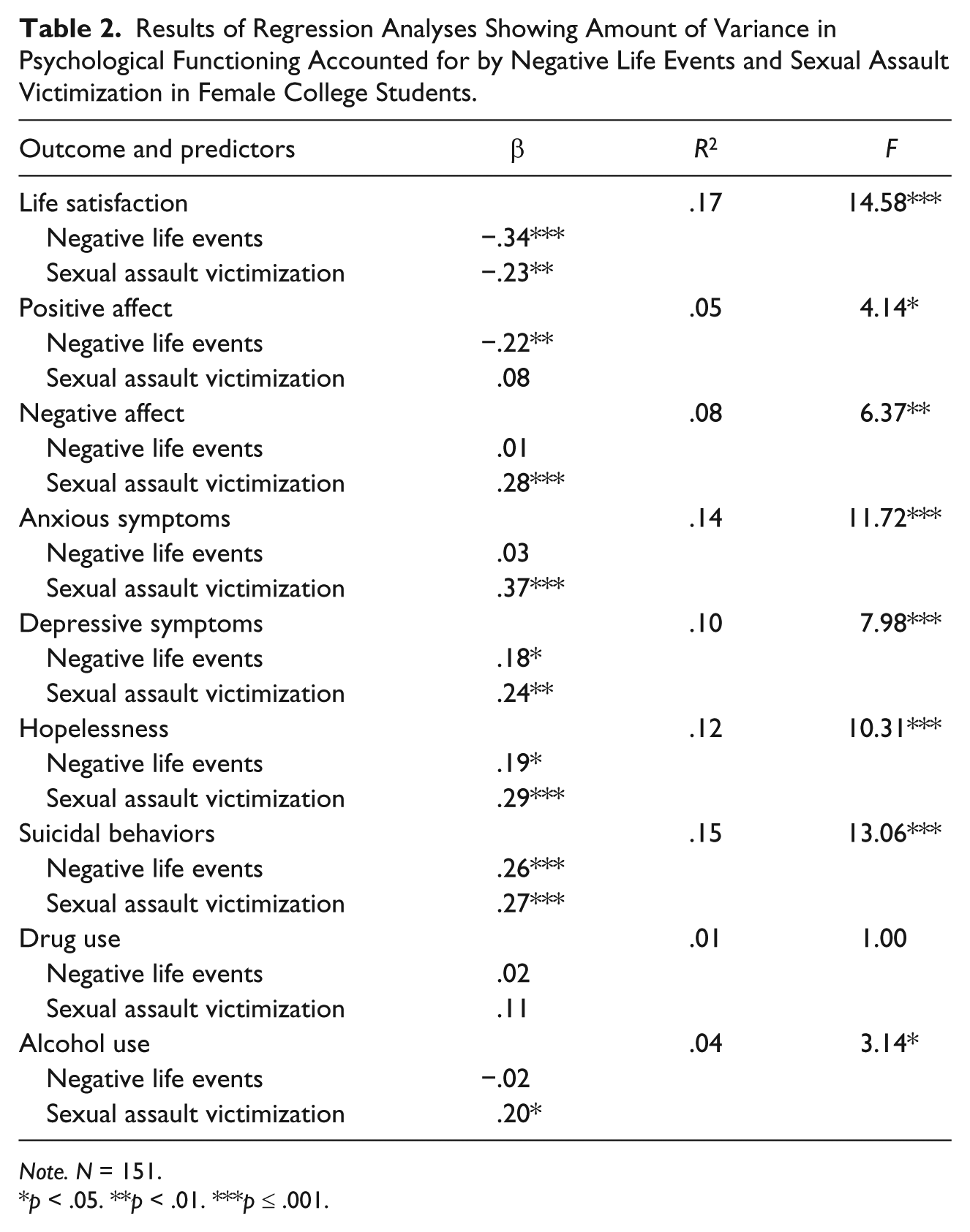
Next, to determine whether NLE and sexual assault victimization were significant unique predictors of psychological functioning in female college students, we conducted a series of regression analyses in which NLE and sexual assault victimization were simultaneously entered as predictors of each of the nine indices of psychological functioning measured in the present study. Results of these analyses for each of the indices of functioning are presented in Table 2. Moreover, if sexual assault victimization was found to be a significant predictor, we then ran additional analyses with NLE and the four sexual assault victimization items as a set to determine which specific type of sexual assault victimization might be involved in predicting psychological functioning. As the table shows, in predicting life satisfaction, NLE and sexual assault victimization accounted for 17% of the variance, with NLE (β = −.34, p < .001) emerging as the stronger unique predictor than sexual assault victimization (β = −.23, p < .01). Independent of NLE, only verbal threat emerged as a significant predictor (β = −.23, p < .05). In predicting positive affect, NLE and sexual assault victimization accounted for 5% of the variance, with NLE (β = −.22, p < .01) emerging as the only significant unique predictor of positive affect.
Results of Regression Analyses Showing Amount of Variance in Psychological Functioning Accounted for by Negative Life Events and Sexual Assault Victimization in Female College Students.
Note. N = 151.
*p < .05. **p < .01. ***p ≤ .001.
In predicting negative affect, NLE and sexual assault victimization accounted for 8% of the variance. Only sexual assault victimization (β = .28, p < .001) emerged as a significant unique predictor of negative affect. Independent of NLE, verbal threat (β = .28, p < .05) and unwanted touching (β = .23, p < .05) emerged as significant predictors. In predicting anxious symptoms, NLE and sexual assault victimization accounted for 14% of the variance. Only sexual assault victimization (β = .37, p < .001) emerged as a significant unique predictor of anxious symptoms. Independent of NLE, verbal threat (β = .32, p < .01) and unwanted touching (β = .21, p < .05) emerged as significant predictors.
In predicting depressive symptoms, NLE and sexual assault victimization accounted for 10% of the variance, with sexual assault victimization (β = .24, p < .01) emerging as a stronger unique predictor than NLE (β = .18, p < .05). Independent of NLE, only verbal threat emerged as a significant predictor (β = .40, p < .001). In predicting hopelessness, NLE and sexual assault victimization accounted for 12% of the variance, with sexual assault victimization (β = .29, p < .001) emerging as a stronger unique predictor than NLE (β = .19, p < .05). Independent of NLE, only verbal threat emerged as a significant predictor (β = .34, p < .01). In predicting suicidal behaviors, NLE and sexual assault victimization accounted for 15% of the variance, with NLE (β = .26, p ≤ .001) and sexual assault victimization (β = .27, p < .001) as significant unique predictors. Independent of NLE, only verbal threat emerged as a significant predictor (β = .33, p < .01).
In predicting drug use, NLE and sexual assault victimization accounted for 1% of the variance. Neither NLE nor sexual assault victimization emerged as a significant unique predictor of drug use. Finally, in predicting alcohol use, NLE and sexual assault victimization accounted for 4% of the variance. Only sexual assault victimization (β = .20, p < .05) emerged as a significant unique predictor of alcohol use. However, independent of NLE, no specific type of sexual assault victimization emerged as a significant predictor. Overall, these multiple regression results indicate that, depending on the specific outcome, NLE and sexual assault victimization are important and unique predictors of psychological functioning in female college students. Moreover, within sexual assault victimization, our ad hoc findings clearly highlight the consistent and robust role verbal threats appear to have on psychological functioning in female college students.
Interestingly, given that some researchers have argued that exposure to multiple forms of adversity might be associated with more extreme psychological disturbances or disorders (Adams et al., 2016; Mednick et al., 1998; Sabina & Straus, 2008), we were curious to examine the possibility that the experience of both NLE and sexual assault victimization would place some female college students at the greatest risk of poor psychological functioning. To test this possibility, we reran our earlier analyses, but this time used hierarchical regression analyses and included NLE and sexual assault victimization as a predictor set in Step 1, followed by the NLE × Sexual assault victimization interaction term as a predictor in Step 2. Noteworthy, we found no evidence for a significant NLE × Sexual assault victimization interaction effect in predicting any of the nine indices of psychological functioning assessed in the present study.
Discussion
As discussed earlier, findings from studies examining adversity as a correlate or predictor of psychological functioning have indicated that NLE and sexual assault victimization are significantly involved in poor psychological functioning (e.g., Chang et al., 2017; Eshelman & Levendosky, 2012; Rowe et al., 2013). However, what remained unclear in the extant literature was the degree to which NLE, sexual assault victimization, or both, represented important and unique predictors of psychological functioning. Accordingly, the present study attempted to address this question in a sample of female college students (i.e., a population at high risk of sexual assault victimization; Carey et al., 2015; Turchik & Hassija, 2014) by examining the role of NLE and sexual assault victimization as predictors of a wide range of psychological indices of functioning, ranging from life satisfaction, suicidal behavior, to substance use.
Our findings indicate that the roles of NLE and sexual assault victimization in predicting psychological functioning in female college students are complex, but not arbitrary. Specifically, at least five patterns are worth noting from the present findings. First, NLE, but not sexual assault victimization, was found to be a reliable negative predictor of positive psychological functioning in female college students. Specifically, NLE emerged as the only negative predictor of positive affect and a stronger negative predictor, compared with sexual assault victimization, of life satisfaction. Thus, for example, although our findings imply that sexual assault victimization may reduce life satisfaction in female college students, our findings imply that NLE plays a stronger role in diminishing their ability to experience life satisfaction. Given that life satisfaction represents a cognitive construct, whereas positive affect represents an emotional construct, it would be important in future studies to determine whether sexual assault victimization has a stronger impact on positive cognitive outcomes (e.g., optimism, hope), than on positive emotional outcomes (e.g., self-esteem, happiness). Furthermore, given that life satisfaction and positive affect represent fundamental expressions of subjective well-being in adults (Diener, 1984), it would be important to determine whether the present findings can be replicated in a culturally different female student population (e.g., Indian female college students, Turkish female college students; Muyan & Chang, 2019).
Second, with regard to negative psychological functioning, sexual assault victimization was found to be a reliable and unique positive predictor of six out of the seven indices of negative psychological functioning in female college students. Specifically, sexual assault victimization emerged as the only positive predictor of negative affect, anxious symptoms, and alcohol use. Interestingly, these three indices represent typical symptoms or sequelae of posttraumatic stress disorder (PTSD; e.g., anxiety, engagement in risky behavior, American Psychiatric Association, 2013). For example, in a review of studies focusing on female victimization, Hanson (1990) found that one of the most common long-term PTSD symptoms of sexual assault victimization in females was fear or anxiety (e.g., fear of revictimization). Similarly, in a study of adult females, Breslau, Davis, Peterson, and Schultz (1997) found that the presence of a prior traumatizing event (e.g., sexual assault victimization) significantly increased the risk of developing an alcohol use disorder. Moreover, it is important to appreciate that many campus sexual assault experiences occur in the context of alcohol (e.g., social gathering, party; Krebs et al., 2009). Interestingly, the finding that sexual assault victimization, as well as NLE, did not predict drug use suggests that other factors may need to be considered (e.g., cost of drugs, source/accessibility of drugs, campus drug policies; White & Rabiner, 2012) when examining the association between sexual assault victimization and drug use.
Third, of the three remaining indices of negative psychological functioning, both NLE and sexual assault victimization were found to be reliable positive predictors in female college students. Specifically, NLE and sexual assault victimization emerged as positive and unique predictors of depressive symptoms, hopelessness, and suicidal behaviors. Interestingly, these three indices represent outcomes that are commonly examined in studies of suicide risk in adults. For example, depressive symptoms have often been linked to greater suicide risk in adults, including in college student populations (e.g., Chang & Chang, 2016; Cukrowicz et al., 2011). Likewise, and not surprisingly, findings from studies have shown that both hopelessness and suicidal behaviors reliably predict risk of making a suicide attempt among adults (e.g., Beck, Steer, Kovacs, & Garrison, 1985; Osman et al., 2001). Accordingly, our findings might be taken to suggest a need to consider the potential negative impact of NLE and sexual assault victimization in heightening suicide risk in female college students.
Fourth, it is worth noting that we failed to find any evidence for a significant NLE × Sexual assault victimization interaction effect in predicting any of the nine indices of psychological functioning in our study of female college students. Given the somewhat diverse range of positive and negative indices of functioning (e.g., life satisfaction, depressive symptoms, and alcohol use) included in the present study, one might conclude that, for example, the presence of NLE does not appear to further intensify the association between sexual assault victimization and poor psychological functioning in female college students. However, this should not be taken to suggest that it would not be important, for example, to develop and implement effective campus-wide strategies to reduce or eliminate the risk of both NLE and sexual assault victimization among female college students (Carmody, Ekhomu, & Payne, 2009). Indeed, as noted earlier, both NLE and sexual assault victimization uniquely predicted variance in a number of important positive and negative outcomes, including life satisfaction, negative affect, depressive symptoms, hopelessness, and suicidal behaviors.
Fifth, within sexual assault victimization, it is worth noting that although unwanted touching emerged as an important unique predictor of negative affect and anxiety, verbal threats for sex was found to be a unique predictor of six out of the seven outcomes in which sexual assault victimization was found to be a unique predictor of. This pattern indicates that for female college students, their level of psychological functioning is affected by the threat for sex made by others, even in the absence of any physical contact attempted or made against them. Given that males are more likely to be the perpetrators, and females the victims, of sexual assault, our findings also point to a potential need to establish a campus culture in which college males are sensitized to how their sexualized comments, thoughts, and verbalizations might detrimentally affect the lives of their female peers (McDermott, Kilmartin, McKelvey, & Kridel, 2015).
Taken together, these patterns of findings indicate that NLE and sexual assault victimization are complexly involved in the psychological functioning of female college students, with NLE playing a stronger role in subjective well-being, sexual assault victimization playing a stronger role in symptoms and conditions related to PTSD, and NLE and sexual assault victimization playing comparable roles in suicide risk. Thus, in contrast to our general expectation that sexual assault victimization, compared with NLE, might emerge as the more robust predictor of psychological functioning in female college students, our findings indicate that one adversity is not necessarily more important than the other in predicting psychological functioning. Rather, our findings indicate that depending on the outcome of interest, the impact of NLE, sexual assault victimization, or both, in female college students need to be considered. Thus, for example, in studying and preventing suicide risk (e.g., depressive symptoms, suicidal behaviors) in female college students, it would be incomplete to just focus on the impact of NLE or sexual assault victimization alone. Both factors matter. In that regard, our findings make clear that more needs to be done in developing campus-wide strategies and policies that promote a healthy campus environment in which risk exposure to NLE and sexual assault victimization is lessened, if not eliminated, for female college students (Potter, 2016).
Some Limitations of the Present Research
Although the present study is the first to examine the comparative roles of NLE and sexual assault victimization in predicting psychological functioning in female college students, some limitations are worth noting. First, because our sample was predominantly European American, it would be important to determine whether similar or different findings emerge when studying diverse ethnoracial and cultural groups (e.g., Latin Americans, Asian Americans, and Black/African Americans; Muyan & Chang, 2019; Nguyen, Kaysen, Dillworth, Brajcich, & Larimer, 2010). As noted earlier, some ethnoracial differences were found on drug use and alcohol use in the present study. Relatedly, given the small sample size of the present study, a large nationally representative sample culled from diverse sites would be useful for providing greater power to identify and examine for the impact of more nuanced factors (e.g., differences in risk associated with class standing, impact of polyvictimization, use of alcohol or drugs, experience of precollege victimization). Second, although the present study focused on the prediction of positive and negative indices of psychological functioning, it would be useful to determine whether NLE, sexual assault victimization, or both continue to be significant and unique predictors of other important indices of functioning in female college students (e.g., eating disturbances, academic performance; Baker et al., 2016). Third, and relatedly, although we were interested in testing a prediction model involving NLE and sexual assault victimization as predictors of psychological functioning, our findings do not preclude the possibility that psychological functioning may play an important role in increasing the risk of NLE and sexual assault victimization in female college students. For example, as noted earlier, sexual assault on campus often occurs in the context of a party environment where alcohol is present (Krebs et al., 2009). Thus, building on the present findings, prospective studies would be useful for examining the extent to which NLE and sexual assault victimization predict changes in psychological functioning over time in female college students. Fourth, our measure of NLEs did not assess for salience or severity of each of the events. Accordingly, it would be useful in future studies to determine whether severity ratings associated with specific types of negative events might add further explanatory power in predicting psychological functioning, as well as to determine whether more chronic negative events (e.g., daily hassles) have a similar impact as acute negative events on psychological functioning (Harkness & Monroe, 2016). Similarly, in the context of a larger study, it would be useful to build on the present set of findings by using more comprehensive and nuanced measures of sexual assault experiences and victimization in future studies (e.g., specific type of attempted or completed penetration, characteristics of the perpetrator, presence of institutional resources; Koss et al., 2007). For example, our assessment of verbal threats for sex fails to consider situations in which those threats are and are not associated with physical sexual assault. Finally, given that prior victimization has been found to amplify the negative effects of later adult victimization (Arata, 2002; Walsh et al., 2012), it would be important in future studies to determine whether prior victimization (e.g., victimization beyond the past 12 months) might moderate the associations found in the present study involving sexual assault victimization and psychological functioning in female college students.
Concluding Thoughts
The present study is the first to examine whether NLEs and sexual assault victimization represent important and unique predictors of positive and negative indices of psychological functioning in female college students. Although we found that both NLEs and sexual assault victimization were important predictors of functioning, their involvement was in part determined by the specific index of functioning examined. That is, we found NLEs to be a reliable negative predictor of subjective well-being (e.g., life satisfaction, positive affect), sexual assault victimization to be a reliable positive predictor of PTSD-related symptoms and conditions (e.g., anxiety, alcohol use), and both to be reliable positive predictors of suicide risk (e.g., depressive symptoms, suicidal behaviors). Accordingly, our findings underscore a need for researchers to develop more complex models of psychological functioning in female college students that take into consideration not only different types of adversities but also different aspects of psychological functioning across the spectrum.
Footnotes
Acknowledgements
The first author would like to acknowledge Chang Suk-Choon and Tae Myung-Sook for their encouragement and support throughout this project.
Declaration of Conflicting Interests
The author(s) declared no potential conflicts of interest with respect to the research, authorship, and/or publication of this article.
Funding
The author(s) received no financial support for the research, authorship, and/or publication of this article.