



Abstract
Measuring experiences of intimate partner violence is critical for researchers and advocates. One measure, the Abusive Behavior Inventory (ABI), has limited testing but is used more frequently by advocates in domestic violence organizations. This article describes the psychometric evaluation of the ABI through confirmatory and exploratory factor analyses among data collected with 457 female survivors of abuse in seven states and Puerto Rico. The findings provide evidence for the reliability of a revised ABI (ABI-R) with three factors: physical violence, psychological abuse, and sexual abuse.
Accurately measuring intimate partner violence (IPV) has challenged researchers over the last 40 years. Many scales exist, measuring different forms of IPV, including physical, psychological, emotional, sexual, and economic abuse. Some, such as the Conflict Tactics Scale (CTS; Straus, 1979) and the Revised CTS (CTS2; Straus, Hamby, Sugarman, & Boney-McCoy, 1996) have been frequently used in IPV research and have demonstrated strong psychometric qualities with internal consistency reliability on the CTS2 ranging from .79 to .95 (Straus et al., 1996). Another measure, the Abusive Behavior Inventory (ABI), has limited testing but is used more frequently by advocates in domestic violence organizations as it is based on the coercive control framework (Stark, 2007). This framework theorizes that IPV encompasses a wide range of strategies in which an abuser purposefully and maliciously attempts to control his partner. Such a framework for the ABI is in contrast to the conflict theory guiding CTS and the CTS2 which purports that IPV may be a discrete incident of abuse. The purpose of this article is to fill the gap in the testing of the ABI by examining its factor structure and assessing the psychometric properties of the ABI using confirmatory factor analysis (CFA) and exploratory factor analysis (EFA) from data collected from female survivors of abuse.
Measuring IPV
The National Family Violence Survey (NFVS) was one of the first nationally based surveys that attempted to capture the magnitude of domestic violence in families (Straus & Gelles, 1986). Conducted in 1975 and again in 1985, the NFVS relied on the CTS and the Revised CTS, scales developed using the conflict theory as its framework. Such a theory frames violence as a discrete, autonomous experience that is used in relationships as part of the conflict that erupts in those relationships (DeKeseredy & Schwartz, 1998). Results indicated that violence was equally perpetrated by men and women against each other, which is in contrast to criminal justice and social service data (Hamby, 2009; Tjaden & Thoennes, 2000). The CTS and the CTS2 count the number of times someone uses a strategy to resolve conflicts in the relationship with a primary focus on the use of physical tactics (Straus, 1979; Straus et al., 1996). The CTS2 is widely used in research, providing data collectors a simple instrument to understand the prevalence of IPV (Lehrner & Allen, 2014).
However, the CTS and the CTS2 have been criticized for relying on conflict theory which sets violence in the context of family disagreement and conflict (DeKeseredy & Schwartz, 1998; Johnson, 1995; Saunders, 1988; Shepard & Campbell, 1992). In addition, the CTS does not include any items related to psychological abuse; even the revised version (CTS2), while including items on psychological conflict, has limited attention to such abuse (Tolman, 1989). The CTS2 also includes a sexual coercion subscale; unfortunately, very few researchers use that scale and the items are limited to forced penetration (Hamby, 2009). Finally, the CTS and the CTS2 fail to take into account the fear that violence instills in the victim (Belknap & Melton, 2005; Kimmel, 2002); such fear allows the perpetrator to continue to abuse the victim without needing to use extreme forms of violence. In sum, the CTS and the CTS2 “does not consider the history of coercion, control, and violence in creating a climate of fear and dominancy in the relationship” (Gilfus, Trabold, O’Brien, & Fleck-Henderson, 2010, p. 250). Indeed, researchers have repeatedly demanded a better measurement for IPV and to include the context in which the IPV occurs (Lehrner & Allen, 2014; Lindhorst & Tajima, 2008; Ryan, 2013; Woodin, Sotskova, & O’Leary, 2013).
Other nationally based studies used their own measures to collect the victims’ perspective and attempt to understand the context in which the violence occurs. The National Crime Victims’ Survey (NCVS) and the National Violence Against Women Survey (NVAWS) demonstrated that women were overwhelmingly the victims of male perpetrated violence; indeed, female victims needed medical attention following the abuse at least seven times more often than males who experienced abuse (Bachman & Saltzman, 1995; Tjaden & Thoennes, 2000). These surveys are based on the different strategies abusers may use to coercively control victims such as physical and sexual violence and verbal threats, not just strategies used to resolve conflicts.
The ABI
The ABI (Shepard & Campbell, 1992) is a commonly used measure to assess for physical and psychological abuse experiences. The ABI was developed as an alternative to the CTS and views violence as part of coercive control, which is based on feminist theory and patriarchal terrorism (Johnson, 1995; Stark, 2007). Coercive control and patriarchal terrorism frame violence in relationships as tactics used by an abuser (usually male) to maintain power and control over his partner. Such tactics are purposefully chosen that range from physical, sexual, emotional, and economic with the intent to intimidate, isolate, and control the partner. The assumption is that conflict occurs naturally within relationships, whereas coercive control is an intentional pattern of behavior that occurs over a period of time (Johnson, 1995; Stark, 2007). Hence, instructions given at the beginning of the ABI frames violence as one person’s efforts to control the partner instead of reporting typical arguments a couple may have with each other (Kimmel, 2002). The ABI is a self-report questionnaire that utilizes 30 Likert-type scale items to measure two subscales: Physical Abuse (10 items) and Psychological Abuse (20 items). The items were developed in consultation with advocates and survivors and were based on the “Power and Control” wheel, an educational tool developed for the domestic violence field (Pence & Paymar, 1985). The “Wheel” describes domestic violence as a series of tactics used by an abuser to maintain power and control over a victim. Such tactics include, but are not limited to, restricting finances, sexual coercion, physical violence, isolating the victim, preventing the victim from working, and name-calling.
The original scale (Shepard & Campbell, 1992) was tested with four groups of men (n = 100) and women (n = 78), recruited from an inpatient treatment facility equally divided into groups of abusers/abused and non-abusers/non-abused. The alpha coefficients for the four groups ranged from .70 to .92 demonstrating good reliability with the ABI. Original analyses included (a) conducting analysis of covariance to identify criterion-related validity, (b) correlating the ABI with other known abuse measures (e.g., clinical assessment of abuse, client assessment of abuse, and previous arrest for domestic abuse) and then correlating with demographic variables (e.g., age, household size) to establish construct validity, and (c) conducting a factorial validity analysis to examine correlations of individual items with the instrument’s score and not with unrelated variables. Results indicated that the ABI had good criterion-related validity with the ABI scores accounting for 25% of the variance between the abuse and no abuse groups. In addition, the ABI had good construct validity through the correlation of the ABI to other known abuse measurements and the lack of correlation to demographic variables. Finally, after conducting the factorial validity tests, the subscales were modified by shifting a few items from the psychological subscale to the physical subscale because these items discussed threats of physical force.
Originally developed to evaluate a domestic violence program, the ABI has since been used in a variety of settings, including medical settings (Ali et al., 2000), counseling settings with abusers (Bevan & Higgins, 2002), college campuses (Harned, 2001, 2002), high schools (Holt & Espelage, 2008), batterers intervention groups (Burch & Gallup, 2000), female perpetrators of IPV (Ridley & Feldman, 2003), and community settings with victims (Postmus & Severson, 2006). In addition, pieces of the ABI have been widely used in a number of studies (e.g., Haj-Yahia, 2000; Spath, 2003).
Despite the widespread use of the ABI, our literature review found no published research, since the original creation and validation of the scale that examines the factor structure of the ABI. In addition, the original research was limited to a small sample size that resided in a substance abuse program. Examining the factor structure of a measurement is important because this procedure confirms the theoretical constructs by demonstrating whether scale items load on the same factor and whether any scale items cross-load on more than one factor. Furthermore, Shepard and Campbell (1992) identified two subscales for the ABI, physical abuse and psychological abuse; however, the measure contains no subscales on sexual abuse or economic abuse, even though items reflecting these constructs are included. Three items reflect sexual abuse (“pressured you to have sex,” “physically forced you to have sex,” and “physically attacked the sexual parts of your body”) but are subsumed on the physical abuse factor. In addition, the ABI includes three items on economic abuse (“prevented you from having money for your own use,” “put you on an allowance,” and “stopped you or tried to stop you from going to work or school”) that fall on the psychological factor.
Therefore, the purpose of this article is to assess the psychometric properties of the ABI using CFA and EFA from data collected from female survivors of abuse. The article describes the women’s responses to the 30 original items in the Shepard & Campbell’s ABI, evaluates the reliability and factor structure of the scale, and discusses the clarity, relevance, and efficacy of the scale for use in both practice and research. We hypothesize that there may be more subscales (i.e., sexual abuse and economic abuse) than the original two (physical and psychological abuse) subscales of the ABI.
Method
This article utilizes survey data collected during the pre-test interview of 457 IPV survivors who participated in a longitudinal, randomized control study evaluating the impact of the Moving Ahead Through Financial Management curriculum. This curriculum, created by The Allstate Foundation in partnership with the National Network to End Domestic Violence, was created to help IPV survivors identify the signs of economic abuse, increase their knowledge of and ability to manage their finances, and obtain the confidence needed to strengthen their financial lives (www.clicktoempower.org).
Sample
Four hundred fifty-seven female IPV survivors participated in the pre-test interviews. The mean age was 36 years (SD = 9.15). The participants were racially diverse with 18% of the women identifying as Caucasian, 20% as African American, 54% as Latina/Hispanic, and 8% as “Other,” reflecting the demographics of our study cities in states such as Texas, New York, and New Jersey and Puerto Rico. Approximately half (52%) of the respondents were born in the United States. Almost half (48%) reported a yearly income under US$10,000. Eighty percent of the women reported having children.
Data Collection
Participants were recruited from 14 IPV programs in seven states (Connecticut, Iowa, New Jersey, New York, Rhode Island, Texas, and Wisconsin) and Puerto Rico. These programs were selected from areas representing different socioeconomic backgrounds, from both city and suburban locations, and from the Northeast, Midwest, Texas, and Puerto Rico. Advocates, provided with a screening checklist, recruited participants by advertising the study at their program. The checklist included the eligibility criteria which stated that the woman must (a) have experienced some form of IPV (i.e., physical, sexual, emotional, or economic) within the past 12 months and (b) be 18 years of age or older. Women who met the criteria and who expressed interest in the study completed a contact sheet; researchers then contacted each participant to arrange a face-to-face interview.
During the interview, participants were informed of the purpose of the project as well as any possible risks and benefits to participating in the study. Precautions were taken to ensure all contact with IPV survivors was conducted in a safe and sensitive manner. All materials (i.e., survey instrument, consent forms) were available in English and Spanish; research participants could also choose whether they wanted the interview to be conducted in English or Spanish. Such options were available as many of the IPV programs involved in the study had large numbers of Spanish-speaking survivors in their programs. The translation of the study instrument was a lengthy and complex process and focused on the cultural and contextual translation of the document for women from different Latino groups, including Puerto Ricans and Mexicans. In addition, all materials were approved by the Institutional Review Board located at the authors’ university. Finally, all interviewers had multiple years of experience working with IPV survivors and received training on the research protocol.
The pre-test interview lasted approximately 1 hr and covered a wide range of measures, including the ABI and a number of demographic questions. The survey instrument was available in paper and online formats, using SNAP, an Internet-based survey tool. All answers were either recorded on the paper survey or recorded directly into the SNAP survey; those answers on the paper survey were later put into the SNAP survey by the interviewer. For their participation in the interview, participants received a US$20 gift card. At the end of the interview, participants were randomly assigned to an experimental or control group to further test the impact of the curriculum. Three additional interviews followed this pre-test interview; however, the results in this article come from the pre-test data only.
Measures
The survey instrument was comprised of numerous validated or revised scales. For this article, the ABI and several questions on demographic variables, such as age, ethnicity, country of origin, income, and number of children, were included (Table 1).
Sample Characteristics (n = 457).

The ABI included 30 items encompassing two subscales, Physical Abuse (10 items) and Psychological Abuse (20 items). Participants were asked to indicate how often a partner had committed specific abusive acts over the last 12 months prior to completing the pre-test interview. The survey used a 5-point scale with answers ranging from 1 (never) to 5 (very often). The ABI has exhibited good reliability and construct validity in previous studies (Postmus & Severson, 2006; Shepard & Campbell, 1992). Both subscales in this study demonstrated good internal reliability in the current sample (Physical Abuse, α = .91; and Psychological Abuse, α = .93).
Data Analysis
The analysis was conducted in three phases. In Phase 1, we conducted CFA, using AMOS 19, of the 30-item ABI with the original two subscales (physical violence and psychological abuse) to determine whether the two-factor structure fits the data of this sample. Prior to conducting the CFA, frequencies were run for each of the items on the Abuse Behavior Inventory to examine the frequency with which participants answered each item. A CFA was then utilized to approach the data with the specified two-factor structure of the ABI and to assess the model fit among this sample. A combination of several fit indices were examined to assess the model fit as no one agreed upon single standard existence (Hair, Anderson, Tatham, & Black, 2005). Maximum likelihood procedure was used as the technique for parameter estimation. Chi square statistics as well as the comparative fit index (CFI), the incremental fit index (IFI), and the root mean square error of approximation (RMSEA) were used as model fit indices (Hu & Bentler, 1999).
In Phase 2, we conducted an EFA to re-examine the factor structure of the ABI. In contrast to the CFA that was utilized during Phase 1, during Phase 2, an EFA was utilized to explore the underlying factor structure without imposing a pre-determined model. As the data were collected through interviews, there were little missing data. In fact, missing data on the ABI items ranged from 0% to 2%. However, to ensure there was not a pattern of missing data, Little’s (1988) Missing Completely at Random test was run and found to be non-significant (p = .093) indicating that the pattern of missing data was not significantly different from a pattern of randomly missing data. Therefore, the pairwise deletion of cases was utilized for the EFA. We performed the EFA through a series of principal components analysis with no rotation, followed by a series of principal axis factor analyses with varimax rotation. At last, a series of principal axis factor analyses with oblimin rotation was conducted. We considered three criteria for the determination of the appropriate number of factors and items to remain. First, we examined the scree plot. Second, we used a theory-driven approach and examined the interpretability of the factor structure and item inclusion. Third, using a threshold for loading of .4 (Tabachnick & Fidell, 2007), items that loaded weakly and inconsistently across solutions and/or had low communalities across solutions were removed.
In Phase 3, we examined the internal consistency reliability of the revised ABI (ABI-R) by assessing the Cronbach’s alpha coefficient and the item-total correlations of the total scale and each of the three subscales. To check the magnitude of cross-scale loadings, each item was correlated with the three subscales.
Results
Phase 1: CFA
Table 2 presents the item analysis for each item of the Abuse Behavior Inventory. The distributional properties of each item were examined by inspecting the skewness and kurtosis of the item’s distribution, as well as the pattern of response frequency. Skewness ranged from −1.19 (“Called you a named and/or criticized you”) to 1.93 (“Used a knife, gun, or other weapon against you”). Kurtosis ranged from −1.72 (“Used your children to threaten you”) to 2.419 (“Used a knife, gun, or other weapon against you”).
Frequency Table for Abuse Behavior Inventory Items.

Note. 1 = never. 2 = rarely. 3 = sometimes. 4 = often. 5 = very often.
The original ABI (Shepard & Campbell, 1992) included two subscales: physical violence and psychological abuse. Therefore, we conducted a CFA on the ABI using our data to find out whether this factor structure would fit. For a factor structure to be a good fit, the chi-square would ideally be non-significant; in addition, higher values of the CFI and IFI, historically .90 or higher, and lower values for the RMSEA, historically .05 or lower, would indicate a well-fitting model (Byrne, 2001; Hu & Bentler, 1999). When the two-factor structure was tested with our data, the results were a poor fit, χ2(404) = 2237.09 (p < .001); CFI = 0.775, IFI = 0.758, RMSEA = 0.100.
Phase 2: EFA
An EFA was then conducted utilizing principal axis factoring extraction and direct oblimin rotation. Oblique rotation was utilized because of the assumptions that the constructs would be highly correlated (Worthington & Whittaker, 2006). Using a threshold for loading of .4 (Tabachnick & Fidell, 2007), items that loaded weakly and inconsistently across solutions and/or had low communalities across solutions were removed.
A three-factor solution was accepted, utilizing 25 of the original 30 items, Kaiser-Meyer-Olkin (KMO) = .948, χ2(300) = 7085.293, p < .001. The combined three factors accounted for 60.48% of the total variance. Items in the three factors are presented in Table 3. We interpreted the three factors as Physical Violence (9 items), Psychological Abuse (13 items), and Sexual Abuse (3 items).
Pattern Matrix Rotated to Oblimin Criterion.
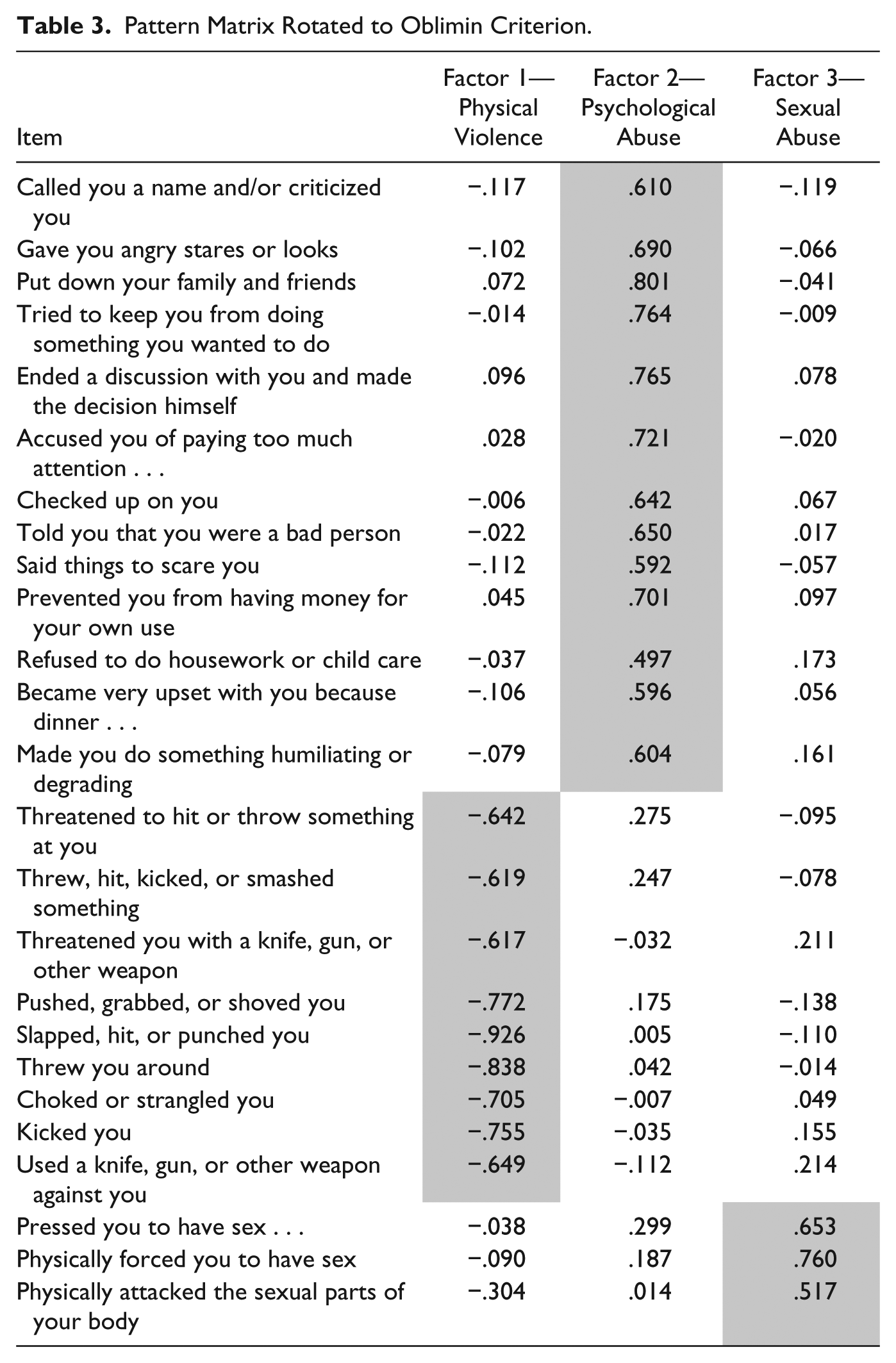
The Physical Abuse factor consists of nine items including items that measure physical violence or threat of physical violence. From the original ABI physical abuse subscale, there was one item dropped (“spanked you”), three items moved to the sexual abuse subscale (“physically forced you to have sex,” “pressured you to have sex,” and “physically attacked the sexual parts of your body”), and three items from the original psychological abuse subscale were added to the physical abuse subscale (“threatened to hit or throw something at you,” “threatened you with a knife, gun or other weapon,” and “threw, hit, kicked or smashed something”). The Sexual Abuse subscale is a new subscale consisting of three items capturing the use of manipulative and forceful sexual abuse behaviors. These three items (“physically forced you to have sex,” “pressured you to have sex,” and “physically attacked the sexual parts of your body”) were originally on the physical abuse subscale of the ABI.
The Psychological Abuse subscale includes 13 items capturing controlling and degrading abusive tactics. From the original ABI psychological abuse subscale there were 4 items removed (“put you on an allowance,” “used your children to threaten you,” “drove recklessly when you were in the car,” and “stopped you or tried to stop you from going to work or school"). In addition, 3 items from the original psychological abuse subscale moved to the physical abuse subscale (“threatened to hit or throw something at you,” “threatened you with a knife, gun or other weapon,” and “threw, hit, kicked or smashed something”).
Phase 3: Reliability
The internal reliability consistency of the ABI-R was assessed by examining the Cronbach’s alpha coefficient and item-total correlations of the total scale and each of the three subscales. The total ABI-R had a reliability coefficient of .95, with the Physical Violence, Psychological Abuse, and Sexual Abuse subscales all demonstrating strong internal consistency, with alpha coefficients of .93, .92, and .85, respectively. Note that a coefficient alpha of .70 to .79 is considered fair, .80 to .89 is good, and above .90 is excellent (Hair et al., 2005). In addition, the corrected item-total correlations ranged from .52 to .73. The corrected item-total correlations of the Physical Violence subscale ranged from .64 to .84, the corrected item-total correlations of the Psychological Abuse subscale ranged from .56 to .73, and the corrected item-total correlations of the Sexual Abuse subscale ranged from .60 to .82.
To check the magnitude of cross-scale loadings, each item was correlated with the three subscales. As presented in Table 4, this analysis revealed that all the physical violence items were more highly correlated with the physical violence subscale than with the psychological or sexual abuse subscales, the items of the psychological abuse subscale were more highly correlated with the psychological abuse subscale than the physical or sexual abuse subscales, and the sexual abuse items were more highly correlated with the sexual abuse subscale than with the physical or psychological abuse subscales. Furthermore, the three subscales were moderately correlated with each other. The physical abuse subscale was significantly correlated with the psychological abuse subscale (r = .63, p < .001) and the sexual abuse subscale (r = .59, p < .001), and the psychological abuse subscale was significantly correlated with the sexual abuse subscale (r = .53, p < .001). The positive correlations indicate that higher levels of one form of abuse are significantly related to higher levels of another form of abuse. Although the correlations between the three subscales were positively correlated they were only of moderate strength (ranging from .50 to .63). This provides evidence that the three subscales are unique constructs. Taken together, the factor analysis and the correlational analysis strongly support the existence of the ABI-R three-factor model.
Item-Total and Item-Scale Correlations for the ABI-R.

Note. ABI-R = The Abusive Behavior Inventory–Revised.
p < .001.
Discussion
Our study attempted to replicate the factor structure found in the original development of the ABI and found that a two-factor model was a poor fit. Further investigation revealed that a three-factor model was a better fit for the data, including a third subscale on sexual abuse in addition to physical and psychological abuse subscales. This finding supports the notion that sexual abuse is indeed a separate construct from physical abuse. The results from this study indicate that the ABI would benefit from including three different subscales including physical, psychological, and sexual abuse.
Treating sexual abuse as a distinct construct is important for a number of reasons. Previous studies have suggested that sexual violence may be a marker for more severe forms of violence (Coker, Smith, Bethea, King, & McKeown, 2000). Research indicates that women who experience sexual forms of IPV in addition to physical forms of IPV are at a greater risk for additional negative outcomes on their physical and mental health and well-being than those who experience physical, non-sexual forms of violence (Bonomi et al., 2007; Howard, Riger, Campbell, & Wasco, 2003; Pico-Alfonso et al., 2006). Experiencing sexual forms of IPV is also associated with seeking more help although victims’ needs are often unmet, perhaps due to unique, complex emotions that occur when sexual assault is experienced within the context of IPV (Cattaneo, DeLoveh, & Zweig, 2008). Survivors of sexual forms of IPV may need tailored types of intervention, to address the physical and emotional consequences that are unique to sexual violence. Many other IPV measurement tools identify sexual violence as its own subscale, rather than as a part of physical abuse (Marshall, 1992; Swahnberg & Wijma, 2003).
In addition, our results demonstrated some consistency with findings from the original validation study (Shepard & Campbell, 1992) in that, in our results, we dropped the item “spanked you” and moved three of the psychological items “threatened to hit or throw something at you,” “threatened you with a knife, gun, or other weapon,” and “threw, hit, kicked or smashed something” to the physical violence subscale. These findings support the concept that the category of physical violence consists of a number of types of behaviors beyond direct physical assaults, including threats of physical harm or implied threats of physical harm. Further research is needed to understand how the term threat is operationalized and understood from victims’ perspectives. Perhaps these items belong in the psychological abuse subscale as Shepard and Campbell first determined; perhaps they belong in the physical abuse subscale as we determined.
In addition to findings from the original validation (Shepard & Campbell, 1992), our results also suggested deleting four items, including “put you on an allowance,” “used your children to threaten you,” “drove recklessly when you were in the car,” and “stopped you or tried to stop you from going to work or school.” Most likely two of these items (“used your children to threaten you” and “drove recklessly when you were in the car”) did not hold up in the factor analysis because they are items that do not apply to every victim (i.e., victims without children and victims that do not own/use cars). Curiously, 80% of the women in this sample were economically responsible for children; however, this particular item still did not have a high loading to be included in the psychological factor. While “using children to threaten you” is often considered a common tactic used by abusers to gain control over their partner, one could argue that this item should be theoretically included in the ABI-R. However, among this sample 42% responded “Never” to this item. This suggests that perhaps using children to threaten the victim is not a tactic frequently used by abusers. Further research is needed to explore how this item would be answered among other samples of IPV survivors, and in particular, among samples from different ethnic/racial backgrounds.
The other two items that were dropped (“put you on an allowance” and “stopped you or tried to stop you from going to work or school”) are items that were originally included on the psychological subscale but are more accurately measures of economic abuse experiences. Because economic abuse has been identified as a unique form of abuse, and not just subsumed under psychological abuse, it is important to include measures of this when assessing for IPV (Stylianou, Postmus, & McMahon, 2013). However, the economic abuse questions originally included in the ABI are not comprehensive enough to measure the range of economic abuse behaviors that perpetrators utilize to gain financial control over the victim.
The findings from this study must be interpreted within a number of limitations. First, the sample included a convenience sample of women who had experienced violence and were receiving services. Replication of the factor structure with a sample of women (and men) not receiving services would help improve the instrument’s reliability and invariance. Study participants also differed, ethnically and in terms of nativity, from the general U.S. population. This difference is related to the characteristics of our study sites, which included agencies in New York, New Jersey, Texas, and Puerto Rico. Although not similar to the IPV survivor population on a national level, the sample differed little from the typical women who visit agencies in our study cities. In addition, with the increase of technological forms of abuse, it is important for instruments to include measures of this type of experience as well. Further research should expand these measures to gather more descriptive information about the forms of abuse (i.e., did they happen repeatedly, as a form of self-defense, in conjunction with other forms of abuse).
Implications and Conclusion
Despite these limitations, the ABI-R provides a reliable tool to measure experiences of physical, psychological, and sexual abuse. Practitioners and advocates working with IPV survivors should screen for all forms of violence and abuse, including physical, psychological, sexual, and economic as well as experiences of stalking. The ABI-R provides a strong tool to evaluate physical and psychological abuse as well as a few questions on sexual abuse. Acknowledging sexual violence on these three questions should prompt further discussion and screening of more detailed and nuanced sexual victimization. Validated questions about sexual violence are available from well-developed scales, such as the Sexual Experiences Survey (Koss et al., 2007), the 2010 Centers for Disease Control (CDC) National Intimate Partner and Sexual Violence Survey (Black et al., 2011), and The Campus Sexual Assault Study (Krebs, 2009). These scales could compliment the ABI as tools to understand the different types of abuse experienced by survivors. Furthermore, adding scales such as the Scale of Economic Abuse–12 (Postmus, Plummer, & Stylianou, 2016) could shed light on the myriad ways abusers control their partners. Such understanding would benefit practitioners and advocates as they provide comprehensive services to survivors. Practitioners can use the scores on the scales to assess the cumulative experiences of violence for victims, which can help practitioners tailor their interventions. In addition, discussing specific examples of different abuse strategies provide greater education for survivors who may not realize or understand that abuse is much more than just physical violence. For those individuals who may still be in abusive relationships, scores on the subscales may help prompt discussion about safety planning. Further work could examine how the ABI-R can work in conjunction with lethality assessments to maximize the opportunity to engage in safety planning.
In conclusion, the three-phase study indicates that the ABI-R offers a solid tool to be used by researchers when studying IPV. The first phase indicated that the two-factor original model was not a good fit, suggesting that physical and psychological factors were not adequate. The second phase of EFA revealed that, indeed, sexual violence is a separate, third factor. Reliability was established by the third phase of the study. Together, these results suggest that these three types of abuse should be recognized and measured as separate constructs. Further research can attempt to replicate the factor structure with other samples and populations. For example, it is important to look at measurement invariance across different groups such as Spanish-speaking individuals, or those from various ethnic or cultural backgrounds. In addition, determining how the ABI-R can work in conjunction with other IPV measurement tools to provide a comprehensive measurement package may allow researchers and practitioners to better assess the experiences of IPV survivors. Although further testing is needed for the ABI-R, the results from this study provide evidence of the strength of this tool to be used with IPV survivors. With the framing of IPV as coercive control and not framed as conflicts, the ABI-R provides researchers with a tool to measure physical, psychological, and sexual abuse among respondents. Additional testing is also needed with women as well as men who are not “known” IPV survivors or receiving services from a domestic violence organization. Instead, the ABI-R should also be tested with community samples to determine its reliability as a measure of IPV.
Footnotes
Authors’ Note
The opinions and conclusions expressed herein are solely those of the authors and should not be construed as representing the opinions or policies of The Allstate Foundation.
Declaration of Conflicting Interests
The author(s) declared no potential conflicts of interest with respect to the research, authorship, and/or publication of this article.
Funding
The author(s) disclosed receipt of the following financial support for the research, authorship, and/or publication of this article: This research was supported by the Allstate Foundation, Economics Against Abuse Program.