



Abstract
This qualitative project was the first to study values and practices about sexual assault among migrant communities from the Cook Islands, Fiji, Niue, Samoa, Tokelau, Tonga, and Tuvalu in New Zealand. It aimed to identify customs, beliefs, and practices among these ethnic groups that were protective and preventive factors against sexual violence. Researchers were ethnically matched with 78 participants from the seven ethnic communities, and conducted individual interviews and one female focus group using protocols that were culturally appropriate for each ethnic group. Interviews were thematically analyzed. The study identified the brother–sister covenant and the sanctity of women as strong protective and preventive factors against sexual violence, expressed differently in each culture. Most participants viewed sexual violence as involving their extended families, village, and church communities, rather than solely the individuals concerned. However, the communal values and practices of these seven Pacific cultures raise questions about the individualistic assumptions and the meaning of violence underlying the Power and Control Wheel and the Duluth Model of domestic violence. It also raises questions about how such an individualized model can help services effectively support women in these collective societies who are experiencing violence, and how it can contribute to Pacific community prevention of violence. This study is therefore relevant to countries with significant populations of Pacific peoples and other collective cultures.
Duluth Model of Power and Control
The most commonly used model of violence among intimate partners in Aotearoa/New Zealand 1 is the Duluth Power and Control Wheel (the wheel), created by the Minnesota Domestic Abuse Intervention Project (DAIP) in Duluth, USA. It was developed in 1981 in focus groups over several months, from the experiences of more than 200 women who had been abused by their partners. The wheel included their partners’ most common abusive tactics and behavior (DAIP, 2011) and was not intended as a universal description of battering behaviors (Pope & Ferraro, 2006). It was seen as part of a co-ordinated community response to domestic violence (DV) involving “systematic arrest, court action, probation supervision, victim supports, additional social services, and further sanction for noncompliance” (Gondolf, 2010, p. 996).
The wheel places power and control at the center; the segments represent different types of abuse, intimidation, and coercion used by male abusers to keep female partners subordinate and afraid. These are reinforced by physical and sexual violence, the rim of the wheel. A companion Equality Wheel was developed to “to describe the changes needed for men who batter to move from being abusive to non-violent partnership” (DAIP, 2011, par. 9).
Developed in a town that is more than 90% White, the DAIP (Paymar & Barnes, 2007) relates sexism to other power structures enabling groups to connect oppression at individual, group, and cultural levels (Pope & Ferraro, 2006). Developers acknowledged that
the materials of the DAIP are presented generically without any cultural referents. Such an appearance of neutrality often signifies a white, middle class, heterosexual experience of the world. . . . The DAIP leaves it to those who experience other types of oppression to articulate how multiple sites of power intersect their lives through the battering dynamic. (Pope & Ferraro, 2006, p. 4)
Originators encouraged adaptations of the wheel, as long as they were created from focus groups of those experiencing abuse in the community involved (DAIP, 2011). DAIP believes the process of adapting the wheel to describe violent male behaviors in different populations is “a unique opportunity to connect theory and practice, expand group understandings of how oppression works, and improve the ability to design responsive intervention strategies” (Pope & Ferraro, 2006, p. 7).
The wheel has since been translated into some 40 languages, used with groups of abused women and abusers, in police and legal training (DAIP, 2011); adapted for people in same-sex relationships, people of all ages, transpeople, Native American, Islamic and trafficked women, women with disabilities and mental illness, deaf people, people with HIV/AIDS, immigrant communities, and street sex workers (Hann, 2007; J. Kim, 2010; NCDSV, 2013; Witko, Martinez, & Milda, 2006); violence between female in-laws in India (Rew, Gangoli, & Gill, 2013); and to illustrate the violence inherent in structural racism in Aotearoa (Came, 2012).
The National Collective of Independent Women’s Refuges, the major provider of refuge (shelter) and DV services in Aotearoa, has used a slightly amended version of the wheel for many years (Women’s Refuge, n.d.). New Zealand government agencies also used the wheel from the mid-1980s, within a gender-neutral paradigm (Herbert, Hill, & Dickson, 2009).
The first Duluth training manual identified four elements of culture that support partner abuse and explain the gendered nature of DV (Pence, 1985):
The belief in a natural order of (male) power and authority within adult relationships
The objectification of women
Forced submission of the victim (female partner)
The unbridled use of physical coercion.
Pacific Critique of the Power and Control Wheel
Crichton-Hill (2001) critiqued these four conditions from a Samoan perspective, arguing that the roles and status of Samoan women “do not appear to support the belief in natural order (men’s right to control women) as an underlying cultural facilitator of domestic violence” (pp. 205-206). The role of taupou (a ceremonial virgin) was also at odds with objectification of women, and she concluded that objectification “exists in parts of the culture, whereas in other areas of the culture women are held in high regard with the same rights and status as men” (Crichton-Hill, 2001, p. 207).
She said that the lack of a village structure in Aotearoa meant Samoan women were isolated from traditional supports, such as the village women’s group, becoming more vulnerable to forced submission. Village structures also suppressed expressions of anger and violence toward people of higher status, whereas nuclear households in Aotearoa create more potential for men to use physical violence. She concluded that “ . . . although some of the Duluth cultural facilitators may resonate with Samoan experience . . . sometimes the cross-cultural meaning gaps are like chasms” (Crichton-Hill, 2001, p. 208).
Other sources suggest that Pacific women’s leadership roles do not imply men’s natural right to control women. Women are equally acceptable as chiefs on Rarotonga (Mason, 2003) and eldest daughters have significant leadership roles in extended families in different ethnicities (Koloto & Sharma, 2005). Women have relatively high status in the matrilocal Tokelau system, occupying houses owned by kin groups and managing extended family economies as the fatupaepae (foundation stone; U.N. Committee on the Elimination of Discrimination Against Women [CEDAW], 2002). Male control of money was not a feature of Pacific married couples in a New Zealand study, in contrast to Palagi (White) couples (Fleming, Taiapa, Pasikale, & Easting, 1997).
The brother–sister covenant, expressed in differing ways in the seven Pacific cultures, is one of the most significant relationships in these societies. It is characterized by the utmost respect, avoidance of body contact and any sexual topic, and reserved or indirect conversations (Huntsman & Hooper, 1996; James, 1990; Simanu, 2002; Taafaki, 1983; Vini, 2003). This covenant seems inconsistent with as assumption that women in these cultures are objectified. In Fijian culture, for example, a brother’s sister embodies divine reproductive powers (Sahlins, 2004). In Samoa “women were seen as sharing divinity with the gods” (Tui Atua Tupua Tamasese Efi, 2007, p. 7) and no covenant is seen as more binding and sacred than that between a sister and her brother (Tuimaleali’ifano, 2000, p. 172). The relationship also extends to close cousins and relatives, and to children brought into the family. Samoan gender arrangements between males and females are based on this covenant.
The arrival of Christianity in Samoa in 1830 reconceptualized this covenant (Leacock, 1993). Missionaries were designated “quasi-sisters” of each village and given the ceremonial address of fa’afeagaiga taulagi—like the sister. This status remains for Samoan Congregational Church ministers. Elders have recently said that the fa’afeagaiga status of religious ministers usurped the status of the sister and that marriage eradicates a woman’s status as feagaiga (covenant) and her covenantal relationship with her brother (Percival et al., 2010, p. 67).
“Tongans view the sister–brother relationship as the bedrock of anga faka-Tonga (the Tongan way)” and a site of opposition to Westernisation (James, 1990, p. 308); some idealize sister–brother faka’apa’apa (respect) in an increasingly conservative way (Lee, 2003; Small, 1997). Sisterhood is the third aspect of the complex Tongan ranking system. A sister outranks a brother, especially socially, but the brother is politically superior (Finau, 1982).
Spousal violence was not widely accepted or supported among Pacific peoples in Aotearoa; even 20 years ago, two thirds of the Samoan women interviewed by Duituturaga (1988) and Cribb (1997) did not accept intimate partner violence. Pacific concepts of violence come from a different paradigm to the Power and Control Wheel (Ministry of Social Development, 2012), for example, as “the violation and transgression of boundaries of relationships which disconnect victims, offenders and their kāiga (families) from wellbeing” (Ministry of Social Development, 2012: Tokelau, p. 50).
Some sources support the wheel assumptions. The husband is a traditional authority figure in most Pacific families (Pitt & Macpherson, 1974). A large majority (89%) of women in a survey in Samoa and almost all men (97%) believed that a good wife obeys her husband (Secretariat of the Pacific Community, 2006). Service providers in this study said the parallel between disciplining a disobedient child and a disobedient wife suggested that Samoan women do not have full adult status. A large majority (83%) of women in Tonga also believed that women have to obey their husbands, and 59% believed that a wife cannot refuse sex with her husband (Jansen, Johansson-Fua, Hafoka-Blake, & ‘Ilolahia, 2012). However, a majority agreed that women could refuse sex if her husband mistreated her, he was drunk, or if she was sick. Just over half the women (56%) believed that a husband had the right to beat his wife if he found out she was unfaithful, and 33% if he suspected she was unfaithful. Rape within marriage was generally not recognized by Pacific women in Aotearoa 20 years ago—sex was seen as a marital obligation (McPhillips, Berman, Olo-Whaanga, & McCully, 2002).
Other Critiques of the Power and Control Wheel
Hughes (2005) argues that the wheel depicts an abused woman “who is raceless, classless . . . ageless, nondisabled, and of undetermined sexual orientation, whose experiences of violence can be unproblematically applied to all women” (p. 213). The wheel also reflects an individualist culture where the abuser and victim are isolated from wider family intervention, and change relies on the police and the justice system. The wheel focuses on actions by one man against one woman, and does not take into account situations where other family members may also be abusive (M. Kim, 2002).
Where models are unaware of their cultural assumptions, values from other cultures can be perceived as “add-ons” (Chavis & Hill, 2008). Practitioners can then construe cultural differences as problems that “reside somewhere within the minority group’s difference from Whites—never within the system of power dynamics that White domination of institutional structures has created” (Almeida & Dolan-Delvecchio, 1999, p. 655). Dominant culture models can also fail to identify the historical and social power relations affecting minority groups, and leave “the cultural, political, economic, and representational apparatus of the dominant majority intact” (Sajnani & Nadeau, 2006, p. 46). Intersections with ethnicity, class, sexuality, and other power relations shape women’s experiences of violence (Hughes, 2005; Kasturirangan, Krishnan, & Riger, 2004; West, 1998).
The impacts of racism, colonization, and capitalism on marginalized ethnic groups can cement oppressive customary practices as groups attempt to preserve their identities (Almeida & Dolan-Delvecchio, 1999). Dominant culture models can misinterpret these differences in ways that increase the danger facing minority victims of DV. USA group Incite!: Women of color against violence (n.d.) argues that “strategies designed to combat violence within communities (sexual/domestic violence) must be linked to strategies that combat violence directed against communities (i.e., police brutality, prisons, racism, economic exploitation).”
Most such critiques accepted the wheel’s concept of DV as a pattern of behavior and tactics used to control women in intimate relationships. However, the Māori Mauri Ora framework for transforming whānau (wider family) violence concluded that “strict gender arguments render cultural oppression and racism as invisible. They offer important but inadequate explanations of whanau violence” (Kruger et al., 2004, p. 30). Chavis and colleagues (2008) critique the original wheel and others aimed at just one community as “too narrow in scope to fully explain victims’ experiences, which frequently encompass multiple oppressions” that include sexism, racism, heterosexism, ageism, ableism, classism, and religion (p. 137).
Collective Responses to Abuse
Collective cultures may deal with DV within the family or community; religious and community leaders may influence the response (Eisikovits, Buchbinder, & Bshara, 2008; Kasturirangan et al., 2004; M. Kim, 2002; Tiatia, 2008; Wurtzburg, 2003), and the open-plan housing in many of the Pacific islands enabled other family members to intervene in DV (Magnussen, Shoultz, Hansen, Sapolu, & Samifua, 2008).
A Samoan participant in one study said, “ . . . when you are married, you are married to the whole family. You are not married as an individual to another individual” (Wurtzburg, 2003, p. 439). Samoan women went to their families, including matai (family heads), about partner violence (Simi, 1985), and could stay in the house of the church minister or the matai (U.N. CEDAW, 2003). “If the families were interested in preserving the relationship, the couple’s parents would talk about the violence and then the couple would be advised by the parents” (Magnussen et al., 2008, p. 392).
In Samoa if the family could not control the violence, the village chief would gather all parties for a discussion, often involving the church minister. “If the violence did not stop, the perpetrator would be asked to leave the village or be dismissed from the village council” (Magnussen et al., 2008, p. 392). Village councils may fine a perpetrator who seriously injures a female partner, or councils may act as a court witness. The accused may be pardoned if they have already paid a tribute to the council. The woman who was beaten does not directly benefit, though their family may receive some material goods (Secretariat of the Pacific Community, 2006).
This systematic communal process has been disrupted by migration (Magnussen et al., 2008). However, Samoan women in Hawai’i said that their families would support them if they decided to leave an abusive relationship, and women expected families, especially brothers, to intervene on their behalf. Sometimes, the women did not tell their brothers because they feared that his reaction would lead to his arrest. Pacific women in Aotearoa often relied “on the church minister to compensate for the absence of the other networks that they would normally have (in Samoa)” (Wurtzburg, 2003, p. 437).
In Fiji, individual actions affect their family’s status: “individualism within the family can work against the common good and is often frowned upon” (Ministry of Social Development, 2012, p. 24). Bulubulu, a contemporary Fijian ceremony of atonement, is often used to seek forgiveness for acts of sexual assault and rape (Cretton, 2005). The perpetrator and their family may approach the victim’s family (both usually represented by senior men) and carry out the ceremony, usually in an attempt to avoid the justice system. Women can still make an official complaint, but this would go against the wishes of both families. Māori whānau violence practitioners also perceived individuals within the whānau context (Cooper, 2012).
In some societies, it is the responsibility of male members of the woman’s family to respond to her partner’s violence against her, and her partner may be ostracized (Fernandez, 2006).
If migrant women in collective cultures experience abuse, the option of leaving a violent partner may “seem irrational to a woman who depends on her spouse to . . . navigate everyday situations in a new country” (Kasturirangan et al., 2004, p. 323). In collective cultures, relationships are very important, even when they carry heavy costs (Fernandez, 2006; M. Kim, 2002).
Factors Supporting Violence in Collective Cultures
Protective communal living and extended family networks, which have provided important safeguards for Pacific women, have been eroding due to rapid urbanization, globalization and cultural change (Law Commission, 2006; Ministry of Justice, 2007; UNICEF, 2005; Wurtzburg, 2003).
As head of the family, fathers in many Pacific ethnicities have a responsibility and obligation to other members. Pacific people said this role was interpreted in a negative way “as being ‘boss’ and having ultimate power and control over members” (Hand et al., 2002, p. 71), treating their wives as property (MWA, 2007), and seeing family violence as discipline or the rightful exercise of male authority (Families Commission, 2008).
Accusations of violence can damage family honor, so women are often discouraged from seeking help from police or outside agencies (Eisikovits et al., 2008). Reputation for many Pacific families was so important that women who disclosed sexual assault “may be re-abused, disowned and disassociated” by their families (McPhillips et al., 2002, p. 99).
Culturally Sensitive Interventions in Collective Societies
Interventions developed in an individualist culture may be inappropriate for people in collective, relational cultures (Kasturirangan et al., 2004). Immediate DV interventions in Western societies encourage the woman involved “to develop an independent self” (Fernandez, 2006, p. 255; M. Kim, 2002). In collective cultures, such interventions will be more strongly resisted and may be ignored. Women experiencing DV must perceive the available options as improving their situation, rather than “further unravelling their social and cultural fabric” (Fernandez, 2006, p. 258). Informal family, community, and spiritual sanctions against DV may be more effective in preventing partner violence than police interventions (M. Kim, 2002; Sayem, 2012).
Pacific peoples prefer to talk about healthy relationships and processes for dealing with violence rather than use terms such as victim and blame (Tiatia, 2008). For example, a Tongan family violence prevention program in Sydney developed peace and harmony in the family as challenges to DV (Moore, Lane, & Connolly, 2002).
The taboo on sexual topics between brothers and sisters makes it inappropriate to discuss sexual violence with a mixed-gender Pacific audience, or one of New Zealand–born youth and Island-born elders (Tiatia, 2008). Topics such as sexual violence that could cause offense in some Pacific contexts need to be communicated using allusion, allegory, and metaphor (Tui Atua Tupua Tamasese Efi, 2003). Some cultural forms such as falea’itu (Samoan comedy) can convey strong messages about rape.
A Pacific family violence report concluded that programs to restore family relationships needed to emphasize “fluency in the ethnic specific and English languages; understanding values; understanding the principles of respectful relationships and the nature of connections and relationships” (Ministry of Social Development, 2012, p. 4). Pacific providers of DV services in Aotearoa called for “recognition of ethnic Pacific models of practice as best practice” for working with Pacific peoples (Chauvel, 2012).
DV services by and for Pacific Islands women in the United States focus more on community intervention, with refuges as a minor element (M. Kim, 2002). For Samoan communities, this included work with the church minister and his wife, parenting classes, abusers’ treatment, and support for the woman. Other organizations developed perpetrator accountability to their communities, which can include the abuser promising to family and community members that he would no longer be violent, and making reparations to his female partner (Dabby & Poore, 2007; M. Kim, 2002).
Pihama, Jenkins, and Middleton (2003) argued that DV interventions for Māori needed to be holistic, provided within a tikanga (customary) Māori framework, and include the historical and current impacts of colonization. Cooper (2012) says that tackling the issue of whānau violence must acknowledge the “centrality of the collective” (p. 162). A transformative strategy used the concepts of mana tāne (the status of men) and mana wāhine (the status of women), enabling intimate partners to deal with each other out of “respect for the other’s uniqueness and value” (p. 168).
Pacific Populations
More Pacific peoples live in Pacific rim countries than in the island states; more than one million Pacific peoples, more than half of whom were Polynesian, lived in the United States in 2010 (U.S. Bureau of the Census, 2012); at least 150,000 in Australia; and more than 50,000 in Canada (Bedford & Hugo, 2012). In 2013, Pacific peoples made up 7% of the New Zealand population, that is, more than 295,000 people (Statistics New Zealand, 2014) and half (49%) were Samoan, followed by Cook Islands Maori (21%), Tongan (20%), Niuean (8%), Fijian (5%), Tokelau (5%), and Tuvalu (1%).
Pacific cultures are collective; active family networks contain up to several hundred people (Fiatoa & Palafax, 1980) and may extend to different countries, especially the island homeland (Peteru, 2012). More than four out of five Pacific adults had a religious belief in the 2006 New Zealand Census, overwhelmingly Christian (Statistics New Zealand, 2006), and Pacific churches play a major role in supporting Pacific languages and cultures in New Zealand (Ministry of Pacific Island Affairs, 2012), Australia (Moore et al., 2002), and the United States (McGrath & Ka’ili, 2010). Churches have been identified as a major potential site for prevention of sexual and other violence in Pacific communities (Capstick, Norris, Sopoaga, & Tobata, 2009; Cribb, 1997; Dabby & Poore, 2007; MWA, 2007).
Method
This study was the first in Aotearoa/New Zealand to explore seven different Pacific worldviews, focusing on values and practices that could protect against or prevent sexual violence. The project conformed to guidelines for Pacific research, being led, carried out, and advised by Pacific people (Health Research Council of New Zealand, 2005), and recognizing the different frameworks of knowledge in each culture (Anae, Coxon, Mara, Wend-Samu, & Finau, 2001). Because the study aimed to explore social meanings, the team chose a qualitative methodology, for the depth and richness of data it provides (Davidson & Tolich, 1999). A senior and respected multilingual researcher from each ethnic group led that group’s project. As this project investigated a taboo subject, each researcher adapted purposive sampling to select participants, for knowledge of sexual violence, cultural practices and concepts, as well as leadership roles, age, rank, and gender. They used culturally appropriate interview methods, including their Pacific languages, which differed for each ethnicity (described in Percival et al., 2010). In 2010, interviews were carried out in New Zealand with 78 participants from the Cook Islands (5), Fiji (12), Niue (13), Samoan (9), Tongan (12), Tokelau (17), and Tuvalu (10) communities. They included health professionals, church ministers, elders, youth, parents, family and community leaders, people who worked in sexual and family violence, and victims of sexual violence. Apart from one focus group of Niue women, all interviews were one-on-one.
All participants were asked the same set of open-ended questions to elicit knowledge of sexual violence; perceptions of protective, causal, and risk factors; specific terms in their language for sexual violence; and prevention activities, and participants were encouraged to take their discussion in the direction they felt was important. Interviews were taped, transcribed, and coded, and inductive thematic analysis was used to identify themes in the data (Braun & Clarke, 2006).
Research Results
Meanings of Violence
The few participants who described the cultural meaning of personal violence supported the concept of a violation of relationship boundaries that destroys balance. The study’s Niue Advisory Group said that when discussing family violence, Niue oral tradition starts with a state of well-being, when peoples’ relationships with god, their environment, their family, and other people are in balance. Violence disrupts these relationships and thus family and community well-being. One Niue man said that after sexual violence, the wronged family “will do something . . . to rectify that mistake by another.”
Several Samoan participants perceived violence as a disruption of va (relational space between people) that fractures relationships and could result in punishment. One male matai said, “Erosion of va tapuia (the sacred relationship) of the feagaiga (sister), the sacred covenant between the brother and sister, means that the safety of the sister has been compromised.” One Tongan woman suggested more family gatherings: “this way, we will protect each other’s welfare and prevent breaking of the tapu and va.”
The following sections report results related to the four assumptions behind the Power and Control Wheel.
Underlying Element 1: The belief in a natural order of (male) power and authority within intimate adult relationships
Most participants implicitly disagreed with this assumption. An older Cook Islands man said: “This act of raping . . . of coercing women, these thoughts of sex . . . God created this as sacred . . . and that sacredness is recognized in society.” This was echoed in a woman’s description of her Cook Islands grandfather’s teachings about the brother–sister relationship: “You the sisters, respect your brothers. You the brothers, treasure your sisters. I am not saying that any of you have rights over the other.”
An older Tokelau woman described married relationships: “We can’t believe anything can happen so violently because we respect one to another . . . it is precious and cherished to respect one to another.” Young Samoan women expressed clear rejection of violent male authority: “If one of my mates came to me and told me he was thinking something like that [rape] . . . I kick his muli [arse].”
Most people who spoke of male power did not talk of it as the natural order. One Tokelau man said control may motivate men to rape: “I think rape happens within a family relationship because (men) don’t have sexual intercourse as they want.” A young Samoan woman agreed: “Maybe he’s the type of dude that wants to control a woman and can’t do it like a man so he has to do . . . something like that . . . get his way.” Two Cook Islands men agreed, talking about some young men: “If you have achieved what you have done according to your desires, to rape this girl, even though that girl did not agree, it’s still a situation that will be taken as pride for you.”
Underlying Element 2: The objectification of women
We identified a theme about women’s sacredness, which was inconsistent with an objectified view of women. Several Fijian participants spoke of the protective and preventive values within the brother–sister covenant. One man said, “The relationship is called mata ne veiganeni (sacred) and I cannot talk directly to my sister. Similarly my wife cannot talk directly to my young brother.”
One Tokelau man recounted an ancient story about how a single woman bathing was so sacred that encountering her titi (grass skirt) stopped a war party from continuing their attack on another island. One Tokelau woman said, “The sister is like the pearl and is so significant in the Tokelau culture. Even if she does something wrong, the brother will go to any length to protect her.” Another Tokelau man agreed:
Tokelau women were referred to by the name manu hā (sacred animals) . . . people are animals but the woman was referred to as sacred. This means that we don’t abuse her, it’s important that we take care of her, that we don’t scar her.
Niue women spoke of “fakataputapu [sacredness], and girls are not allowed to be harmed or ‘dirtied’ by anyone.”
The protective function of the brother–sister covenant was another strong theme. Most Tongan participants discussed the faka’apa’apa (respect) in the covenant. One male elder said this covenant “means that they will treat other women as they will treat their biological sisters.” One female elder said, “Veitapui is sacred va or space. The sacred va between the brother and sister, extend to male and female cousins to ensure distance and maintain absolutely no sexually suggestive context.”
A Tuvalu woman said Church workshops should “revisit Tuvalu culture values that focus on the importance of women, mutually respectful relationships between men and women.”
Fijian and Tongan participants spoke of the social requirement for modest female dress, particularly in the village. They viewed appropriate clothing as an expression of respect for the agreed village dress code and the girl’s family. Revealing clothing was not seen as an expression of individuality but as breaking the barriers of tapu (sacredness), va, and respect, and challenging the onlookers with sexual suggestions.
A few participants described some men’s objectifying attitudes. One Niue man said:
Some people say “Oh, it’s the woman that seems to be enticing me” . . . That’s rubbish. It’s just how the male as an individual see the world, eh, or see the other person . . . who’s a woman as, you know, sexual objects . . . It’s just thinking in their lopsided way of looking at other people, that lack of respect, I guess.
Underlying Element 3: Forced submission of the victim
Participants’ talk of respect in intimate adult relationships did not support this assumption. One male matai described a power imbalance between a man and his female partner as part of gender violence. One Fijian man said, “We need to go back to the traditional upbringing. Like one of the major ones is respect of each other.” One Tongan woman said of young people: “They must know the basic Tongan values, for example, faka’apa’apa (acknowledging respect).” Some viewed men who raped or beat their partners as sinful or mentally ill. Only two participants talked about a requirement for female submission: One Cook Islands counselor said that many women believed they could not say no to sex with their husbands. “This woman believes that this is her husband: ‘He has the right with my body because . . . ‘You belong to me . . . I am your husband, I have the right to do what I want with you.’”
Underlying Element 4: Unbridled use of physical coercion
Participants discussed more examples of physical punishment for abusers than they did approval of men’s violence to their partners or other women. Their comments did not support any widespread entitlement of men to use physical coercion on partners. One Tokelau participant described two teenage boys who had raped a teenage girl being taken to the takapau (disciplinary mat) in the council house in front of the girl’s family, and sentenced to be shaven with machetes and communally beaten. Other Tokelau women were confident of family support when they yelled about moetolo (night crawlers) creeping in to attempt rape. A Fijian man said that sexual violence “will be dealt with by the family—they will give him a hiding!” The Niue women, when asked about appropriate punishment for mulefu (sexual abusers), said,
Quite appropriate to fana mate (shoot him). . . . or glue his genitalia. How sad (laughter) . . . Quite appropriate hehele, uta kehe (to cut and remove). Yes, and bring hot water and throw it at his genitalia.
This group uniformly disapproved of sexual violence, calling it “disgraceful,” “evil,” and “sin.” One woman mentioned recurring DV on the island: “I remember where we lived every night you would hear particular women wailing and crying because they were being beaten.” Older family members sometimes intervened: “Some will visit and say ‘Leave them (your wife) alone—that is not a good thing that is being done.’ So yes, there is interference among families.”
One Niue man believed open discussion was changing community attitudes about husbands’ violence against wives:
We did that anti-violence in the families after church. Some of them, I’m not saying all of them, are perpetrators themselves . . . so talking bluntly to them “Hey it’s a male problem that . . . beats up your wives” . . . don’t make excuses: ‘Oh my wife yells at me or smart at me.’ You know that’s rubbish" . . . yeah, they’re sort of starting to open up.
Another Niue man acknowledged his earlier violence and said his behavior had changed: He no longer believed that giving “my wife a hiding” was okay.
Participants talked about examples of men who forced unwanted sex on their wives, employees, and young men and women. The speakers strongly disapproved of these actions but many talked of young women being blamed and sometimes punished for men’s abuse. One Tokelau woman spoke of a man who had sex with many teenage girls, and whose family would “turn a blind eye or laugh it off.”
Collective Responses to Family Violence
Another strong theme was a collective familial response to sexual abuse. When one Cook Islands woman disclosed childhood incest, her family’s first response was a collective one: “They requested that a family meeting be held among the sisters . . . and they asked me if I could talk about it.”
A Fijian woman described a traditional process:
When there is bad behavior the family that has been involved will try to hide it from the chief. Even before it comes out in the open they will send their family member away from the family and the family that has been victimized—they will do nai soro (apology); they will take the kava to the family with mats and food to say sorry for what they have done. If the families agree they will settle it then. But if it is not and it is heard by the chief then it will be different.
Two Niue men described a ceremony where a family approaches another to taute mafola (make peace) after such a transgression. One Niue man said about village council decisions about sexual violence: “It is possible for a perpetrator to be banned and treated as an outcast; or ‘he’s not allowed to go near any kids,’ but that seldom happens.”
Participants said that in Samoa, a moetolo (night crawler for sex) who is caught is usually beaten by the men of the household and punished by the village, but did not mention whether this practice continued in Aotearoa.
In Tokelau, the behavior of moetolo was seen as bringing shame to the men’s families and incurred the wrath of the community; the family they had offended decided their punishment. Tongan participants identified the importance of the obligations of feveitokai’aki (reciprocal respect), which give men the responsibility of stopping sexual violence to their kin and respecting other kin by refraining from violence themselves.
Some participants spoke of church involvement in this collective process. One Fijian man said, “If it happens only the Talatala (minister) may be aware of it and will deal with the family directly.” Many participants were ambivalent about the church’s role, viewing it as a potential site of help that currently ignored or condoned sexual violence.
Discussion
Meaning of Family and Violence
Most participants in this study saw violence as involving their extended families and their village and sometimes church communities, rather than only the two individuals concerned. For some, sexual abuse would bring shame to the perpetrator’s family; many others described the victim being blamed for this family shame. In some cases, the victim’s brothers or other family members would take immediate action and community elders or church ministers could also become involved. The meaning of violence articulated in earlier research and by some participants—a disruption of balanced relationships needed for well-being—indicates the relational web surrounding Pacific perpetrators and victims. These communal responses distinguish Pacific perceptions of the issue from the individualized Western concept behind the Power and Control Wheel, and raise the strongest questions about the appropriateness of the wheel and the Duluth Model in Pacific contexts.
The brother–sister covenant, which many participants placed at the heart of their family and cultural values, was identified as a protective factor against sexual violence in all seven ethnicities (Percival et al., 2010). However, it is little known in the dominant culture, and not mentioned in other studies of DV among Pacific peoples (e.g., Paterson, Feehan, Butler, Williams, & Cowley-Malcolm, 2007). This covenant was also identified in seven Pacific frameworks for dealing with DV, with the Tongan DV group strongly supporting “the re-institution of vā relationships, which places the responsibility of ending violence on men” (Ministry of Social Development, 2012, p. 68).
This study showed that some Samoan women clearly believe their role as feagaiga (sister) is an important part of their birth right, and a way to restore balance, peace, and harmony in families. The designation of Samoan missionaries and later ministers as fa’afeagaiga seemed unique to Samoa, and a recent reinterpretation of the feagaiga (brother–sister) covenant by orators has major implications for the social position of Samoan women. Any prevention campaign against sexual and DV in Pacific populations would benefit from wider discussion of these concepts in Samoan communities.
Elements Underlying the Power and Control Wheel
Participants mentioned some of the power and control tactics listed in the wheel, particularly minimizing and denying the abuse and blaming the victim, making threats and giving hidings, as well as using privilege by acting as the boss. However, this study supports Crichton-Hill’s earlier critique of the assumptions underlying the wheel.
Belief in a natural order of (male) power in adult relationships
Participants’ repeated emphasis on the respect expected between men and women opposed this belief, and some participants argued strongly against assumptions of male of power over women. None said that men should have such power over women, although several described people who believed this.
The objectification of women
Many participants, including many older men, emphasized the sacredness of women and the respect required in the brother–sister relationship, which counters the objectification of women as a cultural norm. Some participants reported objectifying attitudes to women, particularly among some young Pacific men in New Zealand, supporting Crichton-Hill’s conclusion that objectification of women existed in some parts of these cultures and not in others. Her argument about women in Pacific community leadership roles has become stronger since her study, as higher proportions of women continue to be appointed to roles such as church ministers and matai.
Forced submission of the victim
Again, participants’ talk of respect in relationships did not support a cultural norm of forced submission. Some young female participants interpreted violence as an issue of gender struggle, clearly rejecting male dominance and holding men responsible for their violent actions. No participants said that women should be submissive. They did talk of women being less able to use community networks to escape violent partners in individualized households. However, two participants described women who felt forced to submit to their partners, and several described men being excused for sexually violent behavior toward women to whom they were not married. Again, it may be that submission is forced on women in some parts of these cultures and not in others.
The unbridled use of physical coercion by men
Many of the participants’ examples of physical coercion were about sexually violent men being punished by the woman’s family with community endorsement, usually in the island homeland. This socially sanctioned retribution may be described as a vigilante action in New Zealand, and it was not clear how much it continues here. Several participants described situations where older men, or those in positions of authority as ministers or bosses, had abused younger or less powerful women without such retribution, but participants strongly disapproved of this male behavior. No participants said that men had the right to be physically violent to women, although one had formerly believed this.
Challenges to Prevention
Several participants said that the brother–sister covenant and obligations precludes brothers and sisters talking about sex, or other people talking about sexual topics when brothers and sisters, and opposite gender cousins, are present. This has a protective effect but also poses a challenge to violence prevention campaigns in Pacific communities. Pacific peoples may also perceive words and images about sexuality in some anti-DV campaigns as offensively explicit.
Questions About the Power and Control Wheel
This study raises major questions, not about the patterns of behavior used to control women spelt out on the wheel, but about the individualistic assumptions underlying the wheel and the Duluth Model. It also indicates a major gap between the meaning of violence in the wheel and its meanings in Pacific cultures. What would a Pacific collectivist model of domestic and sexual violence look like?
Similar questions about dominant health models have led to the development of Pacific and Māori models of well-being in Aotearoa, for Pacific and Māori health workers and those from dominant cultures. They include Pulotu-Endemann’s 1995 Samoan Fonofale model (Kingi-Ulu’ave, Faleafa, & Brown, 2007), represented by a traditional Samoan meeting house. The foundation is the aiga or extended family. The first pou (post) is Fa’aletino (physical health), the second Fa’ale-Mafaufau (mental health), the third is Fa’ale-Agaga (spiritual health), the fourth is Isi mea (other factors such as money, gender, age, education and sexual identity), and the roof represents the sixth dimension of Taualuga (culture; see Figure 1).
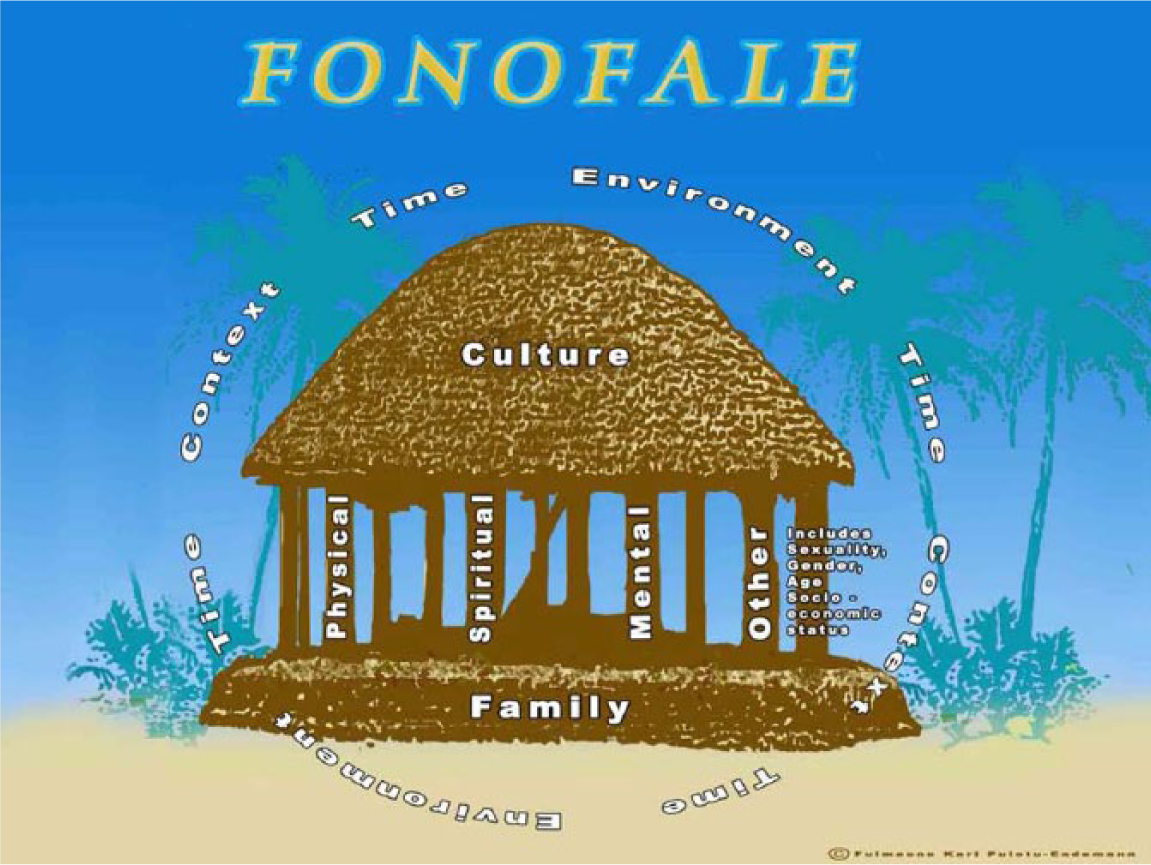
The Fonofale model.
Te whare tapawhā, a commonly used model of Māori well-being, also uses the image of a Māori meeting house; one wall represents whānau (extended family well-being), another tinana (physical well-being), another hinengaro (mental health), and the fourth wairua (spiritual well-being; Durie, 1994; see Figure 2).
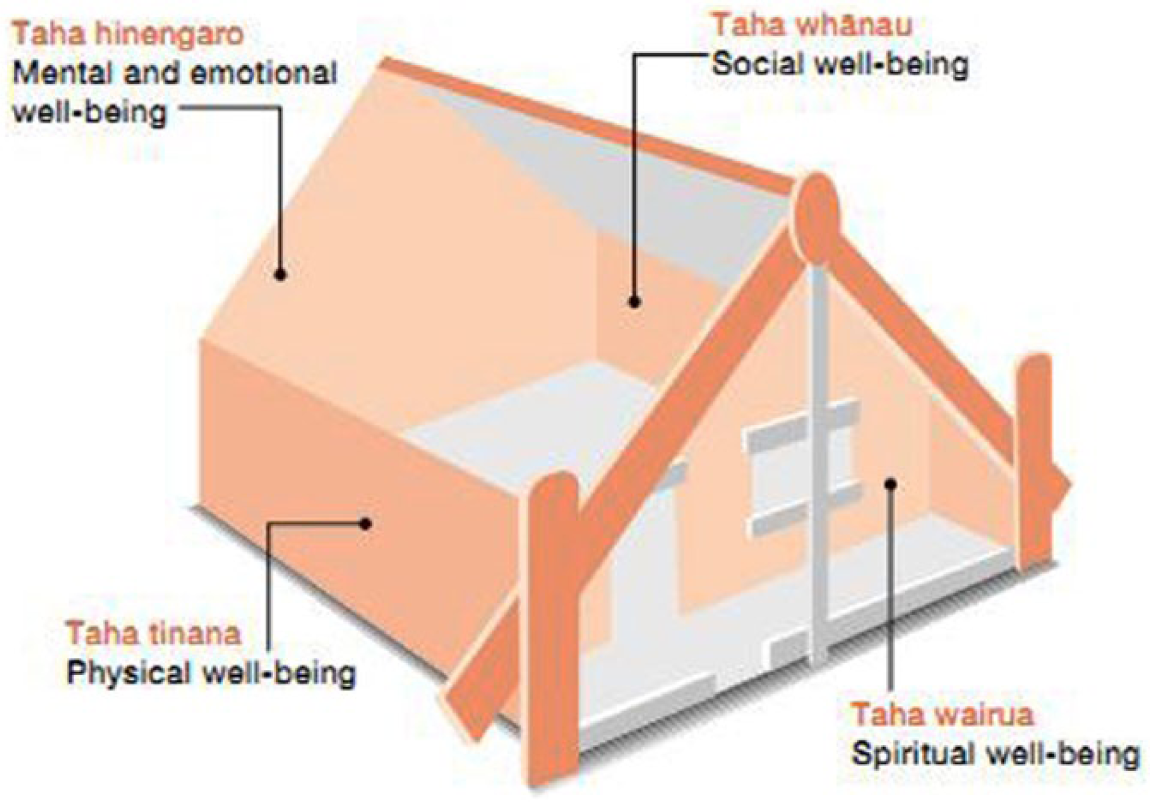
Te whare tapawhā model.
In 2012, half the Pacific groups providing family violence services used the Fonofale or other Pacific health models and four had developed their own Pacific models. Pacific providers said they needed to discuss together “what specific ethnic-specific and pan-Pacific interventions and programmes may . . . look like in practice.” However, for most dominant culture Stopping Violence programs, Pacific perspectives were an add-on rather than a starting point (Chauvel, 2012).
How can services using the Wheel model best support women from Pacific cultures who are experiencing domestic and sexual violence, when there is a shortage of Pacific anti-violence workers? The literature indicates that reliance on police and refuges is inadequate, and an emphasis on independence may be inappropriate, and that the approach of Pacific services, especially in training church and community leaders, involving the families, and generating community discussion of the issue in culturally sensitive ways, is more useful.
How can prevention programs against sexual violence based on the Wheel work in collective cultures with different meanings of violence, and taboos on its public discussion? These questions are best answered from within Pacific communities. This study shows the importance of dominant culture anti-violence services listening to the answers from Pacific and Māori communities, and recognizing and changing the individualist assumptions built into their model of violence and their practices.
Strengths and Limitations of This Study
This study was a response to calls for ethnic-specific data on social issues for Pacific peoples (e.g., Auckland Regional Public Health Service, 2005) and revealed some of the many differences in seven Pacific cultures (Percival et al., 2010), which are often homogenized as “Pacific” culture (Chu, 2009). A limitation is that the study asked only about sexual violence, and did not focus on DV. Questions about DV would have elicited other responses, although a subsequent DV study with the same ethnic groups drew out similar concepts (Ministry of Social Development, 2012).
Another limitation is the purposive sampling, which meant that some participants were known to the researchers and that participants in some groups were older people—Cook Islands participants were all over 30, Niue participants were all over 40, and Tongan participants were mostly older. It is not possible to estimate the representativeness or gaps that result from these factors. This study is thus preliminary and exploratory, providing a first glimpse of the perceptions of a range of Pacific people with knowledge about their cultures and sexual violence. The views of these participants do not represent the views of all Pacific peoples in these ethnicities, particularly young people. For example, older participants may describe complex cultural concepts about relationships differently to young Pacific peoples. Research with young, New Zealand-born participants about ways to combat violence is needed to gain a more rounded picture.
Conclusion
This study indicates that while the tactics in the Power and Control Wheel may be relevant to many women from Pacific cultures, the Wheel’s underlying individualistic assumptions ignore the most significant values and relationships in seven Pacific ethnicities. The study raises three major questions about concepts of violence, interventions, and prevention based on the Wheel in Pacific communities.
Footnotes
Acknowledgements
Special thanks to those who contributed to the project as research participants, advisors, research assistants, interviewers, and members of the project Advisory Group.
Declaration of Conflicting Interests
The author(s) declared no potential conflicts of interest with respect to the research, authorship, and/or publication of this article.
Funding
The author(s) disclosed receipt of the following financial support for the research, authorship, and/or publication of this article: This research was funded by the New Zealand Ministry of Pacific Island Affairs as part of the Taskforce for Action on Sexual Violence program.