




Abstract
The purpose of this review is to evaluate the current status of scientific knowledge on intimate partner violence (IPV) and sexual violence, with a particular focus on the measurement of gender patterns. A multimethod analysis of estimates for the incidence and prevalence of intimate and sexual aggression reveals consistencies across some methodologies and inconsistencies across others. In particular, self-report using behavioral checklists such as the Revised Conflict Tactics Scales yields results that are very discrepant from other research findings. Contrary to some assertions, self-report studies using simple checklists do not represent “most data” on intimate violence; there are large criminological and public health databases that warrant attention. When these sources are considered and placed in the context of other data on violence and aggression, a clear pattern of gender asymmetry emerges, with males perpetrating more physical and sexual violence than females for virtually every form of violence ever studied. Violence research has been hampered by the conservative forces that affect most social science research, including peer review, grant review, and tenure review processes that discourage methodological innovation and reward incremental research studies. We need to focus resources on scientific and technological innovation to better understand violent phenomena and better serve all those involved in violence. Two examples of self-report methods that do not produce gender symmetry are described.
Keywords
Our contemporary understanding of violence is a product of tremendous scientific and technical innovation. In the latter half of the 20th century, the scientific community began to appreciate the power of self-report for understanding “private” phenomena. Alfred Kinsey probably deserves credit for being the first to truly explore the boundaries of what people would tell researchers when given assurances about anonymity and confidentiality. Sexual behavior in the human male and its companion work on the human female were remarkable for the personal details they contained about the most private behaviors (Kinsey, Pomeroy, & Martin, 1948; Kinsey, Pomeroy, Martin, & Gebhard, 1953). Perhaps surprisingly, the self-report study of criminal victimization began in earnest somewhat later, during the 1960s when the U.S. National Crime Survey (NCS) began estimating the amount of crime that was not reported to police (Dodge & Turner, 1981). Like most of these phenomena, it had been known for centuries that not all crime victims report to police or other authorities, but the NCS was one of the first systematic efforts to estimate the true prevalence of crime, including unreported incidents. These lines of research demonstrated that people would disclose violent behavior and intimate behavior to scientists.
The work of early researchers on family and sexual violence can be seen as extensions of these two separate tracks of research on intimate behavior and violent behavior. The 1975 National Family Violence Survey conducted by Straus, Gelles, and Steinmetz (1980) was the first large-scale effort to study violence by intimates. Mary Koss soon extended this research even further to the study of sexual violence by intimates (Koss & Oros, 1982). Even today, one of the most common questions I get at conferences is, “Will people really tell you about this?” The answer is yes, they will. Although obtaining full disclosure is not easy and requires a number of methodological supports, including complete confidentiality and anonymity, it turns out that most people will discuss the details of any topic that is put to them. There is no topic of study that people refuse to discuss. Not criminal perpetration, not illegal drug use, not socially taboo sexual behaviors, not any topic that has yet been studied. This recognition has spawned entire disciplines of research, but we do not always stop to reflect on where we have been and where we might go.
Critical Findings in Research on Intimate Partner and Sexual Violence.
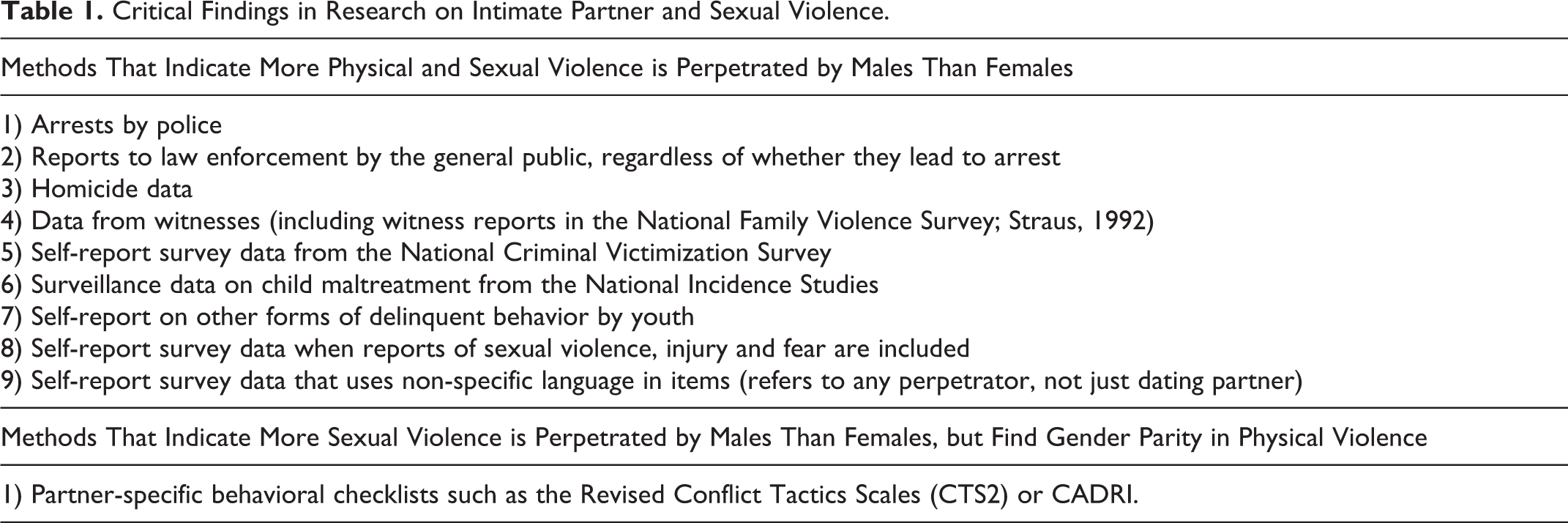
This article will review the scientific and technological status of our knowledge about intimate and sexual violence, with special attention to what is known—and not known—about gender differences and what is known and unknown about the unique population of college students. It is the thesis of this article that scientific and technological stagnation has impeded our efforts to resolve many ongoing controversies in violence research and intervention, including the controversy regarding gender patterns. Recommendations and examples of ways to advance the science of violence are also presented.
The Contributions of Early Research
The early studies on intimate and sexual violence were remarkable achievements and remain some of the most influential social science ever conducted. For the first time, they applied the scientific method to adversities that have been known essentially since the dawn of recorded history. The application of science—the systematic study of a phenomena to identify general patterns—had a huge impact on changing perceptions of family and sexual violence. Systematic study led us from the view that intimate and sexual violence are rare acts committed by a deviant few to understanding that they are distressingly common events that touch large swaths of the population. Our contemporary understanding of family and sexual violence as major social problems is, to no little degree, due to the impact of these studies. It would probably be hard to overstate their importance. These studies almost single-handedly led to disciplines of study that now produce thousands of articles a year (Hamby, 2011, 2012). Perhaps even more importantly, they had huge impacts on policies and interventions for these and other forms of violence and helped justify the huge societal investment we now make in these problems.
Technological Progress and Stagnation
Despite these enormous contributions, early research on intimate and sexual violence should be understood in its historical context. They were technologically sophisticated for their time. Science relies heavily on technology, and although in the field we are not used to thinking of it this way, survey research uses technology too. I use the term “technology” to refer to all of the scientific tools of our trade. These days the mention of the technology of survey research might bring associations to computer interfaces such as Survey Monkey or MTurk, but the technology of surveys also exists at an even more fundamental level. Questionnaires are also scientific technology, because it is through the use of questionnaires that we systematize knowledge about violence. The Conflict Tactics Scales (CTS; Straus, 1979) and Sexual Experiences Survey (Koss & Oros, 1982) were innovations due to their emphasis on behavioral descriptions and avoidance of terms such as “abuse” and “rape” that are still sometimes used in survey research despite extensive data documenting the problems with such language (Hamby & Finkelhor, 2001; Hamby & Gray-Little, 2000).
Indeed, this single issue regarding inattention to language is a good exemplar of a major ongoing and underrecognized problem in research on violence: scientific progress requires technical progress. Science is never “done” and we must build more systematically on past achievements if we are to continue to make progress. We do not use telephones from the 1970s or computers from the 1970s and we should not settle for the technological capacity we had for violence research in 1975.
Systemic Drags on Science in the Current Research Environment
As I have written with John Grych, the current research and academic environment has created a number of drags on scientific innovation (Hamby & Grych, 2013b). These forces are some of the reasons that the most commonly used measures for family and sexual violence research have changed little in more than 30 years (in the case of the CTS, 2014 marks the 40th anniversary of its first publication; Straus, 1974). Many of these are conservative forces throughout academia and across funding agencies. Journal and grant reviewers alike are often more comfortable with familiar questionnaires and methods and are more likely to criticize methods that they have not seen before. Frequent use is often used as a proxy for reliability and validity, even though frequency of use is completely orthogonal to these constructs. Leeches and other forms of bloodletting were once commonly used to treat a host of physical ailments but that does not mean they were effective (Hamby & Grych, 2013a).
Grant reviewers and many funding agencies also often seem to prefer low-risk methods. Certainly, avoiding wasting money is a good idea, but the downside of a preference for low-risk research is that it often means low-impact research too (Azoulay, Graff Zivin, & Manso, 2011). Both grant and journal reviewers can give preferences to results that confirm their preconceptions. (The media can do this as well.) Further, tenure and promotion are often based on the quantity, not quality, of publications. Although this may in part stem from a need and desire to create a metric that can be applied across disciplines, the result nonetheless can incentivize the wrong kind of research. These forces can also lead to inadvertently reinforcing practices such as piecemeal and even duplicate publication, as some academics try to derive as many publications as possible from a single project. One consequence is that literature reviews for some articles are written after data are collected and authors are trying to craft something beyond the project’s original intent. Although these manuscripts can certainly still make a contribution, the result is sometimes a very post hoc justification for included variables and chosen methods, instead of a planned contribution to existing knowledge. Reinventing the wheel is just one of numerous adverse consequences of these conservative systemic forces on scholarship (Hamby & Grych, 2013b).
Other systemic problems include the way that our publishing formats emphasize empirical findings and not long-term insights. As a journal editor, I place tremendous value and dedicate a significant amount of my own time and energy to promoting rigorous empirical articles. I do not mean to diminish their importance. However, they should not be the only esteemed format for presenting scholarship. The science disciplines used to value book length and other alternative formats much more than they do today. I have on many occasions seen junior faculty advised to stay away from books because they could actually hurt their tenure review. Even literature reviews—systematic meta-analyses or more traditional narrative reviews—are sometimes frowned upon because of the time needed to write them and the pressure to get a certain quantity of peer-reviewed publications regardless of their scope. In addition to books, other disciplines also use tools such as exit interviews and “lessons learned” compilations to more systematically collect the accumulated wisdom of experience.
Another systemic problem is hyperspecialization (Hamby & Grych, 2013b). All forms of violence are interconnected, yet we tend to focus on one particular type as if it is somehow possible to isolate it and study it separately from other forms. Although specialization in science certainly has its purposes, it also has its drawbacks, especially for the study of behaviors such as violence, which in the real world is always socially embedded in contexts of families, communities, and cultures. Hyperspecialization hampers our research. For example, a typical study on intimate partner violence will group people into IPV victims and IPV nonvictims based on the CTS or similar instrument. The two groups do not always look as different as one might expect. It is likely that in many cases this is due to the fact that researchers are actually measuring a group that has experienced bullying, exposure to community violence, and perhaps even other forms of family violence—but not IPV—to another group that has also experienced bullying, exposure to community violence, other forms of family violence—and also IPV. When abused groups do not look too different from nonabused groups, it is likely our simplistic approach to research that is to blame (Hamby & Grych, 2013b).
Even more specifically to the case of IPV research, our emphasis on physical assault in assessments of IPV is overly narrow and probably accounts for a great deal of the gender parity that is found (Hamby & Turner, 2013). Intimate relationships—and the abuse and violations that can occur within them—are about much, much more than just pushing and slapping. As I have written elsewhere, although I understand that there are systemic pressures, such as reluctant institutional review boards (ethical review boards), that can make focusing on sexual violence and other forms of abuse harder to study, that is no excuse for misrepresenting the abuse that occurs in close relationships (Hamby, 2014).
Technological Imprecision
It is not unusual to see acknowledgment of the breathtakingly wide range in variation of reported estimates of violence, which have ranged anywhere from under 2% to over 60% in the U.S. “community” samples that are supposed to be otherwise similar. We have not come to terms with what this means, but it indicates that our technology is far from adequate when we cannot precisely identify the reasons for this range. Is your tumor 2 mm in diameter or 60? We expect far more precision from medicine and virtually every other field of scientific endeavor. Further, we seem blind to other implications of this degree of imprecision when we interpret small differences in groups—or lack of differences in groups—as evidence of enduring patterns when in other aspects our data may be off by a factor of 30. However, we settle for what are obviously imprecise estimates instead of applying ourselves diligently to improving the technology of violence measurement.
How can we move forward in our understanding and ability to prevent and intervene against intimate and sexual violence? This is a scientific problem and will require a scientific answer. We need to reinvigorate the field with new methods and new approaches and stop making incremental variations on long-established methods and research aims. The first essential step in this process is taking stock of where we are now, in 2014.
A Multimethod Analysis Shows Problems With Behavioral Checklists as IPV Measures
The hyperspecialization of violence research has meant that many debates regarding gender differences in IPV are held in complete isolation from and seeming indifference to the wealth of other relevant data (Hamby, 2005, 2009). Other relevant data include data on the criminal behavior of the general population and youth involvement in delinquent and violence behavior. These other areas offer multiple methodologies to compare to self-report on checklists of acts. These other data provide a remarkably consistent and detailed picture of the patterns of all kinds of aggression and deviance, none of which would lead one to think that women would perpetrate as much or more IPV than men. It should be the burden of IPV scholars to explain marked differences from these other data on gender.
Gender Differences in the Perpetration of Interpersonal Violence
As I have outlined in detail elsewhere (Hamby, 2005), the United States collects considerable data on all forms of violent crime. Although no data are perfect, these data have strengths that are almost never seen in most university-based studies of violence, because they are often population data (i.e., they are not samples but provide close to 100% coverage of the populations in question). Further, the methodologies have also often undergone more rigorous development and evaluation procedures than most questionnaires, including efforts such as reverse–record–check studies that are almost never seen elsewhere (for more details, see Hamby, 2005).
Although these are sometimes referred to globally as “crime data” or even “arrest data,” multiple methodologies are involved. Arrest data are indeed one important source on the rates, gender patterns, and other characteristics of violent crime. As noted previously, by the 1960s it was realized that arrests were not a perfect indicator of crime, because not all criminal incidents are reported to the police. This led to the establishment of the NCS, now called the National Criminal Victimization Survey (NCVS). The NCVS is one of the largest ongoing surveys in the world and every year includes the experiences of about 70,000 individuals aged 12 and older (Truman, 2011). Because of the changes in survey coverage brought about by cell phones, caller ID, and other new technologies, it has recently returned to a door-to-door sampling frame. Thus, the coverage of the U.S. population is without parallel, especially in the 21st century. Numerous other countries have similar surveys. Homicides are tracked in a separate database (obviously victims cannot be interviewed) and are monitored regardless of whether they lead to an arrest or are otherwise “cleared” (e.g., through the death of the suspected perpetrator; Federal Bureau of Investigation, 2002). A fourth methodology was recently added to this list in many states, the National Incident Based Report System (NIBRS). NIBRS greatly expands the amount of data that are recorded at the initial police report, regardless of whether an arrest is made. There are many reasons why a police officer may not make an arrest, from an inability to locate or identify the perpetrator to a determination that the offense was not serious enough to warrant arrest. As has long been observed by domestic violence advocates, the latter determination is colored by social norms and sometimes by victim-blaming attitudes. Thus, there are limitations to arrest data beyond the fact that not all crimes are reported to police. NIBRS helps address some of these limitations by providing information on all incidents that the public deemed serious enough to report to the police (Snyder & McCurley, 2008).
As I have summarized elsewhere, none of these data suggest any gender parity in physical or sexual violence. Not a single indicator (Hamby, 2005, 2009). Not for aggravated assault, simple assault, robbery, homicide, intimate partner homicide, or sexual assault. The smallest difference is still on the order of 3 male offenders for every female (for simple assault and intimate partner homicide). Contrary to statements that are sometimes seen in published scholarship, “most” data do not show gender symmetry. Far from it. The total n for all of the data included in the Archer meta-analysis (2000) is surpassed by one year’s worth of NCVS data alone, and that data has been collected every year for more than four decades. The arrests and NIBRS databases are similarly massive in scale. Snyder and McCurley's (2008) analyses of NIBRS data included more than 800,000 reports to police. The National Violence Against Women Survey, a self-report survey of over 16,000 people, also found more reports of female than male victimization, including for physical IPV, sexual IPV, and rape by any perpetrator (Tjaden & Thoennes, 2000, 2006). Archer obtained his well-known result of gender parity by systematically excluding these huge databases. There is no reason to privilege the data on small convenience samples of college students over these nationally representative or population-based data sets that are collected by the Federal government. It would be like surveying your class about winter flu symptoms and claiming your data is better than that of the Centers for Disease Control and Prevention (CDC).
The various methods for tracking crime data consistently point to a range of 10–25% female-perpetrated physical violence. For sexual assaults, all data indicate the rate of female perpetration is even lower, in a range on the order of 4–7% of all offenders.
Gender Differences in Violence Against Other Family Members
It is sometimes suggested that women prefer to hit family members and that explains gender parity. The data suggest that this is also overstated. Most data on child sexual abuse do not look different from data on criminal sexual assault, with far more male than female offenders. Existing data on elder physical abuse also suggests more male perpetrators. Data on child physical abuse are more mixed, but men comprise more perpetrators in some data sets (Snyder & McCurley, 2008). However, as I have noted elsewhere, these data cannot be directly compared to IPV, because there are far fewer male caregivers than female caregivers (Hamby, 2005). This is true both for children and for older adults. Men do not have equal “opportunity” to offend against children or elders in their care (National Alliance for Caregiving & AARP, 2004). Access, however, is perfectly equivalent between two intimate partners.
The best data on non-IPV domestic assaults suggest that women comprise perhaps 30–35% of offenders. This somewhat higher rate, compared to general criminal assault, likely reflects the increased access of females to domestic victims because so many U.S. homes do not have an adult male present. In NIBRS, only 20% of IPV assaults reported to the police are female perpetrated, which is actually lower than the rate for other domestic assaults (NIBRS allows one to parse out the victim–offender relationship better than most other crime data).
Youth Involvement in Violence
The federal government also engages in large-scale surveillance of youth involvement in many forms of violence and delinquency that are especially important for understanding college students and other younger populations. The CDC’s Youth Risk Behavior Surveillance System (YRBSS) asks thousands of youth attending school about a number of risky behaviors (CDC, 2008). Some of these pertain to violence and also show that males are more involved in violence than females. For example, almost 80% of youth who have recently carried a gun or taken a weapon to school are male. Almost two of three who report having been in a physical fight are male. In a review of the reviews of behavioral and personality traits that included predominantly youth samples, physical aggression showed one of the largest gender differences out of all of the behaviors examined (Hyde, 2005), again indicating males perpetrate more aggression than females.
However, gender differences may be smaller for younger people. In NIBRS, for example, the percentage of juvenile offenders of stranger assault is 21% female versus 19% female for adult offenders. For offenses against acquaintances, juvenile offenders are 31% female versus 29% female for adult offenders. The largest difference is seen for the “domestic” offender groups (offenses against any family member or intimate partner), which is 35% female among juveniles and 23% female among adults (Snyder & McCurley, 2008). Even more specifically, 29% of juvenile IP offenders were female, whereas only 20% of adult IP offenders were female. YRBSS finds more gender parity for dating violence than other forms of violence (CDC, 2008), another discrepancy that is often taken at face value but has yet to be explained.
Data from the National Survey of Children’s Exposure to Violence (NatSCEV) are a particularly rich source for comparing gender patterns across different types of violence. NatSCEV assesses more than 20 different forms of direct victimization against youth (Hamby, Finkelhor, & Turner, 2013). All other forms of physical assault show a predominantly male-on-male pattern. For the most part, female-on-male physical assault is the rarest of all four possible victim–offender combinations (also including male-on-female and female-on-female). Sexual assaults, conversely, show a predominantly male-on-female pattern. So does kidnapping. Some nonphysical forms of child maltreatment (neglect, psychological abuse, custodial interference) show more gender parity, but caregiver physical abuse is more male perpetrated despite the fewer numbers of male caregivers in U.S. homes. On the whole, male-perpetrated offenses are not only more numerous, they are also far more severe. For example, male-perpetrated sexual offenses are 7 times more likely to involve penetration than female-perpetrated ones (Hamby et al., 2013).
The considerable data on juvenile aggression and victimization suggest that 20–35% of numerous forms of delinquent and criminal behaviors are female perpetrated. Unlike the data on maltreatment, where the low number of male caregivers create situations of unequal access, most of these incidents involve juvenile-on-juvenile. Juvenile males and females are roughly equal in number in the general population. Juvenile offenders appear to be somewhat more likely to be female than adult offenders, which is consistent with the higher rates of violence found in many high school and college samples than community samples of the adult population.
Data From Witnesses
Yet another methodology involves getting the reports of other informants, a procedure that has long been esteemed in social science but is infrequently used in violence research. Nonetheless, several studies have asked about witnessed violence and these data also do not show gender parity. NatSCEV found that 81% of all perpetrators in incidents witnessed by children were males. The largest category was fathers (62% of all perpetrators), but boyfriends of mothers and other male caregivers also perpetrated IPV in front of children (Hamby, Finkelhor, Turner, & Ormrod, 2011). It is not widely appreciated that the National Family Violence Resurvey, Straus and Gelles’ second nationally representative study that found surprising gender symmetry in self-reports of IPV, also found more male perpetration in reports about violence witnessed as a child (Straus, 1992). In that sample, 50% reported only father perpetrators, 31% reported both, and 19% reported only mother perpetrators. This suggests the possibility of a reporting artifact perhaps even more directly than any of the foregoing. In the very same sample, two sets of questions about purportedly the same phenomena, about IPV in either a current relationship or parental relationship, yielded very different patterns of results. As seen below, it turns out that seemingly small changes in wording can have large effects on gender patterns and the field needs to start paying more attention to these types of discrepancies.
Summary of Data Across Methodologies
In sum, there have been a very wide range of methodologies applied to the study of violent and aggressive behavior and, with the exception of the behavioral checklist format of instruments like the CTS, none of them of show gender parity in acts of physical violence. These include arrest by police, reports to law enforcement agencies by the public, homicide data, youth violence surveillance, reports by witnesses, and some survey formats. These provide, by survey research standards, a fairly narrow range of estimates for female perpetration. For physical assault, the range is about 20–35% for female perpetrated and for sexual assault 3–30%, with most estimates under 10%.
If a screening measure for a medical condition gave a different result than every other known test for that condition, people would question the validity of the screening test, not the condition. It should be noted that it is perfectly possible for a test to be incredibly reliable and yet not valid. There is no question that the CTS, the CADRI, Index of Spouse Abuse and other similar checklists (Hudson & McIntosh, 1981; Straus, Hamby, Boney-McCoy, & Sugarman, 1996; Wolfe et al., 2001) produce consistent results. Yet, a scale can give the same result every time you step on it and still be miscalibrated.
The State of Knowledge on Violence Against College Students
It is ironic, but the population that is the focus of the largest number of studies—college students—is also the population that, in many ways, we know the least about. There are many large and surprising gaps in our knowledge about violence against college men and women. The evidence base on intimate and sexual violence against college students is a scientific desert in many ways, a mono-ecology with surprisingly little variation. A few of the key gaps are identified below.
Physical IPV: Lack of Nationally Representative Data and Little Methodological Variation
Surprisingly, there is a near-complete lack of nationally representative data for physical IPV that focuses on risk among college students. This is probably not an intentional oversight, but, for whatever reason, college students have fallen through the cracks of U.S. national surveillance for IPV—and the lack of information is even more extensive and troubling outside of the United States.
As noted earlier, there are several forms of nationally representative surveillance for adults. In the United States, these include the National Intimate and Sexual Violence Survey, the NCVS, and the National Violence Against Women Survey. A number of other U.S. household surveys have also asked about IPV. There are also nationally representative surveillance efforts for teens, including the National Survey of Adolescents and the National Survey of Children's Exposure to Violence. It turns out we know more about people who are both younger and older than college age than we do about college students.
College students are not intentionally excluded from the sampling frames of the adult studies, which typically start at age 18, but they are not well represented or well described either. Few of these surveys analyze victimization rates by age group. Some surveys do not collect sufficient demographic information to identify college students from nonstudents and few, if any, can identify traditional full-time residential students from part-time or full-time “commuter” students who do not live on campus. Perhaps most importantly, the sampling frames of most studies omit institutional housing and many of them have limited coverage, if any, of cell phone users. Thus, students living in dorms are not well represented in these data sets and those that are included often cannot be distinguished from a part-time student of a community college who also works full time. This is important because the policy and intervention implications are very different. Students living in the general community are probably best served by state and local law enforcement, rape crisis, and other agencies. Students living in dorms are more likely to be served by college systems, including campus police and campus student health services. They may also face different risks, such as greater difficulty avoiding their attacker.
The result of this lack of national surveillance is that existing information on college students is almost entirely based on relatively small convenience samples relying on the single methodology of perpetrator-specific behavioral checklists. The reliance on a single method makes it difficult to evaluate the quality of this information. For the broader adult population, we know that checklists produce findings that are discrepant from other measures of IPV, especially with regard to gender patterns. We also know that the same is true for measures of teens—data from the National Survey of Adolescents and NIBRS yield different gender patterns for juveniles than CTS-type measures. As described in more detail subsequently, a recent analysis of NatSCEV data starts to shed light on the impact of operationalization on rates on estimates of adolescent IPV (Hamby & Turner, 2013). Because we know that methodology affects gender patterns for teens and for older adults, it seems very likely that it affects rates for college students too. Unfortunately, we have less concrete information on how the gender symmetry observed in so many college student convenience samples would compare to other methodologies. We also know that large, representative samples often produce somewhat lower estimates than convenience samples (Ji, Finkelhor, & Dunne, 2013) and the lack of alternative information raises questions about how accurate estimates are that sometimes suggest almost half of college students are involved in abusive relationships.
Sexual Victimization: Lack of Comprehensive Data on Gender Differences
Sometimes individuals have important influence on a field and thanks in large part to the work of Mary Koss, we know much more about sexual victimization against college students than we do about IPV against college students. She conducted some of the first national studies of rape against college women (Koss, 1988; Koss, Gidycz, & Wisniewski, 1987; Mohler-Kuo, Dowdall, Koss, & Wechsler, 2004). Bonnie Fisher and colleagues have also conducted important research on sexual victimization against college women (Fisher, Cullen, & Turner, 2000). These studies share some of the technological innovations of IPV surveillance, especially a shift away from emotionally laden terms such as “rape” to more behaviorally specific questions that enhance disclosure (Fisher et al., 2000; Hamby & Gray-Little, 2000).
There are, however, gaps in our knowledge. Chiefly, perhaps, the study of the sexual victimization of college men lags far behind that of college women. What exists relies heavily on the Sexual Coercion scale of the CTS which does not produce gender symmetry (Straus et al., 1996) but is limited in its focus on acts involving penetration (omitting other types of sexual offenses). There are substantial questions about developmental trajectories. Data on child sexual abuse show that most perpetrators of rape against male children are also male (Black et al., 2011; Finkelhor, Hotaling, Lewis, & Smith, 1990). However, this pattern eventually shifts, although the specifics of the developmental trajectory are not well known. In adolescence, some forms of sexual victimization, especially nonviolent forms, have fairly high rates of female-on-male perpetration. For example, 42% of all reported cases of sexual misconduct with a minor are female-on-male perpetrated in NatSCEV (Hamby et al., 2013). Many studies of sexual victimization experienced by college students focus on victimization in heterosexual relationships, but heterosexual individuals can experience assault by same-sex offenders.
In sum, data on intimate and sexual violence against college students also originated with early innovation and frontier testing followed by a period of technological and theoretical stagnation, where decade-old instruments are still heavily relied upon and there have been few efforts to push methodological frontiers in recent decades.
Advancing Knowledge on Intimate and Sexual Violence
The CTS will be 40 years old this year. There are few realms of our life where we continue to use technology from the early 1970s and this is especially true in the fields of science and medicine. Social scientists need to focus on technological innovation as well. Here I describe a few efforts to better understand the technology of violence measurement.
Increasing the Sophistication of Operationalizations of Violence
The first example comes from NatSCEV (Hamby & Turner, 2013). Times have changed since the days of pencil-and-paper questionnaires and in many settings it is possible to administer surveys with the assistance of a computer. NatSCEV is a computer-assisted telephone interview, and this allows follow-up questions that are based on skip patterns. The NatSCEV interview is not particularly complex in this regard—most follow-up “trees” and “branches” are only one level deep. In other words, almost everyone who endorses a victimization type gets the same list of follow-ups. Nonetheless, it does allow us to collect considerably more incident data than provided by a behavioral checklist (Finkelhor, Hamby, Ormrod, & Turner, 2005).
An analysis of NatSCEV reports of teen dating violence show that the operationalization applied by the CTS and similar measures—any report of any physical aggression, no matter how minor or severe—is the only one that produces more reports of male victimization. As I have written elsewhere, it is biased to collect data on intimate relationships without collecting data on sexual aggression (Hamby, 2009). When focusing on youth behavior, it can also be problematic to fail to screen out horseplay and wrestling. Using injury, fear, or a sexual component as markers of incidents that are most in need of intervention puts the reports of teen dating violence into the same range as all of the data on violence described above (Hamby & Turner, 2013).
Further, of the more than 40 forms of victimization assessed in NatSCEV 1, the fear reports of male and female adolescents were the most discrepant. The gender difference in fear ratings for teen dating violence was more than twice as big as for any other form of violence. These data comparing across types of victimization are important because they counter one common hypothesis about gender differences in some other methodologies, that males are simply more reluctant to report fear. Males are somewhat less likely to report fear, but fear reports by adolescent males and females are much more similar than one might expect based on gender stereotypes. Fewer than half of the victimization types showed gender differences in fear reports, and most of the significant ones were still in the same range on the scale. For example, the average fear report for threats against school, one of the more frightening incidents, was 2.10 for males and 2.30 for females on a scale from 1 to 3 (not at all, a little, or very afraid). This was a statistically significant difference, but both males and females reported being somewhat more than “a little” afraid, on average. For females, physical dating violence was also rated similarly—2.19 on the same scale. The mean for males, however, was 1.11—the lowest average fear rating in all of NatSCEV. Lower than for property crimes, even. Almost 9 of 10 (89%) male victims said they were “not at all afraid” during the physical aggression incident they reported to the dating violence screener (Hamby & Turner, 2013).
Simple Experiments Show Gender Patterns Are Strongly Affected by Questionnaire Characteristics
One brief example will show how easily new knowledge can be attained and also how easily the “consistent” pattern of gender symmetry can be upset with just small manipulations in formatting and wording changes. A simple experiment was conducted with a sample of 238 college students (Hamby, 2014a; Hamby & Chandrasekaran, 2012). As has been the case in literally hundreds of previous studies, the CTS2 Physical Assault scale (Straus et al., 1996) was administered. However, only half of the sample received the standard CTS2 that asks about each act of violence using dating partner–specific language (e.g., “My partner pushed me”). The other half received a nonspecific alternative that substituted “someone” for “my partner” in the items. Then, a follow-up question presented four possible perpetrator categories-family, friend or acquaintance, dating partner, or stranger-and an IPV victimization score was computed by just scoring the responses identified as perpetrated by a dating partner (Hamby, 2013b). Overall, this manipulation had relatively little impact on overall rates. The overall rate for intimate partner violence victimization (including males and females) was slightly lower for the severe subscale for the nonspecific versus partner-specific condition. Importantly, however, there were significant interactions between form (nonspecific or partner specific) and gender. These were true crossover interactions. For the standard, partner-specific CTS2, males reported a higher number of IPV victimization modes (number of different CTS questions endorsed) than females. In contrast, for the nonspecific condition, females reported a higher number of IPV victimization modes than males. Most of this effect turned out to be differences in the severe subscale, which also showed the same crossover interaction. The pattern was similar for the minor assault items—the same crossover was observed—but the difference was not significant.
Some statistical power is lost when dichotomous rates are used but again a crossover pattern was observed and this one approached significance, p = .072. In terms of meaningful differences, the effects were dramatic. The prevalence rate in the standard CTS2 condition was 40% for males and 33% for females. In the nonspecific condition, the prevalence rate fell to almost half for males—24% and actually increased for females—39%. Once again this difference proved to be mostly due to the effects on the items in the severe subscale, which did show a significant interaction, p = .005. In the standard CTS condition, more than four times as many males reported being the victim of severe intimate partner violence—25%—than females, 6%. It would be hard to overstate how discrepant this finding is from every other data point on IPV and gender. Change the wording, however, and the severe victimization rate falls to 7% for males and rises to 16% for females. Once again, a similar crossover pattern was observed for the minor subscale but did not meet significance.
Any violence researcher should be dismayed that IPV rates can shift so dramatically with the slightest tweaking of our measures, regardless of whether one is politically aligned with the gender symmetry or asymmetry camps or not aligned at all. We do not understand the technology of violence and we cannot draw conclusions about gender patterns until we understand how people answer questions about their experiences.
The Solution Lies in Science and Technology
It is truly something of a scandal that our technology for assessing the important social problem of violence has barely advanced in four decades of research. The majority of the changes in IPV survey research, in particular, have been incremental changes that despite good intentions have not yielded better results (Hamby, 2014). The good news, however, is that the path to progress is known and quite easily accessible. We need more experimentation on violence measures and other technological aspects of violence research, just as the field of medicine is always striving for better medicines and better screening tools and the field of criminal justice has produced innovations such as the National Incident-Based Reporting System to collect better data on crime and crime services. Earlier, I have shown how making use of the power of computers to increase the specificity of incident data and experimenting with language can provide insights into data on violence. Other possibilities are making more use of more private survey formats. Computer-assisted surveys have shown promise for this as well, as they provide more confidentiality and anonymity than interviews and even paper-and-pencil surveys (Hamby & Finkelhor, 2000; Turner et al., 1998). Qualitative research that focuses on definitions and measurement is another avenue that holds promise (Foshee, Bauman, Linder, Rice, & Wilcher, 2007; Hamby & Koss, 2003). The most important point concerning these efforts is not regarding the form that the efforts take but rather the number that should be occurring. There should be continuous, extensive efforts to expand our skills and improve our technical know-how that matches our efforts to identify new patterns or mechanisms.
Looking Ahead
We are far behind virtually every other field of scientific endeavor in terms of technological innovation and progress. I would like to refer back to the historical achievements in violence research mentioned earlier. We can honor the achievements of past violence research without remaining in the past. We honor those who invented the first antibiotics, the first chemotherapies, the first computers. Honoring these truly remarkable achievements does not require continuing to use these early scientific technologies. In the same way, I hope to honor the truly remarkable achievements of social science in the latter half of the 20th century. After centuries of resignation and misinformation, that research helped produce a remarkable social transformation. We now devote considerable resources to understanding, preventing, and overcoming violence.
Science is never a completed achievement, however. It is the ongoing striving toward new frontiers. We need to let go of some of our affinity for scientific convention and get back to the true practice of science, which is always focused on the novel and the innovative (Hamby, 2014; Hamby & Grych, 2013b). Anyone who considers themselves a scholar, provider, or scientist who has not recently reexamined why they are doing what they are doing is not conducting best practices. There is ample information to guide us and advances in knowledge are attainable. We owe it to every person who has ever been involved in violence to do better and to get it right.
Implications of Existing Data on Intimate and Sexual Violence for Practice, Policy, and Research
Providers and policy makers should rely on the data from methodologies that are consistent with other known data and use great caution when relying on other sources. Researchers should pursue new technologies to improve the measurement of violence. Researchers should conduct more experimental research testing the effects of measurement conditions on rates and patterns of violence. This should include research not only on item wording but also on setting, mode of administration, degree of confidentiality and anonymity, and other factors. Violence scholarship needs to make more use of “lessons learned,” exit interviews, and other ways of disseminating the insights obtained in long careers. The field needs metrics to assess quality and impact of scholarship as well as quantity. More institutional priorities need to be placed on innovative methodologies and integrative and theoretical work.
Footnotes
Declaration of Conflicting Interests
The author(s) declared no potential conflicts of interest with respect to the research, authorship, and/or publication of this article.
Funding
The author(s) received no financial support for the research, authorship, and/or publication of this article.