



Abstract
The present study assesses the association between childhood exposure to parental violence and perpetration of marital violence as adults among a representative sample of 3,396 men in Bangladesh. We used secondary analysis of survey data from the nationally representative Bangladesh Demographic and Health Survey 2007 to examine factors associated with perpetration of martial violence among 3,396 ever-married men between the ages of 16 and 50 years. Outcome measure, marital violence perpetration, was measured using a modified Conflict Tactics Scale, and predictor variables included childhood exposure to parental violence, justification of marital violence, marital duration, religion, and demographic variables. Results indicate that marital violence perpetration is significantly associated with childhood exposure to marital violence, suggesting a cycle of violence that is maintained across generations. Implications for policy and practice are discussed.
In the present study, marital violence is conceptualized as “assaultive and coercive behaviors that adults use against their intimate partners” (Holden, 2003, p. 155). In Bangladesh, studies report marital violence prevalence rates that range from 25% to 72% based on different samples and sampling methods (Bates, Schuler, Islam, & Islam, 2004; Garcia-Moreno et al., 2006; Hadi, 2000; Koenig, Ahmed, Hossain, & Mozumder, 2003; Murshid, Akincigil, & Zippay, 2015). Such high prevalence rates of marital violence mean that children are likely to be exposed to that violence (Fantuzzo & Mohr, 1999).
Childhood exposure to parental violence, visual and aural, has the potential to have psychological, cognitive, and behavioral effects on individuals (Edleson, 1999; Karakurt, Smith, & Whiting, 2014; Shalev et al., 2013). Among the behavioral outcomes that children portray as adults is the perpetration of violence against their intimate partners (Caesar, 1988; Doumas, Margolin, & John, 1994; Ellsberg, Pena, Herrera, Liljestrand, & Winkvist, 1999; Hotaling & Sugarman, 1986; Jewkes, Levin, & Penn-Kekana, 2002; Kalmuss, 1984; Kalmuss & Straus, 1982; Martin et al., 2002; Straus & Gelles, 1986, 1990; Straus, Gelles, & Steinmetz, 1980). This study adds to the literature on intergenerational transmission of martial violence using social learning theory that suggests that children learn scripts provided by their parents and enact those scripts in similar situations in their own lives (Akers, 1977; Bandura, 1971, 1973, 1986; Black, Sussman, & Unger, 2010; Widom, 1989).More specifically, we examine the association between men’s exposure to parental violence as children and the use of violence against their wives as adults using a nationally representative sample of 3,996 married men in Bangladesh, controlling for justification of marital violence, marital duration, and demographic factors. Utilizing data from the 2007 Bangladesh Demographic and Health Survey (BDHS, 2007), the present study provides nationally representative estimates for variation in men’s perpetration of marital violence using chi-square and logistic regression analyses.
Extant literature suggests that childhood exposure to parental violence has differential impact on boys and girls; boys externalize their problems, for example, by being aggressive and hostile, whereas girls internalize their problems, for example, showing symptoms of depression and anxiety (Bornstein, 2006; Edleson, 1999; O’Keefe, 1998). This maps on to the literature on the effect of childhood exposure to parental violence in Bangladesh and elsewhere that suggests that women exposed to childhood parental violence have increased odds of experiencing intimate partner violence or marital violence as they internalize patriarchy and subjugation as norms (Ahmad et al., 2004; Dobash & Dobash, 1979; Edleson, 1999; Karakurt et al., 2014; Murshid, 2012; Shalev et al., 2013). However, there are no studies delineating how men in Bangladesh respond to exposure to parental violence; this is the gap that the present study fills by examining a sample of men. We hypothesize that men are more likely to perpetrate marital violence when they report exposure to parental violence. We argue that this is because men who are exposed to parental violence as children undergo observational conditioning (Heyes, 1994) that allow them to contextually imitate (Byrne, 2002) the violence that they become conditioned to.
Theoretical Framework
Scholars of social learning and behavior adoptions suggest that children develop violence as a “habitual response” to conflict through observational learning (Akers, 1977; Bandura, 1971, 1973, 1986; Widom, 1989). Others argue that crimes are learnt though social interactions (Sutherland, 1939) in which individuals respond to behaviors based on “differential associations” that shape individual meaning-making and definitions which in turn determine the position that individuals take in response to, for example, exposure to violence; the response could be in opposition to the use of violence, in agreement with use of violence, or neutral (Akers, 1977; Heyes, Jaldow, Nokes, & Dawson, 1994). The response that is in agreement with the use of violence, some argue, follows a process known as observational conditioning (Call & Carpenter, 2002) which involves two steps. First, when a child, in the context of this study, observes that conflict is resolved by the use of violence, he or she learns that violence is a form of conflict resolution (in the absence of that observation, this learning would not have occurred). The next step involves imitating that observed behavior (Byrne, 2002); the kind of violence and context of the violence provide cues to children as to when, how, and what kind of violence is “justifiable.” Parental marital violence modeled to children “provides scripts for violent behaviors” and “teaches the appropriateness and consequences of such behavior in an intimate relationship to children through direct and vicarious reinforcement of rewards and punishments” (Black, Sussman & Unger, 2010, p. 1024). Thus, the lesson becomes as follows: violence, its threat, and the promise of concessions based on conditionalities are ways to wield power and create/maintain hierarchies. Potentially, then, children learn that inequality in relationships is “normal” which in turn normalizes the use of violence against individuals who are deemed subordinate (Anderson & Kras, 2007; Ehrensaft et al., 2003; Foshee et al., 2005; Hotaling & Sugarman, 1990; Komter, 1989, p. 213).
In the Bangladeshi context, certain factors exacerbate the process identified above. First, an entrenched patriarchal society means that women are automatically deemed subordinate. Second, although on the decline, many households are still joint-families (men live with their parents even as adults with their wives and children), which means that parental violence may still be an on-going issue and if not, the memory of it is hardly distant. The norm of violence identified above, then, affects not only the man, but the entire household. In such cases, not only would the in-laws be reluctant to come to the rescue of the wife, but may even participate in the perpetration of violence directly or indirectly (because they themselves have been perpetrators/victims who have internalized and accepted the use of violence as legitimate). Such an environment is likely to reinforce the idea that aggressive behavior toward the wife and exercising control over her is a sign of masculinity, and hence something to nurture—another lesson for members of all generations in the household (Amin et al., 1996; Bhuiyan, Faraizi, & McAllister, 2005; Campbell, 1992; Christelow, 1997; Hadi, 2000; Kabeer, 2005; Koenig et al., 2006; Koenig et al., 2007; Lane, 2003; Naved et al., 2006; Schuler, Hashemi, Riley, & Akhter, 1996).
Poverty and high population density in Bangladesh play a role, too. Even middle-class homes are small and house many people, which means that a fight between a husband and wife cannot remain private. Children (and other family members) do not have a choice but to observe. Again, the joint-family structure can play an intermediary role; grandparents may well be the ones who tell children about domestic power structures and what it means to be a man, thereby perpetuating gender inequalities. In addition, we might argue, a high incidence of low-scale political violence in Bangladesh—initiated by and targeted toward political parties—plays an overarching role in making “minor” acts of violence acceptable in the domestic sphere. Thus, individual and household level normalization together with the social structure of Bangladesh that is largely patriarchal and accepting of a certain degree of violence makes marital violence highly likely, this study suggests (Amin, 1998; Bhuiyan et al., 2005; Islam, Tareque, Sugawa, & Kawahara, 2015; Sarah, 2012)
Method
Data
The present study utilizes the BDHS 2007 which consists of survey data from 10,400 households. As part of the survey, 3,771 ever-married men between the ages of 15 and 54 years were interviewed. The survey was designed to produce nationally representative estimates for the indicators for the country of interest—Bangladesh in this case—for urban and rural areas, and for each of the six major divisions of Bangladesh: Dhaka, Chittagong, Barison, Khulna, Rajshahi, and Sylhet. The sampling frame was based on the Population Census from 2001. Two-stage stratified sampling was conducted to select sample households. The study contains 361 primary sampling units, 227 rural and 134 urban. The data were collected from January to March 2007.
The current study uses the men’s sample that, after accounting for missing data, amounts to 3,396 respondents between the ages of 16 and 54 years (Table 1).
The Study Population and the Sample.

Note. Percentages may not add up to 100 due to rounding or missing data.
N = 3,396, percentages are weighted, reflecting nationally representative estimates.
Measures
Marital violence
A modified Conflict Tactics Scale created by Demographic and Health Survey was used to measure marital violence; respondents chose from never, sometimes, and often to indicate the frequency of marital violence experienced. The Cronbach’s alpha for the items is .79, indicating good internal consistency for this measure for this sample. The items of the modified scale include the following items:
Were there situations in the last 12 months in which you felt the need to do the following:
Slap your wife?
Twist her arm or pull her hair?
Push her, shake her, or throw something at her?
Punch her with your fist or with something that could hurt her?
Kick her, drag her, or beat her up?
Try to choke her or burn her on purpose?
Threaten or attack her with a knife, gun, or any other weapon?
Physically force her to have sexual intercourse with you even when she did not want to?
Force her to perform any sexual acts she did not want to?
In the present study, marital violence perpetration was dichotomized, taking the value of 1 when respondents indicated that they either “sometimes” or “often” used violence against their wives, and 0 when they reported “never.”
Justification of marital violence
The Demographic and Health Survey measured justification of marital violence by asking respondents to select any of the four culturally specific scenarios in which respondents may justify marital violence. The internal consistency of the measure, as captured by the Cronbach’s alpha for the scale, was .79. The items of the scale are as follows: Wife beating is justified if she goes out without telling him; Wife beating is justified if she neglects the children; Wife beating is justified if she argues with him; Wife beating is justified if she refuses to have sex with him.
Childhood exposure to parental violence
Exposure to parental violence was measured by one item that asked respondents to answer the question “Did your father beat your mother?” Although this one-item measure fails to encompass the different types of interpersonal violence that can take place in a dyad, including emotional, verbal, and financial abuse, it is perhaps a question that reliably characterizes the presence of violence because the reliability of the measure is dependent on the rate of recall of the respondents; it is expected that respondents are more likely to remember witnessing physical violence as a child over other types of violence including psychological and economic abuse (Postmus et al., 2012). However, the low construct validity of a one-item scale remains a limitation of the study in the absence of more information related to childhood exposure to parental violence in the BDHS.
Other variables
The present study controlled for demographic variables associated with marital violence: age, marital duration, education, religion, and their position on the wealth index where respondents are categorized into five groups: poorest, poorer, middle, richer, richest.
Data Analysis
Descriptive statistics for the study population were obtained to describe the nature of the demographic variables and model covariates. Correlations between independent and dependent variables were examined to determine cross-sectional bivariate relationships using chi-square tests. Logistic regression analyses were conducted to delineate the association between exposure to marital violence, justification of marital violence, and marital violence perpetration while controlling for demographic variables. The assumptions of regression analyses such as linearity, homoscedasticity, and normality were determined by plotting residuals against predicted values and by examining the distribution of residuals, prior to running these tests. Because the BDHS used stratified sampling with 179 strata and 361 primary sampling units, Stata 12 was used to analyze the data using survey techniques.
Results
The descriptive statistics indicated that 16.4% (n = 542) of the nationally representative sample of men aged 15 to 54 years perpetrated violence against their wives in the preceding year, 26.5% (n = 868) reported childhood exposure to parental violence, and 35.7% (n = 1,158) justified marital violence.
The bivariate associations between variables were assessed using chi-square tests, as presented in Table 2. The table shows the percentage of respondents who perpetrated marital violence in each category.
Bivariate Associations Between the Dependent and Independent Variables (Based on Population Estimates).
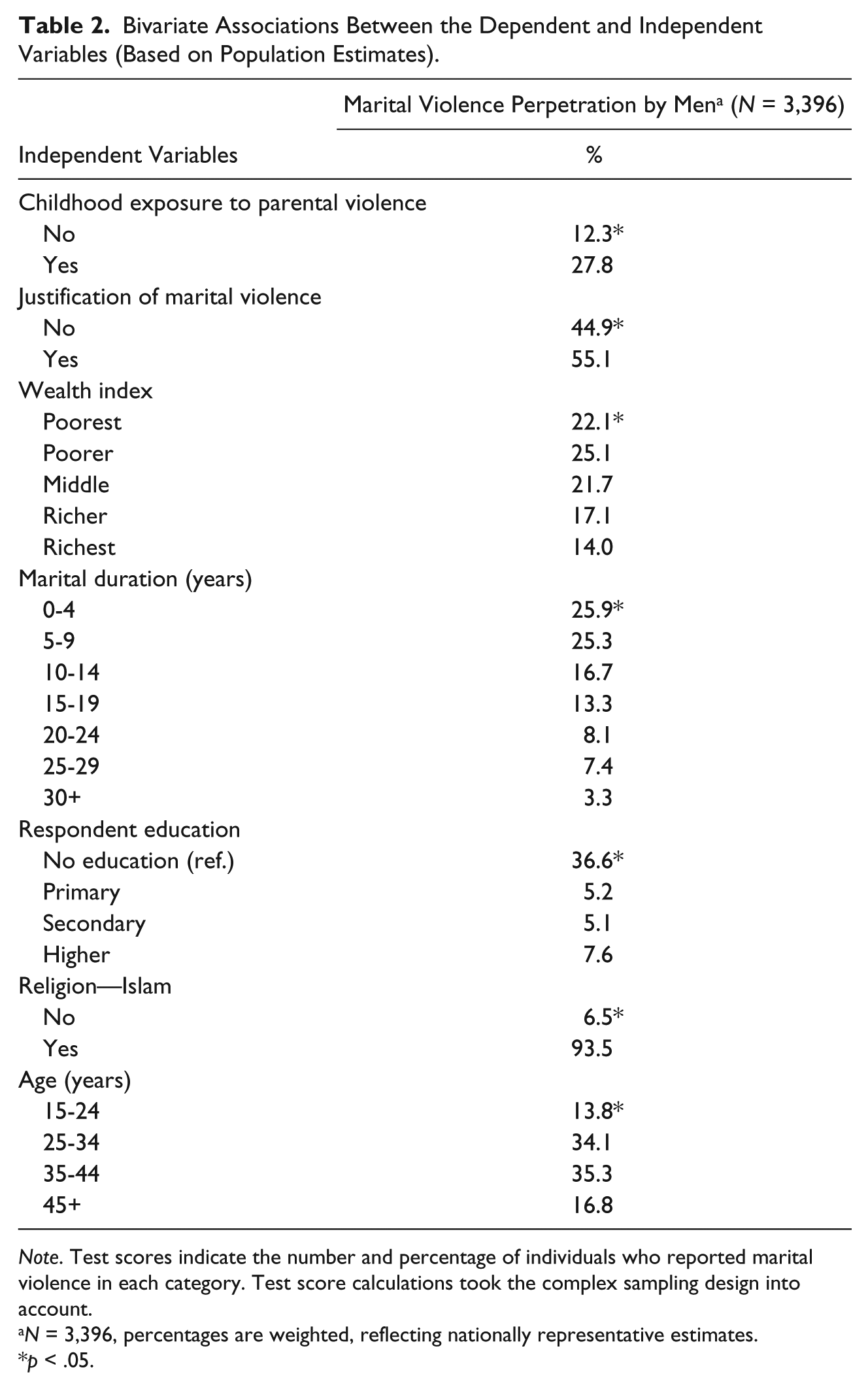
Note. Test scores indicate the number and percentage of individuals who reported marital violence in each category. Test score calculations took the complex sampling design into account.
N = 3,396, percentages are weighted, reflecting nationally representative estimates.
p < .05.
The findings indicated that 28% of the study population who reported exposure to parental violence perpetrated marital violence as adults compared with 12% of those who perpetrated violence but did not report exposure to parental violence (p < .001) and 55.1% of men who justified marital violence perpetrated marital violence compared with 44.9% who perpetrated marital violence but did not justify marital violence (p < .001). The findings also indicated that higher wealth protected men from perpetrating marital violence; only 14% of those who reported having the highest wealth perpetrated marital violence, compared with 22% of the poorest, 25% of the poorer, and 21% of the middle wealth groups (p < .001). In addition, significantly more men aged between 25 and 44 years perpetrated marital violence than other age groups (35.4%, p < .001); significantly more men married for 0 to 4 years perpetrated marital violence than men married for more than 4 years (25.9, p < .001); significantly more men with no education perpetrated marital violence than men with any level of education (36.6%, p < .001); and more men who reported to be Muslim perpetrated marital violence than men who reported otherwise (93.5%, p < .001).
Multivariate analyses included logistic regression using survey techniques. The results, as presented in Table 3, indicate a significant overall F(15, 170) = 13.45, p < .05. Goodness of fit was tested using svylogitof.
Logistic Regression: Associations Between Marital Violence and Independent Variables (N = 3,186).

Note. Reported beta-coefficient and margin effects from the logistic regression model in which the dependent variable is experience of marital violence, based on the full sample (N = 3,396). Calculations are weighted, representing nationally representative estimates. OR = odds ratio; CI = confidence interval.
p < .05.
The logistic regression revealed that the odds of perpetrating violence were significantly higher for respondents who had family history of violence, that is, had childhood exposure to parental violence (odds ratio [OR] = 2.45; 95% confidence interval [CI] = [1.9, 3.1]) and for respondents who justified marital violence (OR = 2.21; 95% CI = [1.8, 2.7]). Marital violence perpetration was also significantly associated with various levels of marital duration: 15 to 19 years (OR = 0.50; 95% CI = [0.3, 0.8]), 20 to 24 years (OR = 0.37; 95% CI = [0.2, 0.7]), 25 to 29 years (OR = 0.47; 95% CI = [0.2, 0.9]), and 30 years or more (OR = 0.33; 95% CI = [0.1, 0.9]). Respondents who were Muslim were equally likely to perpetrate marital violence as non-Muslims, wealthy respondents were equally likely to perpetrate marital violence as respondents who were not wealthy, respondents with no education were also equally likely to perpetrate marital violence as respondents with any education, and older men were equally likely to perpetrate marital violence as younger men, the logistic regression revealed.
Discussion
Marital violence is an insidious social problem in Bangladesh that includes violent acts from acid attacks and homicide to physical, emotional, and sexual violence that affects over a quarter of its female population (BDHS, 2007). The fact that exposure to marital violence has implications for boys such that boys grow up to inflict marital violence as adults provides an insight into how marital violence has remained a pervasive social problem in Bangladesh (Sarah, 2012), building on the proposition by Akers (1977) and Sutherland (1939) to suggest that crime is learned through social interactions in the family. This finding is in line with studies that show the intergenerational transmission of marital violence across the world (Bandura, 1986; Caesar, 1988; Cummings, Davies, & Campbell, 2000; Doumas et al., 1994; Foshee, Bauman, & Linder, 1999), supporting the theoretical notion that boys are likely to experience observational conditioning and imitate learned behaviors in similar contexts when they are exposed to parental marital violence (Byrne, 2002; Heyes et al., 1994; Leadbeater, Kuperminc, Blatt, & Hertzog, 1999).
The finding that childhood exposure to parental violence and justification of marital violence increases the odds of perpetrating violence is particularly useful in conjunction with the studies based on the women married to the sample of men in the present study, 25% of whom reported experiencing marital violence (Islam et al., 2015; Murshid, 2012). Using a representative sample of the women married to the sample of men in the present study, Islam et al. (2015) and Murshid (2012) show that women who justify their husbands’ use of violence and were also exposed to parental violence as children are more likely to experience marital violence than their counterparts.
The finding that men who justify marital violence are more likely to perpetrate marital violence raises an important question about how men come to justify marital violence, a question that future studies need to explore in qualitative studies. On the face of it, however, it perhaps speaks to the normalization of marital violence which then allows for its perpetration. The fact that demographic factors do not make a difference in men’s perpetration of marital violence in this study perhaps speaks to that same normalization process, which makes marital violence a social problem that cuts across all boundaries of education, wealth, and age. These findings contradict scholars who argue that higher education, age, and income are associated with decreased marital violence in Bangladesh (Bates et al., 2004; Hadi, 2000; Koenig et al., 2003; Naved & Persson, 2005). These studies, however, are based on samples of women. Seen in conjunction with the findings in this study, it becomes clear that gender plays a role; socioeconomic factors that reduce the propensity of marital violence for women may not prevent men from perpetrating marital violence. In addition, this study confirms that long duration of marriage decreases the odds of marital violence perpetration by men, in line with extant literature on the role of marital duration in marital violence in Bangladesh (Hadi, 2000; Koenig et al., 2003; Schuler et al., 1996).
This study has implications for researchers in the field of marital violence across developing countries who might find it useful to examine the context of the linkages found in this study by conducting longitudinal qualitative research using ethnographic methods to gain a deeper understanding of how men learn to perpetrate marital violence. Future studies should explore whether women are more likely to justify marital violence if their husbands justify violence, and whether there is increased violence when both partners have had childhood exposure to parental violence, compared to one partner having such exposure. In addition, studies should be conducted to assess whether exposure to psychological violence yields similar results in terms of intergenerational transmission.
The main results of the study, particularly those pertaining to the high rates of marital violence perpetration and its association with childhood exposure to parental violence, have important policy implications for policymakers, practitioners, and social workers who work on violence prevention, family and intimate partner violence, and interventions aimed at mitigating violence in women’s lives. Part of the efforts by policymakers and practitioners should consist of addressing trauma that men feel when they are exposed to parental violence as children, research suggests, so as to mitigate the trauma response (Edleson, 1999). In addition, any evidence suggesting an intergenerational link for marital violence has to be addressed by making campaigns against violence on women and children a national priority. At the same time, work is needed to create and foster a culture of non-violence, specifically that which entails three things.
First, it is imperative that men are made part of the solution to the problem of marital violence. Perhaps part of the gender issues in Bangladesh stem from the fact that a wide range of services and tools have been geared toward women, including microfinance, but men have been left out without the knowledge of how these services change women and their relationships with them. So, in the same way that women in Bangladesh have been taught about their enhanced roles in society beyond the birthing and raising of children, men need to be made aware of these changing gender roles as they happen and taught how to deal with these changes. This could perhaps be part of the services that are geared toward women to begin with so that the changes occur simultaneously, not one person at a time. Once men are brought into the fold to fight marital violence, they will be well positioned to model anti-violent behaviors and worldview to other men (Katz, 2006)
Second, it is important to imbed ideas of good citizenship as part of primary school curriculum that includes ideas of gender equality and respect for all of human kind. The curriculum should be geared toward building feminist ideas of women and other minority groups.
Third, a mass social campaign needs to be forged against marital violence across all socioeconomic groups. This means radio, television, print, and new media should be brought into the fold to publish content that denounce and condemn acts of all forms of violence against women. Ideas regarding the negative consequences of marital violence should also be widely disseminated and shared. Given the importance that children have in the lives of parents, parents embroiled in violent relationships may find a way to address their issues without the use of violence if they are aware of the intergenerational ramifications of marital violence.
Limitations of the Study
The study is constrained by the measures of the data set including the controversial Conflict Tactics Scale that does not account for the context in which violence takes place, as well as the cross-sectional design of the study that makes it difficult to establish causality. The data are also susceptible to issues such as social desirability bias that comes with self-reports and corresponding problems stemming from under-reporting of data pertaining to sensitive issues such as marital violence. This is particularly true in the present study where men were asked about situations in which they perpetrated physical and sexual violence against their wives. The study findings, as such, are likely to under-represent the extent to which marital violence is perpetrated by men; the outcome variable, then, can perhaps more accurately be seen not as perpetration of marital violence, but admission of marital violence, keeping in mind that not all men who perpetrate violence admit to perpetrating violence. The cross-sectional nature of the data can make endogeneity a limitation of the study as well, but because we are not using contemporaneous variables but reports on parents’ past behavior as the main independent variable, endogeneity is unlikely to bias our results. Despite the limitations, we are able to provide evidence to support an idea that perhaps has acceptable in popular parlance but has not been studied directly before.
Footnotes
Acknowledgements
We are grateful to Macro International for providing the data set and acknowledge all of the individuals and institutions in Bangladesh involved in the implementation of the 2007 Bangladesh Demographic Health Survey (BDHS). Our sincere thanks to anonymous reviewers for helpful comments.
Declaration of Conflicting Interests
The author(s) declared no potential conflicts of interest with respect to the research, authorship, and/or publication of this article.
Funding
The author(s) received no financial support for the research, authorship, and/or publication of this article.