



Abstract
Limited attention has been directed at adult children with a history of parental incarceration. The goal of the current study is to expand our understanding of the gendered effects of imprisonment on the adult offspring of incarcerated parents through the exploration of violence perpetration among a sample of young adults. Congruent with problem behavior theory, it is hypothesized that young adults who have been affected by parental incarceration will report greater aversive outcomes (i.e., more risk factors and violence perpetration) than their peers without a history of parental incarceration. Furthermore, it is hypothesized that parental incarceration predicts violent perpetration even after controlling for individual and familial risk factors and demographic characteristics. A series of bivariate and multivariate statistical models utilizing self-report data from 534 college students were generated to test said hypotheses. In addition, the moderating effects of students’ sex and exposure to parental incarceration on the relationship between violence perpetration and risk factors were explored through the utilization of split logistic regression models. Roughly 1 in 10 (13.3%) students surveyed had experienced parental incarceration. As expected, students affected by parental incarceration were significantly more likely to perpetrate violence than their peers not affected by parental incarceration, net individual and familial risk. Although only a small percentage of students had experienced the imprisonment of a parent, parental incarceration predicted violence perpetration in young adulthood. These findings highlight the need to explore the long-lasting effects of parental incarceration on prisoners’ offspring across the life course.
Keywords
Introduction
The United States ranks as a world leader in mass incarceration rates, largely due to the implementation of stricter sentencing laws starting in the 1960s (Foster & Hagan, 2009). In less than two decades (1991-2007), the number of incarcerated offenders with minor children increased by 80% (Glaze & Maruschak, 2008). As a result, incarcerated parents represent over half of all state prison populations and nearly two thirds of the federal prison population (Glaze & Maruschak, 2008). Although the effects of mass imprisonment on offenders and communities has been well documented (see, for example, Mauer & Chesney-Lind, 2002; Petersilia, 2003; Travis, 2005), the collateral consequences of incarceration on families, particularly children, has received less scholarly attention (Arditti & Salva, 2013; Bernstein, 2005; Wakefield & Wildeman, 2013).
An estimated 1 in 43 American children have an incarcerated parent, although the actual number of children affected by parental incarceration remains unknown as there are no systematic methods for collecting this information at the local, state, or federal levels (Schirmer, Nellis, & Mauer, 2009). Existing literature on school-aged children who have been exposed to parental incarceration indicates they are at an increased risk of internalizing and externalizing behaviors (Kjellstrand & Eddy, 2011), low academic attainment and failure (Foster & Hagan, 2009; Murray & Farrington, 2008a), and juvenile delinquency (Kjellstrand & Eddy, 2011; Murray & Farrington, 2005), yet the literature typically stops short of identifying how long such risks remain present. As such, there exist a number of unknowns about the impact parental incarceration has on college-aged offspring (Wakefield & Wildeman, 2011). This is unfortunate as it is estimated that one third of children affected by parental incarceration will reach the age of 18 during their parent’s term of incarceration (Glaze & Maruschak, 2008; Gottschalk, 2011).
Therefore, it is imperative that the body of research concerning the collateral consequences of imprisonment be expanded to include literature on the outcomes of young adults that have experienced parental incarceration in childhood. Research is needed to answer pertinent questions, such as what are the demographic and social characteristics of adult children with a history of parental incarceration? Are they behaviorally different from their peers in terms of engagement in criminality? The purpose of this research is to answer such questions by exploring the impact of parental incarceration on violence perpetration within a sample of college students while controlling for pertinent individual and family risk factors.
Parental Incarceration
Glaze and Maruschak’s (2008) Bureau of Justice Statistics special report on parents in prison and their minor children revealed that one half of state inmates and nearly two thirds of federal inmates were parents, and together they had a combined total of 1.7 million minor children. For many inmates, the physical separation imposed by incarceration severs the connectedness of familial and communal bonds, negatively affecting the continuity of care and overall sense of security among the children they leave behind (Foster & Hagan, 2009; Hanlon, Carswell, & Rose, 2007; Mumola, 2000). Subsequently, these children are likely to be subjected to feelings of anger, depression, anxiety, guilt, fear, worry, confusion, and embarrassment (see Johnson & Easterling, 2012 for a review). They are also at an increased risk of developing attachment disorders and exhibiting aggressive and antisocial behavior (Aaron & Dallaire, 2010; Adalist-Estrin, 2006; Dallaire, Ciccone, & Wilson, 2010; Hanlon et al., 2007; Johnson, 2006).
In light of this, it is fairly easy to assume that children with incarcerated parents face many obstacles as they approach adulthood. Although there is a paucity of research that has examined the longitudinal effects of parental incarceration on offspring, what little research that does exist makes a rather convincing argument that these children are likely to follow in their parents’ footsteps. Researchers have found an increased likelihood of criminal justice involvement as an adult for individuals who experienced the incarceration of their mother and/or father during childhood (Farrington, 1989; Huebner & Gustafson, 2007; Kjellstrand & Eddy, 2011; H. V. Miller & Barnes, 2013; Murray, Janson, & Farrington, 2007; Roettger & Swisher, 2011; Swisher & Roettger, 2012; van de Rakt, Murray, & Nieuwbeerta, 2012). In addition to an increased risk of criminal offending, a growing number of studies have shown that parental incarceration negatively affects the health (Lee, Fang, & Luo, 2013; Roettger & Boardman, 2012; Roettger, Swisher, Kuhl, & Chavez, 2010; Swisher & Roettger, 2012) and educational outcomes (Foster & Hagan, 2009) of offspring well into adulthood.
The gendered effects of parental incarceration have largely been overlooked by the empirical literature (K. M. Miller, 2006). Although limited by sample size and methodology, Gabel and Schindledecker (1993) provide preliminary insight regarding the differential impact parental incarceration has on adolescent boys and girls. Specifically, these authors found that parental incarceration increased violent behavior and aggression among boys. Girls whose parents had been incarcerated, however, were not significantly more likely to display such behaviors, however they were more likely to have attention problems. Altogether, both Gabel and Schindledecker’s findings and the overall lack of research understanding concerning the gendered effects of parental incarceration highlight the need for further research on this topic.
Theoretical Explanations for the Effect of Parental Incarceration on Violent Behavior
Violence perpetration is disproportionately common among young adults (Leigh, 1999; Sussman, Skara, Weiner, & Dent, 2004) and those whose parents have experienced incarceration (Farrington, 1989; Kjellstrand & Eddy, 2011; Murray & Farrington, 2005). The relationship between parental incarceration and violence in young adulthood can likely be examined via problem behavior theory (PBT), which focuses on how delinquent behavior is caused or controlled by demographic, personality, and environmental factors (see Jessor, 1987; Sussman et al., 2004).
In simplified terms, PBT incorporates a wide array of different social characteristics and beliefs as a means of explaining involvement in conventional and problem behavior. Importantly, it notes that the roots of young adults’ beliefs, which lead to behavior, can be traced to their parents and socialization during adolescence (Jessor, 1987). Negative outcomes experienced during this formative stage can therefore have a lasting impact throughout the life course. Parental incarceration, in particular, could have a substantial influence on future behavior because it guides interpretations of deviance and the acceptability of problem behavior, as well as disrupts the family climate (Murray & Farrington, 2008b; van de Rakt et al., 2012). Furthermore, parental incarceration has been linked to a multitude of other risk factors, such as lower socioeconomic status, community disorganization, and family instability (Kjellstrand & Eddy, 2011); all of which PBT theorizes to be determinants of one’s proneness to the development of problem behaviors.
Although PBT is typically used as a means of explaining involvement in deviant behaviors such as problem drinking (Jessor, 1987) and risky sexual behavior (Leigh, 1999), research has also linked it to the perpetration of interpersonal violence. According to Sussman et al. (2004), many of the risk factors for problem behaviors can also increase an individual’s likelihood of engaging in violent behavior. For example, low socioeconomic status has been found to be related to one’s exposure to violence, which could therefore influence perceptions of the acceptability of violence as a means of normal conflict resolution (Eitle & Turner, 2002; Sussman et al., 2004). Given the significant overlap between parental incarceration and risk factors for problem behavior, as well as between problem behavior and violence perpetration, the same tenets of PBT should be useful in explaining the relationship between parental incarceration and violent offending.
Violence Perpetration Among Young Adults
Violence perpetration refers to an individual’s involvement in one of a wide range of different acts, including assault, aggravated assault, robbery, and murder. A substantial amount of research attention has focused on the causes of violent criminality; specifically on whether or not its root causes are inherent or socially acquired (see Geen, 2001, for a review). According to Brookmeyer, Henrich, and Schwab-Stone (2005) witnessing violence during adolescence is commonly considered to be one of the strongest predictors of future violent behavior because it imparts norms and behavioral cues concerning how to deal with social situations. Gorman-Smith, Henry, and Tolan (2004) expand on this understanding by noting that although exposure to violence in the community increases individuals’ propensity toward violence perpetration, this is moderated by one’s family environment. This finding is furthermore supported by biosocial explanations, which argue that although certain genetic markers increase one’s likelihood toward engaging in violence, these markers require environmental stimuli to be expressed (Raine, 2002).
A plethora of empirical research has shown that young adults are disproportionately likely to engage in violent behavior (Bosick, 2009; Hirschi & Gottfredson, 1983; Leigh, 1999; Sampson & Laub, 1992). Specifically, criminality increases sharply at the onset of adolescence, peaks during the late 20s, and then declines with age. Researchers have also found that this relationship endures irrespective of time or place, with the same distribution of violent crime perpetration being reported across cultures and social conditions (Hirschi & Gottfredson, 1983; Junger-Tas, Terlouw, & Klein, 1994; Sampson & Laub, 1992). The reasons for increased violent criminality during young adulthood are varied; however, most explanations link it to involvement in risk-taking behaviors such as thrill-seeking, alcohol abuse, and substance abuse (Leigh, 1999).
College Students
Although most college students are indeed young adults, there are several unique qualities among this population that separate them from those who are not enrolled in higher education. Specifically, research has consistently shown that even when compared to other young adults, college students are at a higher risk of engaging in risky behaviors such as binge drinking and casual sex (Cooper, 2002; Gfroerer, Greenblatt, & Wright, 1997; Grello, Welsh, & Harper, 2006). Over-representation of binge drinking among college students is especially concerning given the relationship between alcohol abuse and delinquent behaviors such as property damage and physical violence (Leigh, 1999; Wechsler, Davenport, Dowdall, Moeykens, & Castillo, 1994).
Despite such differences, there has been little empirical support for the notion that there are specific demographic characteristics that predispose college students to violence perpetration/victimization over their non-collegiate counterparts (Fisher, Sloan, & Lu, 1998; Hart & Miethe, 2011). In addition, several researchers note that the demographic shifts that are currently being experienced in American society will likely have a drastic impact on the makeup of collegiate student bodies (Azziz, 2014). If current population trends continue, Murdock and Hoque (1999) postulate that college students in 2050 will be older, poorer, and more likely to be minorities than the student population in the 1990s. Woodard, Love, and Komives (2000) also note that psychosocial problems are increasing among student populations, likely a result of increased violence and neighborhood dysfunction experienced during adolescence. Researchers have yet to study the impact of these demographic shifts on the likelihood of delinquent and violent behavior during the college years; however, it is worth nothing that the demographic makeup of college students is becoming increasingly saturated with known correlates of delinquency (i.e., low socioeconomic status, weak educational achievement, and neighborhood dysfunction). Therefore, it is plausible that college students are at a disparate risk of engaging in violence.
Adult Offspring of the Incarcerated
Interestingly, limited research attention has been directed at the impact parental incarceration may have on violence perpetration. This is unfortunate as the aforementioned research suggests that children affected by parental incarceration are likely to be exposed to a variety of risk factors associated with violence perpetration at both the individual and familial level (Murray & Farrington, 2008b). For instance, Murray and Farrington (2008b) explored the relationship between parental incarceration and internalizing problems among 411 males who participated in the Cambridge Study in Delinquent Development. They found that the incarceration of a biological father or mother was positively associated with internalizing problems such as anxiety and antisocial tendencies well into adulthood, even after controlling for salient individual and family characteristics. More research is needed to explore the impact of parental incarceration on violence perpetration, as internalizing problems are associated with both areas.
Current Study
The goal of the current study is to expand our understanding of the effects of imprisonment on the adult offspring of incarcerated parents by exploring the likelihood of violence perpetration among a sample of young men and women, some of whom have experienced parental incarceration as a child. It is hypothesized that young adults of convicted parents will report more individual (e.g., poor school attachment, delinquent peers, and low self-control) and familial (e.g., parental neglect and violent socialization) risk factors than their peers who have not been affected by parental incarceration. It is also hypothesized that students with a history of parental incarceration will be more likely to have perpetrated violence than students without such a history. Finally, it is hypothesized that parental incarceration will predict violence perpetration even after controlling for the aforementioned risk factors.
Method
Data for the current study were collected via a convenience sample of college students at a sizable university in the southeastern United States in the fall 2010 and spring 2011 semesters. Introductory undergraduate criminal justice courses were selected for participation in the study. Respectively, the five courses (three in the fall and two in the spring) maintained a total combined enrollment size of approximately 557 students. A graduate student administered the survey in each of the courses on a date selected by the course professor, who was absent from class. Participation was voluntary. Professors agreed to offer grade compensation in the form of extra credit for participation in the study. Each student participant completed a single self-administered pencil-and-paper questionnaire. In all, a total of 534 students completed the survey (95.9% response rate). An a priori power analysis was performed to assess adequacy of sample size. The power analysis using a conventional cut-off of 0.8 indicated that 400 cases were sufficient for detecting small effect size (es = 0.20; α = .05) using Cohen’s (1988) criteria.
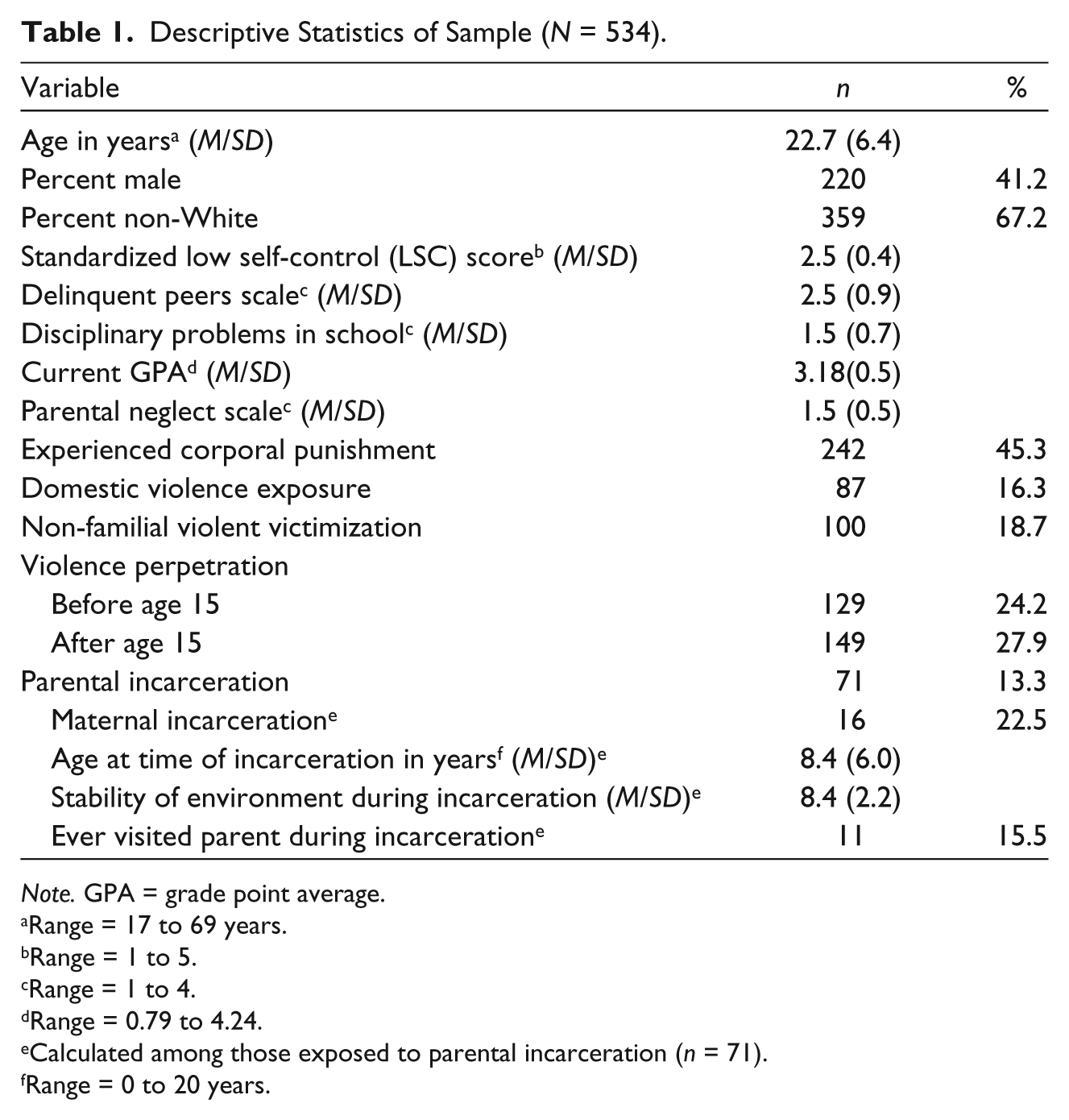
Descriptive statistics on all independent, dependent, and control variables included in the current study are presented in Table 1. Results revealed that overall the sample was predominately female and non-White. The median age was 22.7 years. This is comparable to the university population from which the sample was drawn.
Descriptive Statistics of Sample (N = 534).
Note. GPA = grade point average.
Range = 17 to 69 years.
Range = 1 to 5.
Range = 1 to 4.
Range = 0.79 to 4.24.
Calculated among those exposed to parental incarceration (n = 71).
Range = 0 to 20 years.
Measures
Dependent variable
By and large, research that examines violence has found that the commission of such behavior declines with age. However, for some violent individuals, research has indicated that there may be no decline, with recent research indicating that individuals whose trajectories are not characterized by early onset may be more likely to remain violent longer (see Marcus & Jamison, 2011 for a review). As such, we have chosen to use Straus, Hamby, Boney-McCoy, and Sugarman’s (2009) scale of criminal history that measures violence perpetration before and after age 15 to explore differences by age. Participants were presented with four questions regarding violence perpetration (e.g., “Before age 15, I physically attacked someone with the idea of seriously hurting them” and “Since age 15, I have physically attacked someone with the idea of seriously hurting them”), to which responses were coded using a 4-point Likert-type scale with 1 indicating strongly disagree and 4 indicating strongly agree. For ease of interpretation, each response was later dichotomized to reflect whether or not a participant had ever engaged in physical violence before and after age 15 (1 = yes, 0 = no). Roughly equal proportions of students self-reported having perpetrated violence before the age of 15 (24.2%) and after the age of 15 (27.9%).
Independent/predictor variable
The key variable of interest is parental incarceration. Survey participants were presented with a question regarding their experience with parental incarceration, to which they responded “yes = 1” if their parent had ever been incarcerated and “no = 0” if their parent had never been incarcerated. There were 71 students who reported having been affected by parental incarceration (13.3%).
If a student indicated they had been exposed to parental incarceration, further questions were asked including which parent was incarcerated (mother, father, both), at what age was the respondent when his or her parent was incarcerated (in years), the stability of the home environment during the parent’s incarceration (rated on a 10-point scale with higher scores representing greater stability), and whether the respondent ever visited his or her parent during the parent’s period of incarceration. As depicted in Table 1, nearly one quarter (22.5%) of students exposed to parental incarceration had a mother who was incarcerated. The average age of respondents at the time of their parent’s incarceration was 8.4 years (range = 0-20, SD = 6.0). In general, respondents reported that their home environment during their parent’s incarceration was relatively stable (M = 8.4, range = 1-10, SD = 2.2). Very few respondents (15.5%) had visited their parent while incarcerated.
Control variables
Several criminological risk factors were included in the current study. They include variables generally associated with control and learning theories that operate at the individual (i.e., poor school attachment, delinquent peers, low self-control) and familial (i.e., parental absence, parental neglect, and violent socialization) levels. The inclusion of risk factors at the family level beyond parental incarceration is critical because parental incarceration is likely only one of many risk factors associated with aversive outcomes for the offspring of prisoners (Arditti, 2012). In addition, participant demographics (i.e., sex, age, and race) are included as control variables.
School attachment
Two measures of poor school attachment were included as controls. First, disciplinary problems at school were used as a quasi-measure of poor school attachment. Students self-reported whether they had experienced disciplinary problems in elementary, middle, and high school on a scale of 1 (strongly disagree) to 4 (strongly agree). The mean of these items was calculated to create the disciplinary problems scale, with higher values indicative of having experienced more disciplinary problems in school (M = 2.5, SD = 0.7; Cronbach α = .807). Second, current grade point average (GPA) was included (M = 3.18, SD = 0.5; range = 0.79-4.24).
Delinquent peers
Two questions (“I spend time with people who have been in trouble with the law” and “I have friends who have committed crimes”) were taken from the delinquent peer subscale developed by Straus and colleagues (2009) and utilized to control for the influence of delinquent peers. Participants indicated their level of agreement or disagreement with each statement on a 4-point scale. The mean of these items was calculated to create the peers scale, with higher values indicating more involvement with delinquent peers (M = 2.55, SD = 0.94; Cronbach α = .872).
Self-control
Grasmick, Tittle, Bursik, and Arneklev’s (1993) scale of self-control was used to measure the six dimensions of self-control noted in Gottfredson and Hirschi’s (1990) General Theory of Crime. Students were presented with 24 questions concerning the dimensions of self-centeredness, risk-taking, temper, physicality, impulsivity, and ignoring, to which responses were coded using a 5-point scale indicating agreement or disagreement with each individual question. The overall score for each individual reflects the average of the 24 items with lower scores indicative of higher levels of self-control, whereas higher scores represent lower levels of self-control (M = 2.57, SD = 1.7; Cronbach α = .811).
Parental neglect
Eight questions were taken from the parental neglect subscale developed by Straus and colleagues (2009). Questions included, “My parents did not comfort me when I was upset” and “My parents did not keep me clean.” For all the items, participants indicated their level of agreement or disagreement with each statement on a 4-point scale. The mean of these items was calculated to create the parental neglect scale, with higher values indicative of greater parental neglect as a child (M = 1.47, SD = 0.51; Cronbach α = .823).
Violent socialization
Three separate dichotomous measures were used to capture violent socialization as a child. Specifically, participants were asked about their individual experiences with corporal punishment, exposure to domestic violence, and non-familial violent victimization. First, students were asked to self-report whether or not (yes = 1, no = 0) they had been “spanked or hit a lot” by their mother or father before the age of 12 (i.e., child abuse). Almost half of survey respondents (45.3%) indicated they had been subjected to corporal punishment before the age of 12. Second, students were asked to self-report whether or not (yes = 1, no = 0) as a child had they witnessed their mother or father “kick, punch, or beat up” their partner (i.e., domestic violence). Overall, 16.3% of students revealed that as a child they had been exposed to domestic violence. Finally, students were asked to self-report whether or not (yes = 1, no = 0) they had ever been “pushed, shoved, or slapped” by a non-family member when they were a child (i.e., non-familial violent victimization). Roughly one of five students (18.7%) reported having experienced non-familial violent victimization as a child.
Analytical Plan
To test the hypothesis that parental incarceration aversively affects young adults, different statistical models were generated. Bivariate statistics (i.e., chi square and independent t tests) were calculated to examine differences in demographics, risk factors, and violence perpetration for adult children of the incarcerated compared with their peers who were not affected by parental incarceration. Logistic regression was used to predict violence perpetration based on parental incarceration while controlling for individual characteristics and risk factors. Finally, split logistic regression models were generated to explore the moderating effects of students’ exposure to parental incarceration and biological sex on the relationship between violation perpetration and risk factors. We now turn to the results from these analyses.
Results
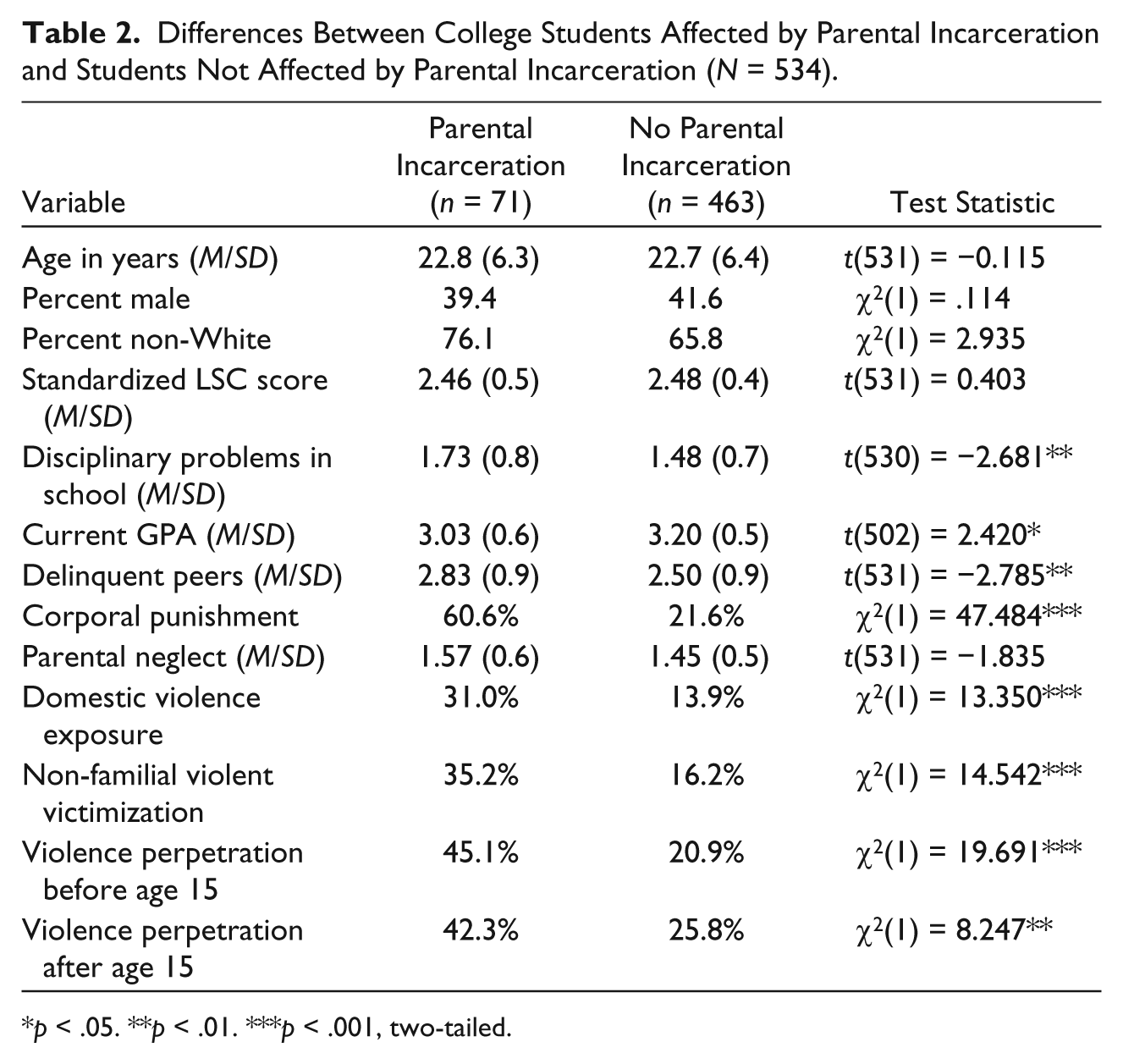
As expected, adult children of the incarcerated were more likely to associate with delinquent peers, twice as likely to have experienced non-familial violent victimization, and twice as likely to have been exposed to domestic violence compared with their peers (see Table 2). In terms of violence perpetration, adult children of the incarcerated were significantly more likely to have perpetrated violence, before and after the age of 15, compared with their peers who had not been affected by parental.
Differences Between College Students Affected by Parental Incarceration and Students Not Affected by Parental Incarceration (N = 534).
p < .05. **p < .01. ***p < .001, two-tailed.
To test the hypothesis that exposure to parental incarceration predicts violence perpetration even after controlling for relevant individual and family risk factors, a series of conditional logistic regression models were computed. Specifically, models were run to examine the influence of parental incarceration on violence perpetration while controlling for participant characteristics (Table 3, Model 1) and individual and family risk factors (Table 3, Model 2). Results are described in terms of adjusted odds ratios, exp(B) = OR. Because of high rate of collinearity, parental absence was excluded from the multivariate models.
Logistic Regression Coefficients for the Impact of Parental Incarceration on Violence Perpetration.

R2 = .115, χ2(4, 533) = 42.507, p = .000.
R2 = .382, χ2(11, 532) = 152.619, p = .000.
R2 = .086, χ2(4, 533) = 32.677, p = .000.
R2 = .258, χ2(11, 532) = 104.875, p = .000.
p < .05. **p < .01. ***p < .001, two-tailed.
As depicted in Table 3, parental incarceration predicted violence perpetration in both models over and above demographic characteristics and risk factors. It is important to note that as individual and family risk factors were added to the second model, the influence of parental incarceration on violence perpetration remained significant but the size of the coefficient decreased. Moreover, the R2 increased from .103 in the first model to .294 in the second model, indicating that while parental incarceration exhibits a direct effect on violence perpetration, the consideration of risk factors is also important.
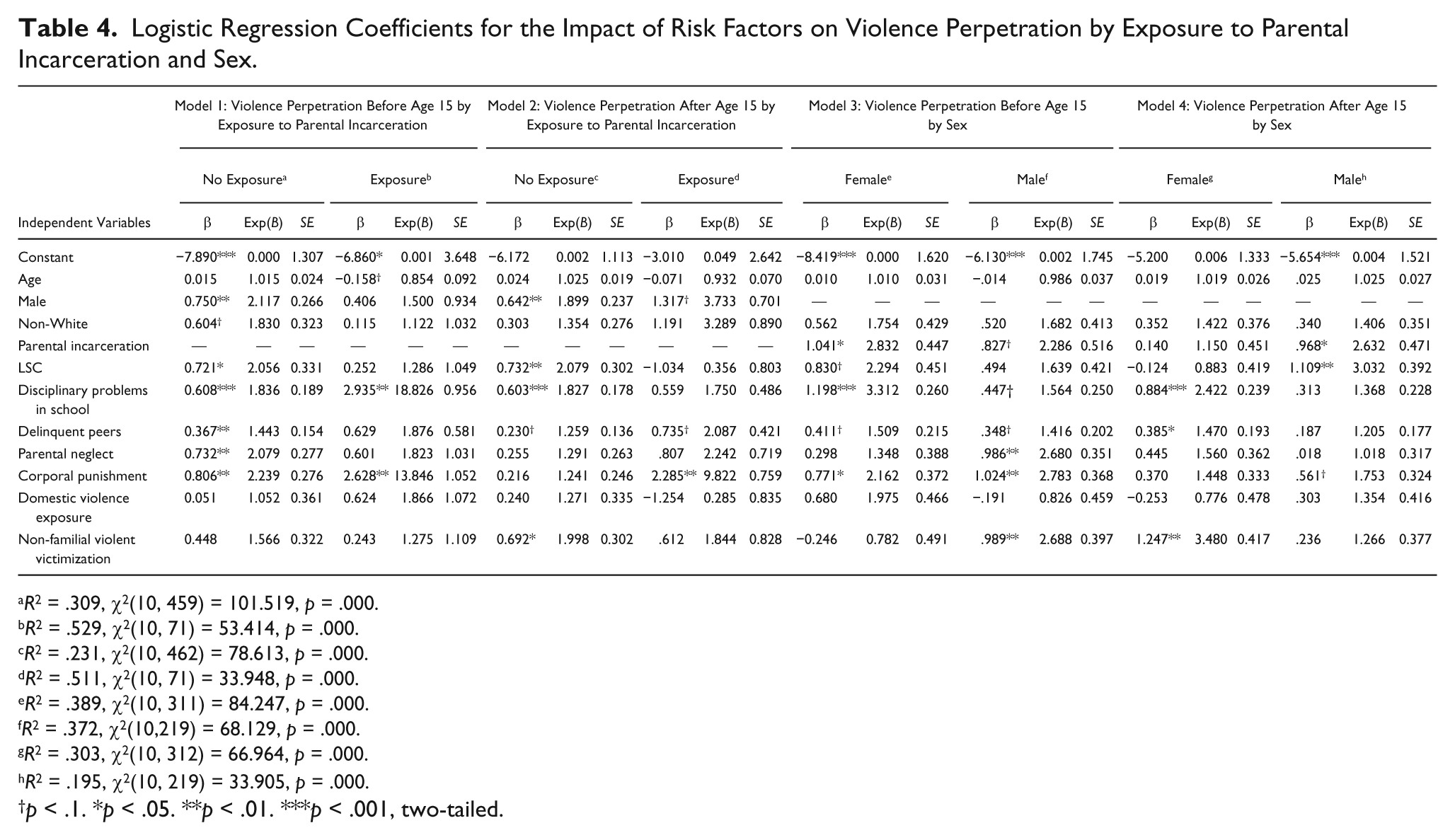
Finally, we wanted to assess whether risk factors for violence perpetration are dependent on exposure to parental incarceration (Models 1 and 2 of Table 4). To explore this question, split models were calculated. Although traditional criminological variables (e.g., LSC, delinquent peers, disciplinary problems in school) were found to be strong predictors of violence perpetration before and after the age of 15 among young adults not exposed to parental incarceration, these same variables failed to predict (as was the case with LSC and delinquent peers) violence perpetration among young adults who have been affected by parental incarceration.
Logistic Regression Coefficients for the Impact of Risk Factors on Violence Perpetration by Exposure to Parental Incarceration and Sex.
R2 = .309, χ2(10, 459) = 101.519, p = .000.
R2 = .529, χ2(10, 71) = 53.414, p = .000.
R2 = .231, χ2(10, 462) = 78.613, p = .000.
R2 = .511, χ2(10, 71) = 33.948, p = .000.
R2 = .389, χ2(10, 311) = 84.247, p = .000.
R2 = .372, χ2(10,219) = 68.129, p = .000.
R2 = .303, χ2(10, 312) = 66.964, p = .000.
R2 = .195, χ2(10, 219) = 33.905, p = .000.
p < .1. *p < .05. **p < .01. ***p < .001, two-tailed.
In the bivariate and multivariate models, sex was an important predictor of violence prediction. As such, we ran two more sets of split models to consider whether risk factors for violence perpetration are gendered among this sample (see Table 4, Models 3 and 4). Some interesting differences emerged. First, parental incarceration was predictive of violence perpetration before the age of 15 for females but not males, and predictive of violence perpetration after the age of 15 for males but not females. Second, the only risk factor that was the same for both sexes was corporal punishment, which was predictive of violence perpetration before age 15 but not after 15 for both male and female students. Finally, it is also important to point out that the risk factors for early and late violence perpetration varied by student sex. For instance, females were most likely to engage in violence before the age of 15 if they had experienced parental incarceration, corporal punishment, and had disciplinary problems in school. In contrast, they were most likely to perpetrate violence after the age of 15 if they had disciplinary problems in school, associated with delinquent peers, and had experienced non-familial violent victimization.
Discussion
Mass incarceration policies in the United States have resulted in surging prison populations that have increased the number of children affected by parental incarceration. To date, little is known about the impact of parental incarceration on young adults. The goal of this study was to add to the growing body of literature devoted to the study of the collateral consequences of imprisonment by exploring the effect of parental incarceration on violence perpetration in early adulthood. Utilizing self-report data collected from 534 college students at a public university in the South, it was predicted that young adults with a history of parental incarceration would have more individual and family risk factors and greater rates of violence perpetration than their peers who had not been affected by parental incarceration.
As expected, students impacted by parental incarceration were more likely to have experienced disciplinary problems in school, associated with delinquent peers, experienced the absence of at least one biological parent while growing up, been exposed to domestic violence, and experienced non-familial violent victimization than their peers who had not experienced the incarceration of a parent. This confirms previous research that has found that children with an incarcerated parent are likely to encounter a host of difficulties in addition to parental incarceration (Arditti, 2012). Furthermore, adult children affected by parental incarceration were significantly more likely to have perpetrated violence than their peers who had not been exposed to parental incarceration, net individual and familial risk.
This study extends the literature pertaining to the impact that parental incarceration has on criminological outcomes of offspring in several ways. First, the current study utilized a fairly recent dataset that is somewhat unique in the parental incarceration literature because it comes from a study that was designed specifically to survey young adults about their personal experiences with parental incarceration. It is not part of a larger study designed to assess other outcomes (i.e., adolescent health) nor does it rely on the assessments of others (e.g., parents, caregivers, or teachers). There is a benefit to this approach. Specifically, controls for well-established correlates of violence perpetration (e.g., self-control, association with delinquent peers, and violent victimization) were included in the study design. Accordingly, findings suggest that both family and individual characteristics are important in explaining violence perpetration among college students. We were surprised to find that key theoretical variables (e.g., LSC, delinquent associates, and problems at school) were only predictive of violent behavior for college students without a history of parental incarceration. Other research has produced mixed results regarding the robustness of criminological variables to elucidate the relationship between parental incarceration and criminal behavior (Huebner & Gustafson, 2007; Muftić, Bouffard, & Armstrong, 2016; Porter & King, 2014). Further research is needed to explore these associations.
Although in the last decade there has been an increasing number of studies that have examined the impact parental incarceration has on adverse outcomes (e.g., substance use, arrest, poor health) among adult offspring, the majority of this research has either been conducted with samples from Europe (Murray & Farrington, 2008b; Murray et al., 2007; van de Rakt et al., 2012) or from data collected as part of the National Longitudinal Study of Adolescent Health (Add Health; H. V. Miller & Barnes, 2013; Porter & King, 2014; Roettger & Swisher, 2011; Swisher & Roettger, 2012). Questions remain whether the results from the studies utilizing European samples generalize to the United States, where the incarceration experience (and social safety net for families affected by incarceration) is markedly different. In addition, one of the more prominent European datasets, the Cambridge Study in Delinquent Development, follows a cohort of boys born in South London in 1953 (Murray & Farrington, 2008b). Although the longitudinal nature of this dataset does indeed allow for the evaluation of the long-term effects of parental incarceration, it is extraordinarily likely that the experience of parental incarceration has changed substantially in the past 50 years. A more modern understanding of the influence of parental incarceration on violent offending in late adolescence is thus warranted. To the authors’ knowledge, the current study is one of the first to explore the effects of parental incarceration (paternal and maternal) within a college sample that includes male and female offspring.
Finally, while the lion’s share of research attention has focused on minor children affected by parental incarceration, it is also import to recognize that all children of incarcerated parents will eventually become adults. Therefore, there is a need to understand the long-term effects of parental incarceration. Our findings that parental incarceration exhibits continued significance on offspring violent behavior even after controlling for individual and familial risk not only strengthens the importance of our findings but suggests the robustness of this effect into early adulthood.
Although this study contributes to the literature in several important ways, there are some shortcomings that need to be noted. First and foremost, some may argue that the generalizability of the findings may be problematic. Because the study was conducted at a large, urban, public university in the South, the majority of study participants were Black females. Overall, the study sample was comparable with the university population from which participants were drawn; however, it is more diverse than the general population of the state in which the university is located. According to the U.S. Census Bureau, the general state population is almost 63% “White,” while only about 30% of the student sample characterized themselves as being “White.” It should also be noted that the student sample affected by parental incarceration (of which almost 25% characterized themselves as “White”) reflects the racial composition of the state jail population, of which only 19% is “White” (Mauer & King, 2007). Because of the small sample size of students affected by parental incarceration (only 13% of the students surveyed had experienced parental incarceration during childhood), we were unable to parse out whether type of parental incarceration (paternal vs. maternal) experienced had an effect on violence perpetration. Existing research indicates that maternal incarceration may be more affecting on children than paternal incarceration (Hanlon et al., 2007; Mackintosh et al., 2006). Subsequent research is needed to explore the impact of maternal incarceration into young adulthood for children with incarcerated mothers. Research should also explore the presence of siblings to examine sex group variations and outcomes across all children of the incarcerated to determine whether college students of the incarcerated faired similarly or differently than their siblings.
Relatedly, there were no differentiations made across students whose parents were incarcerated in jail versus students whose parents were incarcerated in prison. Where a parent serves out his or her period of incapacitation is important as location may affect outcomes among students of the incarcerated. Most inmates are disproportionally from urban areas (Massoglia & Warner, 2011). Although parents who are incarcerated in jails typically remain closer in distance to their families and experience a shorter period of incarceration, parents incarcerated in prisons serve longer sentences and are housed in rural areas that are further distances from their home. Incarceration of a parent in a distant prison may impose difficulties for family members to readily visit and maintain close ties (Massoglia & Warner, 2011).
It is also important to point out that having an incarcerated parent (or parents) does not automatically guarantee a child a life of hardship. The risks associated with parental incarceration can be mitigated by a child’s social environment. Research indicates that a number of promotive and protective factors inclusive of social support, and stable, continuous, and sensitive caregiving, are positively associated with outcomes among children of the incarcerated (Dallaire, 2007; Hanlon et al., 2007). Among this sample, students of the incarcerated reported that their home environment was relatively stable during their parent’s incarceration. This may explain how they have beaten the odds and are currently enrolled in higher education.
Similarly, the quality of familial relationships before and during parental incarceration may influence children’s emotional and behavioral responses (Johnson, 2006). Unfortunately we have no measure of the quality of the relationship between the incarcerated parent and child prior to, during, and after the parent’s period of incarceration. Future studies may want to include such a measure as prior research has indicated this may be a modifier (Arditti, 2012). Finally, future research should explore environmental contexts that may contribute to aversive outcomes for the offspring of prisoners (e.g., residing in socially disorganized communities, inadequate schools, and socioeconomic disadvantage) as well as biological factors related to family and social processes (e.g., see Murray & Murray, 2010).
In conclusion, children affected by parental incarceration face a multitude of risk factors as they approach young adulthood. Existing literature concerning the impact of parental incarceration on aversive outcomes among adult offspring has been limited to samples from Europe (Murray & Farrington, 2008b; Murray et al., 2007; van de Rakt et al., 2012) and data collected as part of the National Longitudinal Study of Adolescent Health (H. V. Miller & Barnes, 2013; Roettger & Swisher, 2011; Swisher & Roettger, 2012), with the primary focus on paternal incarceration only. This study sought to explore the effects of parental incarceration (paternal and maternal) on violence perpetration within a college sample that included males and females. Findings from this study indicate that adult children of the incarcerated are more likely to have perpetrated violence than students without such a history, even after taking into consideration important individual and familial risk factors. By establishing a relationship between young adults affected by parental incarceration and violence perpetration, appropriate services may be targeted to children of the incarceration to reduce the likelihood of violence perpetration in young adulthood, mitigating the long-lasting effects of parental incarceration across the life course.
Footnotes
Declaration of Conflicting Interests
The author(s) declared no potential conflicts of interest with respect to the research, authorship, and/or publication of this article.
Funding
The author(s) received no financial support for the research, authorship, and/or publication of this article.