



Abstract
Israeli regulations require teachers to subject pupils who participate in violent altercations to severe punishment. How teachers actually apply this policy, however, has not yet been researched. The current study investigates teachers’ intentions in disciplining students who brawl. Two hundred ninety-nine teachers read fictional vignettes about students who took part in fighting and are asked to describe the disciplinary measures that they would invoke. The teachers’ responses are quantified on the basis of a specially developed key that determines the severity of the steps that the teachers propose to take. Multi-level regression is utilized. The results reveal that students who explain their use of violence as a response to a violent provocation await only mild discipline if they can prove their claim; those who cannot prove it face severe punishment. Students who turn out to be the aggressors are punished even more severely. The research participants are inclined to punish students more harshly for involvement in retaliation than in involvement in self-defense. The differences in inclination to discipline students with and without attention deficit hyperactivity disorder (ADHD) are inconsequential. The discussion examines the importance of the need to prove guilt in weighing disciplinary action and the compromise between two needs—to discipline violent students and to treat self-defenders fairly—that teachers make when administering punishment.
Introduction
Fighting among students is one of the most frequent and dangerous manifestations of interpersonal violence in school. Educators prescribe vigorous action against belligerency on school grounds (Pepler & Craig, 2008). In many countries, including Israel, where the study described below took place, zero-tolerance policies toward school violence are the norm. Such policies require automatic and severe discipline for anything violent that a student does—meaning that even relatively mild acts of violence result in very severe discipline (Skiba, 2012).
According to the zero-tolerance approach, all participants in a brawl among students, aggressor and self-defender alike, deserve punishment. This approach, however, frustrates attempts to punish students on the basis of their having initiated the altercation. A student whose role in the fracas is that of an unprovoked aggressor—whose fighting is a proactive act of violence—is disciplined in the manner of a pupil who participates in the fight in response to violence, that is, who commits a reactive act of violence. Both may face the same punishment (Teske, 2011) even though the former usually acted with malice and for the purpose of a gain (Hubbard, McAuliffe, Morrow, & Romano, 2010) whereas the latter generally did so impulsively and without prior intent, often in pursuit of vengeance (Hubbard et al., 2010) and, at times, in self-defense (Teske, 2011).
Such policies claim a price in student–teacher cooperation, in which both sides should perceive the method of punishment as fair (Goodman, 2007). Therefore, teachers should differentiate between aggressors and the aggressed when applying discipline (Teske, 2011), as is done away from school (Nourse, 2001). We still do not know whether teachers in zero-tolerance schools reconcile the contradiction between the imperative of de facto equal disciplining of aggressors and self-defenders and the need to treat self-defenders more leniently. Neither do we know whether teachers take the type of justification for this response into consideration when asked to punish students who responded violently to a provocation. Do teachers, for example, treat self-defense more forgivingly than vengeance? Another lacuna in our knowledge concerns teachers’ mindfulness of students who have self-control difficulties. For example, do teachers tend to treat students with attention deficit hyperactivity disorder (ADHD) differently from others when they weigh a disciplinary response to violent and reactive behavior?
The current study seeks to answer these questions by asking teachers how they would discipline students who participate in violent altercations.
The Meaning of Reactive Acts of Violence
Acts of physical violence, even if provoked, cause harm by amplifying hostilities and risking escalation to physical blows (Berkowitz, 1993; Davis, 2006). Even reactive violent acts—those undertaken in response to provocation—may contaminate students with violence and cause it to spread (Anderson, 1999; Warren & Anderson-Butcher, 2005). For example, an investigation of the effect of student retaliation on the spillover of violence from one recess to another found that standoffs beginning in one recess expand to wider circles of students in the next recess (Warren & Anderson-Butcher, 2005).
Conversely, reactive violent acts may impose limits on an overall level of violence. A large population of individuals who are willing to defend themselves, for example, makes aggressive behavior unrewarding (Axelrod, 2006). Reactive acts of violence, particularly when geared to self-defense, are arguably the most effective behavior strategy that an individual may adopt (Axelrod, 2006). Self-defenders hit back at their tormentors as long as the assault lasts and may deter them as well. They also cooperate with others who, like them, have peaceable strategies; therefore, they may gain from peaceful relations among rivals. Conversely, aggressors may embroil themselves in ceaseless disputes that cause them much harm.
Attitudes Toward Violence
Most children appear to see things much as Axelrod does. They object to proactive violence (Vaillancourt et al., 2008) but are much more forgiving toward reactive violent acts (Bradshaw, Sawyer, & O’Brennan, 2007; O’Brennan, Bradshaw, & Sawyer, 2009). For example, children express more positive attitudes toward reactive violent acts than toward proactive ones (Ardila-Re, Killen, & Brenick, 2008; Gasser, Malti, & Gutzwiller-Helfenfinger, 2012). By and large, the more obviously reactive an act is—that is, the more severe the preceding provocation is (Ardila-Re et al., 2008)—the more benign it is regarded by students. Even students who do not fight intensively agree that “It’s OK to hit someone if they hit me first” (O’Brennan et al., 2009). Schoolchildren’s support of reactive violence makes sense because they would lose social “face” by failing to react (Copeland-Linder et al., 2007; Nabuzoka, 2003). Furthermore, refraining from self-defense may render relations between an aggressor and the object of aggression unbalanced, turning the former to a bully and the latter into a victim who faces an unending series of attacks and, in turn, psychological injury as well (Fleischmann, 2015; O’Brennan et al., 2009).
Although children’s attitudes toward violence, including reactive acts of violence, have been researched at length, studies on teachers’ attitudes toward reactive acts of violence are few and far between (Waasdorp, Pas, O’Brennan, & Bradshaw, 2011). Scholarship has found that teachers denounce student violence, suffer from it, and strive to prevent it (Bradshaw et al., 2007; Nesdale & Pickering, 2006; Wilson, Douglas, & Lyon, 2011). An examination of the responses of 1,547 teachers from various U.S. schools suggests that most teachers also oppose reactive violence (Bradshaw et al., 2007). They, like students, frown on violence irrespective of its instigator. Several studies show that teachers assign negative traits not only to aggressors who “start it” but also to the students who are the targets of these attacks as well (Fox & Boulton, 2005; Nabuzoka, 2003).
Punishing Violence
Punishment Policy
Some regard an authoritarian approach backed by disciplinary measures as an appropriate way of dealing with school violence problems (Christie, 2005). The United States (Fenning et al., 2012; Skiba, 2012) and some other countries including Israel (Wininger, 2011) have introduced policies of stringent punishment of school violence, cresting with zero tolerance (Skiba, 2012; Wininger, 2011). This has led to the extensive use of severe measures, most conspicuously expulsion. Furthermore, the zero-tolerance policy toward violence results in excessive punishment of students who have adjustment difficulties, for example, those from dire socioeconomic backgrounds and those with developmental disorders (Fenning et al., 2012; Martinez, 2009; Nesdale & Pickering, 2006; Skiba, 2012).
One-size-fits-all education policies that disregard the diversity of the student body are not only unfair but also ineffective (Gilmore, 2012; Miles & Ainschow, 2011). The policy on discipline in the United States, for example, results in stiffer penalties for students with ADHD who take part in violent interactions than for students without ADHD. Some also censure such a policy toward ADHD students on fairness grounds, arguing that these students have poor self-control and find it difficult to refrain from violent and impulsive response to provocations (Card & Little, 2006; Waschbusch et al., 2003). The rampant use of harsh punishments has been criticized because it sends some of those penalized on a downward spiral that continues with their dropping out of the education system and, in a disproportionate number of cases, ends in criminality. It may also exacerbate student–teacher relations and have dubious educational effect (Sherer & Nickerson, 2010; Skiba, 2012).
Zero-tolerance policies have been criticized pointedly for an additional reason: They are said to violate everyone’s basic right to self-defense. Relating to remarks before the U.S. Senate Judiciary Subcommittee on the Constitution, Civil Rights, and Human Rights, for example (Coulson, 2012), Clayton County (Georgia) Juvenile Court Chief Judge Steven Teske wrote,
Zero tolerance policies are contrary to our fundamental right to self-defense . . . Many kids are assaulted in schools every day and punished for fighting back, or in fear of being punished do not fight back and are beaten.
The answer, Teske suggests, is not for teachers to punish both protagonists—aggressor and self-defender—as the zero-tolerance policy prescribes, but to identify the instigator and discipline him or her only (Teske, 2011). Others propose replacing the strict punishment policy with one that specifies gradated and moderate discipline (Martinez, 2009) or rehabilitative steps (Calhoun & Daniels, 2008; González, 2012). Still, severe punishment remains a common practice in the United States (Fenning et al., 2012; Skiba, 2012) and many other countries (SRSG on Violence Against Children, 2012) including Israel (Wininger, 2011).
For example, Fenning et al. (2012), reviewing codes of conduct in several U.S. schools, found expulsion penalties imposed even for middling and mild offenses. Most schools’ codes of conduct prescribe the suspension of students involved in fighting with other students (Fenning et al., 2012). In Israel, the Ministry of Education proposed a cornucopia of disciplinary penalties in schools, including reprimand, notification of parents, a warning, an assignment, a mark on the report card—lowering the student’s grade or inserting a comment on the “behavior” line, detention (e.g., holding a student back during recess), permanent transfer to a parallel class, an educational assignment, and suspension (Wininger, 2011). Ministry of Education procedures mandate the suspension of any student involved in battery. School-level codes of conduct also lean toward the suspension of students involved in violence (Author, 2015).
De Facto Punishment
When a punishment is immoral, for example, selective and disproportional to the infraction, many students may deem it unjust (Koutrouba, Baxevanou, & Koutroumpas, 2012). Such a penalty may sabotage cooperation between students and school authorities (Goodman, 2007; Koutrouba et al., 2012). Furthermore, when teachers’ behavior is perceived as unfair, it may even exacerbate bullying (Lenzi et al., 2014). As many students sanction reactive violent acts, teachers who punish students for committing them, especially in self-defense, may trigger a confrontation and even violence. Schools may aggravate such differences in approach if they treat information that confirms guilt and self-defense differently from the public’s assessment of such matters away from school. In many countries, society and even criminal law accept the principle of self-defense (Nourse, 2001). Sometimes the law goes so far as to treat violent retaliation sympathetically (Naravan & von Hirsch, 2005).
In a recent qualitative study, teachers claimed that though students may indeed plead self-defense and retaliation under various circumstances, they as schoolteachers could not accept such pleas because they lacked the tools and the time to evaluate them. Accordingly, in the opinion of the teachers interviewed, such claims should pass unheeded unless the students who raise them back them with solid evidence (Author, 2015). This previous study, however, did not attempt to identify the punishments that teachers mete out to students under different circumstances.
Research Questions and Goals
This study investigated how a student’s role in an altercation influences the nature and intensity of the punishment that teachers consider appropriate. For this purpose, a profile of teachers’ inclinations to punish students who participate in fighting served to determine how students who take part in violent altercations with other students are punished when they invoked violence in response to another student’s aggression. To create the profile, three secondary questions were asked. The first concerned the student’s role in the brawl and whether the teacher is aware of it. A previous study found that teachers could determine who “started it” and who responded in only a minority of altercations (Fleischmann, 2015). That qualitative study, however, isolated three situations that may offer assistance, each corresponding to one of three roles that a student in a fracas may play: a self-defender whom the teacher recognizes as such, an aggressor whom the teacher recognizes as such, and one whose role the teacher does not know. The aforementioned qualitative study indicated that students justify their response to violent aggression by claiming self-defense or the seeking of vengeance (Fleischmann, 2015). The current study asked what punishment teachers are inclined to inflict for the three roles indicated above, what sought a qualitative or quantitative difference among them, and teachers how they would punish students who argue self-defense or vengeance and whether they would do so differentially, depending on the claim presented. Finally, the punishments that teachers are inclined to use against students who have difficulties in controlling their responses were reviewed. To obtain this information, the teachers in the study were asked how they would punish students with ADHD who respond to aggression against them; their responses were then tested for differences between punishments administered to students with and without ADHD.
Method
Participants
The sample comprised 299 educators who were studying for MEd degrees at a private college. Two hundred sixty-nine identified themselves as women and 27 as men. Their mean age and service time were 39.01 (SD = 8.11) and 14.21 (SD = 8.09), respectively. Their ranges of age and service time were 23 to 59 and 0 to 35 years, respectively. Forty-nine respondents worked in kindergartens, 132 in primary schools, 60 in junior-high schools, and 41 in senior-high schools.
Research Instrument
Construction of the questionnaire
To produce a profile of disciplinary measures that best corresponds to the severity of punishment actually applied in schools, vignettes were used. The research participants were asked to describe the punishment that they would administer to students on the basis of open-ended questions. The severity of discipline was determined with the help of the research referees. This quantitative content analysis approach maximized the preservation of research reliability without requiring a very large quantity of items, as in conventional questionnaires (Neuendorf, 2002).
The respondents completed an anonymous self-report questionnaire, constructed specifically for this study, regarding their inclination to discipline students who are involved in a violent altercation. The questionnaire presented seven vignettes, each describing the aftermath of a severe altercation in which two students appear to have engaged in fighting. The respondents examined the intersection of three factors, each corresponding to one of the research questions—the first of which is the “role” of student in the fight. Hence, the study delineated three categories of student role. In the first, other students backed the student’s claim of having been attacked with solid testimony (making the student’s role one of a reactive violence). In the second category, the claim of being attacked lacked proof (an unproven violent role). The third category comprised proven instigators, that is, those who attacked their opponents without provocation (a proactive violent role).
The second factor was the type of excuse offered by the attacked student for his or her violent response (self-defense and retaliation).
The third factor relates to the student disorder. In some of the vignettes, one of the students is described as having ADHD and others without ADHD.
As an example, one of the vignettes follows:
You encounter two students who were just involved in a violent quarrel. One of them is diagnosed with ADHD and the other is not. Their faces are swollen and their noses are bleeding. Each accuses the other of having started it; both claim that they were merely defending themselves. Although other students were nearby during the quarrel, you cannot determine who started it.
After reading each vignette, the respondents were asked whether they would discipline each of the involved students. An example of such a question was, “Would you punish the aggressor?” To answer, they had to circle an optional “yes” or “no.” Then the respondents were asked to explain briefly (in four lines or less) the sort of punishment that they would impose (i.e., to specify “intensity of punishment”), that is, “What punishment would you give the offender?”
Altogether, 13 different student situations were presented (see Table 1).
Descriptive Statistics of Punishment Intensity for the 13 Examined Situations.

Note. To determine the intensity of punishment, the respondents’ answers to the open-ended item on inclination to punish are quantified. 0 = no disciplinary action; 1 = a disciplinary conversation with a faculty member; 2 = some form of detention (revocation of recess privileges, etc.), a punitive assignment or writing a letter of apology, or notifying parents/guardians; 3 = inviting parents to a meeting at school; 4 = a final warning before suspension and a proceeding that may end with suspension; 5 = suspension or expulsion. ADHD = attention deficit hyperactivity disorder.
The sentenced student (left side) and his or her rival (right side) have (yes) or lack (no) ADHD.
Median.
Confirmed reactive act of violence.
Unproven reactive act of violence.
Confirmed proactive act of violence.
Development and validation of the questionnaire
Initially, a small group of teachers (n = 30) received a preliminary questionnaire for testing purposes. Asked to comment on difficulties in filling in the questionnaire, these respondents confirmed that the vignettes were clear and easy to answer. They understood the difference between retaliation and self-defense and the differences among the situations that represented the three aforementioned categories of violence.
Development of a key for the evaluation of intensity of punishment
Three additional research aides (experienced teachers) were asked to analyze the statements elicited by the preliminary study. Each aide had to consult with other teachers about the meaning of the statements that categorized the severity of the punishments. Finally, the aides were asked to devise a key for the ranking of respondents’ statements. The result was a stepladder of measures that the respondents chose by consensus. The researcher, a mentor of graduate students who is familiar with school atmosphere and school violence, took responsibility for resolving the few disagreements that the referees had among each other.
The six steps on the scale (key) were as follows: 0 = no punishment; 1 = disciplinary talk with a faculty member, not necessarily the teacher responsible for resolving the violent encounter—such a conversation might take place either with the participation of the specific student alone or with a group of students that includes him or her; 2 = some form of detention, revocation of recess rights, a punitive assignment or writing a letter of apology, or notifying parents/guardians; 3 = summoning parents to a meeting at school; 4 = a final warning before suspension and the possibility of suspension, for example, referring the student to a school authority that may decide on suspension; and 5 = suspension or expulsion. If a student received discipline at several levels, the intensity of punishment was set commensurate with the most severe form of discipline administered.
Procedure and statistical analysis
The respondents received 410 questionnaires in classrooms at a designated time and completed 299 of them. The two independent referees used the punishment-intensity key to evaluate the open-ended responses; their average evaluation is regarded as the intensity of punishment.
To calculate the extent of agreement among the referees as to the intensity of punishment of students in their various roles, Cohen’s kappa was used (see Table 1). These values suggest very strong agreement among the referees (Landis & Koch, 1977). The Cronbach’s alpha of the entire scale was high (.94).
The vignette response data, in which the teacher’s response is the intensity of punishment that he or she proposed, are clustered at the teacher level, that is, each teacher responded to all seven vignettes. Strong correlations between vignette responses appeared (.3 < Pearson’s r < .7; not shown). These correlations indicate the potential clustering of the teachers’ responses. Thus, a multi-level regression was performed to determine the effects of teachers’ characteristics (Level 2 data) and event characteristics (Level 1 data) on punishment-intensity response. The first vignette that made no prior distinction (namely, proactive vs. reactive roles, with ADHD vs. without ADHD) served as a control for the teacher’s spontaneous response. All other vignettes are repeatedly clustered within teachers. Given the imbalance among the responses, we could only control for the source, for example, ADHD proactive role versus without ADHD reactive role, and so forth. Thus, each teacher was repeatedly measured 12 times on six vignettes. A preliminary analysis of missing data revealed that such data were not random, resulting in the replacement of missing data at the teacher level only. The prior missing data are minor, at a level of less than 1.5%.
Results
Disciplining the Various Groups of Students
Students who claim self-defense and can prove it face very mild punishment. Half are not disciplined at all or are merely summoned to a disciplinary talk (see Table 1).
The punitive measures reserved for those who professed retaliation and proved it are more severe than those meted out to students who proved that they were defending themselves. However, even those who proved that they responded for revenge purposes received mild penalties. Indeed, a large minority of retaliators received no punishment at all or only a reprimand (see Table 1).
Next, a qualitative examination was performed of the situations in which students who blamed their violent responses on previous aggression but failed to prove it. In this inquiry, most of the respondents expressed the intention of punishing such students. A minority of respondents even intended to expel or consider expelling students in these situations (see Table 1). Proven aggressors, in turn, received more severe discipline than those who claimed self-defense but could not prove it. Quite a few of them received the ultimate penalty, expulsion (see Table 1).
Students with and without ADHD were punished similarly; the differences between the groups were small.
Multi-Level Regression
The next stage was a two-level regression (HLM V7.01; Raudenbush, Bryk, & Congdon, 2013) with gender, seniority, and spontaneous response as explanatory variables at Level 2, and claim, role, and ADHD and their interactions as explanatory variables at Level 1. To empirically support the multi-level structure of the data, an intra-class correlation (ICC) for punishment intensity (see Table 2) was calculated.
Estimates for Fixed and Random Effects in a Multi-Level Regression Model.
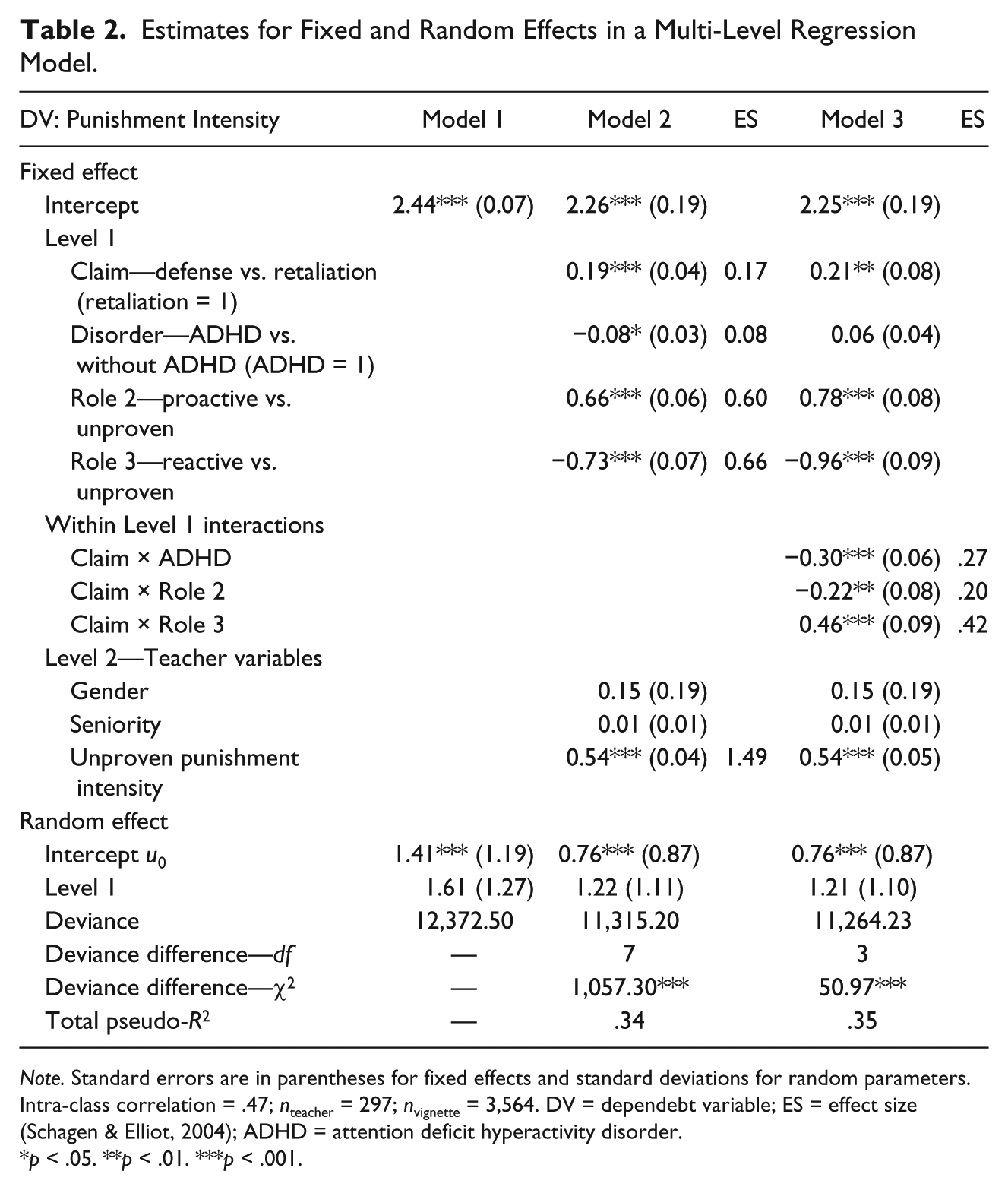
Note. Standard errors are in parentheses for fixed effects and standard deviations for random parameters. Intra-class correlation = .47; nteacher = 297; nvignette = 3,564. DV = dependebt variable; ES = effect size (Schagen & Elliot, 2004); ADHD = attention deficit hyperactivity disorder.
p < .05. **p < .01. ***p < .001.
The value of ICC (.47) indicated a high potential for explained variance at the teacher level beyond the vignette level. In other words, a difference exists between teachers in their punishment intensity across vignettes (Roberts, Monaco, Stovall, & Foster, 2010). Table 2 reports the unconditional model as Model 1, main effects as Model 2, and interactions as Model 3. The unconditional model was set to evaluate the ICC level unconditioned by any independent variable. A significant reduction in deviance indicates that adding further main effects and interactions improved the overall fit of the model.
The results for Level 1 main effects show that retaliation drew more severe punishment than self-defense (b = 0.19, p < .001). This difference has a big size effect, whereas students with ADHD were punished more leniently than those without ADHD (b = −0.08, p < .01). The size effect of the difference between students with and without ADHD in teachers’ inclination to punish, however, was very small (Table 2). Proactive-role cases faced more severe punishment than unproven (b = 0.66, p < .001), while reactive cases invited lighter punishment (b = −0.73, p < .001). These differences had a big size effect.
Interestingly, gender and seniority were not found to affect punishment intensity. However, the unproven punishment intensity as a Level 2 control affected punishment intensity across other vignettes. Teachers who showed a stronger spontaneous response were also predicted to invoke more inflexible punishment in response to all vignettes (b = 0.54, p < .001). Note that the Level 1 intercept is the mean across all vignettes, whereas the random intercept is the variance across teachers.
As not all interaction pairs lent themselves to measurement, only two relations between claim and disorder and role were estimated and found significant. Note that role appears in two forms. The source of these analyses appears in Figure 1 (Preacher, Curran, & Bauer, 2006).

Source of interaction analysis, claim on disorder, claim on role: (a) ADHD versus no ADHD and (b) reactive versus proactive versus unproven.
Figure 1a shows that students with ADHD await milder (insignificant) punishment if they retaliate, whereas students without ADHD will probably receive slightly but significantly more severe punishment in this event (b = 0.20, p < .01). As Figure 1 shows, a reactive act of violence and an unproven role increase the punishment response intensity (b = 0.67, p < .001; b = 0.21, p < .01, respectively), whereas proactive violence remains intensively punished but does not change in the shift from defense to retaliation.
Discussion
Punishing Proactive and Reactive Violent Acts
The vignettes that served to test teachers’ inclinations in this study describe confrontations between students that were accompanied by physical blows. According to the zero-tolerance approach expressed in the Ministry of Education policy and various Israeli schools’ codes of conduct (Wininger, 2011), teachers should oust all the students involved. The findings, however, show that students who use reactive violence, especially in self-defense, are mildly disciplined.
If so, teachers do not strictly observe zero-tolerance rules, apparently because the rules sometimes clash with common sense, and seem immoral in the eyes of some teachers (Fleischmann, 2015). By implication, it is worth investing thought in revisiting the disciplinary policy that underlies these rules.
The teachers tended to punish proactive acts of violence more harshly than reactive acts of violence. Although previous studies show that most teachers oppose both types of violence, proactive and reactive (Bradshaw et al., 2007; Nesdale & Pickering, 2006; O’Brennan et al., 2009), one can understand why teachers take a more lenient view of confirmed reactive violent acts: the public feels the same way. Not only do students accept reactive acts of violence, so do their parents (Berkowitz, 1993; Davis, 2006; Goodman, 2007).
The public’s attitude has the advantage of common sense, namely, if those aggressed upon cannot defend themselves, they may lose their equal status vis-à-vis aggressors due to the lack of tools with which to deter the latter, possibly exposing them to repeated attacks, that is, victimization (Fleischmann, 2015; Teske, 2011). Furthermore, if claims of self-defense (Nourse, 2001) and retaliation (Naravan & von Hirsch, 2005) may result in the remission of punishment in criminal courts, they may have the same outcome in teachers’ eyes.
Knowing the self-defender’s identity
The results indicate that teachers perceive the disciplining of students who claim to have fought reactively but cannot prove it much as they do the disciplining of aggressors.
Qualitative research has found that teachers are afraid to legitimize self-defense lest it inspire aggressors to express this claim spuriously (Fleischmann, 2015). Consequently, they feel that the pardoning of reactive violence on the part of students who cannot prove their innocence would not only break school rules but also shelter faux victims from penalties. Teachers’ concerns on this account are on solid ground even when mendacity is not alleged. Aggressors frequently regard their predations as self-defense (Englander, 2003; Furlong & Morrison, 2000), and violent children often misjudge vague social cues as attacks and, thus, may construe their own attacks on victims as self-defense (Dodge et al., 2003). Consequently, given the violent reality that besets many schools, differentiating between a proactive and a reactive violent act is unfeasible if not hopeless (Berger, 2007). If so, an effective school policy from teachers’ standpoint is one that explicitly bans reactive violence as well, even in self-defense.
In that case, however, why are unproven reactive acts of violence punished less severely than proactive ones?
The way an individual responds to a situation such as that described in this study is not only the outcome of expediency but also a compromise between expediency and psychological and moral considerations, for example, the quest for fairness (Sanfey, 2007). The relatively mild punishment given for a proven reactive act of violence and, particularly, proven self-defense makes it appear that the respondents definitely bear considerations of fairness in mind. A teacher who decides to discipline a student who describes his or her violence as reactive but fails to prove it has to consider that this student may be telling the truth. Therefore, punishing him or her is a compromise between the respondent’s predisposition to fairness, which would encourage greater lenience toward reactive acts of violence, and the need to deter violent students.
Self-defense and vengeance
The findings show that the research participants also deem the claim of vengeance worthy of consideration but punish more leniently when violence is invoked in self-defense. These differences in the intensity of punishment are especially large in situations where a student manages to prove his or her claim of having been attacked; they are smaller when his or her claim is not proved, and they drop to zero when he or she is found to have been the aggressor. The difference in attitude toward vengeance versus self-defense is understandable: People consider self-defense legally and morally legitimate but rarely extend that defense to vengeance (Nourse, 2001). This makes it less moral to punish for self-defense, especially when the student proves that such was his or her motive. When teachers find that students lied on this account, however, and turn out to have “started it,” they—the teachers—no longer have to keep the claim of self-defense in mind. Accordingly, the students’ claim carries no advantage and the difference zeroes out, as in the results between such students and those who falsely claim that they used violence for vengeance purposes.
Attitude toward ADHD
Students with ADHD have impaired self-control and are prone to impulsive and undirected behavior (Waschbusch et al., 2003). Therefore, it has been proposed that teachers should take these students’ hardships into account in the direction of punishing them more sparingly than their non-ADHD peers (Soleil, 2000). Indeed, the participants in the present study punished students with ADHD less, but only slightly so. Previous studies reported contrary findings, showing that students with ADHD are disciplined and expelled much more than others (Barkley, Fischer, Edelbrock, & Smallish, 1990; Krezmien, Leone, & Achilles, 2006; Xin, Yu, & Shaver, 2014). This ostensible over-punishment, however, does not contradict the findings of the present study because it may reflect the greater involvement of students with ADHD in discipline problems (Soleil, 2000) as opposed to teachers’ attitudes, which the present study investigates. It may also originate in deficient social acceptance of students with ADHD, as with members of other disempowered groups, for which reason many students with ADHD fail to line up exculpatory witnesses—a fact that in itself may intensify the disciplinary measures taken against them.
Limitations
The study has several limitations. Its sample, though highly diverse, is not representative. The respondents were MEd candidates who worked in many schools across an entire country, Israel. In a nod to the country’s demographics, Jewish and Arab teachers were sampled. They held various positions, were of varied ages, had amassed different amounts of service time, and taught different grades. Whether they were representative or not, evidence from complementary qualitative research as well as the author’s earlier quantitative and qualitative studies show that their behavior patterns, as observed in this study, recur among other populations of teachers. Nevertheless, future research should target different combinations of teacher characteristics for investigation. For instance, the effect on the research findings of other samples in terms of gender, teaching classes, and scholastic subjects demands examination. The current study found sizable differences among teachers in both their general attitude toward punishment and their approach to different kinds of violence. Additional studies and different samples explain the reasons for these differences.
In any case, before one can infer that the current study reflects the reality in Israel, and especially if one wishes to compare its findings with those in other countries that have zero-tolerance policies, further research in other countries should address the issue on the basis of larger and more representative samples. Such studies may create an infrastructure for additional knowledge on a topic for which knowledge is far from complete: the rules that schools actually use.
The current study was conducted along quasi-experimental lines. A true experiment, in which students beat each other up, is out of the question for obvious reasons. Just the same, additional studies aided by observations may revisit the results of the present study under school conditions. Therefore, one hopes that the foregoing study will inspire further research into the logic behind disciplinary measures in school generally and the use of such measures against students who engage in self-defense particularly.
Conclusion
Schools accommodate students who come from diverse backgrounds and have different capabilities (Miles & Ainschow, 2011). Nothing is more unequal than an approach that treats everyone equally (said the Grand Rabbi of Kotzk). Approaches that fail to take account of diversity in students’ abilities are both unfair and conducive to poor scholastic and social outcomes (Gilmore, 2012). The current study shows that teachers’ attitudes may take inadequate account of the structural difficulties of students with ADHD, causing these students to be punished much as non-ADHD students are. An approach that shows no consideration for the difference between ADHD students and others may have dire implications for the ability of the former to survive in school. The pro-punishment approach needs to be reexamined and teachers should be shown that each group of students should be treated in a manner befitting its capabilities, yielding disciplinary methods that are fair to and appropriate for each category of students and inducing outcomes that will empower all students and thwart their exit from the education system.
This study shows that teachers are relatively strict in punishing students who cannot prove that they acted in self-defense. When a student who does defend himself or herself gets punished for it, the result may be a bitterness that will impair student–teacher cooperation and prevent teachers from getting to the root of a violent eruption (Goodman, 2007;). Furthermore, self-defending students who believe that their teachers treated them unfairly because they could not prove self-defense may respond with frustration and slide into violence. As socially unacceptable students may be punished more severely due to their inability to procure exculpatory witnesses, they may be sucked into a cycle that ends with greater violence. Previous research demonstrates the grave harm that excessive punishments and expulsion may cause. They may culminate with the student’s dropping out of school, potentially followed by deterioration into drug use and criminality (Martinez, 2009; Skiba, 2012). If so, it may be necessary to replace methods of discipline in school that force attacked students to invoke reactive violence.
The exact method of solving violence problems lies outside the purview of this study and entails further discussion. Mediation and conflict resolution come to mind as possible courses of action (Johnson & Johnson, 1996).
Footnotes
Declaration of Conflicting Interests
The author(s) declared no potential conflicts of interest with respect to the research, authorship, and/or publication of this article.
Funding
The author(s) received no financial support for the research, authorship, and/or publication of this article.