



Abstract
This study investigated the role of present and future time perspectives, and their relationships with subjective norms and beliefs regarding violence, in predicting violent behaviors among urban middle school students in the Midwestern United States. Although present time perspective covaried with subjective norms and beliefs, each made a unique prediction of self-reported violent behaviors. Future time perspective was not a significant predictor when accounting for these relationships. In addition, present orientation moderated the relationship between subjective norms and beliefs and rates of violent behaviors; those with higher present orientations exhibited stronger associations. We replicated this pattern of results in data from new participants in a subsequent wave of the study. Interventions that explicitly address issues related to time perspective may be effective in reducing early adolescent violence.
Adolescent violence persists as a social problem (Jain & Cohen, 2013). Both perpetrators and victims of adolescent violence can experience physical injury (Kann et al., 2000; Shanklin, Brener, McManus, Kinchen, & Kann, 2007), and victimization is associated with an array of mental health and behavioral problems, including posttraumatic stress disorder (Abram et al., 2004; Fitzpatrick & Boldizar, 1993), depression (Kilpatrick et al., 2003; Ozer & Weinstein, 2004), illicit substance use (Kilpatrick et al., 2003; Tyler & Melander, 2015), and aggressive behavior (DuRant, Cadenhead, Pendergrast, Slavens, & Linder, 1994; O’Keefe, 1997; So, Gaylord-Harden, Voison, & Scott, 2015; Sullivan, Farrell, & Kliewer, 2006).
Adolescents are not equally likely to engage in violent behavior, and multiple modifiable risk factors are associated with violent behavior. Consistent with the theory of reasoned action (Fishbein & Ajzen, 1975), subjective norms with respect to violence and adolescent beliefs about violence are risk factors that have been consistently associated with violent behavior. When adolescents perceive that their community or their peers endorse violent behavior, they are more likely to engage in violent behavior (Bernburg & Thorlindsson, 2005; Beyers, Loeber, Wikström, & Stouthamer-Loeber, 2001; Jemmott, Jemmott, Hines, & Fong, 2001; Stewart, Simons & Conger, 2002). In addition, favorable attitudes toward fighting and other problem behaviors (Beyers et al., 2001; Stewart et al., 2002) and intentions to fight (Jemmott et al., 2001) are associated with higher rates of violent behaviors in adolescents, explaining a large proportion of the variance in such behaviors. Although norms, attitudes, and intentions contribute significantly to violent behavior among youth, other individual characteristics may be important to consider. For example, time perspective may be an individual characteristic worthy of consideration.
Psychological pioneers such as William James and Kurt Lewin regarded time perspective as an important psychological dimension, and contemporary researchers consider time perspective to be a pervasive and powerful influence on human behavior, yet one that has yet to be sufficiently recognized (Holman & Zimbardo, 2009; Zimbardo & Boyd, 1999). Others have argued that time perceptions play a fundamental role in the selection and pursuit of social goals (Carstensen, Isaacowitz, & Charles, 1999). Mischel and colleagues documented the relationship between future-oriented self-control at age 4 and a wide range of outcomes 10 years later, including social competence, educational achievement, and resilience to frustration and stress (Mischel, Shoda, & Rodriguez, 1989). A strong future orientation has also been correlated with beneficial outcomes such as higher socio-economic status, superior academic achievement, less sensation seeking, and fewer health risk behaviors (Mischel et al., 1989; Oyserman, Bybee, & Terry, 2006; Stoddard, Zimmerman, & Bauermeister, 2011). Another study noted that present and future time perspectives predicted health-related behaviors such as alcohol consumption, physical exercise, eating breakfast, and wearing safety belts in undergraduates, beyond the variance accounted for by sex and Big Five personality traits (Daugherty & Brase, 2010). Risk taking has been shown to be higher among individuals with a stronger present time perspective, who believe life is unpredictable and immediate consequences are most relevant (Brezina, Tekin, & Topalli, 2009; Keough, Zimbardo, & Boyd, 1999). Stronger present and weaker future time perspectives both have predicted risky driving behaviors (Zimbardo, Keough, & Boyd, 1997). Those individuals with a strong present orientation were at greater risk of adverse outcomes such as mental health problems, juvenile delinquency, crime, and addictions when they live in future-oriented societies (see Zimbardo & Boyd, 1999).
Time perspective may become a psychological construct central to understanding human behavior with life history theory (LHT), an integrative theoretical framework that can illustrate how behavioral variation is contingent on experiences in the social-developmental environment (Kruger, Reischl, & Zimmerman, 2008). Biologists who initially formulated LHT proposed that organisms living in unstable and unpredictable environments would develop a “faster” life strategy to be successful when mortality may always be imminent (MacArthur & Wilson, 1967; Pianka, 1970). In contrast, individuals growing up in stable environments would have a longer term strategy with high levels of investment in development. Although shorter time horizons, stronger present orientation, and weaker future orientation are associated with socially undesirable behaviors and outcomes, they may be the product of an evolved psychological system designed to take advantage of fleeting opportunities. In Mischel’s famous “marshmallow test,” children who are presented with an unreliable experimenter show a strong tendency to choose the smaller, more immediate option (Kidd, Palmeri, & Aslin, 2013).
Several researchers have found support for the connection between shorter time perspective and risky and violent behaviors. Community college students who saw the future as less predictable and estimated their life spans as shorter exhibited risky behavior more often than students who saw the future as more predictable (Hill, Ross, & Low, 1997). Youth who anticipated an early death tended to pursue high-risk behaviors associated with immediate rewards, including crime and violence (Brezina et al., 2009). Data from the National Longitudinal Survey of Adolescent Health indicated that poor impulse control and high future discounting independently predicted a range of problem behaviors, with poor impulse control uniquely predicting violent offenses and high future discounting more strongly predicting property offenses (Nagin & Pogarsky, 2004). Present- and future-oriented time perspectives mediated the relationship between social conditions in the developmental environment (including personal safety, helpfulness of others, direct and indirect victimization experiences) and violent and property offenses among adolescents (Kruger et al., 2008).
Although researchers have produced evidence that time orientation and violent behaviors are associated among adolescents (Birnbaum et al., 2003; Brezina et al., 2009; DuRant et al., 1994; DuRant, Getts, Cadenhead, Emans, & Woods, 1995; but also see Blitstein, Murray, Lytle, Birnbaum, & Perry, 2005), additional research is needed to clarify the nature of this relationship. Previous measures of future orientation have generally focused on whether adolescents expect negative events in their future life, rather than whether they believe that their futures are influenced by their current actions. In the current study, we examined the influence of present and future time perspectives on violent behavior. We integrated these constructs with one of the most prominently utilized model for predicting behaviors related to health and social outcomes, the theory of reasoned action (predecessor to the theory of planned behavior), which includes measures of attitudes and social norms in predicting behavioral tendencies.
We believe this to be the first study to incorporate constructs from the time orientation model and the theory of reasoned action simultaneously. Individuals who are more present oriented may exhibit a form of hypervigilance in assessing their environment and responding accordingly. This would be useful as the unstable environments associated with shorter time horizons may change quickly, and threats may be more imminent than in more predictable environments. Thus, adolescents with stronger present orientations may be more susceptible to beliefs encouraging risky behaviors, including violence, as well as show more influence from the environmentally relevant information contained in perceived peer beliefs and social norms.
We hypothesize that present orientation will directly predict rates of reported incidents of violent behaviors among early adolescents and that future orientation will inversely predict these rates. These relationships will be partially independent of subjective norms and beliefs regarding violence. Yet, those who have stronger present orientations may be more susceptible to subjective norms and beliefs promoting violence and thus may have higher rates of violent behavior. In contrast, those with stronger future orientations may have a protective buffer against perceived social norms encouraging violence.
Method
Setting
Flint, Michigan, is an industrial city whose population has grown and declined during the 20th century with the manufacturing capacity of the city’s largest employer, General Motors (GM). In 1970, GM employed an estimated 80,000 workers at Flint area plants. GM and affiliated industries employed around 8,000 workers during the timeframe of this study (Seibt, 2007). As these manufacturing jobs left the area, so did a significant portion of Flint’s population, declining by 48% from 196,940 in 1970 to 102,434 in 2010 (U.S. Census Bureau, 2012). The city of Flint also has experienced higher unemployment rates than most urban centers in Michigan. One recent compilation of FBI crime statistics noted that Flint had the third highest rate of crime among U.S. cities (Morgan, Morgan, & Santos, 2015) and the FBI Uniform Crime Report indicated that Flint was the most violent city in the United States with 22 violent incidents per 1,000 during 2010 (FBI, 2011).
Participants
The project attempted a census-style sampling method, including every student in the population (N = 952) from two Flint middle schools before an afterschool violence prevention program began in one of the schools. Overall, 64% of students participated. Of the students on class lists at the two middle schools in the study, 10% were excluded because their parents were not on the mailing list provided by the school or their addresses were not deliverable; 6% of students were excused due to parental or student refusal to participate and 20% of students were absent on the day surveys were administered.
Of survey participants (n = 609), 50% were female, 51% were in eighth grade, 49% were in seventh grade, 57% attended one school, and 43% attended the other school. The mean age was 13 years (SD = 1, range 11-15). Students could self-identify with multiple racial/ethnic categories and described themselves as 74% Black, 8% White, 3% Hispanic, 1% Asian, 9% other ethnicity, and 21% Native American. The U.S. Census Bureau (2001) indicates that in 2000, 0.7% of early adolescents aged 10 to 14 years in the Flint metropolitan area were American Indian or Alaska Native, so the high proportion of students identifying as Native American was most likely due to a misinterpretation of this category.
Measures
We included adaptations of the present-hedonic orientation and future orientation scales from the Zimbardo Time Perspective Inventory (Zimbardo & Boyd, 1999). Future orientation was assessed with five items examining delayed gratification, planning for the future, and the importance of hard work (e.g., “I finish my work that is due tomorrow before playing today”). Present orientation was assessed with three items assessing attitudes toward risky behavior and the arbitrariness of goal-related outcomes (e.g., “I do risky or dangerous things to put excitement in my life”). Four subjective norm items assessed participants’ friends’ attitudes toward fighting and whether friends would think the participant was scared if he or she refused to fight (e.g., “If I refuse to fight, my friends will think I’m scared”). Five items from Dahlberg, Toal, Swahn, and Behrens’s (2005) study assessed beliefs about fighting (e.g., “If I walk away from a fight I would be a coward”). Violent behaviors were assessed with four items from Bachman, Johnston, and O’Malley’s (2005) work and Shanklin et al.’s (2007) work (e.g., “Have you hurt somebody badly enough to need bandages or a doctor?”).
Data Analysis
We made a preliminary examination of the constructs with a confirmatory factor analysis (CFA). The one-factor model of subjective norms and beliefs had equivalent fit to the two-factor model separating subjective norms and beliefs, so the subjective norms and belief items were combined into one nine-item scale. We imputed missing values with linear interpolations based on scores from other items within the same scale: 16% of responses for future orientation, 17% of responses for present orientation, 13% of responses for subjective norms and beliefs, and 6% of responses for violent behaviors. We tested our conceptual framework with a structural equation model (SEM). We expected that subjective norms and beliefs encouraging violent behaviors and stronger present orientation would directly predict rates of violent behaviors. We expected that future orientation would be inversely associated with rates of violent behaviors. This initial model was created and non-significant paths were trimmed from the model. A final model was constructed with remaining paths that were significant at p < .05 (see Figure 1).

Structural model with significant predictions, Year 1 data.
To test the hypothesized moderation of the influence of subjective norms and beliefs encouraging violent behaviors by time perspective, scores from scale items were averaged into scale scores, as the interaction of the abstract exogenous constructs cannot be computed directly.
A stepwise linear regression predicting rates of violent behaviors was performed, with individuals’ scale scores and their interaction terms as potential predictors.
Results
The CFA indicated that subjective norms and beliefs regarding violence could be combined into one construct for a parsimonious model. All other constructs exhibited enough unique variation to be distinguished from other constructs. We then estimated our full SEM. Results indicated that the data had an acceptable fit to the hypothesized model (see Figure 1). Controlling for the influence of subjective norms and beliefs regarding violent behaviors, present time perspective explained a substantial proportion of the variance in self-reported violent behaviors. Once these associations were accounted for, future time perspective did not explain a significant proportion of variance in violent behaviors and was unrelated to present orientation. Although present time perspective covaries with subjective norms and beliefs regarding violent behaviors sharing 7% of their variance, the two constructs each made a unique prediction. Combined, subjective norms and beliefs and present time perspective explain 61% of the variance in rates of violent behaviors.
The stepwise linear regression with individuals’ scale scores and their interaction terms indicated that the interaction of present time perspective and subjective norms and beliefs regarding violent behaviors predicted rates of violent behaviors, t(607) = 9.05, p < .001. Once this association was accounted for, no other individual scale scores or interaction terms explained a significant proportion of variance in rates of violent behaviors. Adolescents with higher present orientation showed a stronger relationship between subjective norms and beliefs and rates of violent behaviors (see Figure 2).
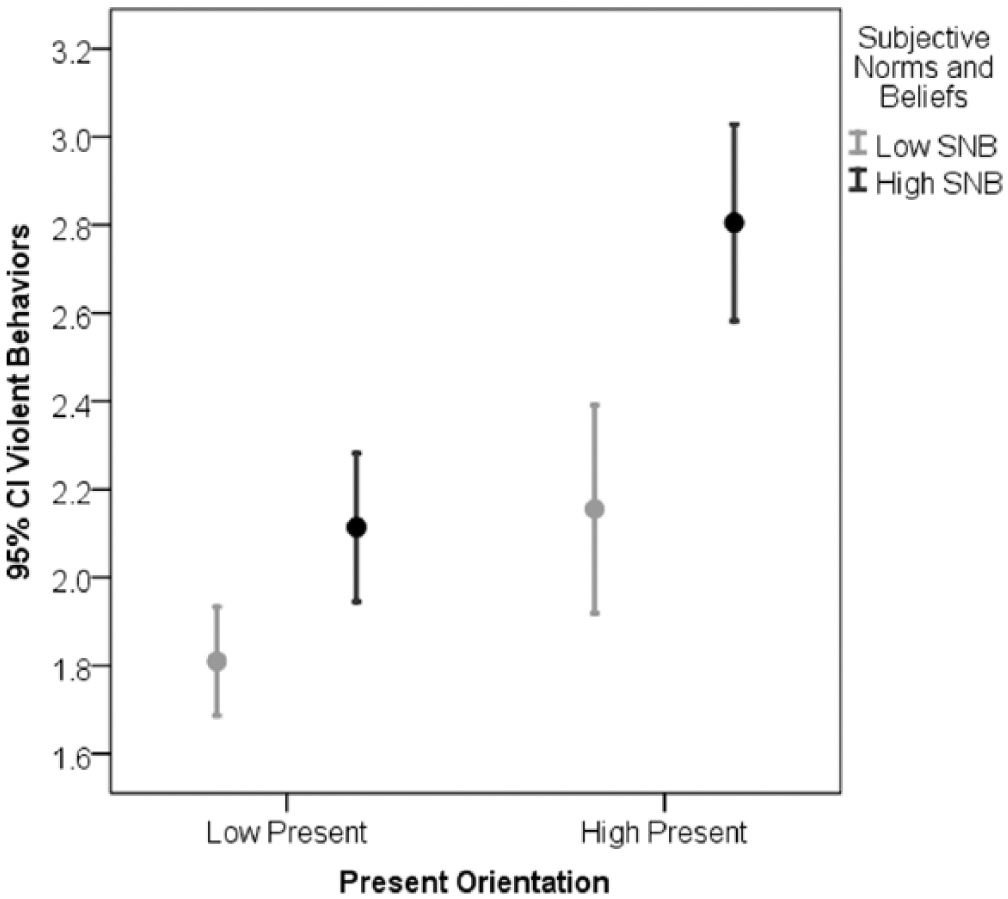
Interaction of present time perspective and subjective norms and beliefs in predicting violent behaviors, Year 1 data.
We replicated these results with 407 new participants from a separate wave of school surveys conducted 2 years after the original data collection. Demographic characteristics were similar to the first sample: 46% were female; 51% were in eighth grade and 49% were in seventh grade; the mean age was 13 years (SD = 0.82, range 11-16); 71% were Black. The pattern of results was identical for the SEM (see Figure 3). In this analysis, both present time perspective, t(405) = 2.64, p = .009, and the interaction of present time perspective with subjective norms and beliefs, t(405) = 6.44, p < .001, significantly predicted violent behaviors, accounting for 21% of the variance (see Figure 4).
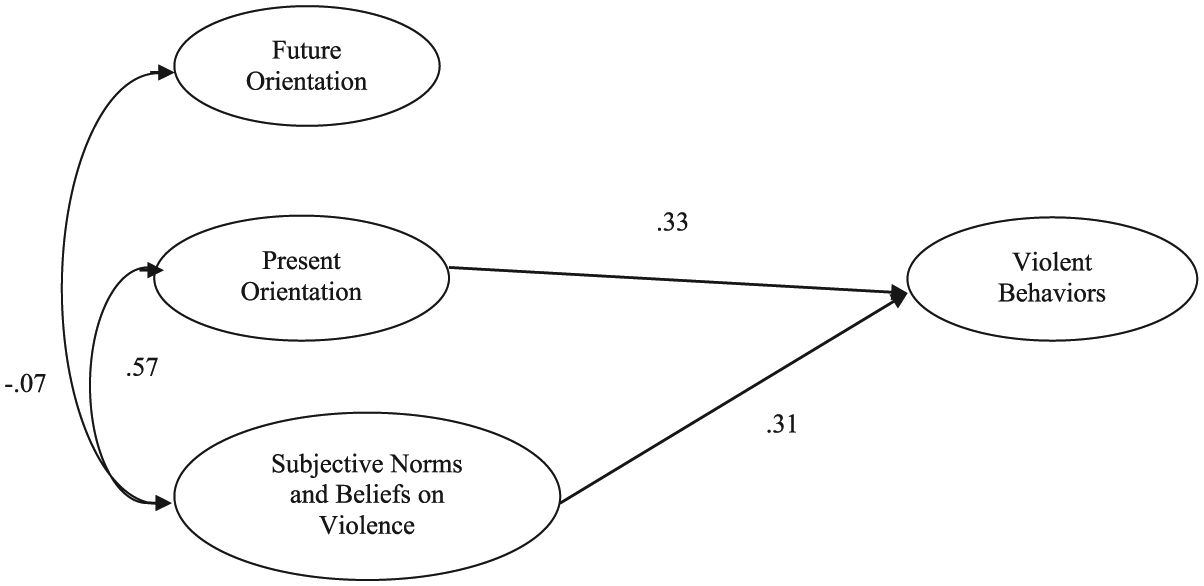
Replication of structural model with significant predictions, Year 3 data.

Replication of interaction between present time perspective and subjective norms and beliefs in predicting violent behaviors, Year 3 data.
Discussion
Adolescent violence is a substantial social challenge, with potentially life-long consequences for both perpetrators and victims. This study advances the understanding of psychological factors predicting violent behavior during early adolescence, and suggests the importance of holding a present-oriented time perspective in accounting for violent behaviors. In this study, present-oriented time perspective included (a) risky or dangerous behaviors for immediate excitement and (b) beliefs that positive life outcomes are not related to intensive effort.
The results—found in two separate samples—provided partial support for our hypotheses. Early adolescents with a stronger present orientation were more likely to commit violent acts than those with a weaker present orientation and were also more strongly influenced by their own beliefs and perceptions of peer beliefs about the acceptability and effectiveness of violence. We also noted the significance of this predictive relationship even after we controlled for the significant influence of the adolescents’ subjective norms and beliefs (justifying violent behaviors as acceptable and effective responses). Somewhat surprisingly, future orientation—characterized by (a) behaviors such as completing required work before playing and planning for the future and (b) beliefs in the efficacy of planning and in how present behaviors affect future outcomes—did not uniquely predict violent behavior.
Some consider the short-time horizons of adolescents and young adults to be a rational response to uncertainty (e.g., Gardner, 1993; Wilson & Daly, 1997) and that those who grow up in relatively uncertain environments, as is the case with our sample, will develop riskier behavioral patterns to take advantage of possibly fleeting opportunities (Chisholm, 1993). Similarly, neighborhood homicide rates may correspond to neighborhood life expectancy (excluding the effects of homicide) and neighborhood income inequality (Wilson & Daly, 1997).
Our study participants were drawn from schools in neighborhoods with physical decay and high rates of violence. We considered this sample highly appropriate for such a research project, as local rates of violence are extremely high compared with other communities in the United States. Such settings may be where research on violence is most needed to promote understanding and eventually actions that will be effective in reducing levels of violence.
Wilson and Daly (1997) argue that in environments where the probability of receiving delayed benefits is uncertain or low and the expected benefits of safer courses of action are negligible, risky strategies will be favored. Indeed, the mean benefit of risky strategies in such environments may be favored over cautious strategies because of the perceived benefits such as gaining access to financial and material goods and gaining respect from peers. Engaging in risky behaviors may also provide more immediate access to valued social relationships and the associated protection against other threats (e.g., violence, property loss). Adolescents developing in environments where personal safety, social support, and resource control are low or uncertain may be more likely to discount future outcomes in favor of more immediate (i.e., present) outcomes. In Brazil, children who grew up in impoverished neighborhoods discount the future more so than those who grew up in affluent neighborhoods (Ramos, Victor, Seidl-de-Moura, & Daly, 2013). These adolescents may be more susceptible to peer influences encouraging risky, dangerous, and/or illegal behavior because they are looking to maintain social relationships in their lives right now. Indeed, this study underscores the importance of gaining immediate benefits in shaping adolescent behaviors.
Our participants are early adolescents living in a community characterized by high poverty rates and relatively limited opportunity. They represent a restricted range in some types of population diversity such as family socio-economic status, though they do represent the ethnic diversity of their school attendance areas. Still, the areas where these students reside exhibit considerable variation in socio-economic conditions; for example, the poverty rate ranges from 8% to 64% (M = 32, SD = 12; U.S. Census Bureau, 2001), and rates of adolescent violence vary considerably as well (Kruger, Aiyer, Caldwell, & Zimmerman, 2013). Thus, despite the plausibly restricted range, we expected to see substantial variation in our study variables.
Limitations
As noted above, our sample represents a population where youth violence is frequent and socio-economic conditions are generally adverse. Because of the parent study’s intended design to reduce violence in a high-risk urban school, our participants may represent a restricted range on the study variables, as described above. Samples from more affluent populations may exhibit stronger influences of future orientation, as planning for the future may be more common for these youth. Our sample was predominantly African Americans living in predominantly African American inner city areas. Thus, our results may not be generalizable to other groups of adolescents. Nevertheless, lower income urban African American adolescents may be particularly vulnerable to influences promoting present-oriented behaviors. The path toward a middle-class lifestyle or professional careers may not be as apparent in lower income neighborhoods. In addition, urban youth may be exposed to adults engaging in illegal economies (e.g., selling drugs) that involve great personal risks for immediate gratification (e.g., cash, social status). According to teacher reports, many students in our sample have low levels of literacy. This likely contributes to noise in the data and attenuates statistical relationships. Participants may increase in their future orientation as they age. Because of the factors described above, we do not discount the potential role of future perspective, but simply note that we do not find substantial effects of future orientation in our particular samples.
Special populations may present a more complex dynamic with time perspective. For example, those with damage to the frontal lobe of the brain have a short attention span and difficulties with planning (Kalat, 2007). Attention deficit hyperactivity disorder is characterized by difficulty focusing on tasks and frequently switching activities. Those with substance addictions and/or other cognitive impairments may be oriented toward immediate rewards and also have difficulties with future planning. We did not assess these characteristics in our participants, so we are unable to examine them as potential influences.
Practice Implications
Our results suggest that interventions explicitly addressing issues related to time perspective, and particularly to reducing present orientation, may be one strategy for reducing early adolescent violence in this population. Such interventions may focus on encouraging planning for long-term outcomes, the adverse consequences of behavioral strategies for short-term gains, or even modifying perceptions of environmental conditions that may promote present-oriented strategies. These approaches could focus on analyzing different scenarios, actively engaging in problem solving for the scenarios with the explicit goal to discuss current and long-term solutions and consequences, and helping individual identify and realize possible selves (Oyserman & Markus, 1990). Previous research demonstrates that neighborhood conditions predict adolescents’ present and future orientations (Kruger et al., 2008). The neighborhood factors that predict strong present orientations are intuitive to community members considered experts by residents of neighborhoods with high youth violence (Yonas, O’Campo, Burke, & Gielen, 2007). Interventions where adolescents are actively involved in neighborhood improvement activities may be effective in part because they change perceptions of neighborhoods and future expectations.
Conclusion
In two analyses of survey data from inner city middle school students in the Midwestern United States, we demonstrate that a stronger orientation toward immediate outcomes predicts rates of violent behaviors. Strong present orientation predicts violence both independently of subjective norms and beliefs encouraging violence, and also exacerbates the association between holding subjective norms and beliefs favoring violence and violent behaviors. Thus, future research and intervention would benefit from incorporating individuals’ time perspectives or time orientations in efforts to understand and reduce early adolescent violence.
Footnotes
Declaration of Conflicting Interests
The author(s) declared no potential conflicts of interest with respect to the research, authorship, and/or publication of this article.
Funding
The author(s) disclosed receipt of the following financial support for the research, authorship, and/or publication of this article: Youth Empowerment Solutions for Positive Youth Development was supported by the U.S. Department of Health and Human Services–National Institutes of Health (1R01HD062565-01A1). Authors were also supported by the Centers for Disease Control and Prevention (5U01CE001957-02; principal investigator, M.A.Z.).