



Abstract
The purpose of this study was to determine the direction of the general offending–sexual assault relationship in young males transitioning from late adolescence to early adulthood. It was predicted that the path leading from general offending to sexual assault would be significant and the path leading from sexual assault to general offending would be non-significant. This hypothesis was tested in a convenience sample of 851 male college students using three waves of data. Four cross-lagged correlations were compared after controlling for race, relationship status, blame attributions, and precursors for each predicted variable. Consistent with the hypothesis, both general offending leading to sexual assault pathways were statistically significant and both sexual assault leading to general offending pathways were not non-significant. Supplemental analyses revealed that more than half the specific non-sexual offenses contributing to the general offending score were capable of predicting general offending, indicating that the non-significant sexual assault pathways were not simply a function of the more limited size or scope of the sexual assault measure. The fact that general offending predicted sexual assault but not vice versa suggests that adult-onset sexual assault may be an extension of prior non-sexual offending.
The transition from adolescence to adulthood, referred to as emerging adulthood by Arnett (2014), brings with it many opportunities and challenges as adolescents begin taking on adult responsibilities. Whether the transition turns out to be positive or negative depends to large extent on how the opportunities are handled and the challenges met. One consequence of failure to actualize the opportunities and satisfy the challenges of emerging adulthood is an increased propensity on the part of some males to engage in sexual assault. The peak age of those arrested for forcible rape is 18 to 24 years (Greenfeld, 1997). More recently, a bimodal age–sex crime curve has been identified for the incidence of general sexual offending, with sexual offending peaking between the ages of 16 and 25 years and then again between the ages of 35 and 45 years in one study (Hanson, 2002) and in mid-adolescence and then again in the mid to late 30s (Smallbone, Marshall, & Wortley, 2008). Differential opportunity structures are viewed by the authors of these studies as the principal reason for these peaks: with sexual exploration and dating during mid- to late adolescence providing the opportunity structure for the first peak and marital-relationship difficulties and increased access to children providing the opportunity structure for the second peak. Because many sex offenders do not restrict themselves to sexual offending and can be as criminally versatile as their non-sex offending counterparts (Harris, 2008; Harris, Smallbone, Dennison, & Knight, 2009; Lussier, 2005; Miethe, Olson, & Mitchell, 2006), there is a distinct possibility of overlap between sex offending and non–sex offending. The current study was designed to test whether non-sexual offending predicts sexual offending in certain individuals.
Lussier and Blokland (2014) studied 341 juvenile sex offenders (JSOs); 377 adult sexual offenders (ASOs); 7,339 juvenile non-sex offenders; and 18,321 adult non-sex offenders from the 1984 Dutch Birth Cohort through age 23 years and discovered that most JSOs did not go on to become adult sex offenders and most ASOs had no history of juvenile sex offending. Three patterns of continuity were identified in the Lussier and Blokland study: (a) a small group of JSOs who continued to offend sexually into adulthood (prevalence = 2.3%); (b) a larger group of JSOs who offended non-sexually in adulthood (prevalence = 46.4%); (c) an even larger group of juveniles with a history of juvenile non-sexual offending but with no history of sexual offending who began offending sexually in adulthood (prevalence = 51.3%). Whereas the “persistent JSO” group (Pattern 1) comprised only 5% to 10% of the JSO sample and just 4% of all adult sex offenders (Lussier & Blokland, 2014; Lussier, Van den Berg, Bijleveld, & Hendriks, 2012), the “chronic juvenile offender grown up” group (Pattern 3) comprised the majority of adult sex offenders (i.e., slightly over half). Pattern 3, in fact, has been observed in a number of other studies (Francis, Harris, Wallace, Knight, & Soothill, 2014; Nisbet, Wilson, & Smallbone, 2004; Zimring, Piquero, & Jennings, 2007) and may hold clues for researchers interested in studying the effects of general offending on sexual assault.
If the majority of adult sex offenders have no history of juvenile sex offending but were significantly involved in non-sex offending prior to transitioning into adulthood, it may be that non-sex or general offending serves as an antecedent to sexual offending. One way to test this hypothesis would be to cross-lag general and sexual offending across two or more waves of data while controlling for several additional variables. Demographic (age, sex, and race) controls are fairly standard in research on sexual and general offending, although in the current study, age (18) and sex (male) were constant. It was reasoned that relationship status (single, dating, engaged, married) might also have a bearing on the results and should therefore be controlled. Based on research showing that cognitive distortions, negative attitudes toward women, and acceptance of common rape myths tend to correlate with coercive sexual behavior in college males (Malamuth, 1998), the current study controlled for blame attributions (i.e., tendency to blame the female victim of a sexual assault for her predicament). It is also important that previous levels of the outcome measure be controlled when performing a causal analysis (Cole & Maxwell, 2003). Accordingly, prior sexual assaults were controlled when predicting sexual assaults and prior general offending was controlled when predicting general offending.
Dating back to Loeber and Farrington’s (1998) edited volume on serious violence in juvenile offenders, it has been reported that sexual assault is often the culmination of a history of prior non-sexual offending. In addition, there is evidence that people convicted of a sexual offense are more often generalists rather than specialists in sex offending (Harris, Mazerolle, & Knight, 2009). Integrating the life-course approach to criminology with the criminal versatility construct may well advance our understanding of sexual offending in emerging adulthood males. Prior research denotes that most adult sex offenders have no record of juvenile sex offending (Lussier & Blokland, 2014; Mulder, Vermunt, Brand, Bullens, & Van Marle, 2012; Waite et al., 2005). In some instances, this is because the individual was never caught for the juvenile sexual crimes he did commit, but in other instances, it is plausible that the individual never committed any sexual offenses during adolescence. Because there is no juvenile sexual offending antecedent to adult sexual offending in many adult sex offenders, perhaps general offending serves as the antecedent. There is no reason to assume that juvenile sexual offending will serve as an antecedent to adult general offending, and so this pathway was introduced into the current study as a control for the natural overlap between different offending behaviors.
The current study was designed to test whether the juvenile-adult disconnect in sexual offending observed in prior research (Francis et al., 2014; Lussier & Blokland, 2014; Mulder et al., 2012; Nisbet et al., 2004 Waite et al., 2005; Zimring et al., 2007) is an indication that general criminal offending serves as an antecedent to sexual assault in early adulthood. Hence, the current study sought to explain a portion of the diversity in patterns of general and sexual offending when males in emerging adolescence are surveyed about their general and sexual offending on three occasions over a 3-year period. The hypothesis tested in the current study held that the cross-lagged correlations running from general offending to sexual assault would be significant, the cross-lagged correlations running from sexual assault to general offending would be non-significant, and the difference between the two sets of cross-lagged correlations would be significant after statistically controlling for race, relationship status, blame attributions, and prior levels of the outcome variable.
Method
Participants
The sample for this study consisted of 851 male college students from the Longitudinal Study of Violence Against Women (LSVAW; White, Smith, & Humphrey, 2002). The LSVAW is a longitudinal survey administered to a convenience sample of men and women from a large state-supported university in the United States. The original purpose of the LSVAW was to investigate the developmental antecedents of physical and sexual abuse against young women. Only the first three waves of the five-wave survey were used in the current study. Participants were freshmen and 18 years of age at Wave 1, primarily sophomores and 19 years of age at Wave 2, and primarily juniors and 20 years of age at Wave 3.
Measures
The current design called for two independent/dependent/precursor variables: general offending and sexual assault. The two independent/dependent variables were cross-lagged and the precursor to the outcome (e.g., Sexual 1 in the equation predicting Sexual 2) included in each regression to control for pre-existing differences in the outcome variable. General offending was assessed in the current study by a respondent’s self-report of the number of times he engaged in six non-sexual offenses over the past year: purposely damaged or destroyed property, knowingly bought stolen goods, carried a hidden weapon, stole from a family member, hit another student, and stole something worth US$5 to US$50. Each item was rated on a 5-point scale (1 = never, 2 = 1 to 3 times, 3 = 4 to 5 times, 4 = 6 to 10 times, 5 = more than 10 times) and then summed to create a scale that could theoretically range from 6 to 30.
Sexual assault was measured by asking respondents if they had ever engaged in the following seven behaviors since age 14 (Wave 1) or in the last school year (Waves 2 and 3): attempted to have sexual intercourse with a woman through force, gave her drugs in an attempt to have sex, engaged in sexual intercourse by overwhelming her with arguments and pressure, engaged in sexual intercourse from a position of authority (e.g., boss, teacher, camp counselor), engaged in sexual intercourse by giving her drugs, engaged in sexual intercourse by threatening or using force, and engaged in sex acts other than intercourse through threats or using some level of physical force. Each item was evaluated using a 2-point scale (1 = no, 2 = yes) and the individual scores summed to produce a scale that could theoretically range from 7 to 14. The internal consistency of this scale across the first three waves of the LSVAW was good (α = .87-.90).
Three control variables, all measured at Wave 1, were included in each of the regression equations: race, relationship status, and blame attributions. Race was dichotomized as White (1) versus non-White (2). Relationship status was rated on a 4-point scale: 1 = single, 2 = dating one individual, 3 = engaged to be married, 4 = married or divorced. Blame attributions measured the respondent’s tendency to blame the female victim of a sexual assault using two items—(a) In most cases, when a woman gets raped, she was asking for it; (b) If a woman is making out and she lets things get out of hand, it’s her own fault if the man forces sex on her—each rated on a 5-point Likert-type scale (1 = strongly disagree, 2 = disagree, 3 = neutral, 4 = agree, 5 = strongly agree). The two blame attributions items correlated .47 with each other during Wave 1 and formed a scale that could range from 2 to 10.
Procedure
The current study employed a cross-lagged panel design composed of three waves, with a 1-year lag between waves and no overlap in collection periods, making this a prospective design. The structured equation modeling (SEM) analysis produced four regression equations. The first equation regressed Sexual Assault-2 (outcome) on the three control variables (race, relationship status, and blame attributions), General Offending-1 (predictor), and Sexual Assault-1 (precursor). The second equation regressed General Offending-2 (outcome) on the three control variables, Sexual Assault-1 (predictor), and General Offending-1 (precursor). The third equation regressed Sexual Assault-3 (outcome) on the three control variables, General Offending-2 (predictor), and Sexual Assault-2 (precursor). The fourth equation regressed General Offending-3 (outcome) on the three control variables, Sexual Assault-2 (predictor), and General Offending-2 (precursor). The three synchronous correlations (Offending-1 with Sexual-1; Offending-2 with Sexual-2; Offending-3 with Sexual-3) were also included in the model.
The first step of the analysis was to test whether the current study satisfied the two principal assumptions of the cross-lagged method: namely, synchronicity and stationarity (Kenny, 1975). Synchronicity holds that the two variables in a cross-lagged analysis are measured simultaneously, with complete overlap between the periods covered. Stationarity means that the causal structure of each cross-lagged variable does not change over time. Synchronicity was assessed by comparing the time frames during which each measure was administered and stationarity was tested by constraining the two sets of cross-lagged regressions and two sets of serial correlations (autocorrelations) to equality. The second step of the analysis was to calculate a single structured equation model encompassing all four regression equations. This analysis was conducted using a maximum likelihood estimator calculated with the SEM program, MPlus 5.2 (Muthén & Muthén, 1998-2007).
Model fit was also assessed in this study. Fit was based on cut scores from Hu and Bentler’s (1999) criteria for good, fair, marginal, and poor absolute fit. These criteria were organized into general rules of thumb that were then used to gauge the degree of fit between a model and observed data. The specific fit measures utilized in the current study were the comparative fit index (CFI), the Tucker–Lewis Index (TLI), and the root mean square error of approximation (RMSEA). Good fit was marked by a CFI or TLI ≥ .95 and a RMSEA ≤ .06; fair fit was marked by a RMSEA > .06 but < .08; marginal fit was marked by a CFI or TLI ≥ .90 but < .95 and a RMSEA ≥ .08 but ≤.10; poor fit was marked by a CFI or TLI < .90 and a RMSEA > .10. This secondary analysis of data from the LSVAW was reviewed and approved by the Kutztown University Institutional Review Board.
Missing Data
Approximately one third of the LSVAW participants had complete data on all nine variables included in this study (n = 272, 32.0%). Of the remaining participants, 20.1% were missing data on one variable, 15.3% were missing data on two variables, 8.5% were missing data on three variables, 13.6% were missing data on four variables, and 10.5% were missing data on five to seven variables. The two variables with the most missing data, 46.4%, were Offending-3 and Sexual Assault-3, followed by relationship status (39.6%), Sexual Assault-2 (24.1%), Offending-2 (24.0%), race (3.5%), and blame attributions (3.2%). Missing data were handled in this study with full information maximum likelihood (FIML), a procedure that calculates missing values for model parameters and standard errors from estimated likelihood functions derived from observed relationships between non-missing data.
Results
Testing the Synchronicity and Stationarity Assumptions
Synchronicity was tested by comparing the point at which the two variables in the cross-lag analysis (general offending and sexual assault) were administered and the time frame covered by each variable. The timing for administration of the general offending and sexual assault variables was identical across all three waves in that they were both part of the same survey and were therefore completed at the same time. The time frame covered by the two measures, however, varied to some extent. Whereas the Wave 1 administration of the general offending measure went back 1 year to age 17, the Wave 1 administration of the sexual assault measure went back 4 years to age 14. In addition, whereas the Waves 2 and 3 administrations of the general offending measure referenced the last year, the Waves 2 and 3 administrations of the sexual assault measure referenced the past school year. Hence, the synchronicity assumption was only partially satisfied in this study.
Two forms or versions of stationarity were tested in this study: weak and strong. Weak stationarity was tested by constraining the two General Offending leading to Sexual Assault cross-lagged regressions to equality and the two Sexual Assault leading to General Offending cross-lagged regressions to equality and comparing the fit of this model to the unconstrained model. Strong stationarity was evaluated by not only constraining the two cross-lagged regressions to equality but also constraining the two autocorrelations (General Offending → General Offending; Sexual Assault → Sexual Assault) to equality and comparing model fit to that of the unconstrained model. The difference in chi-square model fit between the constrained and unconstrained models when just the two cross-lagged regressions were constrained was non-significant, Δχ2(2) = 2.31, p = .32, revealing evidence of weak stationarity. Strong stationarity, however, failed to receive support in this study, Δχ2(4) = 39.56, p < .001.
Principal Analysis
The means, standard deviations, and zero-order correlations for the nine variables included in this study are listed in Table 1. After organizing these nine variables into three control measures and six independent/dependent/precursor measures, a cross-lagged path analysis was performed. The overall fit of the model to the data was fair to good: Chi-Square Test of Model Fit (4 df) = 12.81, p = .012, CFI = .99, TLI = .91, RMSEA = 0.51 (90% confidence interval [CI] = [0.021, 0.083]). The results for each of the regressions are summarized in Table 2 and indicate that while the two General Offending leading to Sexual Assault regressions were statistically significant, neither of the Sexual Assault leading to General Offending regressions was significant (see also Figure 1). The difference between the two cross-lagged correlations, however, was not statistically significant for either the Wave 1 → Wave 2 cross-lags, Wald (1) = 0.02, p = .89, or Wave 2 → Wave 3 cross-lags, Wald (1) = 1.84, p = .19.
Descriptive Statistics and Correlations for the Nine Variables Included in This Study.
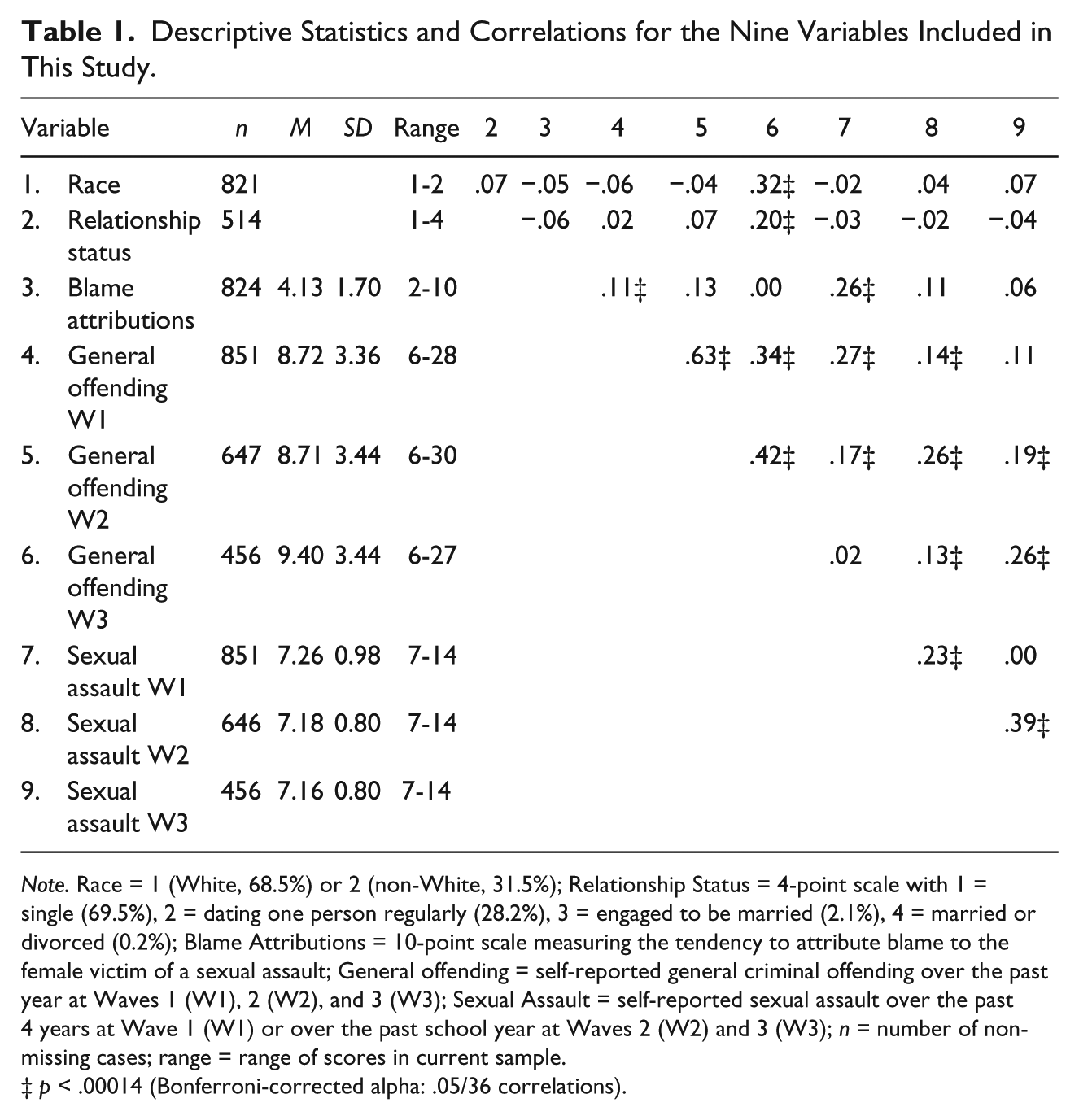
Note. Race = 1 (White, 68.5%) or 2 (non-White, 31.5%); Relationship Status = 4-point scale with 1 = single (69.5%), 2 = dating one person regularly (28.2%), 3 = engaged to be married (2.1%), 4 = married or divorced (0.2%); Blame Attributions = 10-point scale measuring the tendency to attribute blame to the female victim of a sexual assault; General offending = self-reported general criminal offending over the past year at Waves 1 (W1), 2 (W2), and 3 (W3); Sexual Assault = self-reported sexual assault over the past 4 years at Wave 1 (W1) or over the past school year at Waves 2 (W2) and 3 (W3); n = number of non-missing cases; range = range of scores in current sample.
p < .00014 (Bonferroni-corrected alpha: .05/36 correlations).
Results of a Cross-Lagged Path Analysis of General Offending and Sexual Assault From Waves 1 to 3 of the Longitudinal Study of Violence Against Women.

Note. Sexual Assault-2 (outcome) = regression equation with Wave 2 sexual assault as the outcome variable; General Offending-2 (outcome) = regression equation with Wave 2 general offending as the (outcome) variable; Sexual Assault-3 (outcome) = regression equation with Wave 3 sexual assault as the (outcome) variable; General Offending-3 (outcome) = regression equation with Wave 3 general offending as the (outcome) variable; Race = 1 (White) or 2 (non-White); Relationship Status = 4-point scale with 1 = single, 2 = dating one person regularly, 3 = engaged to be married, 4 = married or divorced; Blame Attributions = 10-point scale measuring the tendency to attribute blame to the female victim of a sexual assault; General offending = self-reported general criminal offending over the past year at Waves 1 (W1), 2 (W2), and 3 (W3); Sexual Assault = self-reported sexual assault over the past 4 years at Wave 1 (W1) or over the past school year at Waves 2 (W2) and 3 (W3); Offending with Sexual = synchronous correlations between general offending and sexual assault at Waves 1 (1), 2 (2), and 3 (3); Estimate (95% CI) = unstandardized coefficient and the lower and upper limits of the 95% confidence interval for the unstandardized coefficient (in parentheses); t = asymptotic t test (standard z test); p = significance level of the asymptotic t test; N = 851.

Cross-lagged path analysis of general offending and sexual assault as predictors of one another over the first three waves of the LSVAW.
Supplemental Analysis
Given the presence of several widely divergent correlations involving control variables and the three General Offending measures (e.g., race and relationship status with General Offending-3), the cross-lagged path analysis was calculated without the three control variables but with the four precursor measures. The results were comparable with those obtained when the three control variables were included in the analysis: the General Offending-1 leading to Sexual Assault-2 (p < .05) and the General Offending-2 leading to Sexual Asault-3 (p < .01) paths were statistically significant and the Sexual Assault-1 leading to General Offending-2 and the Sexual Assault-2 leading to General Offending-3 paths were both non-significant (p > .10).
In a second supplemental analysis, the six individual offenses from the general offending scale were removed from the scale one by one and used to predict the general offending score (minus the predicting offense t). Two non-sexual offenses (stole from a family member, stole something worth US$5 to US$50) failed to predict general offending, one non-sexual offense (purposely damaged or destroyed property) predicted general offending from Wave 1 to Wave 2, two non-sexual offenses (carried a hidden weapon, hit another student) predicted general offending from Wave 2 to Wave 3, and one non-sexual offense (knowingly bought stolen goods) predicted general offending from Wave 1 to Wave 2 and from Wave 2 to Wave 3.
Discussion
The results of this study provide partial support for the hypothesis that general offending may serve as an antecedent to sexual assault in some male college students transitioning from adolescence to adulthood. Although the two sets of cross-lagged regressions were not significantly different from one another, both general offending leading to sexual assault cross-lags were significant and both sexual assault leading to general offending cross-lags were non-significant. The consistency of results may compensate somewhat for their lack of power. What the consistency if not the power of these results indicates is that general offending is more likely to lead to sexual assault than sexual assault is to lead to general offending in male college students in emerging adulthood. This, in turn, may account for the large group of adult sex offenders with no history of juvenile offending. In at least some cases, the trajectory, rather than going from juvenile sexual offending to adult sexual offending, goes from juvenile general offending to adult sexual offending. As indicated by the supplemental analyses, the lack of effect when going from sexual to general offending was not simply the result of the more limited size and scope of the sexual offending score in that several non-sexual offenses were capable of predicting general offending. Trajectory analysis was not conducted in the current study but has been performed in other research, the results of which have identified one or more groups of adult sex offenders who did not offend sexually during adolescence (Francis et al., 2014; Lussier, Tzoumakis, Cale, & Amirault, 2010).
Based on the results of a trajectory analysis conducted on a group of 246 adult male sex offenders, Lussier and Davies (2011) argued that a sex offense may be better conceptualized as a transitory phase in a criminal career than as evidence of a distinct sexual criminal career. Even though the current study did not directly test Lussier and Davies’s supposition that some adult sex offending is transitory, the current results are consistent with this perspective. Sexual offending in early adulthood may be a reflection of a criminal pattern that began in adolescence but only manifested itself sexually because of differential opportunity structures unique to the adolescence-to-adult transition (Smallbone et al., 2008). As such, in many cases, the sexual offending may be transitory. This, of course, does not relieve the individual of responsibility for any sexual or non-sexual offenses he or she may commit during this period, although it does suggest that a sexual criminal career is much less likely than a general criminal career and that sexual assault is not a life-long risk for many who sexually offend in early adulthood. Sexual offending has traditionally been viewed as the combined result of antisociality and sexual deviance (Hanson & Bussiere, 1998; Knight, 1999). The current results insinuate that in a certain portion of cases, general offending or criminal versatility can serve as a precursor to sexual offending, although prior sexual assault continued to predict future sexual assault in the current study even when controlling for prior general offending.
Implications
There are both theoretical and practical implications to the current results. One theoretical implication is that substantial diversity exists in the juvenile and adult sex offending populations that may not be readily explained by extant theories. Prior research has clearly shown that most JSO do not go on to become adult sex offenders and that most adult sex offenders have no record of juvenile sex offending (Francis et al., 2014; Lussier & Blokland, 2014; Lussier et al., 2012; Nisbet et al., 2004; Zimring et al., 2007). The current results suggest that while general offending may serve as an antecedent to sexual assault, prior sexual offending is still capable of predicting subsequent sexual offending, even after controlling for general offending. A theory capable of explaining this diversity in sexual offending during emerging adulthood is therefore required. In a study investigating the behavioral antecedents of sexual aggression in 553 convicted sexual offenders, Lussier, LeClerc, Cale, and Proulx (2007) identified three broad dimensions of deviance in the developmental backgrounds of these individuals. Chief among these was an externalization dimension characterized by authority-conflict, recklessness, deceit, and aggression. Hence, theoretical progress could be made by exploring the putative causal link between childhood and adolescent externalizing and antisocial behavior, as represented in the present study by general criminal offending, and adult patterns of sexual assault.
A practical implication of the current results is that prior sexual offending and prior non-sexual offending should probably both be measured when conducting sex offender risk assessment. According to the present findings, general offending in late adolescence may be a risk factor for sexual offending in early adulthood. A potentially fruitful avenue for risk assessment research, then, would be identifying the conditions under which juvenile non-sexual offending is most likely to lead to future sexual offending. The current results, in addition to having implications for risk assessment, also have potentially important implications for sex offender treatment. Not only should general antisocial behavior be addressed when intervening with adult sex offenders (Przybylski, 2015), but antisocial risk factors should also be taken into account when trying to prevent sex offenders from dropping out of treatment in light of the fact that those most likely to benefit from treatment (high risk, high need) are also the ones most likely to drop out of treatment (Olver, Stockdale, & Wormith, 2011). Implementing programs with non–sex offending juveniles that have not yet begun to act out sexually to address blame attributions and other cognitive distortions that support sex offending behavior (Blumenthal, Gudjonsson, & Burns, 1999) is another practical recommendation suggested by the current results.
Limitations
Cross-lagged analysis is fettered by stringent assumptions and weak power, both of which were evident in the current study. The synchronicity assumption was only partially satisfied because while the general offending and sexual assault measures were collected at the same time, the Wave 1 sexual assault measure went back 4 years compared with only 1 year for the Wave 1 general offending measure and the Wave 2 and Wave 3 sexual assault measures covered the past school year as opposed to the last full year for the Wave 2 and Wave 3 general offending measures. In addition, there was evidence of weak stationarity when just the cross-lagged correlations were constrained but not of strong stationarity when both the cross-lagged correlations and autocorrelations were constrained. Stationarity is probably more of a concern than synchronicity in this study. The fact that the Sexual Assault-1 predictor was gathered over a longer period of time than the General Offending-1 predictor and the Sexual Assault-2 outcome was collected over a shorter time frame than the General Offending-2 outcome should have favored the Sexual Assault-1 leading to General Offending-2 cross-lag, yet only the General Offending-1 leading to Sexual Assault-2 cross-lag was significant. Weak synchroncity, however, means that a number of third variable explanations cannot be ruled out as possible explanations for the current results. Cross-lagged analysis has also been faulted for weak power (Kenny, 1975), which may be one reason why there were no significant differences between the general offending leading to sexual assault and sexual assault leading to general offending cross-lags.
In addition to limited power and weak satisfaction of the synchronicity and stationarity assumptions, there are three other drawbacks to the present study that need to be taken into account when interpreting the results: generalizability, mono-operational bias, and missing data. First, this study was conducted on a convenience sample of college males from a single state-supported university. Additional research is required on college and non-college males transitioning from adolescence to adulthood to gauge the generalizability of the current findings. Second, all of the data for this study came from respondent self-report. The use of a single data source can lead to inflated coefficients by introducing mono-operational bias into a study (Shadish, Cook, & Campbell, 2002). Nevertheless, shared method variance resulting from the use of self-report measures did not differentially benefit one cross-lagged relationship over the other in that both were based exclusively on self-report, and only the general offending leading to sexual assault lags achieved significance. Third, there were no missing data for the independent/dependent variables at Wave 1 but there was a moderate amount of missing data at Wave 2 and a moderately high degree of missing data at Wave 3. The FIML procedure used to manage missing data in the current study is superior to traditional missing data approaches such as listwise deletion and simple imputation (Allison, 2012; Peyre, Leplége, & Coste, 2011), but even this procedure is stretched to the limit when missing data for single variables approaches 50%. Additional research on this issue should not only use different samples but also attempt to keep missing data to a minimum, perhaps by using an interview format instead of a questionnaire survey as was employed in the LSVAW.
Conclusion
Research on juvenile and adult sexual and non-sexual offending could be advanced by research probing the mechanisms that support the general juvenile antisocial behavior–early adult sexual assault relationship. One way general juvenile antisocial behavior and early adult sexual assault may be linked is through mediation. Cognitive variables like criminal thinking (Walters, 2015a, 2016), outcome expectancies (Walters, 2016), efficacy expectancies (Walters, 2015a, 2016), short-term goals, and hedonistic values (Walters, 2015b) have been found to mediate the relationship between past criminality and future criminality, a relationship frequently referred to as crime continuity. There may also be continuity between general deviance and sexual offending, in a process known as heterotypic continuity (Lussier et al., 2007). As with crime continuity, the mediating variables in heterotypic continuity may be cognitive in nature. Following 322 male inmates released from a prison-based sex offender program for an average of 42 months, Walters, Deming, and Casbon (2015) determined that general criminal thinking, reactive (impulsive, irresponsible, emotional) criminal thinking, and an attitude of entitlement predicted general recidivism whereas general criminal thinking, proactive (planned, calculated, scheming) criminal thinking, and entitlement predicted failure to register as a sex offender. Given that these thinking styles were originally designed to explain general criminal behavior but seem to operate in much the same manner with sex offenders as they do with non-sex offenders (Walters, Deming, & Elliott, 2009), they would appear to be good candidates for mediating the general offending–sexual offending relationship and explaining heterotypic continuity between general adolescent antisocial behavior and adult-onset sexual offending.
Footnotes
Declaration of Conflicting Interests
The author(s) declared no potential conflicts of interest with respect to the research, authorship, and/or publication of this article.
Funding
The author(s) received no financial support for the research, authorship, and/or publication of this article.