



Abstract
This study adopts a social-ecological/contextual perspective to explore Arab youth involvement in cyberbullying perpetration. We explored the association between individual (age, gender, and impulsivity), family (socioeconomic status and parental monitoring), and community (experiencing neighborhood violence) characteristics and cyberbullying perpetration. A moderation model exploring individual, family, and context interactions was tested. A sample of 3,178 Arab students in Grades 7 to 11 completed a structured, anonymous self-report questionnaire. The findings suggest that almost 14% of the participants have cyberbullied others during the last month. Adolescent boys with high impulsivity, low parental monitoring, and who experience a high level of violence in their neighborhood are at especially high risk of cyberbullying perpetration. Parental monitoring moderated the effects of impulsivity and experiencing neighborhood violence on adolescents’ involvement in perpetrating cyberbullying. Furthermore, the results show that impulsive adolescents who experience high levels of neighborhood violence are at higher risk of cyberbullying perpetration than low impulsive children who experience the same levels of neighborhood violence. The results highlight the central role parenting plays in protecting their children from involvement in cyberbullying perpetration by buffering the effects of personal and situational risk factors.
Keywords
Introduction
Over the past several decades, bullying among children and youth has become recognized as a significant problem, resulting in greater local, national, and global focus on research, intervention strategies, policy developments, and pedagogical responses. Researchers have increasingly sought to understand the protective and risk factors associated with bullying involvement (Smokowski & Kopasz, 2005). More recently, the proliferation of information and communication technologies (ICTs) has led researchers, policy makers, educators, and advocates to investigate the changing landscape and context of bullying among children and youth today.
Despite the many benefits of cyber interactions such as social support, identity exploration, and cross-cultural interactions (Jackson et al., 2006), there are risks for youth, in particular the risk of cyberbullying (Berson, Berson, & Ferron, 2002; Gasser, Maclay, & Palfrey, 2010). There is not a universally accepted definition of cyberbullying, or a strong theoretical model to explain this phenomenon (Low & Espelage, 2013). The existing definitions and conceptualizations indicate that cyberbullying involves the use of ICTs to bully an individual or a group of individuals (Bhat, 2008; Kowalski, Giumetti, Schroeder, & Lattanner, 2014). Moreover, cyberbullying can be understood as the deliberate and repeated use of technology to bully another person (Patchin & Hinduja, 2012), which includes criteria of intent to harm, a specific target, and a power imbalance (Smith, del Barrio, & Tokunaga, 2013).
Previous research has found that cyberbullying has behavioral and psychological consequences (Gradinger, Strohmeier, & Spiel, 2009; Heiman & Olenik-Shemesh, 2016; Hinduja & Patchin, 2008; Ybarra, 2004), with effects on the well-being of youth over and above traditional bullying (Hinduja & Patchin, 2009; Limber, Kowalski, & Agatston, 2008). After controlling for traditional bullying victimization, children who experience cyberbullying victimization exhibit more depressive symptoms than those who are not involved in cyberbullying (Ybarra, 2004), have lower self-esteem (Hinduja & Patchin, 2009), report having more behavioral difficulties such as skipping school (Hinduja & Patchin, 2007), and express having suicidal ideation (Bonanno & Hymel, 2013).
Cyberbullying prevalence rates typically range from about 10% to 35% (Hinduja & Patchin, 2008; Limber et al., 2008; Patchin & Hinduja, 2011). Based on a representative sample of 7,508 U.S. adolescents in Grades 6 through 10, Wang, Iannotti, and Nansel (2009) found that 8.9% of the participants cyberbullied others at least once in the previous 2 months. Similar results were reported in a Canadian study of middle and high school students in a large city (Mishna, Khoury-Kassabri, Gadalla, & Daciuk, 2012). Significantly higher rates were reported by Patchin and Hinduja (2011) with a sample of 1,963, sixth- to eighth-grade students in the United States, with more than 21% of the participants reporting that they participated in cyberbullying behaviors two or more times in the previous 30 days. A similar trend was found in a study among a sample of 1,094 Jewish students in Israel, with 17% of the students reporting having engaged in cyberbullying others (Heiman, Olenik-Shemesh, & Eden, 2014). Such variability is due in part to inconsistent definitions.
Little is known about Arab youth’s involvement in cyberbullying. One of the few studies that examined cyber victimization used a small convenience sample, and did not investigate perpetration (Heiman & Olenik-Shemesh, 2016). The aims of the present study are to examine cyberbullying among a large and representative sample of Arab youth in Israel; investigate the contribution of individual (e.g., gender, age, impulsivity), parental (e.g., socioeconomic status [SES], monitoring), and community (e.g., exposure to neighborhood violence) factors to explain variation in cyberbullying involvement; investigate whether parental monitoring plays a moderating role in explaining associations between impulsivity and exposure to neighborhood violence and cyberbullying perpetration; and explore the moderating role of impulsivity on the association between experience of neighborhood violence and cyberbullying.
Arab Youth in Israel
Today, the Arab minority in Israel comprises 20% of the total Israeli population (Central Bureau of Statistics, 2015) and is characterized by significantly lower SES and allocation of social resources than the Jewish majority (Hammack, 2010). The Arab minority population is also largely characterized by traditional, patriarchal, and authoritarian family values (Kaufman, Abu-Baker, & Sa’ar, 2012). In recent decades, however, Arab society in Israel has undergone a number of modernizing economic, political, and social changes (Al-Krenawi & Graham, 2000; Gharrah, 2012). The rapid modernization process experienced by Arab society in Israel has inevitably had an effect on parent–child relationships, although this change has not occurred at an equal pace among the children and their parents. Some adolescents are quicker or more willing to adopt Western values than are their parents, resulting in a generation gap (Sherer, 2009), which can lead to parent–child conflict, lack of supervision, and reduced harmony (Szapocznik & Kurtines, 1993). These factors can place children at higher risk of involvement in violence (Lee & Stockdale, 2008).
The present study is largely guided by Bronfenbrenner’s (1979) social-ecology/contextual theory of human behavior, which offers a framework for integrating various factors associated with youth violence. Previous research on cyberbullying has focused mainly on individual factors to explain youth’s involvement. This study simultaneously explores factors at different levels of the ecological system including the child’s individual characteristics, parental factors, and community indicators (Kuppens, Grietens, Onghena, Michiels, & Subramanian, 2008).
Individual Factors
Inconsistent results have been reported in previous studies with regard to gender differences among child and youth involvement in cyberbullying perpetration. Much of the previous research has found that boys were more likely to cyberbully others than girls (Arıcak, 2009; Fanti, Demetriou, & Hawa, 2012; Floros, Siomos, Fisoun, Dafouli, & Geroukalis, 2013; Heiman et al., 2014; Shariff, 2009; Wang et al., 2009). Other research, however, found no significant gender differences (Aoyama, 2010; Hinduja & Patchin, 2008; Mishna et al., 2012). The results by Low and Espelage (2013) were among the few works that have reported that females had higher levels of cyberbullying perpetration than males.
Inconsistency is also evident with respect to age and cyberbullying. Williams and Guerra (2007) reported that cyberbullying reaches its peak in ninth grade (approximately age 14), with 12.9% of participants at this age reporting cyberbullying others. Rates of involvement decrease with age, with 9.9% of 11th-grade students reporting perpetrating cyberbullying. In their study of students ages 10 to 17 years, Mishna et al. (2012), however, found that the older the children, the higher their involvement in cyberbullying, similar to a trend reported by Ybarra and Mitchell (2004). In contrast, Patchin and Hinduja (2006) found no significant age differences among students who reported cyberbullying others (see also Wang et al., 2009).
Another individual factor that has been found to be significant in explaining child and youth involvement in violence is the extent to which they behave in an impulsive manner (Moffitt, 1993; Vitulano, Fite, & Rather, 2010). Among a sample of 2,017 students in Greece, Floros et al. (2013) found impulsivity to be associated with a greater likelihood of perpetrating cyberbullying. Multiple psychological traits have been identified as underlying impulsive behaviors (Zimmerman, 2010). Examining various conceptions of impulsivity, Whiteside and Lynam (2001) identified four personality traits that lead to impulsive behaviors: urgency (a tendency to experience strong impulses, frequently under conditions of negative affect), lack of premeditation (a tendency not to consider the consequences of an act before engaging in that act), lack of perseverance (an inability to remain focused on a task that may be boring or difficult), and sensation seeking (a tendency to enjoy and pursue activities that are exciting; a willingness to try new experiences that may or may not be dangerous). Impulsive young people were found to be more likely to act without appropriate forethought (Dickman, 1993), to act on the spur of the moment without regard to the consequences, and to enjoy taking risks and engaging in dangerous activities (Bhat, 2008; Jones, Cauffman, & Piquero, 2007; Whiteside & Lynam, 2001). These are critical factors that may increase youth’s involvement in cyberbullying. In contrast, a study conducted with 1,416 adolescents living in Cyprus (Fanti et al., 2012) found no significant association between impulsivity and cyberbullying perpetration.
Parental Monitoring
Family and parenting processes are critical factors in shaping children’s developmental outcomes. There is strong empirical evidence showing that parenting behavior (such as attachment, supervision/monitoring, support) is associated with their children’s involvement in antisocial behavior (Farrington, 2005; Hamner, Latzman, & Chan, 2015; Loeber & Stouthamer-Loeber, 1986). A study conducted by Vazsonyi, Hibbert, and Snider (2003) found that among other factors, parental monitoring of children’s behaviors was negatively related to children’s misconduct in school, drug and alcohol use, and total deviance (including the above-listed measures along with assault, theft, and vandalism). Previous research examining the effects of parental monitoring on child cyberbullying involvement has focused mainly on parental monitoring of their children’s computer use (Mason, 2008). These studies have reported mixed results. On one hand, for example, Vandebosch and Van Cleemput (2009) found a marginally significant negative relationship between parental monitoring of a child’s Internet use and cyberbullying behavior. Floros et al. (2013), in contrast, found that parental supervision did not prevent children from perpetrating cyberbullying.
The present study builds on existing research that examines general parental monitoring of child behavior and the extent of parental involvement in a child’s daily life, such as knowing with whom they spend time and where they are (Pickering & Vazsonyi, 2010), rather than focusing specifically on parental monitoring of Internet use. Research conducted by Hay, Meldrum, and Mann (2010) is among the few studies that have examined the association between general parental monitoring and child involvement in cyberbullying perpetration. They found parental monitoring to be negatively and significantly associated with cyberbullying. During adolescence, youth tend to spend more time with their peer group and less time with their parents. Parental monitoring therefore becomes critical during this age period. This factor is important in light of the effects of changes in the Israeli Arab community on parent–child relationships and parental ability to monitor their child’s behaviors.
Children raised in families with low SES are at higher risk of involvement in antisocial behavior (Farrington, 2005; Khoury-Kassabri, Attar-Schwartz, & Zur, 2014). The findings related to SES and cyberbullying are inconsistent, however. A study conducted by Ybarra and Mitchell (2007), with 1,500 students between the ages of 10 and 17 revealed that decreased household income was associated with greater Internet harassment. In a study with 1,344 students in South Korea, however, Yang et al. (2013) found that the association between the family’s SES and youth’s involvement in cyberbullying was insignificant.
Contextual Factors
The present study seeks to explore youth’s experience of neighborhood violence such as being a victim of violence and experiencing gun shooting (Selner-O’Hagan, Kindlon, Buka, Raudenbush, & Earls, 1998) as well as their involvement in cyberbullying. To the best of our knowledge, the effects of community violence on cyberbullying involvement as perpetrator or victim have not been previously studied. In their meta-analysis, Kowalski et al. (2014) concluded that research on cyberbullying should incorporate a focus on community factors, in addition to individual and family factors, in an effort to understand this phenomenon.
In contrast to the lack of investigation of the links between community factors and cyberbullying involvement, the association between the effects of youth exposure to community factors such as crime rates, violence, poverty, and disadvantage on child well-being and behavioral difficulties has been extensively examined (Borofsky, Kellerman, Baucom, Oliver, & Margolin, 2013; Gorman-Smith, Henry, & Tolan, 2004; Romero, Richards, Harrison, Garbarino, & Mozley, 2015). Youth exposed to community violence have been found to be at greater risk to experience both internalizing and externalizing difficulties such as posttraumatic stress disorder (PTSD), depression, and aggression (Gorman-Smith & Tolan, 1998; Huesmann & Guerra, 1997; McMahon & Watts, 2002). Exposure to community violence is related to later violence perpetration (Gorman-Smith et al., 2004; Hamner et al., 2015) and involvement in delinquency (Patchin, Huebner, McCluskey, Varano, & Bynum, 2006).
Haj-Yahia, Leshem, and Guterman (2011) conducted one of the few studies that explored Arab youth exposure and experience of community violence (in school, family, and the neighborhood). This study was conducted with a sample of 833 Arab junior and senior high school students in Israel. Almost one third of the study’s participants (30.4%) reported experiencing violence in their neighborhood. An aim of the present study is to build on the literature by exploring the association of Arab youth’s experience with neighborhood violence and their involvement in cyberbullying. This examination is important especially because of the high levels of community violence to which Arab youth are exposed.
Ecological Correlates
According to the social-ecological/contextual model of human behavior (Bronfenbrenner, 1979), children’s behavior can best be understood by exploring the interaction effects of personal traits and social contextual factors. A purpose of the present study is to explore the moderating effects of parental monitoring on the association between an adolescent’s individual characteristic (impulsivity) and a contextual characteristic (experiencing neighborhood violence) among Arab youth in perpetrating cyberbullying. This model (see Figure 1) is based on previous work showing that, in addition to the direct correlates between family factors and violence/delinquency, positive family relationships can play a protective role, buffering the negative effects of individual (Jones et al., 2007) or contextual (Gorman-Smith et al., 2004) risk factors for delinquent behavior.

The research model: Direct and interactive correlates of impulsivity, parental monitoring, and experiencing neighborhood violence on cyberbullying perpetration.
With respect to the interaction of individual and family, an aim of the present study is to explore whether the link between child impulsivity and cyberbullying varies according to the level of parental monitoring. Previous studies have examined this association by focusing on parenting and aggressive and antisocial behaviors. For instance, Jones et al. (2007) found that parental support has fewer effects on adolescents’ level of involvement in antisocial behavior among those individuals who are higher in impulsivity compared with those with lower impulsivity.
Gorman-Smith et al. (2004) explored the interactive effects of parenting and community factors. They found that youth from exceptionally well-functioning families (emotionally enriching and with positive parenting practices and structure) who were exposed to high rates of violence in their community were less involved in violence than youth who were exposed to similar levels of community violence but lived in less well-functioning families. In this study, we explore whether parental monitoring moderated the relationships between impulsivity and exposure to neighborhood violence and youth involvement in cyberbullying perpetration.
According to the personality trait approach, the effects of individual/personality traits (such as impulsivity) are consistent over contexts (Vazsonyi, Cleveland, & Wiebe, 2006). Research has shown, however, that impulsivity interacts with other individual factors and with social factors in predicting aggressive and delinquent behaviors, such as peer group delinquency (Vitulano et al., 2010), neighborhood poverty (Lynam et al., 2000), and social information processing (Fite, Goodnight, Bates, Dodge, & Pettit, 2008). In a study conducted by Lynam et al. (2000), impulsive boys in disadvantaged neighborhoods were found to be at higher risk of involvement in delinquency than impulsive boys in less disadvantaged neighborhoods. According to these findings, impulsive children are more vulnerable than nonimpulsive children, when they live in high-risk communities (see also Vazsonyi et al., 2006). The present study explores whether the effects of experiencing neighborhood violence on youth cyberbullying perpetration vary by the level of impulsivity.
Study Hypotheses and Questions
Method
Sample
The overall sample was designed to represent Arab students in Grades 7 to 11 in the official school system supervised by the Israeli Ministry of Education, in the northern and central parts of Israel where the majority of the Arab population lives. A stratified probability sample was used; the stratum was based on the locality SES index as reported by the Central Bureau of Statistics. This index is a measure often used to describe the SES of localities in Israel and is based on various social and economic indicators, such as education level, income, employment, housing characteristics, and receipt of social benefits (see Gharrah, 2012). From each SES cluster containing Arab localities, up to 20% of Arab localities were randomly sampled. In the first stage, 21 schools were randomly selected from a list provided by the Israeli Ministry of Education; two classes were selected randomly from each grade level at each school, with all students in the selected classes asked to participate. The total sample is 3,178 students, with an approximate response rate of 93%. The sample consisted of 59.6% girls, ages 11 to 18 (M = 14.88, SD = 1.40), with 48.2% in secondary schools (Grades 7-9). The average score of the fathers’ education was 3.21 (SD = 1.20) and mothers’ education 3.46 (SD = 1.13) on a scale ranging from 1 (elementary school) to 5 (undergraduate degree or above), and the average of family’s economic situation was 3.54 (SD = .77) on a scale ranging from 1 (very low) to 5 (very high).
Data Collection
Information was collected from the adolescents through a structured, anonymous self-report questionnaire, which they completed in the classroom under the guidance of a research assistant. Confidentiality and anonymity were ensured for all participants. The questionnaire, informed consent forms, and instructions were reviewed by The Hebrew University Internal Review Board and by the Israeli Ministry of Education. Before the study began, school principals sent consent forms and letters to the parents informing them of the study goals and the questionnaire. Parents had the option to refuse participation on their child’s behalf. The approximate refusal rate of parents was 2%. The students were free to withdraw from the study at any time for any reason. The approximate refusal rate by the students was 5%.
Measurements
Cyberbullying involvement
The questionnaire comprised a series of questions (eight items) on various online behaviors, without explicitly defining the behaviors as bullying (Mishna et al., 2012). Participants were asked to indicate whether they perpetuated any of the following acts in the previous month, prior to the administration of the survey: calling someone names, spreading rumors, threatening someone (by SMS or by the Internet) to hurt him or her, spreading harmful comments about someone, spreading harmful or insulting pictures, spreading a harmful video, creating a harmful Internet page, and/or pretending to be someone in a harmful way (α = .91). The response options ranged from 0 = never to 4 = every day. Respondents were assigned 1 point for each specific behavior in which they had engaged. The scale was based on accumulation of items and ranges between 0 and 8.
Impulsivity
Students’ impulsivity was measured using four items from the Teen Conflict Survey (Bosworth & Espelage, 1995). These items measure the frequency of impulsive behaviors, such as lack of self-control, difficulty sitting still, and trouble finishing things (α = .73). Respondents were asked to indicate how often they engage in certain impulsive behaviors using a 5-point Likert-type scale (1 = never to 5 = always). The scale was based on the means of the included items.
Parental monitoring
Five items of the Adolescent Family Process (AFP) scale (Vazsonyi et al., 2003) were used to measure parental monitoring (α = .76), such as “When I am not at home, my mother/father knows my whereabouts.” Students were asked to rate their level of agreement with each item (1 = strongly disagree to 5 = strongly agree). The scale was based on the means of the included items.
Experiencing neighborhood violence
This variable was assessed using the My Exposure to Violence Scale (MYETV; Selner-O’Hagan et al., 1998). We used the Arabic version of this scale (Haj-Yahia et al., 2011). The scale includes six violent acts about which students were asked whether they experienced in their neighborhood, during the last month (such as “someone hit you”), on a 4-point Likert-type scale (0 = never to 3 = many times) (α = .83). The scale was based on the means of the included items. For the descriptive analysis, we created an additional measure whereby respondents were assigned 1 point for each specific behavior that they had experienced in their neighborhood. The scale is based on an accumulation of items and ranges between 0 and 6.
Sociodemographic characteristics
A number of control variables were included in the analysis: gender (0 = female, 1 = male); age, grade level (7-11); and family SES, which was created from three relevant markers: mother’s and father’s education levels (ranging from 1 = elementary school, to 5 = undergraduate degree or above) and family’s economic situation (ranging from 1 = very low to 5 = very high). A principal components factor analysis showed that all three SES markers loaded on a single factor. A composite SES measure was therefore created by standardizing the three markers and computing their mean score.
Data Analysis
Using SPSS 21, we first examined the descriptive data related to cyberbullying perpetration and the student, family, and community factors. Second, bivariate analyses were conducted to test the relationships among young people’s involvement in cyberbullying and the independent variables. The correlations among all other variables were also tested and are presented in Table 1. Third, to test the moderating effect of parental monitoring on the relationship between impulsivity and cyberbullying, and the moderating effects of parental monitoring and impulsivity on the relationship between experiencing neighborhood violence and cyberbullying, we performed a PROCESS analysis using SPSS (PROCESS-Model 3; Preacher & Hayes, 2008). In this analysis, gender, age, and family SES were held as covariates.
Correlations Among the Study’s Variables.

Note. N = 2,751 adolescents. SES = socioeconomic status.
p < .05. **p < .01. ***p < .001.
Results
In the present study, 14.1% of the students reported cyberbullying others at least once during the previous month. More than 10% (11.3%) of the students were involved in at least three cyber acts of cyberbullying others, and 2.8% were involved in four to eight acts of cyberbullying others during the previous month.
On a scale ranging from 1 (never) to 5 (always), the means of children’s reports of impulsivity was 2.32 (SD = 0.92). The average of the perceived parental monitoring was 3.50 (SD = 0.63), on a scale ranging from 1 (strongly disagree) to 5 (strongly agree). Almost half (46.6%) of the students experienced violence in their neighborhood during the previous month and 9% experienced at least three violent acts in their neighborhood during the previous month.
Bivariate Analyses
As shown in Table 1, the bivariate relationships between the independent, moderating, and dependent variables were examined. The findings show, first, that males reported cyberbullying others significantly more than females. It was also found that the higher the adolescent’s impulsivity the higher were their reports of cyberbullying others (r = .21, p < .01). A similar trend was found with respect to adolescent experience of violence in their neighborhood, which was significantly and positively correlated with cyberbullying perpetration (r = .34, p < .01). Finally, a negative significant correlation was found between parental monitoring and adolescents’ reports of cyberbullying others (r = −.21, p < .01). Insignificant correlations were found between age and family SES and students’ involvement in cyberbullying.
Research Model: Interaction Effects Between Individual, Family, and Contextual Factors
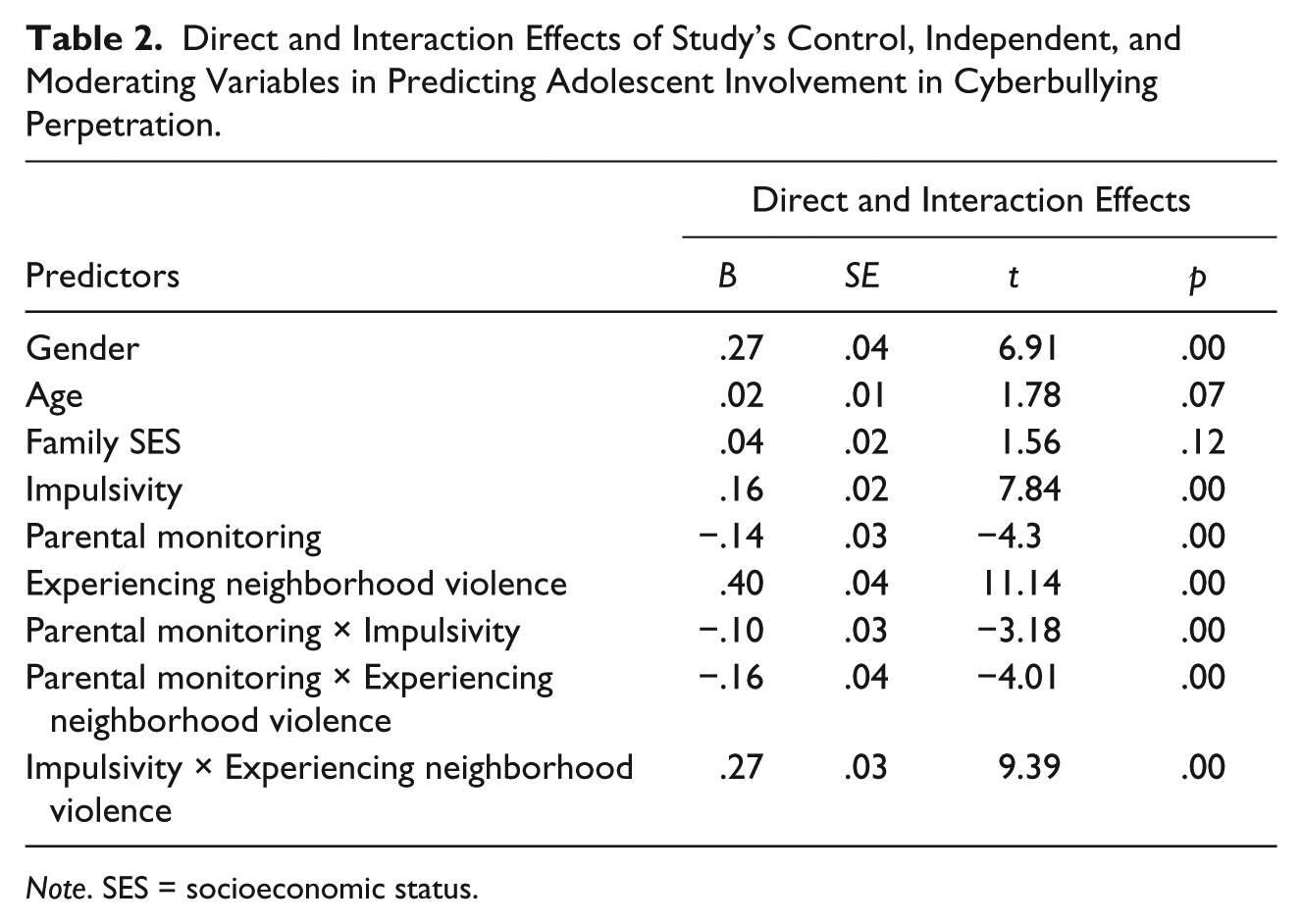
In this study, we explored whether parental monitoring moderates the association between impulsivity, experiencing neighborhood violence and youth cyberbullying involvement as a perpetrator. As presented in Table 2, both of the interaction effects were significant.
Direct and Interaction Effects of Study’s Control, Independent, and Moderating Variables in Predicting Adolescent Involvement in Cyberbullying Perpetration.
Note. SES = socioeconomic status.
The findings reported in Table 2 and illustrated in Figure 2 show results regarding the central role impulsivity plays in predicting cyberbullying and the moderating role parenting has on the association between adolescents’ level of impulsivity and cyberbullying.

Interaction between parental monitoring and impulsivity in predicting cyberbullying perpetration.
The results illustrated in Figure 2, first, show that the positive association between impulsivity and cyberbullying perpetration is stronger among youth who have low parental monitoring than those with high parental monitoring. The figure also shows that as far as the adolescent’s impulsivity is low, their involvement in cyberbullying is low and the extent of parental monitoring does not really matter. Adolescents with high impulsivity, on the contrary, are more likely to be involved in cyberbullying in both levels of parental monitoring than low impulsive adolescents; however, the highest risk group for cyberbullying involvement is impulsive adolescents with low parental monitoring.
With respect to the association between experiencing neighborhood violence and cyberbullying perpetration, the results in Table 2 and illustrated in Figure 3 indicate that the effects of experiencing violence in the neighborhood on involvement in cyberbullying are weaker among youth with higher parental monitoring than among those with less parental monitoring. This indicates that the gap between cyberbullying perpetration and parental monitoring levels (high vs. low) is smaller in a situation of low neighborhood violence experience compared with situation of high neighborhood violence where the gap between low and high parental monitoring has increased dramatically. This finding indicates that the experience of neighborhood violence is a greater indicator of the extent of cyberbullying perpetration, especially among adolescent with low parental monitoring.

Interaction between parental monitoring and experience of neighborhood violence in predicting cyberbullying perpetration.
In this study, we also sought to determine whether the association between contextual factors (i.e., experiencing neighborhood violence) and cyberbullying perpetration varies according to the youth’s level of impulsivity.
The results in Table 2 and illustrated in Figure 3 show that, among adolescents who are more impulsive, there is a stronger association between experiencing neighborhood violence and involvement in cyberbullying perpetration than among adolescents with low impulsivity. These results emphasize, once again, that impulsive children are at higher risk of cyberbullying perpetration compared with low impulsive children who are exposed to a similar contextual risk factor experiencing neighborhood violence.
The study’s model explains 22.12% of the variance in adolescents’ involvement in cyberbullying as perpetrators.
Discussion
This study is unique as it is among the first to explore Arab youth involvement in cyberbullying perpetration and to explore the direct and moderating effects of factors at the individual, family, and community level.
With a representative sample of almost 3,200 Arab adolescents, almost 14% of the students self-reported having cyberbullied others during the previous month. These reports are almost at the same level of those reported by Jewish students in Israel (17%; Heiman et al., 2014) and significantly higher than those reported in other countries, which is approximately 8% to 9% (Dehue, Bolman, Völlink, & Pouwelse, 2012; Mishna et al., 2012; Wang et al., 2009).
The present study has two key findings. First, the results revealed that adolescents’ cyberbullying perpetration is directly associated with individual, family, and community factors. Second, the findings indicated that factors at different levels interact with one other in predicting youth perpetrating cyberbullying.
Direct Association of Cyberbullying Perpetration and Individual, Family, and Community Factors
In accordance with other research and the study’s first hypothesis, and as reported in Table 1, boys reported cyberbullying others more than girls (Floros et al., 2013; Heiman et al., 2014; Vandebosch & Van Cleemput, 2009; Wang et al., 2009). These results are also consistent with previous research exploring traditional violence perpetration of Arab youth that found that boys reported using aggression toward peers and teachers more frequently than girls (Khoury-Kassabri, 2012). The author explained this gender gap by referring to the cultural norms of a traditional society, such as the Arab society, where more restrictions and control are put on girls’ behaviors compared with boys, which might increase boys’ involvement in violence and antisocial behavior. This interpretation should be further explored, especially with respect to youth involvement in cyberbullying.
With respect to the study’s second question, the results show insignificant correlations between age (see similar trend in Patchin & Hinduja, 2006; Wang et al., 2009) and family SES and students’ involvement in cyberbullying (see also, Yang et al., 2013).
The results presented in Table 1, indicating that adolescents who reported higher levels of impulsivity were more likely to cyberbully others are consistent with previous studies (Bhat, 2008; Kokkinos, Antoniadou, & Markos, 2014). In addition, according to the findings in this study, impulsivity of adolescents seems to be a leading indicator of cyberbullying perpetration, even with the moderation effects of parental monitoring. As illustrated in Figure 2, the findings show that highly impulsive adolescents are much more likely to be involved in cyberbullying perpetration than low impulsive youth in both high and low levels of parental monitoring. In addition, as shown in Figure 4, the role of impulsivity as an indicator of cyberbullying perpetration is strong. Highly impulsive youth who experience neighborhood violence are at the greatest risk of cyberbullying perpetration, compared with adolescents with low impulsivity who are exposed to similar levels of community violence.

Interaction between impulsivity and experience of neighborhood violence in predicting cyberbullying perpetration.
Components of impulsivity, such as acting on the spur of the moment with no forethought, and without considering the consequences of their actions, may contribute to adolescents perpetrating cyberbullying. Such impulsivity is particularly salient in the cyber world due to the ease and immediacy with which someone can respond, which can be a barrier to self-reflection and restraint. Thus, those youth who are impulsive are more likely to retaliate with precipitous online aggression should they experience even a “slight, imaginary or real” (Bhat, 2008; Kowalski et al., 2014). The results of the present study offer additional support to the extensive literature that emphasizes the important role parenting plays in shaping children’s behaviors. In accord with the study’s fourth assumption, we found parental monitoring to be significantly and negatively correlated with cyberbullying perpetration. This finding is consistent with intensive literature in the field of crime and delinquency which suggests that weak parental monitoring is associated with increased child involvement in antisocial and aggressive behaviors (Peterson, Lee, Henninger, & Cubellis, 2014; Sampson & Laub, 1993; Svensson, 2003). The results can be understood in light of Hirschi’s (1969) Social Control Theory whereby parental monitoring and supervision are among the factors considered to help in developing parental control and restraining children from committing crime (Svensson, 2003).
Although the link between exposure to community violence and externalizing and internalizing behavior is well documented (Hamner et al., 2015; Sampson, Morenoff, & Raudenbush, 2005), to the best of our knowledge, this is the first study to address the effect of community violence on youth cyberbullying perpetration. Consistent with our fifth hypothesis, the results reported in Table 1 show that children and youth who experience higher levels of violence in their neighborhoods are more likely to cyberbully others.
According to Agnew’s (1992) General Strain Theory, experiencing violence in the neighborhood is considered to be negative stimuli that may cause an adolescent to experience strain. Strain may lead to negative emotions, such as anger and frustration, both of which are among the strongest emotions to predict violent behavior (Patchin & Hinduja, 2011). Experiencing violence in the neighborhood may lead to youth perpetrating cyberbullying, as a coping mechanism in response to their anger and frustration caused by the strain of being victimized. The specific characteristics of the cyber world such as perceived anonymity might offer a victimized adolescent the opportunity to bully others, whereas in other circumstances, the youth would not be willing or able to do so.
Interactional Effect: Individual, Family, and Community Factors
Informed by Bronfenbrenner’s (1979) social-ecology/contextual theory emphasizing the interactional perspective on human development, the present study simultaneously explored the interactions among individual, family, and contextual factors in explaining adolescents’ perpetration of cyberbullying. The aim of this examination is to test whether individual and situational effects on adolescent behavior depend on parental factors, and whether individual factors interact with contextual variables in explaining cyberbullying perpetration.
In support of the study’s sixth hypothesis, we found that parental monitoring buffers adolescents from involvement in cyberbullying perpetration resulting from individual (impulsivity) and contextual factors (experiencing neighborhood violence).
With respect to the moderation role of parenting in the association between impulsivity and cyberbullying involvement, the results presented in Table 2 and illustrated in Figure 2 indicate that parenting plays a particularly important role with adolescents who are impulsive and at high risk to engage in cyberbullying others. The findings show that highly impulsive children with high parental monitoring were less involved in cyberbullying than their counterparts with high impulsivity but with low parental monitoring. These findings are supported by previous work showing that parenting may play an important role in influencing behaviors among high-risk children (B. R. E. Wright, Caspi, Moffitt, & Silva, 2001).
According to their self-control theory, Gottfredson and Hirschi (1990) posit that parents play a central role in helping their children develop self-control, mainly in the first decade of their life, by monitoring/supervising and correcting their children’s misbehaviors (Vazsonyi, Machackova, Sevcikova, Smahel, & Cerna, 2012; J. P. Wright & Beaver, 2005). As indicated earlier, children with higher self-control (low impulsivity) are less involved in crime and other antisocial behaviors. Another finding is that impulsivity has a genetic component (Khadka et al., 2014; B. R. E. Wright et al., 2001). Nevertheless, the relationship between impulsivity/self-control and child antisocial behavior is not predetermined. The findings of this study are important because although impulsivity has a significant impact on youth involvement in cyberbullying perpetration, as illustrated in Figure 2, this effect can be moderated by parental monitoring. These results emphasize the continued influence of parenting on child behavior even during adolescence (Jones et al., 2007; Vazsonyi, Roberts, Huang, & Vaughn, 2015).
Another finding of the study is that, in addition to the interaction between parenting and individual factors, parenting has a moderating effect on the relationship between contextual factors and adolescent behavior. More specifically, we found as assumed in the study’s sixth hypothesis, and illustrated in Figure 3, parental monitoring plays a moderating role, decreasing the negative effects of experiencing neighborhood violence on adolescent involvement in cyberbullying perpetration. A similar trend was reported by Bacchini, Miranda, and Affuso (2011) with respect to adolescent involvement in antisocial behavior and symptoms of anxiety/depression (see also Hamner et al., 2015). Similar to the buffering effect on individual factors such as impulsivity, these results show that notwithstanding the significant effects of exposure to community violence on child behavior, factors such as parental monitoring can decrease the negative effects (Gorman-Smith & Tolan, 2003).
Another important finding illustrated in Figure 3 is the strong negative effect experiencing community violence has on adolescents’ involvement in cyberbullying perpetration. Adolescents who were exposed to community violence reported significantly higher levels of perpetrating cyberbullying regardless of the level of parental monitoring (high vs. low) compared with those who experience low levels of community violence.
These finding are important, especially for Arab children in Israel, who are exposed to high levels of neighborhood violence (Haj-Yahia et al., 2011), which could increase the likelihood of Arab adolescents be involved in cyberbullying as perpetrators. The buffering effect of parental monitoring as reported in Figure 3 is important in such circumstances because although the ability of parents to affect their neighborhood situation might be severely limited, they nevertheless have the ability to protect their children from the adverse impacts of the neighborhood violence, through their involvement and monitoring of their children’s behaviors.
An additional contribution of this study is the person–situation interaction. The results of the present study supported out seventh hypothesis indicating that impulsivity serves as a moderator in the association between the experience of neighborhood violence and adolescent involvement in perpetrating cyberbullying. Thus, as illustrated in Figure 4, highly impulsive adolescents who live in high-risk environments are more likely to engage in cyberbully perpetration, than adolescents with low impulsivity who experience similar levels of violence in their neighborhood. Impulsivity can thus heighten adolescents’ vulnerability when they live in high-risk environments. These findings correspond with previous research that has examined the interaction between impulsivity/self-control and situation factors (such as poverty and disadvantage) in predicting adolescent delinquency and violent behaviors (Lynam et al., 2000; Vazsonyi et al., 2006). The results can be understood based on Sampson, Raudenbush, and Earls’ (1997) finding that in disadvantaged neighborhoods (e.g., high levels of poverty, crime, and violence) informal social control is relatively low. This might be more critical for children with low internal control—impulsive children who live in such an environment (Lynam et al., 2000) resulting in a limited ability to suppress their antisocial behavior (Vazsonyi et al., 2012).
Limitations
This study has several limitations. First, as a cross-sectional design was utilized causal inferences cannot be made. Second, we used adolescents’ self-reports to measure all research variables. It will be necessary in the future to collect information from additional informants, such as parents. Moreover, the study explored cyberbullying perpetration using one measure. Although it is a reliable and valid scale, it may not have captured all techniques children use to cyberbully others, especially those techniques used differently by girls and boys, or according to the age of the young people involved. Future studies should further examine gender and age differences in their involvement in cyberbullying using additional tools to measure cyberbullying. Third, future research is needed to examine additional child characteristics (such as traditional and cyberbullying victimization), as well as additional parent characteristics (such as support), as well as further contextual factors (such as the neighborhood poverty level, crime rates) that might be related to adolescents’ involvement in cyberbullying perpetration. Fourth, the study is largely guided by Bronfenbenner’s social-ecology theory. It is missing, however, an important contextual factor that refers to ethnic-cultural affiliation. As the study is based on a large and representative sample of Arab youth in Israel, results can be generalized to the Arab youth population in Israel, but not to the entire Israeli adolescent population or to youth in other countries. It is important to explore whether the results can be generalized due to the present study’s population of Arab adolescents living in Israel in a socioeconomically inferior position in a hugely minority population and the attendant associated personal and social tensions. Thus, the study should be replicated among other populations within and out of Israel.
Conclusion
The findings of this study emphasize the importance of addressing youth involvement in cyberbullying from an ecological perspective referring simultaneously to individual, family, and contextual factors. It was found that factors at different levels interact in influencing adolescents’ engagement in cyberbullying perpetration. A major finding was the significant role parental monitoring plays in mitigating the effects of impulsivity and neighborhood violence. The findings make it evident that practitioners who work with adolescents must include parents in their prevention and intervention efforts. This is particularly salient in the work with children who are at higher risk of involvement in violent behaviors (impulsive youth and those who experience high levels of violence in their neighborhood).
Footnotes
Acknowledgements
This article is based on a study supported by a research grant from the Israel Science Foundation. The authors would also like to thank the many young people who generously gave their time and support to make this study possible.
Declaration of Conflicting Interests
The author(s) declared no potential conflicts of interest with respect to the research, authorship, and/or publication of this article.
Funding
The author(s) received no financial support for the research, authorship, and/or publication of this article.