



Abstract
The underreporting of sexual assault is well known to researchers, practitioners, and victims. When victims do report, their complaints are unlikely to end in arrest or prosecution. Existing research on police discretion suggests that the police decision to arrest for sexual assault offenses can be influenced by a variety of legal and extra-legal factors particularly challenges to victim credibility. Although extant literature examines the effects of individual behaviors on police outcomes, less is known about how the accumulation of these behaviors, attributions, and characteristics affects police decision making. Using data collected from the Los Angeles Police Department and Sheriff’s Department, we examine one police decision point—the arrest to fill this gap in the literature. First, we examine the extent to which the effects of potential challenges to victim credibility, based on victim characteristics and behaviors, influence the arrest decision, and next, how these predictors vary across circumstances. Specifically, we examine how factors that challenge victim credibility affect the likelihood of arrest in sexual assault cases where the victim and offender are strangers, acquaintances, and intimate partners.
It is well known that low rates of arrest and prosecution following reports of sexual assault do little to encourage victims to make formal report of the crime (Campbell, Wasco, Ahrens, Self, & Barnes, 2001; Rennison, 2002). For victims who report to the police, their cases rarely result in arrest and conviction. In fact, evidence suggests that there is substantial attrition in sexual assault cases (Spohn & Tellis, 2012). Research conducted with police agencies across the United States documents that between 55% and 88% of cases reported to the police will not result in an arrest (Alderden & Ullman, 2012; Bouffard, 2000; Spohn & Tellis, 2012). Once cases reach the prosecutor, 18% to 61% of the cases are not prosecuted (Alderden & Ullman, 2012; Spohn & Tellis, 2012).
Previous research suggests that this attrition occurs at every stage of the criminal justice system (Alderden & Ullman, 2012; LaFree, 1981; Spohn & Tellis, 2012), but much of the literature has focused on the prosecutorial charging decisions (cf. Alderden & Ullman, 2012; Spohn & Holleran, 2001; Tasca, Rodriguez, Spohn, & Koss, 2013). There is good reason for this approach because the discretion inherent in the prosecutor role makes him or her an extremely powerful decision maker (Davis, 1975). Prosecutors can decide whether or not to pursue a case criminally, whether to accept a plea bargain and reduce charges or to push for a trial. Yet, the importance of the police role in decision making cannot be overstated. Police are considered to be the gatekeepers of the criminal justice system in that they can restrict the flow of complaints to the rest of the system. Most importantly, police can decide whether to make an arrest when the suspect is known. As noted above, the majority of sexual assault cases reported to the police will never result in an arrest (Alderden & Ullman, 2012; Bouffard, 2000; Spohn & Tellis, 2012).
Research on police discretion suggests that the police decision to arrest in cases of reported sexual assault can be influenced by a variety of legal and extra-legal factors (Alderden & Ullman, 2012; Spohn & Tellis, 2012; Tasca et al., 2013). Legal factors are those that provide evidence (i.e., witnesses or physical evidence) of elements of a crime as defined by statute. Extra-legal factors are those thought to be legally irrelevant to the definition of the crime. These include victim, suspect, or other characteristics associated with an incident such as the relationship between the victim and the offender. In particular, research suggests that extra-legal factors, namely, the characteristics of the victim and her behavior prior to or following the alleged rape, can influence the outcome of sexual assault cases (cf. Du Mont, Miller, & Myhr, 2003; LaFree, 1989). For example, women who have engaged in what has been termed by some as high “risk” behaviors such as hitchhiking, drinking alcohol, or using drugs may not be viewed as genuine victims (Du Mont et al., 2003).
Spohn and Tellis (2012) suggest that perhaps the relationship between extra-legal factors and decision making is uncovered when more sophisticated methodologies are used—case characteristics can differentially affect criminal justice decision making across circumstances. For example, in prosecutorial decision making, personal characteristics of the victim influenced charging decisions only in cases involving acquaintances and intimate partners but not those involving perpetrators who were strangers (Spohn & Holleran, 2001). This same nuanced decision making, has not, however, been explored with a focus on the police.
Extant police literature does examine the individual effects of different victim behaviors and case characteristics (cf. Du Mont et al., 2003; LaFree, 1989; Spohn & Tellis, 2012) on police outcomes. Yet, we do not know whether and how the accumulation or “piling up” of these behaviors, attributions, and characteristics affects police decision making—specifically across circumstances such as when there are differing victim and offender relationships. In an effort to better understand the nuances in the police decision to arrest in sexual assault cases, we explore effect of these challenges to victim credibility or “risk taking” behaviors. Using data collected from the Los Angeles Police Department and Sheriff’s Department (Spohn & Tellis, 2012), we examine one police decision point—the arrest. First, we determine the extent to which the effects of potential challenges to victim credibility, based on victim characteristics and behaviors, influence the arrest decision, and next, how these predictors vary across circumstances. Specifically, we examine how factors that challenge victim credibility affect the likelihood of arrest in sexual assault cases where the victim and offender are strangers, acquaintances, and intimate partners.
Review of the Literature and Theoretical Foundations
Once a sexual assault is officially reported, police have a very high level of discretion about how to proceed. First, the police must decide whether the report is founded, meaning the police must determine whether they believe the incident actually occurred. Misuse of the power to unfound remains a serious issue in disposing of sexual assault cases (Police Executive Research, Forum, 2012). Officers have unfounded complaints erroneously when they cannot substantiate evidence of physical trauma or because they believe that prosecutors would decline to pursue the case (Police Executive Research, Forum, 2012). Neither of these is actually a legitimate reason for unfounding a sexual assault claim. Irrespective of the evidence, police are more likely to unfound cases where there were questions regarding the victim’s moral character or credibility (McCahill, Meyer, Fischman, 1979) and a perception of victim unwillingness to cooperate with the investigation (LaFree, 1989).
More pertinent to the current investigation, once a case is founded, it can be open and inactive or it can be cleared. Cases that are open and inactive may lack the evidence necessary to identify a suspect. Police may choose to leave the case open in hopes that new evidence will emerge. The other outcome is clearance, and there are two clearance categories that can be used by the police. These categories are cleared by arrest and cleared by exceptional means. According to the Uniform Crime Reporting (UCR) Handbook (2004), a case may be exceptionally cleared if the following criteria are met: (a) The police have definitely established the identity of the offender; (b) there is enough information to support an arrest, charge, and turning over to the court for prosecution; (c) the exact location of the offender is known so that the subject can be taken into custody; and (d) there is some reason outside law enforcement control that precludes arresting, charging, and prosecuting the offender (Federal Bureau of Investigations, 2004).
The use of the exceptional clearance category to close a case was originally intended for those rare cases where an offender is known and probable cause exists for arrest, but due to circumstances, beyond the control of law enforcement, no arrest is made (Feeney, 2000). This could be, for example, when the offender has died or is already imprisoned for another offense. According to Spohn and Tellis (2012), 45.7% of sexual assault incidents reported to the police in Los Angeles were officially classified as cleared or solved by the police. Many of these incidents (33.5% of all cases), however, did not result in an arrest, but instead were cleared using a UCR exceptional means classification. So although a suspect was known to the police, no arrest was ever made and the case was closed. Broadening the Spohn and Tellis research, Pattavina, Morabito, and Williams (2016) found that in an analysis of National Incident Based Reporting System (NIBRS) cases, 45% resulted in clearance by exceptional means and that agency, legal, and extra-legal factors predicted the use of exceptional clearance relative to arrest.
The Decision-Making Process
Researchers and practitioners have sought to understand how these decisions are made by the police in cases of reported sexual assault (Kerstetter, 1990; Spohn & Tellis, 2012). Evidence suggests that legal and extra-legal factors can define this decision-making process. Kerstetter (1990) found that legal factors, such as whether physical evidence was gathered, the use of a weapon, injury, whether a suspect was in custody, and the presence of witnesses predicted the founding of a crime. Case factors indicating strength of the evidence such as the number of witnesses and the collection of physical evidence have been found to be significant predictors of arrest in non-stranger cases, but not for cases involving intimate partners (Spohn & Tellis, 2011).
One interpretation of the influence of physical evidence on outcomes is that victims who receive medical exams have a strengthened complaint because there is an increased likelihood of documented evidence of the assault. However, the completion of a medical exam may also imply that victims have engaged in the behaviors they are “supposed to” after they have been assaulted and that they reported in time for such evidence to be collected. The literature suggests that the availability of this type of evidence and the behavior of the victim immediately after the assault can affect criminal justice outcomes (Nugent-Borakove et al., 2006; Spohn, White, & Tellis, 2014). Finally, whether the complaint was investigated by a specialized sexual violence unit should also be considered. This may capture investigative resources specifically allocated to handle sexual violence cases, which may result in more complete investigations and evidence gathering. There has been scant investigation into how special units affect case outcomes in sexual assault cases and the evidence of their effectiveness is lacking. For example, LaFree (1989) found that although there were improved attitudes toward rape and rape victims in a specialized sexual assault unit, there were virtually no differences in arrest rates. Similarly, in their examination of prosecutor’s offices, Beichner and Spohn (2005) found virtually no difference in case outcomes between an office with a specialized sexual assault unit and one without. Although this does not apply specifically to police agencies, it does call into question the efficacy of the specialized unit in responding to sexual assault.
Extra-legal factors also have been found to be important in assessment of victim credibility and ultimately in the arrest decision. Myths about rape and rape victims are still prevalent (Suarez & Gadalla, 2010). Victim behaviors may contribute to this assessment particularly if the victim believes that the complaint will not be taken seriously by the police. If, as a result of fears of the police response, the victim ceases to cooperate with the police investigation, then her credibility may be doubted by the police. This may become a vicious circle of police doubts that then trigger victim reluctance to cooperate, which in turn lead to more doubts about credibility. Herman (2003) notes that victims might be willing to participate in formal legal proceedings if they believed that the system offered remedies that could potentially make the ordeal worthwhile. Some evidence suggests that victims only participate in the sexual assault investigations when they believe that the complaint is being taken seriously by police and prosecutors (Spohn & Tellis, 2012). Thus, the relationship between victim cooperation and case characteristics that affect case outcome is quite complicated. Regardless of the reason for not cooperating, prior research suggests that when victims are viewed as uncooperative or in a straightforward manner withdraw their cooperation, the sexual assault complaint is less likely to end in arrest (Bouffard, 2000; LaFree, 1981).
The relationship between the victim and the offender is also an important extra-legal predictor of the likelihood of arrest. Spohn and Tellis (2012) note that police and prosecutors are more likely to devote resources to cases involving strangers than those where the assault was perpetrated by an intimate partner. This finding supports earlier work conducted by McCahill and colleagues (1979) that found sexual assaults by strangers were more likely to be taken seriously by the police. The best evidence suggests that the predictors of case outcomes differ based on the relationship between the victim and the offender (Mccahill et al., 1979; Spohn & Holleran, 2001). While this literature informs the field about the allocation of resources, scant research exists exploring the variations in outcomes for cases involving different relationships between the victim and offender.
Victim race has been identified as an important predictor of sexual assault case outcomes but is inconsistent across studies (LaFree, 1989; McCahill et al., 1979; Tellis & Spohn, 2008). Victim race seems to be an important predictor when the relationship between the victim and the offender (Spohn & Holleran, 2001) and the credibility of the victim (Spears & Spohn, 1997) are taken into account (Spohn & Tellis, 2012). Yet overall, the findings are mixed regarding the influence of race on case outcomes (LaFree, 1989; Spohn & Tellis, 2008).
Victim credibility represents another extra-legal influence on police decision making separate from considerations of the interactions between credibility and cooperation with the police. There exists a large body of literature examining victim credibility in sexual assault cases (cf. Jordan, 2004; McCahill et al., 1979; Spohn et al., 2014). “Poor” victim character is indicated by engaging in what is viewed by the police as risky behaviors (Jordan, 2004), having behavioral health challenges (Spohn et al., 2014), or general “misbehavior.” A “lack of credibility” means that some women may not be viewed as genuine victims of sexual assault (Du Mont et al., 2003) because they are considered to be responsible for their own victimization. These threats to victim credibility—namely, engaging in what is viewed as “risky” behavior and experiencing behavioral health challenges—may reduce the likelihood that sexual assault cases end in arrest. In short, women who do not act like what is deemed to be the expected behavior of “real victims” may have difficulty fully engaging criminal justice services.
“Risky” behaviors have been variously described as those behaviors that are “unfeminine” or involve the victim being on some levels complicit with the perpetrator or even breaking the law. Hitchhiking, engaging in sexual activity with strangers, or walking alone at night are all viewed as threats to victim credibility (Myers & LaFree, 1982; Spears & Spohn, 1997. Generally, engaging in these activities may brand a victim as less credible or lead to her being viewed in an unsympathetic manner (Kerstetter & Van Winkle, 1990).
Behavioral health challenges involve substance abuse and mental illness. Women who were drinking or using drugs at the time of the rape or who are known addicts may be considered to be unsympathetic (Kilpatrick, Resnick, Ruggiero, Conoscenti, & McCauley, 2007; Schuller & Stewart, 2000). Women with serious mental illnesses who are sexually assaulted also may experience difficulty establishing credibility as victims (Tasca et al., 2013). Some of the difficulty for those with mental health problems may be a reflection of the manifestation of symptoms. For example, Goodman, Rosenberg, Mueser, and Drake (1997) note that for people with serious mental illnesses, accurate recall of events may be complicated by delusions or hallucinations, side-effects from medication, or the co-occurrence of a substance abuse disorder. All of these factors can affect memory and can potentially contribute to police doubts about the victim’s credibility. Compounding the impact of behavioral health challenges is the association of these issues with an increased likelihood of experiencing homelessness, substance abuse, and engaging in risky sexual behavior (Goodman et al., 1997)—meaning that with addiction or mental illnesses come other risk factors that can also negatively affect believability. Indeed, some victims of sexual assault who are dealing with multiple pre-existing behavioral health issues may also have engaged in “risky” activities—thus presenting many of the characteristics that have traditionally been viewed as threats to victim credibility.
Researchers have identified the importance of studying the relationship between these behaviors and police decision making. Some of these threats to victim credibility have been examined individually with respect to police decision making (cf. Kerstetter, 1990; Tasca et al., 2013). Yet, none of the literature includes a discussion of how many threats are too many. Specifically, research does not exist that explores whether there is a cumulative effect to these threats to victim credibility. For example, a police officer may be sympathetic to a victim with a mental illness, but we do not know whether that sympathy wanes if she is also addicted to drugs and is homeless. Little is known about combinations of behaviors and challenges that are correlated with victimization (cf. Hiday, Swartz, Swanson, Borum, & Wagner, 1999).
The Nexus Between “Risky” Behaviors and Victim–Offender Relationship
There appears to be an intersection between the victim–offender relationship and the engaging in seemingly “risky” behavior by the victim. For example, women who were at a bar with their assailants prior to the assault may be seen as culpable because they willingly spent time with the suspect acting in a way that is seen as complicit with the offender (Spears & Spohn 1997). Spohn and Tellis (2011) find some evidence to suggest that police look for different levels of evidence depending on the relationship between the victim and attacker. In instances where the victim and offender were acquaintances, the police decisions are often largely predicated on whether or not there was discrediting information on the victim and evidence of victim resistance (Spohn & Tellis, 2011). This suggests that police expect higher levels of proof and more “genuine” or expected victim behavior to make an arrest when the victim and offender have a relationship that proceeds the assault.
When victims do choose to report, often their expectations of poor treatment are met. Recent research suggests that less than half of all reports of sexual assault result in an arrest (Spohn & Tellis, 2012). The police acting as gatekeepers to the criminal justice system make the decision about which crimes will move through to the next level. Our review of the literature suggests a relationship between engaging in risky behaviors and the attrition of sexual assault cases as well as a correlation between victim–offender relationship and case outcome. Yet, little is known about how relationships and behaviors overlap to be predictive of police decision making. The proposed model based on this literature includes measures of legal and extra-legal factors first as predictors of the likelihood of arrest. Specifically, we will focus on the measures of victim credibility. Next, a more nuanced approach is taken to understand the circumstances in which the predictive value of these measures of victim credibility might vary, and we examine changes in predictive value across victim–offender relationship types.
Hypotheses
Data and Method
Data
For this analysis, we consider legal and extra-legal factors identified in prior literature to be influencing the police decision to arrest. The data for the study are from a stratified sample of reported incidents of rape occurring in Los Angeles in 2008. All cases from 2008 were collected from the Los Angeles Sheriff’s Department, and a stratified random sample of cases was collected from Los Angeles Police Department. Our analysis was conducted on 650 cases of reported sexual assaults committed by intimate partners, acquaintances, and strangers. The cases are limited to all sex crimes involving female victims over the age of 12 that were reported in 2008.
Variable Selection
The dependent variable is whether or not the police made an arrest. It is coded as a binary variable: arrest or no arrest. Thirty-seven percent of the cases ended in an arrest. There is ample literature showing that both legal and extra-legal factors play a role in the decision to arrest. In this study, we are interested in examining how much the factors that potentially undermine the police assessment of the credibility of the victim contribute to the likelihood of arrest, especially in cases where the evidence is considered to be strong and the victim is cooperative. We know from prior literature that these are often the strongest predictors of arrest. Table 1 includes the variables we selected along with descriptive statistics.
Descriptives (n = 605).
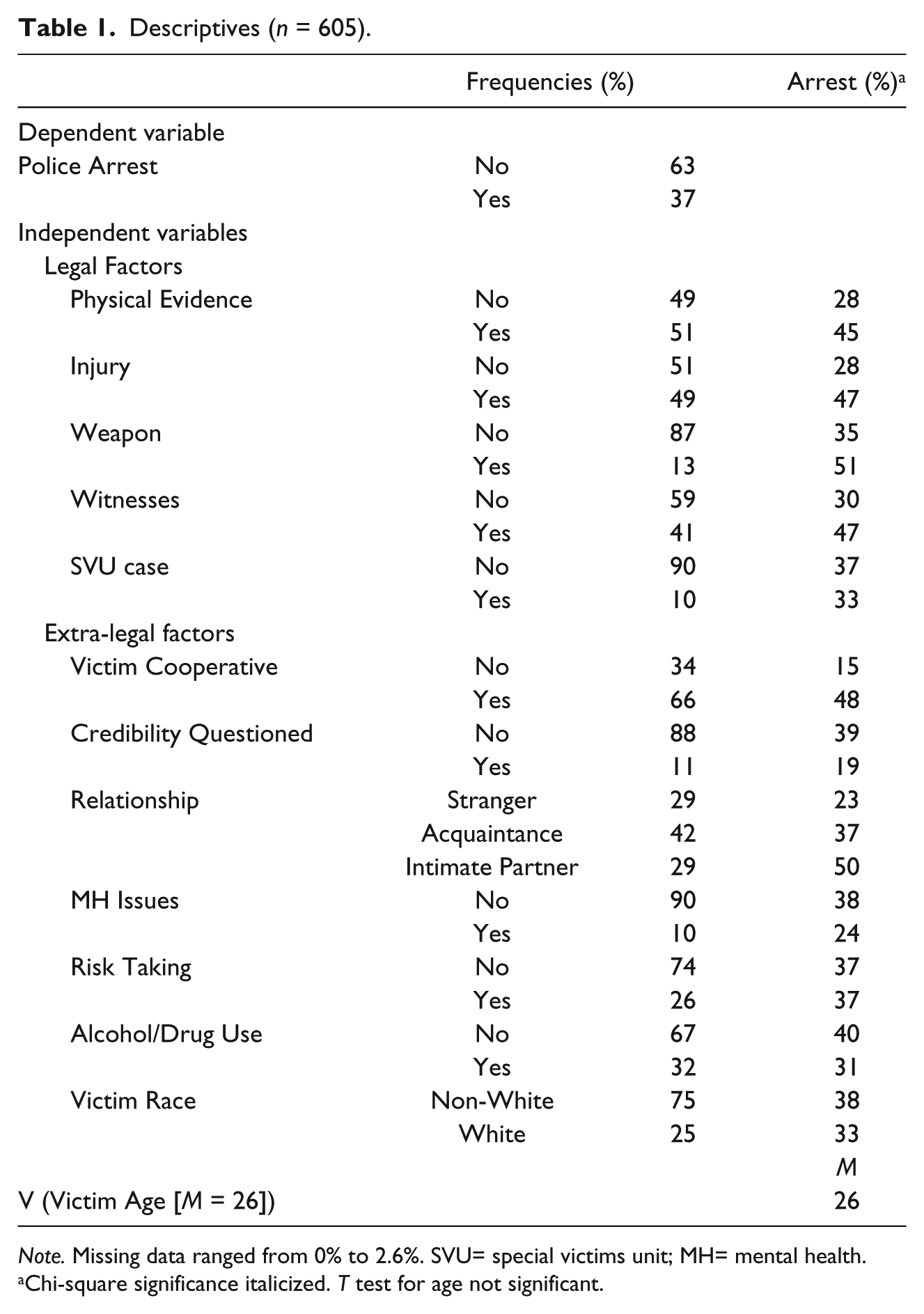
Note. Missing data ranged from 0% to 2.6%. SVU= special victims unit; MH= mental health.
Chi-square significance italicized. T test for age not significant.
Independent variables considered in our analysis include legal factors that provide the strongest legal evidence of the crime. Although such evidence is not required by law, these measures include whether there was any physical evidence gathered, whether there were injuries noted in the police report, whether or not there was a weapon (including a gun, knife, or other weapons) used, and whether witnesses were present. 1 Whether or not a case was handled by a special victims unit (SVU) is also included. These are both coded as binary variables.
Extra-legal factors are victim characteristics or incident details that may influence police outcomes. These factors represent considerations beyond evidentiary standards that come into play when the police make the decision to arrest (or not). As mentioned in the literature review, these characteristics may negatively influence the police perception of the credibility of the victim or likelihood of prosecution of the case. Measures include incident circumstances such as whether or not the victim engaged in “risky” behavior that may have increased her exposure to a perpetrator, including accepting a ride from a stranger or willingly going to a private residence (either victim’s or suspect’s) with the alleged suspect. We also consider whether the victim was reported to have been using alcohol or drugs and whether the police report indicated that the victim had mental health (MH) issues. Each of these is coded as a binary variable. The relationship between the victim and the main suspect (stranger, acquaintance, or intimate partner) is also included as well as victim age (a continuous variable) and the victim’s race (White or non-White). 2 Finally, we include a variable that indicates whether or not the victim was cooperative during the investigation. This is also coded as a binary variable.
Table 1 also includes for the value of each independent variable the percentage of cases that ended in an arrest. Several variables considered in the analysis did not reveal a significant relationship with arrest and were excluded from subsequent analysis. The one exception was victim race. Given the extensive consideration in the sexual assault attrition literature and the inconsistent effect of race in studies on police outcomes, we chose to retain it in the multivariate models.
Results
Table 2 presents logistic regression results predicting an arrest outcome. Model 1 includes only legal or evidentiary independent variables. 3 This model does not control for the extra-legal factor. Whether or not the victim suffered an injury was a significant predictor and increased the odds of arrest by a factor of 1.91. Weapon use also more than doubled (2.12) the odds of arrest. Incidents involving witnesses were significantly more likely to end in an arrest. The strongest predictor was whether the victim cooperated during the investigation. The odds of arrest increased by a factor of five for those incidents where the victim cooperated during the investigation.
Logistic Regression Results Predicting Arrest Outcome.

p < .05. **p < .01.
The extra-legal factors were added to the legal factors in Model 2. This means that the legal and extra-legal factors are both controlled for in the model. The model fit improves significantly with the addition of these variables. The coefficients associated with the legal factors changed little in size and significance in comparison with the first model. In this model, the evidence variable is a significant predictor of arrest. Interestingly, questioning of victim credibility by the investigating police officer was not a significant predictor of arrest when other factors are controlled. More specific measures that have been closely tied to victim credibility did, however, emerge as significant predictors of arrest. For example, incidents where police describe victims as having mental health issues have reduced odds of an arrest by a factor of .47. Similarly, incidents where the victim was reported to have been using drugs or alcohol are less likely to end in an arrest when other factors are controlled. Cases involving intimate partners and acquaintances have significantly higher odds of ending in arrest than incidents involving strangers. Victim race was not found to be significant. We also considered the possibility of interaction between race and mental illness and substance use (not shown), and the results were not significant. 4
We are particularly interested in determining how factors that may influence victim credibility contribute in a cumulative way to the arrest decision that goes beyond legal factors. Given that two factors associated with victim credibility, mental health, and substance use, presented as significant predictors of arrest, we investigate further how these factors contribute to the police decision to arrest, taking the specific strength of evidence into account. Table 3 presents the predicted probabilities of arrest in cases where the evidence is strongest and hence most likely to meet probable cause necessary for arrest, that is, for incidents where there is physical evidence, injury, weapon use, and witnesses, and the victim is cooperative, with the additive impact of mental health and substance use calculated separately, and then together. 5 Essentially, we hold the legal factors and victim cooperation at a value of one (which indicates cases with strong evidence and victim cooperation), and vary the presence of mental health and substance use variables from zero to one (or no to yes) and estimate the additional presence of each to the probability of arrest. The results are further sorted by victim–suspect relationship.
Predicted Probabilities of Arrest for Incidents Involving Victims With and Without Mental Health Challenges and Substance Use.
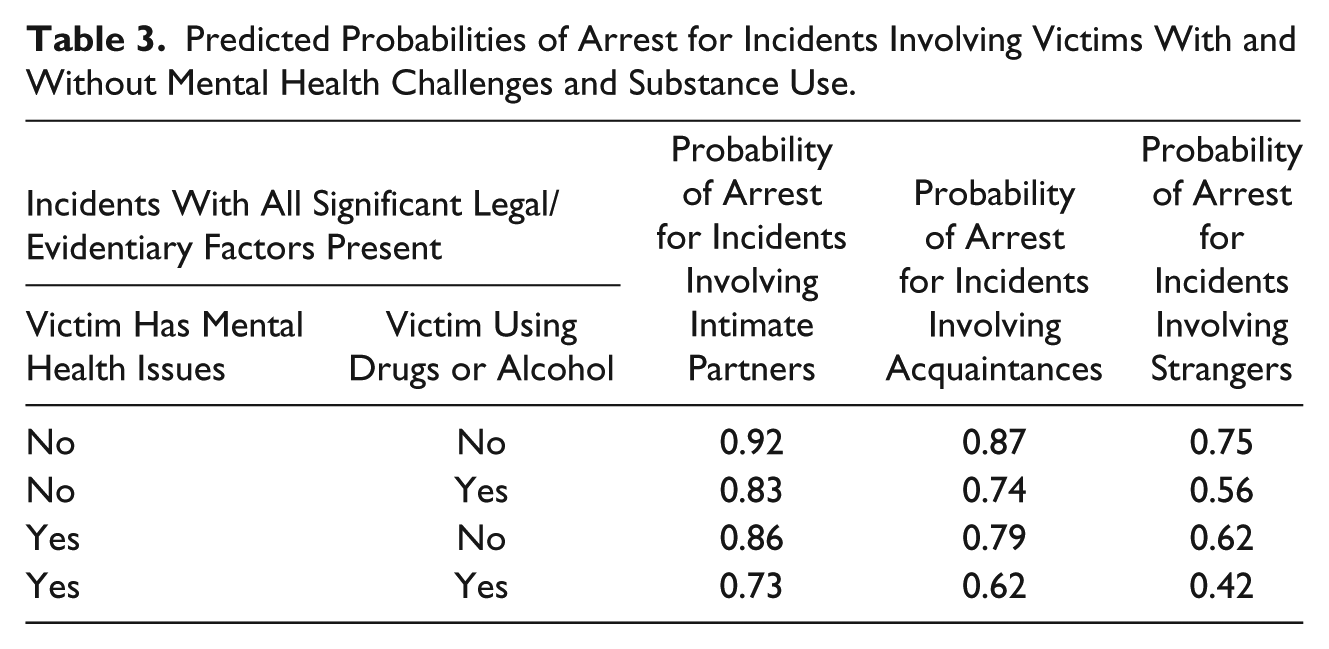
As expected, the probability of arrest for incidents involving intimate partners where the evidence is strong, the victim cooperates, and there is no indication of mental health or substance use issues, is very high at .92. If the victim was using drugs or alcohol, the probability drops to .83. If the victim has mental health issues, the probability drops to .86. If the victim has both mental health issues and was using drugs or alcohol, the probability of arrest drops to .73. For acquaintances, the results show that for incidents where there is strong evidence and a cooperative victim, the probability of arrest is .87. It drops to .74 if the case is otherwise strong but the victim was using drugs or alcohol, and to .79 if the victim had mental health challenges, and finally to .62 if both are present. For strangers, the results show that for incidents where there is strong evidence and a cooperative victim, the probability of arrest is .75. It drops to .56 if the case is otherwise strong but the victim was using drugs or alcohol, and to .62 if the victim had mental health challenges, and finally to .42 if both are present.
Discussion and Conclusion
Our findings suggest that there exists a cumulative or “piling on” effect of risk-taking behaviors and behavioral health challenges. This effect, however, is affected by the relationship between the victim and the offender. As prior research indicated, we found that the more challenges that are faced by a victim (as noted in the case file), the less likely the police will make an arrest. This is true when the victim and offender are intimate partners but even more so when they are acquaintances or strangers. This represents a challenge as acquaintance or date rapes are already challenges for police and prosecutors. When investigating acquaintance and stranger rapes, police must identify a suspect and find evidence to indicate an assault (Tasca et al., 2013). This can be resource-intensive work—made more difficult without a cooperative victim. These findings do support the work of Bouffard (2000) who found that arrest was more likely if the victim and suspect had a prior relationship.
Across all relationship types, the presence of behavioral health challenges reduces the likelihood of arrest. These findings have huge consequences for people with behavioral health challenges. Given that victims of sexual assault often face myriad problems—particularly those with behavioral health challenges (Teplin, McClelland, Abram, & Weiner, 2005), this presents a unique challenge for case attrition. The literature suggests that women with mental illness and who are chemically addicted are more likely to be sexually assaulted than their peers without these behavioral health challenges (Goodman et al., 1997; Maniglio, 2009; Teplin et al., 2005; Wekerle & Hall, 2002). And now, we find that these same victims are less likely to see their complaints end in an arrest of the accused. This finding is concerning because prior research suggests that between 21% and 76% of women with serious mental illnesses experience sexual abuse in adulthood (Goodman et al., 1997). In other crimes as well, police are less likely to make an arrest when the victim has a behavioral health challenge (Tasca et al., 2013).
There are natural and unfortunate consequences that result from these outcomes. First, victims experiencing these challenges may decide to not even report sexual victimization to the police because they fear being discredited and mistreated by the criminal justice system (Herman, 2003). And, when they do report, we can expect few arrests—a troubling outcome that may contribute to further victimization of these individuals, additional behavioral health problems, and victimization of others at the hands of perpetrators who are never brought to justice. Comparatively, there has been quite a bit of concern regarding the drop in arrests for another personal crime—homicide to 60% (Riedel & Boulahanis, 2007)—a rate still much higher than that of sexual assault. Despite this disparity, we are only beginning to understand the decision rules that police officers use to make these decisions in sexual assault cases.
To overcome this challenge, we must first consider why issues of victim behavior affect assessments of credibility and seem to be given weight in sexual assault cases. In particular, a victim’s behavioral health challenges should be unrelated to the police decision to arrest. More discussion is needed about how assessment of victim behavior and challenges affects criminal justice decision making particularly when the victim and offender have an acquaintance. New policies and practices are needed to mitigate the cumulative negative effects of challenges to victim credibility and to clarify and remedy the criminal justice response to sexual assault of those who do not meet societal behavioral expectations. This represents an important training issue for police and advocates, especially in the field of interpersonal violence.
There are a number of limitations that should be addressed in this investigation. First, victims engaged in many “risky” behaviors may be least likely to report based on concerns that police and prosecutors would question their credibility (Bachman, 1998), and thus, most may not have even made it into the sample studied here. There are a number of possible reasons why a victim may decline to participate in the criminal justice process. Personal circumstance such as extreme poverty or geographic isolation may prevent victims from gaining assistance from advocates or criminal justice authorities (DeKeseredy & Joseph, 2006; Lewis, 2003). Victims may also decline to cooperate because of shame, fear of retaliation, or experiences of secondary victimization by criminal justice or victim service agents (Herman, 2003). These victims may have internalized some of the rape myths themselves and thus may not want to cooperate with the criminal justice system (Heath, Lynch, Fritch, & Wong, 2013). Qualitative data could better get at these nuances in victim behavior.
Next, the literature suggests a “downstream orientation” held by police and prosecutors whereby they determine whether to proceed based on their perceived likelihood that the complaint will be successfully adjudicated (Pattavina et al., 2016). As Venema (2014) notes, police officers express frustration when the victim cannot remember the sexual assault because she was self-medicating. The police know that the “bad guy” is getting away and feel somewhat powerless but do not proceed. This downstream orientation may explain some of the police decision making here. In addition, we do not know whether this same orientation is held by victims. Their decision to cooperate may be more complicated than we have operationalized it to be and not simply rest on their expected or actual interactions with the police but may reflect a view that prosecution is unlikely. Future research should explore how this downstream orientation applies to the most vulnerable victims. Finally, these data were collected in Los Angeles, and it is unclear whether police response in this jurisdiction is generalizable to the rest of the country. Additional research is needed to make that determination.
Yet, there are some very real policy implications that arise from these findings. First, we must consider why complaints of sexual assault against victims who have many behavioral health challenges and have engaged in what is viewed as “risk taking” behaviors are less likely to end in arrest. It is possible that police are in effect “triaging” cases due to a lack of resources. If a dearth of resources means that police cannot investigate every case, perhaps they are selecting the cases that they believe are most likely to end in conviction or those where the suspect is identified and the victim is cooperative. If this is in fact true, communities might choose to prioritize the crime of sexual assault—and treat it similar to homicide. With a more elevated status and importance to the community, police might be given more resources to investigate and make arrests even in cases where the victim has these and other behavioral health challenges and has engaged in “risk taking” behaviors. In turn, making response to these cases a priority could have the ultimate effect of encouraging more victims to report. If it becomes known that police can and do fully investigate every case and have resources to assist victims who have other challenges, then victims might be more willing to make a report, and the burden of sexual assault may be, at least on some levels, ameliorated for these victims.
Footnotes
Declaration of Conflicting Interests
The author(s) declared no potential conflicts of interest with respect to the research, authorship, and/or publication of this article.
Funding
The author(s) disclosed receipt of the following financial support for the research, authorship, and/or publication of this article: This project is funded by the National Institute of Justice (NIJ #2012-IJ-CX-0052)—Decision-Making in Sexual Assault Cases: Multi-Site Replication Research on Sexual Violence Case Attrition in the United States.