



Abstract
Advancing dating violence (DV) research requires consistent conceptualization and measurement. However, empirical sudies on the measurement of psychological and physical DV perpetration and victimization are uncommon. There were three aims of the current study: (a) to examine the construct validity of psychological and physical DV perpetration and victimization on the Conflict in Adolescent Dating Relationships Inventory (CADRI) and Revised Conflict Tactics Scales (CTS2) using factor analysis; (b) to compare empirically derived DV scales with ones using face valid definitions of psychological and physical DV within each measure; and (c) to compare results obtained from the CADRI with those obtained from the CTS2. A diverse sample of undergraduates (N = 512; 63.9% female, 50.0% White, 16.2% Black, and 22.9% Latino) completed an online survey. There were two-factor solutions for each survey and DV perpetration and victimization: moderate psychological DV and severe psychological/physical DV on the CADRI; and moderate psychological and physical DV and severe psychological and physical DV on the CTS2. Multiple regression analyses showed that results were similar for empirically and rationally derived scoring methods with one exception: On the CTS2, risk factors associated with moderate DV were not the same as those associated with psychological DV. Moreover, the unique contribution of risk factors to each form of DV depended on which survey was used. In multivariate studies of risk factors associated with psychological and physical DV, the CADRI and CTS2 do not appear to be interchangeable, and may lead to different conclusions about the relative importance of risk factors.
Psychological and physical dating violence (DV) among male and female adolescents and emerging adults are well-established public health concerns (Taylor & Mumford, 2016; Vagi, O’Malley, Basile, & Vivolo-Kantor, 2015). Acts representing psychological DV (e.g., insults, threats, property destruction) and physical DV (e.g., pushes, shoves, slaps) are believed to signify separate constructs; however, factor analyses have yielded conflicting results about this distinction (Cascardi, Avery-Leaf, O’Leary, & Slep, 1999; Fernández-Fuertes, Fuertes, & Pulido, 2006; Taylor & Mumford, 2016). One way to address inconsistencies between empirically derived and face valid or rationally derived definitions of DV is to compare convergent validity results for each definition, but such comparisons are scarce (Cascardi et al., 1999). Direct comparisons of surveys which measure psychological and physical DV are also uncommon. A recent study comparing the Conflict in Adolescent Dating Relationships Inventory (CADRI; Wolfe et al., 2001) and Revised Conflict Tactics Scale (CTS2; Straus, Hamby, Boney-McCoy, & Sugarman, 1996) found that the physical DV scales identified different subsets of individuals (Cascardi & Muzyczyn, 2016). Advancing scientific knowledge requires consistent conceptualization and measurement of DV constructs. There were three aims of the current study in order to further research on the measurement of psychological and physical DV: (a) to examine the construct validity of psychological and physical DV on the CADRI and CTS2 using factor analysis; (b) to compare empirically derived DV scales with ones using face valid definitions of psychological and physical DV within each measure; and (c) to compare results obtained from the CADRI with those obtained from the CTS2.
The CADRI and CTS2 were selected for this study because they are among the most widely used DV surveys (Smith et al., 2015). Although they were developed with similar goals, to objectively quantify types of DV perpetration (DV-P) and victimization (DV-V) among males and females, the CADRI was developed for use with adolescent samples (Wolfe et al., 2001) and the CTS2 was developed with college-aged emerging adults (Straus et al., 1996). This developmental difference may explain discrepancies in content coverage between the two surveys, raising questions about whether they can or should be used interchangeably. Psychological DV on the CADRI refers to acts such as using a hostile tone of voice, keeping track of one’s partner’s whereabouts, jealous accusations, insults, and property destruction. The CADRI also includes separate subscales to measure threatening gestures (e.g., threaten to hit, threaten to hurt) and physical aggression (e.g., push, hit). Like the CADRI, items representing psychological DV on the CTS2 emphasize verbal aggression, threats, and attempts to destroy or damage property, but they do not include items on jealousy and surveillance tactics. The CTS2 also includes more severe acts of physical DV compared with the CADRI, such as beating, choking, burning, and scalding a partner. It remains an empirical question whether these content differences change the meaning of psychological and physical DV. It is plausible that different operational definitions of these phenomena may render seemingly similar surveys not comparable and lead to different conclusions about prevalence, etiology, risk factors, and targets for intervention. Comparing construct and convergent validity of the CADRI and CTS2 may improve understanding about the conceptual and empirical similarities between these surveys.
Distinctiveness of Psychological and Physical DV: Mixed Evidence From Factor Analysis
Previous factor analyses of the CADRI and CTS2 have yielded conflicting results about the distinctions between psychological and physical DV (Exner-Cortens, Gill, & Eckenrode, 2016). Some studies have shown congruence between items face valid for psychological and physical DV and the empirically derived constructs (Fernandez-Gonzalez, Wekerle, & Goldstein, 2012; Wolfe et al., 2001), while other studies have not (Fernández-Fuertes et al., 2006; Taylor & Mumford, 2016). Incongruent results on the CADRI have included threat items not forming a separate factor (Fernández-Fuertes et al., 2006), or these items loading with physical aggression items (Taylor & Mumford, 2016). Results of factor analyses for the CTS2 have also found that threat items loaded with physical aggression items (Barling, O’Leary, Jouriles, Vivian, & MacEwen, 1987; Cascardi et al., 1999) and items face valid for moderate physical aggression (e.g., push, shove, slap) have loaded with psychological aggression (Cascardi et al., 1999). Collectively, these results have suggested that DV dimensions may vary according to the potential of the behavior for emotional or physical harm and not only whether the behavior has (or has not) involved bodily contact (i.e., physical vs. psychological).
One strategy for clarifying the meaning of factor analysis results is to examine whether scales derived from factor analysis (i.e., empirically derived) show different patterns of association with expected risk factors compared with scales derived from rationally derived definitions of psychological and physical DV. Rationally derived definitions would classify psychological DV as words, gestures, and actions that do not involve bodily contact, whereas physical DV would include intentional and aggressive bodily contact. Only one study has compared empirically and rationally derived scales for psychological and physical DV on a modified version of the CTS, finding that the results were generally equivalent regardless of the scoring method (Cascardi et al., 1999). Replicating this type of analysis can advance understanding of the optimal way to conceptualize and measure psychological and physical DV.
Shared Risk Factors 1 Associated With Psychological and Physical DV
Anger, hostility, and emotional distress have been theoretically and empirically linked to physical violence against male and female partners across adolescence, emerging adulthood, and later adulthood (Birkley & Eckhardt, 2015; Capaldi, Kim, & Shortt, 2007; O’Leary, Tintle, & Bromet, 2014). Recently, research has begun to examine whether these variables are shared risk factors for psychological and physical DV-P and DV-V among emerging adults (e.g., Iverson, McLaughlin, Adair, & Monson, 2014; Taft, Schumm, Orazem, Meis, & Pinto, 2010; Simons, Simons, Landor, Bryant, & Beach, 2014). Both psychological and physical DV-V have been independently linked to emotional distress (Arriaga & Schkeryantz, 2015; Jouriles, Garrido, Rosenfield, & McDonald, 2009) and the habitual tendency to experience and express angry emotions (Iverson et al., 2014). Anger has also been a shared risk factor for psychological and physical DV-P when it has been examined as a single variable (Kendra, Bell, & Guimond, 2012; Lundeberg, Stith, Penn, & Ward, 2004), and in combination with hostility (Simons et al., 2014) or emotional distress (Faulkner, Goldstein, & Wekerle, 2015; Taft et al., 2010). In other work, anger has shown a stronger relation than emotional distress to a composite that included psychological and physical DV-P (Faulkner et al., 2015). However, it is difficult to synthesize results across studies because different DV measures are used and/or DV is not operationally defined in the same way. For instance, some investigators who use the CADRI have combined psychological and physical DV into a single composite (e.g., Faulkner et al., 2015; Wekerle et al., 2009), while others who use the CTS2 have treated these behaviors as separate constructs (e.g., Kendra et al., 2012). Research comparing surveys that measure psychological and physical DV can evaluate whether results obtained using different DV definitions and surveys are robust against measurement variations.
It is also plausible that a generalized tendency toward verbal and physical aggression may account for the relation of anger, hostility, and emotional distress to physical DV-P, as prior research has shown that antisocial and aggressive behavior is a reliable risk factor for physical DV-P (Capaldi, Knoble, Shortt, & Kim, 2012). Moreover, these aggressive tendencies may be related more strongly to physical DV-P on the CTS2 than on the CADRI because the CTS2 measures more severe and potentially injurious behavior. Thus, a key goal of the present work is to evaluate whether convergent validity, and nonredundant association of risk factors with psychological and physical DV-P and DV-V, are similar on the CADRI and CTS2.
The Current Study
Using a racially and ethnically diverse sample of males and females, the primary aim of the current study was to test whether psychological and physical DV-P and DV-V represent distinct constructs on the CADRI and CTS2. Factor analysis was hypothesized to yield two dimensions, though the composition of these factors was not specified given variability of results from previous factor analysis studies. The second aim was to compare the convergent validity of empirically derived and rationally derived (i.e., face valid) DV scales using five risk factors (general tendencies toward verbal and physical aggression, anger, hostility, and emotional distress). There were no specific hypotheses about whether risk factors associated with empirically derived scoring methods would differ from those associated with rationally derived scales. The third aim was to evaluate the similarity of results for the CADRI and CTS2. There were three hypotheses associated with this aim. First, it was hypothesized that the relation of risk factors to psychological DV-P would be similar for the CADRI and the CTS2. Second, it was hypothesized that the relation of anger, hostility, and emotional distress would be redundant with general tendencies toward aggression for physical DV-P, and that this effect would be stronger for physical DV-P on the CTS2 compared with the CADRI. Third, results for psychological and physical DV-V were hypothesized to be similar to those obtained for DV-P, since DV-V and DV-P tend to be highly correlated (Cascardi & Muzyczyn, 2016; Orpinas, Hsieh, Song, Holland, & Nahapetyan, 2013; Orpinas, Nahapetyan, Song, McNicholas, & Reeves, 2012).
Method 2
Participants
Data were collected in the fall of 2013 and 2014 at a state university in the northeast region of the United States. All underclass men and women between 18 and 21 years of age (M = 18.49, SD = .72), who were currently dating someone or had dated someone in the past 6 months, were eligible for participation. Participants were recruited via weekly email blasts to all currently enrolled freshmen and sophomores, presentations in mandatory classes, and flyers on campus. The institutional review board (IRB) at this institution approved the study.
The sample included 512 students. They were 63.9% female (n = 327) and of mixed race and ethnicity: 50.0% (n = 256) White, 16.2% (n = 83) Black, 22.9% (n = 117) Latino, with 10.9% (n = 56) Asian, multiethnic, or other. Seven students did not answer the question about dating status, leaving a final sample for 505 participants for analysis. About two thirds of students (61.8%, n = 312) were currently dating, and the remainder (38.2%, n = 193) had ended their relationship within the past 6 months. All relationships lasted 2 weeks or more, with more than one half of relationships lasting 6 months or more.
Procedure
Questionnaires were administered online in a supervised computer lab on campus. Upon survey completion, participants were debriefed, given US$10 for their time, and a list of counseling and legal resources about DV.
Measures
The CADRI (Wolfe et al., 2001) and the CTS2 (Straus et al., 1996) measured actions dating partners had taken to settle differences or disagreements with each other in the past 6 months. The CADRI was created to be sensitive to adolescent dating relationships, which tend to be brief and exploratory, with low levels of commitment (Wolfe et al., 2001). It also includes an assortment of behaviors (e.g., jealous accusations, monitoring partner’s whereabouts, threatening to hurt, pushing) believed to occur in adolescent relationships. Factor analysis of the CADRI in the initial development study identified one abuse dimension that consists of three first-order factors: physical assault, psychological abuse, and threats (Wolfe et al., 2001). These first-order factors were included in the current study: psychological abuse (10 items; used hostile tone of voice), threatening behavior (four items; threaten to hurt), and physical assault (four items; pushed or shoved). The CTS2 measures psychological and physical aggression, sexual coercion, and injury in marital, cohabiting, and dating relationships (Straus et al., 1996). Unlike the CADRI, it was designed to be used for a wide age range and to differentiate between moderate and severe forms of psychological and physical DV. On the CTS2, psychological (eight items; insulted or swore at) and physical (12 items; grabbed, punched) aggression subscales were used. Participants’ rated how often they perpetrated or experienced each item on the CADRI on a 4-point scale, from “never” to “often, happened 6 times or more,” and each item on the CTS2 on an 8-point scale, from “never” to “more than 20 times.” The response option, “happened before, but not in the past 6 months” was coded as never, to ensure equivalence with the CADRI.
Rationally derived scales were computed based on the subscale definitions for psychological and physical DV on the CADRI and CTS2. Internal consistency was acceptable for psychological aggression/victimization (α = .85/.87), for threats perpetration/victimization (α = .65/.77), and physical aggression/victimization (α = .80/.88) on the CADRI. Internal consistency was also acceptable for psychological aggression/victimization (α = .75/.75) and physical aggression/victimization (α = .87/.90) on the CTS2.
Aggression Questionnaire (AQ; Buss & Perry, 1992). The AQ measured an individual’s overall tendencies toward anger, hostility, and aggression. This 29-item measure consisted of four subscales: anger (e.g., “some of my friends think I am a hothead”), hostility (e.g., “I sometimes feel that people are laughing at me behind my back”), verbal aggression (e.g., “I often find myself disagreeing with people”), and physical aggression (e.g., “If somebody hits me, I hit back”). Participants rated each item on a 7-point scale (“extremely uncharacteristic” to “extremely characteristic”). The AQ has undergone extensive validation, primarily in undergraduate samples (Gerevich, Bácskai, & Czobor, 2007), and predicts aggressive behavior in a variety of populations (T. Y. Williams, Boyd, Cascardi, & Poythress, 1996). Internal consistency for each subscale was as follows: anger (α = .78), hostility (α = .78), verbal aggression (α = .72), and physical aggression (α = .82).
The PTSD symptom severity scale ( Foa, Riggs, Dancu, & Rothbaum, 1993 ) measured emotional distress in adults. It consisted of 17-items to evaluate the severity of PTSD symptoms experienced in the past 2 weeks on a 4-point scale (“not at all” to “very much”). Items represented the three Diagnostic and Statistical Manual of Mental Disorders (4th ed.; DSM-IV; American Psychiatric Association, 1994) symptom clusters: re-experiencing, avoidance, and arousal. Reliability and validity are well established (Foa & Tolin, 2000). Cronbach’s alpha was .93.
Data Analysis
Categorical principal components analysis (CATPCA) was used to evaluate the first aim: to identify the underlying dimensions of the CADRI and CTS2. The goal of CATPCA is similar to multivariate principal components and factor analysis: reduce the number of dimensions in the observed data. However, multivariate techniques require numeric data that are linearly related and (multi)normally distributed; assumptions which are violated with CADRI and CTS2 data. While other techniques (e.g., Satorra–Bentler maximum likelihood robust or weighted least squares) are appropriate for estimating nonlinear relationships in categorical data, these techniques do not address two fundamental scaling problems of behavioral frequency measures. First, items on the CADRI and CTS2 frequently have dissimilar scaling properties. For example, physical aggression items show logarithmic distribution with extreme skew and kurtosis (e.g., hit or kicked). More commonly experienced items, such as yelling (CTS2) or speaking in a hostile or mean tone of voice (CADRI), have uniform distributions. Second, the meaning of the distance between response options on the CADRI and CTS2 is uncertain. That is, the scaling distance between “never” and “once or more” as well as “once” or “3-5 times” is not equal and the true measurement distance between these response options is unknown. Thus, CATPCA optimizes the distance between response options of ordinal variables with different scaling properties through a multidimensional quantification process (Linting, Meulman, Groenen, & van der Kooij, 2007a; Linting & van der Kooij, 2012).
The quantification process is accomplished with monotonic spline or piecewise polynomial functions of a low degree (e.g., linear, quadratic) that are joined at particular points called knots. Knots represent the number of response categories best fitting the observed data. A key advantage of monotonic spline transformations is that they maximize potential relationships among scale items. The ultimate goal is to maximize the association among all variables so the most variance can be extracted for each underlying dimension. CATPCA computes eigenvalues and component loadings as in multivariate factor analysis. Although significance testing of model fit and factor loadings is not available in CATPCA, the stability of parameter estimates can be evaluated with balanced bootstrapping. CATPCA recommends balanced bootstrapping with 1,000 samples and Procrustes rotation to construct 95% confidence intervals around parameter estimates (Linting, Meulman, Groenen, & van der Kooij, 2007b).
Using the CATPCA quantification values, two sets of DV scales were computed. One was based on the empirically derived CATPCA dimensions and the other was based on rationally derived scoring of psychological and physical DV for the CADRI and CTS2. To evaluate the second and third aims, bivariate correlations were computed between the five risk factors (general tendencies toward verbal and physical aggression, anger, hostility, and emotional distress) and the empirically and rationally derived DV scales for the CADRI and CTS2. Multiple regression analyses 3 were also conducted to evaluate the nonredundant association of the five risk factors for each scoring method on the CADRI and CTS2. To examine risk factors uniquely associated with psychological DV-P, physical DV-P was statistically controlled. DV-P was also treated as a covariate in analyses for DV-V. Gender was treated as a covariate in all regression analyses.
Results
Descriptive Statistics
Prior to conducting CATPCA, descriptive statistics were computed with SPSS version 23. As expected, the data showed severe skew and kurtosis for many items, problems which were more extreme for the CTS2 than on the CADRI (reported in supplemental tables). Endorsement of physical and threatening DV-P on the CADRI was approximately 28%, and virtually all participants reported at least one act of psychological DV-P (94%). Similar rates were reported for DV-V. Rates of psychological DV were also high on the CTS2, 82% for DV-P and 78% for DV-V. Approximately 29% of the sample reported any physical DV-P or DV-V. Data were transformed using monotonic spline polynomial functions. Inspection of transformed data indicated that there were no scaling problems that could contribute to unstable structural solutions in principal components analysis. Four separate CATPCA analyses were conducted for CADRI DV-P, CADRI DV-V, CTS2 DV-P, and CTS2 DV-V. In each analysis, the optimal number of principal components was based on eigenvalues and interpretability of the obtained component loadings. To evaluate the stability of results, parameter estimates obtained for the sample were compared with average parameter estimates and standard errors generated with bootstrapping. To facilitate interpretation of the two dimensions, principal components were rotated using varimax rotation and Kaiser normalization. Items with component loading values greater than .40 were retained. After the dimensional structure was identified, gender was treated as a supplemental variable (or covariate) in the analyses to determine whether the factor solutions varied by gender.
Aim 1: CATPCA Analysis
In all four analyses, two components (or dimensions) offered the best explanation of the data and gender was unrelated to the dimensional structure.
CADRI: DV-P and DV-V
For DV-P, two dimensions accounted for 46.4% of shared item variability, and parameter estimates were stable over 1,000 bootstrap samples. As shown in Table 1, the standard errors of the 95% confidence interval for the bootstrap parameter estimates are uniformly small. Items representing ridicule, threats of aggression, and perpetration of physical aggression (e.g., push, threaten to destroy partner’s property) formed one factor, labeled severe DV (α = .86), and items representing moderate psychological aggression (e.g., insult, use hostile or mean tone of voice, accuse of flirting) formed the other factor, labeled moderate DV (α = .85). The rotated dimensions were moderately correlated, r = .63. Results for DV-V were similar to those obtained for DV-P (see Table 1).
CATPCA Results for CADRI.

Note. Shading highlights items that did not load on rationally derived scales. CATPCA = categorical principal components analysis; CADRI = Conflict in Adolescent Dating Relationships Inventory; DV-P = dating violence perpetration; DV-V = dating violence victimization; SEV = threats/severe psychological physical aggression; MOD = psychological aggression; PC1 = Principal Component 1; PC2 = Principal Component 2.
CTS2: DV-P and DV-V
For DV-P, two dimensions accounted for 51.0% of shared item variability, and bootstrapping results showed relative stable parameter estimates (see Table 2). The two dimensions were moderately correlated (r = .57) and represented moderate (psychological and physical) DV (e.g., yell, insult, push, slap; α = .84) and severe (psychological and physical) DV (e.g., destroy property, call fat or ugly, punch; α = .88). One item, “threaten to hit”, cross-loaded. Results for DV-V were generally similar to those obtained for DV-P (see Table 2), with four exceptions: The items “push or shove” and “grab” loaded on both dimensions, and “threaten to hit” and “slap” loaded only on severe (psychological and physical) DV.
CATPCA Results for CTS2.
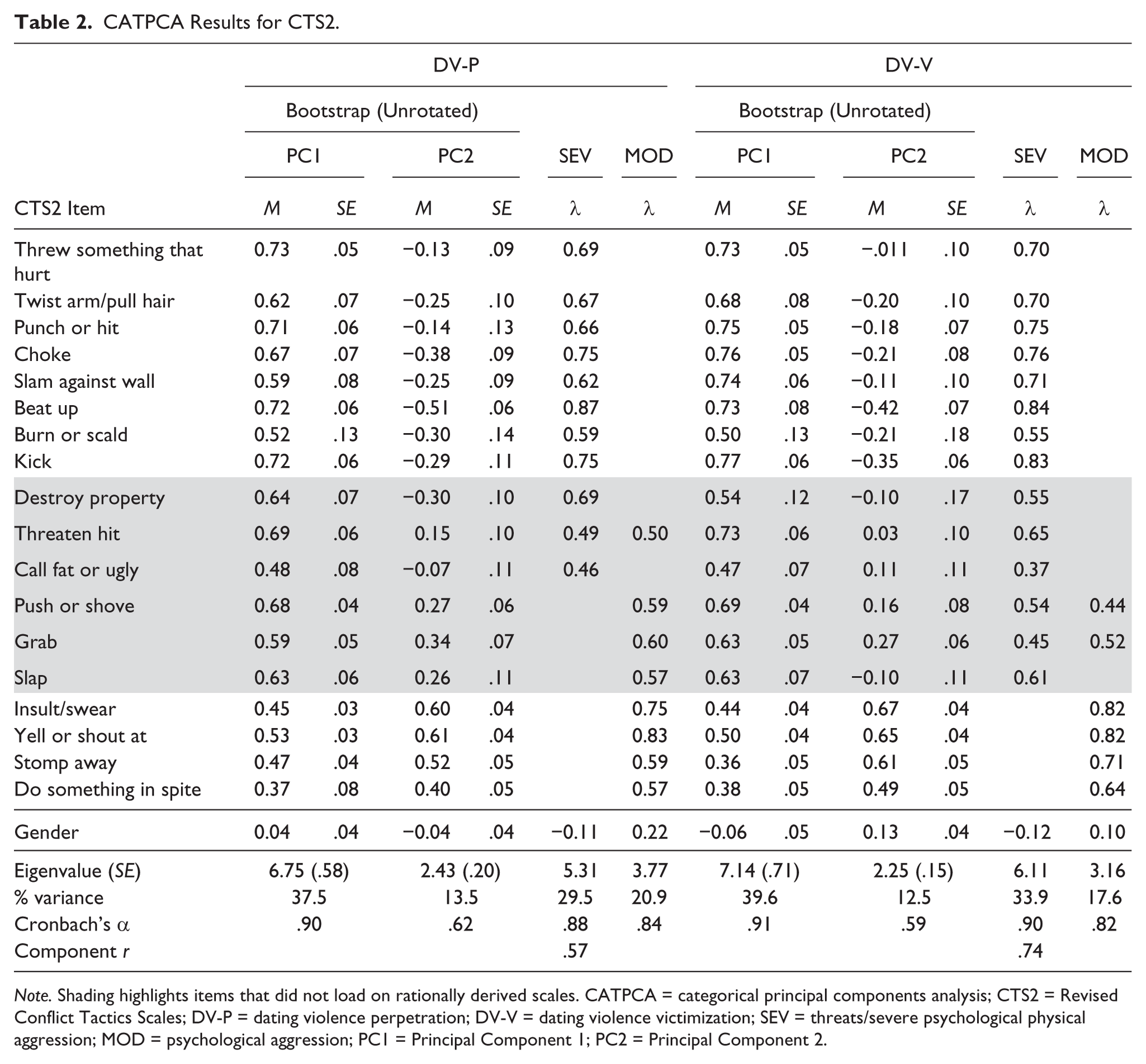
Note. Shading highlights items that did not load on rationally derived scales. CATPCA = categorical principal components analysis; CTS2 = Revised Conflict Tactics Scales; DV-P = dating violence perpetration; DV-V = dating violence victimization; SEV = threats/severe psychological physical aggression; MOD = psychological aggression; PC1 = Principal Component 1; PC2 = Principal Component 2.
Aim 2: Comparison of Empirically and Rationally Derived Scores
CADRI
The empirically derived dimensions for moderate DV-P and DV-V on the CADRI included deliberately frightened and did not include ridicule. The empirically derived dimensions for severe DV-P and DV-V included threats of aggression, ridicule, and the four physical DV items. Pearson’s r for the empirically/rationally derived dimensions for moderate/psychological DV-P and DV-V was r = .98 and r = .99, respectively, and for severe/physical DV-P and DV-V was r = .91 and r = .95, respectively. The bivariate correlation and multiple regression results were similar for the empirically and rationally derived scales for DV-P and DV-V (r, B, F, and R2 for regression models are reported in Tables 3 and 4).
Correlation and Multivariate Regression Analyses for DV-P: Empirically and Rationally Derived Scores.
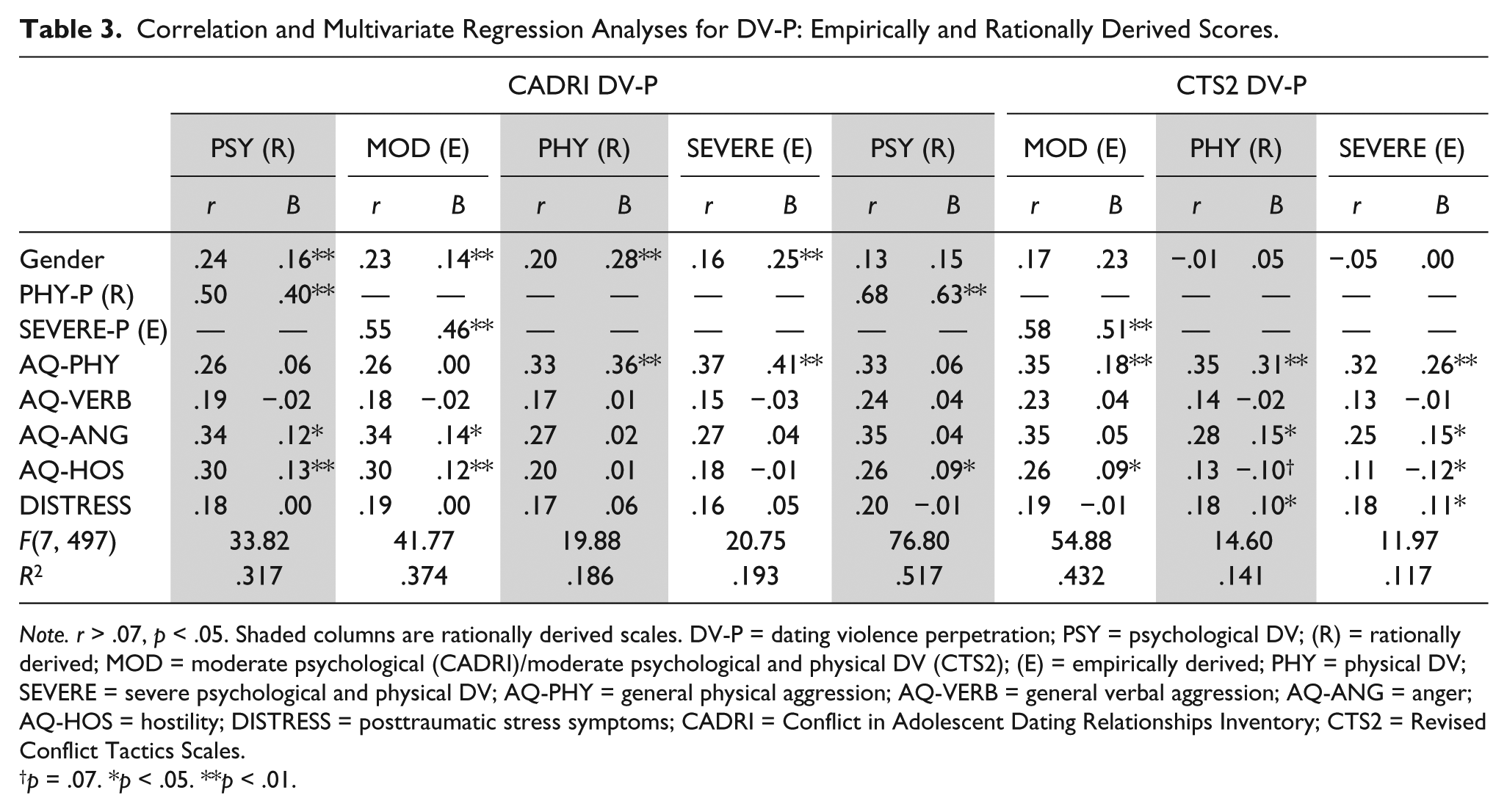
Note. r > .07, p < .05. Shaded columns are rationally derived scales. DV-P = dating violence perpetration; PSY = psychological DV; (R) = rationally derived; MOD = moderate psychological (CADRI)/moderate psychological and physical DV (CTS2); (E) = empirically derived; PHY = physical DV; SEVERE = severe psychological and physical DV; AQ-PHY = general physical aggression; AQ-VERB = general verbal aggression; AQ-ANG = anger; AQ-HOS = hostility; DISTRESS = posttraumatic stress symptoms; CADRI = Conflict in Adolescent Dating Relationships Inventory; CTS2 = Revised Conflict Tactics Scales.
p = .07. *p < .05. **p < .01.
Correlation and Multivariate Regression Analyses for DV-V: Empirically and Rationally Derived Scores.

Note. r > .07, p < .05. Shaded columns are rationally derived scales. DV-V = dating violence victimization; PSY = psychological DV; (R) = rationally derived; MOD = moderate psychological (CADRI)/moderate psychological and physical DV (CTS2); (E) = empirically derived; PHY = physical DV; SEVERE = severe psychological and physical DV; AQ-PHY = general physical aggression; AQ-VERB = general verbal aggression; AQ-ANG = anger; AQ-HOS = hostility; DISTRESS = posttraumatic stress symptoms; CADRI = Conflict in Adolescent Dating Relationships Inventory; CTS2 = Revised Conflict Tactics Scales.
p = .06. *p < .05. **p < .01.
CTS2
The two empirically derived dimensions for CTS2 represented moderate psychological and physical DV and severe psychological and physical DV, whereas the rationally derived dimensions represented moderate and severe psychological DV and moderate and severe physical DV. Pearson’s r for the empirically/rationally derived dimension for moderate/psychological DV-P and DV-V was r = .93 and .90, respectively, and for severe/physical DV-P and DV-V was r = .96 and r = .99, respectively. The bivariate correlation and multiple regression results were the same regardless of the scoring methods, with one exception. After all other variables had been taken into account, general tendencies toward physical aggression were a significant risk factor for the empirically derived moderate DV-P scale, but these tendencies were not a unique risk factor for the rationally derived psychological DV scale (r, B, F, and R2 for regression models are reported in Tables 3 and 4).
Aim 3: Comparison of Psychological and Physical DV on the CADRI and CTS2
Rationally derived scales were used to evaluate convergent validity of psychological and physical DV on the CADRI and CTS2 and with the five risk factors for two reasons. First, there were few differences between rationally and empirically derived scales for DV-P and DV-V. Second, the one difference that did emerge suggested that the risk factors associated with psychological DV-P may be misrepresented when moderate physical DV-P was also included. Psychological and physical DV on the CADRI were moderately correlated with psychological and physical DV on the CTS2 for perpetration (r = .66 and r = .62, respectively) and victimization (r = .70 and r = .68, respectively).
Psychological DV-P and DV-V
Bivariate correlations between the five risk factors (anger, hostility, emotional distress, and general verbal and physical aggression tendencies) and psychological DV-P and DV-V were similar for the CADRI and CTS2. However, in regression analyses, when the redundancy among the risk factors was taken into account, the results for the CADRI and CTS2 were not the same. On the CADRI, gender (being female), physical DV-P, anger and hostility explained 31.7% of variability of psychological DV-P when all other variables were taken into account. However, on the CTS2, being female, physical DV-P, and hostility were uniquely associated with psychological DV-P and explained 51.7% variability. Results for psychological DV-V were similar for the CADRI and CTS2: gender (being male), psychological DV-P, and hostility were associated with psychological DV-V when all other variables were taken into account, and explained 62.7% and 66.7% of variability, respectively (see Tables 3 and 4).
Physical DV-P and DV-V
Bivariate correlations between risk factors and physical DV-P and DV-V were similar for the CADRI and CTS2. Results of regression analyses, however, showed that gender (being female) and physical aggression tendencies explained 18.6% of variability of physical DV-P on the CADRI when all other variables were taken into account. In contrast, on the CTS2, there was less redundancy among the risk factors: anger, emotional distress, and tendencies toward physical aggression were associated with physical DV-P and explained 14.1% of variability. Results for physical DV-V were dissimilar for the CADRI and CTS2 as well. Gender (being male) and physical DV-P explained 25.8% of variance of physical DV-V on the CADRI, while gender (being male), physical DV-P, and hostility were associated with physical DV-V on the CTS2, explaining 57.0% of variance (see Tables 3 and 4).
Discussion
The current study compared the construct and convergent validity associated with psychological and physical DV on the CADRI and CTS2. Consistent with the first hypothesis, two dimensions were identified for DV-P and DV-V on the CADRI and CTS2 using a data analytic technique (CATPCA) that optimized the scaling distance between response options. These dimensions were similar for DV-P and DV-V and for males and females. On the CADRI, a dimension labeled moderate DV consisted of psychologically aggressive behavior, such as insult, jealous accusation, and monitor partner’s whereabouts. In contrast, moderate DV on the CTS2 consisted of moderate psychological (yell, insult) and physical (push, grab, slap) aggression. Items on the second dimension, labeled severe DV, were more similar for the CADRI and CTS2. Severe DV included threats of violence, property destruction, and items representing particularly humiliating actions (call fat or ugly or ridicule in front of others) along with all physical aggression items on the CADRI and more serious physical aggression items on the CTS2. These findings replicate previous factor analyses of the CADRI and CTS that produce DV factors that combine acts of moderate psychological and physical DV on one factor and acts of serious psychological and physical DV on another factor among adolescents (Cascardi et al., 1999; Taylor & Mumford, 2016) and adults (Barling et al., 1987).
One interpretation of the CATPCA results is that threatening behavior, property destruction, and harsh name calling represent more profound intentions to coerce one’s partner or harm one’s partner’s feelings of self-worth and safety in the relationship than other acts of psychological DV (e.g., yell, swear, jealous accusation) or moderate physical DV (e.g., push, shove; Hamby & Sugarman, 1999). Furthermore, the conflation of moderate forms of physical DV against a partner with moderate forms of psychological DV suggests that pushing or shoving a partner may be more psychologically equivalent to yelling or swearing at a partner than hitting, kicking, or beating up a partner. Thus, the DV dimensions may vary according to potential for emotional or physical harm, and not only whether the behavioral expression is physical or psychological.
Although psychological and physical DV were not clearly differentiated constructs, convergent validity analyses (Aim 2) suggest that distinctions between empirically and rationally derived DV scoring methods are largely inconsequential. Bivariate correlations between the rationally and empirically derived scores for DV-P and DV-V exceed .90, and regression analyses comparing risk factors for each type of DV (moderate vs. severe and psychological vs. physical) showed few differences between empirically and rationally derived scoring methods. Overall, findings suggest that whether threats, property destruction, or nasty name calling are counted as psychological or physical DV, the interpretation of risk factors for DV-P and DV-V on the CADRI and CTS2 does not change. There is one important exception to the conclusion. Both general tendencies toward physical aggression and hostility emerged as unique risk factors for the empirically derived combination of moderate psychological and physical aggression on the CTS2. However, only hostility was uniquely related to the rationally derived scale for psychological DV-P on the CTS2. Thus, when pushing, grabbing, and shoving were combined with insults, yelling, and spiteful acts, collectively, they related to general tendencies toward physical aggression. This suggests that the variance shared by physical and psychological DV-P may be missed when face valid psychological DV-P scales are used. Alternatively, results suggest that combining moderate psychological and physical DV-P into one scale may misrepresent risk factors uniquely associated with psychological DV-P.
The hypothesis that the relation of the five risk factors (i.e., anger, hostility, emotional distress, and general verbal and physical aggression tendencies) to psychological DV-P would be equivalent for the CADRI and CTS2 (Aim 3) was partially supported. In support of this hypothesis, bivariate correlations between each risk factor and psychological and physical DV-P on the CADRI and CTS2 were similar. Moreover, when the redundancy among the risk factors was taken into account, hostility consistently emerged as a unique correlate of psychological DV-P on the CADRI and CTS2. Hostility has been conceptualized to refer to beliefs that others cannot be trusted or have malicious intent (Buss & Perry, 1992), and it has also been found to predict psychological DV-P in other work (e.g., Simons et al., 2014). In the current study, hostility appears to be particularly important for understanding the use of insults, threats, and property destruction toward a partner on both the CADRI and CTS2. This maladaptive belief system may motivate psychological DV-P as a form of retaliation against real or perceived injustices committed by one’s partner. Consistent with this idea, prior research has shown that psychological DV-P is motivated by retaliation against emotional hurt or insult (Flynn & Graham, 2010; Shorey et al., 2012).
Although anger was a significant correlate of psychological DV-P on both the CADRI and CTS2, in regression analyses, the influence of anger was redundant with hostility on the CTS2 but not on the CADRI. That is, anger and hostility contributed independently to psychological DV-P on the CADRI but not on the CTS2. The reasons for this disparity are unclear; however, it may be due to differences in item content on the CADRI and CTS2. Specifically, items on the CADRI that refer to jealous accusations may relate more strongly to anger than to hostility. The link between romantic jealousy and negative emotions, such as anger, lends some support to this perspective (Andersen & Guerrero, 1997; Costa, Sophia, Sanches, Tavares, & Zilberman, 2015). That is, anger arousal may reflect an emotional reaction to perceived threat or loss of the relationship, and this potential threat or loss (i.e., jealousy) is measured with the CADRI but not with the CTS2.
The hypothesis that the relation of anger, hostility, and emotional distress would be redundant with general tendencies toward aggression, and that this effect would be stronger for physical DV-P on the CTS2 than on the CADRI, was not supported. Even though this hypothesis was not supported, a general tendency toward physical aggression was the single strongest correlate of physical DV-P on both measures. This finding, regardless of the survey used, is consistent with previous research documenting a consistent association between peer aggression, conduct disorder, delinquent behaviors, and physical aggression against a dating partner, suggesting that physical DV-P may reflect an enduring trait-like pattern of aggressive or antisocial behavior (Ehrensaft et al., 2003; Kim & Capaldi, 2004; T. S. Williams, Connolly, Pepler, Craig, & Laporte, 2008). Results of the current study suggest that a general tendency toward physical aggression may explain the progression from psychological to physical DV-P, including pushing, grabbing, shoving, or slapping. It may also differentiate those who perpetrate only psychological DV from those who perpetrate both psychological and physical DV.
In contrast with expectations, tendencies toward general physical aggression accounted for the relation of anger, hostility, and emotional distress to physical DV-P on the CADRI but not on the CTS2. On the CTS2, but not on the CADRI, anger and emotional distress also uniquely contributed to physical DV-P. One possible explanation for the different results is that the CTS2 measures more serious physically aggressive behaviors against a partner. That is, being quick to anger without provocation and experiencing more severe symptoms of emotional distress may be linked to greater impulsivity, loss of behavioral control, and consequently more severe physical aggression. Although previous research suggests that problems with anger regulation and emotional distress are mechanisms by which psychological and physical DV-P develop (e.g., Faulkner et al., 2015; Taft et al., 2010), current results suggest this better characterizes physical DV-P as measured by the CTS2. Thus, the relative importance of individual risk factors associated with physical DV-P varies depending on the survey.
There was more support for the hypothesis that the CADRI and CTS2 would share risk factors for DV-V. Being male, perpetrating psychological DV, and hostility contributed incrementally to psychological DV-V on both CADRI and CTS2. Physical DV-V was also uniquely associated with being male and perpetrating physical DV on both measures. Overall, DV-P was the strongest correlate of DV-V. This is consistent with a large body of research demonstrating that psychological and physical DV are characterized by reciprocal patterns of hostile, negative exchanges (Capaldi et al., 2007). Even though results were generally similar for physical DV-V on the CTS2 and CADRI, the CTS2 explained twice as much variability in physical DV-V than the CADRI (57.0% vs. 25.8%), suggesting that one’s own physical aggression is less strongly linked to physical victimization reported on the CADRI.
Limitations
Similar to other studies investigating DV, this study used a convenience sample of university students at a public university. In general, the student population represented the racial and ethnic composition of the state, and the sample drawn from this university reflected the student body in regard to race and ethnicity. Nevertheless, it is unclear whether these results generalize to emerging adults in other regions or to those not attending university. Another limitation of the current sample is that it does not include the most extreme cases of DV. The most severe forms of physical aggression that would rise to a level of clinical or legal concern, such as choked, slammed against a wall, beat up, burned, or scalded on purpose, or kicked, did not occur with notable frequency. It is also possible that the different results obtained for the CADRI and CTS2 may not replicate in higher risk samples. This is particularly noteworthy because previous research with the CADRI in maltreated samples has shown emotional distress and anger relate to psychological and physical DV-P (Faulkner et al., 2015; Wekerle et al., 2009; Wolfe, Wekerle, Scott, Straatman, & Grasley, 2004). Finally, these data are cross-sectional, limiting inferences about the temporal or causal relation between risk factors and DV-P and DV-V.
Conclusion and Implications
Strengths of this study include an ethnically and racially diverse sample (50% White, 16% Black, and 23% Latino with White, Black, or multiracial identity) of males and females, as well as examination of psychological and physical DV-P and DV-V separately. Results indicate that threatening behavior, property destruction, more serious psychological DV (e.g., harsh name calling), and more serious physical DV (e.g., hit, punch, beat up) appear to reflect the same underlying construct. Although moderate forms of physical DV, such as pushing or shoving, and moderate forms of psychological DV, such as yelling and insulting, represented a distinct construct, multivariate analyses indicated that combining seemingly moderate acts of psychological and physical DV into a single composite may misrepresent unique risk factors of when psychological and physical DV are considered separately. More specifically, physical DV appears to be related to a predisposition toward general physical aggression, whereas psychological DV does not. Aggressive tendencies may explain the escalation from words and gestures to physical bodily contact, such as pushing and shoving.
There are two important implications from this work. First, the CADRI and CTS2 measure psychological and physical DV-P and DV-V using different behaviors and these differences alter the conclusions one draws about the relative importance of the five risk factors (general tendencies toward verbal and physical aggression, anger, hostility, and emotional distress). Specifically, the larger range and number of behaviors (e.g., jealousy and surveillance) representing psychological DV on the CADRI appears to strength the association of anger and this form of DV. Similarly, the larger range and number of physical DV behaviors (e.g., burn or scald, choke, slam against a wall) assessed with the CTS2 increases the importance of anger and emotional distress in relation to physical DV. Thus, a survey that incorporates these unique features into a single measure will likely offer a more complete perspective of DV perpetrated and experienced among college-aged emerging adults. Future research would benefit from integrating unique features of the CTS2 into the CADRI or vice versa. Second, each survey seems to be appropriate for young adult samples. Even though the CADRI was developed for adolescents, the larger assortment of psychological DV behaviors on the CADRI appears to be important in young adult relationships too. However, use of the CADRI alone may miss more serious, albeit infrequent, forms of physical DV of these relationships. Importantly, the CADRI or CTS2 does not appear to be interchangeable in multivariate studies of risk factors.
Supplemental Material
CBD_supplementary_file – Supplemental material for Comparison of the CADRI and CTS2 for Measuring Psychological and Physical Dating Violence Perpetration and Victimization
Supplemental material, CBD_supplementary_file for Comparison of the CADRI and CTS2 for Measuring Psychological and Physical Dating Violence Perpetration and Victimization by Michele Cascardi, Sean Blank and Vikash Dodani in Journal of Interpersonal Violence
Footnotes
Declaration of Conflicting Interests
The author(s) declared no potential conflicts of interest with respect to the research, authorship, and/or publication of this article.
Funding
The author(s) disclosed receipt of the following financial support for the research, authorship, and/or publication of this article: This research was supported (in part) by a Summer Stipend from the Research Center for the Humanities and Social Sciences at William Paterson University.
Notes
Author Biographies
References
Supplementary Material
Please find the following supplemental material available below.
For Open Access articles published under a Creative Commons License, all supplemental material carries the same license as the article it is associated with.
For non-Open Access articles published, all supplemental material carries a non-exclusive license, and permission requests for re-use of supplemental material or any part of supplemental material shall be sent directly to the copyright owner as specified in the copyright notice associated with the article.
