



Abstract
This study focused on the factor structure of the victimization form of the revised Controlling Behaviors Scale (CBS-R). Data from 1,218 women and men were analyzed in the study. Results of confirmatory factor analysis (CFA) failed to find support for the proposed five-factor structure of the scale, as the items on the scale were better represented by one common factor. In addition, when examining if controlling behaviors are distinct from psychological aggression, the CFA indicated that the items on the CBS-R are clearly distinguishable from the items on the psychological aggression (as measured with the subscales of the revised Conflict Tactic Scales [CTS2]), and that this holds for both males and females. Implications for the general use of the CBS-R and for use in conjunction with psychological aggression and physical aggression in intimate partner violence were discussed.
The relation between intimate partner violence (IPV) and various aspects of health has generated considerable interest during the last two decades as research clearly indicates that IPV is associated with decreased health (e.g., Campbell, 2002; Follingstad, 2009, for reviews).When attempting to explain IPV, it has been noted that merely counting the number of violent acts is inadequate (e.g., Dutton & Goodman, 2005), as it is also important to determine whether the violence is part of a general pattern of power and control in these relationships (e.g., Johnson, 2006; Stark, 2009). Johnson (1995) argued that there is a need to distinguish between physical aggression used within a broader control framework (the presence or absence of controlling behavior) and that used in response to a conflict. There is evidence indicating that controlling behaviors are strong predictors of IPV perpetration (e.g., Graham-Kevan & Archer, 2008; Johnson, 1995, 2006).
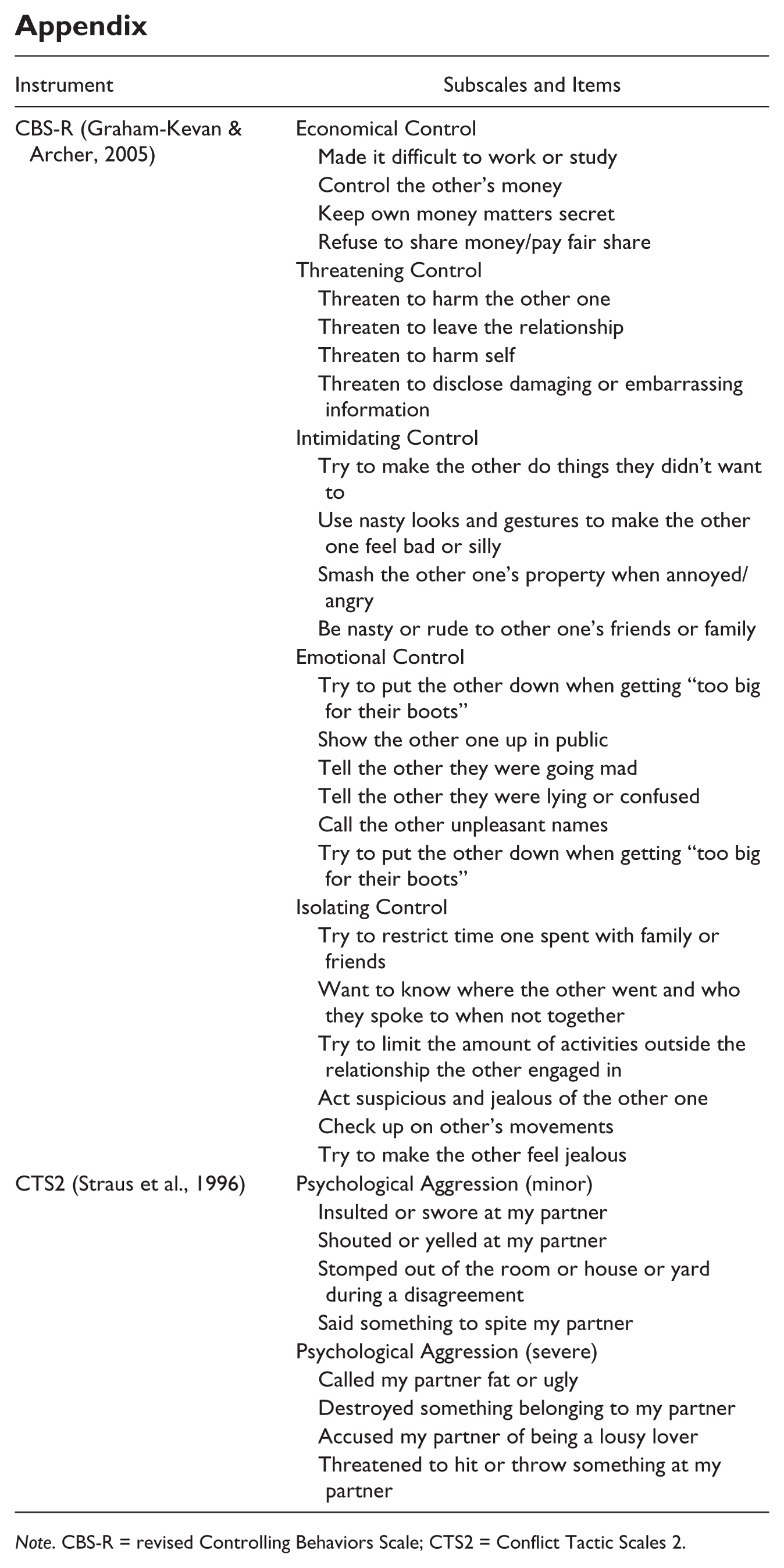
There has been an increased interest to systematically study controlling behaviors in relation to partner violence during the last decade (e.g., Graham-Kevan & Archer, 2003a, 2011; Johnson, 2005; Tanha, Beck, Figueredo, & Raghavan, 2010). There are, however, few validated instruments to assess processes related to partner control. Graham-Kevan and Archer (2003b) developed the Controlling Behaviors Scale (CBS) to differentiate high from low levels of control in relationships, and to obtain a more comprehensive assessment of controlling behaviors that does not also tap aspects of physical aggression. The original version of this measure has been revised (CBS-R; Graham-Kevan & Archer, 2005) and is currently a widely used measure of controlling behavior. The CBS-R asks the participants to rate how frequently they perpetrated and experienced controlling acts over the previous 12 months on a 24-item scale, divided into five subscales, each involving a particular type of controlling tactic within intimate relationships: (a) using economic control, (b) using threatening control, (c) using intimidating control, (d) using emotional control, and (e) using isolating control (see the appendix).
Even though the preliminary psychometric findings are promising, further evidence concerning the measurement properties of this instrument is needed. To our knowledge, there is to date only one study that has looked at the factor structure of the CBS-R. A small-scale study (N = 77) from Korea that used an exploratory factor analysis (with Varimax rotation) found no support for the suggested five-factor solution (Emery et al., 2012). Moreover, when studies typically note that this instrument “has a good discriminative ability” (e.g., Graham-Kevan & Archer, 2005), it simply reflects that this measure is able to discriminate between victimization and perpetration of physical aggression, and that one’s partner’s use of controlling behaviors is the most prominent factor of victimization of physical aggression within relationships (Graham-Kevan & Archer, 2003b). While studies using the CBS routinely comment on this aspect of validity, to our knowledge, the structural validity of the scale has never been the focal point in previous research. Thus, this study focused on the factor structure of the victimization form of the CBS-R. Using confirmatory factor analysis (CFA), the main purpose of the present study was to empirically evaluate the multidimensional model of CBS-R, seeking support for the hypothesized five-factor model.
Despite that the CBS-R does not assess aspects of physical aggression, the factor structure should not be examined without considering other variables extensively used in research concerning IPV. That is, it is important to recognize that there are commonalities between the domains of the CBS-R and some of the domains on the instrument that has been most commonly used to assess IPV, namely the revised Control Tactics Scale (CTS2; Straus, Hamby, Boney-McCoy, & Sugarman, 1996). Specifically, the items on the Psychological Aggression subscales of the CBT2 consist of suggestions of concrete acts such as “threatened to hit and throw something at my partner,” “destroyed something belonging to my partner,” “insulted or swore at my partner,” and “called my partner fat or ugly” (see the appendix). In a similar manner, three domains of the CBS-R, namely, “using threats”, “using intimidation”, and “using emotional abuse” consist of tactics such as “threatened to leave the relationship,” “Smash the other one’s property when annoyed/angry,” and “Call the other unpleasant names.” The items from the two other dimensions on the CBS-R (economic control; for example, “Made it difficult to work or study”: isolating control; for example, “Try to restrict time one spent with family or friends”) show however little similarity with items on the Psychological Aggression subscales. Taking the aforementioned into account, the construct of psychological aggression may overlap conceptually with measures of controlling behaviors. Thus, we need to establish if the construct of psychological aggression is qualitatively different from mere controlling behavior. Yet, there has been no published study comparing these two constructs. In addition to evaluating the multidimensional model of CBS-R, the second purpose of the present study was to examine if controlling behaviors are distinct from psychological aggression.
Data were based on an extended Swedish sample of the Domestic Violence against Women/Men in Europe (DOVE) project. DOVE examined the occurrences, features, predictors, and effects (e.g., physical and mental health) of IPV among randomly selected women/men aged 18 to 64 years from the total population in eight European countries.
Method
Participants and Procedure
The participants in the present study were an extended Swedish sample from the DOVE project (Costa et al., 2013) and consisted of 1,297 (800 women and 497 men, Mage = 44.86, SD = 12.90) individuals randomly selected from the community of Östersund, Sweden. The survey was sent to 5,000 persons stratified according to the number of inhabitants of each age group in the city. The respondents were informed (in writing/verbally) about the research, and informed consent was requested. Questions concerning confidentiality, anonymity, and the respondent’s rights were emphasized. Almost 1,000 individuals were excluded due to different reasons; possible risk for living in the same household (568), questionnaires returned due to not valid addresses (160) or for other reasons (e.g., not able to answer the questionnaire due to not fluent in the Swedish language, 145), disease or other disorders (20). Of 1,430 completed surveys, another 108 individuals were excluded due to not having a partner during the preceding year and 3 due to not answering the question regarding gender. The final response rate was 35%. In addition, only those with no missing data on the measure of controlling behavior and psychological aggression were retained for the analyses (N = 1,218). The proportion of participants were somewhat skewed. Higher proportions than existent in the resident population of men were evident for age groups 25-34, 35-44, and 45-54 years. The eldest age group of men presented a difference of 20% less than the proportion in the resident population. For women, proportions were higher than those in the resident population for all age groups except the eldest (55-65 years). Ethical permission was applied for and received from the regional committee in Umeå (dnr: 2010-275-31-Ö).
Instruments
Controlling behaviors
The revised CBS (CBS-R; Graham-Kevan & Archer, 2005) consists of 24 items. The CBS-R contains examples of controlling behavior against their partners during the past year reported by both victims and perpetrators, rated on a 5-point Likert-type scale, from 0 (never did this) to 4 (always did this). The CBS-R uses behavioral categories and does not involve any items of physical aggression. It produces an overall score and scores for each of five subscales: Economical Control (four items), Threatening Control (four items), Intimidating Control (five items), Emotional Control (five items), and Isolating Control (six items). The scale was translated into Swedish language for this study. The whole translation process consisted of translating, back translation, and committee review. This study focused on the victimization of partner control. Cronbach’s alphas for the different types of controlling behavior were as follows: economical control .69; threatening control .70; intimidating control .78; emotional control .86; isolating control .91; and the entire instrument .94.
Psychological aggression
This measure consisted of eight questions derived from the CTS2 (Straus et al., 1996). The CTS2 contains examples of psychological aggression against partners during the past year as reported by both victims and perpetrators. This subscale is further divided into minor (four items; for example, “insulted or swore at my partner”) or severe (four items; for example, “Threatened to hit or throw something at you”) form of psychological aggression. This study focused on victimization of psychological aggression that occurred during the last year. The aggressive acts may have occurred once, twice, 3-5, 6-10, 11-20, or >20 times during the past year. Cronbach’s alphas for the different forms of psychological aggression were as follows: minor .77 and severe .66.
Analytic Approach
Using CFA, we first tested the hypothesis that the CBS-R structure could be represented by five correlated first-order factors (economic control, threatening control, intimidating control, emotional control, and isolating control). Then, we examined if controlling behaviors are distinct from psychological aggression. However, given the absence of factor analytic studies to date on the structure of the CBS-R, the hypothesized factor structure with respect to the number of first-order factors in this model was dependent on the outcome of the first CFA. Apart from above, a number of a priori assumptions further guided the analyses: (a) Each item would be associated with only the factor it was designed to measure, and other coefficients would be fixed to 0; (b) all factors would be allowed to covary, allowing for an oblique factor model; (c) modifications should be kept at a minimum and be based on statistical as well as theoretical concerns, and should exclude the addition of factorially complex items; and (d) correlated error terms would be restricted within the latent constructs.
The distributions were highly kurtotic and positively skewed for all items. The number of items with a non-normal distribution was due to the participant’s response set, indicating that the items have a low frequency of occurrence. A decision was made not to transform the items because this response set most likely represents the nature of the frequency of controlling and violent act in this sample population. Therefore, the Bollen–Stine (Bollen & Stine, 1992) bootstrap test of goodness of fit was performed. The Bollen–Stine test is not biased by deviations of the sample from normality. The number of bootstrap samples drawn for each analysis was set to 2,000. As with the traditional chi-square test of model fit, non-significant Bollen–Stine corrected p values suggest good model fit. There are numerous measures for evaluating the overall fit of the models that have somewhat different theoretical frameworks and that address different components of fit (e.g., Hu & Bentler, 1995), and it is generally recommended that multiple measures should be used. Although we reported a corrected chi-square statistic (the Bollen–Stine bootstrap) as a stand-alone measure of fit, we also calculated three conventional indices of goodness of fit: the root mean square error of approximation (RMSEA), the standardized root mean square residual (SRMR), and the comparative fit index (CFI). With respect to the RMSEA, values below 0.06 are considered a good-fitting model, values below 0.08 indicate an adequate fit. SRMR values around 0.08 or lower indicate a good fit to the data For the CFI, values above 0.90 suggest an acceptable fit, and values above 0.95 suggest a close fit. See Hu and Bentler (1999) for suggested cutoff criteria for fit indices.
Next, composite reliability (CR) was used as a measure of internal consistency of the factors. CR was used as a measure of internal consistency of the factors, where values greater than .70 are indicative of good reliability. Discriminant validity is achieved when average variance extracted (AVE) is greater than maximum shared squared variance (MSV) or average shared squared variance (ASV). For convergent validity, AVE should be equal to or greater than .50 and lower than CR. Put differently, variance explained by the construct should be greater than measurement error and greater than cross-loadings. See, for example, Hair, Black, Babin, and Anderson (2010) for suggested thresholds for these analyses.
For the analyses, IBM SPSS 20 and SPSS AMOS 22 (Arbuckle, 2013) for Windows were used.
Results
When testing the proposed five-factor structure of the scale, the significant Bollen–Stine (p = .004) suggested a poor fit of the model. Apart from SRMR, all other standard indices suggested an inadequate fit of the model: RMSEA = 0.09, SRMR = 0.05, and CFI = 0.86. A look at modification indices suggested that sufficient improvement could only be achieved by a substantial modification of the model by correlating several error terms, which was deemed inappropriate due to both statistical and theoretical concerns. Table 1 shows that CR indices indicate a good reliability for all factors (all above .70). Indices of convergent validity indicate good validity for all five factors (AVE greater than .50 and lesser than CR). More critically, all AVE values were markedly lower than MSV and also markedly lower than ASV (except for Isolation). In addition, there were strong correlations (.74-.96) between the factors in the model. A subsequent exploratory factor analysis extracted one factor with 47% explained variance.
Indicators of Internal Consistency and Validity.
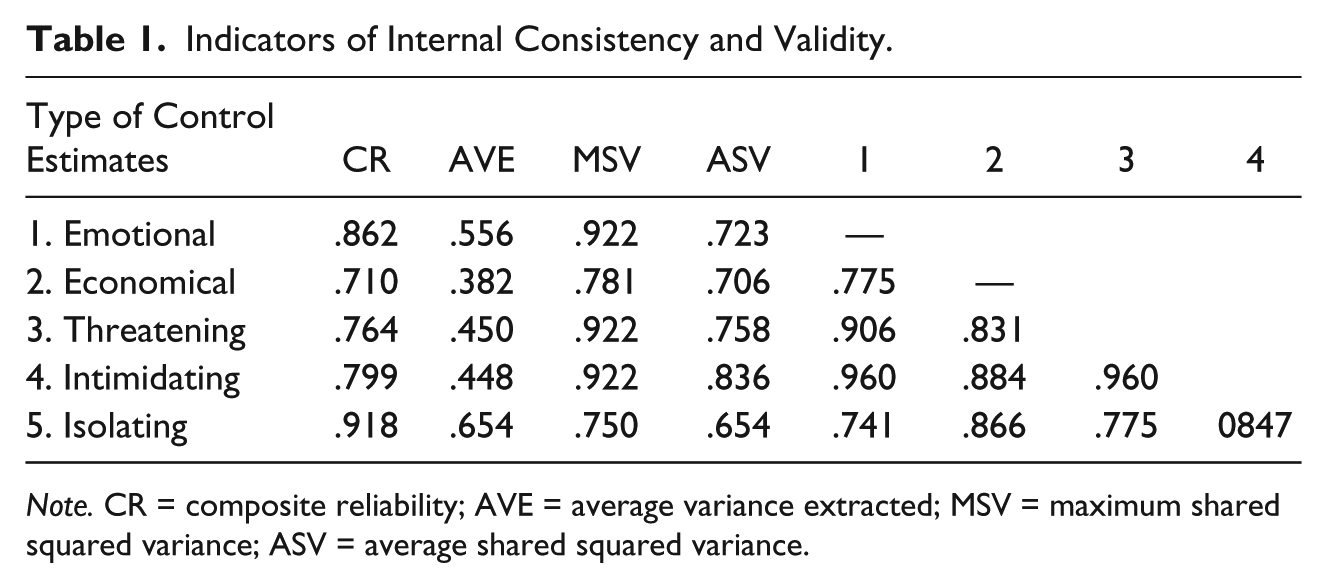
Note. CR = composite reliability; AVE = average variance extracted; MSV = maximum shared squared variance; ASV = average shared squared variance.
As 24 items are a redundant number of items for a single construct, we needed to restrict the number of items when testing if controlling behaviors are distinct from psychological aggression. In the following CFA, we used only items in the CBS-R (threatening control, intimidating control, emotional control) showing a high degree of similarity with items on the two Psychological Aggression subscales. As the items on the Isolation and Economical Control subscales showing little similarity with the Aggression scales, these items were deemed redundant. Thus, we tested if this model could be represented by three correlated first-order factors; one factor consisting of 14 items from three of the dimensions in the CBS-R (threatening control, intimidating control, emotional control) and two separate factors consisting of items from the two subscales (Minor and Severe, four items, respectively) of psychological aggression (CTS2). Due to low intercorrelations with other items on the Severe subscale of psychological aggression and an item-total correlation of .27, one item (“Threatened to hit or throw”) was removed from further analyses (resulting in three items on the Severe subscale).
The proposed three-factor structure model suggested an inadequate fit of the model; the Bollen–Stine p = .028, RMSEA = 0.09, SRMR = 0.07, and CFI = 0.83. However, the relative moderate correlations (.44-.48) between the factors in the model suggested adequate discriminant validity. The modification indices suggested that allowing one pair of error terms to correlate, and permitting “Call the other unpleasant names” (from the CBS-R) to load on both the minor psychological aggression minor factor and the CBS-R factor would substantially improve model fit. Even though the CBS-R item “Smash the other one’s property when annoyed” and the CTS2 item “Destroyed something of my partner’s” are related in content, it was not considered appropriate to allow for these errors to correlate as these items load on separate factors which would complicate interpretation of the two subscales, and therefore the former item was removed. Also, adding a path from psychological aggression minor to “Call the other unpleasant names” (included in the CBS-R) would complicate interpretation of the two subscales. In addition, this item had several error terms that load onto the psychological aggression minor and was therefore removed. With these modifications to the model, the fit significantly improved; the Bollen–Stine p value was no longer statistically significant, p = .20, and all other fit indices approached acceptable ranges: RMSEA = 0.07, SRMR = 0.05, and CFI = 0.90.
Table 2 shows that CR indices indicate a good reliability for all factors (all above .70). However, indices of convergent validity indicated some convergence validity concerns; all three factors AVE were less than CR but marginally failed to be greater than .50. Importantly, indices of discriminant validity indicate good validity for all three factors (all AVE markedly higher than MSV and ASV). Taken together, this CFA indicates that the items on the CBS-R are distinguishable from the items on the Psychological Aggression subscales of the CTS2, and that the minor and severe forms of psychological aggression are two clearly distinguishable factors.
Indicators of Internal Consistency and Validity.
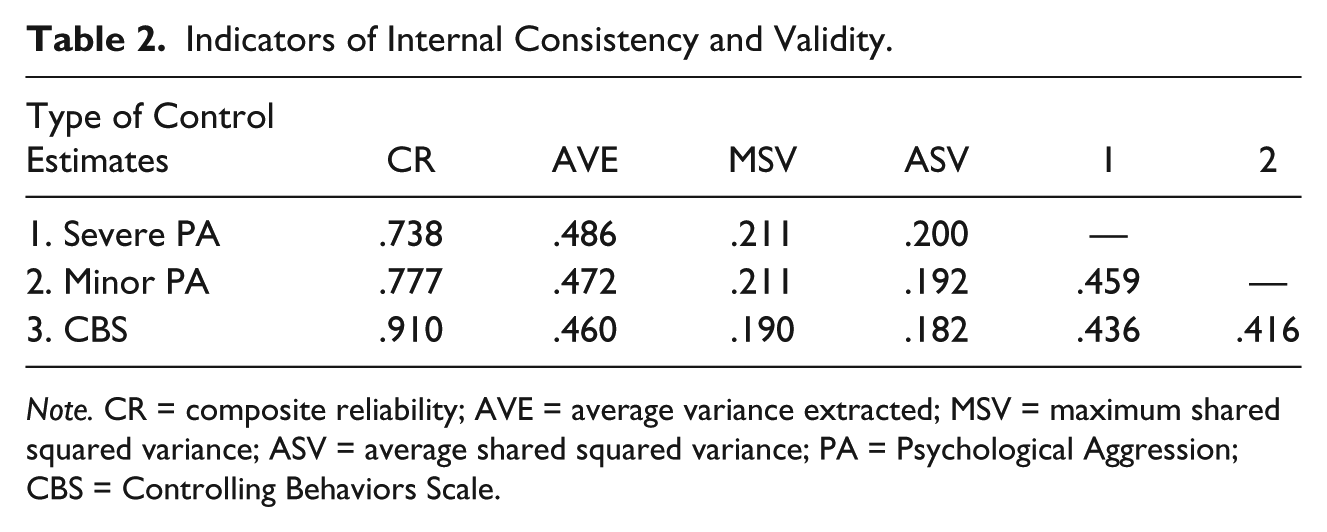
Note. CR = composite reliability; AVE = average variance extracted; MSV = maximum shared squared variance; ASV = average shared squared variance; PA = Psychological Aggression; CBS = Controlling Behaviors Scale.
Next, a multigroup model was specified in which fit for both genders was examined simultaneously. In this model, the factor structure was specified identically across groups, and all parameters were freely estimated across genders. This is a method of formally establishing configural invariance (i.e., equivalence in factor structure across the genders). The fit indices of this configural model showed that this model had an adequate fit to the data (Bollen–Stine, p = .24, RMSEA = 0.07, SRMR = 0.07, and CFI = 0.82), suggesting that the three-factor structure is similar across genders, with the same items characterizing each factor.
Discussion
In this study, we looked more systematically at the validity of the CBS-R compared with previous studies. The analyses permitted tentative answers concerning the generalizability, psychometric properties, and practical utility of the CBS-R. Our results provided support for the internal consistency of the CBS-R. The CR indices indicated good reliability for all five factors, and Cronbach’s alphas were adequate and comparable with those found in previous studies (e.g., Graham-Kevan & Archer, 2003b; Próspero, 2008).However, despite the indices of convergent validity indicated good validity for all five factors, the model which was expected to load onto five factors failed to reproduce this structural pattern. That is, the CFA results indicated that the items on the scale share underlying commonality and are therefore better represented by one common factor than five clearly distinguishable factors.
Apart from a small-scale exploratory factor analytic study (Emery et al., 2012), the present study provides findings that have not been reported in previous research. The fact that the items from the CBS-R are better represented by one common factor than clearly distinguishable factors suggests that people who are exposed to controlling behaviors experience a variety of controlling acts rather than controlling acts that are predominately restricted to one or two forms of controlling behaviors. This result does not rule out the possibility that in certain populations, more rigid forms of controlling behaviors could be found. Graham-Kevan and Archer’s (2003a) findings from a cluster analysis nonetheless point to the possibility that a division of CBS into high and low control, respectively, could be of value when predicting aggressive behavior (see also Tiwari et al., 2015). Nevertheless, our results suggest that the division of CBS-R into several subscales is still premature, and that controlling behavior might better be represented by one common factor resulting from a variety of controlling acts.
When items from the two Psychological Aggression (Minor and Severe) subscales of the CTS2 were included in a CFA along with CBS-R items, the feasibility of a three-factor solution was examined (i.e., controlling behaviors, severe psychological aggression, and minor psychological aggression). The models without correlated errors did not fit the data sufficiently well. The source of the lack of fit was mainly locatable within the CBS-R, and modification indices suggested that relaxation of constraints related to these items would improve the fit of the three models appreciably. With minor modifications of the model, the analyses indicated that the items on the CBS-R are clearly distinguishable from the items on the Psychological Aggression subscales of the CTS2. This means that controlling behaviors are distinct from psychological aggression.
Moreover, results from the multigroup model indicated that the three-factor solution applies for both males and females. As controlling behavior has been suggested as being the key feature of psychological aggression that occurs in the context of physical partner violence (e.g., Follingstad, 2007; O’Leary, 2001), the results of the present study, even though leaving out the history, motive, dynamic, context, consequences, or meaning for those involved into account (Stark, 2010), thus boost the use of CBS-R when investigating potential predictors for physical partner violence.
Before firm conclusions can be drawn, there are some limitations that need to be addressed. One could argue that 24 items are a redundant number of items to measure a single construct. However, it is important to notice that these items do in fact consist of concrete acts. Thus, by reducing the number of items on this scale, we may fail to capture the true frequency of controlling behaviors. The present study analyzed data from a community sample with a relatively low prevalence of controlling behaviors. It is important to recognize that CBS-R itself may demonstrate different psychometric properties depending on the population in which it is used, but also that the psychometric properties may be dependent on individual differences (e.g., gender identity, socioeconomic status, language). Consequently, future research needs to gather information about the CBS-R among specific populations. Adhering to this argument, the population in this study came from a small northern region in Sweden with a response rate of 35%. Another limiting factor was that one criterion of inclusion was participants’ understanding of the Swedish language. Although the randomization procedure mostly rules out influence from the aspects of socioeconomic status, minority groups might have been excluded due to such inclusion criteria. Finally, although sample stratification was used, the sample was somewhat skewed across different age groups. Thus, the generalizability of the results could be restricted.
Notwithstanding, this study provided evidence that a measure that was exclusively developed to capture various forms of controlling behavior is clearly distinguishable from psychological aggression as measured on an instrument that has been most commonly used to assess partner violence. In light of the Istanbul Convention (Council of Europe Convention, 2011) underscoring the importance of control and psychological aggression, this is an important finding because it may help us select measurement tools for the examination of some of the effects of controlling behaviors on both psychological and physical aggression in intimate relationships, and the independent contribution of controlling behaviors and psychological aggression to physical partner violence. Furthermore, as IPV is associated with decreased health among women, and the relation between psychological aggression and depression, anxiety or posttraumatic stress disorder (PTSD) seems firm (e.g., Campbell, 2002; Clements & Sawhney, 2000), the use of controlling behavior in intimate relationships as a precursor or mediator of both mental and physical health could be investigated.
Footnotes
Appendix
| Instrument | Subscales and Items |
|---|---|
| CBS-R (Graham-Kevan & Archer, 2005) | Economical Control |
| Made it difficult to work or study | |
| Control the other’s money | |
| Keep own money matters secret | |
| Refuse to share money/pay fair share | |
| Threatening Control | |
| Threaten to harm the other one | |
| Threaten to leave the relationship | |
| Threaten to harm self | |
| Threaten to disclose damaging or embarrassing information | |
| Intimidating Control | |
| Try to make the other do things they didn’t want to | |
| Use nasty looks and gestures to make the other one feel bad or silly | |
| Smash the other one’s property when annoyed/angry | |
| Be nasty or rude to other one’s friends or family | |
| Emotional Control | |
| Try to put the other down when getting “too big for their boots” | |
| Show the other one up in public | |
| Tell the other they were going mad | |
| Tell the other they were lying or confused | |
| Call the other unpleasant names | |
| Try to put the other down when getting “too big for their boots” | |
| Isolating Control | |
| Try to restrict time one spent with family or friends | |
| Want to know where the other went and who they spoke to when not together | |
| Try to limit the amount of activities outside the relationship the other engaged in | |
| Act suspicious and jealous of the other one | |
| Check up on other’s movements | |
| Try to make the other feel jealous | |
| CTS2 (Straus et al., 1996) | Psychological Aggression (minor) |
| Insulted or swore at my partner | |
| Shouted or yelled at my partner | |
| Stomped out of the room or house or yard during a disagreement | |
| Said something to spite my partner | |
| Psychological Aggression (severe) | |
| Called my partner fat or ugly | |
| Destroyed something belonging to my partner | |
| Accused my partner of being a lousy lover | |
| Threatened to hit or throw something at my partner |
Note. CBS-R = revised Controlling Behaviors Scale; CTS2 = Conflict Tactic Scales 2.
Declaration of Conflicting Interests
The author(s) declared no potential conflicts of interest with respect to the research, authorship, and/or publication of this article.
Funding
The author(s) received no financial support for the research, authorship, and/or publication of this article.